Archive for the ‘Construction’ Category

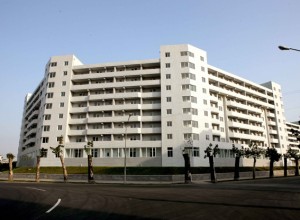
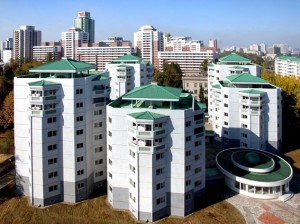
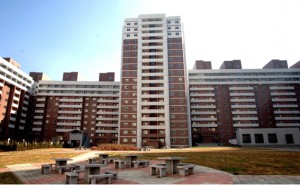
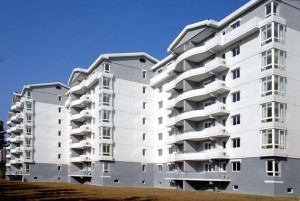
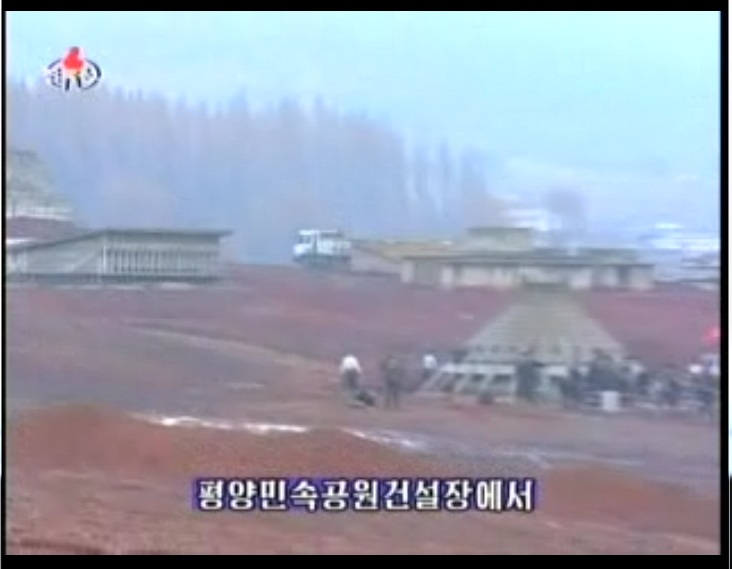
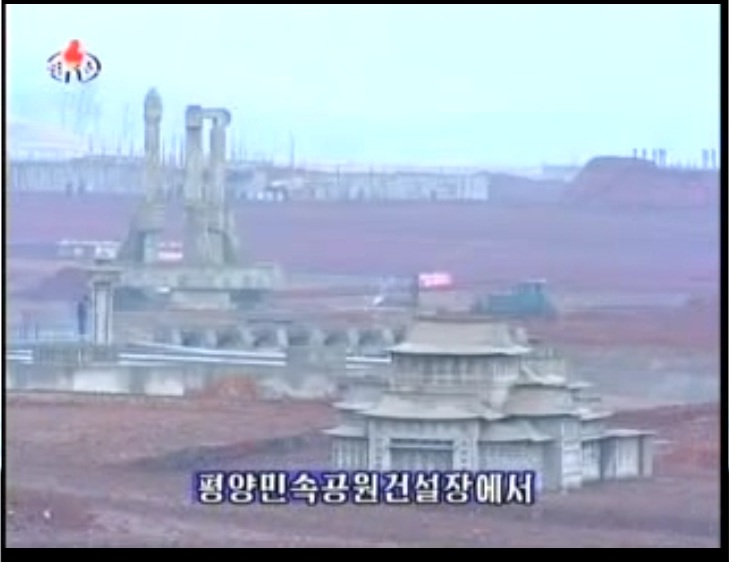
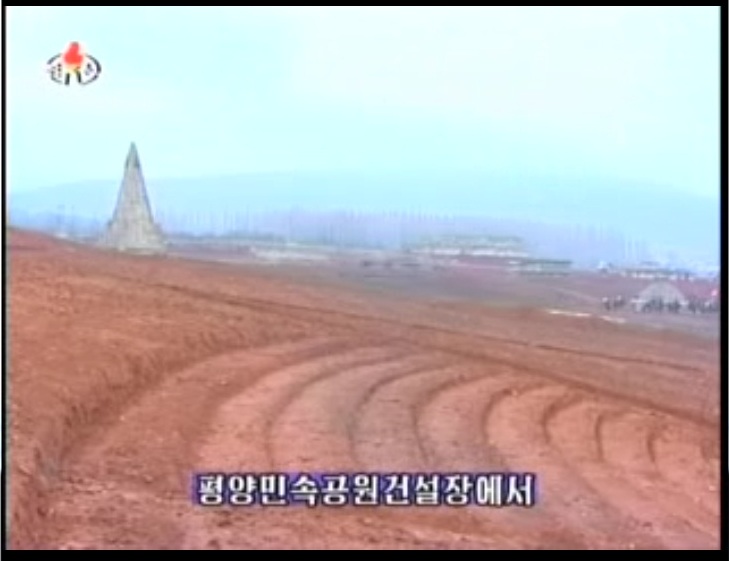
10,000 apartments under construction in Pyongyang

Wednesday, November 11th, 2009

Institute for Far Eastern Studies (IFES)
NK Brief No. 09-11-10-1
11/10/2009

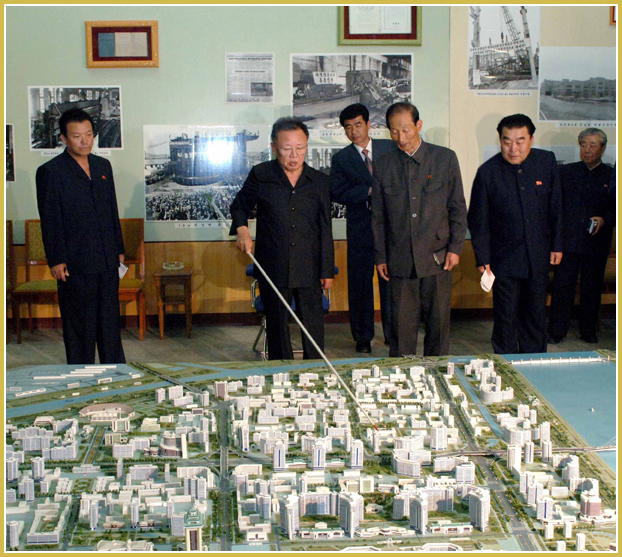
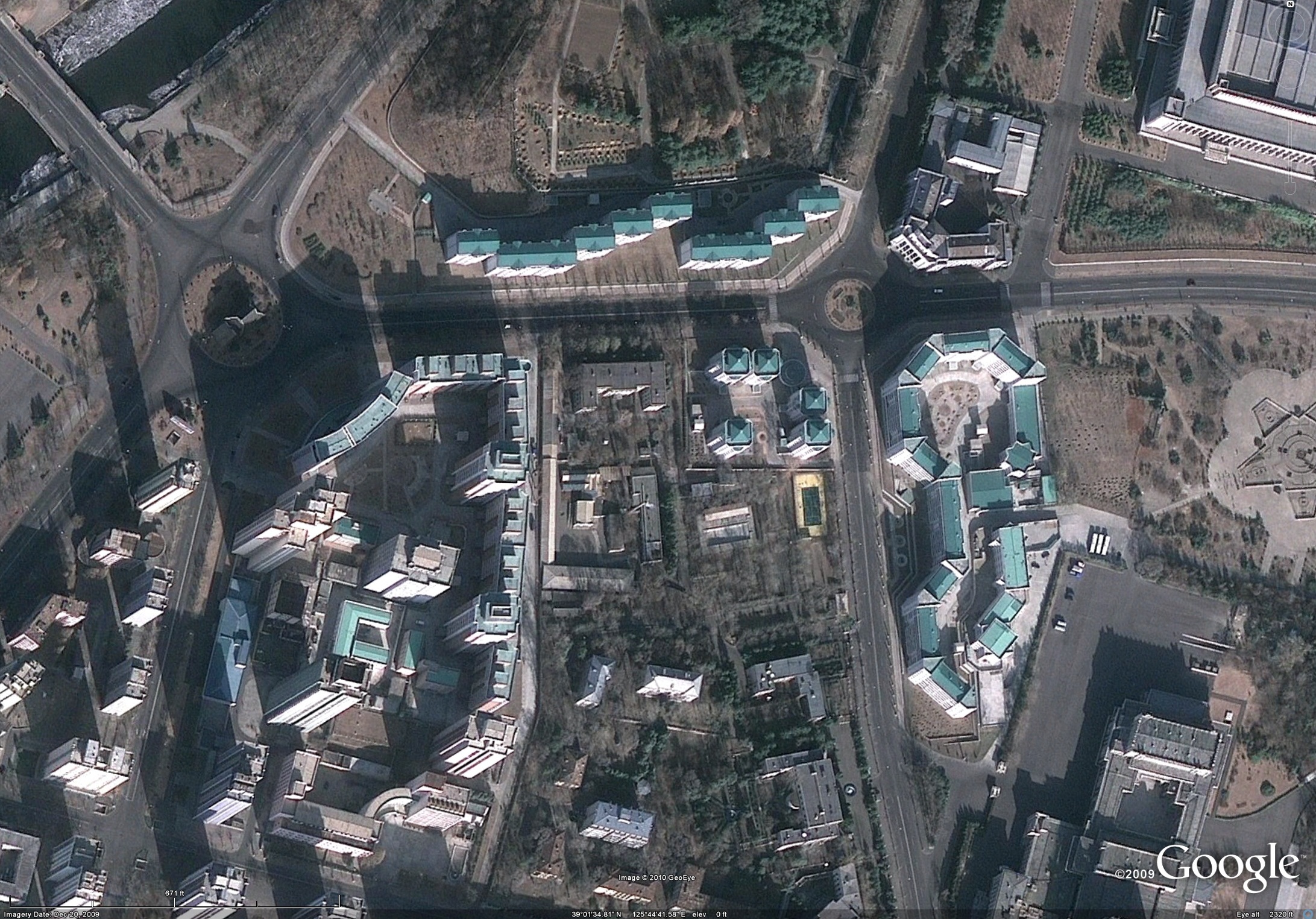
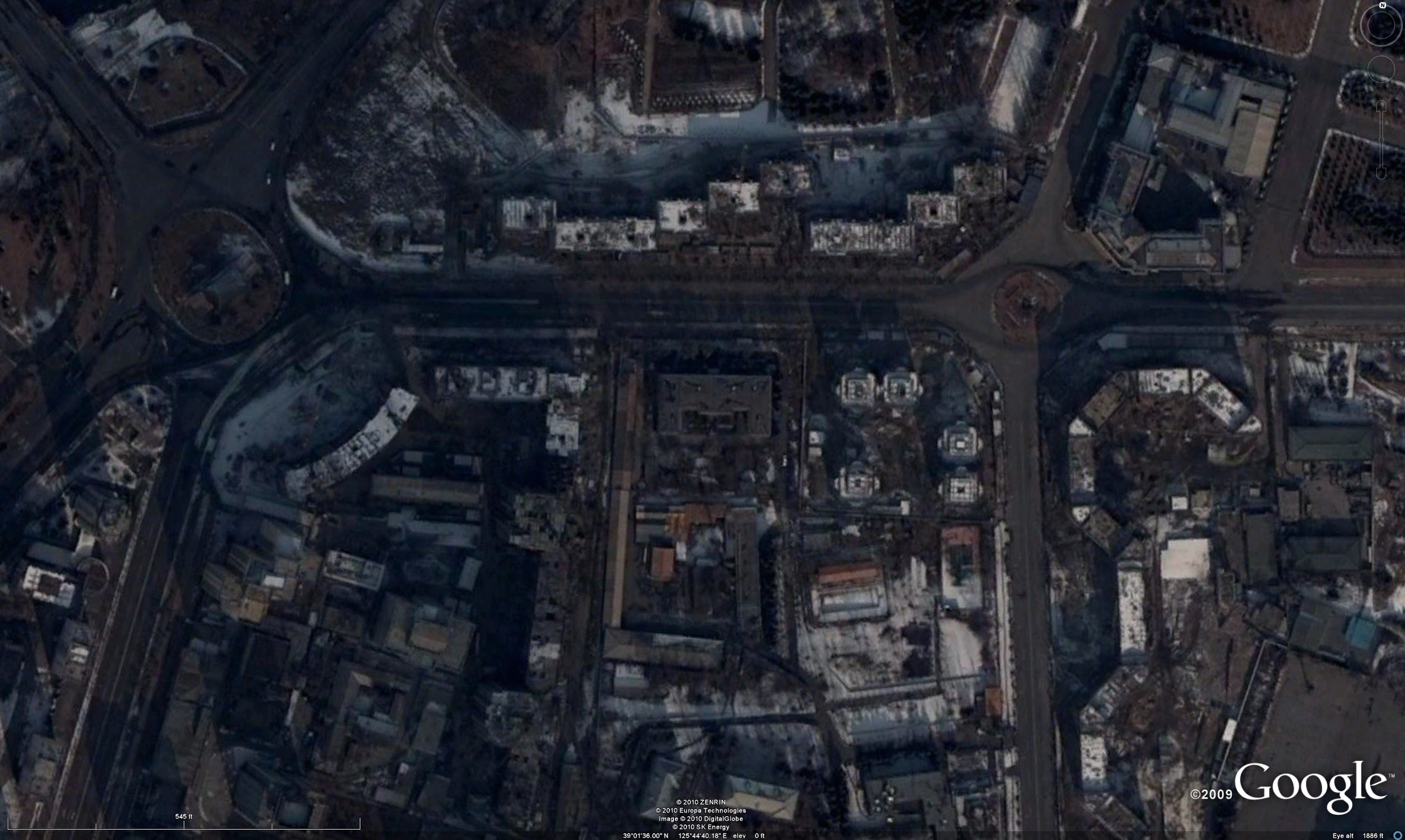
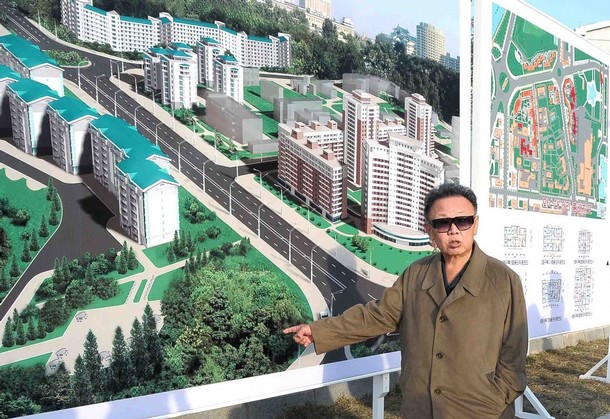
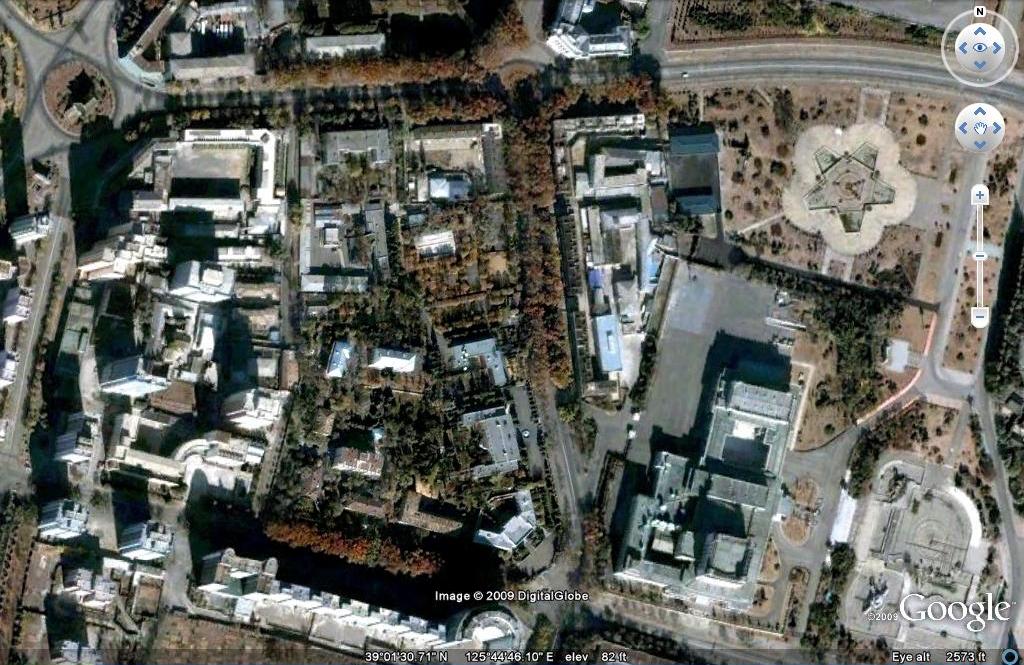
North Korea is pouring all efforts into the construction of 10,000 family homes in Pyongyang by 2012. Whether this construction plan can be completed within the next three years will weigh on the success or failure of the regime’s goal of establishing a ‘Strong and Prosperous Nation.’

An article run on November 4 in the Chosun Sinbo, a newspaper of the Jochongryeon, the pro-Pyongyang Korean residents’ association in Japan, stated, “Currently, the construction of 10,000 family dwellings is underway in Pyongyang, and the efforts poured into this over the next 3 years will show the strength of the country.” It was also reported that “North Korean authorities are devising policies to concentrate all efforts into the construction area in order to see this through.”

The article also confirmed that the apartment construction project was part of the “effort to open the door to a ‘Strong and Prosperous Nation’,” and that completion of the project “would mean the complete solution of the people’s housing problems in Pyongyang.”

The newspaper claimed that the project is the largest project ever undertaken by the North. In the 1980s and 1990s, 5,000-unit apartments were built along Kwangbok Street and Unification Street over 4 to 5 years, but the current project is twice as large. The aim is to complete the project in 3 years. Each unit is said to be 100 square meters.

North Korean authorities are reportedly pledging that the ‘Strong and Prosperous Nation’ will not just be reflected through economic statistics or increased production, but that they are putting all efforts into increasing the standard of living for the people.

In order to meet the expected increase in demand for electricity, a hydroelectric power plant is being built in Huicheon, Chagang Province, and is expected to be complete by 2012.

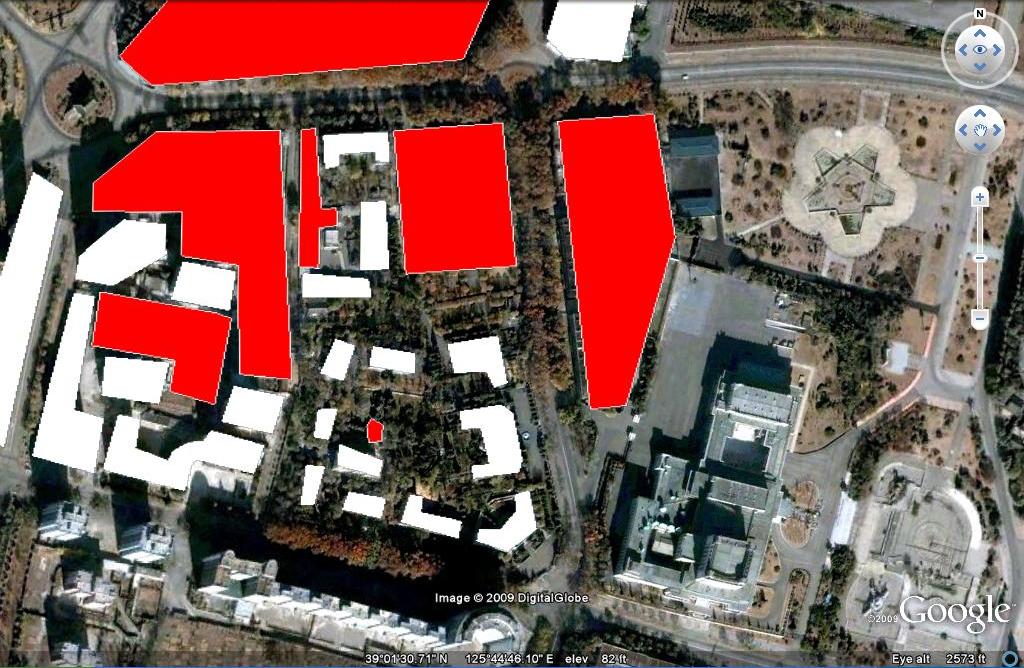
It is expected that it will be difficult for the North to complete 10,000 apartments in the next 3 years, and so authorities are also conducting campaigns to repair and upgrade old production lines in factories and companies in order to meet the demand for materials. As well, Preparations are also underway to create a system of factories and businesses to produce needed materials within Pyongyang. The construction project has meant the removal of some military barracks in the area, causing some conflicts between soldiers and civilians.

Share

Reconstruction of Ryongchon

Wednesday, October 28th, 2009

UPDATE 3 (2014-4-4): Here is the Red Cross report on the Ryongchon explosion (PDF).

UPDATE 2 (2004-4-22): Apparently these buildings have not aged well.

UPDATE 1 (2009-11-6) : This post was picked up by Yonhap:

N. Korea’s Ryongchon blast site reborn with Soviet-era complexes
Yonhap
Sam Kim

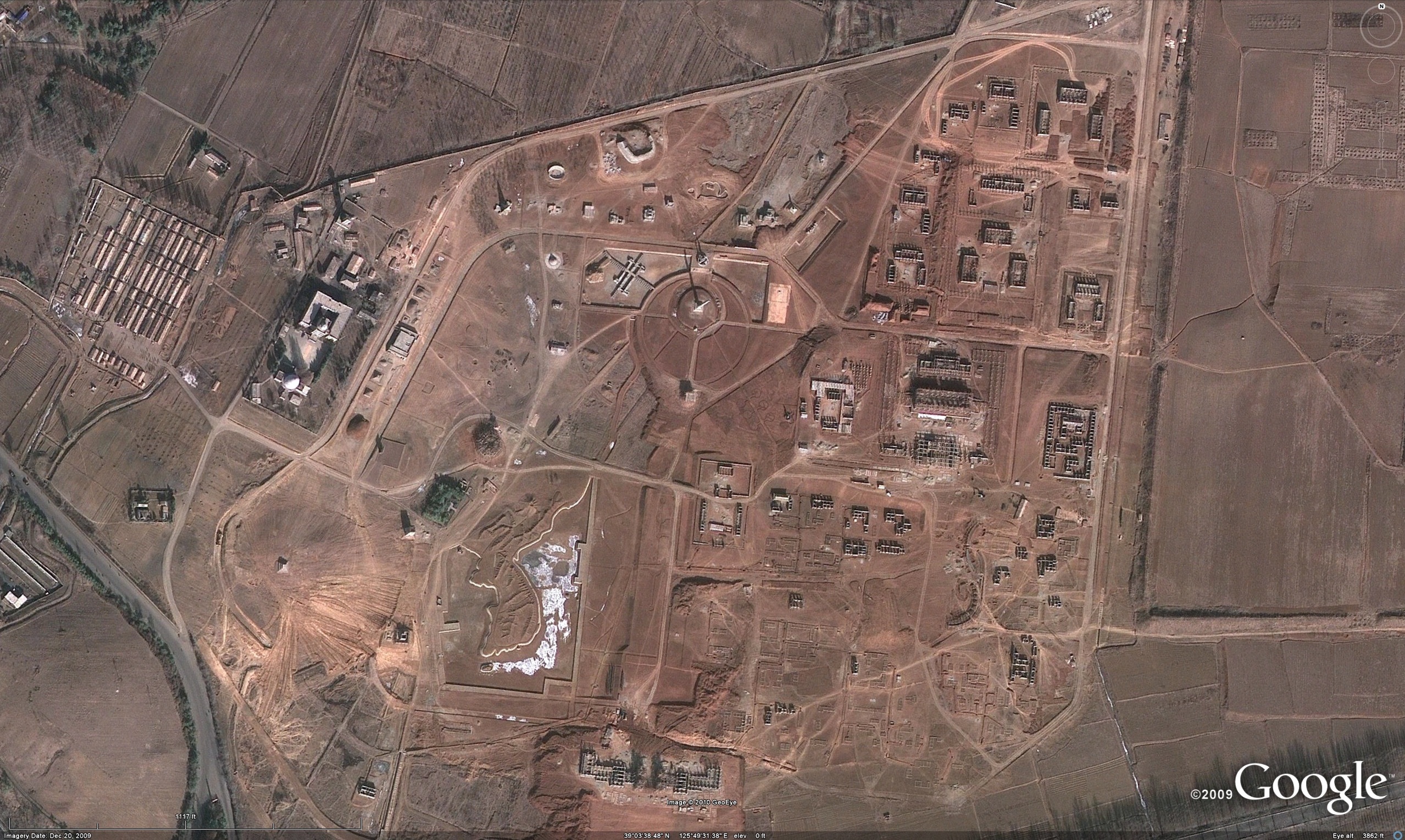
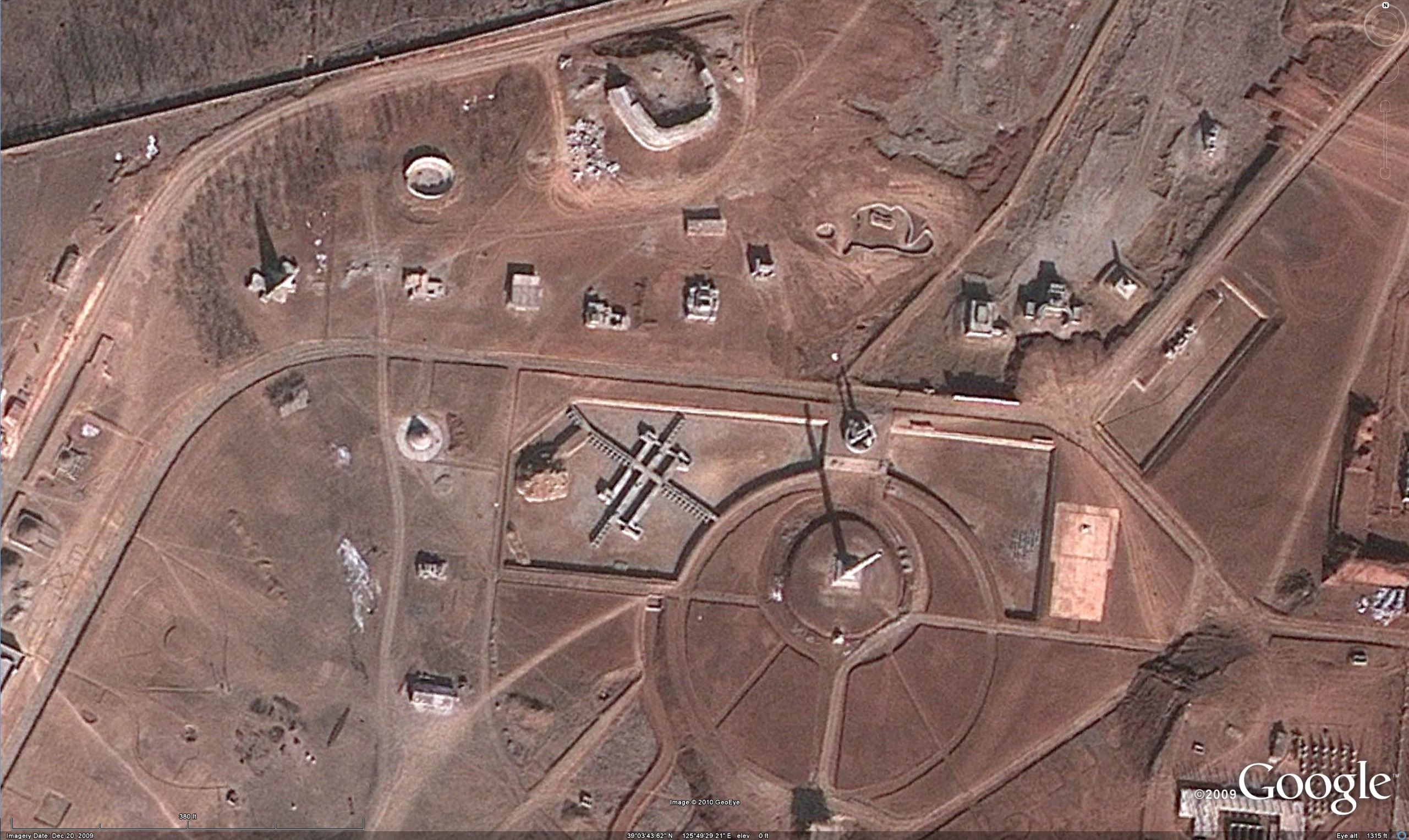
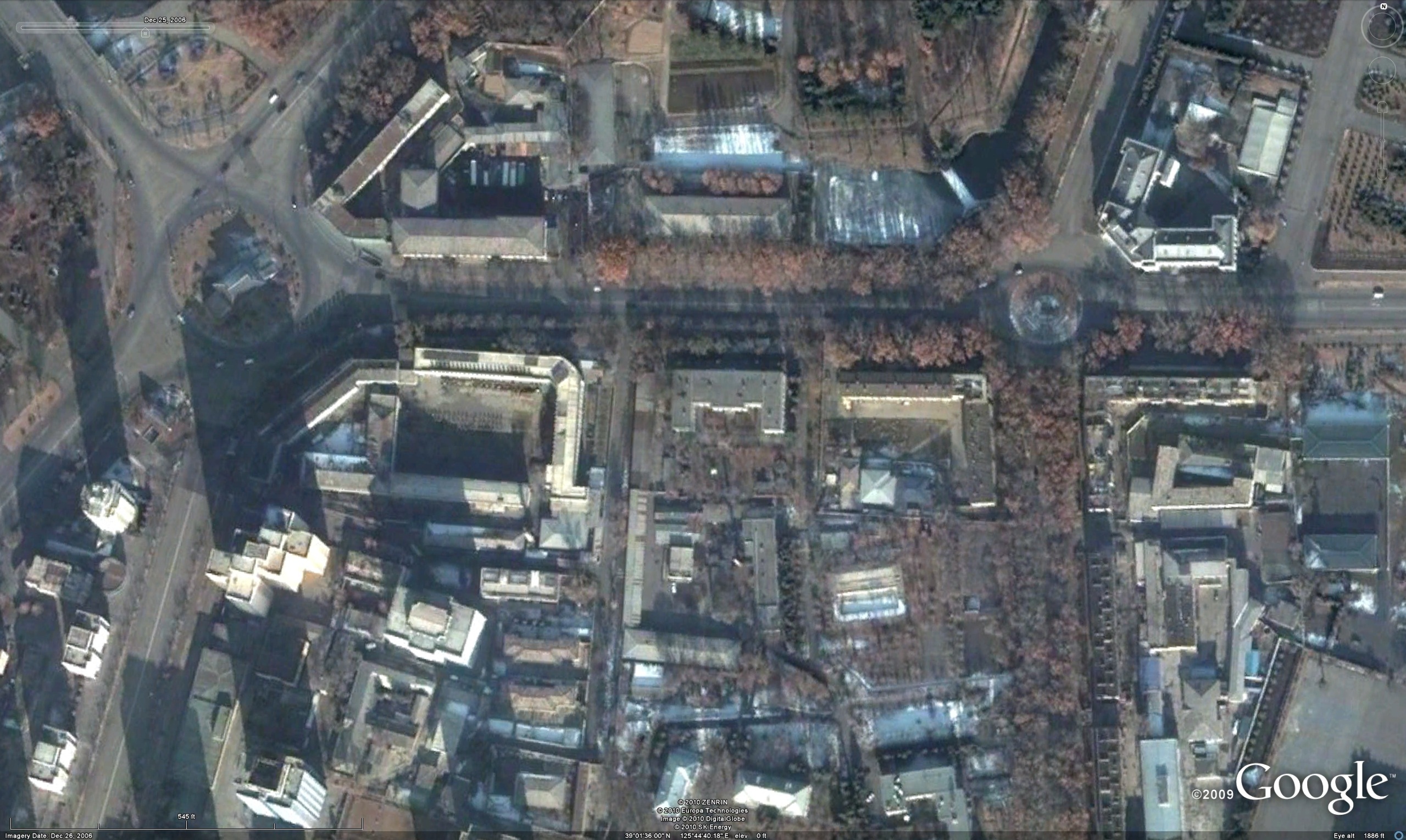
ORIGINAL POST (2009-10-28): In 2004 much of the town of Ryongchon was tragically destroyed in a large explosion.  Here is the Wikipedia page on the disaster if you would like a quick reference.

I compiled a couple of images to construct this “before” picture of Ryongchon:

ryongchon-before.jpg
(Click image for larger version)

Notice that the center of town is composed largely of traditional houses.

Here is the first “after” image (which is the default image on Google Earth):

ryongchon-after1.jpg
(Click image for larger version)

As you can see a large number of traditional houses were destroyed as well as a school.

Below I have compiled more recent images to show how the city was reconstructed.  Gone are the traditional homes.  They have been replaced by typical Soviet-style apartment blocks:

ryongchon-after2.jpg
(Click image for larger version)

Share

Sinuiju market upgrade

Wednesday, October 28th, 2009

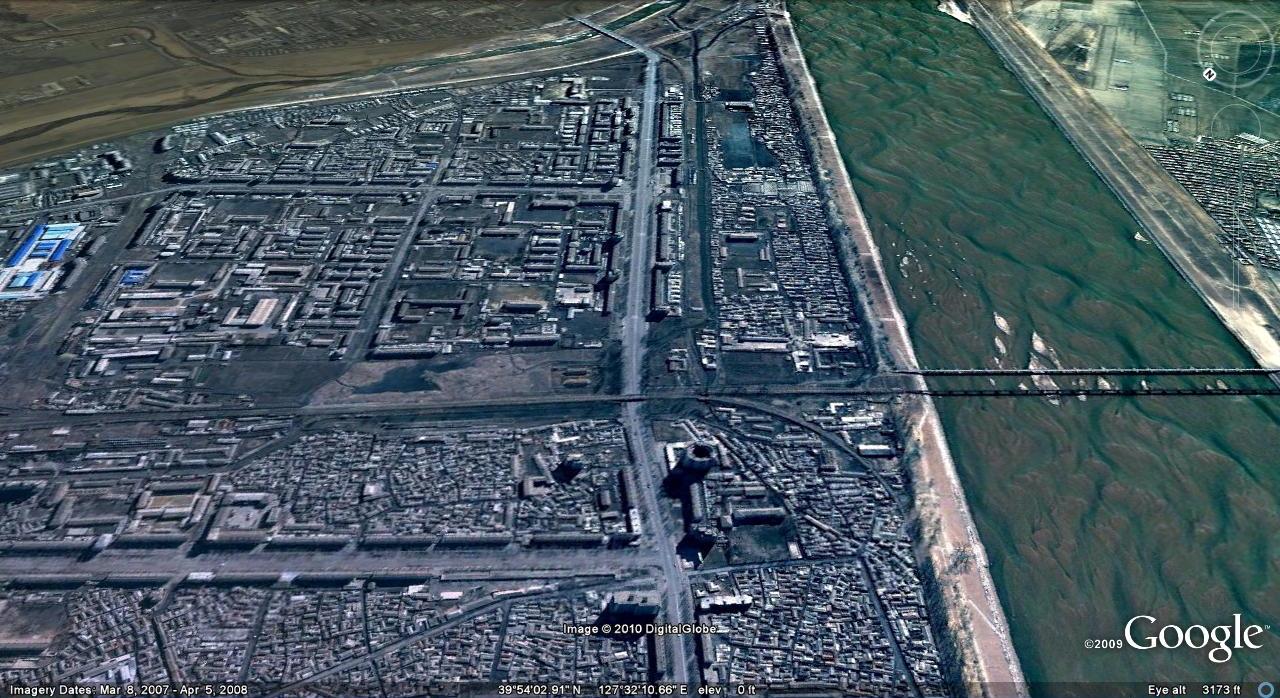
Below is the Google Earth satellite image from an area south of Sinuiju:

oldsinuijumarket1.jpg
(Click image for larger version)

The busy area at the top of the image is a local market (Jangmadang).

Below is a more recent image of the same area.

newsinuijumarket2.jpg
(Click image for larger version)

We can see that the initial market has been closed and relocated to a larger and more modern facility.  This one is closer to the main road and reminds me of the Tongil Market in Pyongyang in terms of size and prominence.  Most all of the other markets are hidden from the main roads.

Share

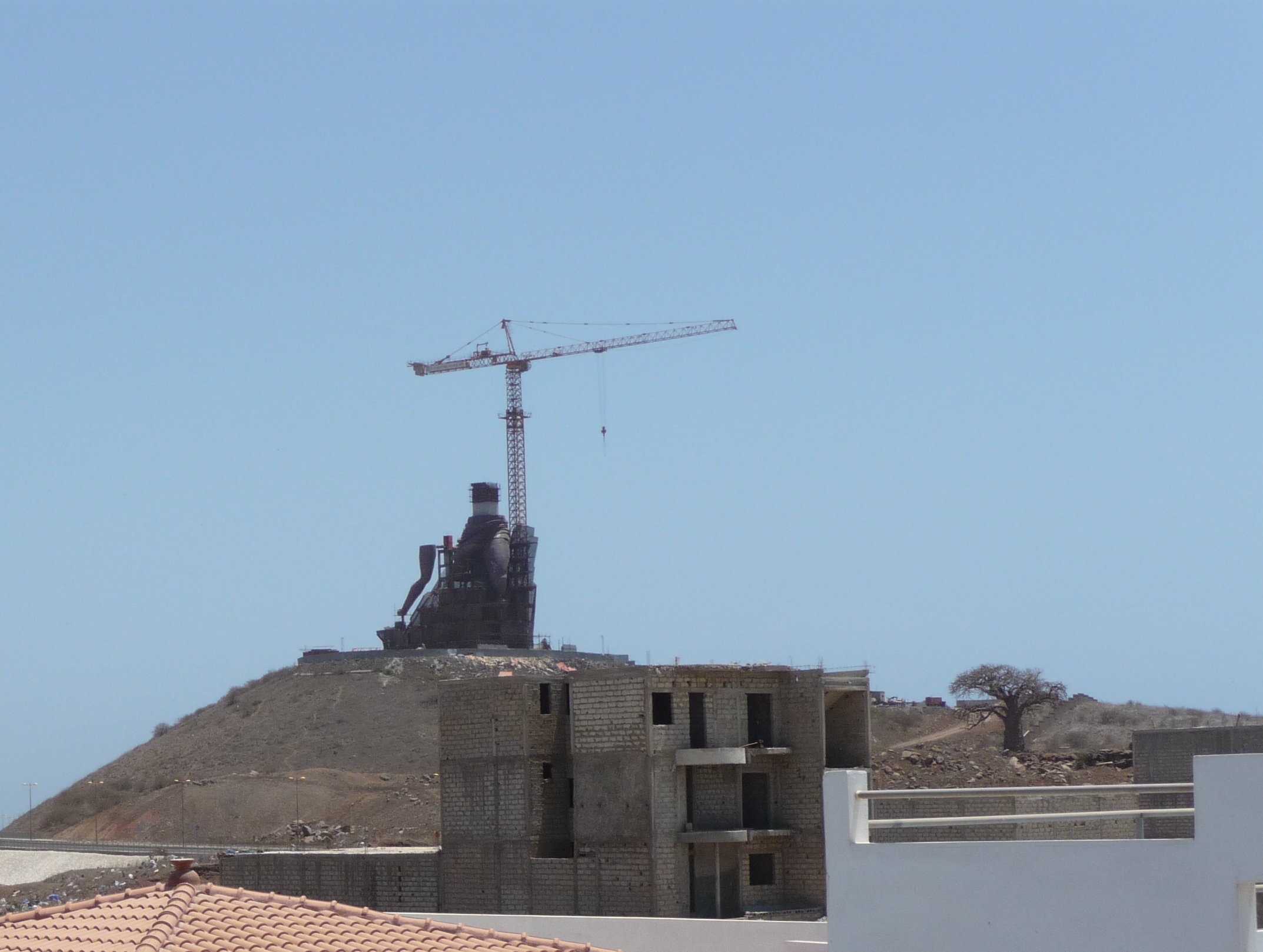
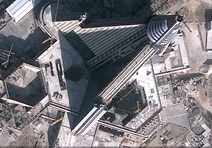
Orascom completing Ryugyong Hotel

Thursday, October 15th, 2009

UPDATE 8:   According to the BBC, Orascom claims the final plans for the hotel have yet to be approved:

Dozens of Egyptian engineers and some 2,000 local workers are working on the Ryugyong project, which Orascom’s chief operating officer Khaled Bichara tells the BBC is “progressing well”, despite reported problems with suspect concrete and misaligned lift shafts.

“There have been no issues that have caused us too much trouble,” Mr Bichara says. “Most of the work at the moment is coverage of different areas of the building. The first job is to finish the outside – you can’t work on the insides until the outside is covered.

“You can see that we have already completed the top of the building where the revolving restaurant will be. After 2010, that’s when it will be fully safe to start building from the inside.”

How the building will be divided up is not yet finalised the company says, but it will be a mixture of hotel accommodation, apartments and business facilities. Antennae and equipment for Orascom’s mobile network will nestle at the very top.

Mr Bichara denies reports that the company’s exclusive access to North Korea’s fledgling telecoms market is directly linked to the completion of the hotel.

But he says the job is a way of planting a rather tall flag in the ground. “We haven’t been given a deadline, we are not tied into doing it by a certain time,” he said.

“But when you work in a market like this, where we cannot sponsor things, a project of this kind is good to do – it’s word of mouth advertising for us, it builds good rapport with the people – on its own it’s a great symbol, one which cements our investment.”

Read the full article here:
Will ‘Hotel of Doom’ ever be finished?
BBC
10/15/2009

Read previous posts about the Ryugyong’s construction below: (more…)

Share

Capitalism spreads among DPRK laborers in Vladivostok

Monday, September 28th, 2009

From Voice of America (excerpts):

In Russia’s largest port city on the Pacific Ocean, Vladivostok, several small-framed Asian men are bustling around a half-built apartment building, trying to move large metal beams. They are North Koreans sent out by their government to earn much-needed foreign currency for the country.

Kim Dong Gil came from North Korea’s second largest city of Hamhung. He brags that North Korean workers have the best skills in the Russian construction market, which is also filled with laborers from Central Asia and Vietnam.

The estimated 5,000 North Koreans in Vladivostok come from various backgrounds and even include doctors.

“I didn’t have any construction skills since I used to be with the military,” said Kim Soon Nam, who served in the army back home. “I learned from scratch when I arrived here. I got trained by a really young person who used to curse and swear at me all the time.”

Despite the stress of living and working in a foreign country, the North Koreans have come to appreciate the culture of capitalism.

“Back home I couldn’t make money even if I wanted to. But here if I work hard, I can make a dozen times more,” explained Han Jong Rok.

Choi Jong-kun, an assistant professor of political science at Yonsei University in Seoul, says money is just one reason to leave home. The other is improving one’s status among North Korea’s political elite.

“If they bring in more money, then they would sort of have sort of upward mobility in their social class,” explained Choi Jong-kun.

North Korea does not reveal significant economic data, but exporting workers is considered a key source of hard foreign currency.

A report by the Korea Institute for International Economic Policy in Seoul estimated in 2007 that Pyongyang earns at least $40 million to $60 million a year from labor exports. Outside of Russia, the institute has tracked North Korean workers in Kuwait, the United Arab Emirates, Qatar, Bangladesh, China and Mongolia.

In Vladivostok, every North Korean worker is required to pay the Pyongyang government around $800 each month.

Kim Soon Nam says he works extra hours to make sure he has money for himself.

“If we want to save some money, we have to work Sundays and holidays, too,” he said. “We must earn a lot of money no matter what. North Koreans have to work from 8 am to 10 pm.”

The North Koreans in Vladivostok usually get a five-year visa, but many get extensions to earn more money. They sleep in dormitories and live to work, spending much of their time outside the construction sites doing extra jobs in local Russian homes.

Kim Chul Woong, a welder, says he is willing to sacrifice time from his family back in Pyongyang to give his son opportunities few North Koreans enjoy, like a computer.

“The video footage on the computer can enhance children’s intellectual development, but I don’t have the kind of money,” he said. “When I go back home after working in Russia I’ll have a good amount of money. I can buy expensive stuff for my son. If he wants to do music I can buy him a violin or a guitar.”

He says he is taking advantage of the work while he can get it. Kim Chul Woong says the construction jobs are dwindling in Russia because of the economic crisis. There is also greater competition from newly arriving Central Asians who are as hungry for dollars as he is.

Read the full story here:
N. Korean Workers Earn Dollars for Construction Work in Russia
Voice of America
Young Ran-jeon
9/28/2009

Share

DPRK preparing for jump in construction demand

Friday, August 14th, 2009

Institute for Far Eastern Studies (IFES)
NK Brief No. 09-8-13-1
2009-08-13

As North Korea continues to pursue the creation of a Strong and Prosperous Nation by 2012, it is now reportedly building a large-scale construction materials facility to meet expected growth in building demand. North Korean authorities have designated the Daedong River Tile Factory, visited by North Korean leader Kim Jong Il on the 13th of last month, as a large-scale construction materials distribution center, and expect the second stage of its construction to be complete by April 2012.

The Tongil Sinbo, a weekly North Korean publication, printed in its recent (July 18) edition that upon completion of the second stage of construction, the facility would be capable of producing 225 million cubic meters of tiles, shingles, plastic materials and other building supplies. The first stage of construction began in July 2003, and was only recently completed, after five years and nine months, opening on April 15. North Korea is expected to invest 10.5 billion Won (80.77 million USD) into completing the second stage of construction, a considerable investment in light of the troubles facing the North‘s economy.

Upon completion of the facility, taking up more than 225 thousand pyong, it will produce indoor and outdoor tile, polished marble tiles, composite glass tiles and other porcelain and plastic products, as well as pre-fabricated housing components and coal gas. According to the newspaper, it will also house its own electrical generator.

When Kim Jong Il visited the factory, located near the Chollima Steel Complex in South Pyeongan Province, he declared the site to “hold a critical role in the development of the country’s construction industry,” stating that upon completion of the second stage of construction, the factory would serve as a “large-scale base for all modern construction projects.”

North Korea is currently pressing ahead with large-scale redevelopment projects in Pyongyang and other major cities, with one goal being the construction of 100,000 new homes by the year 2012. The Workers’ Party of Korea newspaper, the Rodong Sinmun, has called for all citizens to “make something from nothing” in an effort to build up each region. One point of interest to North Korea-watchers as this massive construction scheme unfolds is that a new position was created to oversee the project, and Kim’s third son, Kim Jong-un, was appointed.

Share

The urban dimension of the North Korean economy: A speculative analysis

Sunday, August 9th, 2009

Chapter 11 of North Korea in the World Economy
Bertrand Renauld

(NKeconWatch: the whole paper is worth reading in full.  Below is the introduction.  Here is a link to the chapter in Google Books.

Introduction:

This chapter explores the urban dimension of the North Korean economy. Few areas of economic management of centrally planned economies have met with such widespread dissatisfaction and broad popular support for reforms as housing and urban development. This dissatisfaction arises from the peculiar systemic features of the “socialist city.” Since the early 1990s we have been able to study the economics of this type of city based on data from cities of the former Soviet Union, Central Europe, and also China and Vietnam. Of course, no such access to information exists today in North Korea.

As a starting point, I ask only one question: based on the body of knowledge that we have gained from other centrally planned economies (CPE), what are the systemic features of the North Korean urban economy that we expect to find? By so doing, the chapter applies to North Korean cities the method of “rigorous speculation” used earlier by Noland et al. (2000a) on North Korean macroeconomic and trade performance. According to Noland and his colleagues, “rigorous speculation” is the incorporation of fragmentary information into a consistent analytical framework that can clarify alternative scenarios regarding current economic conditions in North Korea. The results can then suggest suitable reforms to stimulate the economy.

Using a medical analogy, the focus is how the “personal history and diagnosis” of the North Korean urban system should be conducted some day. The analysis should not be misconstrued or misused: it is not offered as an actual diagnosis of the North Korean urban system. Rather, using our body of knowledge of the anatomy and physiology of the “socialist city,” it speculates about what we should expect to find in the Democratic People’s Republic of Korea (DPRK) urban system. This “pre-diagnosis” relies on the limited yet often revealing information available on the North Korean urban system and its patterns of investment. We also can narrow the range of uncertainty about the structure of the North Korean urban system by means of international comparisons. For instance, should we expect the North Korea system of cities to have more in common with the Soviet cities of Russia than with Chinese or Vietnamese cities, both in terms of time paths of development and of institutional arrangements?

The paper contains many interesting facts and data that help us understand just how different centrally planned/socialist cities are when compared with market-based cities.  The paper also spells out some interesting implications for North Korea’s urban residents (the majority of the country’s population) once the transition from a socialist to a market-based infrastructure begins. 

Share

Bank of Korea releases 2008 DPRK economic stats

Sunday, June 28th, 2009

North Korea doesn’t release official economic data.  Since 1991, the South Korean central bank has released its own estimates of the North Korean economy to fill the void.  Its figures are derived from information provided by the ROK’s National Intelligence Service and other sources.  The 2008 statistics can be downloaded here.

According to coverage by the Associated Press:

The North’s gross domestic product for last year was estimated at $24.7 billion, a 3.7% increase from 2007, Seoul’s Bank of Korea said in a news release. The impoverished North’s economy shrank 2.3% in 2007 and 1.1% in 2006.

The central bank said the North’s economic growth was mainly because of “temporary factors” such as favorable weather conditions that resulted in an increase in agricultural production, and the arrival of oil shipments under an international disarmament deal on its nuclear program.

The size of North Korea’s economy, however, was still about 2.6% of South Korea’s, the bank said, adding it was “difficult” to determine whether last year’s growth means the country’s internal economic conditions have improved.

The bank said the North’s agricultural production increased 10.9% last year compared with 2007. The production of coal, iron ore and other minerals expanded 2.3% and the manufacturing industry 2.5%.

…and BBC coverage:

Agricultural production rose nearly 11% in 2008 compared with 2007. And coal, iron ore and other mineral production grew 2.3% for the year.

UPDATE from Business Week:

The surprise underscores the tiny size of the North Korean economy, which could be easily swayed by such factors as weather and outside assistance. Just over two-thirds of the 3.7% growth came from the agricultural sector, and that is heavily dictated by weather. North Korea’s agricultural output increased by 10.9% in 2008 after falling by 12.1% in the previous year as it managed to escape from major floods and drought. Its 2008 manufacturing production also grew by 2.5%, compared with a gain of a mere 0.8% in 2007, thanks to heavy oil supplies by the U.S. and its allies as a result of Pyongyang’s agreement last year to begin dismantling its nuclear facilities.

Even as hope builds in South Korea about a recovery, with the U.S. and China showing signs of revival, prospects for North Korea’s economy are looking grimmer. North Korea’s nuclear test in May and the regime’s missile tests this year have led to an end to outside help and economic sanctions by the U.N. This heralds a poor performance in the manufacturing sector, which will almost certainly face an acute shortage of oil and electricity this year.

Pyongyang can’t count on the agricultural industry for any major contribution to economic growth in 2009, either. Even if North Korea manages to maintain the 2008 grain output of 4.3 million tons, which will be difficult to achieve unless last year’s exceptionally good weather is repeated, it won’t help the economy grow as it starts from a high base.

Those factors make North Korea’s economic growth last year an anomaly. “There’s no indication that North Korea’s growth engine has improved in any fundamental way,” says Bank of Korea economist Shin Seung Cheol. Even with last year’s extraordinary growth, North Korea’s gross domestic product was 1/38 of South Korea’s $935 billion and its trade volume was 1/224 of the South’s $857.3 billion in 2008. As long as North Korea’s reclusive leader Kim Jong Il refuses to open up his country, the gap is bound to keep expanding.

I have collected the most commonly referenced North Korean economic statistics here.

Read more here:
South Korea’s Central Bank Says North’s Economy Grew in 2008
Associated Press
6/28/2009

North Korea’s GDP Growth Better Than South Korea’s
Business Week
Moon Ihlwan
6/30/2009

Share

North Korea on Google Earth v.18

Thursday, June 25th, 2009

North Korea Uncovered version 18 is available.  This Google Earth overlay maps North Korea’s agriculture, aviation, cultural locations, markets, manufacturing facilities, railroad, energy infrastructure, politics, sports venues, military establishments, religious facilities, leisure destinations, and national parks.

This project has now been downloaded over 140,000 times since launching in April 2007 and received much media attention last month following a Wall Street Journal article highlighting the work.

Note: Kimchaek City is now in high resolution for the first time.  Information on this city is pretty scarce.  Contributions welcome.

Additions to this version include: New image overlays in Nampo (infrastructure update), Haeju (infrastructure update, apricot trees), Kanggye (infrastructure update, wood processing factory), Kimchaek (infrastructure update). Also, river dredges (h/t Christopher Del Riesgo), the Handure Plain, Musudan update, Nuclear Test Site revamp (h/t Ogle Earth), The International School of Berne (Kim Jong un school), Ongjin Shallow Sea Farms, Monument to  “Horizon of the Handure Plain”, Unhung Youth Power Station, Hwangnyong Fortress Wall, Kim Ung so House, Tomb of Kim Ung so, Chungnyol Shrine, Onchon Public Library, Onchon Public bathhouse, Anbyon Youth Power Stations.

Share

N. Korea digs tunnels in Myanmar to earn dollars

Friday, June 12th, 2009

Korea Herald and Yale Global
Bertil Linter
6/12/2009

burma-tunnels.jpg

Missiles and weapon technology, counterfeiting money and cigarette smuggling, front companies and restaurants in foreign countries, labor export to the Middle East – North Korea has been very innovative when it comes to raising badly needed foreign exchange for the regime in Pyongyang. But there is a less known trade in service that the North Koreans have offered to its foreign clients: expertise in tunneling. A fascinating new glimpse of this business has now been offered in secret photos from Burma obtained by this correspondent.

The photos, taken between 2003 and 2006, show that while the rest of the world is speculating about the outcome of long-awaited elections in Burma, the ruling military junta has been busy digging in for the long haul – literally. North Korean technicians have helped them construct underground facilities where they can survive any threats from their own people as well as the outside world. It is not known if the tunnels are linked to Burma’s reported efforts to develop nuclear technology – in which the North Koreans allegedly are active as well. (See Burma’s Nuclear Temptation by Bertil Lintner, YaleGlobal, Dec. 3, 2008)

The photographs published here show that an extensive network of underground installations was built near Burma’s new, fortified capital Naypyidaw. In November 2005, the military moved its administration from the old capital Rangoon to an entirely new site that was carved out of the wilderness 460 kilometers north of Rangoon.

Meaning the “Abode of Kings,” Naypyidaw is meant to symbolize the power of the military and its desire to build a new state based on the tradition of Burma’s pre-colonial warrior kings. But underground facilities were apparently deemed necessary to secure the military’s grip on power. Additional tunnels and underground meeting halls have been built near Taunggyi, the capital of Burma’s northeastern Shan State and the home of several of the country’s decades-long insurgencies. Some of the pictures, taken in June 2006, show a group of technicians in civilian dress walking out of a government guesthouse in the Naypyidaw area. Asian diplomats have identified those technicians, with features distinct from the Burmese workers around them, as North Koreans.

This is quite a turn around as Burma severed relations with Pyongyang in 1983 after North Korean agents planted a bomb at Rangoon’s Martyrs Mausoleum killing 18 visiting South Korean officials, including the then-deputy prime minister and three other government ministers.

Secret talks between Burmese and North Korean diplomats began in Bangkok in the early 1990s. The two sides had discovered that despite the hostile act in the previous decade they had a lot in common. Both had come under unprecedented international condemnation, especially by the United States, because of their blatant disregard for the most basic human rights and Pyongyang for its nuclear weapons program. Burma also needed more military hardware to suppress an increasingly rebellious urban population as well as ethnic rebels in the frontier areas. North Korea needed food, rubber and other essentials – and was willing to accept barter deals, which suited the cash-strapped Burmese generals. “They have both drawn their wagons in a circle ready to defend themselves,” a Bangkok-based Western diplomat said. “Burma’s generals admire the North Koreans for standing up to the United States and wish they could do the same.”

After an exchange of secret visits, North Korean armaments began to arrive in Burma. The curious relationship between Burma and North Korea was first disclosed in the Hong Kong-based weekly Far Eastern Economic Review on July 10, 2003. A group of 15-20 North Korean technicians were then seen at a government guesthouse near the old capital Rangoon. The report was met with skepticism, especially because of the 1983 Rangoon bombings. But, when North Korean-made field artillery pieces were seen in Burma in the early 2000s, it became clear that North Korea had found a new ally – several years before diplomatic relations between the two countries were restored in April 2007.

“While based on a 1950s Russian design, these weapons (the field guns) were battle-tested and reliable,” Australian Burma scholar Andrew Selth stated in a 2004 working paper for the Australian National University. “They significantly increased Burma’s long-range artillery capabilities, which were then very weak.” Since then, Burma has also taken delivery of North Korean truck-mounted, multiple rocket launchers and possibly also surface-to-air missiles for its Chinese-supplied naval vessels.

Then came the tunneling experts. Most of Pyongyang’s own defense industries, including its chemical and biological-weapons programs, and many other military as well as government installations are underground. This includes known factories at Ganggye and Sakchu, where thousands of technicians and workers labor in a maze of tunnels dug under mountains. The export of such know-how to Burma was first documented in June 2006, when intelligence agencies intercepted a message from Naypyidaw confirming the arrival of a group of North Korean tunneling experts at the site. Today, three years later, the dates on the photos published today confirm the accuracy of this report. By now, the tunnels and underground installations should be completed, as would those near Taunggyi. This well-hidden complex ensures there is no danger of irate civilians storming government buildings, as they did during the massive pro-democracy uprising in August-September 1988. Sources say that the internationally isolated military junta may also consider these deep bunkers as their last repair in case of air strikes of the kind that the Taliban in Afghanistan or Saddam Hussein regime in Iraq endured.

It is not clear how much, or what, Burma has paid for the assistance provided by the North Korean experts, but it could be food – or gold, which is found in riverbeds in northern Burma. Or some other mineral. Burma, of course, is not the only foreign tunneling venture by North Korea.

In southern Lebanon following the 2006 war, Israel’s Defense Forces and the United Nations found several of the underground complexes, which by then had been abandoned by Hezbollah militants. By coincidence or not, these tunnels and underground rooms – some big enough for meetings to be held there – are strikingly similar to those the South Koreans have unearthed under the Demilitarized Zone that separates South from North Korea. Under small, manhole cover-sized entrances hidden under grass and bushes were steel-lined shafts with ladders leading down to big rooms with electricity, ventilation, bathrooms with showers and drainage systems. Some of the tunnels are 40 meters deep and located only 100 meters from the Israeli border. North Korea’s possible involvement in digging these tunnels is however, difficult to ascertain. According to Israeli investigative journalist Ronen Bergman, a senior officer in the Iranian Revolutionary Guards, who had defected to the West, revealed that, “thanks to the presence of hundreds of Iranian engineers and technicians, and experts from North Korea who were brought in by Iranian diplomats ?¶ Hezbollah succeeded in building a 25-kilometer subterranean strip in South Lebanon.”

Beirut sources suggest that it is more likely that Hezbollah has used North Korean designs and blueprints given to them by their Syrian or Iranian allies – both of whom are close to the North Koreans. (Both Iran and Syria have acquired missile technology from North Korea, and what was believed to be a secret nuclear reactor in Syria built with North Korean help was destroyed by the Israeli air force in September 2007.) Either way, North Korean expertise in tunneling has become a valuable commodity for export. And Pyongyang is flexible about the method of payment as long as it helps the international pariah regime.

Bertil Lintner is a Swedish journalist based in Thailand and the author of several works on Asia, including “Blood Brothers: The Criminal Underworld of Asia” and “Great Leader, Dear Leader: Demystifying North Korea under the Kim Clan.” He can be reached at lintner@asiapacificms.com – Ed.

UPDATE: Burmese whistle-blowers sentenced to death
BBC
1/7/10

Two Burmese officials have been sentenced to death for leaking details of secret government visits to North Korea and Russia, the BBC has learned.

The officials were also found guilty of leaking information about military tunnels allegedly built in Burma by North Korea, a source in Burma said.

A third person was jailed for 15 years, the source added.

The military rulers in Burma (Myanmar) have so far made no public comments on the case.

The source told BBC Burmese that Win Naing Kyaw, a former army major, and Thura Kyaw, a clerk at the European desk of Burma’s foreign ministry, had been sentenced to death by a court in Rangoon on Thursday.

They were found guilty of leaking information about government visits to North Korea and Russia, which reportedly took place in 2008 and 2006.

The two men were also convicted of leaking details of a network of tunnels reportedly being built in Burma.

It is thought the tunnels were built to house communications systems, possible weapons factories and troops in the event of an invasion.

The third man, Pyan Sein, was given 15 years in prison on Thursday.

Burma still has capital punishment, but it has not carried out executions in recent years.

Share

An affiliate of 38 North