Archive for the ‘Construction’ Category

North Korea’s construction boom

Thursday, May 21st, 2009

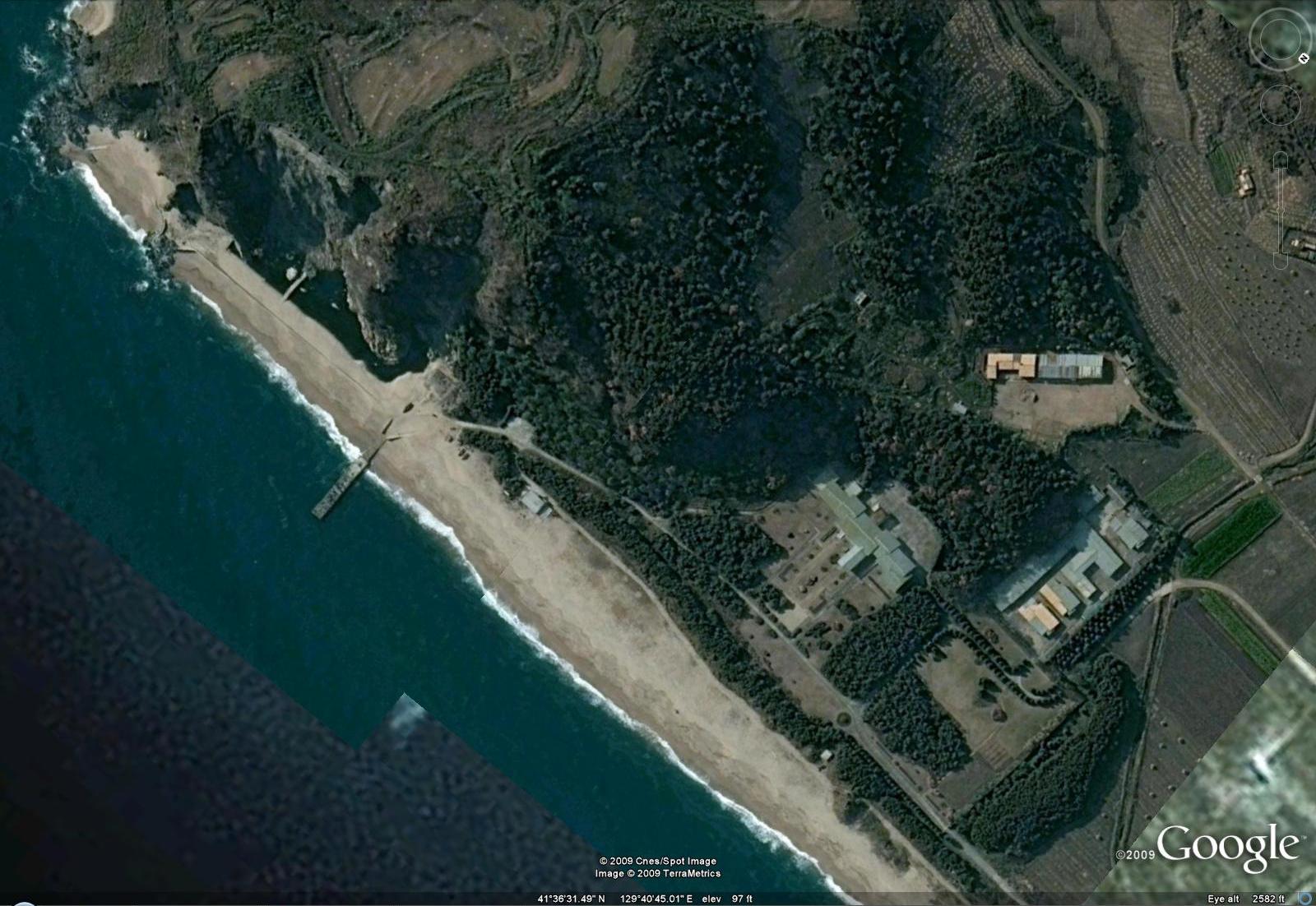
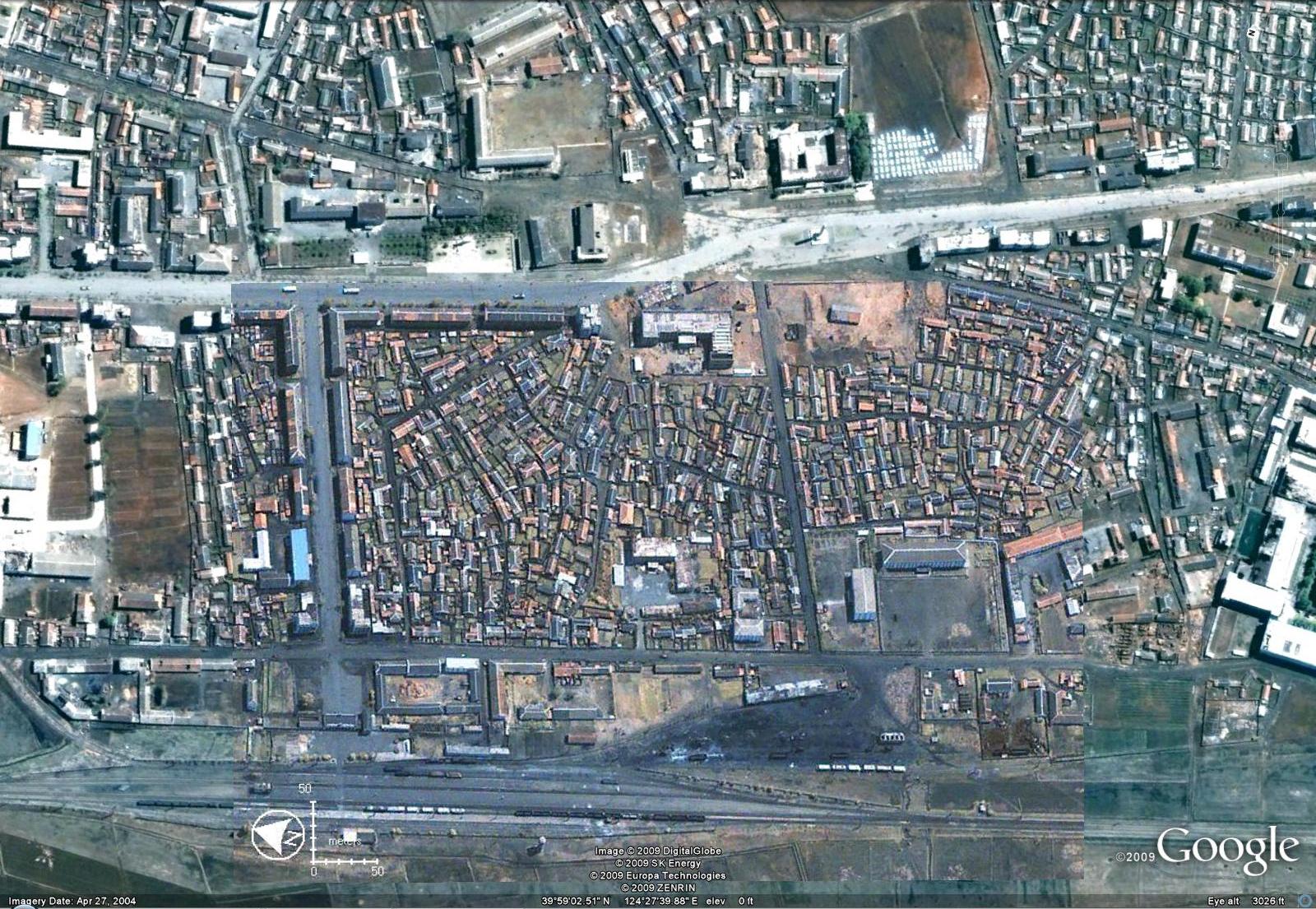
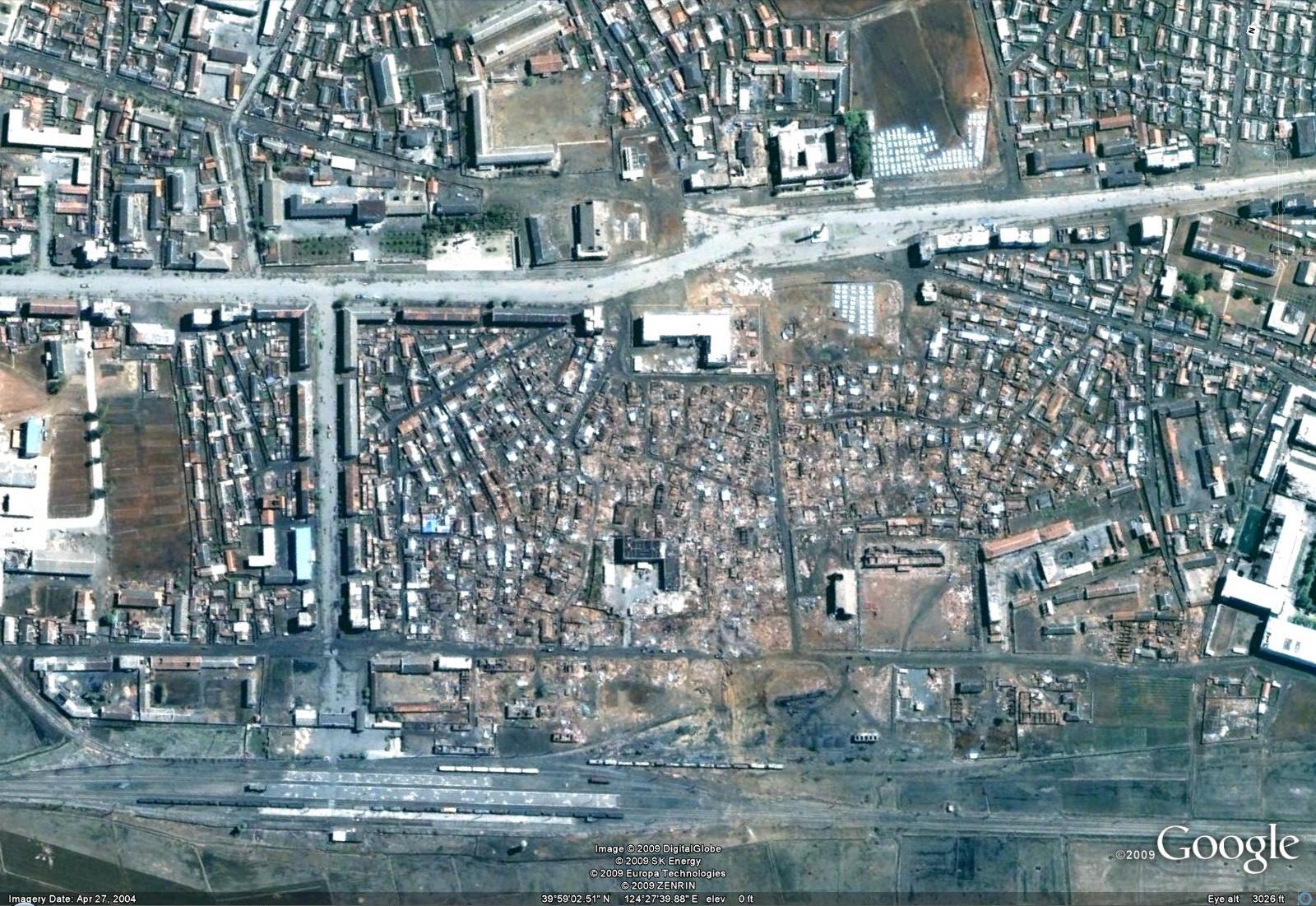
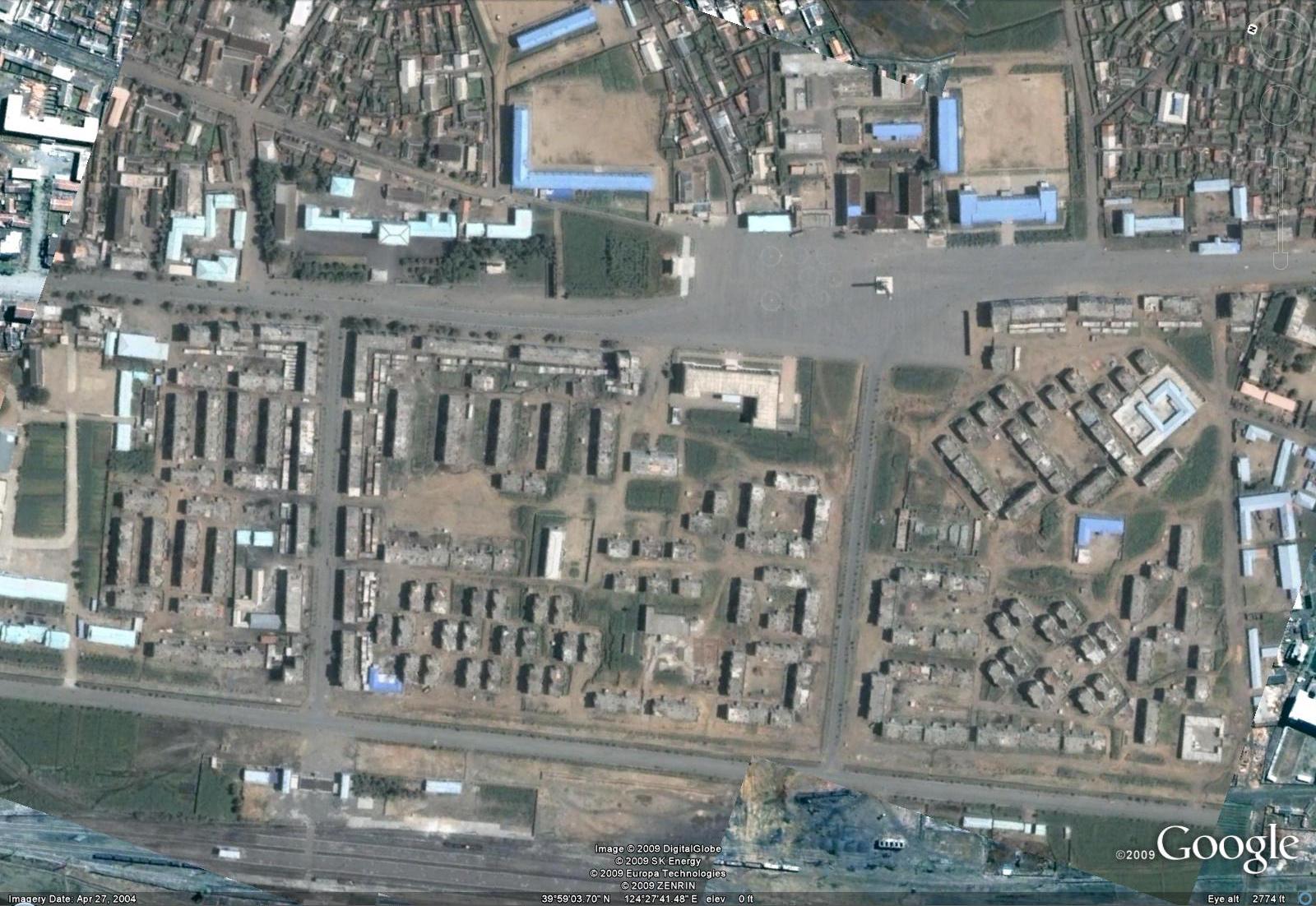
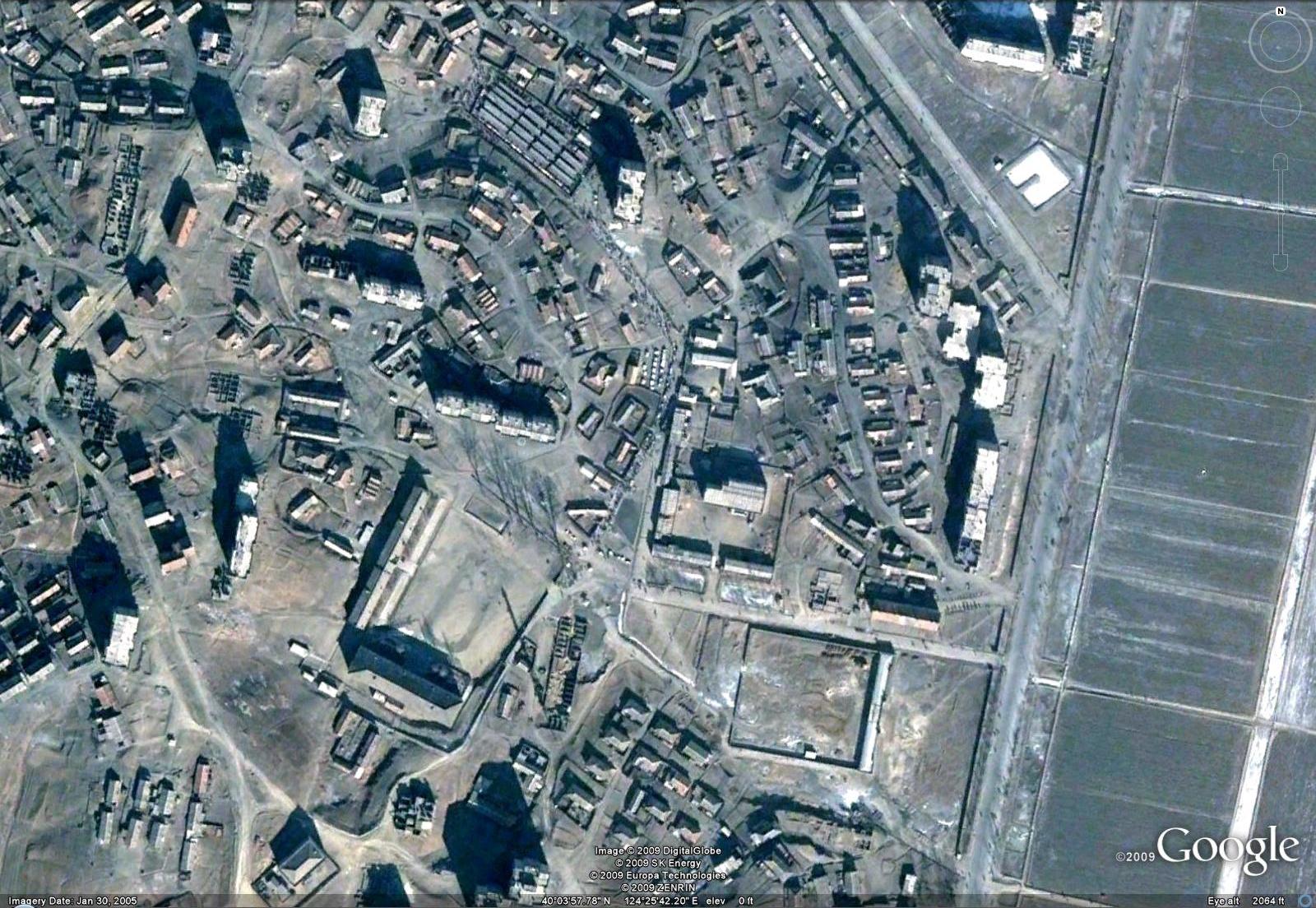
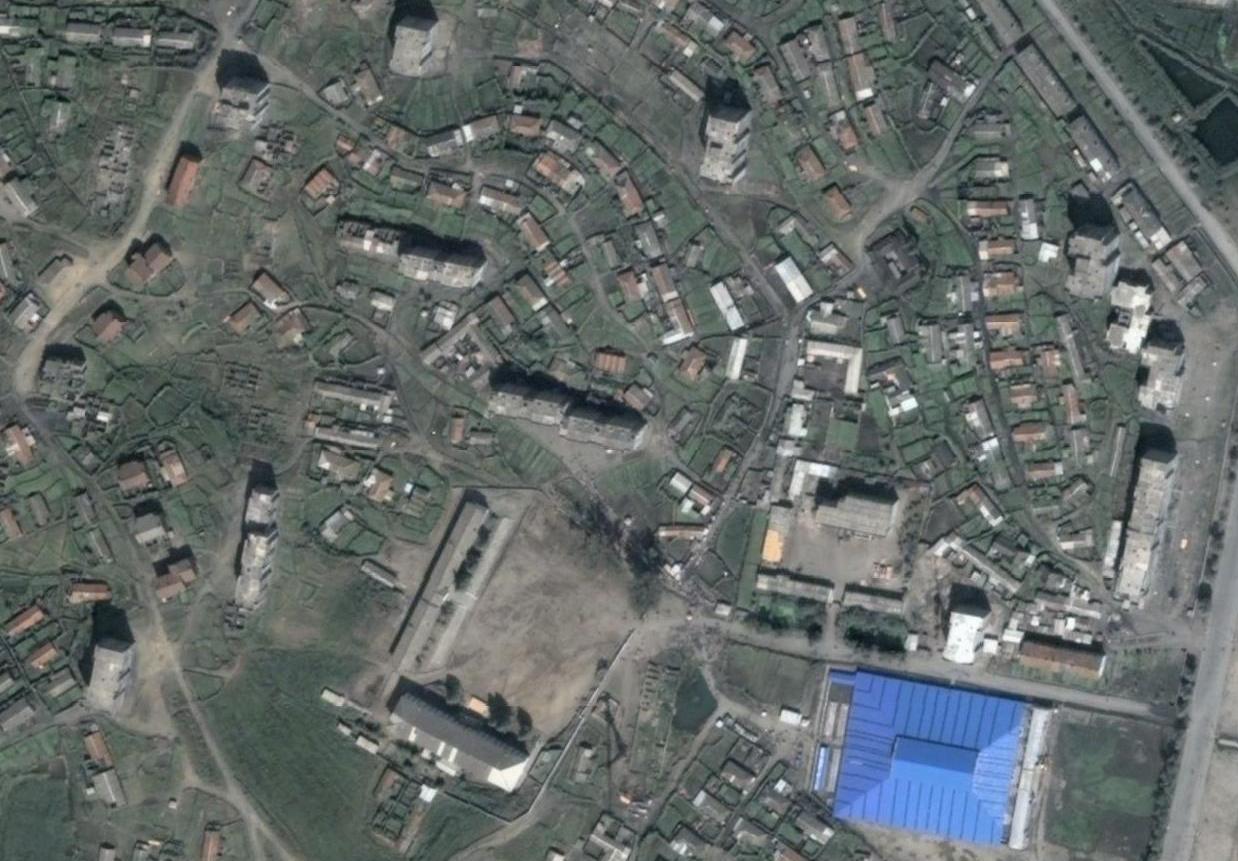
Using Google Earth’s feature which allows users to view the same location at different points in time, we can see that Pyongyang has experienced quite a construction boom in the 21st century, particularly in the southern Rakrang District.  Below I have posted some of the more interesting discoveries (dates are in the upper right corner of the images). 

Tudan Duck Farm (Pyongyang)
tudan-duck-farm1.JPG tudan-duck-farm2.JPG tudan-duck-farm3.JPG

Rakrang District
rakrang1.JPG rakrang2.JPG rakrang3.JPG

rackranga1.JPG rackranga2.JPG rackranga3.JPG

rackranghousing1.JPG rackranghousing2.JPG rackranghousing3.JPG

rackrangb1.JPG rackrangb2.JPG rackrangb3.JPG

Tongil Market (Rakrang)
tongilmkt1.JPG tongilmkt2.JPG tongilmkt3.JPG

Russian Orthodox Church (Rakrang)
orthodoxchurch1.JPG orthodoxchurch2.JPG orthodoxchurch3.JPG

Kaesong Industrial Zone
kaesongzone1.JPG kaesongzone2.JPG

Sinuiju market growth
sinuijumkt1.JPG sinuijumkt2.JPG

sinuijumkta1.JPG sinuijumkta2.JPG

Many have speculated that the construction boom is related to the DPRK’s plan to achieve a “strong and prosperous state” (Kangsong Taeguk) by 2012—the 100th birthday of the country’s eternal president, Kim il Sung.

UPDATE: Jon Herskovitz writes in Reuters that all this construction is actually making pepole worse off.  According to the article:

The programme to forge a “great and prosperous nation” by 2012 was a central part of the mandate for Kim Jong-il, son of the founding president, when parliament extended his official leadership in March for five years.

The goals for the broken economy are lofty. The North wants to revamp its railways, coal mines, steelworks and electrical supply, end hunger and strengthen its already large military.

“The Korean people will strikingly demonstrate their heroic stamina as socialist workers … and thus fling open the gate to a thriving nation in 2012,” North Korean state media said in a report to mark May Day.

Foreign residents in Pyongyang say streets are being spruced up and buildings refurbished to mark the 100th birthday of Kim Il-sung, who died in 1994 but is still considered president for eternity of Asia’s only communist dynasty.

“The 2012 project fits into these themes: glorification of the past, and if past history is any guide, the wasting of huge sums on useless monumental edifices,” Marcus Noland, an expert on the North’s economy with the U.S.-based Peterson Institute for International Economics, wrote in an email.

“The problem for North Korea will be financing this initiative.”

North Korea’s centrally planned economy has shrunk significantly since the rise to power in 1994 of Kim Jong-il, whose government quickly stepped away from early attempts at economic reform which might have threatened its grip on power.

Money from overseas has been drying up as the prickly North has backed away from an international disarmament-for-aid deal and the impact of U.N. sanctions, tightened after its April 5 test launch of what many saw as a disguised long-range missile.

… 

Those likely to bear the brunt of this shift in internal spending will be the most impoverished in the already destitute state, analysts said.

They will be forced to mobilise for government projects, leaving their local and mostly rural economies to stagnate, which means less food in a country that for years has been unable to produce enough grain to feed its 23 million people.

Read the full article here:
North Korea’s prosperity push could raise poverty
Reuters
Jon Herskovitz
5/12/2009

Share

Kim Jong Il, Urban Planner

Friday, April 24th, 2009

Daily NK
Lee Sung Jin
4/24/2009

Hyesan, Yangkang Province: If it had been any other day, on April 18th the entire city would be buzzing with People’s Unit evaluation meetings and cadre lectures. On this particular day, however, influential officials in Yangkang Province, including Kim Kyung Ho, Chief Secretary of the provincial committee of the Party, were gathered together around the railroad tracks in Sungwoo-dong.

The “Ground-Breaking Ceremony” for a project to clear residences near the railroad, so as to fulfill “Supreme Commander Kim Jong Il’s March 4th Decree,” was being held. However, the expressions on the faces of the officials carrying out the decree were grim. The ceremony ended with a few civilians who had been mobilized for the event demolishing an old farmhouse near the railroad and without the top official present making the planned speech. The faces of the bystander officials as well as the gathered civilians betrayed their distress; removal of houses near the railroad has already started, while new homes for residents, whose houses are to be demolished, are not yet prepared.

All of this started with Kim Jong Il’s onsite inspections at Samjiyeon, also in Yangkang Province, on March 4th. Kim, who entered the county along the road connecting Bukchung in North Hamkyung Province and Hyesan, had some choice words for the homes haphazardly clustered around the railroad.

“Why is it so disorderly around here? Get rid of all of the houses surrounding the railroad within the year!”

He also apparently expanded on his beliefs, “Clearing the area around the railway is an important project which improves the image of our country.” Since Kim Jong Il’s words and “instructions” surpass all laws and institutions, his words immediately formed the “March 4th Decree” and were subsequently relayed to all officials in the Yangkang Province region.

Railways in North Korea

In North Korea, there is no protection surrounding railroads, which frequently cut across the center of cities. There are rules that prohibit the construction of public buildings, including residential homes, within 50 meters of railroad tracks, but such rules have existed in name only for a long time.

From the perspective of common citizens, the areas around the railways are some of the most active zones for economic activity. Of course, it is very dangerous when trains are passing, but since they run only once or twice a day at most, the danger is short-lived.

The railroad is a more direct route than the roads, which are in any case not always paved, so it helps conserve time for commuters or those going to markets. It is also convenient to travel on the rails on wooden blocks during the winter! In the border cities of Yangkang and North Hamkyung Provinces, railways running alongside the Yalu and Tumen Rivers serve as important smuggling routes to and from China.

Since the early 2000s, when citizens began to prefer convenient locations around railroads for selling goods or commuting to and from work, the North Korean authorities permitted the construction of residential homes, though bribes had to be offered to officials. In small and mid-size cities, many homes were built within 10 meters of railway tracks.

A source from Yangkang Province explained in a phone conversation with Daily NK on the 23rd while relaying the news of the groundbreaking ceremony, “Workers have to spend most of the year constructing homes. Many people will then be forcibly evacuated from the danger areas.”

The source further commented, “In Hyesan, several hundred households have to be relocated even if only the residential homes within 50 meters of the railway are demolished. Since land is available only on the outskirts of the cities, citizens slated for evacuation have been putting up strong resistance.”

The source also commented dryly, “In resettlement projects, homes are usually built very sloppily. It would be better if the state provided resources to the individuals to build the homes themselves.”

In the areas surrounding the railroad in Hyesan proper, where one-bedroom rentals by university students recently discharged from the army are commonplace, frustration has been running high. The source relayed that while the People’s Units around the railways have been holding daily meetings to decide on the households to be relocated, angry words and even fistfights have been rampant, making mutual agreement difficult if not impossible.

The Party in Hyesan allotted responsibility for the construction of new residences to each factory and enterprises. However, the construction materials provided by the North Korean authorities amounted to just 300kg of cement, which is barely enough for the under-floor heating of a house. Additional materials and means of transportation have to be provided in their entirety by the factories and the enterprises.

Even the citizens who do not live in the vicinity of the railways are incensed by the recent decree. Each household in Hyesan was ordered to make and offer 500 bricks of mud and straw. The factories, in order to secure fuel and other materials, have had to reduce the wages of workers, which at best are not even equivalent to two kilograms of rice, by half.

The source explained, “In 1992, 1,000 homes were built for the discharged soldiers who had been stationed in the Hyesan mine, but in less than three years, at least half had abandoned their homes. Residential homes built in Potae-ri, Samjiyeon or in Daehongdan look great on the outside, but they were all built sloppily, so the soldiers are living in poor conditions to this day.” 

Share

Chinese investment in DPRK

Wednesday, April 8th, 2009

Writing in the Wall Street Journal, Evan Ramstad offers some information on China’s investments in North Korea:

The diplomatic minuet is taking place after China increased trade with North Korea over the past four years. Last year, trade between China and North Korea jumped 41% to $2.79 billion, with most of that coming from increased exports by China.

 On Tuesday, truck traffic between the two countries resumed after a break Monday for a Chinese holiday. Dozens of trucks made the crossing in Dandong, a major city along the North Korean border.

China has been North Korea’s chief political and economic sponsor since the Soviet Union collapsed nearly 20 years ago. For much of that time, it served as donor of last resort, making up the difference when energy, food and donations to North Korea dropped off from other countries. That often amounted to $100 million to $200 million in aid.

China broke from that pattern in 2005 by boosting its exports and widening its trade surplus with North Korea. Outside experts view China’s trade surplus as the chief measure of its economic aid to North Korea because North Korea has no measurable debt instrument and little ability to narrow the trade gap.

Chinese companies, sometimes with help from the Chinese government, are investing heavily in North Korea’s mining industry, construction and light manufacturing such as textiles. Chinese consumer goods line store shelves and market stalls in North Korea.

Many executives of Chinese companies in North Korea say it’s a difficult place to operate. Among the challenges: getting money out of the country. China helped Panda Electronics Group, based in Nanjing, start a computer assembly factory with Taedong River Computer Corp. in North Korea five years ago.

North Korea’s currency, the won, can’t be converted. To move money out of the country, Panda must buy commodities in North Korea and sell them in China for cash, an executive said.

The increased business activity in North Korea reflects China’s desire to treat North Korea more as a “normal country” rather than a socialist brother entitled to unlimited assistance, scholars and analysts in China say. They say China also hopes its companies in North Korea will encourage the North’s government to open its economy as China began to do in the 1980s.

Wang Kai, a manager of Liaoning Fuxin Tianxin Technology and Development Co., says the company decided to build a pipe-making factory in North Korea because the country’s economy has few places to go but up.

“North Korea’s situation and economic status are pretty similar to China’s before the start of the opening up and reform policy,” Mr. Wang said in an interview before the rocket launch.

Others note China’s desire is to prevent North Korea’s collapse, which might pour refugees into China’s northeast.

The increased business is yielding a payoff in political influence for China in Pyongyang that’s become more important since North Korean dictator Kim Jong Il was incapacitated by illness in August. One signal that Mr. Kim was back in control came when he met in late January with a delegation of visiting diplomats from Beijing.

Read the full story here:
Economic interests shape Beijing’s Pyongyang Policy
Wall Street Journal Online
Evan Romstad
4/8/2009

Share

North Korea Google Earth

Wednesday, March 11th, 2009

North Korea Uncovered v.16
Download it here

laurent-kabila.jpg

The most recent version of North Korea Uncovered (North Korea Google Earth) has been published.  Since being launched, this project has been continuously expanded and to date has been downloaded over 32,000 times.

Pictured to the left is a statue of Laurent Kabila of the Democratic Republic of Congo.  This statue, as well as many others identified in this version of the project, was built by the North Koreans. According to a visitor:

From the neck down, the Kabila monument looks strangely like Kim Jong Il: baggy uniform, creased pants, the raised arm, a little book in his left hand. From the neck up, the statue is the thick, grim bald mug of Laurent Kabila (his son Joseph is the current president). “The body was made in North Korea,” explains my driver Felix. In other words, the body is Kim Jong Il’s, but with a fat, scowling Kabila head simply welded on.

This is particularly interesting because there are no known pictures of a Kim Jong il statue.  The only KJI statue that is reported to exist is in front of the National Security Agency in Pyongyang.  If a Kim Jong il statue does in fact exist, it might look something like this.

Thanks again to the anonymous contributors, readers, and fans of this project for your helpful advice and location information. This project would not be successful without your contributions.

Version 16 contains the following additions: Rakwon Machine Complex, Sinuiju Cosmetics Factory, Manpo Restaurant, Worker’s Party No. 3 Building (including Central Committee and Guidance Dept.), Pukchang Aluminum Factory, Pusan-ri Aluminum Factory, Pukchung Machine Complex, Mirim Block Factory, Pyongyang General Textile Factory, Chonnae Cement Factory, Pyongsu Rx Joint Venture, Tongbong Cooperative Farm, Chusang Cooperative Farm, Hoeryong Essential Foodstuff Factory, Kim Ki-song Hoeryong First Middle School , Mirim War University, electricity grid expansion, Tonghae Satellite Launching Ground (TSLG)” is also known as the “Musudan-ri Launching Station,” rebuilt electricity grid, Kumchang-ri suspected underground nuclear site, Wangjaesan Grand Monument, Phothae Revolutionary Site, Naedong Revolutionary Site, Kunja Revolutionary Site, Junggang Revolutionary Site, Phophyong Revolutionary Site, Samdung Revolutionary Site, Phyongsan Granite Mine, Songjin Iron and Steel Complex (Kimchaek), Swedish, German and British embassy building, Taehongdan Potato Processing Factory, Pyongyang Muyseum of Film and Theatrical Arts, Overseas Monuments built by DPRK: Rice Museum (Muzium Padi) in Malaysia, Statue de Patrice Lumumba (Kinshasa, DR Congo), National Heroes Acre (Windhoek, Namibia), Derg Monument (Addis Ababa, Ethiopia), National Heroes Acre (Harare, Zimbabwe), New State House (Windhoek, Namibia), Three Dikgosi (Chiefs) Monument (Gaborone, Botswana), 1st of May Square Statue of Agostinho Neto (Luanda, Angola), Momunment Heroinas Angolas (Luanda, Angola), Monument to the Martyrs of Kifangondo Battle (Luanda, Angola), Place de l’étoile rouge, (Porto Novo, Benin), Statue of King Béhanzin (Abomey, Benin), Monument to the African Renaissance (Dakar, Senegal), Monument to Laurent Kabila [pictured above] (Kinshasa, DR Congo).
Share

Home make-overs: DPRK edition

Friday, February 27th, 2009

In the last twenty years, a number of 1960s-era, Soviet-style houses in the DPRK’s elite housing compounds have been upgraded into more “western-contemporary” housing.  For example, compare Kenji Fujimoto’s 1989 Kangdong photo (below) with a 2004 image from Google Earth:

kangdong1a.JPG

1989

kangdong-new.JPG
2004

Judging from Google Earth imagery, this process is largely completed, though there still appear to be a few locations that that have not been remodeled.  Looking at Onchon County (below) we can see that the reconstruction of old-style compounds was still under way as of 2005.  The house on the left of both photos appears to already be upgraded in 2002, but by 2005 the unit on the right of the first photo (below) has been completely leveled.  Reconstruction of this residence was probably underway into early 2006. 

mar1-2002.JPG
3/1/2002

mar2-2005.JPG
3/2/2005

I do not know the calculus used to determine which residencies are updated, neither in degree nor order.  I am also immediately unaware of which organization/s is/are responsible for construction/maintenance of these facilities.  A KPA unit built Sihanouk’s palace on Lake Changsuwon, and it is reasonable to believe the same unit constructed in the above locations as well.  If any readers have more information on this, please let me know.

UPDATE: (Hat tip to Mike) “The residences are either constructed on commission or they are presented to KJI, or some other CCKWP cadre, as a gift.  KJI, his family, members of the Kang and Jang families, long time CCKWP members and select intelligence/security appartus officials are known to have designated homes.

The home are constructed by KPA construction units (like Changsuwon) in cooperation with civilian crews under the auspices of the Escort/Bodyguard Bureau.  Some members of the civilian crews also work on the large monuments in the DPRK, and overseas.   When the homes are built or renovated on commission, the financing comes from the CCKWP offices.  A lot of the fixtures and furnishings are purchased through SOE’s or  by discreet MOFA officers.  A lot of these purchases are conducted in Beijing, Moscow, Geneva, Vienna and Paris. “

Not to draw to stark a comparison, but the reverse process is also evident through dated satellite photos.  This warehouse/factory near the Bukchang Thermal Power Plant has clearly fallen into disrepair (and possible asset stripping) between 2002 and 2005.

assetstripping-7-7-02.JPG
7/7/2002

assetstripping-11-16-05.JPG
11/16/2005

Share

Expansion of Pyongyang’s east market

Monday, February 23rd, 2009

The newest version of Google Earth allows the user to scroll backwards in time to see how a specific area has changed over the years.  Although the satelite imagery available for North Korea needs to be expanded, by utilizing the current stock of photos we can uncover some interesting developments.

Below is an example—a bird’s eye view of the expansion of Pyongyang’s eastern market (click on images for full size):

pyangeastmarket-12-25-2003.JPG

December 25, 2003

pyangeastmarket-6-4-2004.JPG

June 4, 2004

pyangeastmarket-4-6-2005.JPG

April 6, 2005

pyangeastmarket-10-29-2005.JPG

October 29, 2005

pyangeastmarket-most-recent.JPG

Most recently

If any readers out there discover other interesting developments please let me know.

Share

DPRK relic in Zimbabwe

Tuesday, February 3rd, 2009

heroes-acre-harare.jpg

National Heroes Acre is a burial ground in Harare, Zimbabwe for all Zimbabweans who have been declared a hero by the Government.

The Government started work on the Heroes Acre in 1981, one year after Independence. The design and artwork used at the site was done by seven artists from the Democratic Peoples Republic of Korea and ten Zimbabwean Artists.

Over 250 local workers were involved in the project at the height of construction. The black granite stone used for the main construction was quarried from Mutoko; a rural area situated about 140km Northeast of Harare. The Heroes Acre is protected under the Natural Resources Act.

See the Site on Wikimapia here

Learn more about the site here.

*This location will be added to the next version of North Korea Uncovered (North Korea Google Earth).  If readers are aware of other construction projects the DPRK has supported, please let me know.  I am especially interested in locating the North Korean restaurants in China, Thailand, Cambodia, Vietnam, and Bangladesh.  Are there others?

Share

Assessment of the 2008 DPRK economy, outlook for 2009

Monday, February 2nd, 2009

Institute for Far Eastern Studies (IFES)
ICNK Forum No. 09-2-2-1
2/2/2009

ASSESSMENT OF THE NORTH KOREAN ECONOMY FOR 2008

In the 2008 North Korean New Year’s Joint Editorial, Pyongyang established the year 2012 as “The Year of the Perfect Strong and Prosperous Nation,” while labeling 2008, “The Year of Turnabout,” and, “The Year of the Betterment of the Livelihoods of the People.” As the year marked the 60th anniversary of the establishment of the Democratic People’s Republic of Korea (DPRK), the regime projected a highly motivated façade, but there was no sign of new changes in the North’s economic policies.

Faced with the inability to produce any substantial results in the realm of international economic cooperation, North Korean authorities focused on how to put a positive spin on international conditions that were tied to the progress of 6-Party Talks. However, no visible measures appeared to emerge. Internally, North Korea’s chronic supply shortages drove further disparities between official and market pricing and monetary exchange rates as authorities were unable to stabilize the domestic economy. The growing global economic instability also caused economic policy makers to act more conservatively.

In 2008, North Korea’s food production in 2008 amounted to 4.31 million tons, recording a 7.5 percent increase over the previous year, while energy production is estimated to have grown by approximately 10 percent. Through joint development projects for North Korea’s underground resources, the North received raw materials for light industries (soap and shoes) amounting to 70 million USD in 2007, and 10 million last year. In addition, DPRK-PRC trade and inter-Korean economic cooperation both grew (DPRK-PRC trade increased significantly, while North-South cooperation grew only slightly), but it is difficult to measure the extent to which these increases impacted the North’s economy.

It appears that overall, North Korean trade and industry has improved since 2007, and the 2008 economic growth rate was positive. However, when estimating the North’s economic growth rate in light of the quickly rising exchange rate for South Korean won, DPRK economic growth for 2008 could be seen as a negative value.

While North Korea’s overall industrial production grew in 2008, when compared to previous years, and the primary reason for such was the refurbishment of equipment in most stable industries, development assistance and heavy oil aid as part of the 6-Party Talks, the provision of raw materials for light industries by South Korea, and the rise in prices on goods internationally.

Because of favorable weather conditions and increased production of fertilizer in the North, the agricultural sector showed a relative increase in production in 2008, despite the suspension of fertilizer aid from South Korea. Grain production was up 300 thousand tons, for an estimated total of 4.31 million tons last year. Boosted energy production was helped by improvements in hydroelectrical production and heavy oil tied to 6-Party Talks, and the provision of parts and materials for power plants, which considerably increased power production, at least in the first half of the year. This played an important role in the increase in industrial operations, as well. As electrical supply is the biggest obstacle to raising the operating rate of production facilities, more power resulted in overall production increases.

The construction sector has focused efforts on Pyongyang, and in particular on efforts to improve the lifestyles of its residents. Housing (averaging 20,000 family dwellings per year), restaurants, waterworks, roads, and other construction and repair projects have been aggressively undertaken.

North Korean authorities emphasized the science and technology sector in 2008, although it appears that the actual impact of this campaign topped out at the supply of some practical technology and the at production facilities, power plants, and other factories, and the promotion of modernization and normalization of industrial production.

At the mid-point of 2008, inter-Korean trade had grown by 1.2 percent compared to the same period the year prior, reaching 1.82 billion USD. The freeze on the annual supply of 400 thousand tons of rice and between 300~350 thousand tons of fertilizer from the South had a negative impact on the North’s food situation. On the other hand, DPRK-PRC trade from January-November 2008 jumped by 29.3 percent over the same period in 2007, considerably more than the 14.9 percent recorded in 2005, the 14.9 percent seen in 2006 and the 16.1 percent rise last year.

The increase natural resource development and improvements in core industries, the possibility of expansion of markets, and the advantage of low-cost labor give China, Russia, and other adjacent countries positive perceptions regarding investment in the North, and as Pyongyang continued to expand economic cooperation with these countries last year, it also improved economic relations with Europe as well as Egypt and other Middle Eastern countries.

PROSPECTS FOR THE NORTH KOREAN ECONOMY IN 2009

If one looks at North Korea’s domestic economic policies, one will see that basically, in the 2009 New Year’s Joint Editorial, North Korea’s domestic and international economic policies have not undergone any significant changes. However, in order to accomplish the goal of establishing a Strong and Prosperous Country by 2012, it is expected that all efforts will be poured into reviving the economy. Based on the Joint Editorial, this year, the North’s economic policy is not one of reform due to transformation of the outside environment, but rather a revival of pas, conservatively grounded economic policy. Regarding international economic relations, the 2008 Joint Editorial specifically stressed the building of an economically strong nation based on the principle of the development of external economic relations, but there was no particular reference to this in 2009.

In 2009, resolution of agricultural problems was again prioritized as the task most necessary for the realization of a Strong and Prosperous Nation by 2012. Along with this, the North’s economic policy for 2009 will prioritize the modernization and normalization of the economy’s ‘vanguard sector’, and it is expected to continue to strengthen efforts to revive the economy. As it continues to work toward creating an environment in which it can concentrate efforts on the building of an ‘Economically Strong Nation’, North Korean authorities are expected to issue new measures to strengthen the economic management system, including the planned industrial system, the distribution and circulation framework, and an effective market management system. The North is also expected to further emphasize efforts to modernize the People’s Economy, as it considers modern vanguard science and technology to be the answer to recovery from its current economic crisis.

There is a possibility North Korea’s foreign trade, including that with China, will shrink in the future, as its external economic activity is hit by the current international economic situation and the rising value of the U.S. dollar and Chinese Yuan. Just as was seen in 2008, with the shrinking growth of the Chinese economy, DPRK-PRC trade will be hit negatively. Progress on the rail link being promoted between Rajin and Hasan, as well as the redevelopment of the Rajin Harbor is also expected to face difficulties. This is likely to lead to further efforts by the North to expand economic cooperation with the EU and Middle Eastern countries.

Despite North Korea’s removal from the U.S. list of terrorism-sponsoring states, because sanctions against North Korea still remain, the North will need to make progress in non-proliferation, human rights improvement, and marketization in order to see real economic benefits from improved relations with the Obama administration. However, because of a lack of confidence regarding market reform, differing stances between the U.S. and DPRK on denuclearization, and deeply rooted mistrust, there is a more than a small chance that progress on the nuclear issue will be stretched out over the long term.

Looking at prospects for the main domestic economic sectors of North Korea, firstly, the amount of development in the energy and mining sectors could take a favorable turn if there is movement on the nuclear issue, and this would have an overall positive effect on the entire industrial sector. The drop-off of demand due to the international financial crisis could have a considerable impact on the North’s mining sector, making it difficult to see much growth past the levels seen in 2008.

In 2009, the supply-demand situation regarding North Korean grains is expected to improve over last year. North Korea requires 5.2 million tons of grain, and is expected to harvest 4.9~5 million tons, falling only 200~300 thousand tons short. This is an improvement over the 790 thousand ton shortfall the North suffered in 2008. However, the actual amount of grains distributed to the people may not increase, because some of the 2008 shortage was relieved through the release of emergency rice reserves, and so some portion of the 2009 harvest will need to be set aside to restock that emergency reserve.

In the manufacturing sector, the increase in electrical production and increase in large-scale equipment operations in metalworks, chemicals, construction materials, and other heavy industries, the supply of materials for light industries as well as fertilizer will be extended, but the reduction of inter-Korean economic cooperation and foreign capital will mean a reduction in the ability to import equipment and materials, making it difficult to meet 2008-level growth in industrial production numbers.

In the construction sector, housing construction in Pyongyang and other areas will not fall off suddenly, but with the anniversary of the founding of the Party Museum upcoming and the impact of the furious construction activity that has been underway, it is likely to slow down in 2009. With North Korean authorities restricting private-sector economic activity, controlling the size of markets, and other measures controlling commerce in the North are expected to strengthen, which will considerably restrict anti-socialist commercial activity. To what extent official commerce networks will absorb this activity will be pivotal.

Trade between North Korea and China is expected to shrink as the global economic crisis drives down the price of raw materials that the North exports to the PRC. Following the North Korean authorities’ enforcement of a measure reducing inter-Korean economic cooperation on December 1, 2008, without improvement in the North Korean nuclear issue, and in U.S.-DPRK relations cooperation between Seoul and Pyongyang will gradually shrivel. Trade with other countries is also expected to fall as a result of the current global economic situation. Therefore, reduction of inter-Korean economic cooperation, North Korea’s principle provider of foreign capital, and sluggish trade between Beijing and Pyongyang will weaken the North’s foreign reserves supply-and-demand situation.

As for the investment sector, if North Korea is to succeed in its push to build a Strong and Prosperous Nation by 2012, it must attract foreign investment through aggressive policies of opening its economy. In order to improve the investment environment, Pyongyang must work more aggressively to resolve the North Korean nuclear issue, but despite the demands of the surrounding countries, it is likely North Korea will insist on recognition as a nuclear power, making it difficult to expect progress on this front. Therefore, foreign investors’ interest in North Korean markets, and North Korea’s assention into international financial institutions through improved relations with the United States, appears to be a long way off.

Share

DPRK relic in Ethiopia

Thursday, January 29th, 2009

dergmonument.jpg

The Dialachin Monument (a.k.a. Victory Monument, Derg Monument) was a gift from Pyongyang to Addis Ababa’s Derg regime in the 1970s.

You can see the location of the monument in Wikimapia here.

You can learn more about the Derg here.

See more photos of the monument here.

*This location will be added to the next version of North Korea Uncovered (North Korea Google Earth).  If readers are aware of other construction projects the DPRK has supported, please let me know.  I am especially interested in locating the North Korean restaurants in China, Thailand, Cambodia, Vietnam, and Bangladesh.  Are there others?

Share

North Korea’s real estate black market

Sunday, January 25th, 2009

Some great qualitative information on the DPRK’s underground real estate market from Radio Free Asia:

Central authorities are investigating the practice in all of North Korea’s major cities and have confiscated the homes of “dozens” of local officials in the city of Chongjin, one well-informed source who asked not to be named said.

Private ownership or sale of homes is forbidden by the North Korean state, which assigns dwellings to its citizens based on its own determination of need.

“Most government officials build their residences in the North Korean equivalent of suburbs, in areas that are close to the city but still have a rural flavor,” the source, a Chinese merchant who does business in North Korea, said.

“They sell them when they retire.”

“If someone sells a 50-pyong (1,800-square foot) house in such an upscale neighborhood, he can then buy a house that is three or four times bigger in a different area,” the merchant said.

Party and state officials receive permits and order state-run construction companies to build homes in suburban areas near the sea, the merchant said.

He added that the value of real estate privately sold in North Korean port cities is now appreciating at twice the rate of real estate sold elsewhere in the country.

High-quality materials, including expensive appliances and wallpaper, are often used in the building of officials’ homes, according to a North Korean defector originally from Chongjin but now living in South Korea.

“Small but elegant” patios are sometimes also included, he said.

To justify the construction and occupancy of a larger space, local officials build multi-unit structures and fill them with relatives or people of more modest means, the defector said. 

When the officials retire, they pay the other occupants to move and then sell the entire structure.

North Korean authorities have now sent “task forces” to each of North Korea’s major cities to investigate real estate deals by local officials, the border merchant said, adding that a 40-member group was recently sent to Chongjin, where the homes of dozens of officials were seized.

An official in the city’s Songpyong Ward has reportedly been demoted and reassigned to a more backward part of the country, and fines equal to the actual value of transactions have been imposed on citizens who bought or sold homes.

Some thoughts:
1. IFES reported that private real estate transactions were quite common last september.

2. This report, combined with previous accounts, indicates that, although illegal, the DPRK’s real estate market is quite rational.  Construction quality and location influence housing prices.  According to the Daily NK, the qality of the chairman of the neighborhood people’s committee also influences the price.

3. Could the effort to crack down on these transactions be part of the plans to achieve a “Strong and prosperous nation” by 2012?

Read more here:
North Korean Economy Watch: real estate posts

North Korea’s Black-Market Housing
Radio Free Asia
Jung Young
1/23/2009

Private sector real estate activity booming in the DPRK
Institute for Far Eastern Studies (IFES)
NK Brief No. 08-9-4-1
9/4/2008

Who Is the Chairperson of the People’s Unit?
Daily NK
Moon Sung Hwee
8/18/2008

Share

An affiliate of 38 North