Archive for the ‘Construction’ Category

Mansudae Street residential construction

Friday, April 16th, 2010

UPDATE: Here is a satellite image of the completed project:

mansudae-housing-final-thumb.jpg

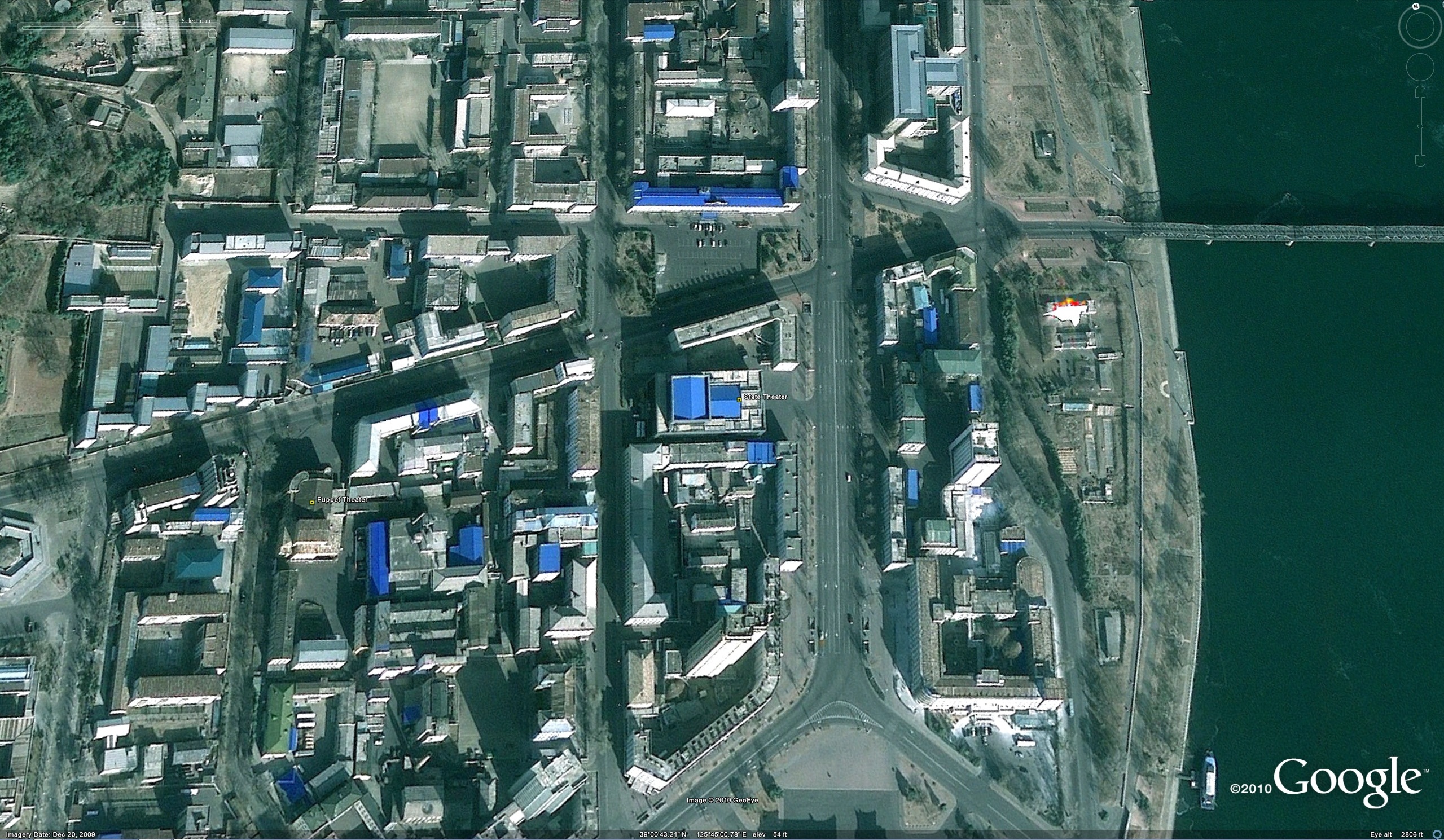
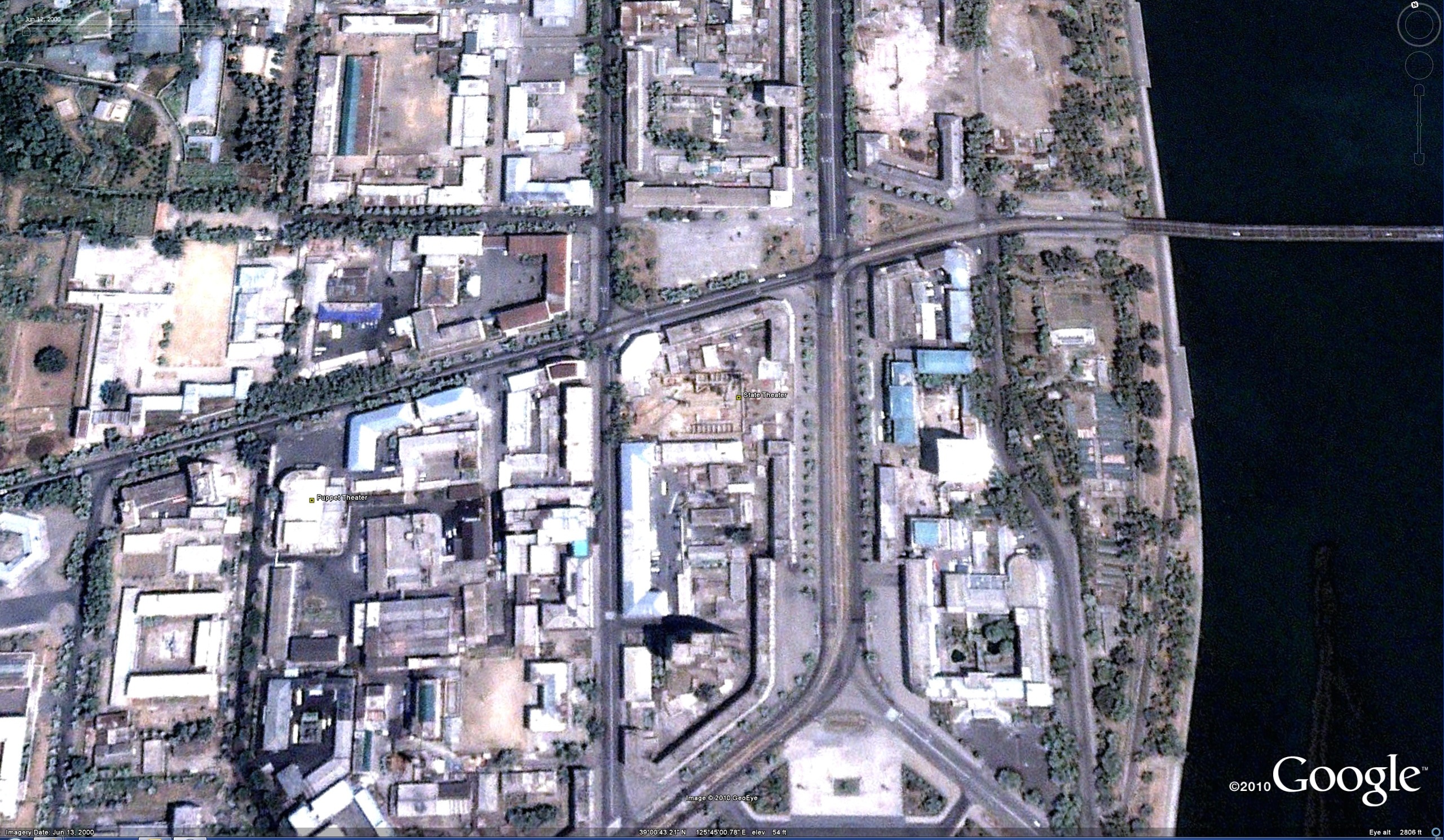
UPDATE: Mansudae Street construction is now visible on Google Earth.  Below I have included before and after pictures.  If you open them in separate browsers, you can click back and forth between images to compare.

mansudae-street-12-2006-thumb.jpg

mansudae-street-1-2009-thumb.jpg

ORIGINAL POST: As capitalist countries are struggling with falling property values and a glut of housing inventories, Pyongyang is experiencing a housing construction boom (previously covered here and here). In North Korea, however, the housing boom is not the result of an “unexpected” asset bubble but rather a deliberate government policy to achieve a “strong and prosperous country (Kangsong Taeguk)” by 2012 — the year the earth is predicted to be destroyed according to the Mayan calendar.

As part of this construction boom, the North Koreans are (re)building a substantial number of housing units on Mansudae Street east of the Potong River Gate and north of the Russian Embassy.  Kim Jong il recently gave an “on-the-spot-guidance” visit there, so using information provided in the coverage of his tour, I was able to map out the areas to be torn down and rebuilt.

First, here is the image from Kim’s visit (courtesy of Daylife and Reuters):

osg-mansudae-construction-10-09.jpg
(click image to enlarge)

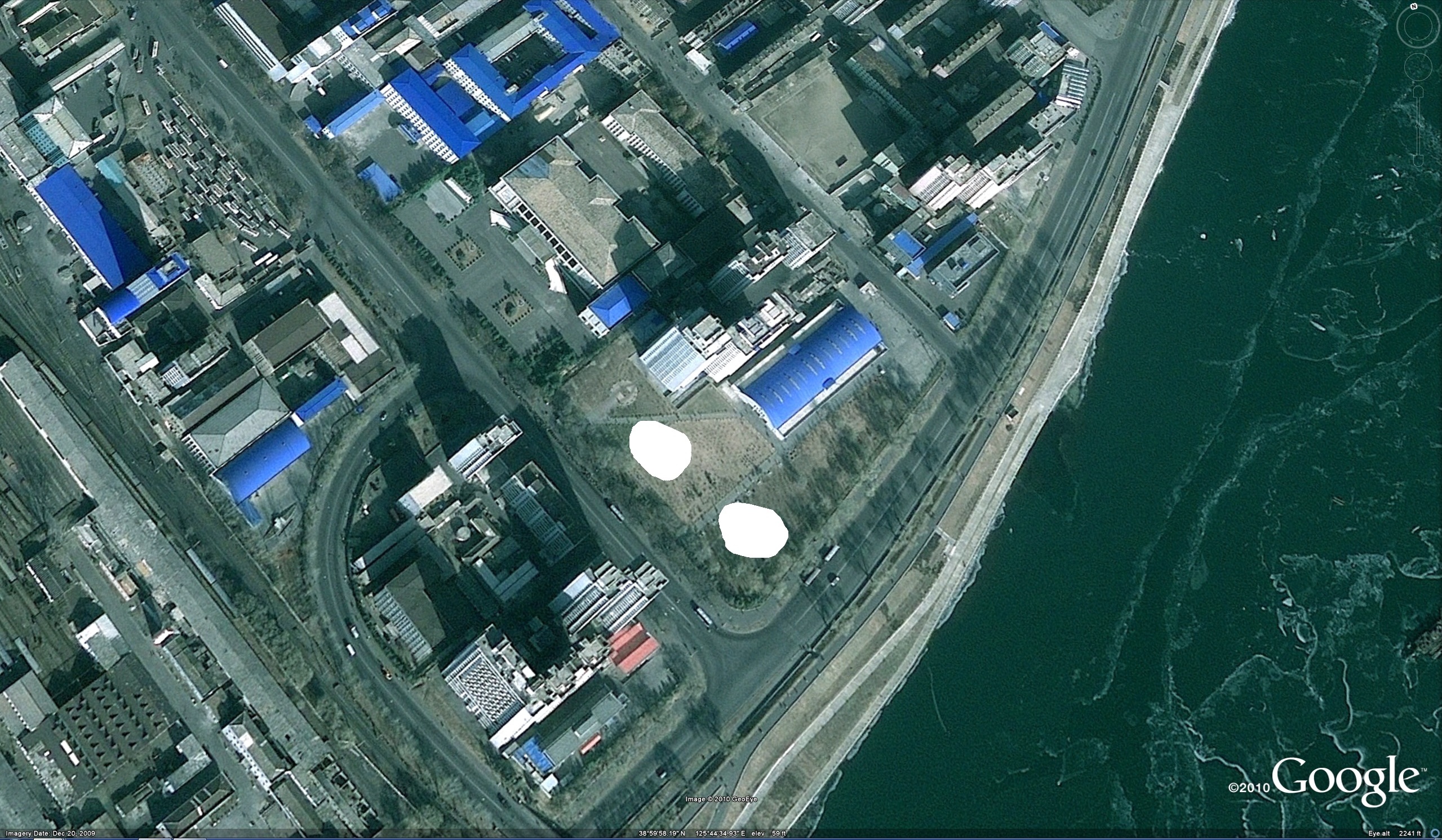
Using this and other information, I was able to map out the construction areas in Google Earth.  Here are some pictures to explain the scale of the work (click images to enlarge):

satellite-before.JPG
Construction area

satellite-after.JPG
(red=demolish/rebuild; white=preserved)

Previous real estate posts can be read here.

Previous construction posts can be read here.

If you would like to make an effort at improving on my work, you can download my Google Earth overlay here and use it yourself. Some of the buildings in the construction area are specifically identified in North Korea Uncovered.

UPDATE: Here are some pics of the construction site:

construction09-1.jpgconstruction09-2.jpgconstruction09-3.jpgconstruction09-4.jpgconstruction09-5.jpgconstruction09-6.jpg

Share

Monument to the African Renaissance Unveiled

Sunday, April 4th, 2010

Click image for larger version

UPDATE 6:  According to KCNA:

Kim Yong Nam Attends Unveiling Ceremony

Pyongyang, April 4 (KCNA) — Kim Yong Nam, president of the Presidium of the DPRK Supreme People’s Assembly on an official goodwill visit to Senegal, participated in the ceremony for unveiling the “Monument to Revival of Africa” on Saturday.

The monument represents in a formative artistic way the strong stamina and will of the African people to bring about their bright future by their own efforts while aspiring after independence and building of a new society. It has been successfully built in a short span of time with help of Korean technicians.

Present at the ceremony were Senegalese President Abdoulaye Wade and heads of state and government from at least 20 African countries, representatives of different international and regional organizations, diplomatic envoys of different countries in Dakar and thousands of its citizens.

Incumbent and former presidents of African countries and representatives of international and regional organizations said at the ceremony that this wonderfully-built monument is pride of not only Senegal but also Africa.

They expressed belief that the African people would make greater progress with the conviction of the future.

UPDATE 5: Senegal unveils £17m African Renaissance statue built by North Korea’s Mansudae Overseas Investment Group.  According to the Gaurdian:

Senegal’s vast African Renaissance monument was unveiled yesterday amid criticism that the 49-metre bronze statue is a presidential vanity project and waste of money.

The representation of a man, woman and child emerging from a volcano was inaugurated at a ceremony featuring hundreds of drummers and dancers.

The statue, which cost £17m and is taller than the Statue of Liberty, stands on a hill overlooking the capital, Dakar. It marks Senegal’s 50 years of independence, and the president, Abdoulaye Wade has said he hopes it will become a tourist attraction.

Wade, 83, who is expected to seek another term in office at elections in 2012, said the monument commemorated the entire continent. “It brings to life our common destiny,” Reuters reported him saying at the launch ceremony. “Africa has arrived in the 21st century standing tall and more ready than ever to take its destiny into its hands.”

Wade has faced criticism for spending so much money on the structure when Dakar residents living in its shadow endure regular power blackouts and flooding. He has angered both Senegal’s Christian minority and some within the Muslim majority population.

Wade apologised to the former group after likening the monument to Christ, while some imams have condemned the Soviet realist-style statue as idolatrous. Other have expressed concern at the thigh-length hemline skirt worn by the female figure.

UPDATE 4: According to Access Asia’s Weekly Website Update – 1st April 2010:

Senegal may not have much to attract tourists, but it does now have something most other potential holiday destinations don’t – a 50 metre high bronze monument crafted by North Koreans. It’s a quick bit of profit for Pyongyang. Hopelessly corrupt and slightly potty Senegalese president Abdoulaye Wade wanted a tall bronze statue – and what he wants, he gets. Actually it’s taller than the Statue of Liberty in the very-difficult-to-get-a-visa-in-these-days United States of America. Called “African Renaissance” it stands on a hill near Dakar International Airport and represents a heroic couple apparently about to launch their child into the sky, for some reason unspecified.

President Wade couldn’t afford the statue so he called in Pyongyang as specialists in providing oversized tat. They did, in return for a prime chunk of real estate in exchange. Pyongyang has since sold the land on, making a tasty profit. Senegal, still mired in poverty, now has Africa’s daftest statue and some dodgy property developers in charge of a chunk of their land – fair swap?

UPDATE 3: Great photos here (h/t Marmot)

UPDATE 2: The Wall Street Journal fills in some more details on the Monument:

This month, workers from Mansudae Overseas Project Group of Companies, a North Korean design firm, were putting the finishing touches on a giant copper sculpture of a family. Senegal President Abdoulaye Wade will inaugurate the African Renaissance Monument in April to mark the 50th anniversary of the country’s independence from France, a ceremony he expects the president of North Korea’s Parliament to attend.

“Only the North Koreans could build my statue,” says Mr. Wade, sitting in a red velvet chair in his palace. Moreover, they offer monuments at a good rate, he says: “I had no money.”

North Korea is mainly known for a totalitarian regime overseeing economic failure. But it has also produced a successful export business—building monuments to freedom and independence. The statues’ selling point: They are big, simple and cheap.

Over the past decade, Mansudae has built dozens of statues and monuments for cash-strapped African countries. Botswana cut the ribbon on a memorial to three tribal chiefs in 2005. Neighboring Namibia boasts a bronze of its founding president wielding an AK-47.

The African Renaissance is Mansudae’s biggest work yet, measuring 164 feet high and crowning two barren hills in Dakar called “Les Mamelles” at the westernmost point of Africa. That makes it taller than either the Statue of Liberty (151 feet) or Rio de Janeiro’s Christ the Redeemer (100 feet). The statue depicts a father holding a baby in his left arm. The man’s right arm is around the waist of the baby’s mother. The three are reaching out to the sky and out to the ocean.

“Its message is about Africa emerging from the darkness, from five centuries of slavery and two centuries of colonialism,” says Mr. Wade.

Africa’s rash of nationalistic monuments, statues and shrines has made Mansudae’s signature aesthetic of socialist realism fashionable. In Benin, for example, a statue of a 19th-century king holds his hand up, symbolically forbidding the French to enter.

Socialist realism is popular “because people can access it easily,” says Mary Jo Arnoldi, curator for African Ethnology at the Smithsonian Institution. It is easy to understand for illiterate populations, she says. “But aesthetically, it’s not going to win any prizes.”

In Senegal, however, the statue has been a beacon of discontent, sparking angry newspaper editorials and protests from religious leaders. The statue’s sultry mother figure, dressed in a wisp of fabric that reveals part of a breast and a bare leg, has offended imams in this majority-Muslim country.

Financing details for the project have been murky, and some taxpayers are outraged by the very idea of it when power outages occur daily and university students strike over rising fees. Mr. Wade had no budget for the African Renaissance, so instead offered a prime chunk of state-owned land in exchange, which North Korea has since resold at a large profit, he says.

However, a panel near the base of the monument lists the official budget as $25 million, though foreign government officials estimate its cost at around $70 million. Mr. Wade says he plans to keep 34% of the profit from entrance fees and merchandise for a personal foundation.

The North Korean role is of less concern, though labor unions do lament that Mansudae got the job when an estimated 49% of the population is unemployed: 150 North Koreans are building the statue, helped by just 50 Senegalese. Mamadou Diouf, the head of the Confederation of Autonomous Unions of Senegal, says the project doesn’t look African.

“If [building the statue] was a priority for our country, it could have been done by Senegalese workers in a manner much more in line with our values,” he says.

A short video related to this story can be seen here.

The monument’s location is here.

UPDATE 1: The Guradian brings us up to date with the monument’s construction:

monument-of-the-african-r-001.jpg

According to the Guardian:

The statue shows a muscular man in a heroic posture, outstretched arms wrapped around his wife and child. Nearly 50 North Korean workers were brought in to build it, because of their expertise with bronze art, and some Senegalese have complained of its communist-era design. It has also drawn criticism from Muslims, who make up 94% of Senegal’s population, because of Islamic prohibitions on representations of the human form.

Abdoulaye Wade, Senegal’s octogenarian president, has compared the work to some of the west’s best-known landmarks, and some Senegalese do regard it as a symbol of pride that has economic spin-offs.

Alassane Cisse, a Senegalese delegate at the world summit on arts and culture in Johannesburg, South Africa, said: “All cities need signatures, but in Dakar we have had only monuments which existed during colonisation. Africa needs its own great monuments like the Eiffel tower and the Statue of Liberty. This symbol of African renaissance will motivate people to rehabilitate and work with Africa.”

He added that the site has exhibition, multimedia and conference rooms, as well as a top-floor viewing platform giving a bird’s eye view of Dakar. “It will be a cultural place. Around the monument there will be a theatre and shops. Many tourists will visit there, so the economic effects will benefit the population.”

But the president has sparked anger by maintaining that he is entitled to 35% of any tourist revenues it generates, because he owns the “intellectual rights”.

Critics say the £17m could have been used for more pressing concerns. Djiby Diakhate, a sociologist at Dakar’s Cheikh Anta Diop university, told the Associated Press: “Senegal is going through a profound crisis. Our economy is dying. People are struggling to eat. We should be spending money helping people survive.”

ORIGINAL POST: As some readers may be aware, I have been tracking down monuments and buildings constructed by North Korea’s Mansude Overseas Project Group.  To date, I have tracked down quite a few (see North Korea Uncovered for the full list).

One such find is the “Monument to the African Renaissance” in Dakar, Senegal.  See this Voice of America story for background.  Well, a friend of mine recently visited Dakar and snapped this photo of the monument’s construction:

african-renaissance.JPG

Click on image for larger version

I believe we can see a leg on the lower left.  The majority of the construction so far seems to be support.

Note to readers: if you are aware of any other North Korean-built (or operated) buildings/monuments/businesses/restaurants in your country, please let me know. I do not believe a comprehensive list of these projects exists, so getting this information together now will certainly be valuable to future historians. How is that for motivation?

Share

Friday Fun: Brigandish drinking game, KFA, and Pyongyang construction mayhem

Friday, April 2nd, 2010

Brigandish Drinking Game
Josh Stanton (One Free Korea) gets credit for inventing the KCNA drinking game.  Every time KCNA mentions “Brandish” behavior, you take a drink.  For those who like to imbibe more frequently, here is a link to every single KCNA story that mentions “Briganish”–all 647 of them. This is courtesy of the indispensable STALIN search engine.

KFA in London
Korean Friendship Association hosted what can only be described as a “hysterical” protest against the US and South Korean embassies in London.  The reasons: Foal Eagle and Key Resolve.  It appears that about half-a-dozen members showed up. See all of their photos here.

Pyongyang Construction Mayhem
The North Koreans are constructing a Pyongyang Folk Village at the foot of Mt. Taesong next to Anhak Palace (satellite image of the construction site here). Below are some images of the construction taken from the Dec 11, 2009 KCTV evening news.

sosan-ice-skating-minsok.jpg

Above are the replicas of the Pongyang ice skating ring and (I believe) Sosan district tae-kwon-do building.

party-founding-minsok.jpg

Above are replicas of the Monument to the Founding of the Worker’s Party, the West Sea Barrage, and the Grand People’s Study House.

ryugyong-minsok.jpg

Above is the replica of the Ryugyong Hotel.  This will likely be the first replica to be completed before the original on which it is based!

No doubt the replica of the Pyongyang Arch of Triumph will also be the worlds largest replica of a triumphal arch as well–over 3 meters taller than the model of the Paris Arch of Triumph at Lego Land!

Share

North Korea Offers Sand, Rents for Concrete, Fuel, Munhwa Says

Wednesday, March 10th, 2010

Sangim Han
Bloomberg
3/10/2010

North Korea’s cash-strapped government is offering to swap sand, resources licenses and rental income in return for concrete, steel and fuel, according to Munhwa Ilbo newspaper.

The government sent letters to companies in China and South Korea asking them to invest $320 million in a construction project in the capital, Pyongyang, the Korean-language paper reported. In addition to the investment, the government is seeking 30,000 tons of diesel and gasoline, 50,000 tons of steel bars and 300,000 tons of cement, the paper said, citing one of the letters.

In return, the letters offer investors long-term rental income, the rights to resource development and sand. North Korea’s finances are being squeezed by United Nations sanctions imposed because of the country’s nuclear weapons program.

The letters were sent to the companies via an investment group, the paper said. The government wants to build 100,000 homes in Pyongyang, it said.

Share

DPRK appropriating KEDO equipment

Friday, January 1st, 2010

According to the Joong Ang Ilbo:

North Korea has reused equipment and materials left from the halted construction work on light-water reactors, breaking a prior agreement with a multinational organization that oversaw the botched construction project.

According to the Unification Ministry and other sources, North Korea has taken 190 vehicles from the site in Kumho, South Hamgyong Province, and 93 pieces of heavy equipment, including cranes and excavators, and is likely using them for military purposes.

Sources said thousands of tons of steel bars and cement and communication devices are also being used by the North.

In late 2005, the Korean Peninsula Energy Development Organization, also known as KEDO, stopped construction of non-military nuclear reactors in the North. The work had begun in August 1997 as part of the 1994 Agreed Framework between the United States and North Korea. Under the terms of the agreement, Washington said it would build two reactors in the North in exchange for Pyongyang’s agreement to freeze all nuclear weapons activities.

But in October 2002, the United States said it had obtained intelligence that the North had been operating a clandestine program to produce highly enriched uranium to develop weapons and the U.S. State Department said North Korea admitted to doing so. By January 2003, the North withdrew from the Nuclear Non-proliferation Treaty. KEDO suspended its construction in November 2003.

Two years later, the KEDO’s board decided to terminate the construction project, which was about 30 percent complete. In December 2005, North Korea asked KEDO workers to leave the country and said they would not be allowed to repatriate equipment and construction materials.

At the time, KEDO and North Korea had agreed to leave materials at the site. Most belonged to South Korean subcontractors, and they had planned to sell off some of it to make up for financial losses stemming from the halted work.

In 2003, after the KEDO first suspended construction, the North said it would not allow the transfer of equipment unless it received compensation. A government official here said, “The North moved the equipment before we could even address the compensation issue, and that’s clearly in violation of our agreement. It can even be regarded as stealing.”

In January 2006, the Roh Moo-hyun administration in Seoul said the North had pledged to store the materials and that it expected the North to honor its word. Despite suspicions that the North had used some of the equipment in preparation for their second nuclear test this year, the current Lee Myung-bak administration has also remained silent.

But intelligence sources tell a different story.

They said the North started using equipment almost immediately after KEDO’s withdrawal and that the North Korean military was involved.

“North Korea is trying to keep South Koreans or KEDO officials from going near the construction base,” one source said. “Recent satellite photos of the site show that hundreds of the black covers that were used to conceal materials are mostly gone.”

Sources estimate equipment and materials are worth about 46 billion won ($39 million). South Korea, one of the founding members of the KEDO, spent $1.1 billion on the construction project.

Here is a satellite image of the KEDO reactorsHere is an image of the KEDO residential compound.

Share

DPRK workers in UAE

Tuesday, December 29th, 2009

According to the Choson Ilbo:

Around 30,000 foreign laborers live in the camps on Reem Island. They come from all over the world, including Pakistan, Bangladesh and China. The North Korean laborers live in a part of the camp 400 m from the entrance. “Money was pretty good about three to four years ago, but now it’s tough to find work,” said one North Korean worker.

Around 1,300 North Koreans work in Abu Dhabi and Dubai, according to sources. Altogether around 6,000 North Koreans work in the Middle East, 3,100 of them in Kuwait. Some 800 work in the UAE and Qatar, with another 300 in Oman and 250 in Yemen. North Korea has been sending workers to construction sites in the Middle East so they can earn hard currency to send back to their impoverished country.

The movement resembles the exodus of South Koreans who came to the Middle East in the 1970s and ’80s to work at construction sites, but the main difference is that the North Korean government takes away the money its workers earn there. When asked about their wages, one North Korean worker said, “A lot of us have many years of experience working overseas as carpenters or welders and make between $150 and $200 a month, which is about the same as the Pakistanis make.” But those wages are what the workers keep after they have made their “loyalty” payments to the North Korean government.

One source in Abu Dhabi said, “North Korean workers make between $300 and $500 a month, but the North Korean government confiscates $150 and even $250 as loyalty payments, leading to a lot of conflict.” North Korean labor export companies skim off an excessive amount of money from salaries. The level of discontent recently prompted the North Korean government to dispatch security agents who trawl construction sites on weekends to provide ideological “cleansing” sessions to workers.

Since the construction industry in the Middle East fell into a slump due to the global financial crisis, North Korean workers have been resorting to other means to make money. The most common method is bootlegging in Abu Dhabi, where alcohol is banned. But that is a criminal offense that carries to two to three months in prison and deportation. “The North Korean companies that sent the workers abroad are aware of the bootlegging but are turning a blind eye as long as the laborers pay portions of the profits,” one local source said.

Some North Koreans leave the construction sites and work as handymen or build fountains for private homes. In August, a North Korean worker was deported after wandering into the home of a high-ranking police officer. “There was an incident early this year where a North Korean agent brought home a worker who was caught making critical comments about the North,” a local source said.

Additional Information:

1. Here is a link to the full story excerpted above.

2. Here is the approximate location of the North Korean workers’ camp in the UAE.

3. According to IFES:  North Korea established ambassador-level diplomatic ties with the United Arab Emirates on September 18, [2007]. A joint statement said the two countries aim to “enhance understanding and boost the links of friendship and cooperation between their two peoples.” Ties with such an oil-rich nation on friendly terms with Washington could be significant as the North moves to dismantle nuclear facilities.

4. This story highlights a strange DPRK-UAE-Unification Church connection.

4. Here is a link to a similar story about North Korean loggers working in Russia.

5. North Korean workers were recently deported from the Czech Republic.

Share

2009 Inspections by Kim Jong Il focus on economic, military sites

Tuesday, December 22nd, 2009

Institute for Far Eastern Studies (IFES)
NK Brief No.09-12-22-1
12/22/2009

The latest on-site visit by Kim Jong Il, in mid December, marked the 156th inspection of the year. This is an increase of approximately 170 percent over last year. Among those accompanying the ‘Great Leader’, Secretary of the Central Committee of the Korean Workers’ Party Kim Ki-nam was seen most frequently, traveling with Kim Jong Il on 107 different occasions. Others seen frequently with Kim include Jang Sung-taek, brother-in-law and right-hand man, as well as Party Central Committee Vice-chairman Pak Nam-ki.

According to North Korean media officials, Kim Jong Il’s on-site inspections this year include 64 visits to economically important locations, 43 to military installations, 13 to sites related to foreign affairs, and 36 to other sites, for a total of 156 visits. Kim made only 90 visits during 2008.

Last year, 55 percent (50 visits) of Kim Jong Il’s on-site inspections were to military sites, while 26 percent (24 visits) of trips were to sites related to the economy. This year, 41 percent of site visits were to economically-relevant sites, while only 27 percent were to military sites.

These visits are linked to the recent ‘100-day Battle’ and ‘150-day Battle’ to boost domestic production in order to meet North Korea’s goal of being a ‘strong and prosperous nation’ by 2012.

North Korean authorities are undertaking massive construction projects across the country, such as the building the Huicheon Thermoelectric Plant, tens of thousands of new housing units, and other large-scale construction projects.

Broken down monthly, Kim Jong Il has ventured out to on-site visits 10-19 times per month, with the exception of July (8 visits). He has made 8 visits in December up until the 17th.

It is also important to note those who have travelled with Kim. As mentioned previously, Kim Ki-nam was seen 107 times and Jang Sung-taek travelled with Kim 82 times. In addition, Hyon Chol-hae, a former bodyguard of Kim Il Sung and confidant of Kim Jong Il, made 56 visits, General Ri Myong-su was seen with Kim 48 times, and Vice Marshal of the Korean People’s Army Kim Yong Chun was seen on 30 different occasions.

Of particular interest among all of Kim Jong Il’s public appearances this year is that in November he made a visit to the headquarters of the Ministry of People’s Security. Kim also visited the naval complex in Nampo in mid November, and made his first visit to the North’s very first free-trade zone, in Rason, North Hamgyong Province, inspecting the Rasong Dae-heung Trade Fishery Complex. Both of these followed the inter-Korean naval clash in the Yellow Sea on November 10th.

Share

Syria’s Tishreen War Panorama

Wednesday, December 2nd, 2009

Visitors to Pyongyang’s Victorious Fatherland Liberation War Museum (Location here) will be interested to know that the DPRK has exported its museum technology to Syria’s Tishreen War Panorama (Location here).

syria-museum.JPGsyria-museum2.JPGsyria-museum3.JPG

The images are from this web page.

According to an official web page (I think), the panorama dimensions are 129.5m x 7.8m.  It was painted by Kim Sing Chol, O Kwang Ho, Ri Jae Su, Ri Kap Il, Kim Chol Jin, Choe Song Sik, Ri Jong Gap, Kim Ki Dok, Cha Yo Sang, Ri Yon Nam, and it opened on 6th October 1999.  These artists are employees of the Mansudae Overseas Development Group (Art Studio).

I thank a reader for sending me this information.  I have been mapping North Korean projects in Africa, Asia, and the Middle East on Google Earth.  Here are some I have blogged about: Monument to African Renaissanace, Zimbabwe Hero’s Park, Ethiopia’s Derg Monument, Kinshasa Kabila Statue, and quite a few more.  If you are aware of any North Korea projects in your area please let me know.

UPDATE: Cairo’s October War Panorama is also built by the North Koreans.   It appears to have nearly identical architecture.  It is located here.

Share

Hyesan getting a facelift

Friday, November 20th, 2009

Kangsong Taeguk 2012 comes to Hyesan! According to the Daily NK:

According to an inside source, the North Korean authorities have, at the behest of Kim Jong Il, been using the “Mt. Baekdu Tourism Fund’ for improving areas in and around the city of Hyesan in Yangkang Province.

The source relayed the news in a phone conversation with The Daily NK on the 11th, saying, “Recently, many changes have been taking place in Hyesan. At the General’s suggestion, the ‘Mt. Baekdu Tourism Fund’ was channeled to the city, and has been used to dramatically improve the road to and beautify the area around the Samsu Powerplant, as well as creating parks around the Kim Jong Suk Performing Arts Theater.”

In May 2007, after five years under construction, the North Korean authorities held a ceremony for the completion of the Samsu Powerplant. Subsequently, in preparation for an onsite inspection by Kim Jong Il, the beautification of the area around the plant was completed and a new, 24km section of the No. 1 Road running from nearby Wangduk Station (one of a number for the exclusive use of Kim Jong Il) up to the powerplant was constructed.

Construction of the road was apparently extremely difficult, involving removing mountainsides and filling in streams to facilitate the construction of the road, part of that which connects Hyesan with Samjiyeon.

North Korea mobilized around 100,000 people in the period between January 2007 and May 2008 for the work, including 30,000 members of the June 18th Shock Troop, workers from a nearby collective farm, Hyesan Factory and other enterprise laborers.

The construction funds, said to be in the region of $800,000, were sent directly, in cash, to the Party Provincial Secretary and the Provincial Trading Bureau in 2007. They even brought in iron rods, gasoline and diesel fuel from China.

It is apparently difficult for even the vehicles of officials to pass down the No. 1 Road due to the existence of an Escort Bureau checkpoint.

The source also explained about other projects, “Separate from this construction, the project to renovate the road which goes around Wangduk to the Chundong district of Hyesan (where the No. 10 Army Corps Headquarters is located) also began recently (in 2009), and $80,000 has been invested in a beautification project in the area around the Kim Jong Suk theater.”

The road construction project connecting Wangduk and the Samsu Powerplant and the project to repave the existing road from Wangduk Station to the No. 10 Army Corps Headquarters in Chundong were both completed between May 2008 and the end of the “150-Day Battle” in preparation for Kim Jong Il’s inspection of army units in the area.

The beautification of the area around the newly constructed Kim Jong Suk Theater is also noteworthy. The surrounding area contains the No. 7 and No. 8 apartments, which until recently were extremely worn out. Additionally, when an 8-floor apartment next to the No. 7 apartment collapsed in July 2007, some 30 people are said to have lost their lives.

The authorities, while remodeling the No. 7 and No. 8 apartments in an effort to clean up the area, renovated dilapidated apartments and even started a project to lay down Chinese paving blocks in the area.

The Daily NK’s source could not be sure what the original source of the funds was, but confirmed in particular that “it was first tapped under the General’s instructions. Most officials are aware of this.”

On a related note, work on the incomplete Mt. Baekdu-Samjiyeon Railway has still not resumed since its interruption in May. This would seem to indicate that even the Mt. Baekdu Tourism Fund was insufficient for the work.

Read the full story here:
Intensive Public Works Reported in Hyesan
Daily NK
Lee Sung Jin
11/20/2009

Share

Friday grab bag

Thursday, November 12th, 2009

North Korean defector poetry: I am personally not a big fan of poetry, but some poetry written by North Korean defectors has been translated into English and published.  Read it in Radio Free Asia.

North Korean Leadership Compounds: We have pretty much located all of the “easy to find” leadership complexes in North Korea on Google Earth.  However, not all of them are visible with high resolution imagery.  Here are a few I have recently taken care of:

1. Sinchon Compound (written about by Keji Fujimoto)

sinchon-elite-copound.JPG

Click image for larger version

Download Google Earth overlay here.

2. Island getaway: For the leader who has everything

island-getaway.JPG

Click image for larger version

Download Google Earth overlay here.

3. Sugnam

sugnam-elite-area.jpg

Click image for larger version

Download Google Earth Overlay here

Eight Scenic Views of the Songun Era:

1. Sunrise over Mt. Paektu. (See here)

2. Snow Covered Tapak Sol guard post in Mangyongdae.  (See here – Actually not sure where the guard post is, but this is Mangyongdae)

3. Royal Azaleas on the Chol Pass. (See here)

4. Illuinated night view of the Jangja River in Kanggye. (See here)

5. Ulim Waterfall. (See here)

6. Rezoned Handre (Handure) Plain on the Unhung Cooperative Farm in Thaechon County. (See here)

7.  Potato flowers in Taehongdan. (See here)

8. Poman-ri fish farm. (See here)

A Song was even written about these places.

Share

An affiliate of 38 North