Archive for the ‘Economic reform’ Category

ROK government planning to resume construction and relax sanctions in Kaesong zone

Thursday, October 20th, 2011

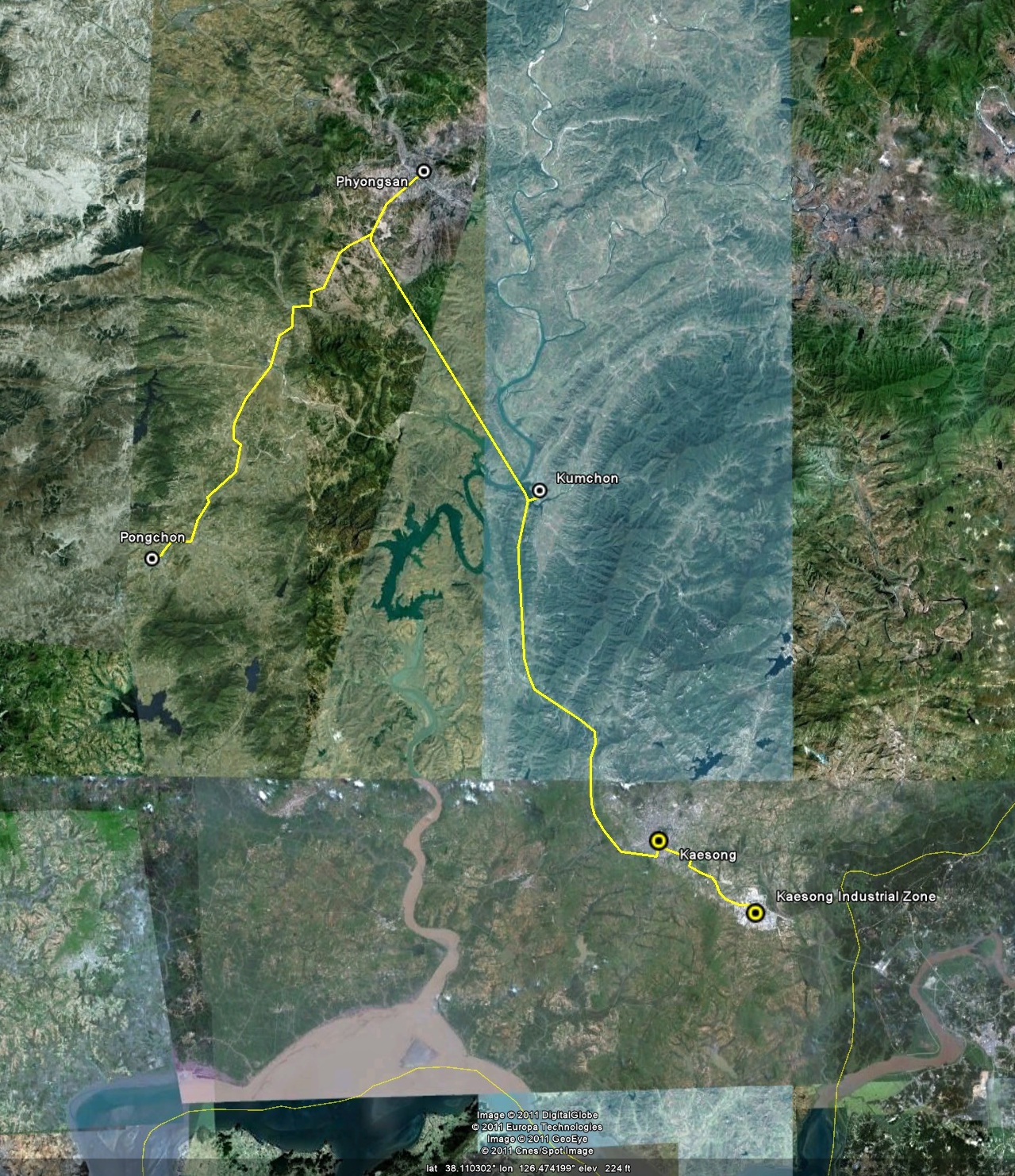
Pictured above (Google Earth): The towns mentioned in the article below from which the Kaesong Industrial Zone could draw more labor: Pongchon (봉천), Kumchon (금천), and Phyongsan (평산).

Institute for Far Eastern Studies (IFES)
2011-10-20

According to South Korea’s Ministry of Unification (MOU), the “May 24 Sanctions” that went into effect after the sinking of the naval boat Cheonan was relaxed and began to permit the resumption of construction of businesses in the Kaesong Industrial Complex (KIC). In addition, plans to build fire stations and emergency medical facilities in the area are also currently underway.

After South Korean Grand National Party chairman Hong Jun-pyo visited KIC on September 30, 2011, the ROK government has reached the following decisions: 1) to allow the resumption of halted factory constructions; 2) to build a fire station and emergency medical facility; 3) to resume repair work for commuting roads for KIC employees; and 4) to extend the operations of commuter buses.

This means seven companies that received permits in the past to begin construction but stopped after the sanctions went into effect would be able to resume the halted construction projects.

According to the Ministry of Unification, the seven companies include three metal and machinery, three textile, and one electronic factories, taking up a total area of 103,527 square meters. The total site of production facilities of stage 1 businesses in the KIC reaches 2,171,900 square meters, in which the currently operating 123 companies take up 783,471 square meters. With the sanctions lifted, the total area of businesses in operation will reach 885,950 square meters.

In addition, five companies awaiting construction for expansion will have to wait a little longer. The authorities announced to discuss this issue at a later date, looking positively on their construction to resume shortly as well.

Also the MOU announced to push forward with the establishment of fire stations and emergency medical facilities, “to protect the properties and health of businesses and employees of the KIC. The plans to break ground for fire station will begin in mid-November and is expected to be completed by late next year.”

The layout for the KIC fire station was completed in December 2009 and 3.3 billion USD has been budgeted to fund the construction. The station will be constructed on a steel frame on a 3,305 square-meter lot with the total floor space to be around 2,182 square meters.

The Kaesong Management Committee has been operating a “fire/police station” from April 2005. But with occurrences of accidental fires since last winter, it has reinforced the number of fire engines and manpower – currently at a total of eight fire trucks and 36 fire fighters.

Medical facilities in the KIC will also be completed by the end of 2012 once the construction begins early next year. About 3 billion USD is set for this project.

Currently at the KIC, Green Doctor’s Cooperation Hospital is in charge of providing medical and health services in the KIC, with South Korea Green Doctor’s Kaesong Hospital treating the South Korean employees and North Korean Comprehensive Clinic treating the North Korean employees exclusively. The South Korea Green Doctor’s Kaesong Hospital is currently operated by volunteers at a clinic level. The hospital was in the process of improving the facilities to more than ten beds. However, this project was halted after the May 24 sanctions went in effect.

On another note, the MOU also announced that maintenance work for the road connecting Kaesong City to the KIC would begin. The road is normally used by North Korean employees of the KIC. It was also announced that the number and operation of commuter buses would increase to help with the commute. The buses operate in the 20 km radius; the plan is to increase that to 40 km. Since September 2010, the number of buses increased to 400.

There are plans to extend the service to cover the areas of Kumchon, Bongchon, and Pyongsang. However, the roads to these areas are unpaved and extension of transportation services to these areas will require negotiations with the North Korean authorities.

Although these measures will alleviate some of the problems faced by the businesses in the KIC, the MOU still stands firm on its position that North Korea must take responsibility and make formal apology for the Cheonan incident in order for a fundamental resolution of the situation to occur.

Share

Some interesting recent publications and articles

Thursday, October 20th, 2011

1. “Relying on One’s Strength: The Growth of the Private Agriculture in Borderland Areas of North Korea”
Andrei Lankov,Seok Hyang Kim ,Inok Kwa
PDF of the article here 

The two decades which followed the collapse of the communist bloc were a period of dramatic social and economic transformation in North Korea. The 1990-2010 period was a time when market economy re-emerged in North Korea where once could be seen as the most perfect example of the Stalinist economic model. The present article deals with one of the major areas of socioeconomic change which, so far, has not been the focus of previous studies. The topic is about the growth of private agricultural activities in North Korea after 1990. This growth constitutes a significant phenomenon which has important social consequences and also is important from a purely economic point of view: it seems that the spontaneous growth of private plots played a major role in the recent improvement of the food situation inside North Korea.

______________________

3. Korea Sharing Movement anti-malarial program (Via Cancor)
Read a PDF of on the project here

______________________

4. What is it like to teach at the Pyongyang University of Science and Technology (PUST)?
Find out from one instructor here. More on PUST here.


Share

1st Rason International Trade Fair (UPDATED)

Wednesday, October 19th, 2011

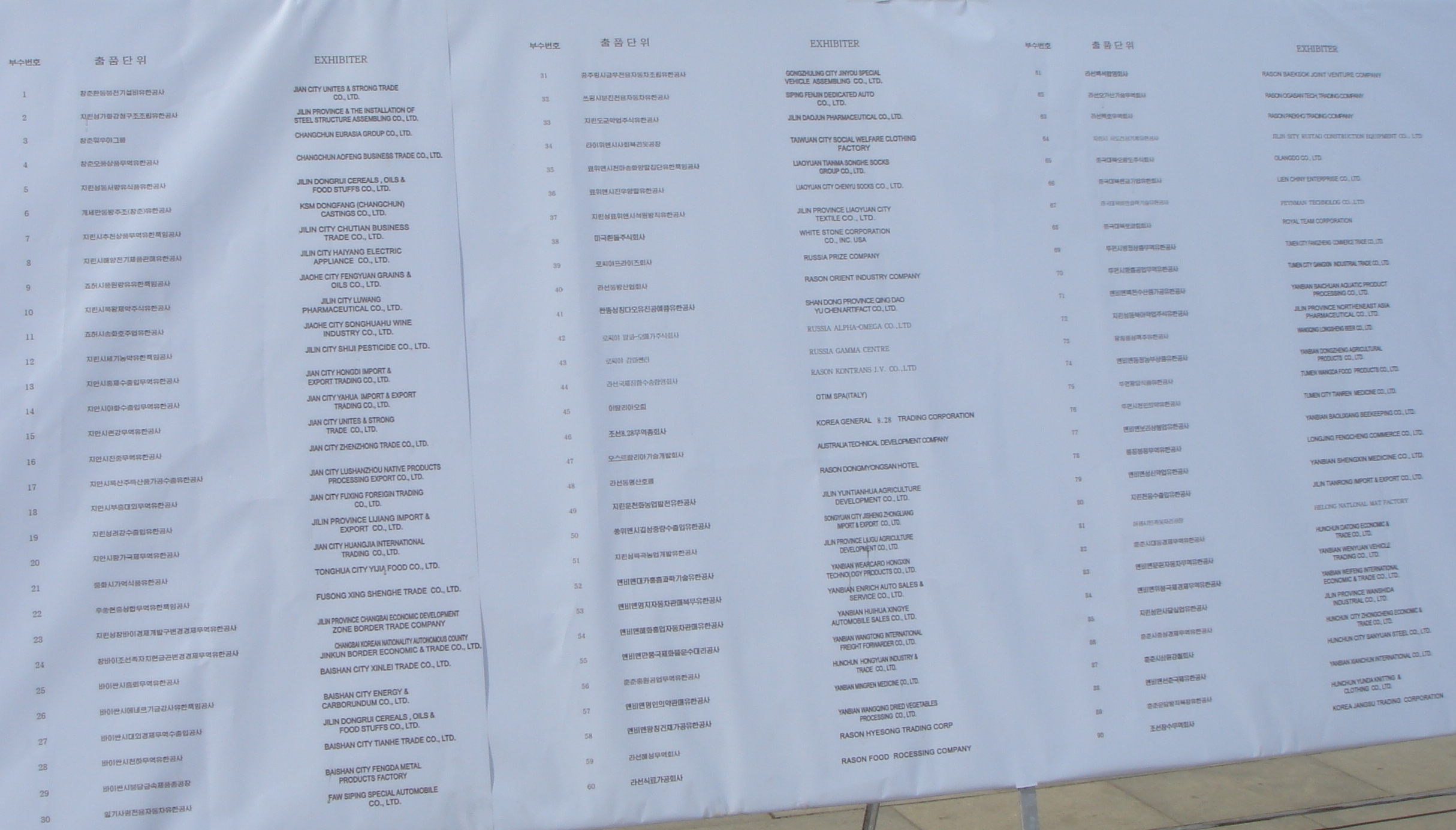
UPDATE 6 (2011-10-19): I finally received a list of companies participating in the first Rason International Trade Fair. Below is a picture of the names of participating companies listed on a display at the show and a PDF of their names (in English). I apologize for any typos:

Here is a PDF of the company names in English.

Most are obviously Chinese companies, though there appears to be at least one American company listed in the mix, White Stone Corporation Co., Inc. USA!

UPDATE 5 (2011-8-22): KCTV produced video footage from the fair.

UPDATE 4 (2011-8-25): KCNA announces the closing of the first Rason International Trade Fair:

First Rason International Trade Fair in DPRK Closes

Rason, August 25 (KCNA) — The first Rason International Trade Fair was closed with due ceremony on Thursday.

Present there were Jo Jong Ho, chairman of the Rason City People’s Committee, officials concerned and exhibitors of different countries and regions.

In a speech a speaker referred to the fact that the fair was successfully progressed and an advance was made in conformity in favor of mutual interests in economy, exchange of science and technology and trade through wide-ranging contacts.

Diplomas were awarded to the exhibitors who presented excellent goods at the closing ceremony.

UPDATE 3 (2011-8-25)): KCNA publishes a short article advertising the economic advantages of Rason:

Rason Economic, Trade Zone with Bright Prospect of Development

Pyongyang, August 25 (KCNA) — Rason City, the DPRK, is situated in an important area which can link China’s three northeast provinces and Russia’s Far East region, both full of natural resources, and many Asia-Pacific nations with each other.

Rajin, Sonbong and Ungsang ports in Rason and Chongjin Port adjacent to the area provide good conditions for transit trade for Northeast Asia and other continents.

The sea off the ports does not freeze in winter, so they are not subject to seasonal restriction.

The reconstruction projects of the Rajin-Khasan railway and Rajin Port launched in Juche 97 (2008) will make it possible to reduce the transport distance from Asia to Europe, sharply cutting down the transport fee.

The Rajin-Khasan railway will serve as a transport route between the DPRK and Russia and between Asia-Pacific and European nations.

Rason City has seafood, agricultural product and wild vegetable processing bases operated by Korean trading companies. The city also boasts of many ponds, lakes and bays favorable for fresh-water fish culture and offshore farm.

Its natural and geographical environment is suitable to an international tourist resort. There are sea-bird, seal and other animal sanctuaries in the area with beautiful islets, like Pipha and Sol.

Some foreigners have already launched business in the area and an increasing number of investors are interested in the zone.

Rason City with amazing geographical and economic conditions is likely to greatly contribute to the development and prosperity of Northeast Asian nations.

UPDATE 2 (2011-8-21): The first Rason International Trade Fair opens Monday. Some interesting information below:

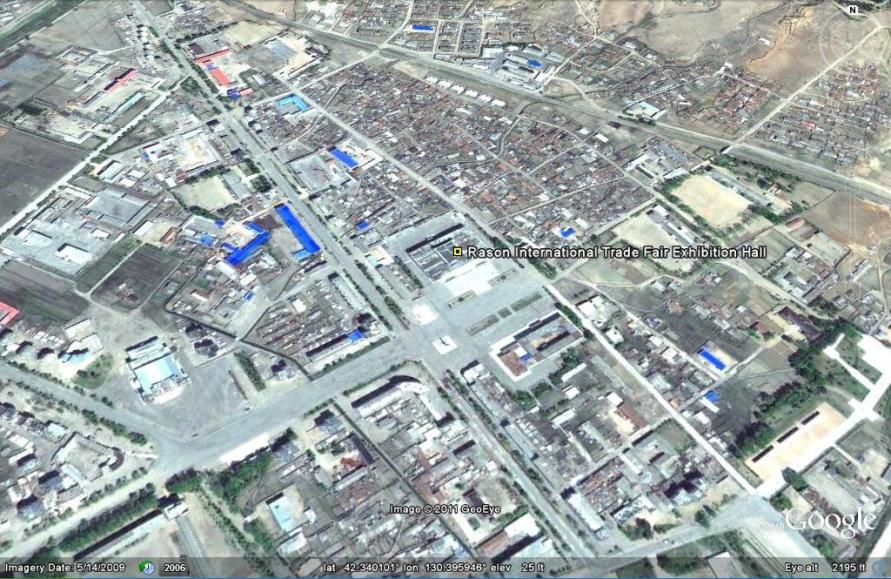
Pictured above (Google Earth): The Rason International Trade Fair Exhibition Hall (See in Google Maps here)

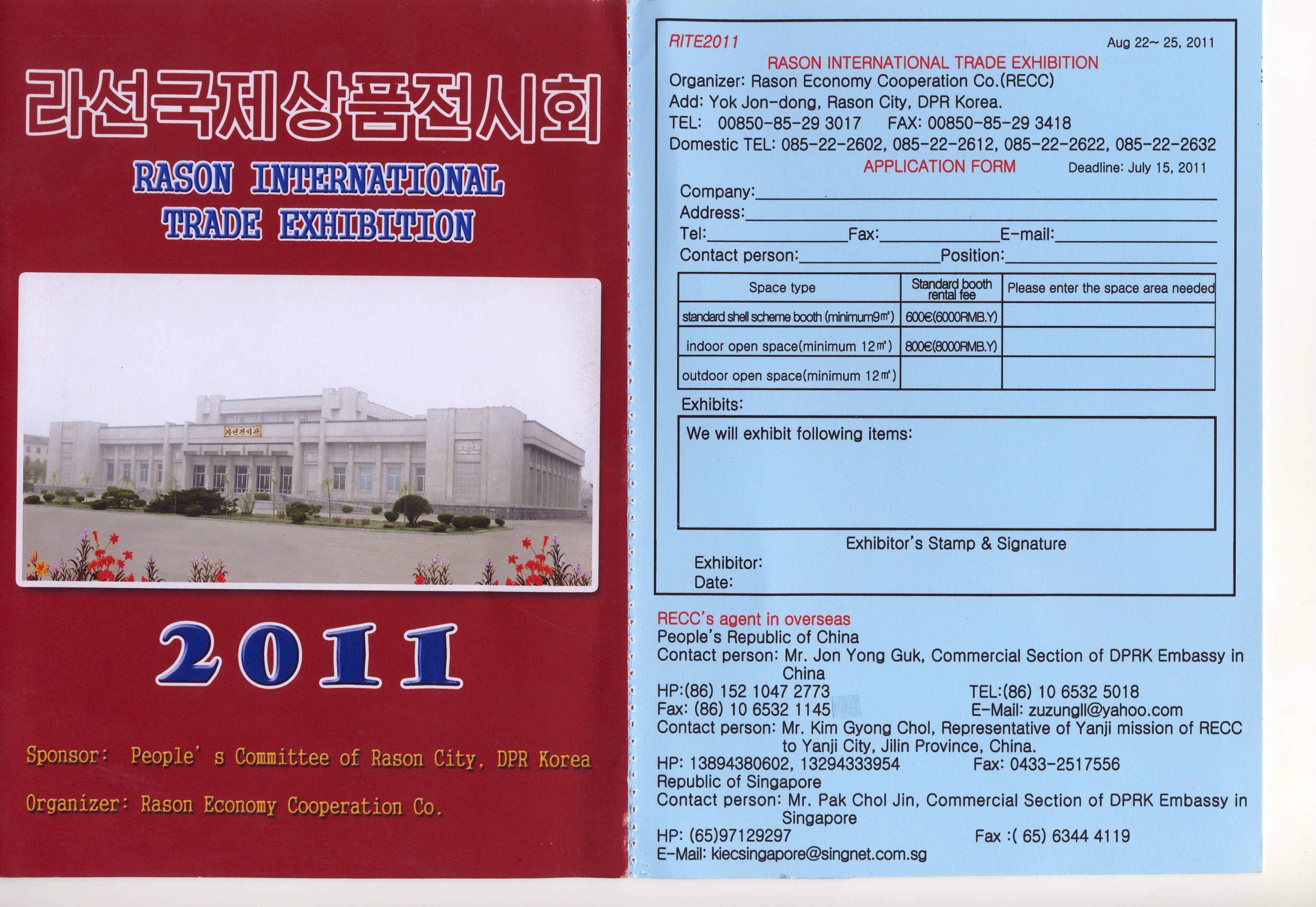
Also, a reader sent in this promotional flyer which is full of information on the trade fair:

See images of the flyer here: Part 1, Part 2, Part 3.

Video footage of the trade fair can be seen here.

UPDATE 1 (2011-8-17): The First “Rason International Product Exhibition” to be Held in Rajin-Sonbong Special Economic Zone
Institute for Far Eastern Studies (IFES)

Rajin-Sonbong or “Rason Special Economic Zone” is a co-development project developed by North Korea and China. The Rason SEZ International Product Exhibition is scheduled to take place from August 22nd to 25th — an exhibition targeted to attract foreign investors to the region.

According to the KCNA article released on August 14, “The exhibition will display a wide array of items from various countries including vehicles, pharmaceutical and clothing products.” It was said that the exhibition promises be an important event to encourage cooperation and exchange with various countries in trade, economic and science, and technology sectors.

This event is expected to not only bring Chinese but also European and other foreign companies into the economic zone, pushing investment into the area.

There is also talk of developing Rason into an international tourism zone to attract tourists from China, Russia, and Japan.

After the closing ceremony of the exhibition, visits to Rajin Harbor, Mangyongbong ferry, and the amusement park are scheduled in order to provide sightseeing tours for the participants to the exhibition.

Mangyongbong ferry, well-known in the past for transporting North Koreans living in Japan back to North Korea, is gaining special attention itself as a new tourist attraction. This cargo-passenger ferry is expected to be utilized further for tourism in the near future, including bringing Chinese tourists from Dairen and other harbors in China to Nampo Harbor close to Pyongyang.

In the late 1950s, Mangyongbong ferry began to shuttle North Koreans in Japan from Niigata Harbor to Wonsan Harbor near Pyongyang. From 1984, it was used to transport cargo into Japan, but this was halted in 2006 due to economic sanctions against North Korea which followed in response to North Korea’s missile and nuclear tests.

There are two ferries in North Korea with the name Mangyongbong. The Mangyongbong-92 will be introduced in Rajin Harbor to maximize the demonstration effect. The Mangyongbong, weighing 3,500 tons, is much smaller and older and inadequate to be used as a ferry.

The Mangyongbong-92 was built in 1992 to commemorate the 80th birthday of Kim Il Sung. The ship was built with funds collected from Chongryon (i.e., the General Association of Korean Residents in Japan). It was estimated to cost over 4 billion JPY at the time, weighing about 9,700 ton with a capacity to hold 350 passengers.

On another note, the fourteenth annual Pyongyang Spring International Product Exhibition held this May hosted over 280 companies from 10 countries. 100 Chinese companies participated in the exhibition. Since then, Chinese corporations from Liaoning and Dandong are reported to have placed contract orders worth 800,000 USD.


ORIGINAL POST (2011-8-15):

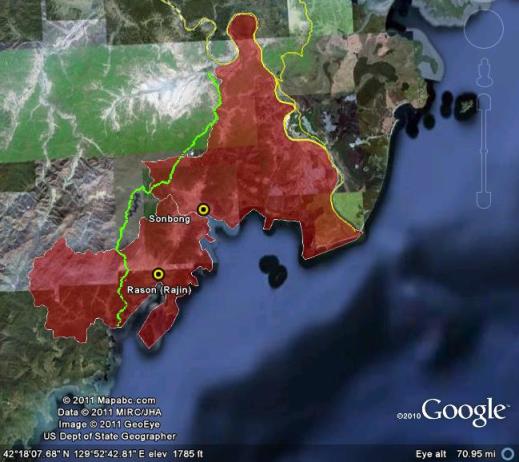
Pictured above (Google Earth): Rason geographic border (in red) and security perimeter fence (Yellow).

According to KCNA:

First Rason International Trade Fair to Be Held

Pyongyang, August 14 (KCNA) — The first Rason International Trade Fair will be held in the DPRK from August 22 to 25.

Vehicles, medicines, garments, etc. presented by companies of different countries and regions including the DPRK will be displayed at the fair.

The fair will contribute to boosting cooperation and exchange among countries and regions in fields of trade, economy, science and technology.

The DPRK is no stranger to trade fairs. By my calculations, the DPRK has hosted the Pyongyang Spring International Trade Fair since 1998 and the Pyongyang Autumn International Trade Fair since 2005. These events, which draw vendors from across the planet, are held at the Three Revolutions Exhibition in Pyongyang.

This is the first trade fair of which I am aware that is being held outside of Pyongyang. The Rajin-Sonbong area was the site of the DPRK’s first experiment with special economic zones. Although it did not generate the expected level of interest, North Korean authorities are hoping that this time around they will be able to capitalize on their proximity to the Chinese market (see here and here).

Additional Information:

1. Previous posts on Rason here.

2. Previous Posts on the Pyongyang International Trade Fair here.

3. The Chinese have been upgrading the road that links the Rason port with the Chinese border.

4. A few days ago I posted a preliminary list of DPRK trade companies published in Foreign Trade magazine. I imagine that more than one of them will have a presence at the trade fair.

Share

Rice price increasing in northern provinces

Wednesday, October 19th, 2011

According to the Daily NK:

New information suggests that the price of rice across North Korea now stands at more than 3,000 won per kilo, the highest market price since the currency redenomination of November 2009.

A source from Yanggang Province told The Daily NK on Friday, “The price of a kilo of rice has finally hit 3,000 won, having been only 2,600 won at the start of October. The won has gone down against the Chinese Yuan too, with one Chinese Yuan worth 515 North Korean won.”

Yesterday, a source from Sinuiju revealed that the cost of rice there has also risen to 3,000 won a kilo, saying, “People are bewildered as to why the cost of food has gone up so much, even though even the corn harvest has been gathered.” Sinuiju is always among the cheapest place to buy rice in North Korea due to its proximity to the major Chinese trading city of Dandong.

The situation is particularly surprising because the arrival of the autumn harvest would ordinarily be expected to drive down grain prices, or at the very least hold them steady. However, this year has seen poor weather feed concerns over crop yields, leading to rising prices throughout August and September. The average price in July, 2,000 won, was 2,500 won by late August. The exchange rate for Chinese Yuan has also been rising.

Some are predicting that the price fluctuations will level off with the end of the autumn harvest, while others believe that prices will simply move with the exchange rate, meaning greater uncertainty.

Read the full story here:
Rice Price Spike Defying Expectations
Daily NK
Kang Mi Jin
2011-10-15

Share

Hamhung traders taxed to fund Pyongyang construction projects

Tuesday, October 18th, 2011

According to the Daily NK:

The North Korean authorities in Hamheung are demanding 150,000 won from each trader in local markets to support construction projects in Pyongyang, according to a source from the city.

“Since the start of October, Hamheung Municipal People’s Committee has been taking money from market traders on the premise that ‘You have to give material support to Pyongyang construction workers,’” the source told the Daily NK today. “In the case of traders in the markets in Hoisang and Sapo, they are being asked for as much as 150,000 won each.”

Hamheung is the most famous industrial city in North Korea, and as such has larger markets than many other places. Thus, given that each of the two markets mentioned by the source has more than 500 traders, if the authorities were to reach their goal figure then they would be able to take 75,000,000 won from each one.

However, the Market Management Office for each market already receives 300-500 won per day from traders in the form of a ‘stall tax’, with sellers of home appliances and other high priced goods paying 500 won and those who sell food only paying 300 won. Thus, 150,000 won represents a huge cost, and many traders are apparently reacting to the demand with incredulity.

The source also noted that this does not appear to represent a central Party directive, with only traders in South Hamkyung and Yangkang Province having been hit by it to date.

“In Hyesan Market in Yangkang Province, it is 100,000 won per trader,” the source revealed, adding, “It seems like a case of the provincial Party preparing funds to support Pyongyang construction by taking money from traders.”

Elsewhere, although traders are now angry at the demand for funding, everything else is good, with official market controls being very lightly implemented at the moment, according to the source.

“The market is open from morning to night, and with the exception of the usual crackdowns on grasshopper traders there are no notable inspections,” he revealed.

But then, he added sarcastically, “They are taking money from the market as if it were some kind of state industry, so maybe that’s why they are leaving it alone.”

Read the full story here:
To Hamheung Traders: 150,000 Won for Pyongyang!
Daily NK
Lee Seok Young
2011-10-18

Share

Plans for SEZ between China and the DPRK to Come Out at Year’s End

Thursday, October 13th, 2011

Institute for Far Eastern Studies (IFES)
2011-10-5

Dai Yulin, secretary of the Dandong Committee of the Communist Party of China, said in his interview with the China Daily on September 28 that concrete plans for the joint development projects between China and North Korea in the Hwanggumpyong and Rajin-Sonbong regions will be announced at the end of the year.

This past June, Dai stated both countries agreement to jointly develop Hwanggumpyong and Rajin-Sonbong as an economic development zone and reported smooth progress in its plans.

According to Secretary Dai, “The joint management committee between China and North Korea has already been formed to promote the Hamggumpyong development project. Both countries are getting up steam to advance the project.”

In addition Dai explained, “China has secured 10 square kilometers of national land to be used to support the joint development of Hamggumpyong.” He also added, “A think tank comprised of 72 experts was also established to advise and buttress the project.”

When DPRK Cabinet Premier Choe Yong Rim visited China last month, Dai commented, “Choe’s visit to China is underlined with North Korea’s strong interest in economic reform. All the high level officials in the economic sectors accompanied him on the trip.”

While visiting China for five days, Choe met with Premier Wen Jiabao and expressed strong motivation for strengthening trade and cooperation with China, especially to improve its infrastructure. He stated, “For those Chinese companies investing in North Korea, we will provide special accommodations to encourage more investments.” In response, Wen Jiabao commented, “China will do all it can to support North Korea, so that they may seek development method most appropriate for them.”

After the meeting between the two top officials, the two nations came to an agreement to cooperate in trade, investment, and infrastructure, resources and agriculture development.

Prior to meeting with Wen, Choe visited Lanxing Chemical Industrial Machine Co. After he paid his courtesy visit to President Hu Jintao of China in Beijing, he continued to make economic related visits to Baoshan Steel Group, Bailian Xijiao Goods Purchasing Center, and industrial facilities in Jiangsu Province.

After North Korea designated Hwanggumpyong Island as a free trade zone, China has signed a 50 year-lease agreement to develop the island. Despite being a “joint development” in name, in actuality, China has the exclusive development rights based on Chinese capital.

However, North Korea is requesting for revision of the name to “co-development between China and the DPRK,” a request that China is expressing some uneasiness over. The initial agreement was to “lease Hwanggumpyong Islands to China,” which gave exclusive and autonomous development and management rights to China in the zone.

China has articulated on many occasions the Hwanggumpyong project must be strictly based on market principles and expressed apprehension that Chinese businesses may be unwilling to invest in the area if North Korea continues to pursue to change it as a joint development.

Share

GPI launching November DPRK business delegation

Wednesday, October 12th, 2011

In an email from Paul Tija:

In the current financial and economic situation, companies face many challenges. They must cut costs, develop new products and find new markets. In these fields, North-Korea could be an interesting option. It is opening its doors to foreign enterprises, its labor costs are the lowest of Asia, and its skilled labor is of high quality. It established free trade zones to attract foreign investors and there are several sectors, including textile industry, agro business, fishing, shipbuilding, logistics, mining/rare metals and Information Technology that can be considered for trade and investment. Most of the North-Korean trade is currently taking place with its neighbours and the amount of production of the South-Korean factories in North-Korea continues to increase. The trade between North-Korea and China jumped from US$1,97 billion in 2007 to $3,47 billion in 2010. A growing number of European firms are exploring the country as well – for example companies currently producing in China, and where the wages are rising fast.

In early November, I will lead a Dutch business mission to North-Korea (already fully booked), but a second mission will take place as well, from 13 – 19 November. Do you want to explore new business opportunities for your company? Then join me on this unique trade and investment mission. The program includes individual matchmaking, company visits, network receptions and dinners. Furthermore, we will meet European business people who are working and living in North-Korea. At the beginning of the tour, in Beijing, we will take part in the seminar: “Doing business with DPRK” (tentative). After the trip to Pyongyang, we will return to Beijing, where you can take a connecting flight or extend your stay in China.

The program of this mission has been attached. In case you are interested to participate: please contact us as soon as possible, so we can start the visa-application procedure. If you are not able to join, then it is also possible for us to do marketresearch and to take part in local meetings in Pyongyang on your behalf.

See the Brochure and itinerary here (PDF).

With best regards, Paul Tjia (director)
GPI Consultancy, P.O. Box 26151, 3002 ED Rotterdam, The Netherlands
E-mail: [email protected]
tel: +31-10-4254172
fax: +31-10-4254317
Website: www.gpic.nl
Twitter: twitter.com/PaulTjia
LinkedIn: nl.linkedin.com/pub/paul-tjia/1/445/958

Share

South Korea to allow firms to resume Kaesong construction

Tuesday, October 11th, 2011

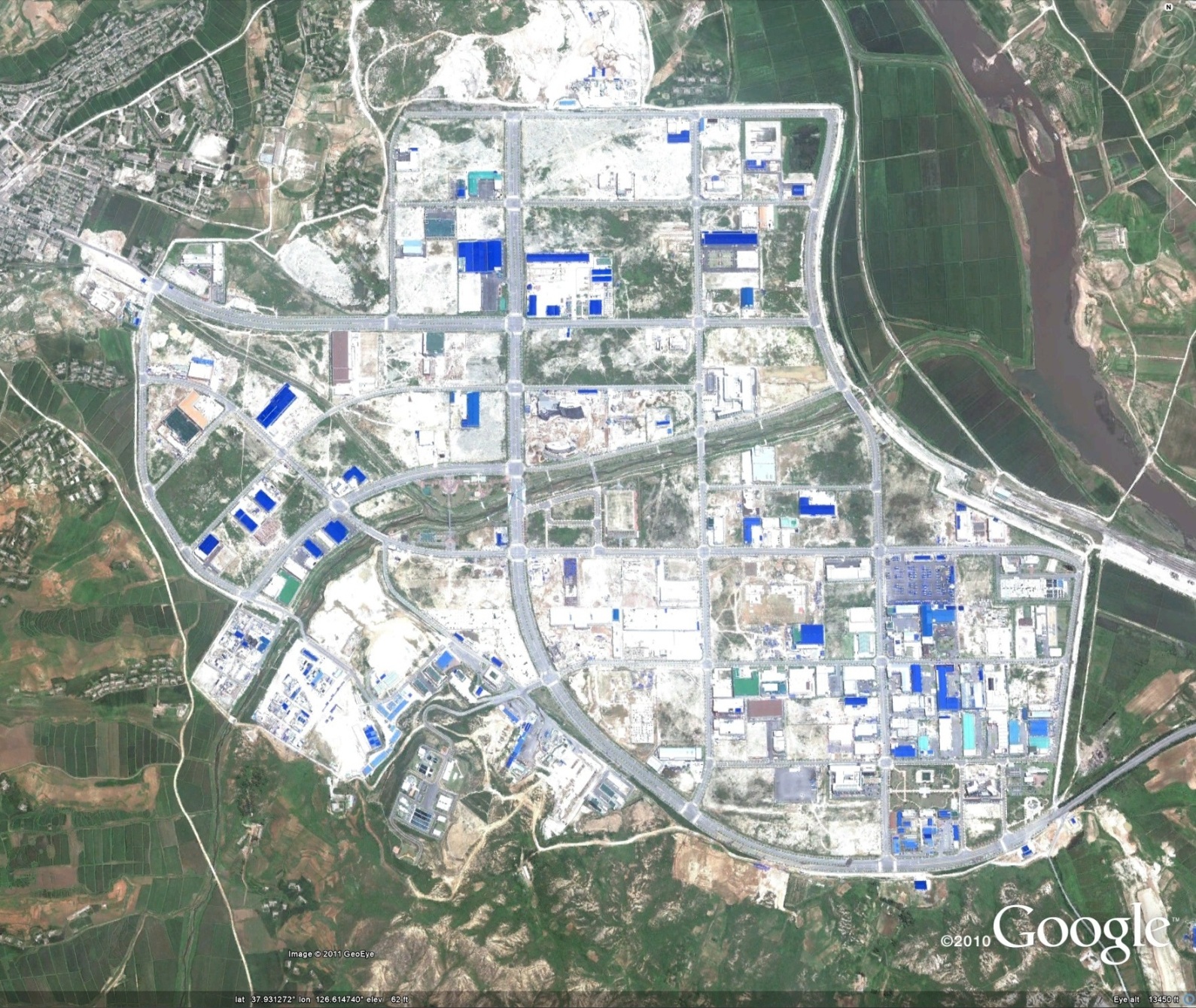
Pictured above (Google Earth): Kaesong Industrial Zone (Sept. 2009)

According to Reuters:

South Korea said on Tuesday it will allow 120 of its firms to restart building a joint industrial park with North Korea, a fresh sign of tensions between the rival countries easing.

Construction of five factories can resume, and work to build seven new ones can go ahead, South Korea’s Unification Ministry said, 17 months after stopping activity in protest at what the South said was an attack by the North on one of its ships.

The South Korean firms employ about 46,000 North Korean workers at the Kaesong industrial park to make clothes, utensils and watches, taking advantage of cheaper labour and property than is available in the South.

According to the Choson Ilbo:

[The Ministry of Unification] will also build a fire station and hospital at the complex, repair a highway linking the city of Kaesong with the industrial complex, and add 45 buses to shuttle North Korean workers to and from the facility.

Previous posts on the Kaesong Zone can be found here.

Read the full story here:
S.Korea allows work at factories in North to restart
Reuters
2011-10-11

Share

DPRK courting Coca Cola?

Wednesday, October 5th, 2011

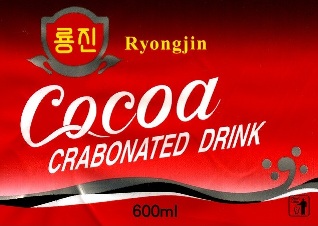
Pictured above, the DPRK’s local cola logo. Image source here.

UPDATE 1: Stephan Haggard believes this is a non-story.

ORIGINAL POST (2011-10-5): According to Forbes:

Global capital is an inherently lonely trade, but as Gabriel Schulze ambles into the conference room of Yanggakdo International Hotel, a towering edifice separated by a ring of water from the rest of Pyongyang, the most impenetrable capital in the world, it’s hard to imagine a more isolated business meeting.

“We warmly welcome you, the Coca-Cola delegation, with Mr. Schulze as your leader,” says Park Chol Su, the president of North Korea’s Taepung International Investment Group, singling out the 6-foot-7 American from his entourage of four people. “I hope this will be a good opportunity to make progress in the relations between the U.S. and Korea.”

Why is a U.S. businessman in Pyongyang pitching America’s most iconic consumer brand to the world’s most inhospitable marketplace? Because, surprisingly, the Democratic People’s Republic of Korea is ready to buy, and eager enough to flex its atrophied capitalistic muscles that it let a FORBES reporter follow along–and record everything–as the Coca-Cola discussions heated up.

Park says his Taepung Group, established by Kim Jong Il himself, wants to bring market principles to a planned economy, even down to setting what price a bottle of Coke made in Pyongyang would go for–sort of. “Costs are based on the demands of the market, but we will respect your price,” Park tells Schulze’s delegation. “If the price is too high, it will be restricted.”

North Korea, the most hidebound and repressive of socialist states, is slowly inviting not only China but also the wider Western World to invest in its near-moribund economy. Officials claim the country is open for business with outsiders, and that the political stripes of the investors do not matter as much as the money in their pockets and the willingness to deal. Chinese companies have signed a number of multimillion-dollar deals to extract resources and build and repair infrastructure, such as making port improvements in the northeastern region of Rason and paving a road from there to the Chinese border. Taepung also claims to have inked billiondollar contracts, including one to develop a huge coal mine, but those deals haven’t been nailed.

American signature brands may actually be most welcome, despite or perhaps because of decades of propaganda casting the U.S. as the devil incarnate. Pyongyang’s economic representatives made clear in this and other meetings, with focus and determination, that they want Yum Brands to open up KFC franchises.

Extreme wishful thinking though this may be, it’s linked to a planned ten-year revamp of the North Korean economy to expand national GDP from a meager $30 billion last year to $1 trillion by 2020. (The country can’t even feed its people; there is severe malnutrition in the countryside.) That all but impossible goal cannot be approached without an unshackling of enterprise, which may never occur, and massive help from the outside world, which may never come. The expression “reform and opening,” so familiar in China, is not yet politically acceptable language in Pyongyang. But North Korea’s courtship of the West has begun.

“Coke is strategic. I hope that Coke will serve as a bridge for relations between the two governments,” says Park, a slight man with a toothy smile and a taste for liquor, over a traditional Korean hot pot lunch and beer. Then, perhaps, sanctions could be lifted and more substantial investments could follow. “The door will be open to the whole world, not only China–even the U.S., even Western countries.”

But so far the West hasn’t come calling. North Korea remains in the dysfunctional totalitarian grip of Kim Jong Il. The regime is a defiant nuclear provocateur linked to proliferating weapons, drugs and counterfeit cash abroad, while operating a terrifyingly effective police state at home. Western companies will require more than the usual amount of persuasion. They will want something the North Koreans can’t possibly provide: a blessing from the White House.

That’s where Gabriel Schulze, scion of the Newmont Mining fortune, with a prospector’s taste for risk and opportunity, comes in. He has been surveying this forbidden market on the strength of informal connections to Coke and one of its bottlers, SABMiller, without either company’s toplevel approval–a Cold War-style mission that affords the higher-ups plausible deniability.

SABMiller sent a regional executive, at Schulze’s invitation, to the May meeting with Taepung Group, adding in a statement for this story, “We have no plans to invest in North Korea.” Coke turned down a request from Taepung Group (via Schulze) to visit this summer, and distanced itself from the remotest hint of soft-drink summitry with this statement: “No representative of the Coca-Cola Co. has been in discussions or explored opening up business in North Korea.”

Coke’s skittishness is striking from a company with a history of selling into almost any market–including such villainous or pariah states as Hitler’s Germany in the 1930s, Franco’s Spain and Pyongyang’s historical sponsors, China and the Soviet Union, in the 1980s (though Pepsi got to the Soviet Union first). North Korea is one of the last frontiers. “That is your task, to become a pioneer,” says Jang Gwang Ho, the senior North Korean official in the coterie greeting Schulze’s group.

Tall, blue-eyed and devout, Schulze is full-blooded pioneer. The great-great-grandson of Newmont founder William Boyce Thompson, he runs a family investment office out of Beijing, Schulze Global Investments, which specializes in China and difficult emerging markets.

While he has close ties to Republicans in U.S. politics, Schulze’s forays abroad, such as a cement plant in Ethiopia, are far from conservative. Schulze Global seeks “double bottom-line returns,” he says, profiting while helping poor emerging markets develop. Bringing Coke to North Korea would be historic, but he knows engagement with Pyongyang might be seen as a folly back home, both financially and politically.

“We understand that there’s a high likelihood that there could be all sorts of trouble and that we could end up losing money,” Schulze tells me after his trip. “There’s a lot of [U.S.North Korea] mistrust, there’s a lot of gamesmanship, and for us it’s not about pretending that that’s not there. We’re not in a little bubble of happiness.”

Would it even be legal for Coca-Cola to do business in North Korea, given international and U.S. sanctions? Those sanctions have proven to be narrow and permissive in practice, and there is no stricture against soft drinks (a sip of CocaCola is already imported, mostly from China, and sold to the few with disposable hard currency).

Hundreds of foreign businesses, most of them Chinese, have come into North Korea despite cautionary tales of investments gone bad, of officials changing the terms or the rules, soliciting bribes, demanding substantially higher payments or expropriating joint ventures.

And these businesses have made money. In a 2007 survey of 250 Chinese operations in North Korea, scholars Stephan Haggard and Marcus Noland found 88% saying they could turn a profit. (A majority also reported paying bribes.) Enterprises routinely encounter difficulties, yet many persist, hopeful for economic liberalization.

At least one American investor has profited in North Korea as well: Schulze Global. Three times in 2008 it made loans of hundreds of thousands of dollars to mining companies to buy equipment and expand, and each was repaid. This summer Schulze lent an additional $1 million to finance a North Korean conglomerate’s purchases of corn to feed its workers. (He consulted with sanctions lawyers in America before making the loans and has filed notices with the U.S. Treasury Department.)

“That opened the doors” to the Coke project, Schulze says. Making the world’s favorite carbonated beverage in Pyongyang would be quite another matter, though. The country still operates on a planned economy and has difficulty even manufacturing plastic bottles and cans. The government barters for sugar from Castro’s Cuba and would probably have to import steel to build a Coke factory. And although the estimated per capita income is $1,200 a year, the Coke factory’s workers would be paid barely more than a dollar a day (low wages are a key selling point to foreign investors). Further, the nation is plagued with persistent food shortages that force the regime to rely on international aid. Does a country this poor have consumers for the iconic American drink?

The answer is yes, at least in the capital. Home to the privileged upper crust, or an eighth of the nation’s 24 million people, Pyongyang has a visibly robust elite economy. The city’s wide Stalinist thoroughfares, bereft of private automobiles five years ago, are now filled with tens of thousands of foreign cars, including American and Japanese brands.

Mobile phone use is common, with more than 300,000 accounts in the capital using the 3G network built by Egyptian telecom Orascom. That includes some of the city’s traffic women, famous for white gloves and powder-blue uniforms. With traffic lights now doing most of their work for them, one was spotted on the sidewalk jabbering into her cellphone.

The city’s new Pothonggang Department Store was fully stocked with imported fare to be had at prices in North Korean won that are affordable only at the black-market exchange rate (2,500 won to the dollar at the time, compared with the official rate of 100 won). Name brands like Heinz Ketchup (the equivalent of $4 a bottle), Mars bars (a little more than $4 per bag) and all manner of high-end liquors and cigarettes are on offer, usually imported from Europe or Asia. On another floor you can find imported sweaters, dresses and shoes.

The checkout lines run briskly in midafternoon, the shopping done mostly by women, many of them likely the wives of government officials and army officers. (Kim Jong Il showcased the store with a visit in December.) Out on the streets the proles shop for snacks and locally made sodas–typically fruity concoctions in glass bottles–at hundreds of kiosks throughout the city, mostly priced at the black market rate of 20 cents to 40 cents.

Those prices would be 25 times higher at government exchange rates and thus out of reach for almost all North Koreans on their official salaries–but hard currency is flowing into the capital, “through this and that channel,” Jang says, and is spent. “Although officially they are not receiving the salaries from the government in hard currency, they have! So they like to spend the hard currency for their children because the children like to drink the Coke,” he explains.

Jang, of course, is not a commoner or for that matter a typical North Korean apparatchik. He speaks fluent if idiosyncratic English, was educated partly in the U.K. and is married to a doctor. First vice president of Taepung Group, he has a dual appointment on a government body overseeing economic development. Over two days of meetings Jang exudes an almost relaxed air of detachment. He typically parries questions with humor and stories while puffing on Dunhill cigarettes and flashing a Longines watch. (The president of Taepung, Park Chol Su, is a Chinese national, chosen in part for his Chinese contacts and experience.)

Do North Koreans like to drink beer? asks Anton van Heerden, a South African who runs SABMiller’s Asian supply chain. Yes, especially a growing cadre of retirees. “I can see so many old men, over 60, normally in the evening if we look around the city, they are making a queue to buy the beer,” Jang says, adding with a laugh: “There are crazy people! A lot of people drink the beer–30 bottles in the evening! I don’t know how.”

Friendly though they are with Schulze, Jang and Park both make clear that they answer to a higher power, the leader they refer to only as “the top man,” “the General” or the “Dear Leader”: Kim Jong Il. Park was born to Korean parents in northeastern China in 1959, as Kim Il Sung’s regime recovered from the Korean War. Park built relationships with North Korean officials by selling them much-needed gasoline in the 1990s. He is a salesman again, puffing up his chest as he blusters about the will of the General to change North Korea’s economy, led by his Taepung Group.

Parse the bombast and you get a rare glimpse inside the complexities of power relationships. Park says he has never met the top man and instead takes his instructions from a close Kim confidant, 73-year-old Kim Yang Gon, who is chief of the United Front Department, an intelligence arm of the Korean Workers’ Party, and chairman of the Taepung Group. Still greater power at Taepung likely lies with another member of the board of directors, Kim Jong Il’s brother-in-law Jang Song Taek, who as vice chairman of the National Defense Commission is considered North Korea’s second-most-powerful man. The National Defense Commission, chaired by Kim Jong Il, is also Taepung’s controlling shareholder.

To some Western analysts the tight control of Taepung signals that Kim’s coterie is not an agent of change and reform but precisely the opposite–a means to tighten its grip over the North Korean economy. The reasoning: Kim wants Taepung to bring in multibillion-dollar deals for resources, power plants, ports and roads, they say, so that he and his cronies can control the spoils.

Schulze hears the skeptics. But he notes that a Coca-Cola investment would be far more symbolic than lucrative. The total ante probably wouldn’t exceed $10 million (with Schulze Global’s share at $2 million)–tiny by comparison with some resource deals. He also argues that the only realistic way to engage with North Korea is precisely through those in power. “People say this is the leadership looking to benefit itself, and I would say yes, that is absolutely true.” But, he adds, “it doesn’t negate the fact that selfish ambition can still drive positive change and development, particularly in the economy, which can make a real difference in the lives of North Koreans.”

His groundwork laid in North Korea, Schulze will continue his quixotic quest to lobby not only Coke but also Capitol Hill and the Obama Administration. He is, in a way, following in the footsteps of his great-great-grandfather Thompson, the mining magnate. Thompson shocked his friends in the business establishment when, after returning from Russia after a trip in the fall of 1917, he urged that the U.S. and Britain engage with the new communist regime there to moderate the impulses of Lenin and Trotsky. No one, obviously, followed that advice.

Read the full story here:
Invading North Korea
Forbes
Gady Epstein
2011-10-5

Share

DPRK expanding Chinese tourism to Kumgang

Monday, October 3rd, 2011

According to Yonhap:

North Korea is expanding travel routes between China and its scenic resort in Mount Kumgang, a source familiar with the North said Monday, indicating Pyongyang’s continued efforts to earn much-needed cash from Chinese tourists.

The new routes will include extra flights from Chinese cities to Mount Kumgang on North Korea’s east coast, in addition to trains and expressways linking Beijing to the mountain resort via Pyongyang, the source said on condition of anonymity.

The move comes after North Korea recently ran a trial cruise from its northeastern port city of Rajin to Mount Kumgang.

The source also said more than 100 Chinese tourists traveled to the resort on a five-day itinerary at the end of last month.

By the end of this month, North Korea is planning to launch a tour program to Mount Kumgang from China’s northeastern city of Harbin, although it is not clear whether the flight will land in Pyongyang or at a military airport on the mountain, the source said.

North Korea is reported to be considering converting a military airfield near the resort to a civilian airport to facilitate travel to the area.

“Starting with Harbin, (North Korea) plans to operate flights for Mount Kumgang from 16 cities across China, including Beijing, Shenyang and Guangzhou,” the source said.

“They also plan to attract Chinese visitors by opening a railway and expressway linking Beijing, Pyongyang and Mount Kumgang,” the source added, saying the first train tour on the route will likely be in April.

The move comes amid a dispute over the handling of South Korean assets at the resort. Seoul halted an inter-Korean joint tour program to the resort in 2008 following the shooting death of a South Korean tourist in the area.

In protest, North Korea recently expelled South Korean workers from the resort and vowed to legally dispose of all South Korean assets there. The tour program had served as a cash cow for the impoverished North.

South Korea has asked foreign countries not to invest or engage in tourism activities at the resort in a bid to protect its property rights there.

Previous posts on Kumgang here.

Read the full story here:
N. Korea expands travel routes for Chinese tourists: source
Yonhap
2011-10-3

Share