Archive for the ‘Economic reform’ Category

On the DPRK’s growing use of markets

Wednesday, September 28th, 2011

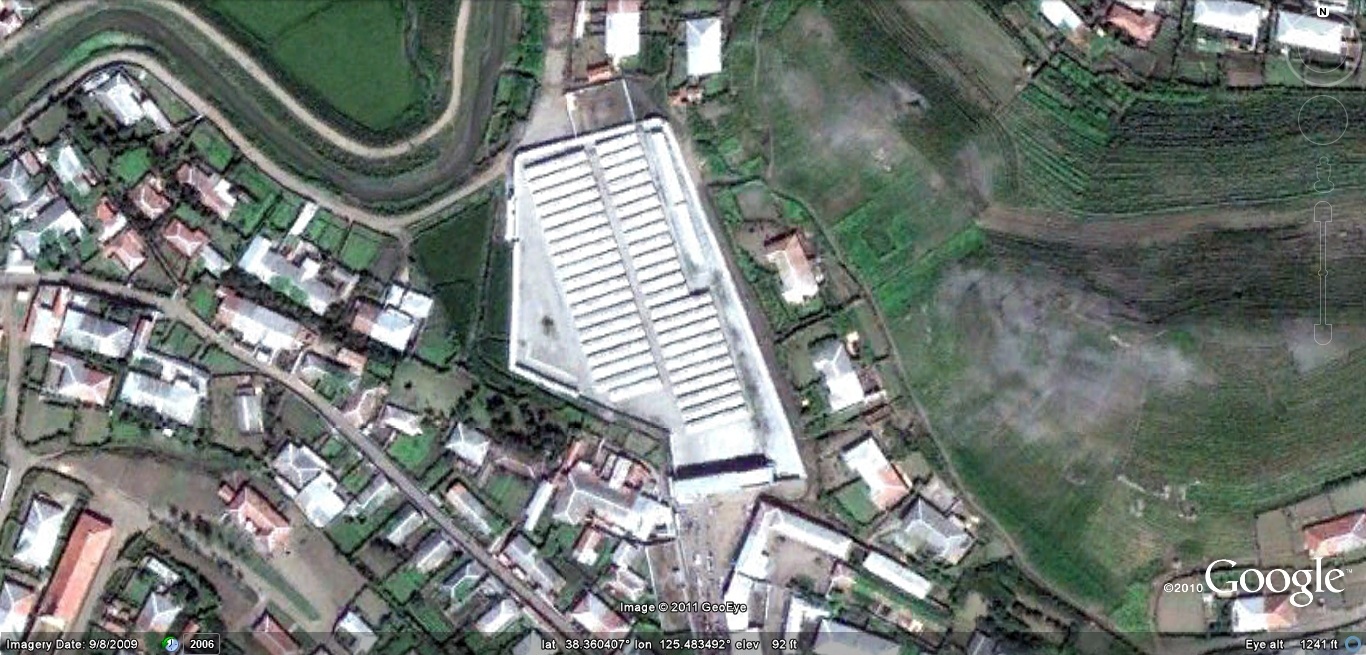
Pictured above (Google Earth): A street market in Rakrang District (락랑구역), Pyongyang.

According to the Korea Herald:

A market economy and new business class have emerged in North Korea since the 1990s even though their government will not acknowledge it publicly, a panel of experts said Wednesday.

Speaking at a luncheon hosted by the Center for Free Enterprise in Yeouido, Seoul, professor Andrei Lankov of Kookmin University said that the populace was forced into adapting to a new market economy after the fall of the Soviet Union in 1991.

Following the collapse of its main benefactor, there are sources that suggest that the North’s industrial output was halved by 2000 compared to what it had been in 1990, and that half a million to 1 million North Koreans perished, he said.

Unlike in former communist countries where the government chose to adopt capitalism or the people demanded it, “in North Korea it was just a way to stay alive,” he said.

“Only top officials survive on salary,” he added.

Walter Klitz of the Friedrich Naumann Foundation for Liberty said that in his periodic visits to North Korea he has seen the effects of the new market economy on the populace, as those in some rural areas of the nation are relatively well off.

“They don’t have a food problem, they have a distribution problem,” he said. Furthermore, he has witnessed traffic jams in urban areas apparently spurred by increased economic activity, something unheard of just a few years ago.

This also indicates that sanctions imposed on the North have been bypassed, particularly through increased investments from China.

The increase in this market activity, however, does not mean that the nation is no longer a planned economy, as the main institutions are still in place, they said. For example, laws against activities such as traveling outside of one’s home county or exchanging foreign currency are no longer enforced.

The North Korean government attempts to contain such market activity, but no longer attempts to clamp down on it since the botched currency reform of late 2009, Lankov said.

Furthermore, the presence of this new business class ― primarily made up of women because men are required to keep up appearances at their state-approved jobs ― does not mean the nation is more prepared for reunification than before. Lankov said that North Koreans who have succeeded in business would likely be swamped by competition for the South, and much of the nation would form a “permanent underclass” should unification take place.

“You would see much of North Koreans disadvantaged and never recover,” he said.

After each member of the panel made their remarks, they took questions from guests, with many questions relating to the succession process from current leader Kim Jong-il to his son and heir apparent Kim Jong-un.

Lankov said that he does not like to talk about succession often.

“I don’t know anything about Kim Jong-un, period,” he said. Whether or not he is more reform-minded than his father or grandfather, though, may not matter.

“His logic … will be much more defined by the political situation than by his own inclinations,” he said.

Another panel member was Donald Kirk, Korea correspondent for the Christian Science Monitor. In response to a question comparing the unification of the two Koreas to East and West Germany in 1990, Kirk called a comparison between North Korea and East Germany “fallacious.”

“East Germany was the most powerful economy in Eastern Europe,” he said. “It was not a starving country. It was certainly not a failed state.”

Read the full story here:
Signs of market economy in N.K. emerging: expert
Korea Herald
Rob York
2011-9-28

Share

DPRK looks to capitalize on high gold prices

Tuesday, September 27th, 2011

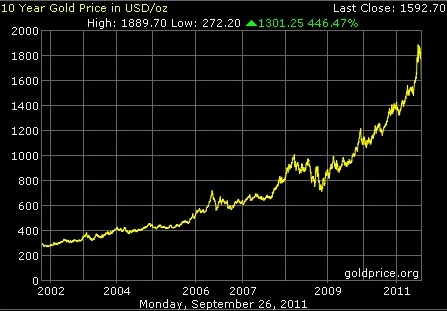
Back in 2002 the price of gold was approximately US$300/oz. Today it is closer to US$1,600/oz. Here is a chart:

The rapid increase in the price of gold is having a supply side effect of stimulating more gold mining across the planet, and North Korea is no exception.  Though the DPRK leadership has traditionally kept a watchful eye on the nation’s gold mines, reports began surfacing back in March that individual North Koreans were getting into the prospecting business:

Located at the base of Mt. Nokbong, near Hyesan in Yangkang Province, one particular village of 24 households saw its schools, public facilities and all other vestiges of welfare disappear following the construction of the Samsoo Power Station in 2004, which deprived the area of power.

And yet this village is now overflowing with people. They are here from all over the country, cramming homes and the nearby valley with one purpose in mind; searching for gold. Housewives, workers, university students, farmers, children, drifters, criminals, soldiers and bureaucrats; men and women alike from all different classes are living in this one place with the same aim.

The majority of people dig, without permission from the authorities and with only rudimentary tools. Their only wish is to avoid having to leave town and, hopefully, find some gold. The soldiers and bureaucrats, on the other hand, do not dig, instead using their authority to cream a share of others’ profits. (Daily NK)

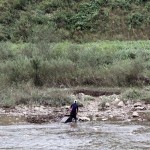
It appears that the gold rush continues to this day, though it may be a bit more organized, at least officially.  A recent visitor to the DPRK took the following picture:

The caption of the photo reads:

“There are hundreds of people working certain rivers in North Korea in what can only be described as a gold rush. The government is buying gold from people who work the rivers. This has expanded considerably from past years when dozens were working the rivers. In one area I saw heavy equipment used to mine the river. The guides explained what was going on yet I cannot help but think this is a form of individual capitalism since it is individuals and families doing the mining.”

I would be interested to know more about what mechanisms the DPRK is employing to manage (control) “spontaneous” gold prospecting–an industry that would be hard for any central authority to police (particularly a poor country with high levels of corruption).  Given the limited amount of information, I can conceive of  two broad institutional arrangements:

Option number 1: Individual families and/or groups are simply registering their “mining companies” as branch enterprises or subsidiaries of existing state owned enterprises and mines.  In this way they take on the legal protection of the state in exchange for some defined percentage of their output.  This is the way many de-facto private North Korean businesses are run.   Under conditions of weak oversight (likely), this would imply that substantial profits from mining can be retained at the lower levels of production (with the firm “owner” or the miners themselves).  Pyongyang would have to be policing the rivers pretty hard and effectively auditing all the enterprises involved if expected to see a substantial increase in revenue from these “spontaneous” mining operations.

Option number 2: The North Korean government has essentially set up a “gold board” that sets a single legal domestic price for the purchase of gold from its people (just as many [exploitative] agriculture boards are set up in developing countries).  The DPRK government would earn revenue by keeping the difference between the amount paid to the domestic miners and the international price at which it sells the gold abroad. This option might make more fiscal sense in a weak institutional environment because the only thing the DPRK needs to police really well is the Chinese border. Under this system, the government does not need to worry about who mines the gold (or where or how) since the “gold board” would ultimately be selling it abroad and retaining the earnings.

I have not heard anything about such and institution existing, however, so until I am told differently I am more inclined to believe that option 1 is being utilized despite its fiscal shortcomings. This would imply that the increase in gold prices will translate to a real increase in wealth for a number of “ordinary” North Koreans. Though the work is not likely to be long lasting, it will provide some with savings or potential operating capital for the next business idea down the line.

Are you aware of other options or do you have some specific knowledge on how the DPRK is managing (controlling) freelance prospecting and mining? Please let me know.

Share

Lankov on DPRK-Russian economic relations

Tuesday, September 27th, 2011

Andrei Lankov writes in the Korea Times:

In 2010, the volume of trade between these two countries was merely $110 million. As international trade goes, this volume is tiny. By comparison, in the same year North Korea’s trade with China was around $3.4 billion, some 30 times larger than its trade with Russia.

The reason for this inactivity is quite simple: Russian companies have no interest in dealing with North Korea. In the Soviet era, trade flourished because it was subsidized due to geopolitical concerns of Moscow. Currently, when it comes to pure economic considerations, North Korea has almost nothing to offer the new Russian economy.

North Korea has only two resources that can be sold on the international market. First, it has deposits of minerals (coal, iron ore). Second, it has a relatively large quantity of cheap labor ― or to put things in a less cynically capitalist way, there are millions of North Koreans willing to work for $10 a month.

But Russian companies are decisively uninterested in North Korean minerals. These mines may be attractive to resource-hungry China, but not to Russia, which has the riches of Siberia at its disposal. The chronic political instability in which North Korea is immersed is another reason which lessens Russian interest in North Korean minerals.

Cheap labor is more attractive, and indeed Russia has continuously used North Korean labor since 1967 but not in the North itself. Some Chinese companies began to outsource to North Korea, and built small factories there, in order to take advantage of the obscenely low local wages. This approach is not very attractive to Russia, since it is not a major player in producing winter parkas, wool hoods, or running shoes. Russian companies prefer to use North Korean workers inside Russia itself.

These workers are sent to Russia by the North Korean authorities and can be described as indentured labor. Their families are hostages who can be punished if a worker does something improper and the workers are also expected to ‘donate’ a significant part of their wages to the state. Despite these harsh conditions, one should not forget that these jobs are among the best paid regular jobs in the country. North Koreans compete for opportunities to become indentured laborers in Russia.

That said, the scale of these ventures is rather limited, as is the demand for cheap labor in the Russian Far East (the only part of Russia where the use of North Korean laborers really makes practical sense).

Aside from this, North Korea has something else to offer – its geographical location. This country blocks all land routes to the prosperous South. Russia has much interest in the South Korean market, especially when it comes to the sale of natural resources. Impeding this is the existence of North Korea, and the continued strained relations between the two Korean states, making sales of Russian commodities rather difficult.

So it is not incidental that the two most important potential projects are a railway and a gas pipeline. Both projects can hardly be described as “economic cooperation” between North Korea and Russia, since neither has much to do with the North Korean economy itself. North Korea, in these cases, is present merely as a space to be traversed. It would be no different if it were a dessert or jungle. Russia is willing to pay North Korea for facilitating Russia’s economic link with the South, and that is all.

So it is not surprising that an agreement on the pipeline construction was signed after the Russian-North Korean summit. This project is indeed acceptable to the North, since it will mean easy money for transit, it is favorable to Russia, and it will be good for the general situation since it will bind Russia, North and South Korea closer.

Yet, a word of caution is necessary. In spite of all official statements, we should not expect large-scale construction work to begin in the near future. The political risks remain huge, so it is likely that Russian companies will not rush headlong into the project. The recent agreement should rather be seen as a declaration of intent. In all probability, the trans-Korean pipeline and trans-Korean railway will be built eventually. But the completion of these important initiatives will probably take many, many years.

Read the full story here:
Russia-N. Korea Trade
Korea Times
Andrei Lankov
2011-9-25

Share

Lankov on measures of economic freedom in the DPRK

Friday, September 23rd, 2011

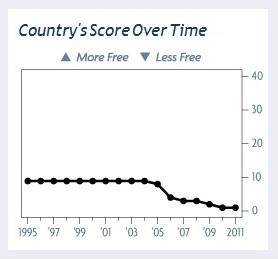
Pictured above: An annual index measure of economic freedom in the DPRK from 1995 to 2011, published by the Heritage Foundation’s and Wall Street Journal’s Index of Economic Freedom.

Andrei Lankov writes in the Asia Times:

[The] Heritage foundation and the Wall Street Journal recently published a new edition of their annual index of economic freedom, according to which North Korea has the world’s least-free economy. One can hardly argue about this – North Korea has for decades worked hard to take Stalinism to its logical extremes, and slightly beyond that.

However, one gets perplexed when looking at the grades of unfreedom that are given by the Heritage Foundation to the North through the 1995-2011 period. According to the index, the level of economic unfreedom in North Korea was essentially the same throughout the entire 1996-2005 period. Then, in 2005 it deteriorated considerably and has continued a slow downward slide until now.

This depiction is bound to raise the eyebrows of anyone who is familiar with actual economic trends in North Korea. The graph is correct when it says that the economy became more restrictive in 2005, when the government tried to re-introduce the rationing and reconfirmed the ban on the private sale of grain (such a ban had existed since 1957, but ceased to be enforced around 1990).

However, the 2005 measures were, essentially, a backlash, an attempt to reverse the half-baked reforms of 2002 – and those reforms can be described only as liberalizing.

On balance, the 2002 reforms should not be overestimated. Nonetheless, the 2002 reforms legalized a significant part of the black economy, and also granted managers of state-owned industrial enterprises a measure of managerial freedom they had not had for many decades.

If this was not an increase in economic freedom, what was it? But the Heritage Foundation graph does not give any hint of this change: the line that purports to depict the level of economic freedom remains on the same low level in 2002.

This is more interesting because 1997-2002 was when actual economic freedom increased dramatically. The old hyper-Stalinist laws remained technically effective, but nobody bothered to enforce these restrictions. It is estimated that in the early 2000s, the average North Korean family drew some 80% of its income from various market activities.

This was technically illegal, but the authorities were ready to turn a blind eye to the re-emergence of some form of a market economy, and in 2002 they even grudgingly and partially legalized the already flourishing market economy.

However, these improvements – both de-facto and, in 2002-2005 de-jure – find no expression in the flat line of the Heritage graph which, however, does not fail to notice that after 2005 the situation again began to deteriorate due to a government backlash against the private economy. The backlash was not particularly successful, but it lasted until 2009, and this is correctly reflected by the downward line at the graph.

However, then the graph begins seriously misleading again – and again, seemingly due the same implicit assumption that in North Korea things can go only from bad to worse. The graph depicts 2009 as a year when the level of freedom went even lower – and this is a correct assumption, since in 2009 the authorities undertook currency reform.

The reform’s main, if not sole, purpose was to annihilate the private economy that had survived the 2005-2009 backlashes surprisingly well. There is little doubt that North Korean decision-makers really want, above all, to revive the hyper-Stalinist economy that alone guarantees the regime’s long-term political stability (or so they – and the present author – believe).

However, the 2009 bold attempt to go back to the Stalinist ways ended in complete and pathetic failure – and the government, fearful of the chaos its inept reform created, backpedaled immediately.

The failure of the 2009 currency reform was followed by another wave of economic liberalization. In May 2010, the government lifted all restrictions and bans on private retail trade that were introduced in the 2005-09 backlash. In fact, the North Korean economy nowadays is roughly as free (or rather unfree) as it used to be immediately after the 2002 reforms. But there is no hint of this roller coaster changes in the slowly descending line of the Heritage Foundation Index.

The same is applicable to the economic situation. Every year, we get reports about a looming famine in North Korea – and this year is no exception. A quick look through headlines of major newspapers can clarify that such reports surface with predictable regularity every year.

In March 2008, the International Herald Tribune ran a headline “Food shortage looms in North Korea”. In March 2009, the Washington Post headline said “At the Heart of North Korea’s Troubles, an Intractable Hunger Crisis”. One year later, in March 2010, the Times of London warned: “Catastrophe in North Korea; China must pressure Pyongyang to allow food aid to millions threatened by famine.” In March 2011, The New York Times wrote: “North Korea: 6 Million Are Hungry.” The predictions of gloom come every year, but famine does not.

Actually, from around 2002-2003, we have seen a steady but clear improvement in North Korea’s economic situation. North Koreans are still malnourished, and likely to remain so for the foreseeable future. Nonetheless, they are not starving any more – at least not in significant numbers.

However, opponents of the regime cannot admit that people are not starving or report about (however marginal) improvement of the food situation, since, as I have said, from their viewpoint nothing can possibly improve in North Korea. At the same time, supporters of the regime will not admit that the North Korean people are still malnourished, and the regime itself is active in presenting exaggerated evidence of a looming famine (or perhaps, even fabricating such evidence when necessary) – as this will help it get more free food from the outside, and this is what Pyongyang needs.

One can see the same trends everywhere. For example, human-rights non-governmental organizations keep telling us about a further deterioration in the human-rights situation in the North. However, the evidence tells a different story. Human rights are still by far the world’s worst, but they are better than 20 or 30 years ago.

Just one example of this under-reported improvement will probably suffice. Until the mid-1990s, the entire family of a political criminal – that is, all people who were registered at the same address as he or she, were by default shipped to a concentration camp. Some 10 or 15 years ago, this approach ceased to be universal, so families of many political criminals – including some prominent activists based in Seoul – remained free.

There is little doubt that families are harassed, and even distant relatives of dissenters are denied good jobs and/or the right to reside in Pyongyang and major cities. Nonetheless, there is a great difference between inability to live in a major city and incarceration in what might indeed be the world’s worst prison camp system.

However, this change is seldom reported. Human-rights advocacy groups obviously cannot bring themselves admit that something can get better under the Kim family regime. Probably, they think that such admission would make the situation look less urgent and thus would help the Kim family regime in some indirect way. These worries might be even well-founded – but the result is the tendency to ignore a particular type of “politically incorrect” news.

Paradoxically, regime sympathizers – whose presence is especially noticeable among the South Korean left – are equally reluctant to attract any attention to these minor improvements. It is understandable, since we are talking about changes from the awful to the very bad, and Pyongyang champions cannot bring themselves to admit how brutal and inefficient the regime actually is.

For example, if pro-Pyongyang media outlets report that the “family responsibility” principle does not apply in many cases, they would have to admit that in the supposed “paradise” of national purity and/or anti-globalist determination in North Korea, not only dissenters, but their families as well were shipped to concentration camps until quite recently. No member of South Korea’s radical nationalist left could bring him or herself to admit this fact.

One cannot imagine a pro-North Korean leftist blogger in Seoul triumphantly writing something like this: “In the past, if somebody watched a South Korean melodrama, he would be arrested, beaten unconscious and then sent to prison for life together with his entire family. Nowadays, things are so better: only his teeth – not ribs! – are likely to be broken during an investigation, and then he or she will spend in prison merely a couple years, and his family are now allowed to keep their freedom. What an improvement!”

The sad irony is that this change is actually an improvement, but neither side of the political debate is going to report it. This is confirmation to the old truism: political passions make people oblivious to the obvious. However, propaganda is a poor substitute for honest and objective analysis – even when such propaganda is produced by people who believe it themselves.

Read the full story here:
It’s not all doom and gloom in Pyongyang
Andrei Lankov
Asia Times
2011-9-23

Share

Rajin-Sonbong Minimum Wage Set at 80 Dollars

Friday, September 23rd, 2011

Institute for Far Eastern Studies (IFES)
2011-9-21

The minimum monthly wage at the Rajin-Sonbong (Rason) Economic and Trade Zone has been set at 80 USD.

The Rason Economic and Trade Zone is a joint development project between China and the DPRK. Recently, a booklet on the “Tax Policy in the Rason Economic and Trade Zone” was published by Rason city’s tax bureau to introduce the zone’s tax policy to foreign investors. The booklet designates the monthly minimum wage for local employees at 80 USD.

The Rason Economic and Trade Zone Law was revised in January 2010, handing to local Rason authorities the jurisdiction to decide on the minimum wage for the North Korean workers working for foreign companies in the region.

With wages in China rising, Chinese firms are tending to look at Vietnam and Indonesia to build factories. The Rason Economic Zone is also becoming an attractive alternative, especially for those investors from companies situated in China’s northeastern provinces.

The monthly minimum wage at Rason will be 25.3 percent higher than the Kaesong Industrial Complex (KIC), which is set at 63.814 USD. However, the minimum wage at Rason still remains below half of the minimum wage of workers in China. According to the (South) Korea Trade-Investment Promotion Agency (KOTRA), the monthly minimum wage in China is 167 USD.

The booklet also provides detailed descriptions of tax related information in the Rason area.

For buildings obtained with one’s own funds, property tax will be exempted for five years. It will also be possible to make inheritance tax payments in installments, if it exceeds 20,000 Euros.

The corporate income tax rates range from 10 to 14 percent. Those companies that invest over 30 million Euros will be exempt from income tax for four years from the year they record a profit. Afterward for the next three years they will receive a 50 percent tax reduction. Other taxes such as sales and transaction taxes are set at 0.6 to 5 and 0.3 to 2.5 percent.

In addition, tax payments are permitted at banks and the tax bureau directly.

Kim Jong Il made a visit to Rason in 2009 where he announced to focus on three main sectors to revive the North Korean economy: manufacturing, transportation, and tourism.

According to a North Korean authority, “Investing in labor intensive industries will be profitable in many ways. Many Chinese and even Taiwanese textile companies are expressing interest in building factories in the Rason area.”

In addition, Rason authorities expressed future plans to attract businesses in the tools, shipbuilding, automobile, and high-tech industries, and are making great efforts to attract foreign investments to the area by promoting the zone’s geographical proximity to China and Russia, cheap labor, and tax benefits.

Additional Information:
1. Read more about the Rason tax and wage policies here.

2. Read previous posts on the Rason Zone here.

Share

DPRK rice price up

Friday, September 23rd, 2011

According to Yonhap:

The price of rice in North Korea has risen constantly over the past six months, reaching as much as 2,400 North Korean won (US$17.18) per kilogram early this month, South Korea’s Unification Ministry said Friday.

After falling to as low as 1,400 won per kilogram, rice prices started to increase in April and reached between 2,200 and 2,400 won by early this month, according to the ministry, which handles inter-Korean affairs.

Here is a compendium of stories about thie DPRK’s alleged food shortage and food aid this year.

Read the full story here:
Price of rice in N. Korea rises over past 6 months: ministry
Yonhap
2011-9-23

Share

New facts about the DPRK’s informal economy

Wednesday, September 21st, 2011

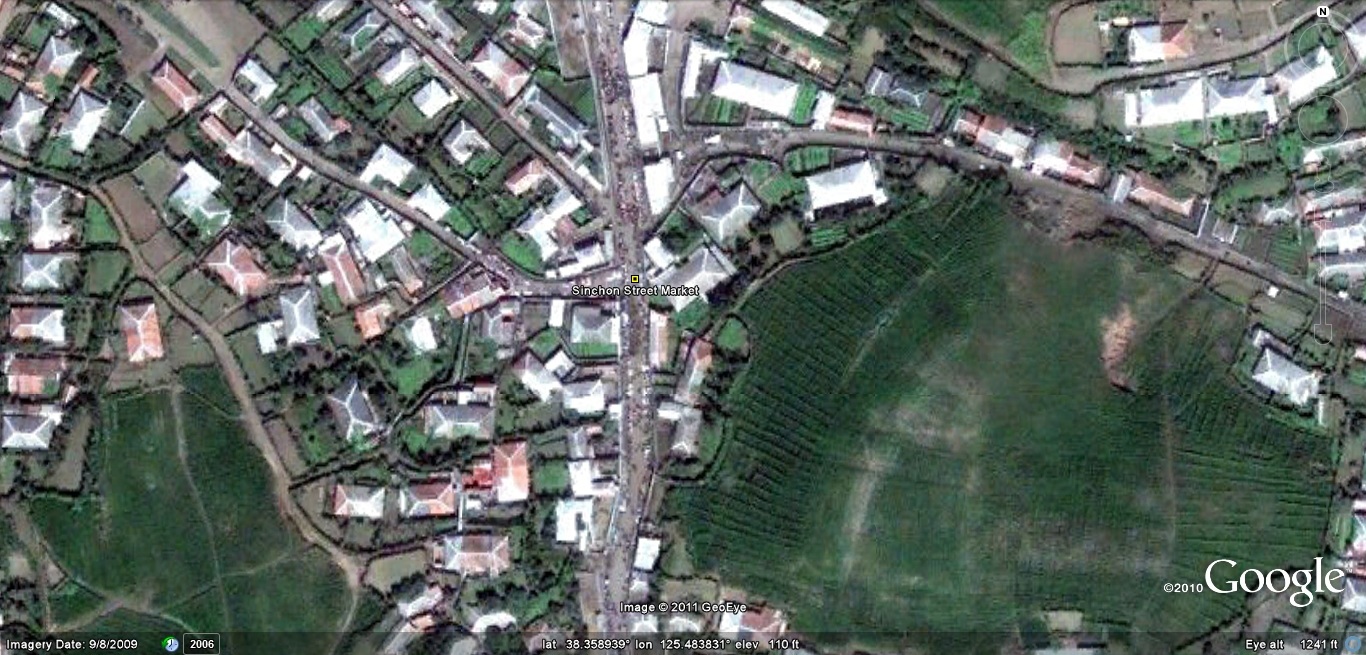
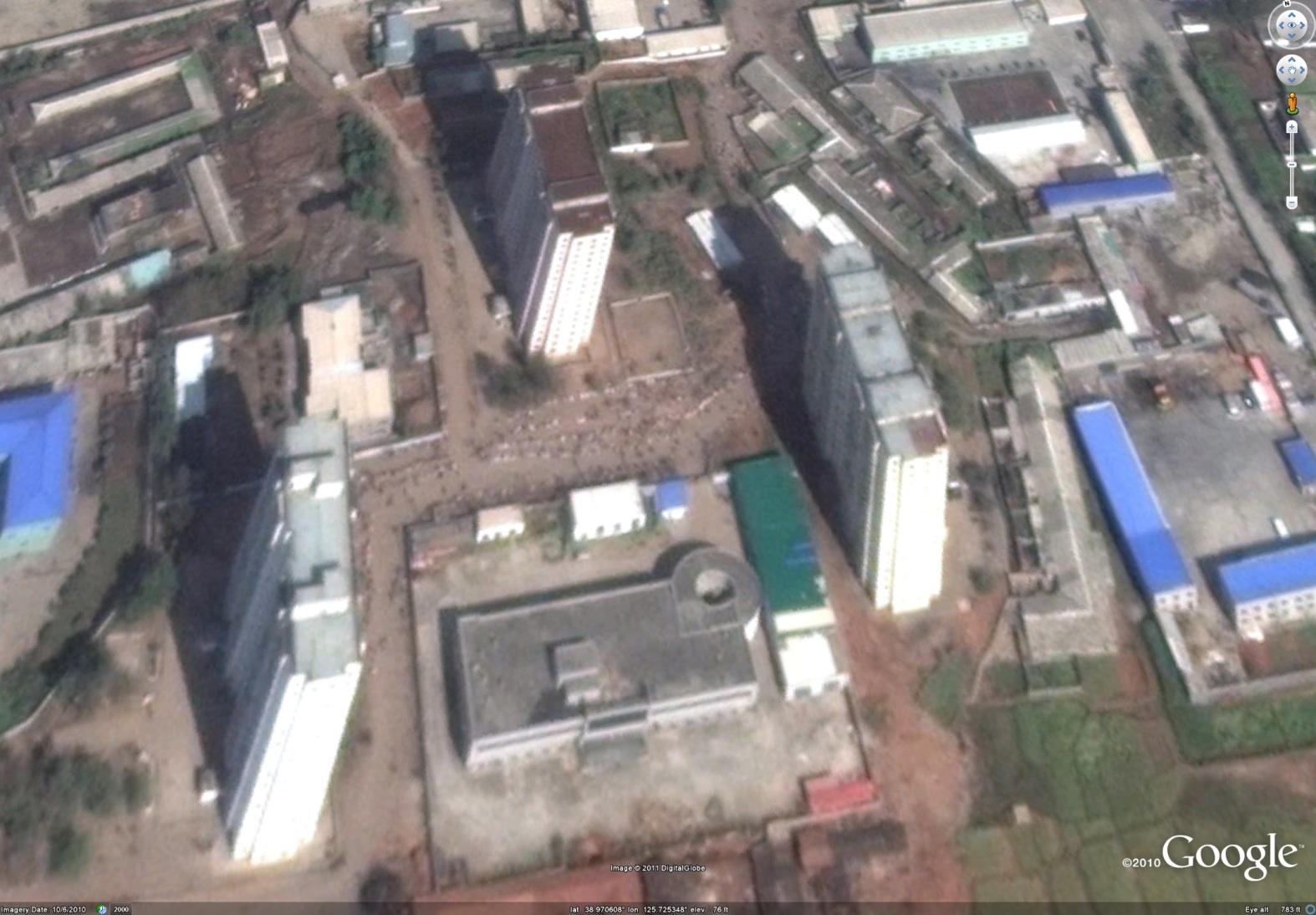
Pictured above (Google Earth): An unofficial street market in Sinchon (신천) is bustling while the nearby official marketplace is closed.  See in Google Maps here.

The Choson Ilbo posted a few factoids about the official and unofficial economies of the DPRK:

The rationing system, the backbone of the socialist planned economy, has nearly collapsed. Some 4 million people still live on rations — 2.6 million in Pyongyang and 1.2 million soldiers.

But a senior South Korean government official said 20 million North Koreans rely absolutely on the underground economy.

“A North Korean family needs 90,000-100,000 North Korean won for living costs per month, but workers at state-run factories or enterprises earn a mere 2,000-8,000 won,” the source said. “So North Koreans have no choice but to become market traders, cottage industrialists or transport entrepreneurs to make up for shortages.”

Many stores, restaurants, and beauty parlors are privately owned. Private tutors teach music or foreign languages. Carpenters have evolved as quasi-manufacturers who receive orders and make furniture on a massive scale. They earn 80,000-90,000 won per month on average.

It is common to find people in front of railway stations or in markets who wait to earn a few extra won by carrying luggage or purchases in their handcarts. Like taxis, their fees are calculated on a basic fee and the distance covered.

In the countryside, people earn money by selling corn or beans grown in their own vegetable gardens in the back yard or in the hills. They can harvest 700 kg of corn a year from a 1,600 sq.m. lot. And by selling 50 kg of corn a month they make 30,000-40,000 won on top of their daily living costs.

“Ordinary North Koreans have become so dependent on the private economy that they get 80-90 percent of daily necessities and 60-70 percent of food from the markets,” the security official said.

Noland and Haggard’s recent book, Witness to Transformation, contains thorough and revealing data on market utilization in the PDRK. More here.

Share

DPRK owes USD $1.5b to ROK

Monday, September 19th, 2011

According to Yonhap:

North Korea owes about 1.8 trillion won (US$1.5 billion) to South Korea in food and other shipments, with its first repayment due next June, but chances of repayment are slim given the country’s crumbling economy, a government report said Monday.

The debt is for food, railway equipment and raw materials South Korea has provided to its impoverished communist neighbor in the form of loans over the past decade, according to the Unification Ministry report submitted for the annual parliamentary audit.

South Korea had been one of the largest aid providers to the North, but such shipments were halted after President Lee Myung-bak took office in early 2008 with a pledge to link aid to progress in efforts to end Pyongyang’s nuclear weapons programs.

Repayment of the loans was scheduled over 20 years with a 10-year grace period, at 1 percent annual interest. The North is scheduled to make its first repayment in June of next year for a $5.83 million food loan extended in 2000.

South Korean officials, however, have cast doubt on that repayment given the North’s dire economic situation.

The DPRK remains in debt default from loans taken in the 1960s and 1970s. The Russians are in talks to forgive DPRK debts (Likely in connection with developments of the Rason economic zone and/or natural gas pipeline).

You can learn more about speculating on the repayment of North Korean debt here.

Share

Chinese joint venture company takes over Hyesan Youth Copper Mine

Monday, September 19th, 2011

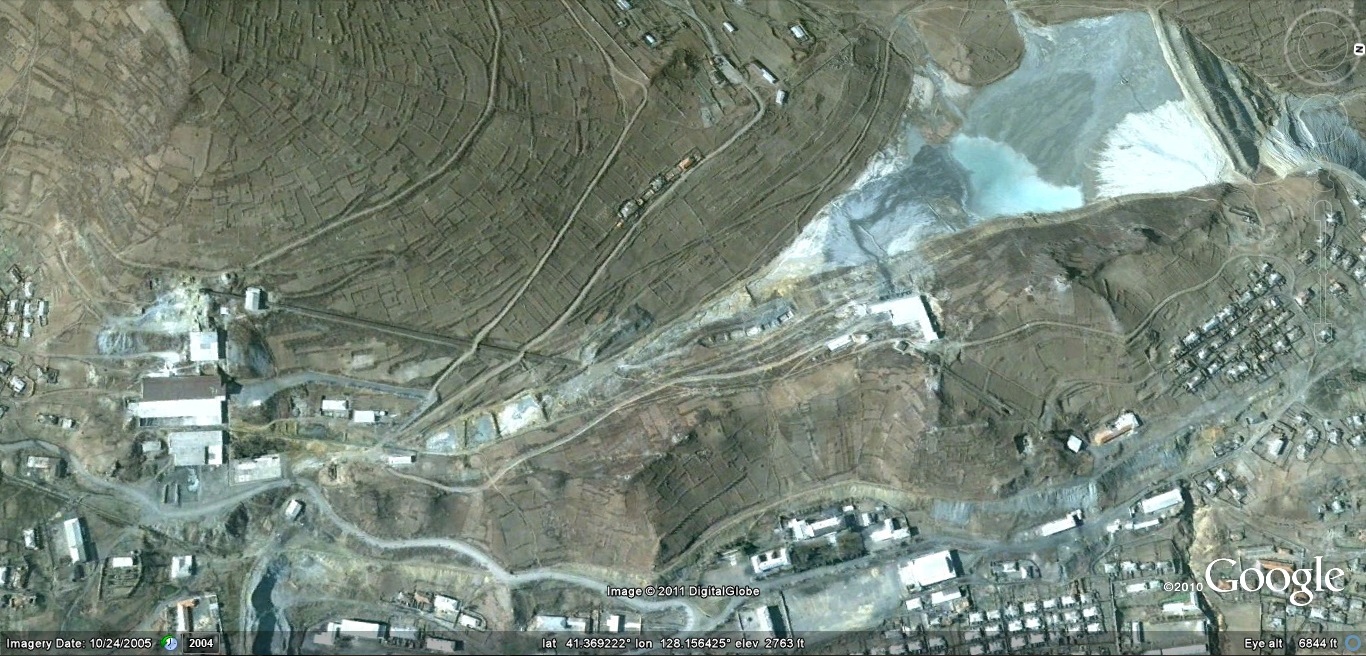
Pictured above (Google Earth): Hyesan Youth Copper Mine.  See in Google Maps here.

According to Xinhua (China):

Hyesan-China Joint Venture Mineral Company, a large joint project between China and the Democratic People’s Republic of Korea (DPRK), started operation at Hyesan of Ryanggang province on Monday.

The mineral company was jointly set up by Wanxiang Resources Limited Company of China and the Ministry of Mining Industries of the DPRK on Nov. 1, 2007. Its main business was to produce and sell copper.

DPRK Mining Industries Minister Kang Min Chol and Chinese ambassador Liu Hongcai attended the opening ceremony.

Kim Chol, chairman of the people’s committee of the Ryanggang province, said at the ceremony that the joint venture was one of the symbols of the development of the DPRK-China friendship and would be a model of modernization, science and economic benefits.

Liu believed the company would make profits for both sides, benefit the two peoples and promote traditional China-DPRK friendship.

According to Reuters:

The mine was located a few miles from the Chinese city of Changbai in the northeastern province of Jilin and was 51 percent owned by Wanxiang, a source with direct knowledge of the project told Reuters on Tuesday.

The mine had a designed annual capacity of 50,000-70,000 tonnes of copper concentrate, expected to contain 20-30 percent copper, he added.

“All the concentrate will be sold to China,” the source said.

The source said the joint venture would conduct second-phase construction to expand the capacity of the mine if production ran smoothly, but did not give details on timing or expanded capacity.

China is the world’s top copper consumer but does not produce sufficient concentrate to meet demand. The country imported 3.4 million tonnes of copper concentrate in the first seven months of 2011, down 11 percent from a year earlier.

According to KCNA:

The Hyesan Youth Mine in Ryanggang Province was successfully updated as required by the new century.

The workers and technicians of the mine together with Chinese technicians and skilled workers completed the vast modernization project and successively ensured their commissioning.

The modernization of various production processes including mining, carriage and ore dressing made it possible to boost mineral production and thus contribute to economic development and the improvement of the standard of people’s living.

A ceremony for the completion of the modernization project at the Hyesan Youth Mine and the Hyesan-China Joint Venture Mineral Company was held on Monday.

Present there were Kang Min Chol, minister of Mining Industry, Kim Hi Thaek and officials concerned, Liu Hongcai, Chinese ambassador to the DPRK, and staff members of his embassy and Han Youhong, president of the Wanxiang Resources Co., Ltd. of China, and personages concerned.

Ri Mun Yong, manager of the Ryanggang Provincial Mining Complex, made an address to be followed by congratulatory and other speeches.

At the end of the ceremony, the participants went round production processes.

That day a reception was given in connection with the ceremony.

Although foreign investors and aid groups frequently build/ repair / upgrade North Korea’s state owned enterprises, it is rare that they are given any credit for their work in the official media.

Previous posts about the Hyesan Mine:
1. Poor electricity supply (2011-5-16)

3. Mine is flooded (2007-11-1)

4. China investing in mine (2007-4-12)

5. Chinese investing in mine (2006-12-24)

Additional mining information:
1. DPRK – China minerals for food program (2011-8-19)

2. DPRK looking to export rare earths (2011-7-23)

3. DPRK – China trade: 1995 – 2009 (2011-6-7)

4. Increase in DPRK’s mineral resources exports to China expected again for this year (2011-2-28)

5. DPRK – China mining deal (2011-2-6)

6. China expanding mining rights in DPRK (2010-1-15)

Share

North Korea Encourages Investment in Rajin-Sonbong (Rason) Economic and Trade Zone

Friday, September 16th, 2011

Institute for Far Eastern Studies (IFES)
2011-9-14

At the seventh China Jilin and Northeast Asia Investment and Trade Expo (NEASIAEXPO), the North Korean delegation actively promoted the Rajin-Sonbong (Rajin) Economic and Trade Zone to attract investment.

During the expo, the DPRK’s Ministry of Trade and China’s Ministry of Commerce and People’s Government of Jilin Province co-sponsored the “(North) Korean Business Day and China-DPRK Trade and Investment Session” at the Changchun International Conference and Exhibition Center on September 7. Hwang Chol-nam, the vice mayor of Rason City, briefed the attendees on the current situation, advantages, and special benefits of his city.

According to Hwang, “The spacious 470 square-kilometer Rason Economic and Trade Zone is one of the largest economic trade zones,” and advertised the geographic and economic advantages of Rason as the “transportation hub of Northeast Asia that connects China and Russia via Tumen River and with Japan across the East Sea.”

He also introduced the three ports in the region. “Rajin Port is equipped with the annual loading capacity of 3 million ton and Sonbong Harbor is able to transport 2 to 3 million ton of oil while Ungsang Harbor is able to handle up to 600,000 cubic-meter of lumber annually.” He also boasted the ports to be deep enough where it does not freeze during the winter.

Rason was also introduced to have received the “special city” designation in 2010 and will grow to have a population of one million. The recently amended “Law on the Rason Economic and Trade Zone” was revised and supplement with over 50 articles.

Hwang also elaborated on the eight preferential policies providing special tax benefits to foreign investors. He asserted, “The government of North Korea will guarantee the investment of the foreign investors by not nationalizing or demanding requisitions. For inevitable cases where such demands occur, proper compensation will be provided.”

The income tax is also at 14 percent, which is 11 percent lower than other areas in North Korea. For companies with business plans over ten years, foreign capital companies will receive three years of tax-free benefit starting from the profit earning year and two years thereon after will receive 50 percent tax-free benefits. According to Hwang, over 100 foreign companies and offices are operating businesses currently in the special economic zone.

He also announced that the current highway construction project connecting Rajin with Wonjung is expected to be completed in October, and that the Tumen-Rajin port railway system is to be upgraded to a broad gauge railway next month.

Specifically, Russian Railways reached an agreement with North Korea to repair the Hasan-Rajin Railway and improve the Rajin port facilities, especially focusing on Pier 3. The plans include upgrading Rajin as a container harbor to be capable of transporting twenty-foot equivalent units annually. Russia and the DPRK have already conducted measurement and geological surveys and reached the process design phase.

However, Seo Gil-bok, the DPRK’s vice minister of commerce, stated in a speech that North Korea would “actively work hard to make the Rason region a successful collaboration between the DPRK and China,” saying further that they would “pull out all the stops to realize the goals agreed by the best leaders from both nations.”

Many foreign media and correspondents were present at the event to cover the “Korean Business Day.” At the event, North Korea actively promoted the Rason Economic and Trade Zone by also presenting a promotional video of the zone.

Share