Archive for the ‘Economic reform’ Category

Hardship changes marriage patterns in DPRK

Monday, November 28th, 2011

According ot the Choson Ilbo:

More and more North Korean women are marrying younger men as their superior earning power makes them increasingly eligible. Park Young-ja of Ewha Womans University’s Institute of Unification Studies told a seminar Thursday more women are becoming breadwinners as the North’s economic hardship deepens.

“Young women are avoiding marriage or opt for informal cohabitation. And an increasing number of women are choosing younger men so that they can have more control in the relationship.”

One female North Korean defector in her 30s said, “Even if the authorities tell people not to, men are living with women who are five or six years older, because these women have experience making ends meet.”

The number of divorces initiated by women is on the rise as well. The regime is threatening to expel divorcees, but to no avail. “North Koreans don’t take warnings from the regime seriously because they believe that there is no need to report marriage or divorce to the government,” Park said.

“Recently an increasing number of people don’t bother to register their partnership and just go their separate ways after a few months or years if they want.”

Hardship Changes Marriage Patterns in N.Korea
Choson Ilbo
2011-11-28

Share

7 Chinese killed in road accidents near Pyongyang

Monday, November 28th, 2011

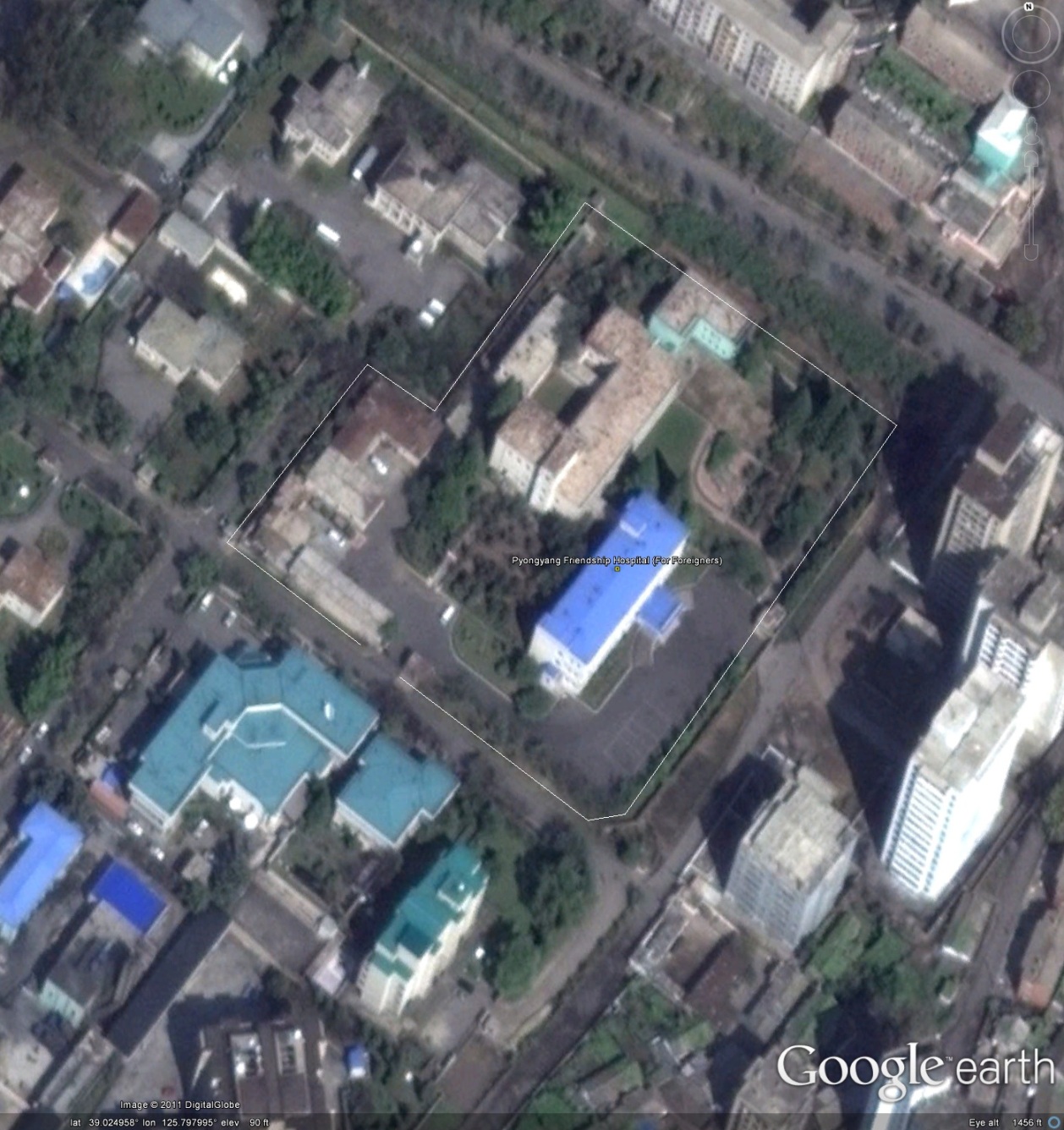
Pictured above (Google Earth): The Pyongyang Friendship Hospital, where the Chinese visitors are being treated.

According to Xinhua (PR China):

Seven Chinese citizens and three nationals from the Democratic People’s Republic of Korea (DPRK) were killed in two traffic accidents near Pyongyang, the Chinese Embassy in the DPRK said Sunday.

On Saturday morning, a bus carrying 27 Chinese tourists overturned about 60 km away from Pyongyang, due to the slippery iced road caused by icy rain. Another bus with a 17-member Chinese business delegation plunged into a ravine from a bridge in the same section minutes later.

Ten wounded Chinese, including three seriously injured, were being treated at the Pyongyang Friendship Hospital, while the others were confirmed unharmed.

A work group sent by relevant Chinese authorities has arrived in Pyongyang. The Chinese Embassy activated an emergency mechanism and dispatched staff to look after the patients in the hospital on a 24-hour duty.

The DPRK government has instructed health, tourism and diplomatic departments to deal with related issues. DPRK officials have also visited the wounded Chinese in the hospital.

UPDATE: Adam Cathcart is also following this story.

Read the full story here:
7 Chinese killed in road accidents near Pyongyang
Xinhua
2011-11-27

Share

Dutch stamp dealer accused of being a spy in North Korea

Sunday, November 27th, 2011

By Michael Rank

A Dutch stamp dealer who was arrested in North Korea this summer has told how he was held in solitary confinement for two weeks and threatened with spending 15 years in prison for spying.

Willem Van der Bijl said in a telephone interview that he had visited North Korea about 24 times since 1998 in order to buy stamps, postal stationery and propaganda posters, and that three of his business contacts were arrested with him last August. Although he was freed after a highly unpleasant two weeks during which he was held in a two-by-three metre cell, he has no idea what has happened to his North Korean colleagues, but fears they will be severely punished.

He said he had been “intimidated” by his interrogators but not physically mistreated during his detention. “They yelled at me but did not hit me”, he said, adding that he was accused of being a spy apparently because of the large number of photographs he had taken of the North Korean countryside during trips to factories outside Pyongyang to discuss possible joint ventures.

He was released after signing a confession to his alleged crimes, and said the North Koreans confiscated his laptop and camera as well as a Kim Il Sung badge that had been given to him, but his money was returned to him. “I was happy to leave,” he said, adding that “There was nothing really wrong in what I did…All I did in North Korea was fairly correct”.

Van der Bijl, 60, photographed here with an interview in Dutch, said his North Korean colleagues were held in the same interrogation centre as he was and that he was deeply concerned that “They will have to face trial, and I will never see them again.”

Although mainly a stamp dealer with a stamp shop in Utrecht, he said he had become interested in collecting propaganda posters during his last few visits, and had a collection of thousands of posters.

He said North Korean officials seemed divided in their attitude as to whether such posters should be sold to foreigners. “The ‘doves’ say this art is popular in the west and should be sold; the ‘hawks’ do not want to export secret paintings, they are meant for the Korean people,” Van der Bijl said.

He said his hopes mounted every Tuesday and Saturday that he would be released as there are flights from Pyongyang to Beijing on those days, and as time progressed he became more worried that he would be sentenced to spending up to 15 years in jail for espionage. When he was freed he was told he could apply for a visa to visit North Korea again, but he told NKEW said he had no wish to do so as long as the current regime remains in power.

He said he had taken car journeys about 120 km outside Pyongyang nominally to visit companies to discuss joint ventures, but he was more interested in taking photographs of the impoverished countryside, and that North Korean factories were too dilapidated for there to be any serious chance of doing business with them.

Somewhat surprisingly, Van der Bijl is quoted on two official North Korean websites here and here before his arrest concerning local elections in North Korea in July. He visited a polling station during the elections and was quoted as saying, “Looking round the poll, I have been greatly impressed by the free and democratic elections and I have had a better understanding of the DPRK’s reality.

“In the DPRK every citizen is eligible to vote and to be elected. Those who have worked a lot for the people are elected as deputies. The popular election system of the DPRK is really excellent.”

He confirmed he had spoken to North Korean reporters at a Pyongyang polling station, but said all he had told them was that he had never seen elections run in such a way before, and strongly denied praising the elections as free and fair

Also surprisingly, Van der Bijl is shown wearing a Kim badge in two photographs of him on the Pyongyang Times websites. It’s rare for foreigners to be given a Kim badge and still rarer for them to be shown wearing one in the official North Korean media. Van der Bijl said he was unsure where the photos were taken. One of the websites shows Van der Bijl’s signature, copied from his passport.

Share

Aidan Foster-Carter on what’s wrong with the DPRK economy

Saturday, November 26th, 2011

Aidan Foster-Carter writes a compendium of problems facing the DPRK economy in 38 North.

Paraphrasing the ailments he cites: Socialism, militarism, royal economy, cult costs, potempkinism, leadership whims, rigidities, coordination problems, unwise leadership priorities.

Read the full story (which is full of fantastic anecdotes) below:
Whim Jong Il: North Korea’s Economic Irrationalities
38 North
Aidan Foster-Carter
2011-11-26

Share

DPRK makes discreet investor plea to French students

Thursday, November 24th, 2011

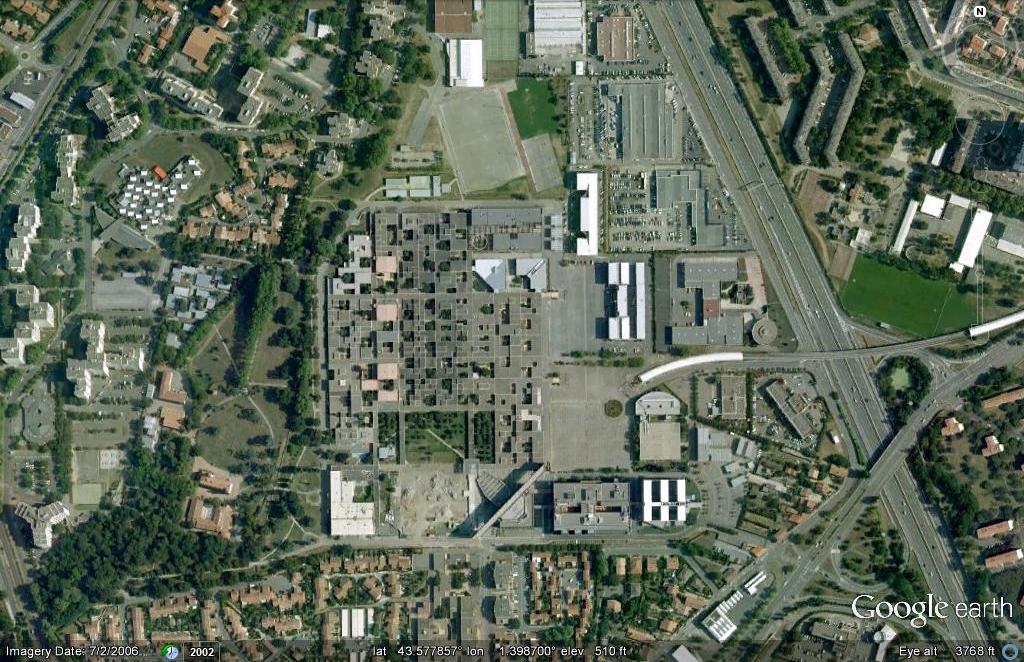
Pictured above (Google Earth): The University of Toulouse, France. See in Google Maps here.

According to AlertNet (Reuters):

Secretive and isolated North Korea is searching for economic allies in the unlikeliest of ways: showing videos of happy North Korean tourists to young French university students in a 13th century convent.

The reclusive communist state has no official diplomatic relations with France, one of only two European Union countries to cut ties with North Korea until it abandons its nuclear weapons programme and improves its human rights record.

But just weeks after Paris decided to open a cooperation office in the North Korean capital, its ambassador to Paris-based UNESCO accepted an invitation to address students from the University of Toulouse within the gothic surroundings of the Franciscan convent’s capitular chamber.

The meeting marked Ambassador Yun Yong Il’s first public appearance in France.

“They are the future,” said Yun, when asked by Reuters why he picked Toulouse to talk. “I’m here for the students who have been waiting to hear from a North Korean official for a year.”

Tensions have gradually eased on the Korean peninsula since the sinking of a South Korean warship 20 months ago and the North’s revelation of a uranium enrichment facility that opens a second route to make an atomic programme.

North Korea and the United States have also held a series of bilateral meetings geared at restarting broader regional de-nuclearisation talks, giving the North a window of opportunity to raise its diplomatic efforts around the world.

Yun, a former political director at the Foreign Ministry, faced about 100 students.

At times, the future political science graduates looked on bemused and surprised as the four-hour presentation cut from a hazy tourism video of the 1980s showing rolling mountains, happy North Koreans on holiday and copious seafood platters to a well structured monologue about the country’s woes and potential.

“Our country is open to everybody who wants to come. You just have to ask for a visa in Paris!” said Yun, who speaks fluent French, but opted to talk in his native language and let his deputy translate into English.

Pyongyang has slowly opened its doors under strict conditions to foreign tour groups, mostly Chinese as a way of earning hard currency.

Yun, who wears a lapel pin of President Kim Jong-il on his suit, said the country’s lack of hard currency as a result of tighter sanctions has made it turn to foreign investors on the “basis of mutual respect and interests”.

“We are looking forward to multilateral and multifaceted economic co-operation with other countries,” he said.

“We are definitely opposed to monopolistic investment of a single country,” said Yun, adding that the country’s natural resources provided opportunities for investors to tap.

CHINESE MODEL, CHINA TRAP

Michel-Louis Martin, director of Toulouse University’s security and globalisation research group said the event was not just propaganda.

“They are trying to go beyond what they usually have to say about North Korea. Don’t forget in France, North Korea is not very well known,” said Martin.

The country’s desire to diversify its economy has echoes of China when it began to allow foreign investment and gave permission for entrepreneurs to start up businesses in the 1970s.

Yun’s presentation attempted to steer clear of its frictions with the United States, South Korea and even its relationship with China, focusing instead on his country’s economic problems.

But by the end he stepped up the rhetoric, firmly laying the blame for Pyongyang’s “misfortune” on the United States.

Michel Dusclaud, a researcher at the University of Toulouse who convinced Yun to speak, said it was normal for ancestral hatreds to come out. Despite this, he said, it was clear the North was beginning to accept that if it did not diversify, it would be engulfed either by its souther neighbour or China, which still has territorial claims to it.

“They have to open up for international cooperation otherwise they will be eaten up by South Korea or China,” Dusclaud said. “It’s imperative, but it’s not because they like us.”

With his speech finished, Yun was quick to shuffle out of the Gothic chapel, declining to speak to Reuters, but also telling a student who attempted to pose a question on whether North Korea’s political system could last:

“I’ll see you in Paris and then we’ll talk.”

Read the full story here:
N.Korea makes discreet investor plea to French students
AlertNet (Reuters)
John Irish
2011-11-24

Share

Orascom releases Q3 2011 sharholder report

Friday, November 18th, 2011

You can read the full report here (PDF).

Since I am behind on numerous commitments at the moment, I am not going to write much about this.  However, the report’s contents have been widely covered:

1. North Korea Tech (Martyn Williams) and here.

2. Reuters


Share

Choson Exchange October trip findings

Monday, November 7th, 2011

From the Choson Exchange web page (November 5):

In October 2011, John Kim, a board director of the Choson Exchange, visited the Rajin-Sonbong Special Economic Zone. The following is a summary of some of his findings based on site visits and talks with senior officials in the SEZ. An longer account of his travels and impressions will be available soon. This information helps elaborate on our report from August.

Rajin Port
The Rajin Port employs 1400 workers. The Chinese have conducted feasibility tests regarding two new piers, but currently the port houses three piers with 9-9.5 meters draft. A 30,000 metric ton coal storage warehouse was built at Pier 1 by the Chinese, who moved 80,000 metric tons through the facility in five shipments from January to September. Pier two, largely dedicated to container shipment, is currently dormant and a Swiss company is currently using Pier 3 to ship manganese and talc out of the region. The Russians also have a 49 year lease agreement signed in 2008.

Oongsang [Ungsang] Port
Oongsang Port exported Russian lumber until 1985, but remains largely quiet now except for the occasional fishing boat. The present draft of 7 meters constricts any major future activity, so the North Koreans hope to bring in over $100M to widen the draft to 9 meters. After Rajin Port activity surpasses capacity there, Oongsang Port will become the next regional hub for drybulk activity.

Sonbong Port
Originally opened in the early 70’s, the draft within the port is 7 meters, but a fully laden Very Large Crude Carrier containing 270,000 metric tons of oil can offload at an offshore facility further out at sea. Two pipes, 63 cm in diameter, run for 9km underground before reaching the storage facility at “Victory Petrochemical”, a simple refinery that was designed to refine crude and send oil products (gasoline, naphtha, jet fuel, diesel and fuel oil) back to the port for export. In addition to this two way flow, fuel oil also arrived sporadically at the port as part of aid packages from 1994 to 2008.

Sonbong Power
This power plant was originally designed to take fuel oil from Victory Petrochemical as feedstock and generate power to feed back to Victory. Since the refinery has been offline, Sonbong Power has at times provided electricity to the region, but with fuel oil prices close to $700/metric ton and current electricity prices at 6.5 eurocents/kwh, the economics of running the plant do not work leaving the 800 workers employed here largely idle.

Victory [Sungri] Oil Refinery
Literally translated as “Victory Chemical Plant”, this refinery was completed in 1973 with a 40,000bbl/day crude distillation unit that typically yields 40~50% residual fuel oil for an average crude feed. Investment into upgrading capacity in the international market has led to an eroding of margins for simple refineries like Victory. Currently the refinery is idle and would need over $500M in investment to become competitive.

Hye Song Trading Company
Mr Kim visited a Sewing Factory owned by Hye Song, which runs 8 such factories employing 2000 workers. Output is recorded for the entire year on a bulletin board at the front entrance of the company. All employees except the handyman were women.

Cell Phone use more prevalent
The number of cell phone users in the DPRK crossed 1 million earlier this year and one official commented that the overwhelming majority of urban households have at least one cell phone. This particular official had 4 phones for a household of 3. Foreigners are allowed to use cell phones on a different network, and users of the domestic and foreign network can not call each other. All usage is prepaid.

Handset Type: Local
Purchase Cost: 1570-2200 RMB
Usage Cost: 250 minutes and 20 text messages, while each additional minute is charged at 60 NKW (about .1 RMB/min)

Handset Type: Foreigner
Purchase Cost: 1800-2400 RMB
Usage Cost: Does not include any free minutes and are charged at 2RMB/min

Banking System has room for growth
There are two banks in Rason, the Central Bank, which is focused on domestic transactions, and the Golden Triangle Bank, which is focused on foreign currency transactions. Transactions for goods and services are conducted almost entirely in cash, usually in RMB or NKW. Mechanisms for savings are credit have room for development. As banks take a fee to deposit and withdraw cash, merchants prefer to hold money in cash (usually RMB). Credit is also available almost exclusively through friends or family.

Bottlenecks
A number of issues require solving if Rason is serious about attracting large scale foreign investment. Among these are reliable access to travel visas, reasonable communications costs with the outside world, a more mature banking system with savings and credit mechanisms and favorable tax treatment with a consistent legal framework. The mere fact that Rason is experimenting with market reform is encouraging, and Mr Kim is optimistic about economic development in the region and the nation as a whole.

Share

Seoul to begin Kaesong road repair

Thursday, November 3rd, 2011

According to Yonhap:

South Korea will next week start repairing a road used by North Korean commuters to reach an inter-Korean industrial complex in the North, an official said Thursday amid signs of a thaw in bilateral relations.

The 4.5-kilometer road linking North Korea’s border city of Kaesong to the nearby industrial park is used by more than 47,000 North Korean workers who are employed by some 120 South Korean firms operating in the zone. South Korean officials earlier said the road was damaged in summer’s torrential rains, prompting the South to conduct an on-site survey.

“After signing an agreement (with the North), we expect to start repair work next week,” said an official at the Unification Ministry, which handles inter-Korean relations in the South.

“It will likely take about three months to complete the work, unless the weather becomes too cold, and cost us around 1.8 billion won (US$1.59 million),” the official said, speaking on condition of anonymity.

The repairs will involve restoring damaged paved sections and filling in holes on unpaved sections. Repairing the road is expected to save time for North Korean commuters and reduce traffic accidents.

The Daily NK offers some additonal information:

A government official explained today that the decision was made pursuant to agreement between the Kaesong Industrial Complex Management Committee, LH Construction and the North Korean authorities.

“The agreement has not yet been signed, but we are hoping to start the construction at the beginning of next week,” the official explained.

“Our side has taken on responsibility for planning the road repairs and supervising the construction,” he went on. “The weather could change things, but the construction should require three months and is expected to cost 1.8 billion South Korean won.”

Aside from the aforementioned construction, there are also plans to reconstruct two turning points for buses serving the complex. The human resources for the construction will be provided by North Korea.

There are plans to extend bus service to cover the areas of Pongchon (봉천), Kumchon (금천), and Phyongsan (평산). However, the roads to these areas are unpaved and extension of transportation services to these areas will require negotiations with the North Korean authorities.

Read the full story here:
Seoul to start repairing road leading to Kaesong complex next week
Yonhap
2011-11-3

Share

DPRK establishes “HGP” and Wihwa SEZ bureau

Wednesday, November 2nd, 2011

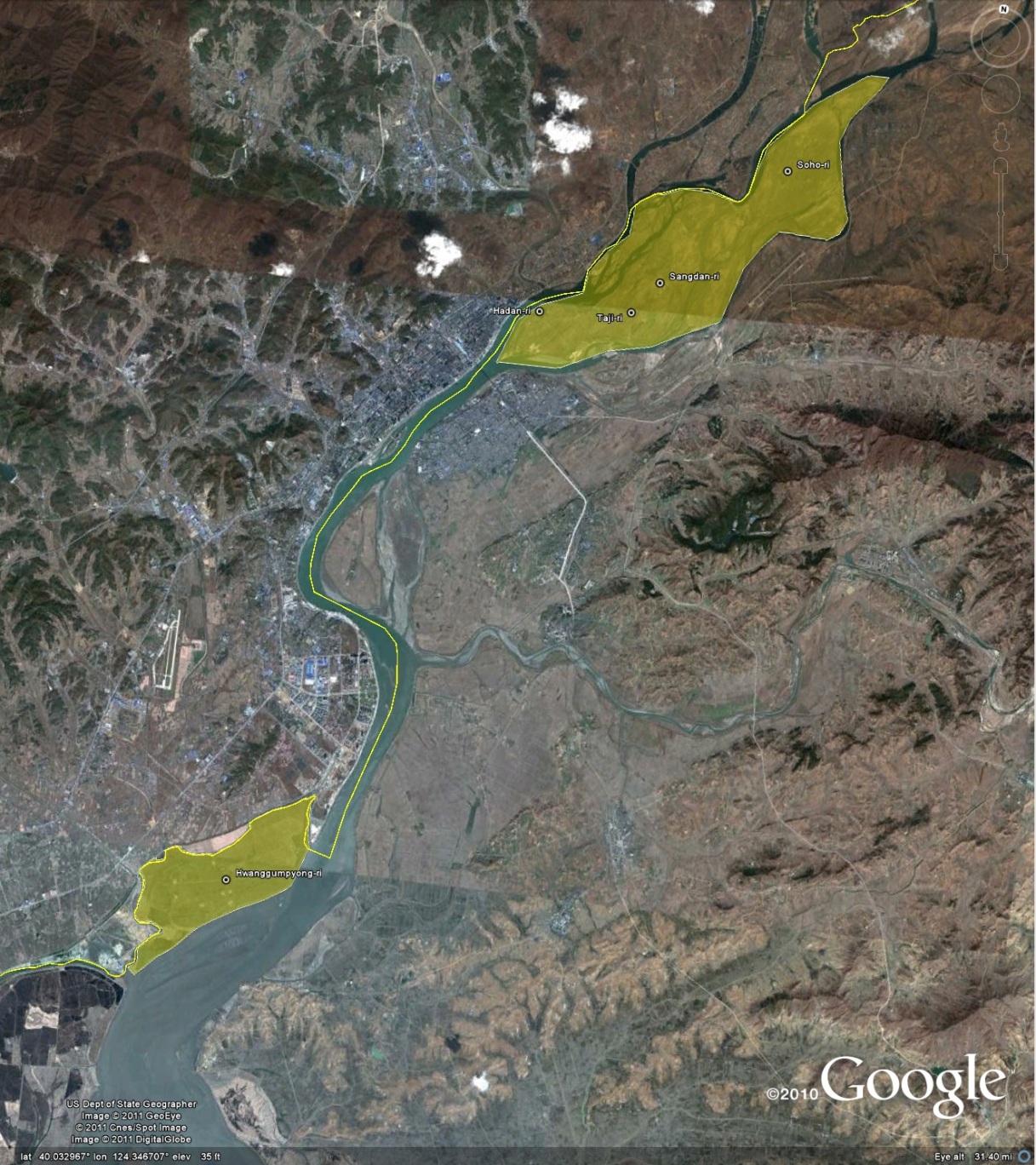
Pictured Above (Google Earth): The new PRC/DPRK economic zone: Hwanggumphyong-ri (“HGP” in Sindo County) and Wihwa Island (Sinuiju and Uiju Counties).  See islands in Google Maps here and here.

According to Yonhap:

North Korea has opened a bureau tasked with running a free trade zone near its border with China, a source familiar with the country said Wednesday, indicating the North’s continued efforts to revive its forlorn economy.

The move came shortly after North Korea and China agreed to create joint economic complexes on the border islands of Hwanggumpyong [HGP] and Wihwa following a summit between their leaders in May.

“North Korea has opened a bureau with some 10 staff members on Hwanggumpyong,” the source said, asking for anonymity. “It opened around August or September.”

The staff includes a ranking official who was in charge of operating the Kaesong industrial complex near the western border with South Korea in the early 2000s, the source said, a sign that the North may want to develop Hwanggumpyong in a similar way to Kaesong.

The inter-Korean industrial park in Kaesong combines South Korea’s capital and technology with cheap labor from the North. More than 47,000 North Koreans work at about 120 South Korean firms operating in the zone to produce clothes, utensils, watches and other goods.

In a related move, North Korea has added two more vice chairmen to a state-run investment committee charged with attracting foreign investment, the source said. The committee, which was launched in July last year, is known to be under the control of Jang Song-thaek, brother-in-law of North Korean leader Kim Jong-il and vice chairman of the North’s powerful National Defense Commission.

North Korea is seeking to boost economic cooperation with China, its closest political and economic ally, as Pyongyang struggles to achieve its stated goal of becoming a prosperous country by 2012.

Read previous posts on Hwanggumphyong (HGP) and Sinuiju here.

Read the full story here:
N. Korea opens bureau to run free trade zone with China: source
Yonhap
2011-11-2

Share

7th Pyongyang Autumn International Trade Fair

Wednesday, October 26th, 2011

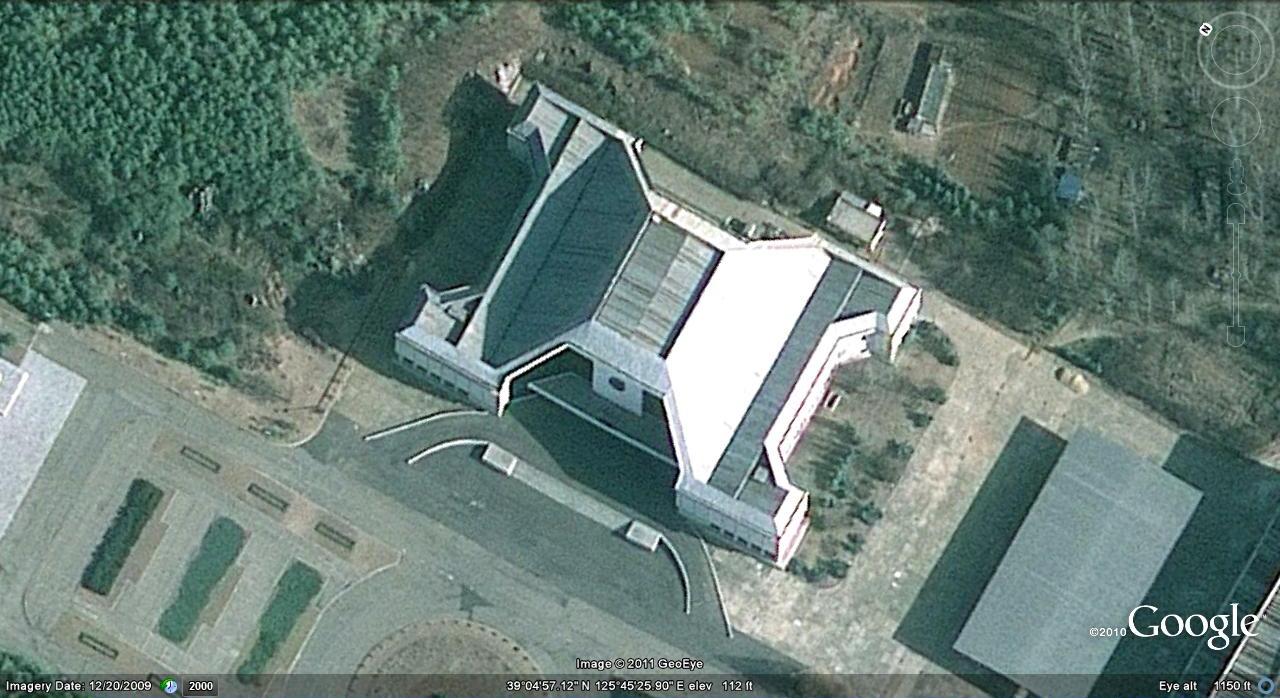
Pictured above (Google Earth): The location of the Trade Fair in the Three Revolutions Exhibition House, Pyongyang

According to the Pyongyang Times (October 2011):

The 7th Pyongyang Autumn International Trade Fair ran between October 17 and 20 in the Three-Revolution Exhibition House.

The annual event serves as an occasion in bolstering up economic relations and bilateral and multilateral cooperation among the countries on the principle of equality and mutual benefits.

The fair drew more than 260 companies from many countries and regions including the DPRK, China, the Netherlands, Germany, Bulgaria, Malaysia, Switzerland, Sweden, Italy, Austria, Australia, India, the UK, the Czech Republic, Poland and Taiwan.

On display in the trade fair were several thousand kinds of products such as electronic goods, machines, building materials, chemicals, medicines, food and consumer goods.

Over ten additional trading companies of the DPRK participated in the expo. The Korean firms exhibited more goods and ads in their booths.

The Kumgang Motor Joint Venture Company put a variety of vehicles on show, the Kwangmyong Contractual Joint Venture Company displayed stainless steel pipes and couplings and the Kyongnim Trading Company put on different kinds of far infrared rays-anionic treatment apparatuses, which drew the attention of viewers.

Draws also included paper samples of the Gratenau & Hesselbacher Gmbh & Co KG of Germany and textiles of the Anhui Xinhe Textile Co Ltd of China.

The deputy general manager of the Shenyang Huanggu Seeds Co Ltd of China who attended the exhibition for the first time said:

“The exhibition served as an occasion in promoting economic exchange and collaboration among the countries. We will boost economic exchange with the DPRK counterparts.”

During the fair there were a briefing on the investment environment in the DPRK and business talks.

Read more about the trade fair at the Choson Exchange web page.

Here, here, and here are articles in KCNA on the trade fair.

Share