Archive for the ‘State Offices’ Category

New facts about the DPRK’s informal economy

Wednesday, September 21st, 2011

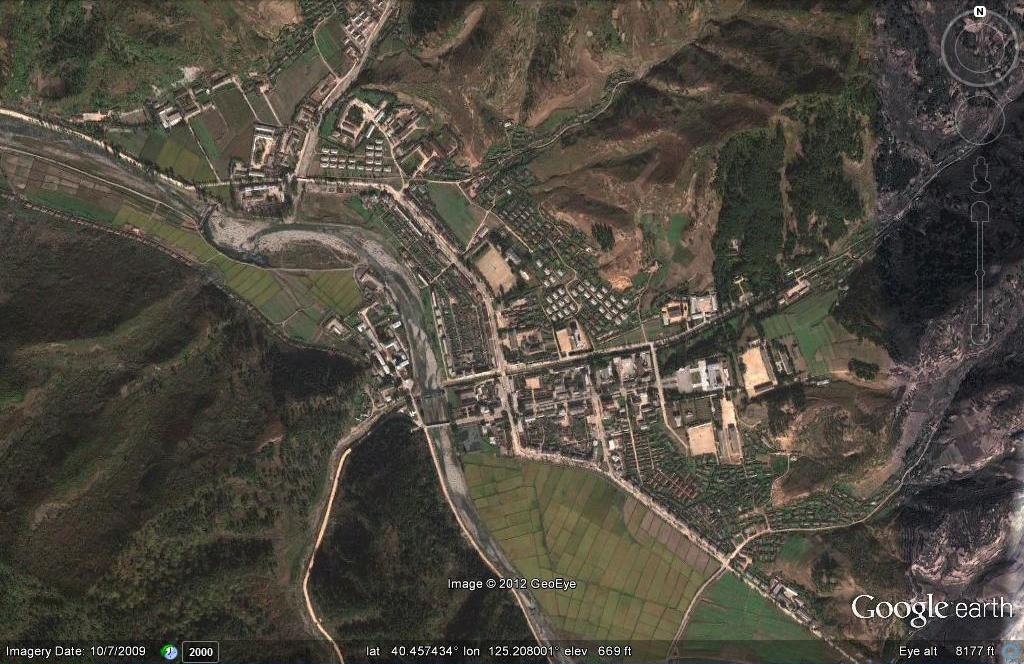
Pictured above (Google Earth): An unofficial street market in Sinchon (신천) is bustling while the nearby official marketplace is closed.  See in Google Maps here.

The Choson Ilbo posted a few factoids about the official and unofficial economies of the DPRK:

The rationing system, the backbone of the socialist planned economy, has nearly collapsed. Some 4 million people still live on rations — 2.6 million in Pyongyang and 1.2 million soldiers.

But a senior South Korean government official said 20 million North Koreans rely absolutely on the underground economy.

“A North Korean family needs 90,000-100,000 North Korean won for living costs per month, but workers at state-run factories or enterprises earn a mere 2,000-8,000 won,” the source said. “So North Koreans have no choice but to become market traders, cottage industrialists or transport entrepreneurs to make up for shortages.”

Many stores, restaurants, and beauty parlors are privately owned. Private tutors teach music or foreign languages. Carpenters have evolved as quasi-manufacturers who receive orders and make furniture on a massive scale. They earn 80,000-90,000 won per month on average.

It is common to find people in front of railway stations or in markets who wait to earn a few extra won by carrying luggage or purchases in their handcarts. Like taxis, their fees are calculated on a basic fee and the distance covered.

In the countryside, people earn money by selling corn or beans grown in their own vegetable gardens in the back yard or in the hills. They can harvest 700 kg of corn a year from a 1,600 sq.m. lot. And by selling 50 kg of corn a month they make 30,000-40,000 won on top of their daily living costs.

“Ordinary North Koreans have become so dependent on the private economy that they get 80-90 percent of daily necessities and 60-70 percent of food from the markets,” the security official said.

Noland and Haggard’s recent book, Witness to Transformation, contains thorough and revealing data on market utilization in the PDRK. More here.

Share

North Korea Encourages Investment in Rajin-Sonbong (Rason) Economic and Trade Zone

Friday, September 16th, 2011

Institute for Far Eastern Studies (IFES)
2011-9-14

At the seventh China Jilin and Northeast Asia Investment and Trade Expo (NEASIAEXPO), the North Korean delegation actively promoted the Rajin-Sonbong (Rajin) Economic and Trade Zone to attract investment.

During the expo, the DPRK’s Ministry of Trade and China’s Ministry of Commerce and People’s Government of Jilin Province co-sponsored the “(North) Korean Business Day and China-DPRK Trade and Investment Session” at the Changchun International Conference and Exhibition Center on September 7. Hwang Chol-nam, the vice mayor of Rason City, briefed the attendees on the current situation, advantages, and special benefits of his city.

According to Hwang, “The spacious 470 square-kilometer Rason Economic and Trade Zone is one of the largest economic trade zones,” and advertised the geographic and economic advantages of Rason as the “transportation hub of Northeast Asia that connects China and Russia via Tumen River and with Japan across the East Sea.”

He also introduced the three ports in the region. “Rajin Port is equipped with the annual loading capacity of 3 million ton and Sonbong Harbor is able to transport 2 to 3 million ton of oil while Ungsang Harbor is able to handle up to 600,000 cubic-meter of lumber annually.” He also boasted the ports to be deep enough where it does not freeze during the winter.

Rason was also introduced to have received the “special city” designation in 2010 and will grow to have a population of one million. The recently amended “Law on the Rason Economic and Trade Zone” was revised and supplement with over 50 articles.

Hwang also elaborated on the eight preferential policies providing special tax benefits to foreign investors. He asserted, “The government of North Korea will guarantee the investment of the foreign investors by not nationalizing or demanding requisitions. For inevitable cases where such demands occur, proper compensation will be provided.”

The income tax is also at 14 percent, which is 11 percent lower than other areas in North Korea. For companies with business plans over ten years, foreign capital companies will receive three years of tax-free benefit starting from the profit earning year and two years thereon after will receive 50 percent tax-free benefits. According to Hwang, over 100 foreign companies and offices are operating businesses currently in the special economic zone.

He also announced that the current highway construction project connecting Rajin with Wonjung is expected to be completed in October, and that the Tumen-Rajin port railway system is to be upgraded to a broad gauge railway next month.

Specifically, Russian Railways reached an agreement with North Korea to repair the Hasan-Rajin Railway and improve the Rajin port facilities, especially focusing on Pier 3. The plans include upgrading Rajin as a container harbor to be capable of transporting twenty-foot equivalent units annually. Russia and the DPRK have already conducted measurement and geological surveys and reached the process design phase.

However, Seo Gil-bok, the DPRK’s vice minister of commerce, stated in a speech that North Korea would “actively work hard to make the Rason region a successful collaboration between the DPRK and China,” saying further that they would “pull out all the stops to realize the goals agreed by the best leaders from both nations.”

Many foreign media and correspondents were present at the event to cover the “Korean Business Day.” At the event, North Korea actively promoted the Rason Economic and Trade Zone by also presenting a promotional video of the zone.

Share

The Environmental Protection Law amended — environmental certification system to be newly introduced

Thursday, September 1st, 2011

Institute for Far Eastern Studies (IFES)
2011-8-31

According to the KCNA, North Korea amended its environmental protection law on August 18, adding development of energy and environmental certification system into the revised act.

The environmental protection law is comprised of four sections and 50 articles, in which articles 38, 39, and 40 were added recently. These contain laws related to the development and usage of renewable energy resources, recycling technology, and implementation of environmental certification system. In addition, articles 44 and 48 were also supplemented in Section 4. They include plans for setting up environmental economic indicators.

According to the KCNA, “Based on this law, each agencies, companies and organizations are reducing fossil energy consumption to protect the environment and promote continuous economic growth. In its place, renewable energy resources such as solar, wind and geothermal energy are currently being explored.”

North Korea has registered eight hydroelectric plants with the UNFCCC (United Nations Framework Convention on Climate Change) to receive carbon credits which can be sold to earn hard currency. Receiving accreditation toward the CDM (Clean Development Mechanism) will allow developing countries to earn tradable carbon credits for emissions reductions from clean-energy projects.

Currently, Ryesonggang Hydropower Plant No. 3, 4, 5 and Wonsangunmin Hydropower Plant No. 1 reached the validation phase while the other four plants are at the prior consideration phase.

On July 26, the KCNA explained the environmental protection law was revised “to beautify our homeland, protect the health and wellbeing of our people, and provide culturally hygienic environment with favorable working conditions.” Accordingly, the environmental protection law passed in 1999 is now ineffective.

In recent years, North Korea seems to be paying keen attention to environmental protection issues. From May 16 to June 10, ten senior officials from the DPRK Ministry of Land and Environmental Protection and National Science and Technology Commission were invited to a training course at the Asian Institute of Technology in Thailand.

The program was implemented by the United Nations Economicand Social Commission for Asiaand the Pacific (ESCAP) as a part of the project “Promoting Regional and Economic Cooperation in Northeast Asia.” The four-week training program provided highly specialized training on integrated watershed management and reforestation.

Additional Information: You can read more about the DPRK’s CDM efforts here, here, and here.

Share

Economic performance and legitimacy in the DPRK

Sunday, August 28th, 2011

Geoffrey See and Andray Abrahamian (both representatives of Choson Exchange) wrote an article in the Harvard International Review which asserts that economic successes are becoming more important to the political narratives that reinforce the DPRK leadership’s claims to legitimacy. Below is an excerpt from their article:

North Korea’s most important domestic policy statement comes each New Year, when the major newspapers publish a joint editorial. The editorial often signals where government priorities will be in the coming year. In 2010 the newspapers spoke of “Bring[ing] about a decisive change in the people’s lives by accelerating once again light industry and agriculture.” Similar themes were echoed in 2011. This is opposed to the joint editorials of the past few years, which have focused on the more traditional themes of military strength, revolution, and socialism.

Another public sign of a shift towards focusing on economic issues is the type of official visits and inspections carried out by Kim Jong Il. Following in the footsteps of his father, Kim uses these visits to signal emphasis or encouragement of specific industries, activities, and policies. According to a report by the Institute for Far Eastern Studies, the first six months of 2011 have seen Kim exceptionally busy, participating in 63 official activities. Unlike previous years, however, the number of military visitations has dropped off: only 14 visits were military related, the lowest number ever recorded. By contrast, 28 visits were economic related.

In terms of policy, North Korea has been haltingly experimenting with Special Economic Zones (SEZ) since the mid-nineties, but has recently built a bit more momentum in this area. Rason, an SEZ in the far northeast, is finally seeing some basic infrastructure upgrades that were long talked about but always delayed. Government investment bodies have started to promote the idea that Rason will be the “next Singapore,” an ambitious marketing claim to anyone who has been to Rason. With both Russia and China leasing port space, it seems more likely to be transformed into a regional transportation hub. Meanwhile, along the Chinese border in the northwest, the Hwanggumpyong SEZ recently held a groundbreaking ceremony, attended by high-ranking North Korean officials and Wang Qishan, China’s commerce minister.

Senior politicians in North Korea are increasingly judged by their ability to bring in foreign direct investments. These efforts appear to be competitive rather than coordinated. North Korean leaders associated with the National Defense Commission, the highest level policy body, have been meeting with visiting foreign investors. In 2009, the Daepung International Investment Group was re-purposed along the lines of a holding company model as a vehicle for attracting foreign direct investment l with “27 joint ventures planned and to be managed by the Group.” Daepung Group is backed by specific high-level individuals. Jon Il-Chun, reportedly the Director of Office 39, a murky international trade and finance organ, is definitely involved with the Daepung Group. Media reports also indicate that Kim Yang Gon, Director of an organization tasked with managing contacts with South Korea, the United Front Department of the Workers’ Party, is also behind the group.

In July of the same year, the Joint Venture & Investment Commission (JVIC) was established. Instead of a holding company model, JVIC is a government institution modeled as a “one-stop shop” for investors – that is, JVIC is meant to “seek out investments and assist investors in setting up operations in North Korea.” While multiple institutions claiming to hold such authority have always existed in North Korea, many of these institutions have been merged into JVIC and long-time investors have been directed to liaise with JVIC as their primary government contact. JVIC’s nominal and public head is Ri Chol, a high-ranking North Korean government official.

In August of 2010, we received credible reports that foreign investors were approached to help set up a group similar to Daepung that would be backed by another member of the National Defense Commission. Given this proposed initiative’s similarities to Daepung, the prior establishment of JVIC, and that all three groups do not appear to communicate with each other, we surmise that these various groups have a competitive relationship with the support of different patrons. Investment officials with whom our teammates have met confirm that the relationship between the agencies is “very competitive.” If this is the case, it is a signal that influential groups in Pyongyang sense that future power bases will require the ability to attract and deploy capital.

The full article is worth reading here:
Harvard International Review
Geoffrey K. See and Andray Abrahamian
August 23, 2011

Share

On the DPRK’s University of Natural Science

Wednesday, August 24th, 2011

Pictured above (Google Earth): The National Academy of Science and what I believe is the Natural Science Academy (University of Natural Science) on the border of Pyongyang and Phyongsong.  If any readers beleive the facility is in a different location, please let me know. See in Google Maps here.

Choi Sung writes in the Korea IT Times:

The University of Natural Science which is a North Korea’s science education university is located in Eunjunggu in Pyongyang. It used to be in Pyeongseong-si with the National Academy of Science, where the university is affiliated to, but it was moved to Pyongyang to benefit scientists as a citizen of Pyongyang. The National Academy of Science is North Korea’s best scientific research complex. Every year, Kim Il Sung University hosts a science competition in early January. The competition subjects include Mathematics, Physics, Chemistry and English and a thousand students who already passed previous competitions in local institutes participate in the final competition.

Students who win first, second and third places in this competition are eligible to enter any Natural Science university of their choice. Also twenty to thirty top students are awarded and are given a chance to sit for an exam at Kim Il Sung University, The University of Natural Science or Kim Chaek University of Technology. However, the top students gets additional points in their admission, so virtually, seats for them are already secured. North Korea’s top talents usually choose between Kim Il Sung University and the University of Natural Science, but the formal is more for the social title and the latter is more for improving science research skills.

The Best Science Educational Institution

The University of Natural Science, where North Korea’s science and technology talents receive full scholarship (including meals, clothes and even underwear) from the government, is affiliated to the National Academy of Science and is nurturing professional science researchers. The National Academy of Science is North Korea’s top scientific research complex, having the University of Natural Science as a branch.

This University was established on 27 January 1967 by Kang Young Chang, the then director of the National Academy of Science and a member of the Central Committee of the Workers’ Party of Korea, and his determination to foster bright scientists. It was rather an unexpected move in the time when the environment variation theory (Lysenkoism- a theory that believes genetic abilities can be changed depending on the circumstance) that doesn’t admit the existence of the gifted was overflowing through the society as well as it was in other socialism countries like Eastern Europe and China. However, as a result of the establishment of the university, North Korea had a significant turning point in its science and technology development.

The University of Natural Science started from Mathematics, Physics, Chemistry and Biology departments in Kim Il Sung University, and all of the professors were members of The Central Committee of the Workers’ Party of Korea. Furthermore, this university was financed by the ruling party’s finance and accounting department as its direct institution and was received special treatment until October 1985. Since then, it became a branch institution of the National Academy of Science, and has established its firm foothold as the top science educational university in North Korea up to now.

Admission Process

Generally, in North Korea, which family one comes from or what kind of social background one has is more important than academic records, however, the ruling party’s Central Committee ordered to select students solely by their academic performance or excellence since 1984. Consequentially, the university has more students who just graduated from high schools, and famous for its young graduates’ scientific achievement after their graduation.

Every university in North Korea has to receive certain percentage (twenty to thirty) of discharged soldiers (served longer than three years) or workers (employed longer than five years), however the University of Natural Science is an exception. It means the university education is focused more on academic performance than ideology, so talented young students can study in this school no matter how old they are. If a gifted student achieves early completion from a high school, he or she can enter the University of Natural Science. Most of the professors at school have Doctorate degree from this university and thirty to forty percent of them have studied in Eastern Europe and the Soviet Union.

Generally, the admission process is divided into two parts, and the first part is that the government sends the university’s professors to the high schools that are considered to be the best in each region, and give top thirty students who want to enter the University of Natural Science a pre-exam. The exam subjects are Mathematics and Physics and top five students are selected to proceed to the next part. In the second part, students take extra Mathematics and Physics exams specially set by the professors of the University of Natural Science in July to August which is the same time as the general university exams are conducted. Students who get ten out of ten in any of those extra exams are specially chosen even if their general exam scores are not as good. For the students who graduate early from high schools are only allowed to enter the University of Natural Science.

Curriculum

Six to seven hundred students a year are entered the university and they study at six departments including Mathematics, Physics, Chemistry, Electronics and Automation, Computing and Biology, and three thousand students are studying at the graduate school, and four thousand researchers and university personnel are working at the research center, and female students account for fifteen percent.

Most of the professors have degrees from this university and currently forty to fifty percent of the professors have studied in China or Eastern Europe, and almost all of them studied abroad at least from six months to a year and they are mostly teaching modern science theories. The University of Natural Science is famous for being the first university to have higher degree graduates in their twenties and the graduates are known for their excellent performance, so now they takes up the major part of North Korean research centers.

Especially, the graduates are the mainstream in the scientific recerch centers of military agencies and the special agencies. The textbooks used in classes are usually written by professors from this university and original books in English. Since 2005, major subjects have been taught in English and the university has quickly adapted revolutionary measures like South Korean style discussion classes and presentation sessions to provide world-class education system.

It takes seven years to receive bachelor’s degree, the longest school system in North Korea and the graduates get the Expert Qualification which is only given to the natural science graduates from Kim Il Sung University while the graduates from other universities are given the Engineer Qualification. Especially, the University of Natural Science requires one to one and half years to finish graduate dissertation, and students conduct research at the research center at the Nationa Academy of Science. Thus it is the only university that has academic-industrial collaboration system which resembles that of South Korea.

In general, foreign books are not allowed to read without permission in universities in North Korea, the University of Natural Science is an exception. The students in this university can read any natural science books even if that was written by authors from capitalism countries, and it is well known that its graduates have no problems in reading in three or more languages.

As for examinations, getting one F means the student will be flunk, and getting two F mean getting expelled automatically. Because there are only ten students in one class, the competition in classes is so intense that one to three students are flunked or kicked out before graduation. It is the only university in NK where actual experiments takes up thirty percent of curriculum and the exams mainly consist of essay questions. Recently, even though major science research institutions welcome its graduates, students in South Korea tend to choose different majors other than natural science because of the economic recession, and the same phenomenon is also found in North Korea.

All of the students in the university live in dormitories. They wake up at five in the morning (six in summer and winter) for stretching and jogging, after that, they line up and sing while they are going to a cafeteria. Every university in North Korea has the same system and lifestyle as those in military base, and the University of Natural Science is not an exception there. After all that, students take ninety-minute-long classes from eight in the morning.

The main text books are written by professors at the university and original English books are used as a subsidiary. Students are not allowed to read foreign books of Social Sciences without permission but they have free access to foreign science books. The library has foreign books mostly from Japan, Russia and the United States. Also, students learn English, Russian and Japanese, mostly focused on reading, and read books written in those three languages fluently.

The exams are taken at the end of semesters in August and January. If a student gets an F in one subject, he or she will be flunked, and two F means getting expelled. Generally, two to three people among fifteen students in a class get flunked and one to two people are expelled before graduation. Because there are only selected intelligent people in the school, competition could get tough.

Educational Achievements

The graduates from the University of Natural Science can have chances to work at special government agencies such as the National Defense Commission, The Central Committee, Ministry of People’s Security and Ministry of State Inspection and also work as a professor at other universities. These incentives seem to attract more students year by year. Especially, it is confirmed that the graduates play the main role to develop strategic technologies such as missiles, nuclear technology and computer hacking.

For example, it was reported in South Korean and international scientific journals that North Korea announced their success in thirty new generic engineering development including embryonic transplant, polytcocia and sex control of goats, and it is known that the graduates from the University of Natural Science are in the center of these cutting-edge scientific achievements.

Recently, a company in South Korea advertised their newly developed Finger Key, a fingerprint recognition system operated by computer, so that people with registered fingerprints can only open the door. However, North Korea already received a gold medal from 22nd International Exhibition of Inventions of Geneva with the same technology in 1994, four years ahead of South Korea. NK has also developed a medical program that can diagnose people’s health by the computer-recognized picture of their faces. All these program development projects were led by the first graduates from the computer engineering department in the University of Natural Science.

The GPS system which was the core technology in recent NK’s rocket launch was the work of software developers at the university, collaborating with China.

Read the full story here:
NK’s Top-Notch Science Education and Research Institute
Korea IT Times
Choi Sung
2011-8-24

Share

Yonhap on the DPRK’s Basic Medicine Research Center in Pyongyang

Monday, August 22nd, 2011

According to Yonhap:

Seok, 46, who defected to the South in 1998, is known for practicing North Korea’s “royal court medicine” that he learned while working at Pyongyang’s top medical research center devoted solely to caring for the health of leader Kim Jong-il.

The research institute is known in South Korea as the Kim Il-sung Longevity Research Institute after the name of the North’s late national founder and father of the current leader. Among North Koreans, it is simply called the “long life research institute,” Seok said, dressed in a white lab coat during a recent interview at his two-story clinic.

“Simply put, the long life research institute is to look after the general,” Seok said, referring to the North’s leader. “I was with the cardiovascular and anti-aging team at the institute.”

Details about the secrecy-shrouded Basic Medicine Research Center in Pyongyang are scarce, but the institute was believed to have hundreds of herbal doctors, physicians, biologists and other scientists working to make sure that the North Korean leader lives for a long time and in good health, Seok said.

Newly developed treatment methods, Seok said, were first tested on people similar to the leader in age and body type and with heart disease, an illness that killed late leader Kim Il-sung in 1994 and the current leader Kim Jong-il, now 68, is believed to be suffering from.

“These people were considered lucky because they were treated with good medicine,” Seok recalled.

Besides medical research, the longevity institute was also charged with growing high-quality organic rice, fruits and other agricultural products for the leader, even burying dogs in the farm fields as fertilizer, he said.

A top graduate from the North’s prestigious Pyongyang Medical College, Seok said he was plucked by authorities and assigned the research center regardless of his desires. Most graduates wanted to work at general hospitals where they could make more money.

“It’s not a place you can apply to work at. It’s a place you are dragged into,” Seok said with a chuckle that appears to imply a sense of relief that he is no longer in the totalitarian nation and lives a happy life in South Korea.

Read the full story here:
Oriental medicine doctor gives S. Koreans tastes of N. Korea’s ‘royal court medicine’
Yonhap
2011-8-22

Share

DPRK-China launch minerals – for – fertilizer program

Friday, August 19th, 2011

Pictured above (Google Earth): The Musan Mine, the DPRK’s largest.  See in Google Maps here.

According to the JoongAng Daily:

During his surprise May visit to China, North Korean leader Kim Jong-il secured free fertilizer and discounted food to help alleviate the impoverished country’s chronic food shortages.

A source in Beijing who monitors North Korea-China relations told the JoongAng Ilbo on Monday that Chinese officials agreed to provide 200,000 tons of fertilizer free of charge as well as 500,000 tons of corn at a discount in exchange for rights to North Korea’s abundant natural resources.

“When 200,000 tons of fertilizer is planted on North Korean soil, it can bring about a three-fold increase in the harvest,” the source said. “This can be the equivalent of giving 600,000 tons of food.”

The source added that China agreed to sell the 500,000 tons of corn for half of the international rate, which would be $30 per ton.

The corn, the source said, had already crossed the border into North Korea from northeastern China.

In exchange, Kim will allow China access to his country’s natural resources.

“The two parties agreed to participate in the extraction of buried rare earth minerals in Musan in Hamgyong Province,” the source said. “It’s quite a profit for China as it is thirsty for materials.”

North Korea is estimated to have around 20 million tons of rare earth minerals, which are vital in the production of high-tech goods.

The Beijing-based source said the agreement gives China the responsibility for the cost of building roads to transport the natural resources as well as lending equipment.

In exchange, North Korea will hand over 50 percent of the extracted rare earth minerals free of charge to China, with the rest to be sold to China at international market rates.

Meanwhile, other sources said that Kim also received a health checkup during his stay in China.

“When Kim Jong-il was visiting Yangzhou, he received a special examination from an oriental medicine doctor that the highest Chinese elite have gone to over the years,” a source familiar with North Korean issues said

The source added: “Kim Jong-il has never trusted China’s Western medicine. I heard from a Chinese official that Kim received an oriental medicine diagnosis by taking his pulse and that it did not involve drawing blood.”

Additional Information:

1. Here is a post linking to all the major DPRK food stories this year.

2. The media has reported on other DPRK food barter deals with Cambodia and Myanmar.

3. The role of the Musan Mine in DPRK-PRC relations has been quite interesting.  Here are previous posts on the mine.

Read the full story here:
North got fertilizer on Kim’s trip to China
JoongAng Daily
Chang Se-jeong
2011-8-19

Share

US sanctions Syrian bank for DPRK connection

Sunday, August 14th, 2011

UPDATE 1 (2011-8-17): The recently sanctioned bank denies it has ties to Iran and the DPRK. According to Lebanon’s Daily Star:

The Lebanese subsidiary of a Syrian bank sanctioned by the United States denied on Wednesday “unfounded political allegations” that it dealt with North Korea and Iran.

“Since the establishment of our institution, we have never had any operation with either a North Korean or an Iranian entity even before the existing sanctions,” the Syrian Lebanese Commercial Bank said.

“As a result, we deny all accusation of being involved in any illegal activity with any suspected country,” a statement added.

The United States Treasury has charged that the state-owned Commercial Bank of Syria allegedly supported Syria and North Korea’s efforts to spread weapons of mass destruction.

Washington last week imposed sanctions on the bank, the Syrian Lebanese Commercial Bank and telecoms company Syriatel over President Bashar al-Assad’s increasingly brutal crackdown on pro-democracy protests.

The move freezes the US assets of the businesses targeted and prohibits US entities from engaging in any business dealings with the two banks.

ORIGINAL POST (2011-8-14): The US has sanctioned a Syrian Bank for its involvement in DPRK proliferation activities.  According to Yonhap:

The Treasury Department said the Commercial Bank of Syria has provided financial services to North Korea’s Tanchon Commercial Bank and Syria’s Scientific Studies and Research Center, both of which were blacklisted for the proliferation of weapons of mass destruction.

The Syrian bank’s Lebanon-based subsidiary, Syrian Lebanese Commercial Bank, and Syriatel, the largest mobile phone operator in Syria, were also sanctioned under Wednesday’s measure.

“By exposing Syria’s largest commercial bank as an agent for designated Syrian and North Korean proliferators, and by targeting Syria’s largest mobile phone operator for being controlled by one of the regime’s most corrupt insiders, we are taking aim at the financial infrastructure that is helping provide support to (President Bashar) Asad and his regime’s illicit activities,” Under Secretary for Terrorism and Financial Intelligence David S. Cohen said in a press release.

The Commercial Bank of Syria also holds an account for Tanchon Commercial Bank, the primary financial agent for the Korea Mining Development Corp., North Korea’s premier arms dealer and main exporter of goods and equipment related to ballistic missiles and conventional weapons, according to the department.

The U.S. is stepping up efforts to isolate the Assad regime amid its brutal crackdown on anti-government protesters.

NTI has additional information here.

Other DPRK-Syria stories below:
1. Syria and the DPRK collaborated on the construction of Syria’s nuclear facility which was destroyed in 2007 by an Israeli air strike.

2. According to Joshua Pollock, over the last decade the DPRK and Syria have cooperated on missile development.

3. The UNSC was investigating a shipment of North Korean chemical safety suits to Syria.

4. Syria’s Tishreen War Museum was designed and built by North Koreans!

Share

Premier Choe Yong-rim is making unprecedented but vigorous economic inspections

Wednesday, July 20th, 2011

Institute for Far Eastern Studies (IFES)
2011-7-13

Kim Jong Il’s field guidance visitations decreased significantly in recent weeks. In place of the North Korean leader, Premier Choe Yong-rim is known to be making solo economic inspection visitations.

According to South Korea’s Ministry of Unification, Premier Choe has made a total of 17 on-site inspections from February. Starting with Huichon Power Plant, four trips in March, two in April, six in May, and lastly, four visits in June were recorded. A high-level official to make on-site inspections unaccompanied by its leader is an unprecedented case. This suggests major change for North Korea in which the chief of Cabinet is now directly heading the economy.

Although these inspections were short day trips, sites visited concentrated mainly on factories, power plants, cooperative farms, and construction sites. While making inspection rounds, Choe’s main duty is to deliver the orders of Kim Jong Il, but he was also witnessed actively suggesting measures to resolve problems that were raised at the sites.

Premier Choe’s economic inspections correspond with the DPRK’s plan of building a strong and prosperous nation by 2012 and an effort to propagate the spirit of self-sufficiency and encourage Juche or self-reliance of the economy throughout the country.

The last report of Kim Jong Il’s official field guidance was on June 3, at the Kosan Fruit Farm located in the Kosan City of Gangwon Province. For more than a month, Kim Jong Il allegedly has not provided any onsite inspections.

There are numerous speculations on the cause of the reduced inspections but many are linking it to Premier Choe.

Many news outlets in North Korea have begun to report on Premier Choe’s economic inspection visits in isolation from Kim Jong Il and related news are on the rise. The details include visits to Kim Chaek Iron and Steel Complex, Nanam Coal Machine Mining Complex, and Chongjin Steel Mill from June 23 to 25 and Chollima Steel Complex on June 29.

On July 2, KCNA covered the news about Choe’s visits to Bukchang Thermalelectric Power Plant. There he presided over meetings discussing the issues of securing raw and building materials to improve facility and technological management as well as specific plans to increase energy production.

Choe’s frequent visits are interpreted to demonstrate the rise in power of the Cabinet compared to its relatively weak position of the past, compared to the Workers’ Party of Korea and National Defence Commission.

Others construe the developments as an effort to weaken any internal dissatisfaction or negative sentiments towards the regime by emphasizing the premier’s active involvement with the economic development to achieve the national goal of becoming powerful socialist state by 2012.

The decline in field inspections by Kim has raised suspicion about the health of North Korean leader. Some suggest that Kim is taking time off to recuperate from the tight schedule of his recent China visit in late May.

Recently, Japanese Kyodo News reported that Kim Jong Il cancelled plans to visit Russia on June 29 for health reasons.

Some speculate Kim is behind the scenes contemplating the changing foreign policies, deterioration of North-South relations, and food shortages.

I am not sure where the Ministry of Unification is getting their numbers. I just did a tabulation of Kim Jong-il’s and Choe Yong-rim’s economic guidance trips and public appearances from February 2011 — July 13 and get very different results than they are announcing: 36 visits for Kim Jong-il and 47 for Mr. Choe.  All the data, including links to the KCNA sources are here in an Excel Spreadsheet.

Also worth mentioning is that between June 3 and July 13 (contrary to the report) Kim Jong-il made 11 or 12 public appearances–four of which were guidance trips. See them here in an Excel Spreadsheet with links to the KCNA source.

Share

Phoenix Commercial Ventures update

Friday, July 8th, 2011

Pictured above (Google Earth): The recently completed Hana Electronics and restaurant building in Rakrang-guyok (락랑구역).  See in Google Maps here.

Phoenix Commercial Ventures has recently launched a new web page and issued the following press release on their latest projects in the DPRK:

FOR IMMEDIATE RELEASE:
Hana Electronics Opens “The Restaurant at Hana”
Pyongyang/London, July 8th 2011

Phoenix Commercial Ventures Ltd (www.pcvltd.com) is proud to announce that Hana Electronics JVC (a 50/50 joint venture based in the DPRK)  completed and moved into its new headquarters based near the T’ongil Market in Pyongyang in Q1 2011.

Having moved in and set up its production facilities, Hana has now opened a restaurant (“The Restaurant at Hana”) and related leisure facilities (swimming pool, sauna, hairdresser, bar, gym etc) in its headquarters.

The restaurant (which comprises a main dining room and several private ones) and leisure facilities are open to locals and foreigners alike. Food for the restaurant is sourced from local markets.

A video and photos of the restaurant can be viewed on the Phoenix website.

About Phoenix Commercial Ventures Ltd
Phoenix Commercial Ventures Ltd offers investors business and investment opportunities in the Democratic People’s Republic of Korea (DPRK), enabling them to take advantage of the economic reforms that are taking place there.

Phoenix Commercial Ventures Ltd maintains an office in Pyongyang, almost the only European company to do so, and operates with the following specific aims:

• Identify commercially viable investment projects in the DPRK, on a case by case basis

• Identify reliable local partners for all forms of business in the DPRK, either trade or investment

• Seek overseas investment sources for such projects

• Minimise the risk in such projects, by taking responsibility for supervision of the local set-up procedures and management of the projects

About Hana
Hana was established in May 2003. In 2004 it began manufacturing and selling DVD and VCD players, as well as pressing and selling CD’s.

When the company first began operations it employed barely a handful of people. Now it employs over 200 people, and has thus become a major employer with significant social responsibilities which it takes very seriously.

Hana have established a nationwide distribution network throughout the major cities in the DPRK. Whilst they manufactured and marketed CD’s, they had an exclusive long term contract with the Mansudae Arts Centre, which belongs to the Ministry of Culture, one of the partners in the JV, for 300 works including; movies, karaoke and other music.

They now produce and sell a range of DVD players, and will move into other consumer electronics products.

Hana is now ranked as one of the top three best performing joint ventures in DPRK, as assessed by the Ministry of Finance.

Hana is proud to have introduced a number of firsts, which show the evolution of the DPRK to a market economy. These include:

• Advertising – the Hana logo, together with the company’s telephone number, appear on every product and packing case

• Offering a guarantee – Hana has also introduced a six-month, no questions asked, guarantee on all products

• Distribution System – Hana have gradually established, from a zero base, a distribution system covering the whole country. They have set up sales offices – for example, in Chongjin, they now have one main office and 13 sub-branches; in Hamhung, they have one main office and 3 sub-offices, and also have offices in Nampo, Sariwon and Sinuiju. They plan to open more outlets, first in the other provincial cities, then in the smaller county seats

• Hana intends to diversify and expand their range of products.

• Hana moved into its newly constructed building, next to the T’ongil Market, in Q1 2011.

• Hana has also opened a restaurant (“The Restaurant at Hana”) and leisure facilities (including a swimming pool) in its new building. The restaurant and leisure facilities are open to locals and foreigners alike.

CONTACT INFORMATION:
Phoenix Commercial Ventures Limited
No. 901
International House of Culture
Ryonhwa-dong
Central District
Pyongyang
Democratic People’s Republic of Korea
Corporate Website www.pcvltd.com

Share

An affiliate of 38 North