Archive for the ‘International Governments’ Category

North Korean oil tanker in Lybia (UPDATED)

Thursday, March 13th, 2014

UPDATE 4 (2014-3-17): US Navy Seals have boarded the Morning Glory.According to the BBC:

The raid by Navy Seals took place in international waters south of Cyprus, said spokesman Rear Adm John Kirby.

The Morning Glory’s evasion of a naval blockade at the eastern port of Sidra prompted Libya’s parliament to sack Prime Minister Ali Zeidan last week.

The oil terminal has been under the control of militia wanting autonomy for eastern Libya since July 2013.

Meanwhile, there has been a deadly attack on the barracks in the main eastern city of Benghazi.

This was their first attempt to export oil from rebel-held areas. It is not clear where the tanker was headed.

Adm Kirby said the operation had been authorised by President Barack Obama and that no-one had been hurt.

“The Morning Glory is carrying a cargo of oil owned by the Libyan government National Oil Company. The ship and its cargo were illicitly obtained,” he said, adding that it would now be returned to a Libyan port.

The vessel was flagged in North Korea but officials in Pyongyang said it had been deregistered because of the incident.

It was said to have been operated by an Egyptian company.

More in the Washington Post here.

See Marcus Noland’s comments here.

UPDATE 3 (2014-3-13): Morning Glory is on the run! According to The Diplomat:

…The Libyan government didn’t take kindly to this and threatened to attack the tanker, threatening airstrikes against it. Eventually, the tanker was intercepted and taken to Misrata where it was held by Libyan warships.

Remarkably, the North Korean tanker managed to escape its capture by the Libyan fleet in the middle of the night. It made its escape when the weather forced the smaller Libyan warships and patrol boats to sail close to the coast, leaving a gap in the convoy guarding the tanker. The Morning Glory made a run for the open seas and is now confirmed to be back in international waters according to Mohammad Hitab a spokesman for Libya’s al-Waha Oil Company, the state-run company running the Es Sider port.

It remains unknown the extent to which North Korea is communicating with Libya’s federalist rebels. In the case of the oil sale, the rebels were looking for buyers willing to purchase risky oil at rates far below the asking market price. Given North Korea’s energy situation, it appeared to be one of the few buyers interested in the deal. A report from the Libya Herald earlier this week noted that members of the federalist rebels were spotted on board the Morning Glory prior to its attempted departure from Es Sider port.

The tanker’s escape resulted in a no confidence vote on Prime Minister Ali Zeidan’s leadership in Libya. Zeidan lost the vote and had his travel barred. Libyan Defense Minister Abdallah al-Thinni was sworn in on Tuesday evening, according to Reuters.

The United States Department of State issued a statement where it said it was “deeply concerned by reports that a vessel sailing under the name Morning Glory is loading a cargo of illicitly obtained oil at the Libyan port of As-Sidra.” The statement does not mention North Korea but notes that the Morning Glory‘s ”action is counter to law and amounts to theft from the Libyan people.” The Italian Navy had reportedly assisted the Libyans in intercepting the Morning Glory but has since withdrawn from attempting to prevent the ship from leaving the Mediterranean.

UPDATE 2 (2014-3-12): Here is the full statement from KCNA on the tanker:

Spokesman for Maritime Administration of DPRK on “Oil Tanker Incident” in Libya

Pyongyang, March 12 (KCNA) — A spokesman for the Maritime Administration of the DPRK Wednesday gave the following answer to the question raised by KCNA in connection with the recent DPRK-flagged “oil tanker incident” which occurred in Libya:

On March 8 the government of Libya informed the DPRK of the fact that the DPRK-flagged oil tanker Morning Glory made an oil contract with an individual armed group in Libya and illegally entered a port under the control of the group in the eastern part of Libya, and urged the DPRK to take a necessary measure for settling it through a formal channel.

As far as the oil tanker is concerned, it is a ship run by the Golden East Logistics Company in Alexandria, Egypt and is allowed to temporarily use the DPRK flag for six months in accordance with the contract made by the company with the DPRK at the end of February.

Right after being informed of the fact by the Libyan side, the DPRK strongly blamed the company side for the violation of the contract and demanded it let the ship leave the port at once without loading oil.

In addition to it, the DPRK formally notified the Libyan government and the International Maritime Organization that it cancelled and deleted the ship’s DPRK registry and invalidated all the certificates as the ship violated the DPRK’s law on the registry of ships and the contract that prohibited it from transporting contraband cargo and entering the warring, dispute-torn or natural disaster-affected areas.

Therefore, the ship has nothing to do with the DPRK at present and it has no responsibility whatsoever as regards the ship.

What matters is that some foreign media are making much fuss, deliberately linking the case with the DPRK, claiming that “the north Korean ship tried to purchase oil from Libya in an illegal manner” and “the government force of Libya opened fire on the north Korean flagged oil tanker.”

Some forces are misleading the public opinion, persistently linking the issue with the DPRK. This is obviously aimed at achieving a sinister political purpose to tarnish its image.

They should clearly know that with neither false propaganda nor mud-slinging can they damage the image of the dignified DPRK.

The AP reports on proof the DPRK provided to the western media to back up its claims:

North Korea offers its flag to foreign-owned ships in the same way as a number of other countries do.

Jon provided a document he said was the official deletion of the Morning Glory from the Maritime Administration’s registry. He also showed email correspondence he said was from IHS Maritime in London, a company that manages shipping information, that purportedly acknowledged the deletion of a vessel from the North Korean registry.

UPDATE 1 (2014-3-12): The DPRK has denied it owns the ship. According to the Wall Street Journal:

North Korea denied on Thursday it was illegally exporting oil from rebel-controlled eastern Libya, claiming that an Egyptian company was operating a North Korean flagged oil tanker in the center of an armed standoff since Saturday.

North Korea said it had revoked the registry of the tanker, named “Morning Glory,” and demanded that Alexandria-based Golden East Logistics Company leave al-Sidra port without loading oil.

The tanker, carrying at least 234,000 barrels of crude oil, sailed from a rebel-controlled port into international waters on Tuesday.

A contract signed by North Korea with the Egyptian company prohibits the tanker from transporting contraband cargo and entering war or disaster zones, North Korea said through a report in its state media.

“The ship has nothing to do with the DPRK at present and it (North Korea) has no responsibility whatsoever as regards the ship,” the report said, using the abbreviation of country’s official name Democratic People’s Republic of Korea.

The Golden East Logistics Company couldn’t be immediately reached for comment.

The presence of a North Korean-flagged vessel in the Mediterranean is very unusual, although the country has been involved in trading arms in the region. Cheong Seong-chang, a senior analyst at Seoul-based think tank Sejong Institute, said the rebels may have offered oil to North Korea at a fraction of market prices.

ORIGINAL POST (2014-3-6): According to IBT:

A North Korean oil tanker has tried to dock at Libya’s Es-Sider port which has been seized by armed protesters, Reuters reports.

It has not yet been confirmed whether the tanker wanted to take oil from the protesters, who have threatened to sell it independently unless they get political autonomy from Tripoli and a greater share of oil revenues, according to Libyan officials.

“The tanker came to Es-Sider but did not load oil,” said an official at the state-owned Waha Oil Co, which operates the port and connecting oilfields.

An official at National Oil Corp (NOC), which owns Waha, said he did not know whether the protesters, led by former militia leader Ibrahim Jathran, had tried to attract buyers with the tanker but said: “We know they have been trying to sell oil.”

It is extremely unusual for a North Korean-flagged oil tanker to operate in the Mediterranean region, shipping sources said.

Jathran’s group seized three oil ports which accounted for 600,000 barrels per day of export, before the protests started in 2013.

The Libyan government has tried to end the protests but little progress has been made so far.

Libya’s defence minister held talks with protesters blocking the 340,000-bpd El Sharara oilfield in the south, but NOC has not confirmed whether it will reopen in the near future.

The strikers are also demanding national identity cards and a local council; the ministers have promised to meet the requests.

Jathran’s group declined to comment.

The Libyan navy fired on a Maltese-flagged tanker which allegedly tried to load oil from the protesters in the port in January.

Libya’s oil output has fallen to little over 200,000 bpd from 1.4 million bpd in July when protests started across the country.

“The financial situation of the government is difficult,” Culture Minister Habib al-Amin, who acts as a government spokesman, said in February.

“Some ministries have been unable to pay for expenditures due to a lack of budget and liquidity.”

Read the full story here:
Libya: North Korea Oil Tanker Tries to Dock at Seized Es-Sider Oil Port
International Business Times
Ludovica Iaccino
2014-3-6

Share

Sino-DPRK trade booms in January 2014

Wednesday, March 12th, 2014

Institute for Far Eastern Studies (IFES)
2014-3-12

North Korea has been actively working to procure large quantities of fertilizer since the beginning of 2014 in an effort to increase production in the agricultural sector. According to statistics provided by the Korea Rural Economic Institute, North Korea imported 35,113 tons of Chinese fertilizer in January 2014.

In January and February of recent past years, North Korea imported small, insignificant amounts of Chinese fertilizer — for example, a mere two tons in January 2013. This year’s sudden increase comes as an unexpected surprise. January imports of Chinese fertilizer doubled that of imports procured in December 2013, increasing by 17,416 tons. This comes in spite of the fact that total imports of Chinese fertilizer decreased 18 percent from 252,789 tons in 2012 to 207,334 tons in 2013.

In the past, the North Korean pattern has been to import Chinese fertilizer from March and peak during the April-to-July farming season. Import figures show that North Korea has begun to procure its fertilizer earlier than usual, beginning in January and February. This vigorous importing of fertilizer could be directly connected to North Korea’s efforts to increase agricultural production to solve the nation’s chronic food shortages.

In his 2014 New Year’s speech, North Korean leader Kim Jong Un pledged to rebuild the country’s moribund economy, emphasizing the agricultural sector in this endeavor. In his letter to last month’s national conference of subworkteam leaders, he also emphasized the need to boost agricultural production in order to attain self-sufficiency.

Subsequently, it is expected that North Korea will actively scale up imports of Chinese fertilizer again this year in correlation with Chinese export tariff cuts.

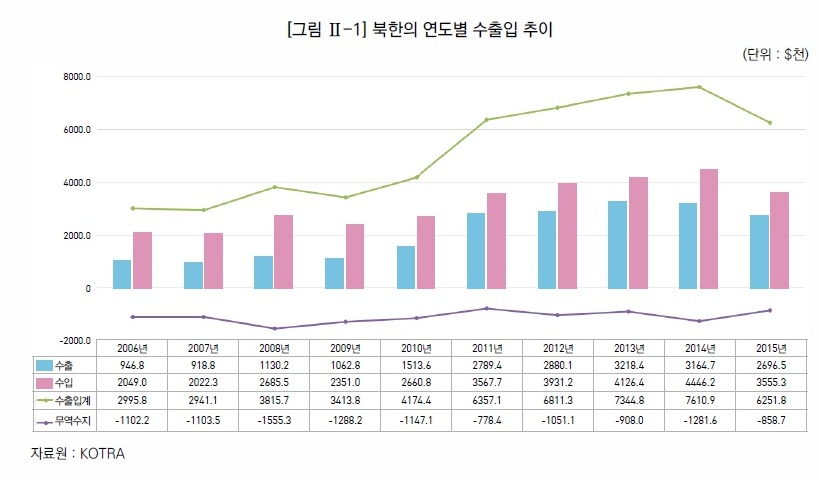
Trade between North Korea and China in January has increased roughly 16 percent against the previous year. After the December 2013 purge of Jang Song Thaek it was predicted that trade between the two countries would decrease; however, there is no visible sign of this yet.

According to the Korean Foreign Trade Association’s data, trade between North Korea and China in February increased from 471 million USD to 546 million USD, up 15.9 percent compared to the previous year.

February also showed an increase in anthracite exports, North Korea’s main export to China, rising 21.3 percent to 102 million USD. Iron ore exports also showed a slight increase of 35 million USD compared to last year.

Chinese exports to North Korea, including leading export commodities such as cellular phones and other wireless radio/communication devices, increased 28 percent compared to January of last year, totaling 14.5 million USD. In February, goods exported through China to North Korea increased by 10.2 million USD, a 38.6 percent increase compared to January of last year.

Share

Zimbabwe signs $5m contracts with DPRK for statue and museum

Wednesday, March 12th, 2014

According to the Christian Science Monitor:

The cost of Bona Mugabe’s wedding on March 1, attended by the heads of state of South Africa, Zambia, and Equatorial Guinea at Mugabe’s private home in Harare’s plush Borrowdale suburb, cost $5 million.

Just after the wedding, plans leaked out that Mugabe’s Zanu (PF) government clandestinely signed North Korea, one of its old friends, to build two statues of Mugabe at an estimated cost of $5 million.

The statues were commissioned by the minister of local government, Ignatius Chombo.

One is a nearly 30-foot high bronze image worth $3.5 million to be placed in Harare; the other is a $1.5 million version to be placed in a $3.8 million museum to be built in Mugabe’s rural Zvimba home, in Mashonaland West. Building statues of leaders is something North Korea has considerable experience doing.

Read more about the story at Bloomberg and Bulawayo 24.

I have documented many of North Korea’s Africa projects on this web page.  See here.

Read the full story here:
Mugabe splashes $5m on N. Korea statues
Christian Science Monitor
Mxosili Ncube
2014-3-12

Share

Hong Kong firm signs onto Sinuiju Economic Development Zone

Wednesday, March 12th, 2014

Sinuiju-SEZ-2014-2

Pictured Above (Google Earth): The approximate borders of the Sinuiju Special Economic Zone.

According to Yonhap:

North Korea has joined hands with a Hong Kong-based company to develop the country’s northwestern border city of Sinuiju into a special economic zone, a North Korean official said.

Sinuiju, which borders China’s Dandong city, has drawn much attention from foreign investors for its geographical advantage as North Korea’s western gateway to China, Ri Chol-sok, the vice chairman of North Korea’s economic development committee, said in an interview in the March issue of Kumsugangsan magazine, a North Korean government mouthpiece.

“Now a joint development company has been established for the development of (Sinuiju) and is striving to win back lost opportunities,” said the North Korean official.

Hong Kong-based conglomerate Great China International Investment Groups Ltd. reportedly signed the deal with North Korea.

North Korea is also making efforts to lure foreign investment to other special economic zones, including one in the Rason area in the northern tip of the country, according to Ri.

The foreign company already has deep ties with the North, having joined the country’s project launched in January to renovate the eastern part of the capital Pyongyang.

The Institute for Far Eastern Studies (IFES) reported the following:

It has been reported that North Korea has established relations with a Hong Kong-based company with the goals of developing Sinuiju, a city bordering China in the northwest region of North Pyongan Province, into a special economic zone (SEZ). Vice Chairman of North Korea’s Committee for Economic Development Ri Chol Sok emphasized the nation’s efforts to attract foreign investors to the Sinuiju economic zone in an interview in the March issue of Kumsugangsan, a North Korean government magazine.

Vice Chairman Ri specifically mentioned that, in the past, Sinuiju garnered praise and attention from foreign investors due to its geographically advantageous location along the western border. Ri also announced the establishment of the Sinuiju-Great China joint venture development company, which plans to draw further interest and investment from abroad.

It is reported that the Sinuiju-Great China joint venture development company was created alongside a Hong Kong-based finance conglomerate known as Great China International Investment Groups, Ltd. (“Great China Groups”). Great China Groups has recently shown great interest in investing in North Korea and recently began the construction of East Pyongyang Commercial Street this past January.

Recent reports from other foreign media outlets have shown that Great China Groups had intentions to invest in the development of the Sinuiju region for some time, but Vice Chairman Ri’s announcement marks the first time that North Korean state media has officially recognized their joint development plans.

Meanwhile, the North Korean foreign publicity website Naenara announced that development of an additional economic development zone (EDZ) in North Pyongan Province along the Amnok (Yalu) River began on January 27 of this year. The Amnok (Yalu) River economic development zone will extend 6.6 square kilometers, with construction taking place in Ryongun-ri and continuing up to the Guri and Ojok Islands, where the North Korean border meets the city of Dandong and the Hu Mountain in China’s Liaoning Province.

North Korea plans to draw in tourists visiting China’s Hu Mountain to Ojok Island, where an “international services station” will offer food, entertainment, and tourist attractions. There are also plans to develop a modern agricultural sciences research complex on Guri Island that will specialize in flower and vegetable production.

North Korea specifically pushed for this location for the development of the Amnok (Yalu) River economic development zone — which will operate autonomously in Pyongan — due to its border location with China. In addition to its desirable geographical location, convenient transportation between the two nations will likely attract more attention from Chinese foreign investors, giving the Amnok (Yalu) River EDZ a higher chance of success compared to other economic development zones.

Investments reaching upwards of 240 million USD (approx. 260.3 billion KRW) make the Amnok River EDZ the largest in scale among the 13 total development areas.  In terms of actual size, however, the largest economic development zone in North Korea is the Shinpyong tourist development zone (8.1km2), located in North Hwanghae province.

Apart from the EDZs in the North Pyongan region of Sinuiju, the central government has announced their plans to push forward with two other special economic zones. The Hwanggeumpyong and Wihwa Islands SEZ was announced in June 2010, and in November of last year, plans were revealed to develop an additional special economic zone in the Sinuiju region.

All the economic development zones are listed here. Some people say there are 13 of them. Some people say 14 because they consider the Sinuiju Special Economic Zone an economic development zone. I am in the 14 camp. There have also been at least three other zones proposed that did not make the final list. 

The Sinuiju Special Economic Zone was announced on 2013-11-21 (the same day as the other 13 EDZs were announced–though in a different article).

Besides the Sinuiju Special Economic Zone, the only other EDZ to have reportedly made any progress is the  North Hamgyong Provincial Onsong Island Tourist Development Zone.

Read the full story here:
N. Korean, Hong Kong firms to develop border city of Sinuiju
Yonhap
2014-3-12

Share

DPRK as e-waste conduit

Thursday, March 6th, 2014

According to Bloomberg:

How did North Korea become the conduit by which thousands of tons of old junk moved from the developed world into China’s bustling e-waste recycling industry?

As with any smuggling story, the tale starts with a prohibition. In this case, Chinese laws and regulations prohibit e-waste — most commonly understood as old, non-working electronics like laptops, monitors and mobile phones — from being imported into the country. The reasons are several, including a government interest in keeping used foreign goods from competing against new ones, and environmental concerns about how some of those goods are recycled. Nevertheless, China’s national-level environmental and customs authorities have long struggled to maintain those prohibitions against local ports and authorities — especially in south China — who view e-waste recycling as a good source of jobs, tax revenue, and used components to drive local industry. Of the several conduits through which e-waste has traditionally been smuggled, the most common and long-standing was over the Hong Kong-China border.

That all changed in February 2013 when — for reasons that are still unclear — Beijing announced “Green Fence,” a high-level crackdown on the import of prohibited waste and recycling exports, including old electronics. Nonetheless, here and there, imported old electronics still turned up in Chinese recycling facilities (I personally saw them).

The likely means, as described in state media after the North Korea bust, was convoluted. A Hong Kong “gang” allegedly received containers of used electronics from abroad. They arranged for them to be placed them on smaller ships bound for a “country in Northeast Asia.” The culprit’s identity is clear from the awkward phrasing. Criticism of North Korea in the Chinese press is exceedingly rare and -– needless to say — connecting the country to an e-waste smuggling ring qualifies as criticism. Were the country Japan, or even South Korea, it would have been named.

In fact, North Korea has long been rumored to be an e-waste recycling center. Since January 2008 a Chinese company based in Liaoning Province along the border has advertised for scrap to feed its e-waste recycling operations in North Korea itself. The facilities are located, according to the ad, in the port of Nanpo, and “take advantage of North Korea’s environmental policies and inexpensive labor resources.” There, the ad promises, prohibited e-waste can be dismantled and transformed into a product acceptable for export to China.

The smuggling ring was allegedly doing something similar, although its “transformed” e-waste clearly did not meet environmental standards. In North Korea the bulky e-waste was dismantled (steel cases would be removed from old desktop PCs, for example), segregated into marketable components like computer chips for re-use, and then sent to Dandong, a Chinese city and port on the Yalu River, directly across from North Korea. From there, the goods were trucked south, to recycling and re-use centers in Guangdong Province, a straight-line distance of roughly 1,800 miles.

Read the full story here:
Did North Korea Recycle Your Laptop?
Bloomberg
Adam Minter
2014-3-6

Share

DPRK fertilizer imports (2013 – Jan 2014)

Tuesday, March 4th, 2014

According to Yonhap:

North Korea’s fertilizer imports from China skyrocketed in January from a year earlier, data showed Tuesday, pointing to Pyongyang’s efforts to increase agricultural output.

The North brought in 35,113 tons of Chinese fertilizer in January, a huge increase from 2 tons from a year earlier, according to the data by the Korea Rural Economic Institute (KREI).

Such an amount is unprecedented for January, as the impoverished communist country used to buy a limited amount of fertilizer in winter, according to KREI experts.

The January figure is also two times bigger than the 17,416 tons for December, according to the data.

“Different from its previous pattern of buying fertilizer in spring, North Korea seems to be taking a very proactive move to secure fertilizer a long time ahead of its usual schedule. This means that the North is putting a priority on improving its farm output,” said KREI researcher Kwon Tae-jin.

It is in line with its leader Kim Jong-un’s policy goal of boosting food production, experts said.

In his New Year’s message, the young leader said all efforts “should go for agriculture … in order to build a strong economy and to improve the people’s livelihoods.”

Last year, Pyongyang bought a total of 207,334 tons of fertilizers from China, down by 18 percent from the previous year.

“This year, the trend is expected to be reversed given the January data and the fact that China has lowered duties,” Kwon added.

Read the full story here:
N. Korea’s fertilizer imports from China soar in Jan.
Yonhap
2014-3-4

Share

Prospects for North Korea’s anthracite exports to China

Monday, March 3rd, 2014

Institute for Far Eastern Studies (IFES)
2014-3-3

For North Korea, anthracite exports are a major means of foreign currency earnings and the country’s top export item to China. Exports are expected to continue to rise this year.

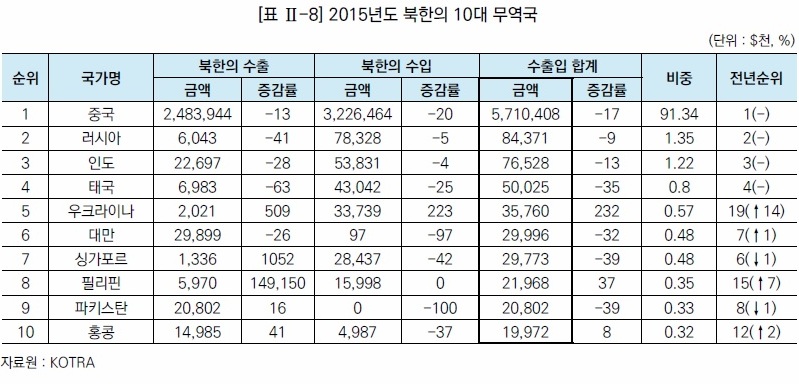
China’s year-on-year import of anthracite from North Korea increased 39.7 percent (16.49 million tons) from the previous year, accounting for 41.5 percent of the total amount of anthracite import for China (39.66 million tons). North Korea has now surpassed Vietnam as the top exporter of anthracite to China.

Other than natural resources, North Korea has virtually no other major export commodities to offer. The recent standstill in inter-Korean economic cooperation and toughened international sanctions has made it difficult for North Korea to earn foreign currency. Thus, North Korea has pushed for a steady increase in its hard coal exports to China. North Korean anthracite is considered to be of relatively high quality, maintaining a higher unit price (10 USD/ton) than Vietnamese anthracite.

Currently, China’s steel industry is the largest consumer of the North Korean anthracite, with the main consumers being local steel companies in Liaoning, Hebei, and Shandong Provinces, as they are geographically closer to North Korea and have easy access to shipping ports.

The market for North Korean anthracite is expected to expand. Since last year, the Chinese government began to implement wide-ranging air-pollution management measures. As a result, Chinese authorities designated the Hebei Province and the surrounding areas of Beijing and Tianjin municipalities as key areas to improve and control air pollution. With the help of allocated subsidies from the central government, local governments began to distribute hard coal briquettes to homes in farming villages. China’s major anthracite producing areas are in remote mountainous regions. So the demand for North Korean anthracite briquettes is anticipated to increase.

Late last year, the former head of the (North) Korean Workers’ Party Jang Song Thaek was accused, charged and executed for, among other “anti-state activities,” selling the country’s “precious [natural] resources” (presumably to China) at very cheap prices. But his execution does not appear to have made a significant impact on the anthracite trade between the DPRK and China. With China’s growing demand for North Korean anthracite, the export volume is expected to rise.

However, some argue that despite the growing demand North Korea’s coal production capacity is limited and will experience difficulties. Currently, North Korea has already suppressed significantly its domestic demand in order to meet the export volume. North Korea’s mining facilities are said to be old and badly in need of repairs, but large investments from Chinese companies that could be put toward this endeavor are reported to have dried up.

Share

UN WFP gives DPRK $3.2m assistance in Feb 2014

Friday, February 28th, 2014

According to Yonhap:

 The U.N. food agency has provided emergency food aid worth US$3.2 million for children and pregnant women in North Korea earlier this month, according to a news report.

The World Food Program (WFP) has given the emergency funding assistance in February, Washington-based Radio Free Asia reported Thursday, citing a spokesman handling North Korean affairs.

The U.N. body has said earlier that it will close five out of its seven factories within this month that produce nutritious biscuits due to a lack of funding, the report said, amid an apparent donor fatigue over North Korea’s missile and nuclear programs.

On Thursday, North Korea fired what appeared to be four short-range ballistic missiles off its southeast coast, South Korean officials said, in a suspected reaction to U.S.-involved military exercises in the South that Pyongyang condemns as a rehearsal for invasion.

The WFP said in November that food production in the North is estimated to have been around 5.03 million metric tons in 2013, up 5 percent from the previous year.

Still, the food security situation remains serious, with 84 percent of all households having borderline or poor food consumption, according to the U.N. food agency.

A few days ago, a report titled “Protracted Relief and Recovery Operation (PRRO) 200532 “Nutrition Support for Children and Women” in DPR Korea” was released with additional data.

Read the full story here:
WFP gives US$3.2 mln in emergency aid to N. Korea: report
Yonhap
2014-2-28

Share

State Economic Development Commission and the Jang purge

Wednesday, February 26th, 2014

Two officials at the State Economic Development Commission have apparently been reinstated following their removal during the purge of Jang Song-thaek. According to Yonhap:

Kim Ki-sok and Kim Chol-jin, chief and deputy chief of the North’s State Economic Development Commission, had been sacked in connection with the purge and execution of leader’s uncle, Jang Song-thaek, in December last year, but have been reinstated after undergoing an “ideology re-education,” the source said on the condition of anonymity.

“Kim Ki-sok and Kim Chol-jin were forced to resign from the posts after being involved in the case of Jang Song-thaek, but reinstated as they were considered not so close to Jang,” the source said.

After reinstatement, Kim Ki-sok, chief of the North Korean commission, made secret visits last week to Beijing and Shenzhen, southern China, during which he met with Chinese business people, according to the source.

Here is what the Choson Ilbo had to say:

A source in Beijing said Kim visited Beijing, Shenzen, Singapore and Malaysia last week. He met with businesspeople interested in developing North Korea’s special economic zones.

Kim also met with Chinese officials who had experience in developing special economic zones, the source said. In Singapore, Kim discussed the development of a tourism zone in Wonsan.

But he apparently returned empty-handed.

Diplomatic sources in Beijing say North Korea is poised to push for more economic exchanges with China after elections for its rubber-stamp parliament on March 9. It will form a new team to handle the initiative now that Jang and his associates have been purged.

Prime Minister Pak Pong-ju or Ri Su-yong, a deputy department chief in the Workers Party who used to manage the coffers for former leader Kim Jong-il, may pay an official visit to China, according to sources.

Read other posts about the State Economic Development Commission here.

Read the full story here:
N. Korea reinstates key officials on economic projects with China
Yonhap
2014-2-26

Share

UN World Food Program operations in DPRK: 2012 Audit

Monday, February 24th, 2014

The UN Office of Inspector General has published a report on the UN World Food Program’s activities in the DPRK throughout 2012. You can read it below (PDF):

Internal Audit of WFP Operations in The Democratic People’s Republic of Korea (DPRK)
Office of the Inspector General Internal Audit Report AR/14/01

Below are the key results of the audit given in the summary:

Positive practices and initiatives
4. A number of positive practices and initiatives were noted, among them, the stable working relationship between WFP and the counterpart at the Ministry of Foreign Affairs, the Government National Coordinating Commission (NCC), with regular weekly meetings at the WFP office; the DPRK Government authorized international Korean speaking staff to work in the WFP Country Office; and the change in the Country Office fundraising strategy yielded commendable results.

Audit recommendations

5. The audit report contains one high-risk and 14 medium-risk recommendations. The high-risk observation arising from the audit was:

6. Programme Implementation: The Country Office did not prioritize the most vulnerable in instances of pipeline breaks nor provide assistance in accordance with the obligations outlined in the project document.

Management response

7. Management accepted all the recommendations. Work is in progress to implement the recommendations
8. The Office of Internal Audit would like to thank managers and staff for the assistance and cooperation accorded during the audit.

The report has been covered by Fox News.

Here is commentary by Stephan Haggard.

Share

An affiliate of 38 North