Archive for the ‘International Governments’ Category

1090 Peace and Unification Campaign offers aid

Monday, February 24th, 2014

According to the Joong Ang Ilbo:

A South Korean civic group sent a large shipment of food aid for North Korean infants, a major humanitarian assistance approved by the Park Geun-hye administration.

A ship carrying 26,000 cans of powdered milk totaling 22.1 tons departed for North Korea yesterday from Incheon Port, west of Seoul. The amount can feed about 13,000 babies for a month, according to the civic group 1090 Peace and Unification Campaign, which is in partnership with the JoongAng Ilbo.

The milk, worth about 340 million won ($316,868) wholesale, will arrive in Nampo, a western port city of North Korea, via Dandong, a port in China.

“At a moment of transition in inter-Korean relations with the ongoing reunions of separated families, it is a meaningful event to send the powdered milk for North Korean babies,” Lee Young-sun, chairman of the group and a former president of Hallym University, told the JoongAng Ilbo.

Along with medicine, powdered milk is needed in the North. Despite frosty relations with Pyongyang over the past few years, Seoul has frequently approved shipments of powdered milk or medicine by civic groups in South Korea. The Ministry of Unification, which is in charge of the approvals, green-lighted the civic group’s plan to send the milk on Friday.

President Park Geun-hye emphasized the need for humanitarian assistance to North Korea at a New Year’s press conference on Jan. 6.

Read the full story here:
Powdered milk sent to hungry babies in North
Joong Ang Ilbo
2014-2-25

Share

2013 Inter-Korean trade

Monday, February 24th, 2014

According to Yonhap:

Trade between South and North Korea fell to its lowest level in eight years in 2013 due to their strained relations, data showed Sunday.

Inter-Korean trade reached US$1.15 billion last year, down a whopping 41.9 percent from the previous year’s $1.98 billion, according to the data from the Korea International Trade Association (KITA).

South Korean exports to the North nose-dived 41.1 percent on-year to $531.8 million, with imports from the communist country sinking 42.5 percent to $617.2 million.

The 2013 inter-Korean trade volume was the lowest since 2005, when the figure came to $1.06 billion.

In contrast to the plunge in trade with South Korea, the North’s trade with China, its chief ally and largest benefactor, jumped 10.4 percent on-year to a record high of $6.54 billion last year, according to the data.

Between 2009 and 2014, North Korea’s trade volume with China, the world’s second-largest economy, had been growing an annual average of more than 40 percent, the data showed.


According to the Choson Ilbo:

Inter-Korean trade fell to 18 percent of the North’s trade with China, the lowest since 2005.

South Korea’s imports of textile goods and electric and electronic products from the North fell 45 percent and 43 percent, while the North’s imports of mineral and textile products from China increased 15 percent and 33 percent.

Of course inter-Korean trade was down due to the DPRK’s closure of the Kaesong Industrial Complex (KIC). Once the complex was reopened, trade began to recover.

More on China-DPRK trade in 2013 here.

Read the full stories here:
Inter-Korean trade hits 8-year low in 2013
Yonhap
2014-2-23

N.Korean Trade with China Grows
Choson Ilbo
2014-2-24

Share

The rise and fall of the Rakwon Chicken Specialty Restaurant (a case study in inter-Korean business)

Tuesday, February 18th, 2014

UPDATE 4 (2014-2-18): Western tourists are still visiting the restaurant (meaning it has a contract with KITC). The restaurant still has the sign “Rakwon Chicken Specialty Restaurant”, though it is a different color than the original. See tourist video here and here.

UPDATE 3 (2014-2-17): The Hakyoreh updates us on the fate of the inter-Korean chicken restaurant:

In 2005, Choi made his first trip to North Korea to inquire about chicken imports. Soon he had changed plans: he would open his own restaurant there selling South Korean-style chicken. Acquaintances tried to talk him out of it, but he was determined. “I went to Pyongyang and I could see there was money in it,” he recalled. And with economic cooperation between South and North at an all time high, he didn’t see much of a political risk either.

He went back and forth to Pyongyang a few times looking for partners. Finally, in June 2007, he opened up the Rakwon Chicken Restaurant, selling South Korean-style chicken on Puksae Road in the Kaesonmun neighborhood of Moranbong District. His North Korean partner provided the building and staff; Choi was responsible for the interiors, ingredients, recipes, and management system. He reached a deal where he took 70% of profits with a total investment of 500 million won (US$470,000). The opening drew a lot of media attention at the time, with write-ups in the South Korean press and foreign outlets like the Washington Post and Japan’s NHK.

Early on, he did strong business selling at fairly steep prices – the equivalent of US$11.30 for a single bird. His clientele came mainly from the city’s upper class and Chinese visitors. Sales of 100 million won (US$94,000) a year looked to be in sight. “My plan was to open up 100 restaurants in the North,” Choi said.

But in 2008, less than a year after he opened the restaurant, Lee Myung-bak took office as South Korean President. Lee’s administration put a stop to the previous decade’s policies of engagement and cooperation with North Korea, opting for sanctions and containment instead.

“There was a promise between the two sides, and I never thought that would be rejected completely,”Choi said. “Suddenly, that was the reality.”

Bit by bit, exchange ground to a halt. A March 2008 shipment of ingredients through Nampo turned out to be Choi’s last interaction. He had not yet received a single share of revenue.

Then came the announcement of the so-called “May 24 measures” in 2010. Following the sinking of the ROKS Cheonan warship the preceding March, Seoul had called a complete halt to all exchange and economic cooperation with North Korea.

“All the May 24 measures did was drive it home,” Choi insisted. “Most of the economic cooperation had been choked off long before that.”

For the next four years, Choi wasn’t able to set foot in North Korea. Without his support, the restaurant lost its chicken focus and began selling ordinary cuisine. Choi’s other business began to suffer too.
“I’d put my house and buildings up as collateral to borrow the 500 million won to invest in the North,” he said. “Then, to top it all off, there was the US financial crisis. Things began to go downhill rapidly in South Korea, and my business started to fall apart.”

UPDATE 2 (2009-1-1): The BBC offers an update of the new chicken restaurant:

The governments may not be on the best of terms but a South Korean businessman seems to have found a way to North Koreans’ hearts: their stomachs.

Choi Won-ho, the owner of a fried chicken chain, was told he was doomed to fail when he opened his first branch in the impoverished North last year.

But encouraged by his progress so far, he is already preparing to open another one.

Mr Choi runs a fast food franchise in South Korea with a total of 70 stores.

He opened one more last year – no real challenge you might think – except this extension to his fried chicken empire is in the heart of one of the most secretive and business-unfriendly places on the planet.

But Mr Choi says the citizens of Pyongyang have been queuing in front of his shop which is taking around $1,000 a day.

He is now preparing to meet North Korean officials in January to finalise the approval for a second outlet.

His customers are almost certainly all members of North Korea’s elite, a country in which the World Food Programme says up to 9m people will face urgent food shortages this winter.

Relations between the two Korea’s have been at a low since the conservative government of President Lee Myung-bak came to power in the South in February.

North Korea has severed official contacts, stopped all cross-border tourism and restricted entry to a joint industrial zone built with southern money.

But despite the chill, Mr Choi’s fried chicken venture seems to be sizzling.

Read the full story here:
South Korea Chicken Success in NK
BBC
John Sudworth
2009-1-1

UPDATE 1 (2008-11-1): The restaurant is set to open in February 2008. According to Yonhap:

An inter-Korean joint-venture chicken franchise will open its first store in Pyongyang early next month, the head of the franchise’s South Korean partner said Friday.

The store set to open in early February will provide a food delivery service using motorbikes for the first time in the communist country, Choi Won-ho, president of the South Korean company said.

No North Korean restaurants offer food delivery service now, according to defectors from North Korea.

Fried, grilled and steamed chicken dishes as well as draft beer are available for delivery, he said, adding the food will be prepared in the North Korean style.

“I recently received a photo of the store’s interior design from our North Korean business partner, Rakwon General Trading Corporation, along with the offer to open the first store before the 66th birthday of North Korean leader Kim Jong-il,” Choi told Yonhap News Agency by phone. “After opening, I will use radio and newspaper ads to promote the business.”

Kim’s birthday, which falls on Feb. 16, is the most festive holiday in the North.

The North Korean company will provide land, some 20 low-cost workers, chicken, and draft beer. The early-stage investment, equipment, cook and spicy chicken will come from the South Korean chicken franchise called “Matdaero Chondak,” Choi said.

The first “Rakwon” chicken restaurant in Pyongyang will have the capacity of seating about 200 people, he added.

The businessman said he will visit North Korea next week to discuss the opening of the store.

“I hope the business will thrive enough so that we can open store No. 10 in Pyongyang,” he added.

Read the full story here:
Inter-Korean joint venture chicken franchise to open first store in Pyongyang
Yonhap
1/11/2008

ORIGINAL POST (2007-11-3): A South Korean entrepreneur is investing in a new fried chicken restaurant in Pyongyang:

According to Reuters:

A South Korean businessman plans to begin a fried chicken delivery service in the North Korean capital, with the first foreign-run restaurant in a country that struggles to feed its own people.

Choi Won-ho, head of a fried chicken franchiser that has about 70 restaurants across South Korea, said Friday he is opening a 50-table restaurant in Pyongyang on Nov. 15. It will also deliver chicken and draft beer to homes.

“I have wanted to be the world’s best chicken brand,” Choi told The Associated Press in a telephone interview.

“But I thought it makes no sense to conquer the world without sharing food with our compatriots. That’s why I went there first,” he said. “I plan to get into the Chinese market via Pyongyang.”

He laughed off concerns his venture may be too risky in the impoverished and isolated country of 23 million, where the elite citizens of the capital are much better off than others.

“I don’t think that I’m going to lose money at all,” he said.

It will be the first foreign-run restaurant in North Korea, according South Korea’s Unification Ministry.

Choi, 48, who has been in the fried chicken business for 15 years, said he hired an ethnic Korean Chinese as the main cook for the Pyongyang outlet and taught him all his cooking know-how. About 20 North Koreans will also work at the restaurant and five scooters will be used for deliveries, he said.

Choi said he invested about 500 million won (US$551,339, ?382,264) in the joint venture with a North Korean trading firm that will take 30 percent of the profits from the business.

North Korea is one of the poorest countries in the world and has relied on foreign food aid to feed the population for more than a decade since natural disasters and mismanagement devastated its economy.

Relations between the two Koreas have improved significantly since their first-ever summit in 2000, spurring a series of exchange projects between the Cold War rivals that fought the 1950-53 Korean War. That conflict ended in a truce, not a peace treaty, leaving the two sides still technically at war.

According to the Joong Ang Ilbo:

South Koreans are making two very different attempts to improve the culinary life of impoverished North Koreans.

First, a South Korean fried chicken franchise will open the only foreign-run restaurant in North Korea, targeting family dining on special occasions.

Second, the labor union of a South Korean conglomerate has built a plant in Pyongyang to provide cheap corn noodles to northerners who suffer from food shortages.

Choi Won-ho, who runs Matdaero, a 70-store fried chicken franchise in the South, said yesterday he would open a restaurant in a joint venture with a North Korean state-run trading company, near the Arch of Triumph in central Pyongyang on Nov. 15.

The restaurant will both receive walk-in customers and deliver chicken and draft beer to homes. Such places are common in South Korea, but it will be the first chicken joint of its kind in North Korea.

Choi has invested 500 million won ($551,000) in the restaurant’s cooking facilities, interior decoration and delivery scooters. He will split the profit 70-30 with the North Korean firm.

Choi, 48, who has been a chicken entrepreneur for 15 years, said there should be sufficient demand despite North Korea being one of the world’s poorest countries, because he plans to offer lower prices to locals.

“I will charge about $3 for a whole chicken for North Koreans and at least $12, the same price as in South Korea, for tourists from the South and other countries,” Choi said yesterday by phone. “One whole chicken will be enough for a four-member family, so the price of $3 will not be too burdensome for special occasions.”

The store will hire about 20 North Koreans to take telephone orders, fry the birds and make home deliveries. It will have seating for 50.

Separately, the labor union of Hyundai Motor Company, Korea’s top automaker, said in a statement that it has completed an 1,800-square-meter corn-noodle plant in Pyongyang. The plant can produce two tons of corn noodles a day, it said.

Hyundai Motor’s 44,000 unionized workers agreed in August to help a South Korean humanitarian group build the noodle factory. Workers donated about 12,000 won each, 500 million won in total, for the facility.

“The plant will be a great help to relieve the food problems of North Koreans,” Chang Kyu-ho, a spokesman for the labor union, said. “Corn is a staple food for North Koreans.”

Read the full stories here:
Fried chicken franchise goes North
Joong Ang Daily
Moon So-young
11/3/2007

S Korean businessman to debut fried chicken at first foreign-run restaurant in North Korea
Reuters (Via DPRK Studies)
Jaesoon Chang
11/3/2007

Share

DPRK food situation improves slightly in 2013 / UNWFP donations at low

Friday, February 14th, 2014

According to Yonhap:

The food situation for North Korean people improved slightly last year thanks to increased food rations and more outside support, a report by the World Food Programme (WFP) said Friday.

According to the WFP report, about 46 percent of North Korean families consumed an “acceptable” level of essential nutrients in the October-December period of 2013.

About 17 percent were categorized as having “poor” food consumption, while the rest, about 38 percent, were defined as at the “borderline” level.

The report is based on a WPF survey of 119 North Korean families as well as the food agency’s interviews with North Korean authorities.

The 2013 figures mark a modest improvement from a year ago, when a similar WPF report put only 26 percent of North Koreans in the relatively well-to-do “acceptable” bracket.

About 50 percent were at the “borderline” level, while 24 percent were ranked as “poor” in the report on the food situation in the fourth quarter of 2012.

The better outcome in 2013 is attributable to more generous food rations as well as WFP’s continued nutritive support, the report noted, adding that the daily food rations for each North Korean grew to 390 grams in October last year, before further raising to 400 grams in the following two months.

Fewer North Koreans are expected to suffer food shortages in the first quarter of 2014, the report predicted, citing protein as the most needed nutrient for North Korean citizens.

Although the Yonhap report does NOT cite a source (!?!) I have found it and offer a link below:
Protracted Relief and Recovery Operation (PRRO) 200532 “Nutrition Support for Children and Women” in DPR Korea (October – December 2013)
UN World Food Program
Other WFP docs can be found here.

At the same time, UN WFP assistance to the DPRK was at an all time low in 2013. According to Yonhap:

North Korea received record-low food aid from the United Nations food agency in 2013 due to sluggish contributions from the international community, a media report said Wednesday.

Some 38,000 tons of food were delivered from the World Food Program (WFP) to the impoverished communist country in 2013, some 30 percent of the agency’s target for the year, according to the Washington-based Radio Free Asia (RFA).

It was less than half the amount sent in the previous year and the smallest since 1996 when the agency began helping the North, the report said, adding it was attributable to the WFP’s failure to raise enough funds to achieve the goal.

The amount of the U.N. agency’s food aid to the North has been fluctuating from some 136,000 tons in 2008, 50,000 tons in 2010, 100,000 tons in 2011 and 84,000 tons in 2012, according to WFP data.

Citing its dark fund-raising prospects in 2014, the WFP told the RFA that most of its factories for producing nutrition biscuits for the people there were on the verge of shutting down in February.

The daily food rations for the people in the North came to some 400 grams per person last year, far lower than the minimum recommended amount of 600 grams and the North Korean regime’s target amount of 573 grams, the WFP said.

North Korea’s food production is estimated to have been at about 5.03 million metric tons in 2013, up 5 percent from the previous year, according to the WFP report posted on its website.

The food security situation, however, is still serious, with 84 percent of all households having borderline or poor food consumption, it added.

The North’s leader Kim Jong-un put an emphasis on food production in his New Year’s message last week, saying “all efforts should go for agriculture … in order to build a strong economy and to improve the people’s livelihoods.”

Read the full stories here:
N. Korea’s food situation better a tad in 2013: WFP
Yonhap
2014-2-14

WFP’s food aid to N. Korea hits all-time low in 2013
Yonhap
2014-1-8

Share

DPRK envoy to UN replaced

Wednesday, February 12th, 2014

According to the Korea Times:

North Korea’s United Nations (U.N.) Ambassador Sin Son-ho will reportedly be replaced by Ja Song-nam, a former North Korean ambassador to Britain.

“Sin will return home after being the North’s permanent representative to the U.N. for five years and six months,” a diplomatic source was quoted as saying by local dailies.

He added that Ja, who is familiar with U.S. representatives, is a leading candidate for the position.

Ja, who also worked for the North Korean mission to the U.N., was involved in the family reunions for Korean-Americans and other issues with the United States.

However, the swap is seen as a regular exchange of personnel, given that Sin has represented the Stalinist country since 2008.

Meanwhile, the new ambassador is raising expectations that the so-called “New York Channel” could be re-activated.

It has facilitated talks between Pyongyang and Washington on several occasions, but since Jang Il-hoon replaced Han Song-ryol as the deputy ambassador in July last year, the North’s U.S. diplomatic channel has seen its role diminishing.

Read the full story here:
North Korea’s UN envoy to be replaced
Korea Times
Kang Seung-woo
2014-2-12

Share

Mongolia ratifies cooperation agreement with DPRK

Friday, February 7th, 2014

According to Xinhua:

The Mongolian government ratified a cooperation agreement Friday with the Democratic People’s Republic of Korea (DPRK) in the areas of industry and agriculture.

Under the agreement, Mongolia will provide livestock husbandry support to the DPRK and, in return, the DPRK will develop light industry using raw materials and resources of Mongolia, such as sheep wool and coal.

The agreement was finalized during a visit by Battulga Khaltmaa, Mongolian minister of industry and agriculture, to the DPRK last October.

Both countries hope the deal will expand reciprocal economic ties between the two countries.

Mongolia is rumored to be involved with the DPRK’s Sepho Tableland project.

Read the full story here:
Mongolia ratifies cooperation agreement with DPRK
Xinhua
2014-2-7

Share

A new electronic entry system launched for the Kaesong Industrial Complex

Thursday, February 6th, 2014

Institute for Far Eastern Studies (IFES)
2014-2-6

A pilot operation of the new electronic entry system, or radio frequency identification system (RFID), to facilitate the travel to and from the Kaesong Industrial Complex (KIC) was completed on January 15 and pilot operation began from January 28, 2014.

According to a Ministry of Unification (MOU) official, “The construction of the system began from December 11 last year and it was completed this month on the 15th. The trial operation period will begin from the 28th.”

The RFID system was agreed upon last September at the second meeting of the South-North Joint Committee for the Kaesong Industrial Complex in order to improve the South Korean companies’ access to the KIC.

The new RFID system will replace the paper document inspection with an electronic card system and personnel screening will be reduced to 5 seconds from 13 seconds while vehicle screening time will be reduced to 7 seconds from 15 seconds.

In particular, the reduced inspection time will facilitate the travel and ease the heavy traffic during Monday mornings and Friday afternoons: for personnel screenings, from 17 minutes to 5 minutes; for vehicle inspections, from 19 minutes to 8 minutes.

However, the existing personnel and vehicle access to the KIC which requires a 3-day advance notice still remains in effect, and the mobility of personnel and vehicles will still be strictly monitored and chaperoned by the North Korean military.

On the other hand, the fourth round of the sub-panel meeting was held on January 24 to discuss the operation of the RFID system, Internet connectivity, and simplification of customs process at the KIC.

In regards to the streamlining of the customs process, the two countries agreed to change it from ‘complete’ to ‘selective’ examination, but differences still remain over the ratio to be applied to the selective probe.

As for the issue of Internet connection, it is still in the infant stage and the two sides agreed to resume the negotiation on February 7.

Share

UN Central Emergency Response Fund

Tuesday, February 4th, 2014

According to Yonhap (via Korea Herald):

The United Nations humanitarian fund created to speed up relief efforts around the world said it allocated $15.1 million for aid to North Korea in 2013.

The Central Emergency Response Fund said on its website that it provided emergency food assistance, as well as vaccines and essential medicines, to people in the flood-affected regions especially children and women in the communist North through the World Food Program and other U.N. organizations.

In 2012, the U.N. humanitarian fund allocated $12.9 million to North Korea.

The CERF provided a total of $482 million to 45 countries across the globe last year, with North Korea being the 11th-largest recipient.

The North has relied on international handouts since the late 1990s when it suffered a widespread famine that was estimated to have killed 2 million people.

Read the full story here:
U.N. fund gives $15.1 mln to N. Korea in 2013
Yonhap (via Korea Herald)
2014-2-4

Share

China – DPRK trade data (January 2014)

Sunday, February 2nd, 2014

Yonhap reports that China – DPRK trade appears unaffected by the purge of Jang Song-thaek. According to the article:

Despite North Korea’s stunning execution of the leader’s uncle in December, its trade with China remained solid in January, up 16 percent from a year earlier, data showed Friday.

Jang Song-thaek, the country’s No. 2 man and leader Kim Jong-un’s uncle, had played an important role in dealing with Beijing before being executed late last year on treason charges. The political upheaval raised concerns over a possible instability that could spill over into other areas of the reclusive country’s moribund economy and society.

Still, trade volume between North Korea and its major trading partner China came to US$546 million in January, compared with $471 million from a year earlier, according to the data compiled by the Korea International Trade Association (KITA).

North Korean exports to China jumped 18 percent on-year to $223 million, with imports rising 14.5 percent to $323 million, the data showed.

Anthracite was the No. 1 export item for the impoverished country to its communist neighbor, selling some $101 million worth of the natural resource last month, up 21.3 percent from a year ago.

North Korea’s anthracite exports are a major source of income, and China is virtually the only destination for the shipments.

Inbound shipments of China-made cell phones soared 28 percent on-year to $14.4 million in January, the data showed.

“Trade volume between the two countries is expected to rise further given China’s growing demand for minerals for its project to develop its three northeastern provinces of Heilongjiang, Jilin and Liaoning,” said Lim Eul-chul, a research professor at Kyungnam University.

“Such political variables as Jang’s execution would not likely affect the trend,” he added.

The heavily sanctioned North Korea has been increasingly reliant on China, though the Asian giant has become frustrated with its wayward neighbor, particularly after Pyongyang’s third nuclear test early last year.

In 2013, trade volume between the two reached a record $6.45 billion last year, up 10.4 percent from the previous year, according to KITA data.

The Wall Street Journal notes:

“Bilateral trade has probably yet to feel the impact of Mr. Jang’s execution,” said Cho Bong-hyun, research fellow at Seoul-based IBK Economic Research Institute.

“Both sides are still acting on trade contracts that have already been signed and usually take effect for six months,” Mr. Cho said.

Mr. Cho said he expects the impact from Mr. Jang’s purge will begin to appear in the data from the second quarter of this year. North Korea may also increasingly turn to trade with South Korea following a thawing of ties and the reopening of a jointly run Kaesong industrial park, he said.

The KITA data show inter-Korean trade volume shrank 42% to an eight-year low of $1.15 billion last year, when the Kaesong complex was closed for several months after North Korea pulled out its workers.

North Korean-Chinese trade volume hit a record high of $6.54 billion last year, according to KITA, as North Korea exported natural resources such as coal and iron ore, while importing fuel and electronics goods.

The Korea Trade-Investment Promotion Agency, Seoul’s state-funded trade agency, said in a report last year that North Korea’s bilateral trade with China accounted for 88% of Pyongyang’s entire external trade in 2012, up from 53% in 2005.

Read the full stories here:
N. Korea, China trade unaffected by stunning execution: data
Yonhap
2014-2-28

Jang Purge Yet to Hurt North Korea-China Trade
Wall Street Journal
Kwanwoo Jun
2014-2-28

Share

DPRK-china trade at record US$6.45b in 2013

Friday, January 31st, 2014

According to Yonhap:

Trade volume between North Korea and its major trading partner China reached a record US$6.45 billion last year, up 10.4 percent from a year earlier, data showed Saturday.

North Korean exports to China jumped 17.2 percent on-year, while imports from China increased 5.4 percent, according to the data from the Korea International Trade Association.

Pyongyang’s trade deficit recorded $721 million, a 25 percent decrease compared with the previous year, the data showed.

North Korea’s major export items were minerals, with $1.37 billion worth of anthracite and $294.1 million of iron ore shipped to China last year.

North Korea’s anthracite exports are a major source of income, and China is virtually the only destination for the shipments.

The isolated socialist state heavily relied on China for crude oil, buying $598.1 million from its sole financial and diplomatic backer.

Inbound shipments of China-made cell phones fell to $44 million last year, shrinking by 26.6 percent from a year ago.

The latest data showed the heavily sanctioned North Korea is increasingly reliant on China, even though the Asian giant has become frustrated with its wayward neighbor, particularly after Pyongyang’s third nuclear test early last year.

Since these numbers are aggregated, we cannot observe if the purge of Jang song-thaek and his patronage network had any effect on DPRK/China trade at the end of the year.

The DPRK also increased oil imports from China in 2013. According to Yonhap (2014-2-10):

Shipments of crude oil to North Korea from China increased 11.2 percent on-year in 2013, a South Korean government report showed Monday, the latest sign that Beijing still gives Pyongyang access to the vital commodity despite its defiant pursuit of nuclear weapons.

North Korea imported a total of 578,000 tons of crude oil from China last year, compared with 520,000 tons in 2012, according to the report based on China’s customs data.

Monthly shipments of crude oil from China to North Korea were absent in February, June and July last year, but Beijing exported “a large amount of crude oil” to Pyongyang in the second-half of last year, the report said.

In 2013, trade between North Korea and China rose 8.9 percent on-year to reach US$6.54 billion, with the North’s exports to China jumping 18 percent to $2.91 billion, the report showed.

“Our overall analysis is that international sanctions against North Korea’s nuclear and missile programs have not reduced or shrunk the North’s trade with China,” a South Korean diplomat said on the condition of anonymity.

Here is coverage in the Daily NK.

Additional information:
1. Imports of grain were up. Food aid imports from UN were down.

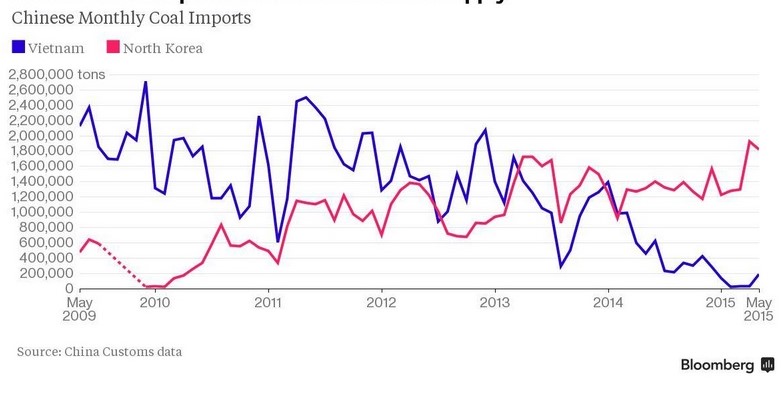
2. Coal exports to China up.

3. DPRK visitors to China up.

Read the full stories here:
Trade between N. Korea, China hits record $6.45 bln in 2013
Yonhap
2014-1-31

N. Korea’s crude oil imports from China rise 11.2 pct in 2013
Yonhap
2014-2-10

Share

An affiliate of 38 North