Archive for the ‘Civil society’ Category

Koryo Tours August 2008 Newsletter

Saturday, July 26th, 2008

Koryo Tours has tremendous access to the DPRK and they are pursuing several interesting projects.  Check out their newsletter here.  Of special note, there will be two different mass games performances this summer/autumn.  From the newsletter:

As before the big news though in terms of tourism in DPRK is the Mass Games event – this year for the first time two different performances have been arranged with the classic Arirang show being performed on Mon, Wed, Fri and Sat, and the brand new, not-yet-seen (even by the critics!) Prosper the Motherland! taking place on Tuesdays and Thursdays. Both of these shows feature the full complement of 100,000 performers in the May Day Stadium and both will run to approx 90 minutes offering anyone who s there the chance to witness what is simply the greatest show on Earth, some information on the events can be found here. The Olympics will pale in comparison… a double dose of Mass Games will undoubtedly be vastly superior to the sight of amateur athletes running around in circles and throwing things!

Also, Nick Bonner is producing a new (non-documentary) film in North Korea. The plot, according to the newsletter:

Comrade Kim goes Flying – we are in development with our new romantic comedy feature film…to be filmed in Pyongyang with Korean cast and crew….more about this later – but a coal miner dreams of flying on the trapeze until she is thwarted by the strong man….

UPDATE: Here is an interview with KT’s Simon Cockerell on Interview Blog.

Share

DPRK Cabinet adopts ‘Border region management provision’

Tuesday, July 22nd, 2008

Institute for Far East Studies (IFES)
NK Brief No. 08-7-22-1
7/22/2008

On July 18, the North Korean Cabinet publication, “Democratic Choson’, revealed that the cabinet had recently adopted the ‘Border Bridge Trade Complex Management Activities Provision’.

According to the newspaper, the provision spells out to whom the rules and regulations must be applied regarding the orders and management activities of the border bridge trade complex. In addition, “by being adopted, the provision firmly creates regulations on foreign economic activities that cross over border bridges and has prepared the legal support for unceasing improvements of the border bridge trade complex’s management activities.”

North Korea relies on border trade with Chinese areas such as the city of Dandong, in Liaoning Province, and the Yanbian Korean Autonomous Prefecture, as cross-border trade shot up to over 200 million USD last year.

Share

Tom and Jerry

Tuesday, July 22nd, 2008

tomandjerry.jpg

I am told that in the 1980s Tom and Jerry was a poplar show on DPRK and USSR state television.  In the DPRK they even kept the names Tom and Jerry.

Share

DPRK competes in International Mathematical Olympics

Monday, July 21st, 2008

UPDATE: I know all of you were wondering how the DPRK fared in the 2008 International Mathematical Olympics!  It is certainly the most under-reported story of the year!

North Korea improved over last year’s performance to capture 7th placeThe team’s individual results can be found hereUn Song Ri led his team to victory scoring a 97.94% and capturing 12th place individually.

Scoring ahead of the DPRK: China (PRC), Russia, USA, Republic of Korea, Iran, Thailand. 

ORIGINAL POST: I was perusing the Korean Friendship Association web site this morning, and noticed this post:

Author: Alejandro Cao De Benos
Subject: International Mathematic Olympics

A Delegation of 6 DPRK students (16 to 19 y.o.) and 2 professors from KIM IL SUNG University and Pyongyang Middle School Number 1, are now in Madrid to participate in the International Mathematic Olympics.

On 15th will be the opening ceremony, 16th and 17th the exams. 21st will be the closing ceremony. (100 countries participate)

After the exams, they are invited by the organizing Committee to tour Madrid city center, Aranjuez, Toledo, Salamanca and enjoy typical Flamenco dance.

I just said goodbye to them after sharing 5 days in the capital. They are studying day and night, eager to get the best marks in the competition.

Ri dongji, best of success for all the team!!

This competition originates in the former USSR and Warsaw Pact countries.  Some quick background info can be found on the competition’s Wikipedia site and official site.

Here are the annual results (grouped by country) since the competition started in 1959.  Of all these years, the DPRK (PRK) only competed in 2007-Hanoi (8th place – see team results here), 1992-Moscow (16th place – team results here), 1991-Sweden (Disqualified – the only team ever disqualified.  Not sure why—anyone out there know?), and 1990-Beijing (19th place – team results here).  Here are the results for all the individuals who have competed on the DPRK team.

Here is where the 2008 team’s results will be posted.  The web page gives a contact name (Ham Yong Chol) and email address.  Some enterprising journalist out there should try to get a story.  

Share

(UPDATE) China asks some North Koreans to leave ahead of Olympics

Monday, July 21st, 2008

UPDATE 2: According to the Associated Press:

[A South Korean] NIS official, who asked not be named, citing an internal policy, told The Associated Press that China had no plans to close all bridge links with North Korea “out of concerns of diplomatic friction with North Korea.”

The official also said China would not ask all North Koreans in China to leave, saying that Beijing plans to crackdown on North Koreans who illegally stay in China and Beijing plans to restrict renewing visas for North Koreans. 

UPDATE 1:  According to the Associated Press, China plans to close all the bridges to the DPRK during the Olympics, starting next month.  This will have a devastating impact on trade with Sinuiju, Manpo, Hyesan, Hoeryong, and many other trading hubs along the Chinese border.

ORIGINAL POST: According to an interesting article in Bloomberg (thanks to reader) China is acting to reduce the chances that North Korea issues will interfere with coverage of the Olympic games in Beijing this summer.

According to the article:

China asked some North Korean work units to leave the country or move their business operations during the Olympic Games, according to documentation from the North Korean embassy obtained by Bloomberg News.

Citing security issues, China asked North Koreans, except trade representatives and government-dispatched personnel, to leave by July 31 and not return until the end of September, the Korean-language statement said. The embassy in Beijing gave the order to North Koreans in a July 11 directive, according to a copy of the document obtained by Bloomberg News.

The order took effect from July 13 and those who delay departure would be fined or not allowed to reenter China, according to the document. Workers scheduled for dispatch to China from July 1 should delay their departure until Sept. 25, it said.

and…

It isn’t clear how authoritative the directive is. Five North Korean businessmen contacted by Bloomberg news provided different departure dates, or said they were not affected by the directive. The people refused to be identified in print, citing possible recriminations.

A press attaché at the Chinese embassy in Tokyo who declined to give his name said he wasn’t aware of the directive and that there would be no way to confirm its existence.

Read the articles here:
China asks some North Koreans to leave ahead of Olympics
Bloomberg
Hideko Takayama
7/15/2008

Report: China to shut down all bridges linked to NKorea during Olympics
Associated Press
7/21/2008

China to step up inspections at border with North Korea during Olympics to stop migrants
Associated Press
Kwang-Tae Kim
7/22/2008

Share

DPRK bolsters social security laws

Monday, July 21st, 2008

Institute for Far Eastern Studies
NK Brief No. 08-7-17-1
7/17/2008

Recent transformations in the North Korean economy and society have led the government to draft policies to link the social welfare matrix to the social security law. The ‘Democratic Chosun’, a publication of the Central Peoples’ Standing Committee and the Cabinet, has on five occasions (April 3 and 4, May 14, 16, and 23, 2008) run articles titled, “Regarding the Social Security Law,” explaining recent changes to the law and its affects on the North’s social welfare.

This law contains six sections and 49 articles, the purpose of which is to strictly establish the structure and methodology of the nation’s social security system, and to protect the health of the people while providing them with secure and happy lives. Details of the law have not yet been made available.

North Korea established the National Social Security Law on August 30, 1951, although it was not actually enforced until after the April 14, 1978 Socialist Labor Law was passed. North Korea’s social security system is a means with which to control the country’s socialist economy, and also acts to restrict the lives of the people, as well. From when the September 8, 1948 Constitution was passed right up until today, North Korea has provided its people with social insurance and social security systems. Society’s sick, feeble, and handicapped receive treatment assistance or material support from the social insurance system.

By looking at past transitioning countries, one can see that transforming systems and quickly changing social and economic structures lead to linking of social security with social welfare in order to protect the society’s weak. In North Korea, the passing of the July 1, 2002 Economic Management Reform Measures and other sudden changes in the social and economic environments raised concerns regarding the issue of protecting the country’s most vulnerable. Combined with the North’s food shortages, the protection of the society’s elderly, children, pregnant, and other vulnerable elements has become a special issue of concern for North Korean authorities.   

NKeconWatch commentary:
This article surprised me.  Aside from this post, IFES updates are pretty well researched.  Does anyone really believe that the dejure intent and defacto incidence of legislation in North Korea are the same?  You would have to be completely ignorant of life in any communist country to actually believe the statement, “From when the September 8, 1948 Constitution was passed right up until today, North Korea has provided its people with social insurance and social security systems. Society’s sick, feeble, and handicapped receive treatment assistance or material support from the social insurance system.”

Not only is health care under-supplied in the DPRK, it is also not provided free-of-charge.  I am told by people who have had to obtain health care in the DPRK that you generally have to pay bribes to get access.  This was the reality of life in most communist countries. Here is a much better analysis of the supply of health care in the DPRK. 

As for the concern of North Korean authorities to maintain a social safety net during a difficult economic transition, this is no doubt true for a number of DPRK policy makers.  But the people who actually make decisions are still siding with security hawks who refuse to give aid workers and NGOs the freedom they need to effectively help people.

Share

GPI Consultancy: Economic Mission to North-Korea

Wednesday, July 16th, 2008

Netherlands Centrum voor Handelsbevordering
27 September – 4 October 2008  
View the information flyer with more information here: it-tour_dprk.pdf

For the past decades, the Democratic People’s Republic of Korea (DPRK) also known as North-Korea has been one of the most isolated countries in the world. Until recently, foreign companies could hardly enter this country. Inspired by the economic successes of its neighbouring country China, North-Korea has since a few years opened its doors for foreign enterprises. The DPRK established several free trade zones to attract foreign investors. In 2002 North Korea started to experiment with the Kaesong Industrial Region, near the South-Korean border. Moreover, other areas were designated as Special Administrative Regions, such as Sinŭiju near the border with China.
 
Currently, China and South-Korea are the most important trade partners of North-Korea; their mutual trade is growing fast. Also for European companies there are many opportunities to trade with North-Korea. During the recent seminar: ‘Doing Business with North-Korea’ (The Hague, 30 May) the representative from North-Korea highlighted that there are business opportunities in several fields, including Textile Industry, Shipbuilding, Agro Business, Logistics and Information Technology.

DPRK finds itself at the beginning of a new era of openness. In North-Korea there is a need for many foreign products and investments. The Chamber of Commerce Amsterdam, GPI Consultancy and the Netherlands Council for Trade Promotion are organizing an economic mission to investigate the business opportunities for foreign companies in this country. This unique economic mission to North-Korea will take place from 27 September to 4 October 2008. Our partner in North-Korea is the Pyongyang Chamber of Commerce. Mr. Renze Hasper, Member of the Board of the Chamber of Commerce Amsterdam, will be the mission leader of this economic mission. 
 
The program includes individual matchmaking, company visits, network receptions and dinners. Furthermore, a visit is being planned tot the Kaesong Industrial Region.

GPI Consultancy is responsable for the IT-program of the mission. As an example, the program for the IT-delegates has been attached; they will visit firms in Pyongyang in the field of software development, animation, cartoons, computer games and BPO (Business Process Outsourcing). Similar matchmaking visits will be arranged for delegates from other business sectors.
  
The mission is open for participants from other countries as well.
If you are interested in joining this trade mission, please contact:

Paul Tjia
GPI Consultancy
P.O. Box 26151,
3002 ED Rotterdam,
The Netherlands
E-mail: [email protected]
tel: +31-10-4254172 
fax: +31-10-4254317
Website: www.gpic.nl 

Share

Pyongyang wants McDonald’s franchise?!?

Wednesday, July 9th, 2008

Incredible! 

Burger Chain ‘Rebuffed N.Korean Overtures’
Choson Ilbo
7/10/2008
 
Influential North Koreans tried to bring McDonalds into the country, but the fast-food chain declined citing lack of profitability, Radio Free Asia reported Wednesday. RFA quoted Nancy Mazeska at MacDonald’s International Franchise Division as saying the person who contacted the chain probably had “political connections” and a “history of success in North Korea.” But due to the poor infrastructure and distribution network and probable lack of demand, McDonalds decided to take a rain check.

McDonalds at one point thought about letting its franchise in South Korea handle North Korean operations, she said. She did not comment further on who the businessman was and when he contacted the company. According to North Korean press, mass-produced hamburgers were distributed in universities in Pyongyang in September 2000 at the orders of North Korean leader Kim Jong-il.

Many thoughts are running through my head:

1.  Can you imagine?  The “golden arches” right next to the Arch of Triumph in Pyongyang.  Of course the North Koreans would make sure that their “golden arches” were the largest in the world—3 meters taller than the ones in America.

2. Rumor has it that no two countries with a McDonald’s in them have ever attacked each other…with one recent exception: the bombing of Serbia in the 1990s.  Despite the fact that McDonald’s is frequently targeted by anti-American activists, the opening of a franchise in Pyongyang would in fact be a great symbol of hope.

I remember visiting the first McDonald’s in the Soviet Union just after it opened in Moscow.  I stood in line for hours to eat food that tasted exactly like it did in America (of course I was living in England at the time and their food didn’t taste much better than the Soviets’).  The reason I stood in line for so long is because so many Russians wanted to try it as well, and it was finally considered politically acceptable.  The same would probably be true of Pyongyang residents, and the line out the door would be telling.

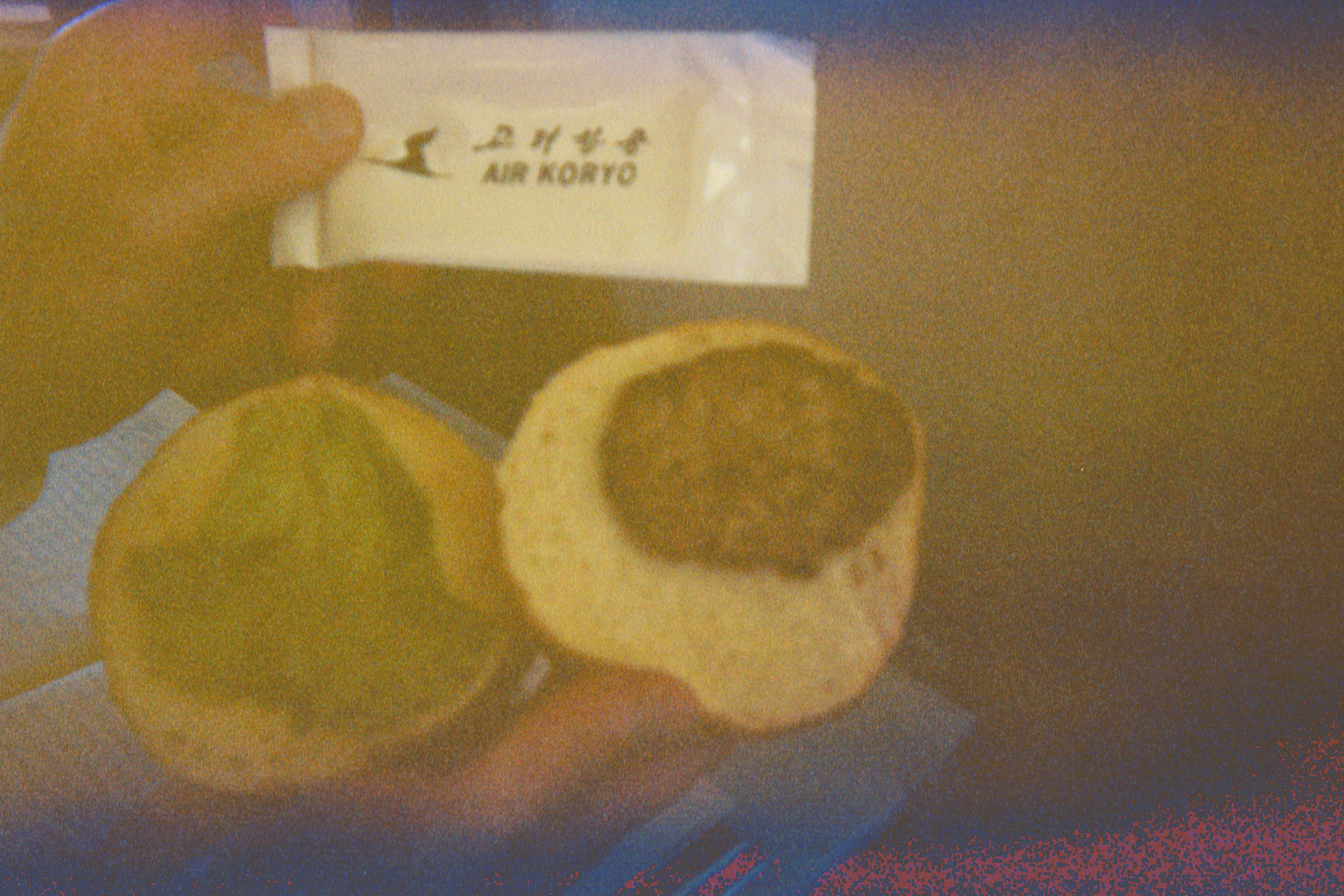
3.  The hamburger is not entirely unknown to North Koreans.  All outbound flights on Air Koryo serve a hamburger (or at least it is some kind of meat patty in a much larger bun with a piece of lettuce).  In business class, you get it on a plate.  I don’t think it is that great, but it is made in the DPRK.  Here is a bad photo I took of the alleged burger.

UPDATE: 4. ROK Drop wonders if they would have used US beef! 

Share

North Korea’s non-profit education fund

Tuesday, June 24th, 2008

Yonhap reports on the DPRK’s efforts to create an education endowment:

North Korea, which is marking the 60th anniversary of its foundation this year, has stepped up efforts to improve educational facilities across the country with help from foreign countries and overseas Koreans, a pro-Pyongyang Korean-language daily in Japan said Monday.

The program is being actively supported by Australian, Swiss, Vietnamese and Finish charitable funds as well as Korean residents in Canada, said the daily of Chongryon, or the pro-Pyongyang Association of Korean Residents in Japan.

Much of the funding is being used to construct a new building for Koryo Songgyungwan, a university of light industry in Kaesong, south of Pyongyang, and modernize educational facilities at Kimchaek University of Technology with a history of 60 years in Pyongyang, according to the report.

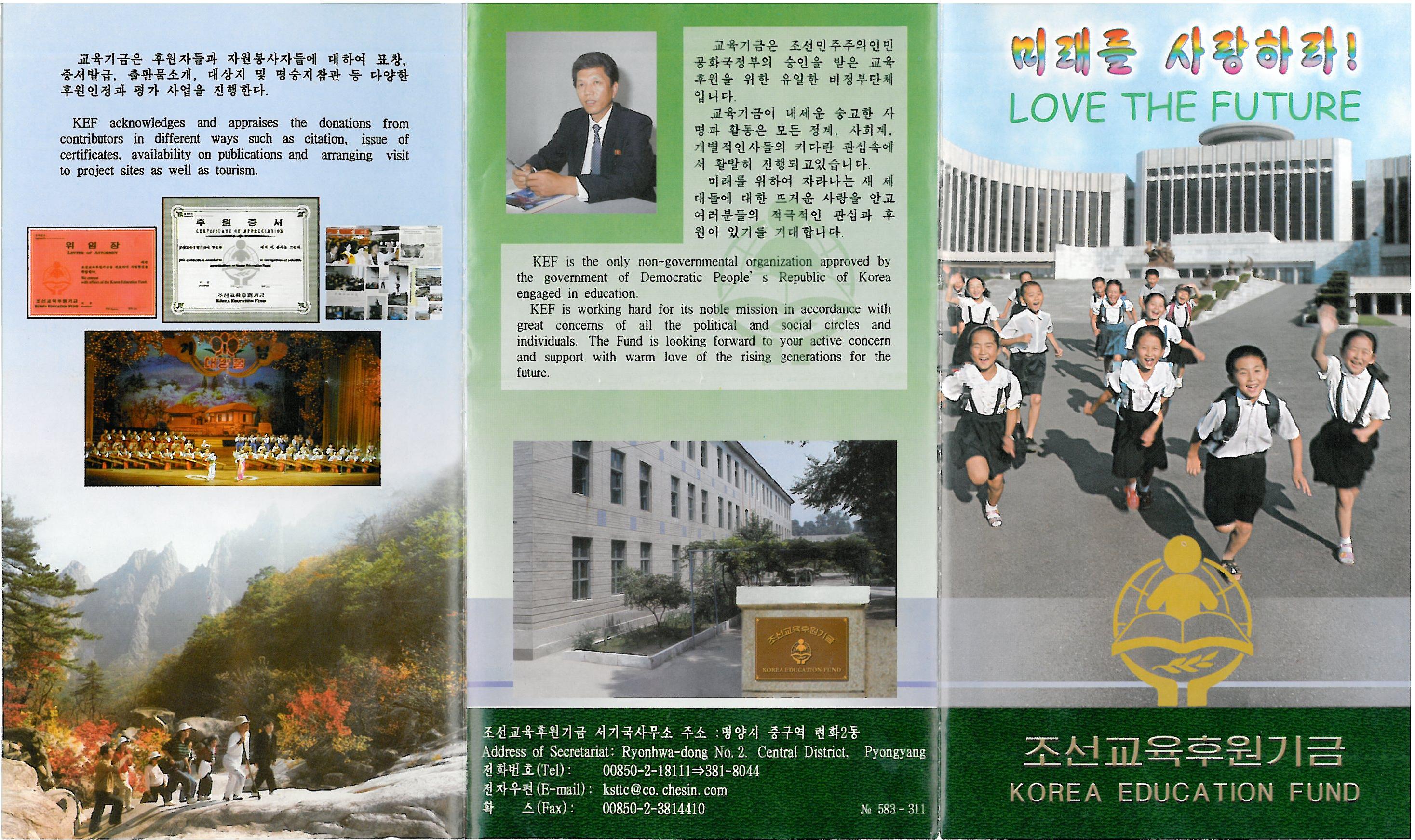
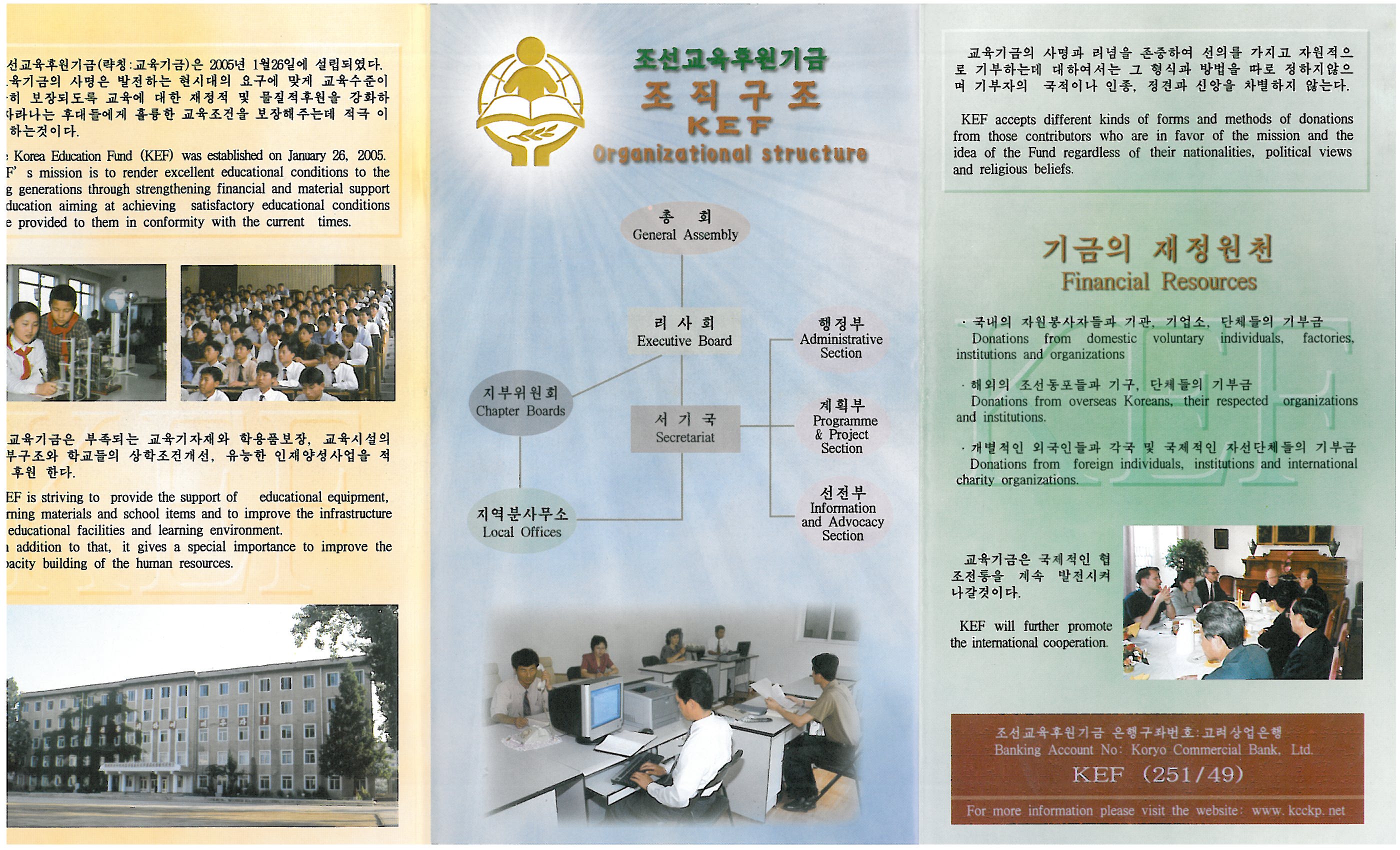
When I visited the DPRK in 2005 for the “60th anniversary of the end of Japanese colonialism (aka the end of WWII),” I picked up a brochure from this foundation—scans below:
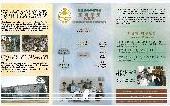
kefsmall.JPG kef2small.JPG

(Click on images to view)

It is interesting to notice just how much they have learned from the Western non-profit world, including how to reward donors:

“KEF acknowledges and appraises the donations from contributors in different ways such as citation, issue of certificates, availability on publications, and arranging visit to project sites as well as tourism.”

Contributions are not tax deductible.

UPDATE: I have not had a chance to review all this material yet, but here are some more links:

KEF official web site

Information from Naenara

From KCNA:

Korea Education Fund Set Up

Pyongyang, June 7 [2005] (KCNA) — The Korea Education Fund (KEF) has been established. It is a legal non-governmental organization for public interests. Its mission is to regulate and strengthen financial and material support necessary to develop education in accordance with the requirement of the times.

Many Koreans at home and abroad and famous political, public and educational figures and organizations have rendered a lot of material and financial backing to the DPRK in its educational work, proceeding from the lofty humanitarianism of loving peace and valuing the future.

It has made a contribution to the improvement of educational conditions and the balanced development of education.

And many figures have advanced a proposal to establish an organization in the form of humanitarian fund for the purpose of strengthening the support to the educational work and have exerted efforts to realize it. Their efforts have resulted in founding the Fund in January last through an agreement and working procedure with parties concerned.

The Fund does not fix the regional limit in general activities such as raising fund and performing support. And it decides personnel selection according to relevant program and the agreed plan on specific objects, transcending the differences in political view, religious belief, race, nationality and sex.

The KEF welcomes all donators at home and abroad who are based on good intentions and voluntary principle.

Its support will be given mainly to the insufficient educational apparatuses and school things, improvement of infrastructure of educational establishments and studying conditions at schools and to training of personnel.

The KEF regards it as a supreme principle of its work to ensure trust in donators, receivers and volunteers. And it respects all those at home and abroad that join the assistance directly or indirectly and positively cooperates with them.

It organizes the work of recognizing and appreciating the donators and volunteers in accordance with the will of receivers and the principle of the Fund’s activity. Such activities include citation, issue of certificate, hanging of board, introduction through publications and organization of tour of the objects and scenic spots.

The KEF has its accounts in the Koryo Commercial Bank and overseas agent banks.

The KEF will be conducive to developing education in the country and rearing well the rising generation, the future of the humankind. (Fax: 0085-02-3814410, E-mail: [email protected])

Read the Yonhap story here:
N.K. renovating schools with foreign donations
Yonhap
Shim Sun-ah
6/23/2008


Share

North Korean film update

Sunday, June 22nd, 2008

The Korean Film Council in Seoul analyzed North Korean films and TV dramas recorded between 2000 – 2006.  As discussed in an earlier post on this topic, initial findings indicate North Korean films made during this period differed tremedously over earlier years in that they portrayed real-life situations including husband-wife conflicts and generational differences (see A School Girl’s Diary).  

In the 1970s, films depicted the achievements of the two leaders. In the 1980s, works portrayed the happiness of citizens living in ‘our socialist society’.  The first kiss appeared in the 1980’s film, Snow Melting in the Springtime (봄날의 눈석이).  After Kim Il Sung’s death, films began to reemphasize the revolutionary tradition. The works focusing on the Kim Il Sung and Kim Jong Il revolutionary achievements were produced in order to strengthen the spiritual training of citizens.   

Read more here:
No Love Scenes or Love Triangles in NK Dramas
Daily NK
Yang Jung A
6/19/2008

Share