Archive for the ‘Civil society’ Category

Kim invited to attend Olympics

Sunday, June 22nd, 2008

Acording to the Korea Times, China invited Kim Jong il to attend the opening ceremony of the 2008 Olympics.  President Bush and Japan’s Prime Minister, Yasuo Fukuda, are still mulling their invitations.

Read the full article here:
‘North Korean Leader Invited to Beijing Olympics’
Korea Times
Kim Sue-young
6/22/2008

Share

North Korea’s continuing social change

Friday, June 20th, 2008

The Daily NK posted a fascinating interview with a local North Korean merchant.  He provides interesting anecdotes of everyday life:

Tongil Market (Featured in A State of Mind):

Nowadays, the way to survive is selling in the jangmadang (market). With the exception of the residents of the Joong-district and its vicinity, who are often mobilized to national events, seven out of 10 households do business in the jangmadang. In the Pyongyang Tongil (unification) Market alone, the number of people doing business is between 5,000~6,000 people. The size of a street-stand is approximately 50cm by 50cm large. There are also about 2,000 people selling outside of the market.”

“There are people also selling in the alleyways. The Tongil Market usually consists of people from the Tongil Street, so merchants from the other regions cannot do business there. In the Tongil Market alone, there are around 8,000 people [doing business]. Because the Market is so large, the cadres from the other regions frequently come to buy goods.”

Even in North Korea, capital enhances worker productivity: 

Mr. A said that in the markets, the sale of industrial goods (all kinds of products such as clothing brought from China) and cosmetics are supposed to be lucrative. The traders usually bring in about 5,000 won per day and 15,000 won per month. Such an amount of money can buy about 2kg of rice per day. The people who make a lot of money are the marine product merchants. They make around 7,000~8,000 won per day. Marine products are often purchased by officials who have money and rice.

The people in the lowest class do not have the capital to do business, so a majority of them sell noodles or food. They make about 1,500 won per day, which can purchase about a kilogram of corn. People who sell food sell rice, sidedishes, and snacks on site. To them, selling is a battle to survive.

Coping mechanisms:

Mr. A relayed that not-so-affluent households raise several domestic cattle, collect medicinal herbs or brew liquor to sell. The remnants of the liquor are used as livestock feed. Selling two bottles of liquor made of corn as raw material generates about 500 won in profit. However, the authorities have strictly been regulating brewing liquor in homes, resulting in difficult situations. If exposed for making liquor, both the person-in-charge and the People’s Party Unit chairman are banished to the countryside.

Beekeeping is seasonally supposed to be lucrative. In May when the acacia flowers start to bloom, the number of people who collect honey in the mountains increases. In the surrounding areas of Pyongyang, there are at least trees on the mountains, so beekeeping has been feasible. One person can collect about 100kg of honey per month by keeping around 15 beehives. The honey is usually consumed by people who want to use it in medicine or by officials.

Work overseas:

“The utmost goal of workers in Pyongyang is to go to another country to earn money. Recently, they have even gone to the Middle East, Southeast Asia, Africa, and the Democratic Republic of Congo. Once they leave, they do not return for three years. They can go back or stay in Pyongyang. Workers who have gone to Russia or to Congo for farming come back with 10,000~20,000 dollars in three years.”

“With that money, they can buy a house and prepare a significant amount of capital for business. Those who have gone abroad not only do the work ordered by organizations, but also engage in private farming, do business and save as much money as they can. There have been a quite a few people around me who have gone abroad recently to make money this way. Out of 100 male workers, there is at least one or two. In order to go overseas, one has to pay 300~400 dollars in bribes.”

Read the full article here:
Doing Business Is a Battle
Daily NK 
Jung Kwon Ho
6/18/2008

Share

DPRK economy shrinks for second year: Bank of Korea

Tuesday, June 17th, 2008

North Korea does not publish economic data.  The size of North Korea’s economy is estimated by South Korea’s Central Bank (Bank of Korea), the US Central Intelligence Agency (CIA), and other think tanks such as the Sejong Institute (Lee Jong Seok)

According to a recent report by the Bank of Korea, North Korea sufferd its second full year of economic contraction (as defined by GDP), 1.1% in 2006 and 2.3% in 2007.  The bank estimates North Korea’s 2007 gross national income (GNI/GNP) at $26.7 billion, per capita GNP at $1,152 (assuming population of 23 million).  If you are interested in knowing the difference between GNP and GDP, click here.

Here are some highlights from the report:

Agriculture, forestry & fisheries marked a 9.4% decrease following a 2.6% decrease in 2006

Mining increased 0.4% in 2007, down from 1.9% increase in 2006

Manufacturing increased 0.8%, higher than 0.4% 2006 increase. -1.7% growth in light industry, due to the decrease in food products and beverages. +2.3% growth in heavy industries led by expansion of metal and machinery products.

Electricity, gas & water production increased 4.8%, (+2.7% in 2006), from hydroelectric and steam power generation.

Construction production -1.5%, (-11.5% in 2006), from reduced non-housing construction and civil engineering.

Services +1.7%, (+1.1% in 2006). Hotel, restaurant, transport, post & telecom industry expanded.

Trade volume (goods) fell 1.8% to $2.941 billion, 1/248 South Korea’s. Exports fell 3.0%, imports fell 1.3%.

These estimates are based on trade figures obtained from the Korea International Trade Association, Korea Trade and Investment Promotion Agency, fuel and food aid figures from aid groups such as the International Red Cross and the World Food Program, as well as information provided by frequent visitors.

More information here:
Full report by Bank of Korea  and data (recomended)

North Korea’s Economy Shrank in 2007, Second Annual Contraction
Bloomberg
Heejin Koo
6/17/2008

Share

British football association donates sportswear to DPRK

Tuesday, June 17th, 2008

From Yonhap:

The British Football Association has donated some 600 items of sportswear such as gym suits and sweat pants to North Korea, a pro-Pyongyang daily in Japan said Tuesday.

The sportswear was delivered to the North Korea’s football association in a ceremony held in Pyongyang on Thursday with the British Ambassador to the country John Everard attending, the Choson Sinbo newspaper said.

Read the full article here:
British football association donates gym suits to N.K.: report
Yonhap
6/17/2008

Share

DPRK embraces comparative advantage to strenghten foreign economic relations

Tuesday, June 17th, 2008

Institute for Far Eastern Studies (IFES)
NK Brief No. 08-6-17-1
6/17/2008

According to an article run in the June 10 issue of the Rodong Sinmun, the newspaper of the North Korean Workers’ Party, economic independence “is not closing the doors and solving everything 100 percent on our own,” and stressed the fundamental rule of ‘selling what is present and buying what is missing’, otherwise known as comparative advantage*, as the key to advancing overseas foreign economic relations.

The newspaper article, titled, “The Main Principle for Maintaining the Basic Path Toward Construction of a Powerful Economic State,” explained, “In every country there are limited resources, and at the level of advancement of the economy as well as science and technology, and on the principle of trading based on what is available and what is necessary in each sector, it is normal to give what one has and receive what one does not in order to advance the economy.”

This fundamental rule of strategic trade can also be seen in the July 2005 agreement reached at the 10th meeting of the South-North Economic Cooperation Promotion Committee. At the time, the two Koreas agreed to mobilize natural resources, funds, technology, and more as much possible, based on what was available in each state, in order to advance joint national projects.

The newspaper stressed that “not mobilizing domestic preparations and possibilities and relying entirely on outside [powers] to advance the economy is, in the end, putting the fate of the economy in someone else’s hands…by fully mobilizing in-country forces and potential as a base, resolving necessary issues through foreign economic relations is just secondary.” The article added that the country “must stand by this principle to build a strong economy with an independent strength that would not waver even if there were global economic waves,” and that this would, “increase and guarantee the physical livelihoods of the people.”

The article closed by noting, “the important, fundamental issue as [North Korea] maintains the basic path toward the construction of a powerful economic state…is keeping the economic structure’s distinctive qualities alive while technically reviving the people’s economy,” and furthering the development of heavy industries and national defense industrial sector.

_______________

*North Korean Economy Watch: “This is not the definition of comparative advantage.  Click here for wikipedia.”

Share

Lim Dong Won book published

Thursday, June 12th, 2008

Today, the Daily NK publishes a review of Peacemaker: South-North Relations and the North Korean Nuclear Issue over the past 20 years,  by Lim Dong Won, “evangelist of the Sunshine Policy” and former director of South Korea’s National Intelligence Service.

The book (not available in English) publicizes dialogues between Kim Jong Il and the author when he visited Pyongyang for the first Inter-Korea Summit in 2000 and as a South Korean delegate in 2002.  

Actually, the Daily NK’s article is not so much a review of the book as it is a series of interesting excerpts:

[Kim Jong il speaking] Joint Security Areais a good movie. I showed it to the generals of the military and cadres of the Party.’ All of sudden, [KJI] asked [the] general of the People’s Army Lee Myung Su and secretary Kim Yong Soon how many series of a South Korean historical drama, “Petticoat Government” they had watched. [KJI] said that ‘South Korea produces historical dramas well. I’ve instructed the Director of the Propaganda Department of the Party to learn the South Korean way of making historical dramas.’

Lim Dong Won also revealed that at the Inter-Korea Summit in 2000, Kim Jong Il agreed with Kim Dae Jung’s comment, “Even after the unification, the U.S. military presence in South Korea will be needed.” The former president Kim asked him “Why are you insisting through your media on the withdrawal of the U.S. military from the South?” and Kim Jong Il replied to him that he wanted President Kim to understand it was just to soothe the peoples’ feeling.

When Lim asked Kim Jong Il to visit Seoul in April of 2002, Kim Jong Il said that “In fact, I tried to visit Seoul in the spring of 2001, but the situation was changed due to George Bush, who looked on us as an enemy, being elected President of the U.S. Furthermore, the situation of the South was such that the leftists demanded that the North apologize to them for the Korean War and the explosion of KAL, and my visiting Seoul would have deteriorated the relations between the North and the South. Therefore, my close associates held me back from going to the South.”

According to his book, Lim revealed that a hot line has been set up since the first Inter-Korea Summit in 2000 and has been used when crises happened between the South and the North. In June, 2002, when a battle occurred in the West Sea, the North sent an urgent telephone-notice, saying “I heard with regret that it happened accidently.”

Read the full story here:
Veiled Dialogues with Kim Jong Il Revealed
Daily NK
6/12/2008

Share

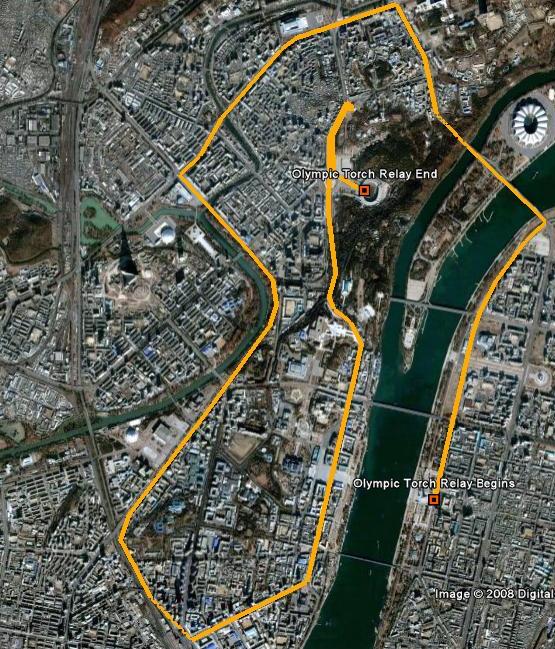
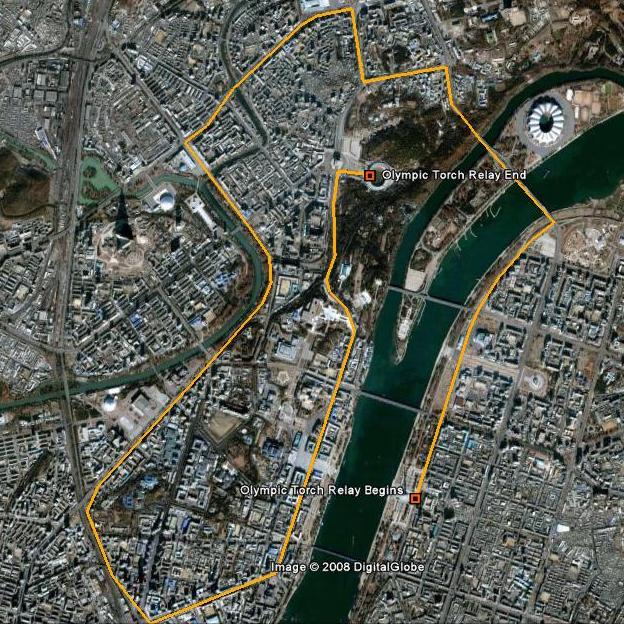
Pyongyang Olympic torch route

Wednesday, June 11th, 2008

olympic-torch-route.JPG 

(Click on image for larger view)

Using Naenara and a Chinese language news broadcast, I pieced together Pyongang’s 2008 Olympic torch relay route.

UPDATED: 6/25/2008
The relay began at the Juche Tower and passed by the Golden Lanes Bowling Alley, East Pyongyang Theater (where NY Phil played) and crossed Chongnyu Bridge to West Pyongyang.  Here it passed the Friendship Tower (commemorating Chinese support in the Korean War), Chinese Embassy, Immortal Tower of Kim il Sung, Victorious Fatherland Liberation War Museum, Pothong River Gate, Central Train Station, Kim il Sung Square, Mansu Hill, Chollima Statue, Arch of Triumph, and finished at Kim il Sung Stadium where the relay ended. 

More on the torch relay can be found here.

This will be included in the next version of North Korea Uncovered (Goolge Earth).

Share

DPRK Womens football team takes championship!

Monday, June 9th, 2008

UPDATE: Associated Press (via Herald Tribune) 

North Korea won the 2008 Women’s Asian Cup with a 2-1 win Sunday over defending champion China.

Two second half goals in 10 minutes saw the North Koreans come from behind in the final to beat their neighbor and win their third Asian crown in the past four tournaments.

Bi Yan opened the scoring for China with a long-range shot in the 11th minute, and it held that advantage to halftime.

North Korea drew level in the 57th minute with a header from Asian player of the year Ri Kum Suk, who scored a hat trick in the semifinal win over Australia.

The North Koreans went ahead in the 66th when China goalkeeper Zhang Ranyu was only able to block a shot into the path of Kim Young Ae, who put the ball into the net.

ORIGINAL POST:
Women’s Asian Cup: Ri Kum Suk hattrick sinks Australia, puts North Korea in final
Associated Press
6/5/2008

Ri Kum Suk scored a hattrick to power North Korea into the final of the Women’s Asian Cup with a 3-0 win over Australia on Thursday.

North Korea will meet the winner of Thursday’s later semifinal between China and Japan.

Ri, the reigning Asian Football Confederation women’s player of the year, opened the scoring in just the second minute, and doubled the lead four minutes before halftime when she blasted home after a pass from Ri Un Suk.

Australia, which only lost the 2006 final by a penalty shootout, pushed hard for a goal to get back into the contest, but Ri sealed the result on the hour when she shot between the goalkeeper’s legs.

North Korea is a two-time winner of the Women’s Asian Cup, with titles in 2001 and 2003.

Share

DPRK gets new golf course

Wednesday, May 28th, 2008

UPDATE:  The Kumgangsan Golf Course is located here (Wikimapia), though it is still under construction in these dated images.

ORIGINAL POST: The DPRK’s golf facilities are all easily recognizable from Google Earth:  There is the 18 hole course half-way between Pyongyang and Nampo; there is a smaller 9-hole course next to the Yangakdo Hotel; there is a driving range in the Sosan sports district; and there is even a three hole course east of town just south of the Ponghwa Barrage on the Taedong River (This area could be the Ponghwa Executive Apartments mentioned in Kim il Song’s North Korea).

According to Yonhap, the DPRK has successfully expanded their number of golf holes by 60%–increasing them from 30 to 48:

The “Kumgang Ananti Golf and Spa Resort,” including a 18-hole golf course, will open to the public Wednesday after nearly four years of construction, Emerson Pacific Group, a Seoul-based leisure firm, said.

Built on about 1.7 million square meters of land, the resort also has a spa, a hotel and restaurants that provide nice sea and mountain views, according to Kim Min-jeong, a publicity official of the company.

The golf course has already drawn media attention over its 929-meter number three hole, the world’s longest.

The facility, however, will be operated on a membership-only basis for the time being, Kim said, adding that the company plans to open the facility to individual tourists around next year.

Emerson Pacific is waiting for Pyongyang to give the company permission to employ about 200 North Koreans, including 60 caddies, at the resort, the official said.

Read the full story here:
Golf course to open at North Korea’s Mt. Geumgang
Yonhap
5/27/2008

Share

DPRK stiffens drug laws

Friday, May 16th, 2008

From the Daily NK:

“The North’s adoption of partial open door policy has resulted in the rapid spread of western culture into the society, which could trigger the collapse of socialist ideology and regime. So, as part of efforts to prevent the collapse, the North adopted a series of amendments to its criminal laws,” explained Choi.

“In March 2008, North Korea introduced another amendment according to which individuals charged with drug possession are to be sentenced to death by shooting because drug use has been increasing among people suffering from the lack of basic necessities and medicine despite the state’s strict drug control,” said Choi.

According to the 2004 amendment, North Korea sentences those charged with drug manufacturing to two to five years in the labor reeducation camp (Article 216), those with drug use to up to two years in the labor-training corps (Article 217), and those with drug trafficking and sales to either up to five years in the labor camp (Article 218).

“The amendment of March 2008 further stiffened penalties against drug offenders. Individuals found to be possessing more than 300 grams of drug are to be sentenced to death penalty,” Choi said, “In addition, North Korea which did not have sufficient legal grounds to punish individuals involved with new types of offenses including making international phone calls, possessing copies of foreign pictures and smuggling now appears to have strengthened legal punishment against them.”

The passage of these statutes is probably as close as the DPRK government will get to admitting that markets for recreational drug use are firmly established.  Stiffening drug laws will make no difference to the dissipation of the state’s socialist ideology, but North Korea’s drug cartels will certainly benefit.

The Economics of Cartels

In a competitive market, it is difficult to maintain a cartel.  Cartels work by restricting output to raise prices.  The problem is that once everyone in the cartel has done so, each individual member has an incentive to sell more than his quota to capture those artificially high profits.  After everyone figures out how to do this, the cartel falls apart and prices return to their competitive equilibrium.

So how can cartel members be relied on to maintain their production quotas and not cheat/sabotage each other?  Many times this is done by group acquiescence to government statutes and regulations.  Restrictions on prices, services, quality standards…these can all be used to protect incumbent firms by driving up costs for smaller competitors, and what’s more, the government pays for the enforcement.

And now for the conspiracy theory 

If there is not already a cartel of “companies” or families seeking to corner the DPRK drug market, there soon will be.  Stiffening criminal penalties for drug production simply raises the costs of small-scale producers and distributors, forcing them out of the market because they cannot afford protection/bribes.  This helps the big guys, who can afford these services, to maintain their price premium.

No doubt the groups coming to dominate the drug trade had representatives involved in making sure these statutes were changed (meaning they are now sufficiently politically connected to protect themselves).  What will be the effects on crime?  Well, if the cartel members keep to their agreements, crime could drop, and police would only be used to break up non-cartel operations.

Small-scale producers will respond by shifting into “high quality, low volume” drugs (much like in prohibition when smugglers carried liquor over beer and wine). 

Thoughtful comments appreciated. 

Read the full story here:
North Korea Has Introduced Amendments to Its Criminal Codes to Save the Regime from Falling Apart
Daily NK
Yang Jung A
5/13/2008

Share