Archive for the ‘International Governments’ Category

ROK Supreme Court rejects ownership claim for property in DPRK

Tuesday, March 22nd, 2011

According to Arirang News (3/22/2011):

The Supreme Court decided Tuesday that South Korean nationals are not eligible to claim ownership of property in North Korea.

A 56-year-old man surnamed Yoo filed a lawsuit, claiming ownership of six lots in the Yeoncheon district of Gyeonggi Province, which is in North Korea, and demanded the court change the land registration back to his name, based on a deed in his ancestor’s name from the early 1900s.

Two lower courts had previously acknowledged the deed and ruled partially in favor of the plaintiff.

But the Supreme Court annulled the decision, saying it is impossible to verify the ownership of the land, since the original land registration was destroyed in the Korean War, restored in 1980 and then discarded in 1991 because the land is north of the Demilitarized Zone.

I am no lawyer or expert in the field of property rights, but my understanding is that when reunification comes property reconciliation will be a nightmare for both Koreas.  Many South Koreans have already prepared the paperwork to reclaim lands confiscated by both the Japanese colonial government and the DPRK government and they are simply waiting to file them.  I imagine there are many North Koreans that have done the same.  No doubt there will be numerous types of claims and remedies—too voluminous to list here.

At a minimum, this case seems to establish the first of many tests for the validity of land reclamation cases: verification.  If a claim cannot be verified in evidence, it will not be honored by the court, and we also have a better idea of what kinds of evidence are not admissible.

Although possessing the right documentation will be important, I can also see all sorts of creative solutions emerging to help establish a claim even for those who lost their land titles long ago–DNA comparisons from family burial plots, to name just one example.

If anyone is aware of any good papers on this topic, please let me know.  There is probably a hefty German literature in this area, though I am not sure how comparable the legal systems are particularly when it comes to the disposition of land.

Some other recent South Korean cases:
1. A South Korean court gave North Korean defectors the right to divorce their spouses in the DPRK so they could remarry.

2. The North Korean children of a deceased, wealthy DPRK defector (who died in South Korea) are suing in a South Korean court for their share of his inheritance.

Share

Kim Jong-il pays respects to memory of Chung Ju-yung

Tuesday, March 22nd, 2011

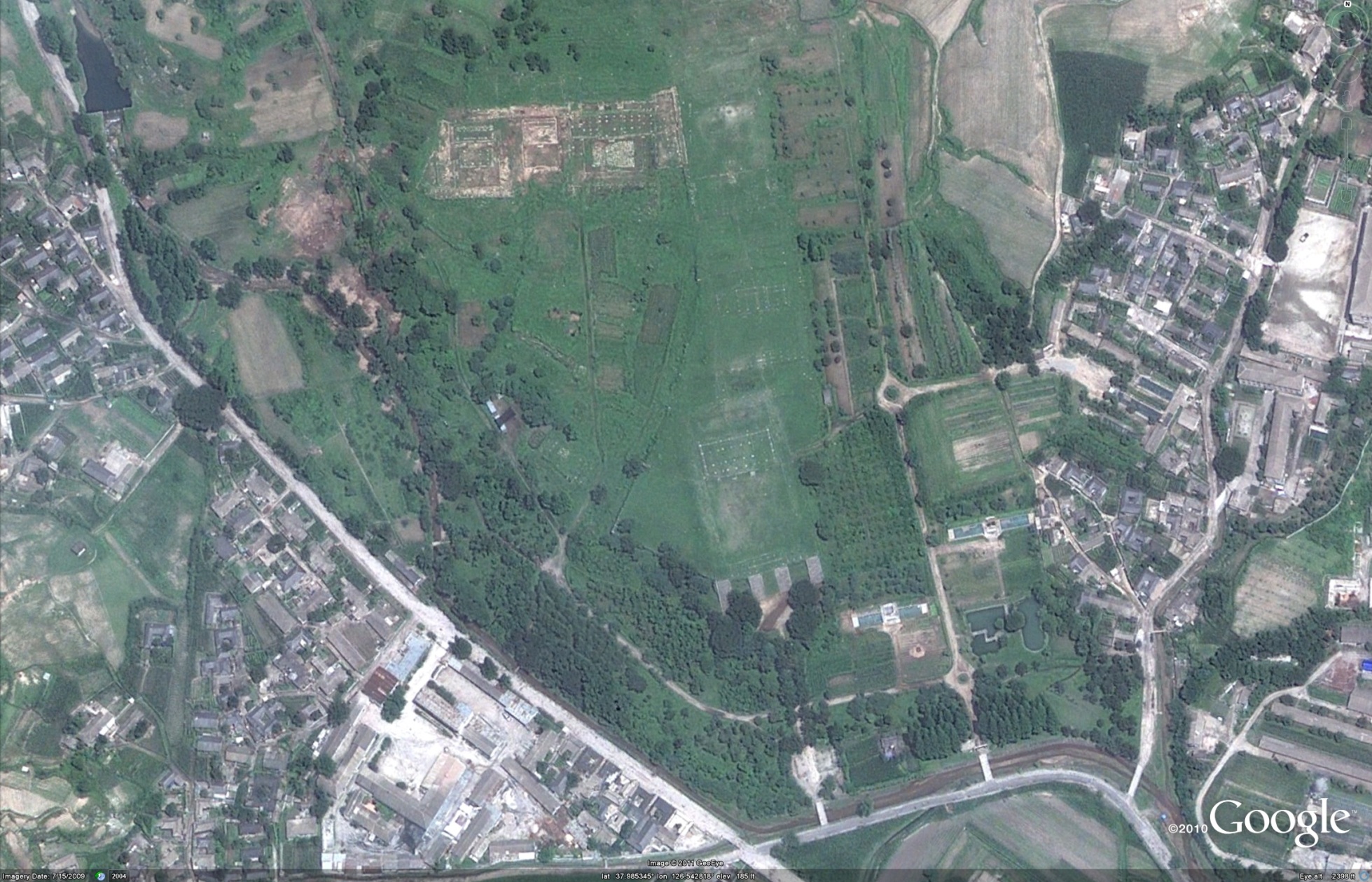
Pictured Above: Chung Ju-yung Stadium in Pyongyang
(Google Earth:  39.040093°, 125.735237°)

According to the Korea Herald:

North Korean leader Kim Jong-il has sent a verbal message to commemorate the 10th anniversary of the death of a noted South Korean industrialist who pioneered cross-border economic projects, the North’s media said Saturday.

Chung Ju-yung, the then chairman of Hyundai Group, initiated a series of major economic projects in North Korea starting in 1998, including a sightseeing tour to scenic Mount Geumgang on the North’s east coast. He died on March 21, 2001.

In the verbal message, the North Korean leader spoke highly of the South Korean industrialist, saying that he did the right thing to promote national reconciliation, the North’s Korean Central News Agency said in a report.

“Chung Ju-yung paved the way for national reconciliation and cooperation and did really a great job for the development of the inter-Korean relations and the sacred cause of national reunification,” the KCNA quoted the leader as saying in the message.

Kim also expressed hope that everything would go well for the Chung family and Hyundai, the KCNA report said.

The report did not say when and how the North Korean leader’s message was conveyed to the Chung family in Seoul. Chung’s eldest son, Chung Mong-koo, heads the nation’s largest automaker, Hyundai Motor Co.

According to the Choson Ilbo:

North Korea has sent a wreath to Hyundai Group to commemorate the 10th anniversary of the death of Hyundai founder Chung Ju-yung.

The wreath that read “In memory of Chung Ju-yung” was delivered from Pyongyang’s Asia-Pacific Peace Committee to Hyundai staffers at the joint-Korean industrial complex in Kaesong.

On Friday North Korean leader Kim Jong-il spoke highly of Chung for his role in paving the way for national reconciliation and cooperation.

Chung initiated various projects with the Stalinist state including the Mt. Kumgang package tours in the North and had sent more than one-thousand cows over the demilitarized zone to North Korea.

The Daily NK also offers some cultural background

Share

69 North Koreans in US military

Tuesday, March 15th, 2011

According to the Rumsfeld Papers there were 69  North Koreans serving active duty in the US armed services in April 2003.

Source here (PDF).

Much more discussion in the comments.

(h/t to a colleague)

Share

Kaesong Complex and ROK goods become harder to find in DPRK

Thursday, March 10th, 2011

According to the Daily NK:

This year, the North Korean authorities have been cracking down on the sale and distribution of products, tools and materials coming out of the Kaesong Industrial Complex. As a result, such Korean goods, formerly an expensive but popular choice in Hwanghae and South Pyongan Provinces, are now hard to find in markets.

A source from South Pyongan Province who spoke with The Daily NK in China explained, “Right up until last year, literally anything being made in the Kaesong Complex was available in the market, including clocks, metal, screws, clothes, underwear, toys and parts of electronics. However, the amounts have fallen dramatically since regulations were strengthened.”

The reason behind the regulations is unclear, however; the source suggested it could only be because of deteriorating inter-Korean relations.

Regardless, the source went on, “Nowadays, revealing the fact you sell those Kaesong Complex goods results in high fines and puts you in a bind” Therefore, he went on, “Only bread (Choco Pies), stainless steel or ceramic bowls and underwear are being sold.”

One consequence of the crackdown is that it makes the sale of other South Korean products smuggled in from China equally difficult. Albeit with some provincial differences, clothes and electronics cannot now be displayed on stalls, and must be sold in alley markets in secret.

A source from Shinuiju explained, “Market watch guards go around markets every day inspecting stalls with no notice; their investigation into South Korean products is really severe.” He explained, “If they find goods with Korean writing on, they confiscate them and give them back after two or three days later, after fines have been paid.”

“I hear there was a decree from above reinforcing crackdowns, but won’t this only lead to bribes?” the source pointed out.

Even when readily available, South Korean products are at the top of the price range, so most average families cannot afford them; one Choco Pie, a circular, individually wrapped chocolate cake made famous by the movie “JSA”, is between 180 and 200 won, a set of women’s underwear is 90,000 won, and a set of roughly ten plates, five or six small bowls and some coffee cups is around 250,000 won.

The source reported, “Due to the severe regulations, some traders sell them at home or in secret, hiding the goods behind the curtain.”

Interestingly, one South Korean official with the Kaesong Industrial Complex told the Daily NK that product leakage is not a problem at Kaesong, saying, “There have been almost no cases of complete products leaking out, but it is possible for stock, tools or things provided to workers like Choco Pies. However, the leaks are not enough to affect factory management.

And yet, one defector who used to be a worker in a shoe factory in charge of testing product quality explained that the siphoning off of materials, complete products, tools and other things is common among North Korean workers.

“The way they hide things and bring them out of the factory is really expert. I sometimes put up to 20 pairs of shoes on my body and came out of the factory. If you wear a long, thick winter coat then it is not so remarkable. Sometimes we did it in collusion with the factory manager.”

Read the full story here:
South Korean Products Disappear from Markets
Daily NK
Park Jun Hyeong and Mok Yong Jae
2010-3-10

Share

Choson Exchange Update

Sunday, March 6th, 2011

From the Choson Exchange web page:

We are looking to build our knowledge pool in the areas of contract negotiations, microfinance and bond markets as there have been requests for knowledge assistance in these areas from Pyongyang. We are told that North Korean firms need to negotiate more effectively with their Chinese counterparts, and require legal training to do so. The fundamentals of micro-finance and bond markets are also of interest to some financial organizations.  We expect initial programs for these areas to take place in April to May this year.

The executive director of Choson Exchange, Geoffrey See, also wrote the following article in the East Asia Forum:

Choson Exchange recently prepared a program for North Korean students to learn business, finance and economics overseas through university courses and internships.

They consulted a range of North Koreans on how it should structure such a program and ‘the Australia National University’ often came back as the model to follow. Up until 2006, ANU hosted North Korean trainees studying economics under programs supported by international and Australian aid agencies. The Australian exchange program was clearly well-regarded by outward-looking North Koreans.

But what would Australia gain from such programs?

A resolution to the constant series of crises on the Korean peninsula is obviously in Australia’s interest. Conflict on the Korean peninsula can destabilize the region and in a worst-case scenario draw China and the United States into a military conflict involving Australian troops. This would cause incalculable harm to the Asia-Pacific economy because of its impact on all the major Northeast Asian economies, not to mention the human cost of conflict. Australia also has long and particular historical interests in commerce with North Korea.

There are some things that Australia can facilitate for North Korea which is in their mutual interest, but which neither the United States nor South Korea can provide anytime soon. The opportunity for North Korean students to study economics, business or law in Australia in long-term university programs is one such crucial shared interest. Yet such programs are currently impossible because of autonomous sanctions in place since 2006 that deny visas to visiting North Koreans. This policy is counter-productive. It trades off the ability to shape longer-term outcomes on the Korean peninsula for short-term public displays of opprobrium. The only countries whose sanctions can hurt North Korea are the countries that actually trade with it. This policy is also unusually harsh of Australia. The United States takes a more nuanced stance by allowing visits by North Koreans for some purposes while publicly preventing political delegations to express its political support for US allies, chiefly South Korea. Similarly, Australia can publicly express its disapproval of current North Korean activities alongside efforts to develop exchanges that shape a future that goes beyond the present stalemate.

These educational exchanges provide Australia with an effective way to shape longer-term dynamics on the Korean peninsula. One way the Korean crisis will end peacefully is when North Korean elites calculate that benefits of economic integration with the rest of the world are great enough to make the costs of confrontation unsustainable. Overseas education can shift this cost-benefit calculus because it equips a new generation of North Korean leaders with the knowledge and the networks to benefit from international trade and integration.

Choson Exchange recently placed a North Korean student in an internship with an international consulting firm. Without such networks, the opportunity would not have materialized. The student also needed coaching on how to explain why his prospective-employer might find value in taking him on. He assumed that a good score on an international English test was the qualification he needed even though most selective employers see fluency as a minimum threshold, rather than a core selling point. This experience helped us see things from the North Korean perspective: there are hardly any commercial benefits to speak of when one lacks knowledge and networks to realize those benefits.

Now is the time to help build this knowledge and network base. North Korea has been active over the past year setting up institutions to promote economic development. This includes the State General Bureau of Economic Development, the Daepung Group, and the State Development Bank. Choson Exchange has led finance workshops with the State Development Bank, and Bank managers agree that training is needed and appreciated. By helping to educate the next generation of North Korean businessmen, economists, financiers or lawyers who will eventually fill these institutions, Australia can play a role in shaping these emerging institutions in North Korea, institutions that could have important ramifications for how North Korea interacts with the rest of the world in the future.

Australia has the opportunity to redefine how such exchanges are conducted. To maximize impact in developing institutions in Pyongyang, we need to think in terms of a “talent pipeline.” We need interlinked programs targeted at different age-groups: training workshops targeting senior or middle management at these institutions, overseas scholarships targeted at university students or recent graduates, and a way to bring both groups together to help maximize opportunities for scholarship recipients to move into the emerging institutions.

Australia has the base from which to take initiatives with North Korea. The North Korean institutions that are looking outwards explicitly seek to build on what has been done with Australia, and specifically through the Australian National University program for training in economics. A comprehensive settlement of the Korean problem is much more likely if we begin again to put this infrastructure in place and help with institutional development in North Korea.

Share

ROK firms hurt by inter-Korean trade restrictions

Sunday, March 6th, 2011

According to Yonhap:

Hundreds of South Korean companies doing business with North Korea are teetering on the edge of bankruptcy due to a prolonged cross-border trade ban, the head of the first inter-Korean joint venture said Sunday.

Inter-Korean trade flourished following a summit between the divided countries in 2000, but has been banned by South Korea since last May in response to the sinking of the Cheonan corvette two months prior, which Seoul says a North Korean submarine torpedoed.

According to the South’s unification ministry, about 860 South Korean companies are operating in North Korea.

“South Korean companies, which invested about 200 billion won (US$179 million) in Pyongyang and Nampo, North Korea, are on the brink of bankruptcy because of the suspension of the inter-Korean trade,” Kim Jung-tae, head of Pyongyang Andong Hemp Textiles, said in an interview with Yonhap News Agency.

Pyongyang Andong Hemp Textiles is the first inter-Korean 50-50 joint venture between the South’s Andong Hemp Textiles and the North’s Saebyol General Trading Co., which was established in October 2008.

Kim said the companies posted a combined $150 million in operating loss due to Seoul’s ban on inter-Korean trade.

In June, Kim formed a body consisting of about 200 South Korean businessmen to seek solutions to the prolonged inter-Korean trade suspension. In its opening ceremony, the body called for the government to implement measures to resume inter-Korean trade.

However, the unification ministry holds firm to its position that the trade ban will remain intact until the North takes responsible measures for the sinking of the Cheonan.

Read the full story here:
S. Korean firms reeling from inter-Korean trade ban
Yonhap
3/6/2011

Share

DPRK-Myanmar shipping

Thursday, March 3rd, 2011

Bertil Linter, who is probably the most prolific author when it comes to illicit DPRK/Myanmar relations, has published an interesting piece in the Asia Times on cargo shipping between the two countries. The whole piece is well worth reading.

The only comment I have on the article is in regards to his economic reasoning for why trade between the two countries makes sense:

All this seems to confirm what diplomatic observers have long suspected: that Myanmar and North Korea, two countries with limited access to bank and other international financial trade facilities, are engaged in barter trade. Myanmar’s ruling generals want more weapons but often don’t have the foreign funds handy to pay for them – or at least they don’t want such transactions to show up in their bank records. North Korea, meanwhile, is starved for food and likewise lacks the finances to pay for imports.

The DPRK does appear to be suffering a shortage of food, but the government does have the funds to pay for food imports–it just prefers to spend those funds in other ways.  Below is a chart of the DPRK’s estimated trade balance from 2000-2008 published by the Congressional Research Service:

As you can see from the bottom line of the table, the DPRK has been running a substantial trade deficit (as a % of its total trade) for nearly the last decade.  This trade deficit must be paid for with hard currency inflows of one kind or another (“aid”, investment, illicit exports). Where these funds are coming from and to whom specifically within the DPRK they are going is a mystery to me, but we do know they are importing (as a group) much more than they are exporting.

Below is the article in the Asia Times:

With the Middle East and North Africa in turmoil, North Korea risks losing some of its oldest and most trusted customers for military hardware. Pyongyang has over the years sold missiles and missile technology to Egypt, Libya, Yemen, the United Arab Emirates, Syria and Iran, representing an important source of export earnings for the reclusive regime. The growing uncertainty among those trade partners could explain why North Korea is now cementing ties with a client much closer to home: military-run Myanmar.

In April 2007, North Korea and Myanmar resumed diplomatic relations. Those ties were after North Korean agents planted a bomb in the then capital of Yangon in October 1983, killing 18 high-ranking South Korean officials who were on a visit to the country. Only days after the restoration of diplomatic ties, a North Korean freighter, the MV Kang Nam I, docked at Thilawa port, 30 kilometers south of Yangon.

Officials claimed at the time that the ship docked to seek shelter from a storm. However, two local reporters working for a Japanese news agency were turned back and briefly detained when they went to the port to investigate, indicating that there could have been other, more secret reasons for the Kang Nam I’s arrival.

The same ship was put on global radar in June 2009 when it was pursued by the USS John S McCain and then reversed course. It was believed that it was on its way back to Myanmar with more unspecified cargo. Military observers tied the Kang Nam 1 incidents to the arrival of another North Korean ship, MV Bong Hoafan, at a Myanmar port in November 2006 before the resumption of diplomatic relations. Curiously, it was also reported to have been “forced” to seek shelter at a Myanmar port because of “adverse weather conditions”.

An Asia Times Online investigation has found that those were not isolated incidents. Shipping records from Myanmar show that North Korean ships have been docking regularly at Thilawa and Yangon ports for almost a decade. Even the ill-fated Kang Nam 1 had docked in Myanmar long before the 2007 and 2009 incidents. The ship made its first voyage to Myanmar in February 2002, carrying what was declared as “general cargo,” according to the shipping records.

North Korean shipments are almost invariably specified as “general goods” and sometimes “concrete”, but both in and outgoing cargo is usually handled by Myanmar’s Ministry of Heavy Industry 2, which supervises the country’s defense industries, the armed forces’ Directorate of Procurement, and the military’s own holding company, the Union of Myanmar Economic Holdings (UMEH).

When the MV Bochon, another North Korean ship, arrived at Thilawa in October 2002, the Myanmar military’s high command sent a document marked “top secret” to the port authorities, requesting them to clear the entire docking area for “security reasons”. They were also advised, according to the shipping records, that some “important cargo” would be offloaded within 36 hours.

When the MV Chong Gen approached Thilawa on April 12, 2010, it asked for permission to fly a Myanmar flag instead of its North Korean one, according to the shipping records. The captain also requested a Myanmar SMC card (smart media card) for a mobile phone, along with coastal charts. These were odd requests for a ship that was officially carrying 2,900 tons of cement and 2,105 tons of “general goods” from the North Korean port of Nampo.

Bizzare barter
Indeed, the requests made by North Korean ships traveling to Myanmar have often been outright bizarre. MV Du Man Gang appears to be one of the most regular North Korean visitors at Thilawa. On one of its many trips to Myanmar, in July 2009 it asked for 150 crates of Myanmar brandy. In March 2010, when another North Korean ship, the MV Kan Baek San, arrived in Myanmar, the North Korean ambassador asked for an unspecified quantity of Myanmar vodka to be sent to the ship, according to the shipping records.

The involvement of North Korean diplomats in these shipments is otherwise more convoluted. In September 2009, the MV Sam Il Po docked at a smaller terminal in Yangon and both the North Korean ambassador Kim Sok Chol and defense attach้ Kim Kwang Chol were present to inspect the cargo along with Lt Col Thein Toe from the Myanmar military. The unspecified cargo was received by UMEH, which in return supplied 1,500 tons of rice which was taken back to North Korea.

That was not the only incident when North Korean freighters returned with Myanmar rice. The MV So Hung arrived in November 2008 with 295 tons of material for the Ministry of Defense and left with 500 tons of rice. When the MV Du Man Gang docked in July 2009 it left with not only brandy but also 8,000 tons of rice. In June 2010, the MV An San arrived with 7,022 tons of what was alleged to be “concrete” and left in July with 7,000 tons of rice.

All this seems to confirm what diplomatic observers have long suspected: that Myanmar and North Korea, two countries with limited access to bank and other international financial trade facilities, are engaged in barter trade. Myanmar’s ruling generals want more weapons but often don’t have the foreign funds handy to pay for them – or at least they don’t want such transactions to show up in their bank records. North Korea, meanwhile, is starved for food and likewise lacks the finances to pay for imports.

When money is involved in North Korea-Myanmar trade, transactions are always done in cash and thus untraceable. Like all other ships, North Korean ones have to pay port fees in Myanmar. The MV Du Man Gang, for instance, asked to pay US$30,994 in cash rather than make a bank transfer. Other ships have made similar requests which has led to speculation about the kind of currency the North Koreans, notorious for counterfeiting US dollars, may be using.

Large quantities of counterfeit US notes have recently shown up in areas around Myanmar. In July and August 2009, a customer tried to change U$10,000 in fake notes at the State Bank of India’s main office in Imphal, Manipur. The fake bills were all of the US$100 denomination and of excellent quality, according to sources. It was the first such incident in Manipur. Although it is not clear whether the bogus notes were printed in North Korea, Imphal is located just over 100 kilometers from Moreh, an Indian town opposite Myanmar’s Tamu where a virtually unregulated border trade is booming.

Trade between North Korea and Myanmar is also apparently being done through front companies. In June 2010, the North Korean freighter MV Ryu Gong arrived with 12,838 tons of what was also described as “cement”. While the shipment was handled by the Ministry of Heavy Industry 2, the stated recipient was a little-known company known as Shwe Me, or “black gold” in Myanmar.

Port documents show that the company has nearly a million US dollars in assets but what it actually intended to do with all that cement is unclear. Just as puzzling is the involvement of Singapore-based shipping companies, which handle most of the cargo’s logistics and operate under innocuous sounding names including words like “maritime” and “services”. One of the companies has a distinct Korean name but is actually based in Singapore.

Port records point to a brisk trade between North Korea and Myanmar, all of which is handled by Myanmar’s military rather than civilian-owned private companies. In August last year, then prime minister and now president Thein Sein visited Pyongyang. According to the official Korea Central News Agency, he said that “the government of Myanmar will continue to strive for strengthening and development of the friendly and cooperative relations between the two countries.”

With those intentions publicly well-stated, Myanmar may well be on its way in overtaking Egypt, Libya and other traditional military trading partners in the Middle East and North Africa as North Korea’s main market for its military hardware.

Read the full story here:
Fog lifts on Myanmar-North Korea barter
Asia Times
Bertil Linter
3/4/2011

Share

US Senate Committee on Foreign Relations hearing

Thursday, March 3rd, 2011

The Senate Foreign Relations Committee held a hearing on March 1st titled, “Breaking the cycle of North Korean provocations”.

All of the video and printed testimony can be found here.

Panelists included:
The Honorable Kurt Campbell
Assistant Secretary of State for East Asia and Pacific Affairs
Department of State
(Download testimony)

The Honorable Stephen Bosworth
Special Representative for North Korea Policy
Department of State
(Download testimony)

Mr. L. Gordon Flake
Executive Director
The Mansfeild Foundation
(Download testimony)

Download Testimony
Dr. Marcus Noland
Deputy Director
Peterson Institute for International Economics
(Download testimony)

Download Testimony
Dr. Robert Carlin
Center for International Security and Cooperation, Stanford University
(Download testimony)

Share

Increase in DPRK’s mineral resources exports to China expected again for this year

Monday, February 28th, 2011

Institute for Far Eastern Studies (IFES)
2/24/2011

The trade volume between North Korea and China has steadily increased, reaching its record high of USD 3.4 billion in 2010. Total exports amounted to 1.19 billion USD while imports doubled that figure to USD 2.22 billion. Imports have continued to grow, increasing by 2.4 times over the previous year.

Since the Cheonan incident and the implementation of May 24 sanctions, inter-Korean economic cooperation has come to a halt, naturally resulting in rise in exports to China. In particular, a significant growth in anthracites exports was observed. The monthly anthracites exports that averaged around USD 10 million surpassed USD 70 million mark last August and maintained USD 50 million monthly average between September to November. In addition, cost-per-ton of anthracite in March which was USD 52.2, jumped to USD 82.8 in November, a climb of 60 percent. This boost is attributed to its increased export.

The current supply of electric power consists mostly of hydroelectric power — reaching over 60 percent– but during the winter season most of the hydropower plants are unoperational due to frozen facilities from harsh winter weather. Anthracites were the alternative resource to fill this gap. Sacrificing power production and exporting great amount of anthracites despite severe winter is a strong indication of the poor foreign currency situation in North Korea.

In its New Year’s joint editorial, North Korea placed heavy emphasis on its anthracite export that took up 60 percent of its total exports. In the statement, four vanguard sectors of coal, electricity, metals, and railroads were highlighted as important industries as “rich underground resources that will help with securing funds and resolving raw material problems.” This is the first time in 13 years – that is, since the Arduous March — for coal to be mentioned first in the New Year’s message.

North Korea also began to lift export restraints of mineral resources like coal and silver from the latter half of last year and ordered to increase imports of rice and corns in place of minerals.

The reason food procurement is placed first at the expense of its mineral resources is believed to be associated with the implementation of the succession involving Kim Jong Un, and to keep North Korean people’s dissatisfaction under control and manage the domestic situation.

North had placed restraints on coal, gold, silver, lead, and zinc exports from 2007 through adopting export control of mineral resources.

In addition, North Korea and China will meet in Beijing to sign an agreement on joint development of underground resources. This agreement will include Musan Mine and rare-earth mines that POSCO (The Pohang Iron and Steel Company of South Korea) has shown interest in in the past for development. China’s moves in this sector are suspected as China’s attempt to monopolize the DPRK’s underground resources.

The DPRK’s Joint Venture and Investment Guidance Bureau and China’s Ministry of Commerce were expected to meet on February 15 to discuss agreements related to underground resources development. On the agenda was Musan Mine, abundant in gold and anthracite, and other mines rich in rare-earth elements. Other mines are also known to be specified in the agreement.

China is expected to bring private companies into the underground resources development project after reaching an agreement with the DPRK. According to our source, “both parties will establish a joint venture investment corporation in Hong Kong after signing the agreement.”

Construction of a highway connecting Heilong City of Yanbian Korean Autonomous Prefecture to Nampyong and Chongjin of North Korea and railway system linking the cities of Heilong, Nampyong, and Musan are currently underway, expected to be in operation by end of this year. Jilin Province and Ministry of Railways of China began construction of this railway system from October 2010 investing CNY 1.19 billion, which runs a distance of 41.68 km. However, it is expected to extend further onto Chongjin and is considered to become the major transportation hub, integrating economic cooperation between the two countries.

Musan Iron Mine is known as the largest outdoor iron mine in Asia and Tonghua Iron and Steel Group along with three other Chinese corporations acquired 50-year development rights of Musan Iron Mine. They are bringing in about 120 tons of iron ore each year and more is expected to be brought in once the Heilong-Musan rail link is completed.

Share

Rason and the Chinese economy

Monday, February 28th, 2011

According to the Choson Ilbo:

But now sources say Beijing seems to think it is high time to persuade the North to reform and open up as the economy is on the verge of collapse. It is pressuring the regime to develop Rajin-Sonbong into a model of Chinese-style reform, and it needs to use Rason Port for its own Tumen River project. This is swiftly attracting Chinese investment to the area.

Beijing reportedly even plans to supply electricity to the Rajin-Songbong area. “The replacement of transformers aimed at getting electricity from China is underway, and Chinese electricity is expected to be supplied from April,” said a North Korean defector.

Beijing has already established an economic mission there that is to handle any conflict with the North Korean authorities. China pressured Pyongyang to sort out traffic, communication and customs issues, and the North apparently agreed to all demands. “Customs clearance took less than 5 minutes,” said a Chinese businessman who visited Rajin-Songbon recently. Previously it took more than three hours and customs officials would extort bribes with false charges. No mobile phone calls to China can be made yet, but landlines are working and mobile phone calls are to be possible soon.

Until last year, not even Chinese people were permitted to watch TV channels from abroad and there were tight limits on what they could say or do. But now Chinese are all but free to do as they please in Rajin-Songbon, and the security officials stationed there have been brought to heel and told not to interfere with Chinese business activities.

Rajin-Songbong used to have so many security officials that it was said the population was half traders and half police, and they frequently hauled people off for questioning on groundless charges.

The North is said to have started selling land in the city to Chinese business at US$50 per 3.3 sq. m downtown and $30 in the suburbs. The Chinese still don’t trust the North Korean regime and are reluctant to purchase, but the fact that the land is for sale at all is a momentous change.

Pyongyang is in negotiations with Beijing to build a massive industrial park in the area like the joint Korean Kaesong Industrial Complex.

Read the full sotry here:
Chinese Businesses Pour into N.Korea’s Rajin-Songbong
Choson Ilbo
2/26/2011

Share

An affiliate of 38 North