Archive for the ‘China’ Category

Groundbreaking for HGP EZ management board

Saturday, September 15th, 2012

KCNA reports that a groundbreaking ceremony for a new management board building at the Hwanggumphyong Economic Zone (HGP EZ) took place on 2012-9-15:

Ground-breaking Ceremony for Hwanggumphyong EZ Management Board Building Held

Pyongyang, September 15 (KCNA) — A ground-breaking ceremony for a building of the management board for the Hwanggumphyong Economic Zone to be jointly developed and run by the Democratic People’s Republic of Korea and China, took place on Hwanggumphyong Islet on Saturday.

Present there were Hong Kil Nam, vice-chairman of the North Phyongan Provincial People’s Committee, and officials concerned in the province and Sinuiju City from the DPRK side and Bing Zhigang, vice-governor of the Liaoning Provincial People’s Government of China and officials concerned in the province and Dandong City from the Chinese side.

Speeches were made at the ceremony.

The speakers noted that after leader Kim Jong Il and President Hu Jintao reached an agreement on jointly developing and managing the two economic zones, a series of issues have been settled for the development of the Hwanggumphyong Economic Zone, with a substantial progress made.

They stressed that the joint development and operation of the zone would be conducive to furthering the DPRK-China friendly relations sealed in blood and attaining co-prosperity.

A ground-breaking milestone was erected there.

The Daily NK adds the following:

North Korea hopes that the groundbreaking ceremony will mark the beginning of serious SEZ development at Hwanggeumpyong, which remained a sleepy agricultural backwater even after last June’s launching ceremony, a fact that led to rampant speculation about problems related to the legal framework for the development of the area.

However, development began to accelerate once again after Jang Sung Taek, the director of the Chosun Workers’ Party Department of Administration, concluded the establishment of the management committee during his visit to China last month.

Rhetoric emerging from the Chinese side is also more positive than it has been for some time. In a recent media interview, the deputy mayor of Dandong, which borders Shinuiju, commented, “Now that the Hwanggeumpyong Management Committee has been established, construction has begun on basic infrastructure including roads. From the 15th, the business of developing Hwanggeumpyong will formally begin.”

“Both governments have decided to develop Hwanggeumpyong first then go on to discuss the development of Wihwa Island,” he added. “When the construction of the New Yalu River Bridge and bridges to Hwanggeumpyong and Wihwado are complete, China-North Korea trade, culture, travel and other exchanges will become more active and the two countries will grow closer.”

Additional Information:

1. Chinese working to attract investment  (2012-9-14)

2. On Jang Song-thaek’s recent visit to China (2012-8-23)

3. Yalu River Bridge (2011-6-25)

4. HGP Announced (2011-6-14)

5. Laws governing HGP (2012-3-19)

6. Previous posts on Hwanggumphyong Economic Zone

Share

DPRK mining investment woes (Musan)

Thursday, September 13th, 2012

UPDATE 2 (2013-1-17):  The latest issue of Digital Globe’s World View magazine contains information on the Musan Mine (page 7):

[…]In a New Year’s message, North Korea’s leader, Kim Jong-un, urged North Korea to become an economic powerhouse by improving productivity. He specifically mentioned the Musan Mine, as it is one of the largest iron ore mines in the region with a reserve of approximately three billion tonnes of ore.  This announcement comes after a Chinese investment firm, Tianchi Industry and Trade, pulled out of the mine in the early fall of 2012.  North Korea demanded a price increase of 20%, on top of the 50-year lease that had been in place since 2005.  With the price increase, Tianchi did not feel the location could remain profitable, and North Korea refused to renegotiate.  As a result, the associated smelter in China was shut down in September 2012.  The presents a loss for the Jilin provincial government in China, which had extended a rail line 42 kilometers to the border to transport ore north after it was processed at the smelter.  With the departure of the Chinese investment firm, the Musan Iron Ore Mine is currently operated by North Korea’s Ministry of Mines. The mine has the potential to produce 1.5 million tonnes of ore a year if the North Koreans can operate it at its former capacity under Tainchi.

UPDATE 1 (2012-10-17):  The Choson Ilbo has picked up on this story first reported in the Hankyoreh last month, yet they have a different English name for the Chinese company. According to the  article:

The Chinese apparently baulked at a price increase of more than 20 percent demanded by the North, although international iron ore prices are plummeting in the wake of the global recession. They won 50-year extraction rights for the mine in 2005.

A smelter in the Chinese province of Jilin near the border with North Korea and operated by Tianchi Industry and Trade, the Chinese partner to the Musan Mine, closed down in September, according to a source in Yanbian on Tuesday. The smelter used to process iron ore extracted at the mine.

The source added, “There’s been no progress in the implementation of plans to lay a railway line and a slurry pipeline between Nanping and Musan.”

Tianchi Industry and Trade turned down the North’s demand, saying it makes hardly any profit as is given wages for North Korean workers and transportation costs.

Tianchi, a private trading company based in Yanbian, has served as a conduit for iron ore produced at the Musan Mine to the Chinese market since the early 1990s. It obtained the extraction rights to the mine in 2005 after concluding a trilateral joint-venture contract with Tonghua Iron and Steel, a Chinese state-run iron and steel mill, and [North] Korea Ferrous Metals Export and Import Corporation.

Tianchi hired North Korean workers and extracted 1 to 1.5 million tons of iron ore at Musan every year, which it supplied to Tonghua and other companies.

But the first cracks in the deal appeared in 2009, and iron ore production had been intermittent since then and stopped completely this year.

The Jilin provincial government has also been hit because it already laid a 41.68 km railway line leading to the border town of Nanping since November last year.

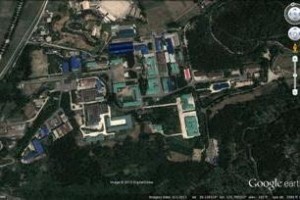
ORIGINAL POST (2012-9-13): We have already heard about Xiyang. Today the Hankyoreh tells us about problems with the Musan Mine…

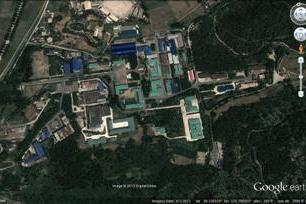
Pictured Above (Google Earth): Musan Mine

According to the article:

However, not all business between North Korea and China is rosy. An iron-smelting factory in Helong City, Jilin, that was visited on Sept. 5, had to close its doors. It used to be a place where iron from across the Yalu River was brought from North Korea‘s Musan iron mine and processed. A railroad was expected to run from the two cities by October of last year in order to increase the amount of iron brought into China. But the construction was never completed. A Chinese company called the Yanbian Cheon-ji Industry Trading Company had rights to the Musan mine for fifty years starting in 2005.

There are many guesses as to why this happened: “North Korea was asking for a price increase of 20% while the price of iron has declined in the rest of the world;” “There was trouble between the Chinese government and the new Kim Jong-un regime on negotiating development rights;” “There was a downfall of development due to differences with foreign investors about investing in electrical power.” No one knows clearly what the reason was, and there are still busy trying to figure out what is the real situation.

Here is the original story:
China adjusts to influx of cheap North Korean labor
Hankyoreh
Song Kyung-hwa
2012-9-13

Share

North Koreans working in China

Thursday, September 13th, 2012

The Hankyoreh posted another interesting story on North Korean workers in China:

In Dandong, where the inflow of North Korean labor is most active, there is a factory operated by a Singaporean company. The company makes men’s suits for export to Europe and used to operate a factory in Pyongyang. Due to problems with the electricity supply, they moved the factory to China where the situation is more stable. In this factory in Dandong, 400 factory workers in their 20s and 30s are North Korean. They work in the factory and live in a nearby company dormitory.

A Taiwanese businessman who used to operate a factory in Shanghai also has plans to move his operations to Dandong. His company has completed construction of facilities and plans to hire around 100 North Korean workers.

Another factory that produces sports apparel for export which used to be in Shandong province moved to a city close to the North Korea-China border. The factory was set up in Tumen and North Korean workers were dispatched for the first time last May. There are 300 North Korean women who work in this factory. A vinyl production factory about a kilometer away also employs North Korean women.

The activities of these North Korean workers are restricted. They live in dormitories or facilities provided by the factories. For lunch, they have been seen going in groups of 20 or 30 from the dormitory to the cafeteria, a 3-minute walk. Mr. Wang, a Han Chinese, 59, who works in a factory nearby said, “About two months ago, I began to notice young North Korean women in their 20s going to get water in groups of two or more. I only know which factory they are in, but I know nothing about their private lives. And the other companies or factories don’t know about them either.”

Some workers have come on one-month or three-month short-term training visas to set up under an official contract between the city and the North Korean government and extend their stay. They are dispatched with a male supervisor who is in charge of keeping an eye on them. It is said that the North Korean government would like to send more supervisors to watch over the female workers, but the factories have refused to allow them, which has been a source of some conflict.

The supply and demand of North Korean labor follows market fluctuations. It depends on the region, but the average wage of a Chinese factory worker is around 2000 to 3000 Yuan a month (between 355,000 and 535,000 won or US$315 to US$475). Meanwhile, the average wage of a North Korean worker is around 1500 Yuan a month (around 267,000 won or US$234). Because North Korean workers do not have the freedom to change workplaces, there is no reason to worry about a sudden outflow of labor.

North Koreans take the opportunity to work in China because wages are higher there than at the Kaesong Industrial Complex, the industrial complex set up by South Korea just north of the DMZ. The average minimum wage set at Kaesong last month is US$67 (about 76,000 won) and last year the monthly wage of a North Korean worker there was around US$110 (around 124,000 won)

Not all of that money goes to the factory workers. There are differences among regions and factories, but on average, the individual worker receives around 150 to 200 Yuan at the end of the month. On average, around 600 Yuan is provided for the individual worker. There are factories where this is then pooled together and redistributed to senior and ordinary workers. The rest of the money goes to the North Korean government. At times the money is used for insurance or a fund for common expenses.

It is estimated that more than 20,000 North Korean women are working in textile or food processing factories in the North Korea-China border region. There are also some North Korean workers who are in more skilled fields like IT or animation. Counting the undocumented workers, the number is much larger. An official from KOTRA’s (Korea Trade-Investment Promotion Agency) Shenyang office said on Sept. 12 that it has been confirmed recently that since Kim Jong-un took power, North Korea has agreed with the different Chinese border cities to dispatch 120 thousand workers, the largest number ever.

Chinese businessmen are watching closely the next move by North Korea as more and more young Chinese workers seek white-collar work instead of physical labor. Securing a work force that is secure and well managed is a great advantage. It costs between 400 and 500 Yuan to cover the expense of one worker including accommodation and meals. But the cheap labor makes up for this. And it is for this reason, more and more Chinese businesses prefer to hire North Korean workers.

A person involved in the export of North Korean labor said that at first the salary was given directly to the individual workers. “But when asked next morning, they all said that they were left with only 150 Yuan. After hearing this, we just gave the lump sum to the manager to be distributed to workers.” Even with this deductions, the money that North Koreans earn is far more than what they could make back home. Thus there is much competition and the selection process is quite thorough. The agent said, “They do a thorough investigation of three generations and if there is any problem, that person is excluded. And only one person per family can come.”

Read the full story here:
North Korean workers come to China as part of broad economic cooperation between two countries
Hankyoreh
Song Kyung-hwa
2012-9-13

Share

KCNA gets another makeover

Sunday, September 9th, 2012

UPDATE 1 (2012-10-1):   Martyn Williams reports that the Chinese funded the renovation of KCNA’s equipment and appearance.

ORIGINAL POST (2012-9-9): This weekend KCTV updated their news format to give it a more modern appearance. See the videos bleow.

In recent years, the appearance of the the DPRK evening news has changed several times (following decades of the same unchanging format). See here and here to learn more about past changes at KCTV.

Martyn Williams provides additional details at North Korea Tech. See here and here.

Share

Chinese customs confiscate North Korean wildlife products

Monday, September 3rd, 2012

By Michael Rank

Pictured above: North Korean tiger bone wine in Rason tourist shop (Source here)

Chinese visitors to North Korea are increasingly bringing back endangered wildlife products, a Chinese website reports.

Between January and July this year Dandong customs have confiscated 137 bottles of tiger bone wine, five bears’ gall bladders weighing 172 grams and five boxes of powdered bears’ gall bladders weighing 50 grams.

It gave no further details but said such confiscations have increased with the growing numbers of Chinese tourists visiting North Korea. It noted that under China’s law on trade in endangered species traffickers can be fined or in more serious cases face criminal proceedings.

North Korea is known to have been involved in rhino horn smuggling in Africa and tiger bone wine is available in tourist shops in North Korea where it is popular with Chinese visitors on account of its alleged aphrodisiac properties. But it is not clear how much, if any, tiger bone the wine actually contains, or where it is derived from.

There is strong demand for bile from bears’ gall bladders throughout East Asia, with large numbers of bears being farmed for this purpose in China and South Korea, although the governments of both countries say the industry is coming under increasingly strict control. Little is known about bear farms in North Korea.

Share

2nd Rason International Trade Fair (UPDATED)

Tuesday, August 28th, 2012

UPDATE 6 (2012-9-1): Over at Choson Exchange, Andray Abrahamian updates us on the current state of Rason’s new highway to China (completed: see here and here for more), Russian railway connection (completed), port construction (on hold), energy supply, tourism and investment.

Some additional areas of construction are available in this Yonhap report.

UPDATE 5 (2012-8-28): Thanks to a valued reader, I have posted a marketing flyer for the Rason International Commerce and Trade Center (AKA Rason International Business Trade Center) which is currently under construction in Rajin City (though it is too new to appear on satellite imagery). According to the front page of the flyer, caucasians will live in the complex, enjoying contemporary housing furnished by Pottery Barn and Oneida.

Below I have posted the marketing flyer featuring Pottery Barn on the cover. If a reader out there can translate Chinese, I would appreciate some assistance:


I hope that one day all North Koreans have the opportunity and the means to shop at Pottery Barn, but I am fairly confident that the company has no plans to open a branch in the DPRK for the foreseeable future.

On page 5 of the flyer, an artist impression is given of what the trade center will look like.  It is slightly different from the model of the complex which appeared in KCNA yesterday and which was also on display at the second annual Rason International Trade Fair:

Here is what KCNA had to say about the complex:

Int′l Commerce and Trade Center to Be Built in Rason City

Pyongyang, August 28 (KCNA) — The development of the Rason Economic and Trade Zone is in full in the Democratic People’s Republic of Korea.

Among the development projects is the Rason International Commerce and Trade Center.

The construction, jointly funded by the Rason Paekho Trading Corporation of the DPRK and a real estate development company in Qin Huangdao, China, began in April this year.

It covers an area of some 40 000 square meters, with a total floor space of 88 000 square meters.

The first-stage construction will be finished in mid-October this year to cover seven buildings for storehouses and wholesale market.

The second stage, to be completed in October next year, will include nine buildings for shops, restaurants and hotel.

The construction is now under way as scheduled.

Song Ryang Dok, manager of the Rason Paekho Trading Corporation, told KCNA that the center is one of the big development projects in the zone.

Additional Information:

1. Here is Yonahp coverage of the story.

2. I hope Qin Huangdao has better luck than Xiyang.

3.Choson Exchange posted pictures of the Rason trade fair including  a large poster of the Pottery Barn image!

4. Yonhap also reports (via the Choson Sinbo) that housing in this facility would be sold to foreigners:

“There were cases in which North Korea allowed foreigners to invest in factories and commerce centers, but no official case of home sales has been reported,” said Im Eul-chul, a research professor at Far Eastern Studies at Kyungnam University. “It can be seen as (the North) making another step forward in its efforts to attract foreign investment.”

UPDATE 5 (2012-8-22): Here is a video of the investment forum that was held at the zone. It features another architectural vision for the city which differs from the previously released video:

 UPDATE 4 (2012-8-21): What’s on offer at the Rason Trade fair? According to the Associated Press:

Some 110 companies from 11 countries have booths at the four-day event, Rason’s second international trade fair, organizers told The Associated Press. Chinese companies dominate the exhibition hall.

While the big goods are parked outside, exhibitors inside are showing off everything from toys to medicine, clothes to household appliances made in countries as far as the Czech Republic and France and as close as factories in Rason. One American is selling T-shirts not far from a North Korean clothing company.

“All these products you see are made or manufactured by our company. And they now are exported to more than 13 countries around the world,” said Pak Kyong Ok, a Rason Hyesong official. “Our products are popular.”

Bob Granger, a British entrepreneur, had something else in mind: a coffee shop in Rason.

“We would like to open in this area, not in the capital, Pyongyang,” said Granger, managing partner of the Green Apple cafe in Tumen, China, as North Koreans sampled his coffee. “We’d like to be bit out in the country meeting the people.”

UPDATE 3 (2012-8-20): Here is the official KCNA video of the opening of the Rason Trade Fair:

UPDATE 2 (2012-8-20): The Exhibition has opened.  According to KCNA:

Second Rason International Trade Fair Opens

Pyongyang, August 20 (KCNA) — The Second Rason International Trade Fair opened with due ceremony in Rason on Monday.

The participants laid a floral basket before portraits of smiling President Kim Il Sung and leader Kim Jong Il in the venue and paid tribute to them.

Present there were Jo Jong Ho, chairman of the Rason City People’s Committee who is chairman of the organizing committee of the fair, officials concerned, officials in the city of Rason, scientists and technicians, representatives and exhibitors of different countries and regions, foreigners active in the Rason economic and trade zone and the consuls general of China and Russia in Chongjin.

An opening address and a congratulatory speech were made there.

The speakers referred to the fact that the fair would contribute to bringing about economic development and common prosperity of different countries of the world.

They expressed belief that the participants would conduct positive and wide-ranging dialogue and multi-faceted commercial and trade activities.

At the end of the ceremony the participants looked round electrical and electronic products, vehicles, light industry goods, medicaments and other commodities presented by more than 110 units of different countries and regions including the DPRK, China, Russia, Sweden, the Czech Republic and Taipei of China.

A reception was given on the same day in connection with the inauguration of the fair.

Here is coverage of the opening of the trade fair in Xinhua.

UPDATE 1 (2012-8-9): The Second Rason International Product Exhibition to be held this month (Institute for Far Eastern Studies):

The second Rajin-Sonbong (Rason) International Product Exhibition is scheduled to be held from August 20 to 23, 2012.

The Korean Central News Agency (KCNA) announced on Aug. 2 that participants from North Korea, China, Russia, France, Switzerland, Australia, Czech Republic, Taiwan and other nations will be attending this exhibition, with electronic, machineries, light industry, and medical products on display.

The KCNA also reported the exhibition will contribute toward trade, economic, and science and technological development and enhance cooperation and exchange with neighboring countries. During this period, North Korea is also planning to hold briefing sessions for investments and visits to Rason Special Economic Zone (SEZ) for companies.

The first international product exhibition at Rason was held last year in August. The Chinese and Russian consul generals of Chongjin attended the opening ceremony with products from over 110 companies from North Korea, China, Russia, Australia, Italy, the United States, and Taiwan.

North Korea continues to expand the joint development of Rason with China, although it is also attracting investments from other countries such as Russia, Australia, and Italy.

In addition to Rason SEZ, North Korea is also promoting tourism. International routes to Pyongyang have increased. From Shanghai, regular flights are scheduled for Tuesdays and Fridays. Since April, chartered flights have been running from Harbin, and since July, from Xian. Other international travelers are visiting Pyongyang via Beijing, Shenyang, and Kuala Lumpur.

The KCNA reported that tourists are visiting Pyongyang and Kaesong on four-to-five day tour packages, touring many historical and cultural attractions including Myohyang and Mt. Kumgang.

With the opening of the Arirang Mass Games from August 1, more foreign tourists are expected to visit.

ORIGINAL POST (2012-5-16): The Hanns Seidel Foundation has made available the marketing and information flyer for the second Rason International Trade Exhibition (RITE) which will take place from August 20 – 23, 2012.

The marketing and information flyer is in a three-part PDF which you can download here: Part 1Part 2Part 3.

Additional Information:
1. Previous posts on the Rason International Trade Exhibition can be found here.

2. Previous posts on the Pyongyang International Trade Exhibition can be found here.

Share

Jang Song-thaek visits China

Thursday, August 23rd, 2012

UPDATE 13 (2012-8-23): The Institute for Far Eastern Studies reports on Jang’s visit to China:

Jang Song Thaek’s Visit to China: Outcomes and Limitations
Jang Song Thaek, vice chairman of National Defence Commission of North Korea recently visited China and is raising many speculations about the outcome of the visit.

From August 13, Jang led 50 North Korean delegations to China, including high ranking officials such as Ri Kwang Gun, the chairman of the joint venture investment committee, Ri Su Yong, the former chairman of the same committee, and Kim Hyung-jun, deputy foreign minister. Together with the Chinese officials, Jang visited Rajin-Sonbong (Rason) special economic zone, and Hwanggumpyong and Wiwha Islands, and discussed the issues of expanding economic cooperation with China.

Jang attended a meeting with China’s Minister of Commerce Chen Deming, titled the Third Meeting of the DPRK-China Joint Steering Committee for the Development of Hwanggumpyong and Rason Districts. In addition to the meeting, Jang visited Jilin and Liaoning Provinces, asking for China’s active assistance and investment in these areas.

Jang also met with Wang Jiarui, head of the International Department of the Communist Party of China (CPC) Central Committee, President Hu Jintao and Premier Wen Jiaobao in Beijing to discuss the future economic cooperation between the two nations and to request for China’s further economic assistance.

North Korea was successful in obtaining positive response from China, promising to help the economic development of North Korea. China has agreed to provide electricity and other necessary infrastructures, including roads and communication network, to push forward with the joint development of Hwanggumpyong and Rason.

However, it is still unclear whether Jang’s visit to China will lead to actual revitalization of bilateral economic cooperation. Chinese companies are still cautious about investing in North Korea with its inadequate infrastructures and legal framework and volatile political situations posing as risks to their investments. Other than labor force export, natural resources development and agricultural and fishery product trades, there is yet to be other model for successful economic cooperation.

Chinese companies consistently argued investment in North Korea can be viable only under the condition that government guarantees or other safety mechanisms are provided to protect the investments of the Chinese companies.

However, in the recent agreement signed by Jang Song Thaek and Chen Deming, two sides have agreed to abide by the principle of development cooperation, to be “led by the governments, based on enterprises, and to achieve mutual benefit and win-win through market operation.” Thus, Chinese government has expressed its intentions to not provide government guarantees for the investments and North Korea has not put forth appropriate policy to soothe the apprehensions of the investors.

Moreover, there are more hurdles to be overcome in Rason and Hwanggumpyong development. Although China gains access to the East Sea through Rason, serving as an important logistics and manufacturing hub in the Northeast Asia reaching South Korea, Russia, and Japan, still no major investment is seen in the area due to the poor industrial infrastructures and basic industries.

Hwanggumpyong and Wihwa Islands are also faced with challenges of its own. Geographically it sits in close proximity to Dandong, in the Chinese territory and while North Korea is pursuing for joint development in the area, China is still passive in the development of this area. This area also frequently fall victim to severe flooding, costly in repairs and maintenance.

China is likely to continue to support North Korea’s economic revitalization efforts and the security of its regime. For North Korea, direct aid is limited and economic cooperation is the most effective option for economic recovery but until it fully accepts the international norm and open up to the outside world, it will be difficult to achieve full economic revitalization.

UPDATE 12 (2012-8-22): Marcus Noland comments on the visit and the agreement here.

UPDATE 11 (2012-8-20): The Choson Ilbo reports that Jang received no official support from Beijing as a result of the visit:

Jang left without receiving any pledges of material support from Beijing, a high-ranking government official here said on Sunday.

Asked about a reported request for US$1 billion in loans from China, the official said, “I have yet to hear of any economic support from China to North Korea, whether it involves $1 billion or $1 dollar. China stressed market principles to Jang.”

UPDATE 10 (2012-8-18): The Hankyoreh reports on a number of investment deals that were inked between the DPRK and Chinese enterprises:

The success of the zones’ development is crucial for North Korea in its current push for economic reforms and improvements to living conditions. This accords with Beijing’s strategy of leading Pyongyang into a gradual normalization through reforms and openness, with an eye to eventually resolving its nuclear program issue.

Another positive signal for Pyongyang is the string of Rason investment declarations by large Chinese corporations following Jang’s visit.

The Yatai Group, a major construction and real estate conglomerate, signed a contract with the Rason people’s committee to develop a construction materials complex in the city. On Friday, the large state-owned Ludi Group announced it would also be investing in Rason. Its director, Zhang Yuliang, announced in an interview with the People’s Daily website people.com.cn that his company would be taking on the construction of basic facilities at Rason, including a power grid.

UPDATE 9 (2012-8-18): Xinhua reports on Wen’s meeting with Jang:

Jang is in China for the third meeting of the joint steering committee for developing and managing the Rason Economic and Trade Zone and the Hwanggumphyong and Wihwa Islands Economic Zone.

Wen said both sides should give priority in developing and managing the zones as well as implement the consensus reached by the joint steering committee.

The premier said the two governments should strengthen the leadership and planning of the cooperation on the zones, improving laws and regulations; encourage relevant regions for active participation with close coordination; and let the market play its role creating favorable conditions for land and tax.

He called on the committee to encourage businesses to invest in the zones and help enterprises solve their problems, and improve customs and quality inspection services to help with bilateral cooperation.

UPDATE 8 (2012-8-18): Reuters reports on Jang’s visit with Wen Jiabao.

Premier Wen Jiabao encouraged North Korea to allow “market mechanisms” help revamp its economy, state media said on Saturday, and laid down other pre-conditions as China tries to wean its impoverished ally off its dependence on Chinese aid.

As well as allowing freer rein to market forces, the Chinese premier also recommended Pyongyang encourage economic growth by improving laws and regulations, encouraging business investment and reforming its customs services.

China’s President Hu Jintao also met Jang in a clear show of support for the North and its new leadership. Jang is seen as the driving force behind reforms that the isolated and destitute North is believed to be trying and for which it desperately needs Chinese backing.

So far North Korea has received around $300 million in non-financial direct investment from about 100 Chinese companies, mainly in the food, medicine, electronics, mining, light industry, chemicals and textile sectors.

China’s exports to North Korea rose 20.6 percent last year to $2.28 billion from 2010, while imports plunged 81.4 percent to $147.4 million, according to Chinese customs figures.

Those numbers are dwarfed by trade with South Korea, China’s third-largest trading partner.

UPDATE 7 (2012-8-17):

Hu Jintao Receives DPRK Delegation
Beijing, August 17 (KCNA correspondent) — President Hu Jintao, general secretary of the C.C., the Communist Party of China, met the delegation of the DPRK-China Joint Guidance Committee led by Department Director of the C.C., the Workers’ Party of Korea Jang Song Thaek who paid a courtesy call on him at the Great Hall of the People in Beijing on Friday. The delegation took part in the third meeting of the DPRK-China Joint Guidance Committee for the joint development and management of the Rason Economic Trade Zone and Hwanggumphyong and Wihwado Economic Zones.

Jang Song Thaek conveyed greetings of the dear respected Kim Jong Un to Hu Jintao.

Expressing deep thanks for this, Hu Jintao requested Jang Song Thaek to convey his warm greetings and sincere congratulations to Kim Jong Un.

Hu Jintao, on behalf of the party, government and people of China, expressed sincere sympathy and consolation over the recent flood that hit the DPRK, causing huge damage.

He hoped that the Korean people would eradicate the aftermath of the disaster and bring the living of the people in the afflicted areas to normal as soon as possible under the leadership of First Secretary Kim Jong Un.

Noting that China and the DPRK are friendly neighbors linked by the same mountain and rivers, he said that the policy of the Chinese party and government to attach importance to and develop the China-DPRK friendship from the strategic viewpoint and on long-term basis would remain unchanged in the future, too.

He expressed his willingness to strengthen the high-ranking visits, cooperation in various fields and the exchange of views on international and regional problems and upgrade the bilateral relations to a new level as agreed by both sides.

He was rejoiced over the fact that the development of the two economic zones has entered a practical phase thanks to the common efforts, wishing that a good example of economic cooperation would be set.

The Chinese party and government support the Korean comrades following the road of development suited to their actual conditions and wish them greater success in their efforts to build a thriving nation under the leadership of First Secretary Kim Jong Un, he said.

The talk proceeded in a comradely and friendly atmosphere.

Present there were members of the DPRK-China Joint Guidance Committee, Ji Jae Ryong, DPRK ambassador to China, Chen Deming, minister of Commerce of China, Wang Jiarui, head of the International Liaison Department of the C.C., the CPC, Zhang Ping, head of the National Development and Reform Committee, Shi Xuren, minister of Finance, Wang Min, secretary of the Liaoning Provincial Committee of the CPC, Sun Zhengcai, secretary of the Jilin Provincial Committee of the CPC, Zhang Zhijun, executive vice-minister of Foreign Affairs, Chen Jian, vice-minister of Commerce, and Liu Hongcai, Chinese ambassador to the DPRK.

UPDATE 6 (2012-8-16): Xinhua reports on the visit:

The Rason Economic and Trade Zone will focus on the development of raw materials, equipment, high-tech products, light industry, the service sector and modern agriculture, the MOC said after the meeting.

It will gradually become an advanced manufacturing base, as well as an international logistics center and regional tourism center for northeast Asia.

The Hwanggumphyong and Wihwa Islands Economic Zone will focus on the development of the information industry, tourism, modern agriculture and garment manufacturing, the ministry said.

The DPRK passed and promulgated the Law for the Rason Economic and Trade Zone and Law for the Hwanggumphyong and Wihwa Islands Economic Zone in December 2011, Shen said.

“Construction on the two economic zones has entered the stage of introducing enterprises to invest in the zones,” he said.

The two sides will continue to make joint efforts to make laws and regulations, make detailed preferential policies, improve construction planning inside the zones and attract companies to invest in the zones.

“Both sides will make full use of their respective advantages and build the zones into models of China-DPRK economic and trade cooperation and platforms for economic and trade cooperation with the rest of the world,” Shen said.

The MOC said Tuesday that China and the DPRK will continue to follow the principle of “government-guided, enterprise-based, market-oriented and mutually beneficial” cooperation in developing the two economic zones.

The meeting was jointly presided over by Minister of Commerce Chen Deming and Jang Song Taek, chief of the central administrative department of the Korean Workers’ Party.

UPDATE 5 (2012-8-16):

Chinese Officials Vow to Make All Efforts to Implement DPRK-China Agreed Points
Pyongyang, August 16 (KCNA) — The delegation of the DPRK-China Joint Guidance Committee sojourned in Jilin and Liaoning Provinces, China on Tuesday and Wednesday.

Department Director of the Central Committee of the Workers’ Party of Korea Jang Song Thaek, head of the delegation of the DPRK-China Joint Guidance Committee, met and had friendly talks with Sun Zhengcai, secretary of the Jilin Provincial Committee of the Communist Party of China, in Changchun City and Wang Min, secretary of the Liaoning Provincial Committee of the CPC, in Shenyang.

Sun Zhengcai extended congratulations to the successful third meeting of the above-said committee.

He said that Jilin Province is a significant place featured by historic relics on President Kim Il Sung and leader Kim Jong Il, recollecting with deep emotion the days when he was received by Kim Jong Il who visited the province in 2010.

The Jilin Provincial Committee of the Communist Party of China and the Jilin Provincial People’s Government will make efforts to implement the points agreed at the third meeting of the China-DPRK Joint Guidance Committee, he concluded.

Wang Min said he was pleased with the achievements made by the Korean people in building a thriving socialist nation under the leadership of the dear respected Kim Jong Un.

He underscored the need to contribute to boosting the traditional Sino-DPRK friendly relations provided by the leaders of the elder generations of the two countries by stepping up the joint development of the Hwanggumphyong and Wihwado Economic Zones.

UPDATE 4 (2012-8-15): The Associated Press reports on the meetings:

The ministry said the two sides signed a number of cooperation agreements related to their development of the two special economic zones: Rason on the Korean Peninsula’s northern tip and Hwanggumphyong, an island in the Yalu River that marks their border to the southwest.

It said plans for Rason would see it becoming a manufacturing base, logistics center and tourism hub, though the new agreements were still primarily focused on basic infrastructure, such as a plan to transmit electricity directly to the zone overland from China.

The Hwanggumphyong zone will focus on information technology, tourism, agriculture and garment manufacturing, it said.

Rason has recently begun to develop thanks to Chinese infrastructure projects, but Hwanggumphyong has languished since ground was broken last year.

The China Daily said in an editorial Wednesday that Chinese investment in the zones would help North Korea’s battered economy and improve stability on the Korean peninsula.

“The DPRK is in urgent need of capital to help revitalize its waning economy,” the paper said. “It can be expected that as a result of the agreements, Chinese investment in the special economic zones of the DPRK will increase rapidly.”

It noted that bilateral trade last year was $5.7 billion, up from $3.5 billion in 2010.

UPDATE 3 (2012-8-14): Ri Chol was among the group of DPRK leaders traveling to Beijing.

UPDATE 2 (2012-8-14): The Daily NK reports on Jang’s trip to China:

The level of popular interest in Jang’s visit is a reflection of two things: first, his relative importance in the North Korean power structure, and second, the fact that he is the highest North Korean official to visit Beijing since the official launch of the Kim Jong Eun regime late last year. Both these facts serve to make it highly likely that the remit of the trip extends quite a long way past the economic agenda cited by KCNA, presumably to encompass political and military concerns as well.

According to one diplomatic source in Seoul, “Kim Jong Eun quite possibly assumes that China harbors some anxiety about his newly launched system. Jang will probably explain the recent purging of former Chief-of-Staff Lee Young Ho, since this only made China more concerned.”

Sohn Gwang Joo, a senior researcher with the Gyeonggi Research Institute, went further, declaring, “The main reason behind Jang’s trip to China is to emphasize that ‘Chosun-China friendship transcends generations’, and that without the political, economic and military support that comes from that friendship, the Kim Jong Eun system cannot be maintained.”

“When Jang Sung Taek meets with high-level cadres including Xi Jinping, the two will discuss the issue of a bilateral summit,” Sohn added, noting the likelihood that such a summit is likely to occur after China’s own leadership transition in October.

Lee Tae Hwan, a researcher with the Sejong Institute, noted also that there is certainly more to the visit than KCNA made public, explaining, “There are a bunch of people who can solve economic problems like those at Rasun, Hwanggeumpyong and Wihwa Island, it doesn’t have to be someone as influential as Jang Sung Taek.”

“Therefore, Jang’s trip to China is not a working-level visit. He is raising the level of bilateral communication.”

UPDATE 1 (2012-8-14):

Third Meeting of DPRK-China Joint Guidance Committee Held
Beijing, August 14 (KCNA) — The third meeting of the DPRK-China Joint Guidance Committee for the joint development and management of the Rason Economic Trade Zone and Hwanggumphyong and Wihwado Economic Zones was held in Beijing on Tuesday.

Present there were members of the delegation of the DPRK-China Joint Guidance Committee led by its DPRK side Chairman Jang Song Thaek who is department director of the Central Committee of the Workers’ Party of Korea and Ji Jae Ryong, DPRK Ambassador to China.

Also present there were members of the delegation of the China-DPRK Joint Guidance Committee led by its Chinese side Chairman Chen Deming, minister of Commerce of China and Liu Hongcai, Chinese Ambassador to the DPRK.

The meeting reviewed the work done for developing them since the second meeting of the joint guidance committee.

In the Rason Economic Trade Zone, a master plan for developing the zone was mapped out, reconstruction of ports and railways made brisk headway, the project for reconstructing Rajin-Wonjong highway is nearing its completion and a work has made brisk headway in various fields including tourism and agricultural cooperation and measurement for the transmission of electricity from China was finished.

In the Hwanggumphyong Economic Zone, favorable preconditions were created for substantially starting the development project including the fixing of the spot for border passage according to the drafted detailed plan.

The meeting stressed the need to quickly start the Wihwado Zone development and show the world the will of both sides for the development of both zones.

At the meeting, both sides appreciated as the successes made since the second meeting the amendment, enactment and announcement of the law on the two economic zones, the agreement of development plans, the establishment of management committee, the work of various panels of the joint guidance committee, the training of management officials of the two economic zones, the promotion of already started projects, the border passage and positive progress in tele-communication cooperation through the joint efforts of the two governments.

Both sides reaffirmed that it plays an important role in consolidating and developing the traditional relations of DPRK-China friendship to invariably implement the historic agreement on the joint development and management of the two economic zones reached between the top leaders of the two countries in line with mutual interests.

Both sides said in unison that to develop the two economic zones of weighty significance in boosting exchange and cooperation in all fields between the two countries, developing economy and achieving regional stability and prosperity is in line with the common interests of the two peoples.

They agreed upon a series of matters of jointly pushing forward the top priority processes in creating environment favorable for investment in the two economic zones to meet international standard and mutual interests.

They agreed to make sure that the two governments support and encourage local governments and enterprises push forward this work now that all the matters related to the development of the two economic zones were agreed upon and have reached the phase of implementation. They also agreed to positively promote the development of the Wihwado zone.

They agreed to hold the fourth meeting of the Joint Guidance Committee in Pyongyang in the first half of 2013.

Minutes of the third meeting and the Agreement on Economic and Technological Cooperation between the Governments of the DPRK and the PRC were signed by Jang Song Thaek and Chen Deming.

A ceremony of declaring the establishment of the Management Committee of the Rason Economic Trade Zone and the Hwanggumphyong Economic Zone took place and relevant documents including The Basic Agreement on Investment in Port and Industrial District of the Rason Economic Trade Zone, A MOU on setting up the Management Committee of the Hwanggumphyong Economic Zone for Joint Development and Management between the North Phyongan Provincial People’s Committee of the DPRK and the Liaoning Provincial People’s Government of the PRC and A MOU on Designing Processes for Basic Facilities in the Hwanggumphyong Economic Zone for the Joint Development and Management between the North Phyongan Provincial People’s Committee of the DPRK and the Liaoning Provincial People’s Government of the PRC were signed during the meeting.

The Chinese Ministry of Commerce gave a reception in connection with the successful third meeting that day.

ORIGINAL POST (2012-8-13): According to KCNA:

DPRK Delegation Leaves for China
Pyongyang, August 13 (KCNA) — A delegation of the DPRK-China Joint Guidance Committee Monday left here for Beijing, China to take part in the third meeting of the committee.

It was headed by its DPRK side Chairman Jang Song Thaek who is a department director of the Central Committee of the Workers’ Party of Korea.

The meeting is reportedly to discuss the joint development and joint management of Rason Economic Trade Zone and Hwanggumphyong and Wihwado Economic Zone.

Share

2012 trade with China up in 1st half of 2012

Thursday, August 9th, 2012

According to Yonhap:

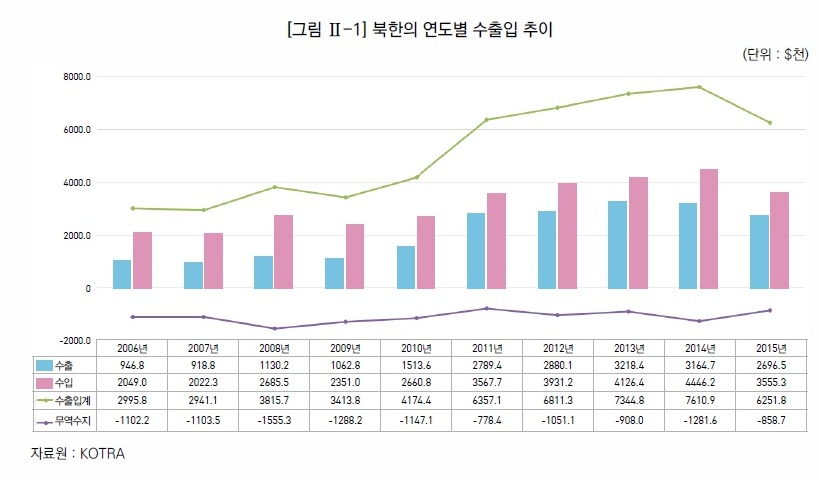
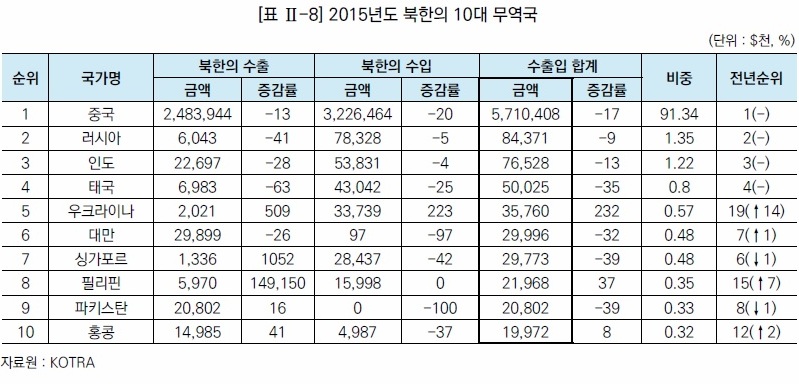
North Korea’s trade with China jumped nearly 25 percent in the first six months of this year, China’s customs office said Thursday, indicating that the North’s reliance on its neighboring ally on the economic front is growing.

According to the data released by the Chinese General Administration of Customs, the two allies’ trade came to US$3.14 billion during the January-June period, up 24.7 percent from the same period a year earlier.

The two countries signed the Sino-North Korean Mutual Aid and Cooperation Friendship Treaty in 1961, whereby China pledged to immediately render military and other assistance to its secretive ally.

The North’s exports to China totaled $1.3 billion during the first half of this year, up 22.2 percent from a year earlier.

Its imports from China grew 26.5 percent on-year to $1.84 billion over the cited period.

This resulted in a trade deficit of about $540 million for the North, the data showed.

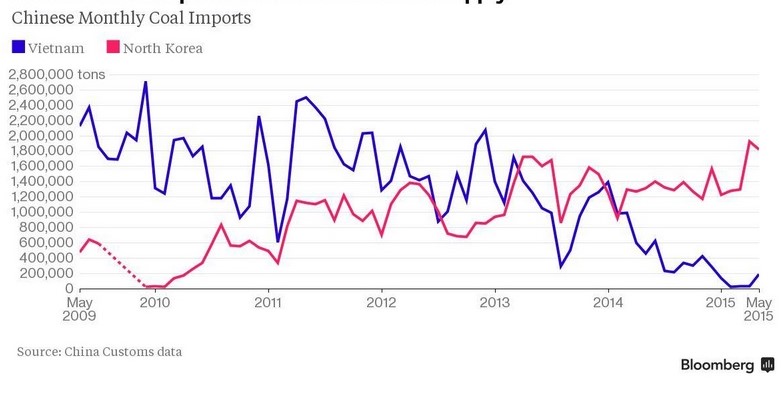
Iron ore was North Korea’s leading export item, while China exported to North Korea crude oil and construction machinery, the customs office said.

With international sanctions in place amid the North’s nuclear ambitions, China has emerged as the communist state’s key supplier of economic goods.

Read the full story here:
N. Korea’s first-half trade with China jumps 25 pct
Yonhap
2012-8-9

Share

North Koreans visiting China rose in 2011

Sunday, July 29th, 2012

According to Yonhap:

The number of North Korean visitors to China increased drastically since then-North Korean leader Kim Jong-il’s tour of the North’s biggest communist ally early last year, Chinese government data shows.

The data on the entry of foreigners obtained Sunday by Yonhap News Agency showed that 152,000 North Koreans entered China in 2011, a sharp rise from 116,000 the previous year. Out of the total, 114,000 were businessmen and laborers.

The comparable figures were 116,000 in 2010, 103,000 in 2009, 101,000 in 2008, 113,000 in 2007 and 110,000 in 2006.

The sharp rise is attributed to the visit to China by late North Korean leader Kim Jong-il in May last year, apparently to enhance bilateral economic cooperation.

The Beijing government said at the time that Kim was invited “so he could have the chance to grasp the developments in China and make the most of them for the development of North Korea.”

The number of North Korean visitors to China will likely increase further this year as China has received 88,000 North Koreans for the first six months this year alone.

Read the full story here:
N. Korean visitors to China rise drastically since last year: data
Yonhap
2012-7-29

Share

North Koreans study China’s Huaxi Village

Friday, July 20th, 2012

They should be studying Xiaogang Village! But instead they are studying Huaxi Village. Why? According to the Joong Ang Ilbo:

For the past six months, seven working-level North Korean officials have been staying at the Longxi International Hotel, located in a 72-story skyscraper in Huaxi Village, in China’s Jiangsu Province, a local government official told the JoongAng Ilbo in a telephone interview.

They’re allegedly trying to learn the secrets of Huaxi Village, known as China’s richest village but one that is still dedicated to socialism.

Huaxi Village is one of the richest places in China and a symbol of a model mixing socialism and capitalism. All the residents are shareholders of the local conglomerate and earn dividends at the end of every year according to its profitability.

“Roughly 20 North Koreans recently toured Huaxi Village,” a local resident told the JoongAng Ilbo. “The seven working-level North Korean officials have been staying in the village for six months learning how to manage a modern-style hotel.” Intriguingly, all seven are women.

The 328-meter (1,076-foot)-high Longxi International Hotel was completed last October and cost 3 billion yuan ($471 million). The five-star hotel has 800 rooms, including suites that go for 99,999 yuan per night.

“Officials from North Korea’s Foreign Ministry and the North Korean Embassy in Beijing also visited the village,” the resident said. “I’m not quite sure whether the women workers are from the ruling Workers’ Party, but they are mostly in their 20s.

“They have a great interest in learning about the dramatic growth of the village,” he continued. “They reportedly receive some kind of wages [from North Korea].”

Starting in 1978, the village’s residents actively participated in the reforms led by Deng Xiaoping. Wu Ren Bao, 84-year-old local secretary of the village, said in an interview with the JoongAng Ilbo in October 2011, “We accepted whatever was needed to make people rich and develop the village.”

Read the full story here:
Title
Joong Ang Ilbo
Chang Se-jeong, Jeong Yong-soo
2012-7-20

Share

An affiliate of 38 North