Stephan Haggard posted some charts of DPRK-China trade taken from KOTRA:
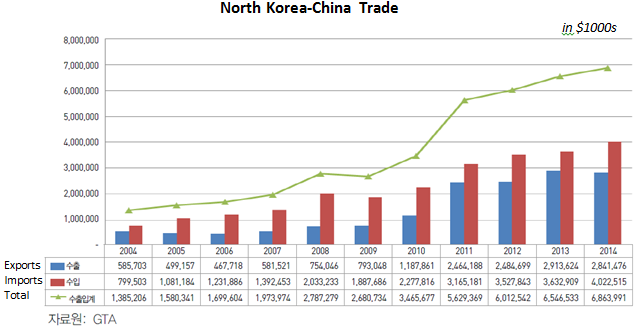
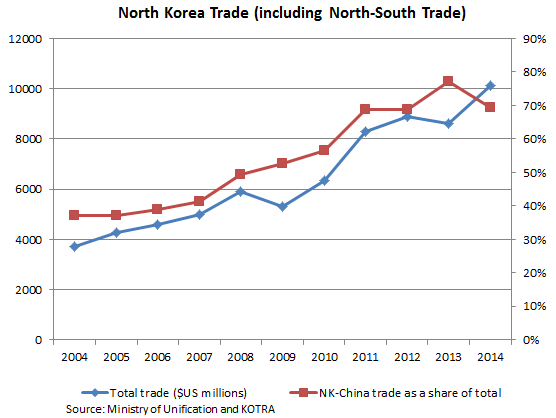
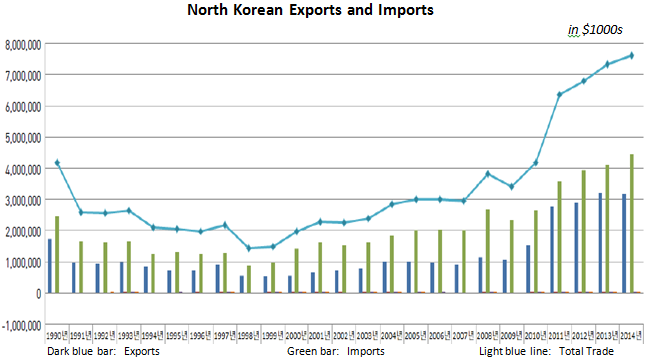

Stephan Haggard posted some charts of DPRK-China trade taken from KOTRA:
According to the Siberian Times:
SWAT team ambush illegal cargo at night in open seas off coast of the Democratic People’s Republic.
The high-quality jade from the Republic of Buryatia was being exported to China without export documents. Its value was put at 50 million roubles or $800,000. Customs spokeswoman Tatiana Shichanina said: ‘We had a tip off that the smuggling was planned and decided to arrange ambush.’
The operation was led from customs vessel ‘Petr Matveev’. Officers seized ten sacks of jade. The crew were detained and taken to Vladivostok.
In China, this mineral is considered a ‘sacred rock’ and it can command a higher price than gold. The value of the ornamental rock in China encourages criminal gangs to collect and smuggle it.
Read the full story here:
Customs seize 3 tons of Siberian jade being smuggled by sea to North Korea en route to China
Siberian Times
2015-10-23
UPDATE 3 (2015-10-22): According to Yonhap (via the Korea Herald):
North Korea and China signed preliminary trade deals worth $1.6 billion at their annual trade fair, a roughly 10 percent gain compared to deals signed at last year’s exhibition, according to a Chinese official on Thursday.
North Korea and China have jointly held the trade fair in October since 2012 in the Chinese border city of Dandong, and this year’s four-day fair ended on Sunday. Last year, the two nations inked trade deals worth $1.36 billion.
Pan Shuang, deputy mayor of Dandong, told the International Business Daily newspaper that about 100 North Korean business entities attended the North Korea-China Economic, Trade, Culture and Tourism Expo.
The number of North Korean business entities attending this year was similar to last year, but Pyongyang sent trade officials and diplomats to this year’s exhibition, Pan said.
At this year’s fair, North Korea and China also agreed to launch new tour routes linking the North’s border town of Sinuiju and Dandong, Pan said.
North Korea and China “further solidified their trade bridge through a wide range of exchange and cooperation” during the trade fair, Pan said.
China is North Korea’s economic lifeline and diplomatic backer, although their political ties remain strained over the North’s defiant pursuit of nuclear weapons.
Political relations between North Korea and China showed signs of a thaw after Liu Yunshan, the Chinese Communist Party’s fifth-ranked official, held talks with North Korea’s young leader Kim Jong-un earlier this month in Pyongyang.
UPDATE 2 (2015-10-11): According to Xinhua:
A 400-strong delegation from the Democratic People’s Republic of Korea (DPRK) will attend the fourth China-DPRK expo scheduled next week, said organizers.
The China-DPRK Economic, Trade, Cultural and Tourism Expo will be held from Oct. 15 to 18 in northeast China’s Dandong City, with more than 100 exhibition booths for DPRK companies.
China and the DPRK will also discuss the launch of new tourism projects to DPRK during the expo, according to organizers.
Firms from Russia, Mongolia, Pakistan, Thailand, Vietnam, Egypt as well as Hong Kong and Taiwan regions will seek business opportunities at the expo.
Dandong is a key hub for trade, investment and tourism between China and the DPRK. There are more than 600 border trade enterprises in the city, and trade with the DPRK accounts for 40 percent of the city’s total trade turnover.
The Guomenwan trade zone in Dandong is expected to open soon to boost bilateral economic cooperation.
UPDATE 1 (2015-10-2): Yonhap reports on the expo:
North Korea and China will launch a joint trade fair on Oct. 15, with some 400 Chinese companies expected to attend the annual exhibition, according to Chinese media on Friday.
North Korea and China have jointly held the annual trade fair in October since 2012, but the number of North Korean business entities attending the event last year was about 30 percent less than 2013.
About 100 North Korean business entities will take part in the four-day trade fair, which will be held in the Chinese border city of Dandong, according to Chinese media reports.
Besides North Korea and China, companies from Hong Kong, Vietnam, Mongolia and Thailand will join this month’s North Korea-China Economic, Trade, Culture and Tourism Expo.
In the latest sign that Pyongyang and Beijing are trying to increase economic cooperation despite strained political ties, North Korea and China will launch a border trade zone in Dandong on Oct. 15 when the trade fair opens.
The Guomenwan trade zone in Dandong, where more than 70 percent of bilateral trade between the two nations is conducted, would cost a total investment of 1 billion yuan (US$157 million), state-run Xinhua news agency reported in August.
ORIGINAL POST (2015-7-12): Adam Cathcart informs us that the fourth China-DPRK Economic, Trade, Culture and Tourism Expo will be held this year. Info on the first, second, and third expos here.
Here is the website for the event (in Chinese).
According to Cathcart:
The going-forward of the 2015 fair was announced in Dandong at a hotel by the city’s vice-mayor; no North Koreans were listed as attending. Nor were any DPRK officials in attendance[.]
Alastair Gale writes in the Wall Street Journal:
China’s economic slowdown and a plunge in coal prices are depriving North Korea of critical foreign currency, threatening to stir discontent among the small, elite class that the nation’s mercurial dictator relies on for support.
The drain on income comes as North Korea continues to plow its limited resources into its armed forces. On Saturday, the isolated state is set to hold a military parade to mark the 70th anniversary of the founding of its ruling party. It has also declared plans to launch satellites, seen by the U.S. and others as a way to test ballistic missile technology.
The value of North Korean exports to China, by far Pyongyang’s biggest trade partner, fell 9.8% through August from the year-earlier period, Chinese data show, accelerating from a 2.4% decline last year.
Adding to the pressure on Pyongyang is China’s attempt to scale back its bloated steel industry, the main customer for North Korea’s biggest export product, coal.
The scenario leaves North Korea’s young leader, Kim Jong Un, vulnerable. North Korea depends on China to buy most of its exports, but ties between the longtime allies have become strained over North Korea’s nuclear brinkmanship. To boost exports, Pyongyang has little option but to turn to its only other significant trade partner, South Korea.
All of this means Mr. Kim has less foreign currency to underwrite the lifestyles of the North Korean elite whose support is essential to maintaining his grip on power.
“Raising living standards for the North Korean apparatchik class is extraordinarily dependent on trade with China in a single commodity,” said Marcus Noland, executive vice president of the Peterson Institute for International Economics, a Washington research group. “A slowdown in revenues will create discontent.”
The depth of possible repercussions is hard to gauge because of North Korea’s opaque economy and political system. There are no clear outward signs of government instability, and prices of daily necessities such as rice—often an indicator of economic shocks—remain steady, said Nicholas Eberstadt, a political economist at the American Enterprise Institute, a Washington think tank.
North Korea continues to press ahead with infrastructure projects, such as the recent opening of a new international airport terminal near Pyongyang. The emergence of semiprivate businesses such as taxi companies in recent years has provided the state with fresh sources of income, said Go Myung-hyun, an expert on North Korea at the Asan Institute for Policy Studies, a Seoul-based think tank.
And China’s ban starting this year on highly polluting types of coal somewhat shields North Korea’s coal exports from a fall in demand because they are mostly high-quality anthracite, a type that produces little smoke.
Still, the fall in trade revenue increases the challenge for Mr. Kim, who has said economic development is a top policy priority despite his reluctance to embrace Chinese-style economic reforms, such as privatizing state businesses. In 2012, Mr. Kim said in a speech that citizens should “not have to tighten their belts again,” and North Korea’s state media frequently tout the construction of apartment buildings and leisure facilities as examples of progress.
Andrei Lankov, a professor at Kookmin University in Seoul, says the regime has been trying to reduce its dependence on China, which now absorbs as much as 90% of Pyongyang’s exports, compared with around 50% in the early 2000s, according to the Korean International Trade Association in Seoul. The value of those exports last year was $2.9 billion, Chinese customs data show.
One sign of that concern came in late 2013 when Mr. Kim executed his own uncle, Jang Song Thaek, an official who was widely seen as a proponent of closer trade links with Beijing. State media blamed Mr. Jang for “selling off precious resources of the country at cheap prices.”
Pyongyang’s diplomats have traveled extensively around the world over the past year, including a rare foreign ministry visit to India in April. Still, many nations remain wary of boosting trade links as North Korea continues a nuclear standoff with the U.S. and other nations.
Last year, North Korea and Russia signed an ambitious economic development agreement, but while Pyongyang and Moscow have warmed politically—reflecting shared hostility toward the U.S.—few economists see much potential for significant growth in bilateral trade; North Korea’s exports to Russia totaling just $10 million in 2014.
U.S. and South Korean diplomats say that greater international scrutiny has crimped another North Korean revenue stream: illicit arms and drugs.
Many economists say South Korea is the North’s only near-term option to offset declining trade income from China and may have motivated Pyongyang in August to reach an accord to end a confrontation after the two sides exchanged artillery fire.
“South Korea is the one potentially interested partner that could provide a significant boost to North Korea’s economy,” said Troy Stangarone, senior director for congressional affairs and trade at the Korea Economic Institute in Washington.
The South imposed economic sanctions on the North in 2010, blocking most bilateral trade, in response to the sinking of a warship that killed 46 sailors. Trade has since edged up and Seoul says it is willing to discuss increasing economic cooperation if progress is made in other areas, such as reuniting families separated by the Korean War.
Lee Jong-kyu, a research fellow at the Korea Development Institute in Sejong, South Korea, said the North may also seek new revenue by ramping up its exports of manual laborers to places such as Russia and the Middle East, try to boost tourism or build up light industry. North Korea also has tried to reboot plans for foreign investment in special economic zones—with little success, say foreign officials.
Ultimately, while Chinese diplomats express frustration with the regime in North Korea, it is unlikely that Beijing would allow its volatile neighbor to become destabilized by a fall in trade and spark a humanitarian disaster on its doorstep, observers say.
“If Beijing is a generous uncle, this will not prove to be a perilous problem because uncle will send more allowance,” Mr. Eberstadt said.
Read the full story here:
Cash Crunch Hits North Korea’s Elite
Wall Street Journal
Alastair Gale
2015-10-8
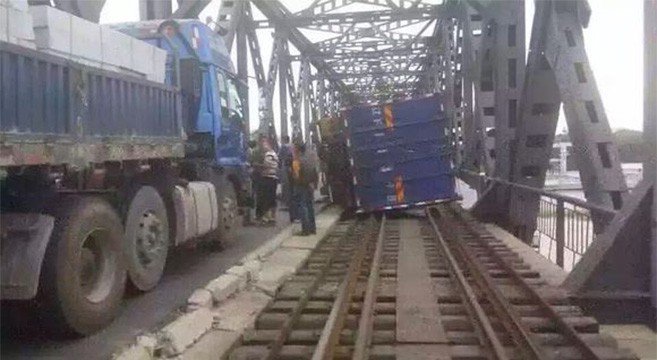
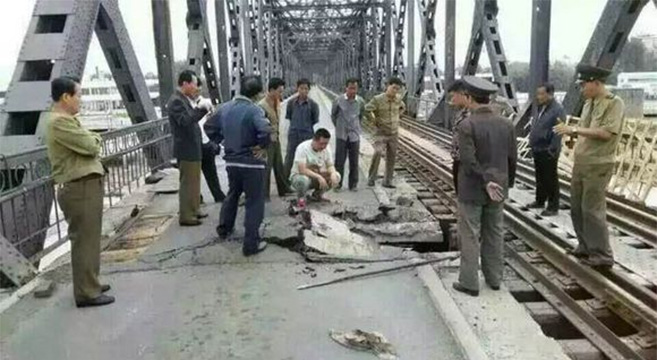
Photos from Daily NK
UPDATE 3 (2015-10-26): NK News reports that the bridge was also closed to road traffic in the last week of October for additional repairs.
UPDATE 2 (2015-10-6): Sino-NK Friendship Bridge to open with new regulations. According to the Daily NK:
The Sino-Korea Friendship Bridge has reopened after receiving maintenance for wear and tear that caused a truck accident and an ensuing shutdown of the bridge late last month, Daily NK has learned.
“The transport of cargo was halted because of the truck accident, which was the first to occur in seven decades since the bridge was built, but they’ve resumed transport starting today,” a source in North Pyongan Province told Daily NK on Monday. “They completed three days of work on the bridge, and all cargo trucks are traveling through, but they’ve limited the weight of the truck and cargo to 15 tons to prevent recurrences.”
This news was corroborated via a second source in the same province.
Following a request from the customs office in China’s Dandong, the two sides agreed to abolish the system of allowing cargo to pass according to respective decisions that had created room for passage of overloaded trucks. Instead, authorities will cap the weight of the vehicle and cargo combined at a total of 15 tons.
There are no exceptions at this time, he said; if a vehicle fails to comply with the limit regulations, no access will be permitted.
“Until now, 20 to 30 tons had commonly been the minimum loaded, and often cargo would be much heavier,” the source explained. “Especially more recently, the loads sometimes reached up to 40 to 50 tons due to overloading because of mineral exports that were done in 30-ton containers.”
The bridge is acutely susceptible to damage, he added, noting that North Korea has been overloading trucks with coal, and minerals such as gold, copper, silver, magnetite, molybdenum, and other minerals to earn in foreign currency and secure ‘loyalty funds’ for the leadership since the 1990s.
Mineral exports have reportedly seen a dramatic surge this year, explained by state efforts to reap in capital for Party Foundation Day preparations. However, no attending measures were implemented to control the pervasive practice of overburdening vehicles.
“We (the North) will face a sense of urgency to push out as many minerals as we can to get our hands on more money and import goods, but now with the restrictions on cargo volume now, traders will be swamped,” the source predicted, adding that the number of trucks on the road is also likely to jump significantly.
A flagrant disregard for concern over safety measures is entirely to blame for the accident, he lamented, noting that traders focus all their energies and concerns on raking in ‘loyalty funds’ above all else. While the need for weight regulations was irrefutable, the source surmised that the sudden modification will soon prove to be a double-edged sword.
Going forward, accidents will, presumably, decrease, but disgruntlement from traders faced with bringing in massive loads of supplies into the country leading up to the October 10 celebration is certain to peak, he concluded.
UPDATE 1 (2015-10-1): According to the Daily NK:
The Sino-Korean Friendship Bridge, connecting China’s Dandong and North Korea’s Sinuiju, has been shut down after damage sustained over a protracted period of time caused a truck to flip over. However, with only a number of days left until the Korean Workers’ Party foundation celebration, traffic was temporarily resumed on September 30th, Daily NK has learned.
“Today (September 30th) they resumed traffic just for one day so that North Korean traders can bring in supplies for the event after a truck crashed because of the damage on Monday,” a source from North Pyongan Province told Daily NK.
An additional source in the same province corroborated this news.
Officials have banned entry from October 1 to 4 so that they can restore the bridge, but facing urgent preparation for the Party’s 70th Foundation Day festivities, they put down steel plates as a temporary fix to get truck loads of supplies through, the source explained.
“The accident has thrown customs offices on either side of the border into mad panic,” she added. “Cadres from both customs services surveyed the site of the accident and put things into motion, so construction work is now underway.”
Starting at 8 p.m. on the day of the accident, train services were up and running, but the battered roads with deep crevices were covered with makeshift steel plates by North Korean workers, allowing vehicles that had entered Sinuiju to return to Dandong. Reconstruction work is currently being carried out by Chinese workers, according to the source.
The source speculated that the project would be finalized by October 5, opening up the bridge for a massive trade of goods, leading up to the Party celebration, which falls on the 10th.
ORIGINAL POST (2015-9-29): According to UPI:
A 72-year-old railroad bridge connecting North Korea and China was closed after a crash involving multiple trucks occurred on the North Korea side of the span on Monday.
The Yalu River Bridge, also known as the Sino-Korean Friendship Bridge, was blocked after three or four Chinese trucks rolled at a portion of the bridge that had sunk between 13 and 22 feet, South Korean news network YTN reported.
The bridge has a lane for road vehicles and another for a pair of railway tracks. Trains traveling from China into North Korea were temporarily suspended, but service was resumed after the tracks were repaired, an unidentified source told YTN on Monday.
Another source told South Korean outlet CBS No Cut News the heavy trucks headed for Sinuiju overturned, fell and collided into the adjacent railway tracks, and the accident occurred between 10 and 11 a.m. Vehicular traffic was closed for the rest of the day, and more than 100 trucks from China waiting to enter North Korea were halted, the source said.
The number of casualties was not disclosed.
The bridge, completed in 1943, accounts for 70 percent of commercial traffic between China and North Korea, and the railroad runs from Sinuiju to Beijing.
China remains North Korea’s No. 1 trading partner, and North Korea imports more than it exports to Asia’s largest economy. Pyongyang’s trade dependence on China runs as high as 90.1 percent, according to South Korean government statistics [which exclude South Korean trade with the DPRK].
Read the full story here:
Truck accident on sinking North Korea bridge suspends traffic
UPI
2015-9-29
UPDATE 1 (2015-9-30): Aram Pan (DPRK 360) has posted a comprehensive video of the trade fair for those of us unable to make it.
ORIGINAL POST (2015-9-28): According to Yonhap:
A Chinese envoy has urged more Chinese companies to make inroads into the North Korean market, while calling for deepening economic and trade ties with North Korea.
Li Jinjun, China’s ambassador to North Korea, made the remarks on Thursday as he visited an annual trade fair in Pyongyang, in which about 110 Chinese firms took part, according to the Chinese Embassy in the North on Monday.
Li urged the Chinese companies to “better understand and enter into the North Korean market.”
The Chinese ambassador also “encouraged them to develop friendly relations between China and North Korea and deepen bilateral economic and trade cooperation.”
Political relations between North Korea and China remain strained over the North’s defiant pursuit of nuclear weapons and missiles, but China is the North’s economic lifeline.
About 300 companies from 10 nations, including China, Germany, Singapore and Vietnam, joined the 11th Pyongyang Autumn International Trade Fair, which was held last week, according to the Chinese Embassy.
Read the full story here:
Chinese ambassador calls for deepening economic ties with N. Korea
Yonhap
2015-9-28
By Benjamin Katzeff Silberstein
This certainly has been the season of contradictory information on North Korea’s food supply. The North Korean government is celebrating and claiming success of their agricultural reforms, while the FAO reports that things have gotten worse. Let us recap what has happened:
First there was the drought. North Korean state media described it as the worst one in 100 years. UN agencies predicted large-scale crop failures and appealed for food aid, warning that large shares of the population would be at great risk if aid did not come. The UN’s emergency response fund (CERF) allocated $6.3 million to counter the impacts of the drought. The rains came, however, and the drought alarms seemed to have been exaggerated.
Next, the North Korean media – assuming you can even talk about it as a single, coordinated entity – went the other direction. In July, the weekly Tongil Sinbo claimed that thanks to agricultural reforms, this year’s harvest had actually increased “despite adverse weather conditions”.
And recently, reports turned the other way again. In early September, the Food and Agriculture Organization of the UN declared that the cereal production forecast for the main season of 2015 had declined drastically from last year due to a “prolonged dry spell”.
The rain that eventually came in July and August, causing flooding in the northern parts of the country and leading to an estimated loss of one percent of all planted areas. The FAO rice production forecast for 2015 is 12 percent below that of last year. State food rations, the importance of which can be debated, declined drastically, according to the agency.
In the midst of all of this, North Korean propaganda is still claiming success for the reforms. Earlier this month, the state news agency KCNA reported that a “dance party” had been held in South Hwanghae, part of the country’s rice bowl, celebrating improving conditions on the countryside:
The performers presented cheerful dances depicting the happy agricultural workers who work and live in the rural areas now turning into a good place to work and live thanks to the successful embodiment of the socialist rural theses under the leadership of the Workers’ Party of Korea.
The picture gets even more complicated if one assigns meaning to the fact that cereal imports from China were reportedly lower in July this year compared to 2014. Figures from just one month might not indicate a trend, but given that July was a particularly dire month, these figures are still significant. If imports are being decreased because the official line is that agricultural conditions have improved, no matter the reality, that might be bad news for those in the North Korean public that rely on the public distribution system for any significant part of their consumption.
Either the FAO is right and the North Korean government wrong, or the other way around. Harvests this season cannot have been improving and getting worse at the same time. The FAO is probably far more likely than the North Korean government to have made a correct assessment here. Even if North Korean authorities aren’t claiming success of the reforms for propaganda reasons – which they may well be doing – it is hard to see why their statistical and monitoring capabilities would be better than those of the FAO.
So, the North Korean government is claiming that agricultural reforms are leading to better harvests and food conditions, even when they probably aren’t. Why would they do that? There are lots of possible reasons and one can only speculate.
One possible reason is that the agricultural reforms have become a prestige project. North Korean propaganda channels and news outlets have publically claimed that reforms are being implemented and leading to good results, even though some adjustment problems have been admitted. The same pattern, by the way, can be seen with regards to forestry policies – state media has publicized them with a bang and claimed that they just aren’t being implemented well enough by people on the ground when they don’t seem to be working as intended.
This could be an indication that agricultural reforms are indeed, like many have assumed, a major policy project of Kim Jong-un and the top strata.
That could be good news. After all, North Korea is in dire need of changes in agricultural structures, production methods, ownership and responsibility.
But it could also be bad news. When policies are strongly sanctioned and pushed by the top, their flexibility is likely to be inhibited. In other words, if the top leadership says that something should get done, it has to get done regardless of whether it works well or not.
Again, look at the forestry policies. According to reports from inside the country, those tasked with putting the new policies into practice on the ground say that doing what the central government asks isn’t smart or possible. Nevertheless, such orders are hard and risky to question.
At this stage it is only speculation, which is always a risky endeavor when it comes to North Korea. It may well later turn out to be wrong.
But if the state is placing enough prestige in the agricultural reforms to claim that conditions are improving even if they aren’t, that may lead to limited flexibility in how they are implemented and changed in the future. In other words, if the leadership thinks they are important enough to claim success even when things are getting worse, they may not be prone to changing their orders to fix what isn’t working.
According to Xinhua:
A bulk cargo and container shipping route between China and the Democratic People’s Republic of Korea (DPRK) has been put into operation, focusing on coal import from DPRK and grocery export from China, authorities said on Friday.
The route, linking Longkou port of east China’s Shandong Peninsula to Nampo port of western DPRK was the first scheduled shipping line for bulk cargo and container between the two countries. It is serviced by seven ships, which complete one circuit of the ports every ten days, according to Longkou Port Group.
The route was jointly established by Longkou Port Group, Liaoning Hongxiang Industrial Group and a shipping company in DPRK in a bid to promote international trade under China’s “Belt and Road” initiative.
Located at the Bohai Sea coast and built in 1914, Longkou port handled 75.07 million tonnes of cargo and 550,000 TEU of containers last year.
“The opening of the route can help improve the service function of the port and is of great significance for the port’s transformation and upgrading,” said Zhang Haijun, general manager of Longkou Port Group.
Read the full story here:
Bulk cargo and container shipping route links China, DPRK
Xinhua
2015-9-25
According to Reuters:
China has launched a bulk cargo and container shipping route connecting it to North Korea that will focus on importing coal and exporting groceries, state news agency Xinhua said on Friday, citing a Chinese port authority.
The route will connect China’s Longkou port in eastern China’s Shandong province with the North Korean port of Nampo, and will be serviced by seven ships, it said.
Though China’s coal imports have slumped 32 percent in the first eight months of the year, deliveries from North Korea have surged 33 percent to 13.4 million tonnes, making it China’s third biggest foreign supplier.
“This big rise is probably down to North Korea’s industrialisation, which should have spurred an increase in production,” said Yao Yao, a coal analyst with China’s Guangfa Securities.
The new route was established by the Longkou Port Group, Liaoning Hongxiang Industrial Group and a North Korean shipping company, Xinhua reported. It said the Longkou Port handled 75.07 million tonnes of cargo and 550,000 TEU of containers in 2014.
Here is the original story in Xinhua:
A bulk cargo and container shipping route between China and the Democratic People’s Republic of Korea (DPRK) has been put into operation, focusing on coal import from DPRK and grocery export from China, authorities said on Friday.
The route, linking Longkou port of east China’s Shandong Peninsula to Nampo port of western DPRK was the first scheduled shipping line for bulk cargo and container between the two countries. It is serviced by seven ships, which complete one circuit of the ports every ten days, according to Longkou Port Group.
The route was jointly established by Longkou Port Group, Liaoning Hongxiang Industrial Group and a shipping company in DPRK in a bid to promote international trade under China’s “Belt and Road” initiative.
Located at the Bohai Sea coast and built in 1914, Longkou port handled 75.07 million tonnes of cargo and 550,000 TEU of containers last year.
“The opening of the route can help improve the service function of the port and is of great significance for the port’s transformation and upgrading,” said Zhang Haijun, general manager of Longkou Port Group.
Read the full story here:
China Launches North Korean Shipping Route
Reuters
2015-9-25
