Archive for the ‘Construction’ Category

Daewoo Shipbuilding [not] to invest in DPRK SEZ

Friday, February 10th, 2012

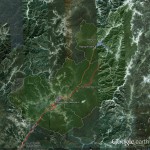
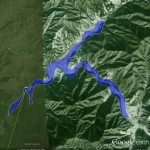
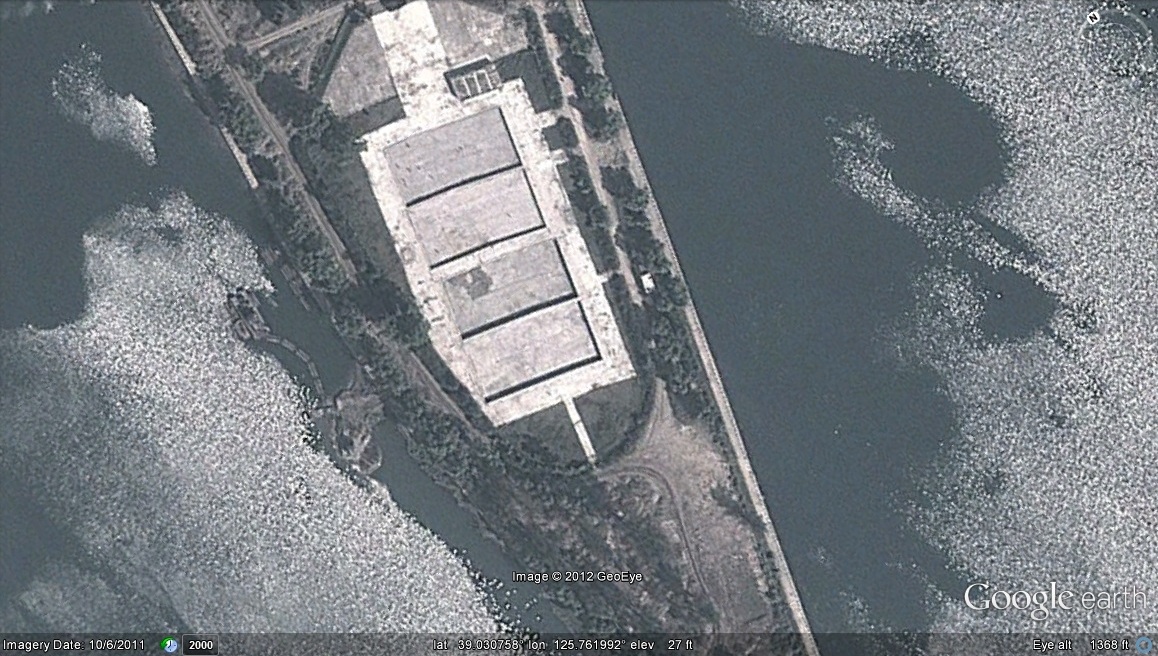
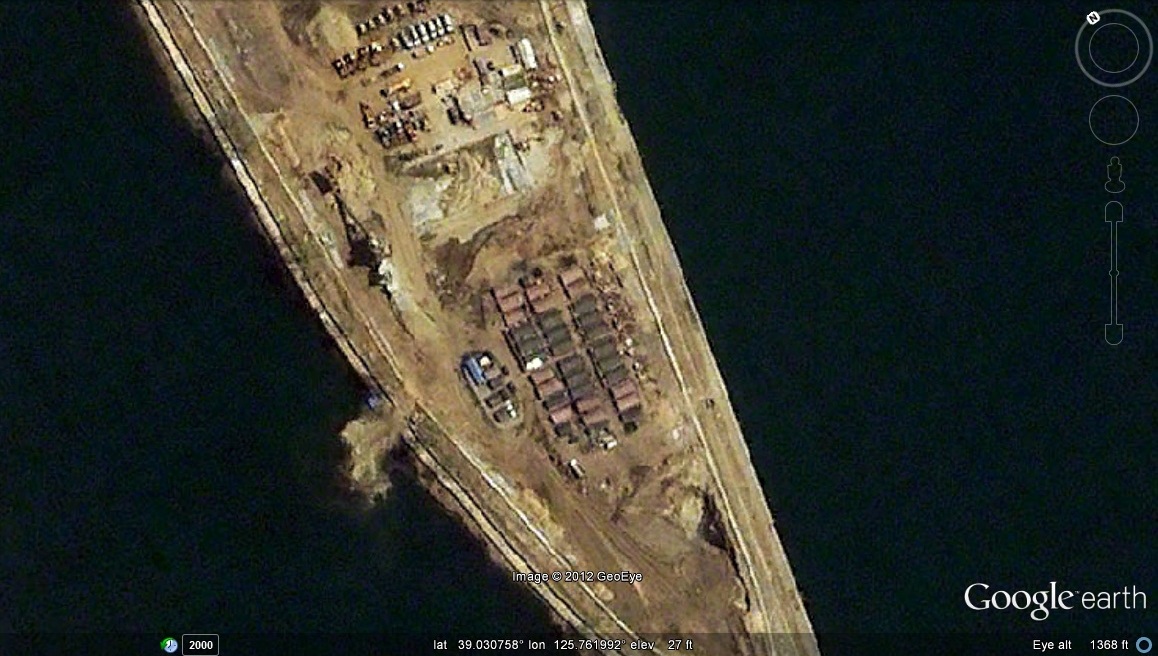
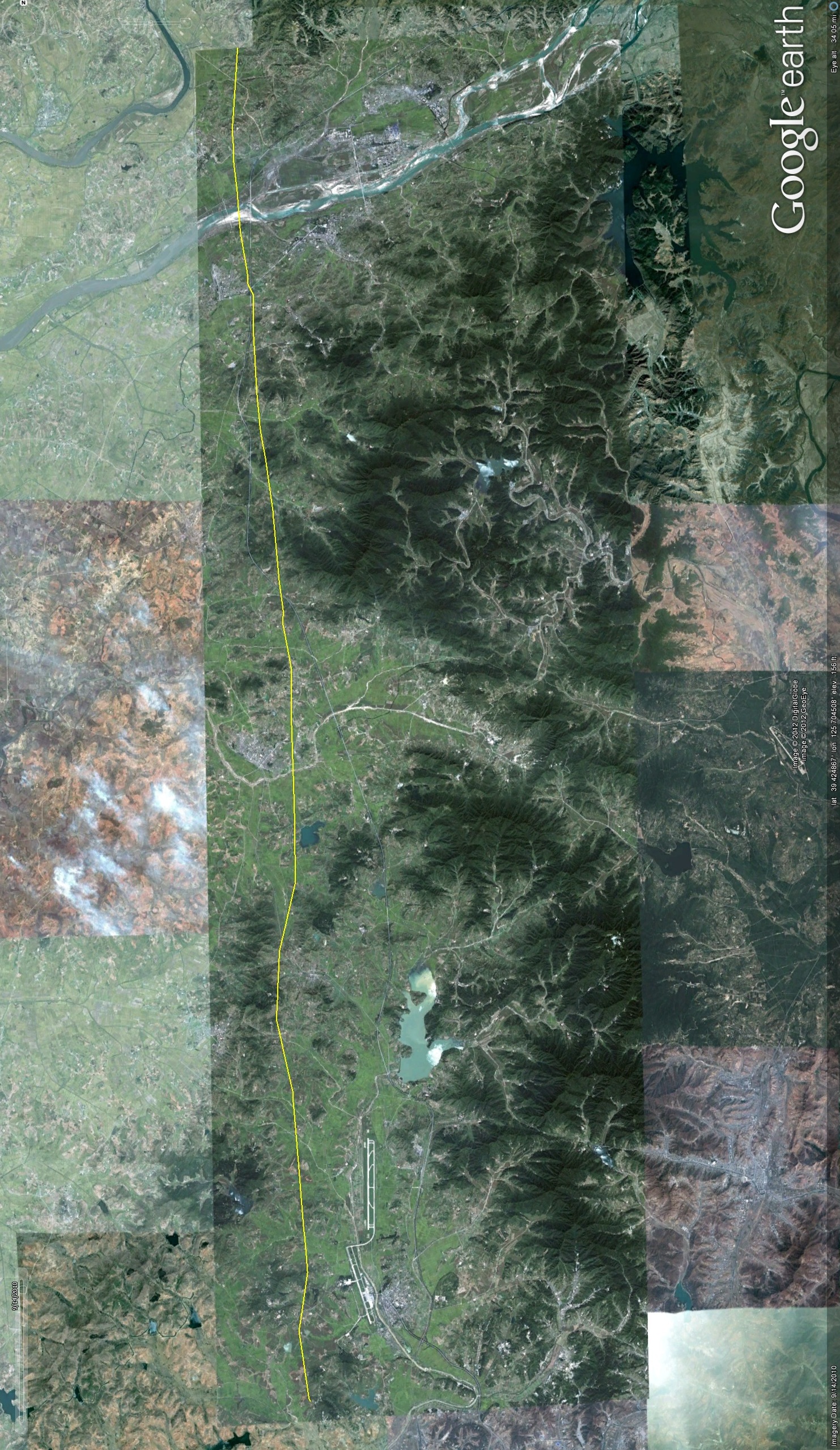
Pictured Above (Google Earth): The Hwanggumphyong and Wiwha Island SEZ on the Yalu/Amnok River which separates the DPRK and PRC.

On Friday, the Donga Ilbo reported that Daewoo Shipbuilding was going to invest in the DPRK’s Hwanggumphyong SEZ (see the original post below).  Today the report appears to be incorrect. According to the Wall Street Journal:

Daewoo Shipbuilding & Marine Engineering Co. on Monday shot down news reports that it had agreed to build a shipyard in North Korea.

“We don’t have any plans to do that,” a spokesman said.

According to some South Korean news accounts over the weekend, the company, which is the world’s second-largest builder of ships and whose controlling stake is owned by the South Korean government, had agreed to help a Chinese company develop an island off North Korea’s northwest coast, near the Chinese city of Dandong.

The DSME spokesman said the company held discussions with the Chinese company but isn’t close to an agreement.

The news accounts said DSME would build a shipyard that would be devoted to repair work. One report said the idea would be presented to DSME’s directors and announced in April.

The company spokesman said it’s unclear how the accounts originated.

See the original report bleow:

(more…)

Share

Kim Jong-il’s name carved on Mt. Sokda

Wednesday, February 8th, 2012


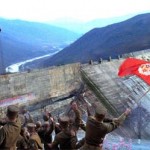
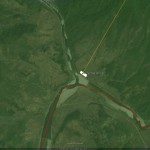
Pictured above: (L) A Google Earth satellite image of the face of Mt. Sokda (석다산) before it was “blessed” with the Kim Jong-il commemorative carving (Coordinates:  39.180907°, 125.361290°) (R) A photo from KCNA of the new carving.

According to KCNA:

Pyongyang, February 8 (KCNA) — Letters “Peerless Patriot General Kim Jong Il. February 16, Juche 101 (2012)” were carved on natural rock in Mt. Sokda, Jungsan County, South Phyongan Province on the 70th anniversary of his birth.

The total length of the letters is 120 meters with his name 10 meters high, 5.5 meters wide and 1.4 meters deep. Other letters are 8.5 meters high, 4.8 meters wide and 0.9 meters deep.

Officials and working people in South Phyongan Province chose the rock that is easily visible, reflecting the ardent desire of the people
around the country to exalt his immortal revolutionary feats forever.

An unveiling ceremony took place on Wednesday.

Present there were Kim Ki Nam, Choe Thae Bok, Yang Hyong Sop officials concerned, party members and other working people in the county and helpers.

There are of course many carvings like this in the DPRK. Here is one of my “favorite” examples.

UPDATE 1: The Daily NK has more. See below:

(more…)

Share

Power shortage in Pyongyang prompts residents to move to older housing

Wednesday, February 1st, 2012

Two stories out with similar themes:

The first is from the Daily NK:

Many of the residents of luxury apartments in Pyongyang are leaving their homes for the heated homes of relatives or other warmer locations.

An inside source who visited Pyongyang at the end of last month said in a phone interview with the Daily NK today, “People previously had no supplies of water so didn’t have drinking water and could not go to the bathroom without difficulty, but now that there are heating problems too the people are inevitably leaving their homes. This year, many people are locking their homes and leaving for warmer places.”

The source said, “When I went to Pyongyang just three years ago, the people still stayed in their apartments even without heat, but now half of them are gone, they went to East Pyongyang where the pre-1980s homes are heated with charcoal briquettes.”

The source added, “Even until last year, the residents in these apartments spent the whole winter season there with cotton blankets on the floor all day long, filling pint bottles with hot water to warm their blankets when they slept; however, as the situation has gotten worse this year whole families cannot take any more and have chosen to leave their homes behind.”

The 20-40 storey apartments on Gwangbok and Tongil Streets, which are boasted of by the North Korean authorities for their modernity, are among those falling into dilapidation.

The source explained, “If the rooms had just enough lukewarm water that they wouldn’t freeze we could live, but now they are not even able to do that. Nobody knows when heat will come.”

Among many North Korean people, the situation is such that the letter ‘ㄹ’ has come to be ridiculed, with people saying that they suffer from a particular lack of words that have the letter ‘ㄹ’ in them, for example, water (‘물’), fire/electric (‘불’), and rice (‘쌀’).

The second story is from Reuters:

North Korea’s capital faces its worst electricity shortages in years just as a new leadership takes power in the impoverished state and pushes ahead with lavish building projects to celebrate the centenary of its founder’s birth.

The Pyongyang-based diplomat, who asked not to be named, said the city of 3 million and home to the leadership elite, has seen daily power supplies almost evaporate as freezing winter temperatures bite.

“Embassies and others with generators are using them most of the time to compensate both for poor quality and cuts, and I can tell you that power problems are a main issue of discussion,” said the diplomat, one of a small number of foreigners allowed to live in the country.

“We certainly assess that there is more darkness on the streets and in the residential blocks in the evening than before/during the mourning period (for Kim Jong-il).”

The young Kim Jong-un has been declared the country’s new “supreme leader” following the death of his father Kim Jong-il in December.

Fuel shortages have long been a chronic problem in North Korea which is heavily sanctioned by the outside world for a series of nuclear and missile tests.

Temperatures in the capital on Wednesday hit -19 Celsius (-2 Fahrenheit).

This winter’s outages have coincided with Pyongyang’s building spree to mark the 100th anniversary this year of the birth of founder Kim Il-sung — the current leader’s grandfather — including building 100,000 new homes in the capital.

The North is also struggling with chronic food shortages, with United Nations’ food agencies estimating nearly 3 million people will need food assistance this year.

Read the full stories here:
No Electricity, No Water, No Patience
Daily NK
Choi Song Min
2012-1-13

North Korea Power Cut: Pyongyang Diplomat Says Capital Faces Worst Electricity Shortages In Years
Reuters
2012-2-1

Share

Mirim’s second Kim Il-sung Square

Tuesday, January 31st, 2012

UPDATE 1: By coincidence NK Leadership Watch and I posted on a similar topic today.  See his post and analysis here.

ORIGINAL POST: Today the Daily NK reported that preparations were underway for another KPA military parade:

A high level government official revealed today, “North Korea has been mobilizing military personnel and equipment to practice for the military parade at Mirim Airfields near Pyongyang. This practice has been taking place since even before the death of Kim Jong Il.”

The official explained the reason for the ongoing parade practice as part of preparations to commemorate Kim Il Sung’s birthday (April 15) and the Mlitary Foundation Day (April 25).

The military parade practice has so far involved the Worker and Peasant Red Guard, which is made up of currently-serving soldiers and reservists, mobilized with the latest-model tanks, armored cars, as well as short and medium range KN-02 and Musudan missiles.

The official added, “North Korea conducts parades on anniversaries such as the Military Foundation Day and other national holidays. Looking at the speed and scale of preparations currently underway, it seems more likely that the parade will take place in April rather than on February 16, Kim Jong Il’s birthday.”

The logistics of these parades are enormous.  I learned a lot about them back in November at a meeting with Osamu Eya in Japan. Among the many things we discussed, I asked him where the North Korean military practices their parades through Kim Il-sung Square. He answered with a single word: “Mirim”.

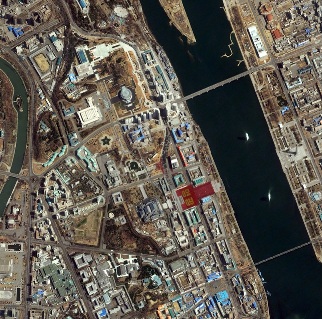
Now I am kind of embarrassed to admit that I never saw the resemblance (because I thought of the Mirim area as a runway strip and because the two places are not geographically laid out in the same directions). Once you rotate the satellite images and set them next to each other, however, there is no denying that the KPA has a Kim Il-sung Square-sized practice area from which to rehearse its grand military parades.


Pictured above (Google Earth): (L) Kim Il-Sung Square, (R) Mirim parade practice area.

Looking at the most current Google Earth satellite imagery (2010-10-6) we can see vehicles already practicing for their next parade:

In this Google Earth image (2006-11-11) we can see people practicing in the area:

Going back to the oldest available satellite image on Google Earth (2000-6-12) the use of the facility as a practice area is a little more clear.  We can also see some of what remains of the original landing strip in this photo:

But Mirim is not just a practice filed.  It also contains facilities to house and feed the thousands of people who come to practice. Just to the left of the field is the April 25 Hotel:


According to KCNA (1998-9-30):

The April 25 Hotel has been built on the outskirts of Pyongyang as a monumental edifice in the era of the Workers’ Party. The hotel with a total floor space of more than 134,000 square metres and accommodation for 20,000 guests has bedrooms, cultural and welfare facilities and cook equipment on a highest level. It will serve servicemen and civilians who participate in national military and civic events. Soldier-builders successfully finished this gigantic project–erection of buildings, assembling of equipment and arrangement of the area–in a little more than one year. A ceremony for the completion of the hotel took place on Tuesday. Present at the ceremony were Jo Myong Rok, Kim Il Chol, Kye Ung Thae and others. A congratulatory message of the Workers’ Party of Korea Central Committee was conveyed to the soldier-builders and helpers who had performed feats in the hotel construction. The message noted that the April 25 Hotel, a monumental edifice of the era, has been built in a short span of time under the present conditions that all the people have to overcome manifold trials and hardships in their advance. it could be done only by the revolutionary army of Korea who knows no impossibility, and it is a proud fruition produced by the might of the army and people rallied around the party as one in mind, it stressed. Highly praising the soldier-builders and helpers for demonstrating again the potentials and stamina of socialist Korea by completing the hotel, the message expressed the belief that they would make greater success in carrying out their revolutionary duties. Jo Myong Rok made a report at the ceremony. The reporter said that the heroic and proud feats performed by servicemen in the noble work to carry out the WPK’s grand plan for construction will be always remembered by the fatherland and handed down to posterity.


KCNA reported on 1998-10-8 that Kim Jong-il visited the hotel:

Pictured above: Kim Jong-il giving “on the spot guidance” at the 4.25 Hotel

[Kim Jong-il] then went to the April 25 Hotel which was newly built on Mirim plain. Looking round the interior and exterior of the hotel including a bedroom, a washroom, a dining hall and a kitchen, he learned how the hotel had been built. He highly praised soldiers and helpers for having built the hotel in a short span of time and contributed to demonstrating the potential and stamina of socialist Korea once again. He said the construction of the hotel in a short span of time is a miracle that can be worked only by the heroic Korean People’s Army (KPA) which is intensely loyal to the party. He added that the country will always remember the soldiers’ heroic feats and proud achievements in socialist construction. He called for equipping the hotel, an asset of eternal value for the army and people, with better facilities, planting many trees around the hotel, creating a pleasure park and providing those who stay in the hotel with good conditions for cultured life. As many servicemen and civilians will use the hotel, they should be given best services, he said, and gave the hotel important tasks for its management and operation. The Chairman of the DPRK National Defence Commission was accompanied by director of the General Political Department of the KPA Jo Myong Rok, chief of the general staff of the KPA Kim Yong Chun, Minister of the People’s Armed Forces Kim Il Chol and general officers of the KPA.

This hotel was built at the time the DPRK was experiencing the “Arduous March” (Forced March)–a famine which killed up to a million people. Despite the acute shortage of food and a breakdown of the DPRK’s revolutionary social contract, KCNA listed this hotel as one of the great accomplishments of the North Koreans during this time (1998-12-31):

This year proud successes have been reported from the DPRK in face of difficulties brought on by the combined effects of the never-ceasing campaign of the imperialists to stifle the DPRK and years of natural disasters. The most remarkable success gained in the forced march this year is artitifical satellite “Kwangmyongsong 1” which was launched into orbit on august 31. The scientists and technicians of Korea launched into orbit the first artificial satellite, a product of their own wisdom and technology, fully demonstrating the national power of Korea with a powerful scientific and technical force and the solid foundations of the independent national economy. Bulky April 25 Hotel and September 9 Street sprang up in Pyongyang to commemorate 50 years of the DPRK (September 9). The hotel with modern equipment and accommodation for 20,000 is on the east outskirts of the capital city. The street linking Pyongyang Airport to the Kumsusan Memorial Palace, the sacred temple of Juche, gave a major face-lifting to the northwest area of the capital city with bridges of special characteristics, flats for thousands of households, ornamental forests, scores of metres wide, on either side of the highway in good harmony with landscape. Thousands of minor power stations were built across the country this year. The locally-built minor power stations in Jagang Province meet the needs for the lighting of the flats for more than 100,000 households and the production of local-industry factories. Flats for 10,000 households in Chongjin, an industrial city, benefit from electric heating. A growing number of cities, counties and units are offsetting the demands for electricity with electric energy turned out at minor power stations. The Huichon General Machine Tool Plant produced hundreds of machine tools in a matter of a few months. In the railway transport diesel engine locomotives were converted into electric locomotives called “forced march.” 60 kilometre-odd-long railroad between Haeju and Ongjin, between singangryong and Pupho in the central area of the country was switched over to a broad-gauge one. The Pyongyang Integrated Circuits Factory, salt refineries and other industrial establishments were commissioned or completed throughout the country. As a result, a more solid economic foundation of the nation was laid.

Share

Another Songun-era agriculture project launched in Haeju

Friday, January 27th, 2012

Pictured Above: The DPRK’s two most famous waterways are the Paekma-Cholsan Waterway (see here and here) and the Kaechon-Lake Thaesong Waterway. A third waterway in the Miru Plain is too recent to appear on Google Earth.

 According to KCNA (2012-1-26):

Waterway to Be Built in South Hwanghae Province, DPRK

Pyongyang, January 26 (KCNA) — A gravity-fed waterway will be built in South Hwanghae Province.

It is another gigantic nature-remaking project in the era of Songun as part of the far-sighted nature-harnessing plan of leader Kim Jong Il and the dear respected Kim Jong Un.

The completion of the waterway will help sufficiently irrigate tens of thousands of hectares of farmland and tideland-turned rice fields including those in Ongjin, Kangryong, Pyoksong and other several counties to ensure a safe and high yield of grain.

It will also help save tens of thousands of kilowatt of electricity and make a great contribution to the economic development and improvement of people’s living standard by preventing the damage by flood in the area along Jaeryong River.

A ground-breaking ceremony took place in Haeju City on Thursday.

Present there were Choe Yong Rim, Kim Ki Nam and other senior officials and officials of ministries and national institutions, builders and working people.

As the DPRK’s “rice bowl”, South Hwanghae Province is home to at least three additional large-scale agricultural projects at the moment: Pujiman Tideland Reclamation (Ongjin)Ryongmae Island (룡매도) land reclamation project, and the Sohae-ri-Nunggum Island Tedeland Reclamation.


Share

KCNA: 20-day industrial output value increases over Jan 2011

Friday, January 27th, 2012

According to KCNA (2012-1-25):

The gross industrial output value grew 1.2 times for twenty days of January this year as against the same period last year.

This is the result of the high-pitched drive waged by all the workers of the country since the first day of this year after receiving with excitement the joint calls of the Central Committee and the Central Military Commission of the Workers’ Party of Korea, the joint New Year editorial for this year and the letter of the working people in South Hamgyong Province.

In the period, the Ministry of Light Industry increased the production 1.4 times and the Ministry of Food and Daily Necessities sharply boosted the production.

Thermal and hydropower stations have increased the ratio of operating the generating equipment.

Much effort is being concentrated on supplying coal to the thermal power plants and chemical and metal plants and developing more coal beds.

The Ministry of Coal Industry produced 12,000 more tons of coal than planned for the 20 days.

Iron mills and steelworks also increased the production.

The freight transport volume increased by 12 percent from the same period last year.

Innovations were made in the production of vinalon and fertilizer by the industrial establishments in the field of chemical industry and in the production of custom built equipment and mining machines by the industrial enterprises of the field of machine industry.

The forestry stations and pit wood stations increased the timber production.

Progress has been reported on a daily basis from the important projects including the building of apartments in Mansudae areas and the Paektusan Songun Youth Power Station.

For the uninitiated, this is about as close as the DPRK gets to releasing economic statistics. Note there are no base numbers–only [some] % increases. Also, despite the measure being officially named “output value”, it is really just a claim of increased physical production.  There is no value (prices) or mention of “services” included in these measures.

Unfortunately without more solid numbers, and the proclivity to ascribe productivity gains to effective propaganda, these reports cannot be taken seriously.

Although we all talk about the DPRK’s GDP and per capita income as if the numbers are solid, the reality is quite the opposite.  In addition to the general lack of information, there are all sorts of methodological problems with assessing the value of the DPRK’s economy.  Here are some helpful sources if you want to learn more:

1. DPRK Economic Statistics Report

2. G. Warren Nutter papers:

– (JSTOR) “Soviet Industrial Growth”, Source: Science, New Series, Vol. 130, No. 3370 (Jul. 31, 1959), pp. 252-255

-(JSTOR) “Industrial Growth in the Soviet Union”, The American Economic Review , Vol. 48, No. 2, Papers and Proceedings of the Seventieth Annual Meeting of the American Economic Association (May, 1958), pp. 398-411

-(JSTOR) Some Observations on Soviet Industrial Growth”, The American Economic Review , Vol. 47, No. 2, Papers and Proceedings of the Sixty-eighth Annual Meeting of the American Economic Association (May, 1957), pp. 618-630

3. The North Korean Economy by Nicholas Eberstadt

4. Assessing the economic performance of North Korea, 1954–1989: Estimates and growth accounting analysis

5. Bank of Korea’s assessment fo the DPRK economy in 2010.

6. My North Korean Economic Statistics Page

Share

Fuller Center to building new village in DPRK

Tuesday, December 6th, 2011

UPDATE 3 (2011-12-6): Accoridng to the Associated Press, six Americans from the Fuller Center are returning to the site to continue construction (just as the winter begins):

A group of Americans is in North Korea to kick off a project to build 50 homes for families working at a tree farm outside Pyongyang.

Six volunteers affiliated with the Fuller Center for Housing arrived Tuesday. Their trip comes at a time of improving relations between the U.S. and North Korea.

The 50-unit project will house the families of workers at a tree nursery in Osan-ri.

Participants with the nonprofit Fuller Center say they’ll be working side by side with North Koreans to build the homes.

They’re aiming to finish three homes this week, and other volunteers are expected to arrive in coming months to help complete the project.

In Americus, Georgia, Fuller Center President David Snell called the project a “true mission of peace.”

The United States and North Korea fought on opposite sides of the Korean War and do not have diplomatic relations. Diplomats from the two countries recently held talks about resuming six-nation nuclear disarmament talks.

Below is the most recent Google Earth image of the Fuller Center’s Osan-ri project dated (2011-5-3):

I have tagged the facility on WikiMapia and you can see it here. The satellite image shows that some progress has been made since the last photo was published in September 2010 (below).

Previous reports of USA-DPRK engagement in 2011 can be found here.

UPDATE 2 (2011-7-13): Google Earth released new imagery of this area today (July 13).  The imagery is dated 2010-9-14, and it shows quite a bit of progress on the Fuller Center’s project:

UPDATE 1 (2010-3-28): Radio Free Asia has reported (in Korean) that the development of the Fuller Center’s housing project in Osan-ri has been delayed.

After running the story through Google Translate it appears that the delay is due to bureaucratic hurdles with getting resources from China into the DPRK (please correct me if I am wrong).

Satellite imagery from March 2010 (Google Earth) shows that the project has been launched, but it has moved from its initial location to the east (just a tad):

A reader named “Bobby” wrote in, however, and told me the following:

The Google Translate version is a little wack but that’s pretty much what happened. The Korean version says that David Snell was originally going to buy the construction materials in China and deliver them directly to North Korea by truck but because there is too much to move they have to ship it by train. The delivery has been delayed because shipping it by train requires a lot of extra paperwork and customs obstacles. The workers can’t get visas until the materials arrive safely so they aren’t even able to enter the country yet.
(Also, I think you accidently blocked my name for commenting before.)

ORIGINAL POST (2009-12-18): The Fuller Center for Housing is a religious organization based in Atlanta, Georgia (USA) which seeks to provide adequate shelter across the globe.  The Fuller Center’s mission statement can be found here.

On November 11, the Fuller Center broke ground on their new project in the DPRK. According to Global Atlanta:

With help from U.S. volunteers, the Americus-based Fuller Center for Housing will work with the North Korean government to construct a 50-unit complex in a small farming community outside the capital city of Pyongyang.

The project will help alleviate a housing shortage caused by a 2006 typhoon that destroyed some 30,000 homes across the country.

North Korea is providing land, labor and heavy equipment for the project, a community of duplexes designed with a variety of measures to boost energy efficiency.

For example, the homes will have a wall of windows on the front. Facing south will allow in the most possible sunlight, reducing the use of electricity to light the homes, said David Snell, the Fuller center’s president.

The Paektusan Academy of Architecture, a government agency responsible for developing much of modern Pyongyang’s cityscape, designed the complex and will manage construction.

The two-bedroom, one-bathroom floor plans include a living room, dining room and an animal shed with multiple stalls on the back of the house. An upper-level attic space is designated as a “greenhouse” on a design posted on the Fuller center Web site.

The center is raising money for the homes from U.S. and European donors. Construction is slated to start in the spring, and the center will begin sending teams of six to eight American volunteers next summer.

Despite many Americans’ negative perceptions of North Korea, the center has started receiving volunteer applications before even officially opening the process, Mr. Snell said.

“The fact that it’s been a forbidden kingdom for all these years adds to the intrigue,” he told GlobalAtlanta.

Mr. Snell, who traveled to North Korea for the third time in the last 18 months to attend the groundbreaking, added that the center’s main mission is to build houses, but it often ends up bridging cultural divides in the conflict-ridden areas where it works.

“Absence of peace seems to be a common thread, so we’re starting to wonder if maybe we have a peacemaking component to our mission,” said Mr. Snell, who stopped in the Philippines and Peru to kick-start projects on his way home from North Korea.

Mr. Snell hopes to have an impact on relations between the U.S. and North Korea at a grassroots level. The nations are currently at odds over a raft of diplomatic issues, most notably North Korea’s evolving nuclear weapons program and belligerent antics on the international stage that befuddle American policy makers.

Such political differences won’t heal until people trust each other, and the housing project will give both countries’ citizens a chance to meet and work together for common good, Mr. Snell said.

“We all demonize our enemies, but I’m finding the Korean people to be just like you and me. We chuckle and laugh and tell stories, and they have the same aspirations for a better life and for peace,” Mr. Snell said. “This notion that we’re bringing peace is shared notion.”

The entire project has so far been an exercise in building trust. The idea came from Don Mosley, who heads Jubilee Partners, a refugee resettlement organization outside of Athens, and Han Park, an international affairs professor at the University of Georgia who has become a trusted unofficial liaison between the two countries.

More information, including YouTube videos of the groundbreaking and a map of the project,  can be found on the Fuller Center‘s web page (HERE).

Share

Pyongyang – Nampho road renovation

Saturday, December 3rd, 2011

Pictured above (Google Earth): The Pyongyang – Nampho road (in yellow) and the Youth Hero Motorway (in orange).

UPDATE 1 (2011-11-29): KCNA has published pictures of the road construction, so it must be continuing apace!


ORIGINAL POST (2011-8-25): According to Yonhap (North Korea Newsletter No. 172–August 25, 2011):

Premier Choe Yong-rim Visits Pyongyang-Nampho Roadwork Sites

SEOUL (Yonhap) — North Korean Premier Choe Yong-rim made spot inspections on Pyongyang-Nampho roadwork sites and discussed with workers ways to provide raw materials for the project, the North’s media said on Aug. 22.

“After going round various places of the project, he held a consultative meeting of officials concerned on the spot,” the KCNA said.

The KCNA also said that “discussed at the meeting were the measures for finishing the project on the highest level in a brief span of time and substantially supplying raw materials for the project at relevant fields.”

Earlier, the Rodong Sinmun, the official organ of the North’s ruling Workers’ Party, on Aug. 18 said repair work of the Pyongyang-Nampho old road is now under way at a faster pace.

Premier Choe has been making brisk inspections on industrial facilities and other economic sectors so far this year.

It is worth pointing out for the new readers that the Pyongyang – Nampho road is not the same thing as the Youth Hero Motorway, which was opened in 2000. Since the motorway opened, however, it appears the original Pyongyang – Nampho road has fallen into some disrepair–requiring repairs.

The original Pyongyang – Nampho road is a bit more “industrial” and “practical” than the Youth Hero Motorway.  The latter extends from Kwangbok Street in Mangyongday-guyok to northern Nampho via the countryside.  It is five lanes in both directions and runs in a kinked straight line.  Because it falls outside any densely populated areas (outside its beginning and end), however,  it is largely empty–serving only through traffic.

The original road, however, stretches from Mangyongdae to Nampho along the Taedong River and through the industrial areas of northern Nampho. It connects populated areas of the Chollima Steel Complex, Taedonggang Tile Factory, Taean Heavy Machine Plant, and Taean Friendship Glass Factory before connecting with the Youth Motor Highway just north of the Pyonghwa Motors Factory.

Share

Recent stories on food prices and inflation

Thursday, December 1st, 2011

Story 1 (Daily NK): Ministry strikes out currency swap (2011-12-1):

The Ministry of Unification has concluded that the currency redenomination implemented by the North Korean government two years ago was, as is already widely accepted, an utter failure in most regards.

According to the ministry, which revealed its assessment today, North Korea intended to use the currency redenomination to weaken the role of the markets, generate supplies of capital for the construction industry and adjust the amount of domestic currency in circulation, but ended up achieving the opposite.

Instead, the overall economy slowed, while markets have now made a comeback, recovering to their state they were in before the event.

The process was simple. Straight after the currency redenomination, the flow of commodities rapidly froze up due to contracting supply and weakening purchasing power. According to the Ministry of Unification, factories and enterprises that relied heavily on materials and capital from the market were fatally undermined. This immediately added to extant difficulties securing daily necessities, and forced the authorities to tolerate the markets once again. Commodity flows are still in the process of recovering.

But worse, the value of the domestic currency fell and people’s preference for US Dollars and Chinese Yuan deepened further, setting exchange rates and prices in a continuously increasing inflationary spiral.

This can be seen in the case of rice, a good proxy for overall economic conditions. In 2009, rice cost between 20 and 40won, but within a year had increased abruptly to approximately 1,500won, and as of November, 2011 was more than 3,000won. Despite the 100:1 ratio of the redenomination, prices have returned to their level before the currency redenomination.

The North Korean authorities even attempted to ban the use of foreign currency in January, 2010, causing various problems which resulted in the withdrawal of the plan in the following month. In December, 2009, a US Dollar was worth 35 North Korean won, but by a year later had soared to 2,000 won, and is currently worth 3,800 won.

The North Korean authorities said the currency redenomination would improve the lives of the people, but in truth because of hyperinflation people’s lives have actually gotten more difficult.

At the time of the currency redenomination, they emphasized care for the common worker, giving them wage increases and cash payments; a one-off bonus (500won per person) to laborers and an additional payment to farmers (150,000won per person). However, nominal wages subsequently increased 100 times, and with a lack of food, necessities and soaring inflation, made the people’s lives worse.

The average worker’s salary is now 3,000won, but the living expenses of a family of four are approximately 100,000 won per month.

In conclusion, an official from the Ministry of Unification declared, “As long as there is deepening popular distrust of the North Korean authorities, it looks like the power to implement future policy will weaken. The decisions made by the authorities that decreased the quality of people’s lives deepened the distrust.”

“The seizure of property, which in the short term alleviated polarization, ended up causing more poverty among the general population and had a relatively minor effect on the people who hold a lot of foreign currency.”

“North Korea tried to restore their socialist economy via the currency redenomination, but in reviewing the comments and perspectives of various North Korea experts and defectors we can see that the currency redenomination was an overall failure.”

That being said, he noted, “There is a limit to the ability of collective discontent to turn into collective political organizing.”

Story 2 (Yonhap): Botched currency reform destabilizes N.K. rice prices, exchange rates (2011-12-1):

North Korea’s currency reform has failed to stabilize rice prices and its currency while the nation still endures lack of food and supplies, Seoul’s Unification Ministry said Thursday.

The North carried out a massive currency reform two years ago to try to rein in galloping inflation, squash free market activities and tighten state control over the economy. The measures failed to halt massive inflation and worsened food shortages and public backlash.

The North Korean won was traded at 35 won to one U.S. dollar in markets right after the currency reform in late 2009. But one dollar was traded at around 3,800 won in November, up from around 2,000 won in 2010, according to the ministry.

The ministry, which handles inter-Korean affairs, also said rice prices have risen to pre-currency reform levels in a sign of food shortages in North Korea.

A kilogram of rice cost up to 40 won in 2009 before skyrocketing to about 3,000 won in November, the ministry said in an assessment of the North’s currency reform.

The dire assessment comes as the North is struggling to achieve its goal of building a prosperous nation by next year, the centennial of the birth of the country’s late founder, Kim Il-sung, the father of current leader Kim Jong-il.

The rice prices started to soar in Pyongyang on rumors that Kim failed to secure much aid during his trip to Russia in August, Good Friends, a Seoul-based private relief agency, said in September.

Rice is a key staple food for both South and North Koreans.

The botched currency reform is “expected to further deepen public distrust of the authorities and undermine their control on the people,” the ministry said in an assessment report.

Still, North Koreans are unlikely to display any collective action, because there is no organized political force, the ministry said.

Kim has been ruling the country with an iron fist, and tolerates no dissent.

There have been reports of growing discontent in the communist country over chronic food shortages and political oppression, though no organized opposition has emerged to challenge the leader.

Story 3 (Daily NK): Rice and Yuan zooming up in Ryanggang (2011-11-28):

The price of North Korean rice and the Yuan exchange rate have both reached post-2009 record levels in Yangkang Province, with domestic rice surpassing 4,000 won/kg and 1 Chinese Yuan selling for 720 North Korean won on November 28th.

Although a geographically remote location when seen from within North Korea, Yangkang Province act as a barometer for the situation in other areas because it stands alongside the capital Pyongyang and the Shinuiju-Dandong area as one of the most marketized, active trading locations of all.

Speaking with Daily NK today, a source from the province commented, “In the daytime on the 27th, the Yuan price, which had risen to 780 won, fell back to 720 won; however, the discomfort of the people is continual,” before adding, “Because of the rising exchange rate, the rice price also went up to 4,000 won.”

According to the source, as the price of North Korean rice hit 4,000 won/kg, that of Chinese rice also reached 3,200 won and sticky rice 5,000 won.

This means that the price of rice in Hyesan, the provincial capital, has now risen 500 won in two weeks, while the value of the North Korean won has depreciated by 120 won over a similar period.

The cause of the problem stems from a number of sources, but at the top of the list is a lack of faith in the North Korean won and the continual desire on the part of people who hold currency not to do so in domestic money.

As a result, the source said that traders are not selling their products, preferring instead to watch for changes, and with customers less likely to buy at such inflated prices, the overall effect is that trading volumes in the market have fallen drastically.

He explained, “There is even one rumor out there suggesting that by year’s end the price of the Yuan will have reached 1,000 won and that before long rice will have gone over 5,000 won. Rice traders are not selling their stock, saying that ‘if it gets more expensive, I’ll sell’, and so those citizens who are unable to get food together are looking pretty uneasy.’

Meanwhile, the new price records present a sense of cruel irony for a country about to commemorate the 2nd anniversary of the November 30th, 2009 currency redenomination.

“This is all the fault of the government, which organized the currency redenomination and destroyed the value of Chosun money,” the source agreed, complaining, “The price of everything is soaring, so the time has come where we can’t even buy blocks of tofu to eat.”

Share

Yanggakdo Golf Course is no more…

Tuesday, November 29th, 2011

UPDATE 2: A recent tourist who visited Yanggak Island in Pyongyang sent in this photo near the construction site:

삼의종합봉센터

UPDATE 1 (2012-7-17): It looks like the progress on this Chinese-funded health complex on Yangak Island is continuing.  I found this recent photo taken by a tourist:

ORIGINAL POST (2011-11-29):


Pictured above (L) is a Google Earth satellite image of the Yanggakdo Golf Club as of 2010-10-6.  Pictured to the right is the course as it looks “today”.  It has been removed.  It looks like something new is being constructed in its place!

Although this nine-hole course has been destroyed, there are still several golf options available in the DPRK if you get the chance:

Pyongyang Golf Course (18 holes):

Google Earth:  38.893709°, 125.435921°


Kumgangsan Golf course (18 holes):

Google Earth:  38.712574°, 128.213298°


KEDO Driving Range:

Google Earth:  40.045135°, 128.322831°


Pyongyang Driving Range:

Google Earth:  39.011826°, 125.694263°


And this three-hole course at an exclusive leadership compound (Wonhung-ri, Samsok-guyok, Pyongyang):

Google Earth:  39.110016°, 125.996765°

Share

An affiliate of 38 North