UPDATE 12 (2012-9-21): Taiwanese television was able to send reporters to the new Changjon Street construction site:
Part 1:
Part 2:
UPDATE 11 (2012-4-23): the Daily NK reports on the quality of the housing:
Complaints have emerged regarding the unfinished and potentially dangerous nature of some of the new apartments built at breakneck speed in Pyongyang to meet the 2012 deadline imposed by the 100th anniversary of Kim Il Sung’s birth and help give the impression of rapid development in the North Korean capital.
In order to declare the successful completion of the new apartments, which are most notably to be found in the Mansudae area of the downtown core, the authorities reportedly gave the order to move people into the buildings before the internal décor could be completed.
A Pyongyang source explained to the Daily NK, “Originally, there was no progress going on with new construction because of a serious shortage of materials, so they ordered it to stop while the interiors of finished apartments were dealt with.”
“Despite this order, the work brigades lacked the construction materials to finish the interior construction, and so they started passing responsibility on to the residents,” the source went on. “Most of them are reluctantly getting on with the interior construction, having been told by the work brigades that they are just going to have to get on with it.”
“The residents, scared as they are that they may lose their homes again after losing them once when they were ripped down in the first place, are just living in them while working on the interior construction,” he added.
However, the source noted, “Due to the serious burden of the materials needed to do that, a few others are selling their homes to middlemen,” before adding, “Soon-to-be residents are not readily moving in either, concerned as they are that the buildings might collapse.”
North Korea faces such difficulties not only because of chronic economic problems but because of corruption in the construction management system.
According to sources, cadres and site managers have been guilty of continuously diverting materials, such as sand and steel rods, materials which in a number of cases have come from local people, not the state.
A South Pyongan Province source criticized the situation, saying, “The authorities goal of ‘a hundred thousand homes’ has not been completed after three years of hard work. What is the purpose of offering materials to the state when the cadres are diverting them for themselves? Only the people will end up suffering.”
UPDATE 10 (2012-4-15): A reader sends in an April 15, 2012 satellite image of Pyongyang allowing me to produce before/after images of the construction:
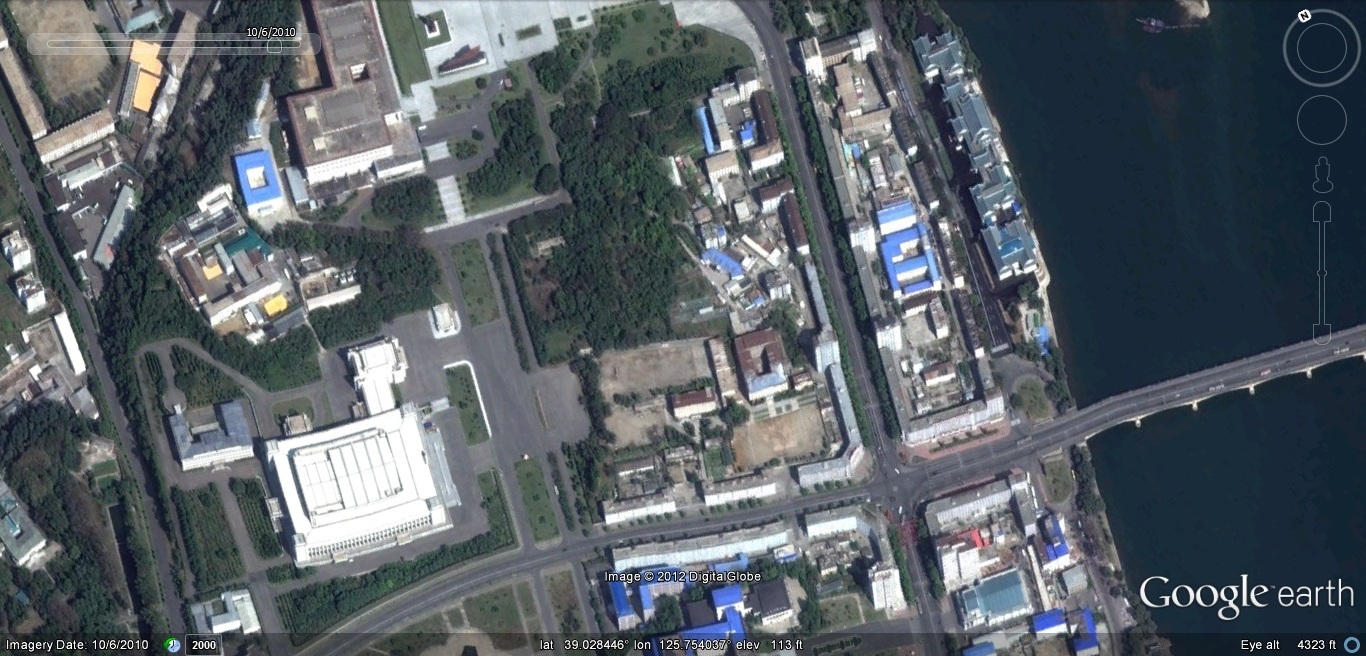
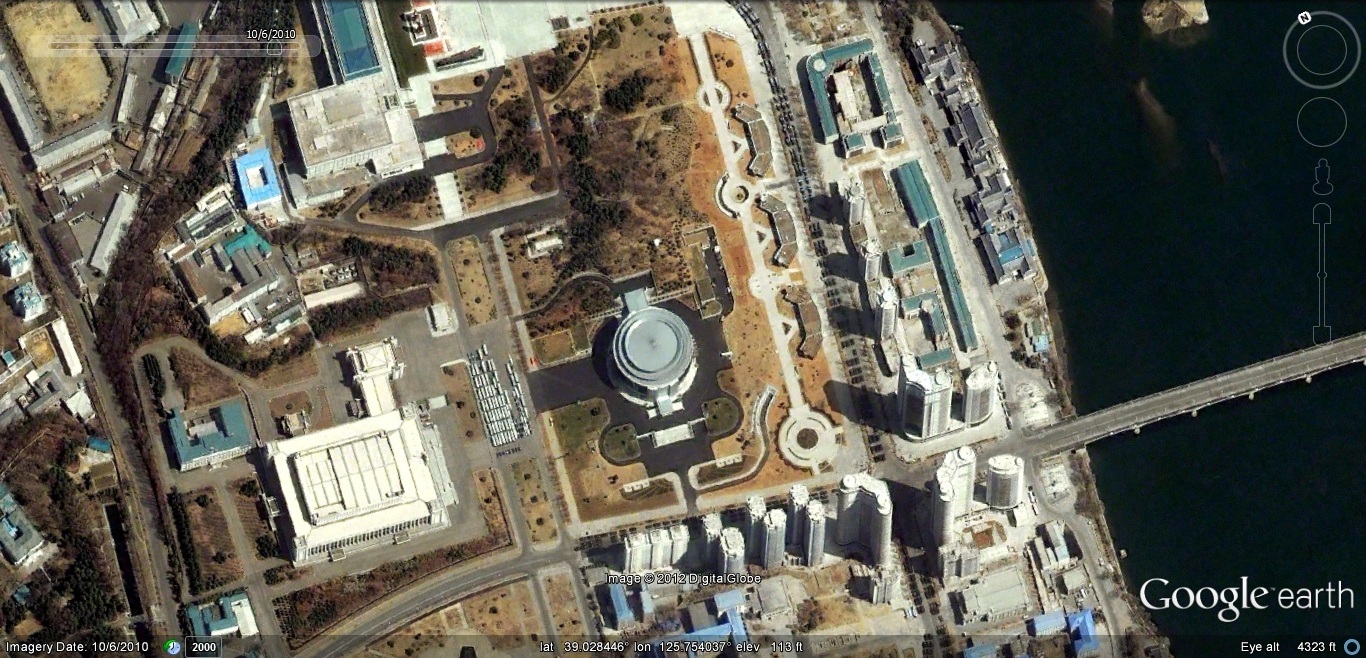
Pictured above: Before and after pictures of the Mansudae Area renovations. Dates: 2010-10-6(L), 2012-4-15 (R)
UPDATE 9 (2012-3-29): The Institute for Far Eastern Studies asks if the Mansudae construcitonis nearly completed:
North Korea announced that the apartment construction in the Mansudae area in Pyongyang is in the completion stage. This has been touted as a part of the effort in building a powerful nation. North Korea announced in January 2008 of its plans to construct 100,000 apartment units in Pyongyang by 2012 to provide housing for the residents.
The Rodong Sinmun, a mouthpiece of the Workers’ Party of Korea, announced on March 24 that, “The completion of Pyongyang Mansudae Apartment Complex is right before our eyes,” and “presenting a magnificent view of the new road in Pyongyang.”
North Korea is busily preparing for the centennial of Kim Il Sung’s birth on April 15, gathering military and youth brigades, and university students to the Mansudae area. When completed, it will house 14 high-rise apartments, convenient facilities and parks in the region.
According to a source in North Korea, “The apartment construction in Mansudae is built differently from the slipform method commonly found in the apartment construction in South Korea. It incorporates a combination of concrete and PC (precast concrete) method.”
The PC method uses less concrete than the reinforced concrete method. North Korea opted to use this method, as it is seen as a better choice for North Korea, which has limited construction equipment (such as concrete mixers and vehicles), and because of the tight time constraint.
Since the seventieth birthday celebration of Kim Jong Il on February 16, North Korea introduced newly constructed buildings and industrial facilities as a symbol of the strong and prosperous nation and as an achievement of Kim Jong Un’s leadership.
On February 23, Rodong Sinmun published an article, “Mansudae area will provide housing for the workers,” and “The nearly completed high-rise apartment is standing tall, boasting to the world of the greatness of our everlasting socialism under the respected Comrade Kim Jong Un.”
In another article, the news reported, “The new road in the Mansudae area incorporates the paramount importance of the people and the masses. We will wholeheartedly remember our Father and Dear Leader Kim Jong Il’s love for his people through the new road.” It added, “At the behest of our General and under the leadership of Kim Jong Un, we are full of determination to construct a powerful socialist nation providing happiness to all the people on our land.”
Such statements are regarded as a movement to idolize Kim Jong Un, by acclaiming the construction of new buildings as emblematic of his accomplishment in building a strong and prosperous nation.
This is similar to what occurred in the 1980s and the 1990s, when there was construction of large-scale buildings including the Juche Tower,Monument to the Party Foundation, the West Sea Floodgate, and the Arch of Triumph. All these buildings were attributed as achievements of Kim Jong Il.
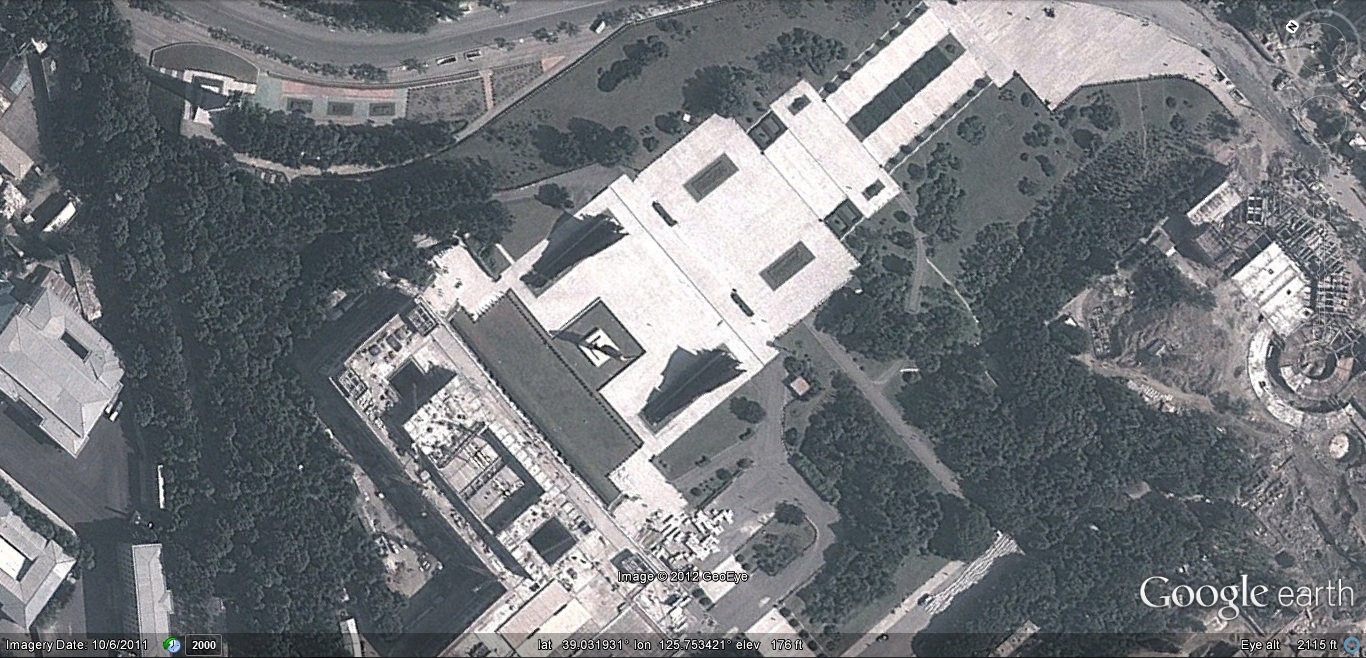
UPDATE 8 (March 2012): Google has updated imagery of Pyongyang:
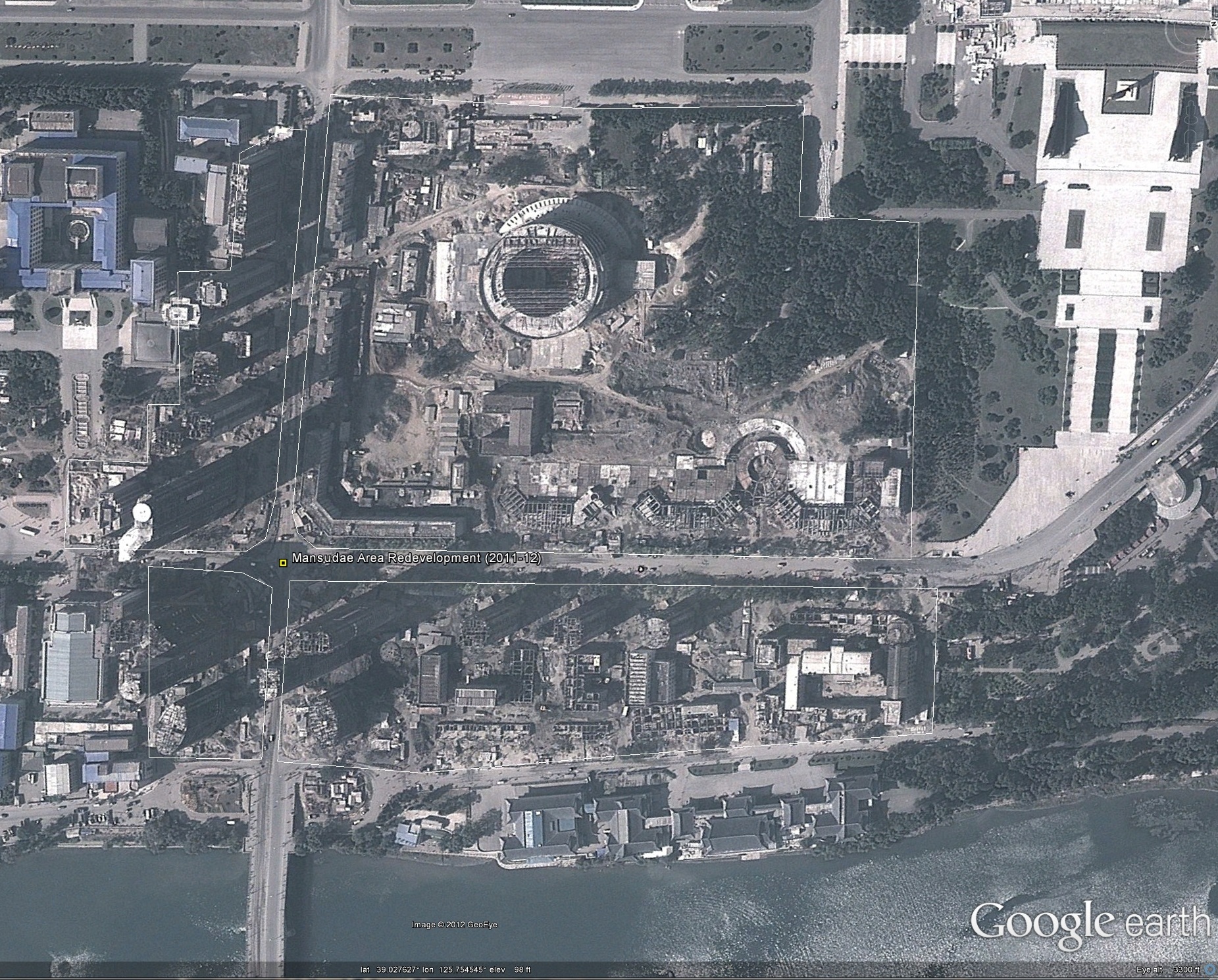
Pictured above (Google Earth: 2011-10-6): Mansudae area renovation
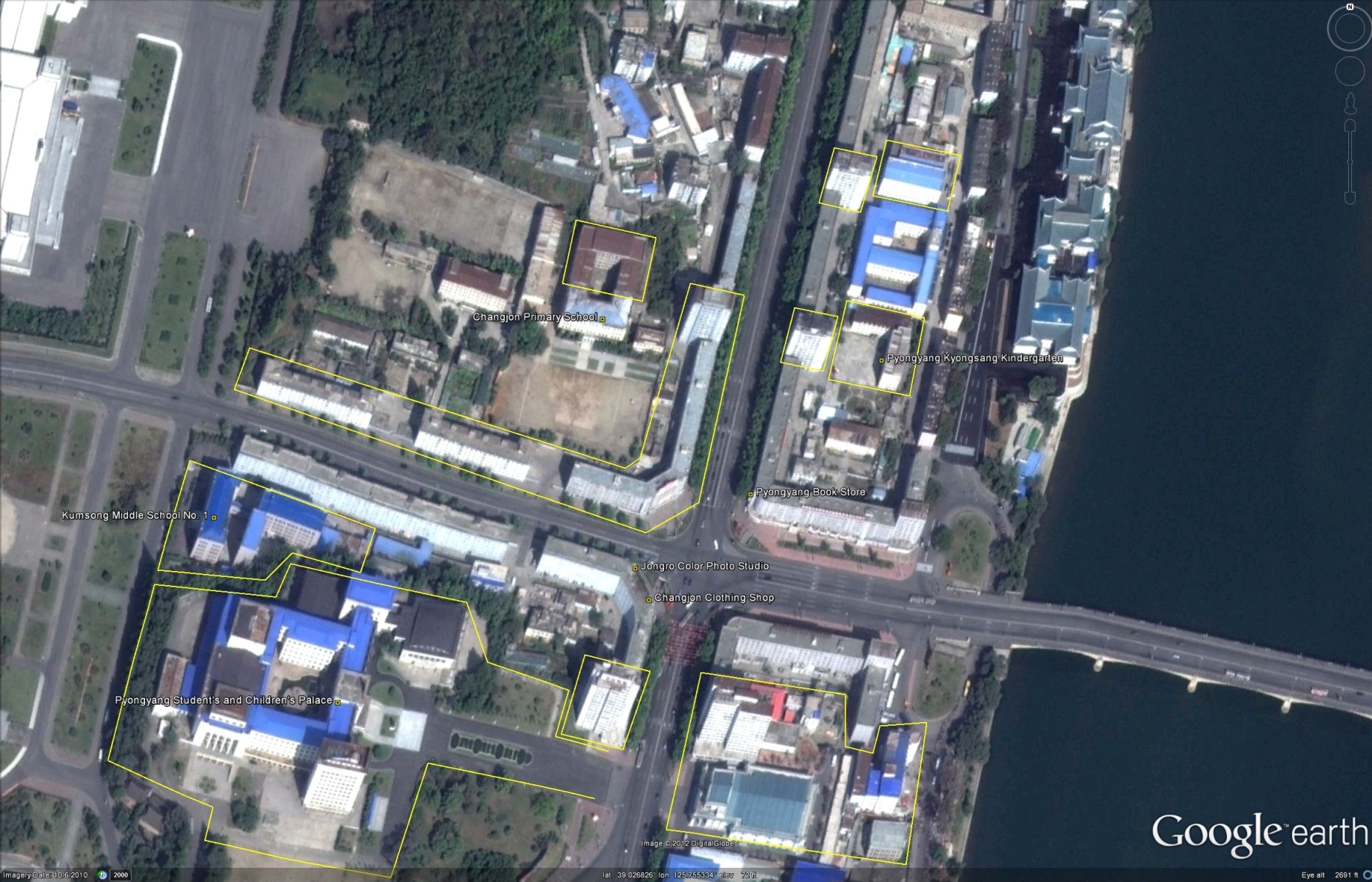
UPDATE 7 (2012-2-14): Google has uploaded new satellite imagery of Pyongyang to Google Maps (but not Google Earth). I just started going through it, but we can see some of the changes in the Mansudae area:
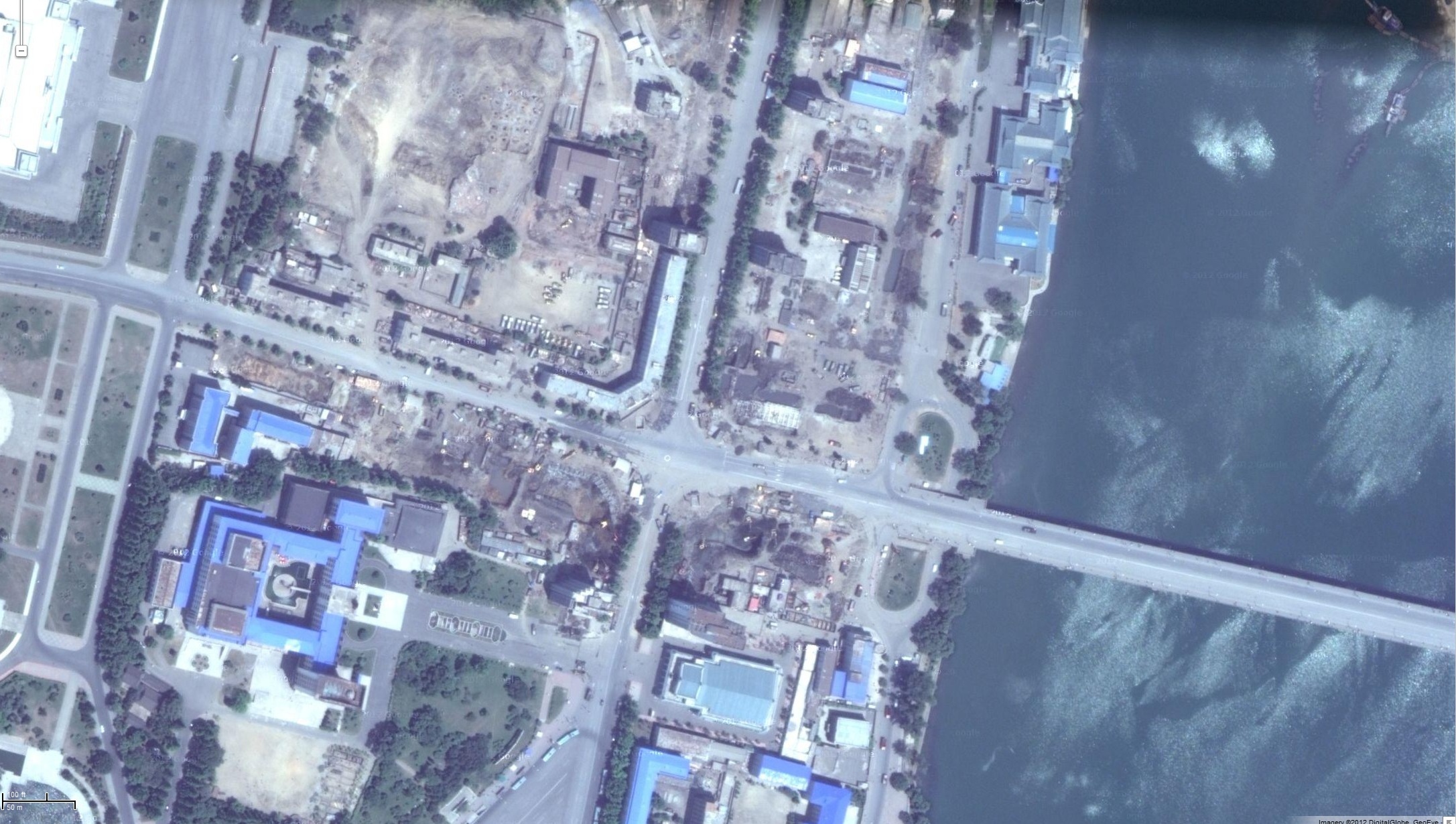
Click images to see larger versions
Pictured to the left is the “before” picture (2010-10-6). The structures that have survived are outlined in yellow. To the right is the new image on Google Maps. I am unsure of the date this image was captured.
The structures that have survived (as of hte image date): 1. Part of the Changjon Primary School, the Pyongyang Kyongsong Kindergarten, and the Kumsong Middle School No. 1.
Access to the Sungri Metro Station also appears to be unimpeded.
UPDATE 6 (2011-10-4): According to the Daily NK:
Progress on the project to build 100,000 homes in Pyongyang is moving forward rapidly in at least one location: central Changjeon Street. According to a source from the city who spoke with The Daily NK yesterday, “There are around 30,000 homes being constructed along Changjeon Street, and the shells have almost all gone up.”
Changjeon Street is in the heart of Pyongyang, near well-known spots such as Mansudae Assembly Hall and the giant bronze statue of Kim Il Sung. The authorities are known to be focusing the state’s limited power on construction in this area, with the intention of completing at least the most visible part of planned projects ordered for the commemoration of the 100th anniversary of Kim Il Sung’s birth in April, 2012.
North Korea is understood to have invited a number of foreign dignitaries to witness several big events it has planned for next April, including the Spring Friendship Art Festival and the April 15th ‘Day of the Sun’ birthday celebrations. In that context, completing construction along Changjeon Street is a natural priority.
Changjeon Street was apparently given a further boost following the visit of Kim Jong Il to China in May. Kim was reportedly struck by the inadequacy of Pyongyang when held up against major cities in China, and called for improvement.
The authorities thereafter ordered that the skeletons of homes on Changjeon Street be completed by the anniversary of the Party foundation, which falls on October 10th. According to the source, “The pace of construction has picked up since the authorities ordered that the building frames be completed by October 10th.”
“They started work on a 40-storey building at the end of May, and now are up to the 35th storey. They are using a waterproofing agent that causes the cement to dry quickly, which means they sometimes get through three floors a day,” he continued.
Rodong Shinmun, the Party mouthpiece publication, described the renewed pace of operations on Changjeon Street last Thursday, stating proudly, “The blinding pace of the audacious construction offensive, paying no heed to night or day, has allowed for the construction of the framework of a 40-floor high-rise residential building in no time at all.”
Similar progress is being seen on road extensions and beautification projects nearby. The source said, “Road extension projects have been completed, including that of the road in front of the Botong River and Pyongyang Gymnasium. They’ve put flower beds by the side of the road and the whole area is now in a very good state.”
However, the fixation with construction on Changjeon Street is leading to accidents there, the source added, noting, “Because they only pressure us to speed up and don’t say anything about safety, there have been frequent incidents of workers falling.”
It is also causing other projects in the city to lag far behind. According to the source, “The authorities are doing renovations on houses along the main roads, but only painting and sprucing up the areas which can be seen. The buildings along Tongil, Hyungsaesan and Yongseon Streets were all demolished in 2009, but as yet there is no sign of progress from the company which has been tasked with the construction work.”
UPDATE 5 (2011-6-8): According to the Daily NK:
Finally, yesterday’s Rodong Shinmun, citing a statement from Kim Jong Il himself, went on to remind the people, “Construction in Pyongyang is not simply an issue of operational economics regarding the formation of roads and construction of homes, it is an important political issue related to the prestige of Socialist Chosun and dignity of the Kim Il Sung Motherland.”
This kind of propaganda push is aimed at ensuring the people are cogent of fact that modern buildings are being constructed by the authorities; an attempt to bring to life ongoing propaganda about the strong and prosperous state, which inside sources suggest is viewed with considerable public cynicism.
According to the Chosun Shinbo piece dated June 23rd, the construction at Mansudae is set to include a complex of 14 new apartment buildings, including North Korea’s tallest at 45 floors, a school, nursery and other public buildings. Elsewhere, there is a plan to pull down older construction in Mansu-dong and replace it with a park, and another to put up a modern cylindrical and square apartment building in the vicinity of Pyongyang Students’ and Children’s Palace.
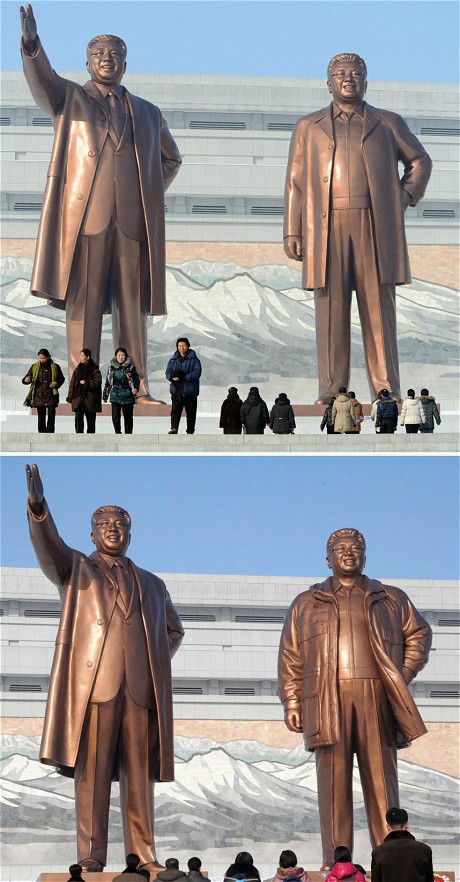
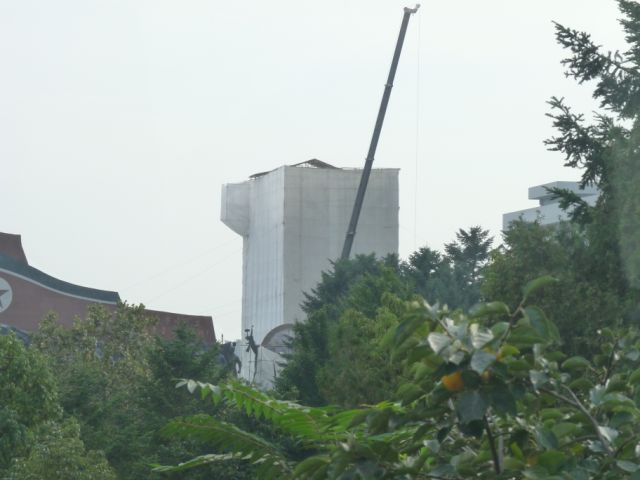
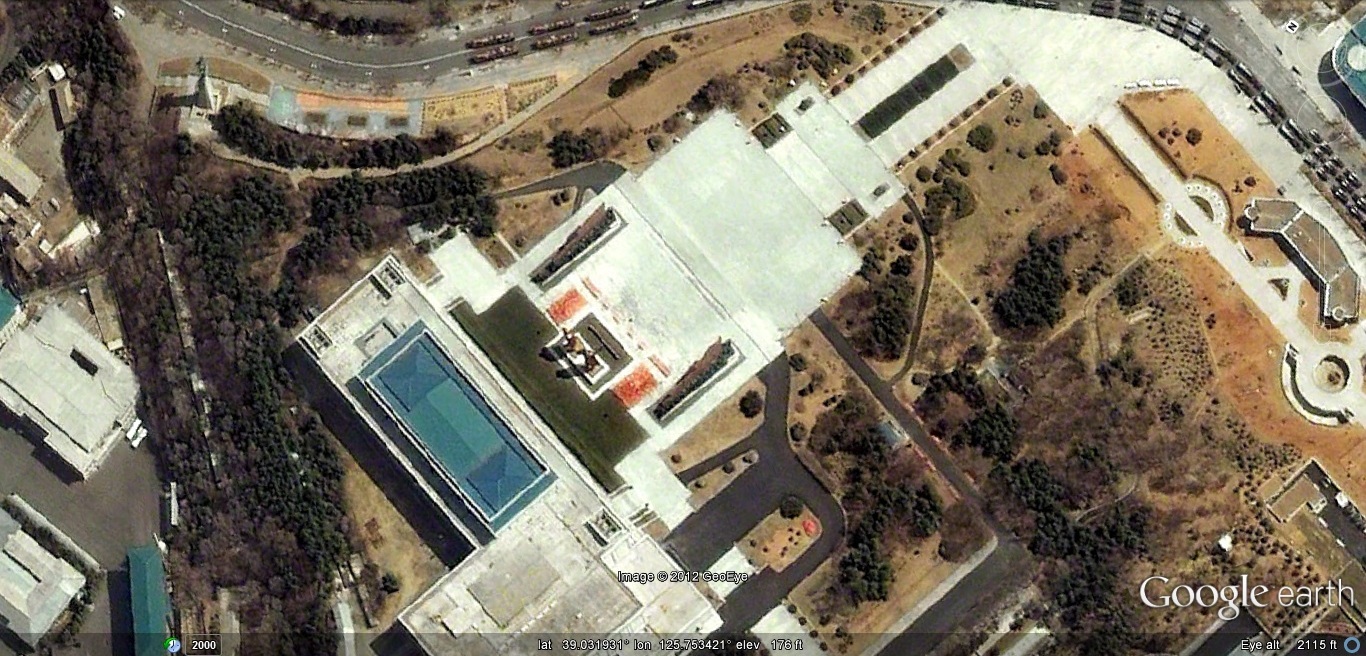
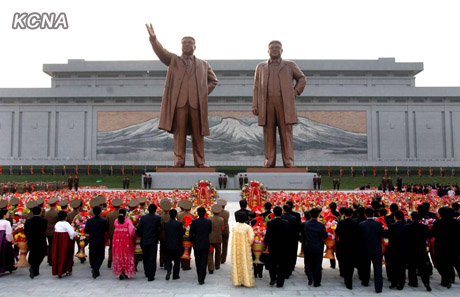
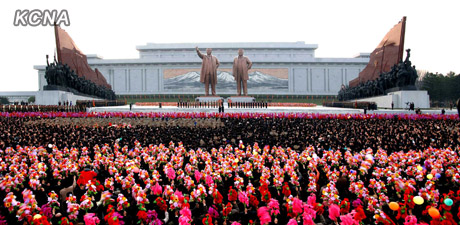
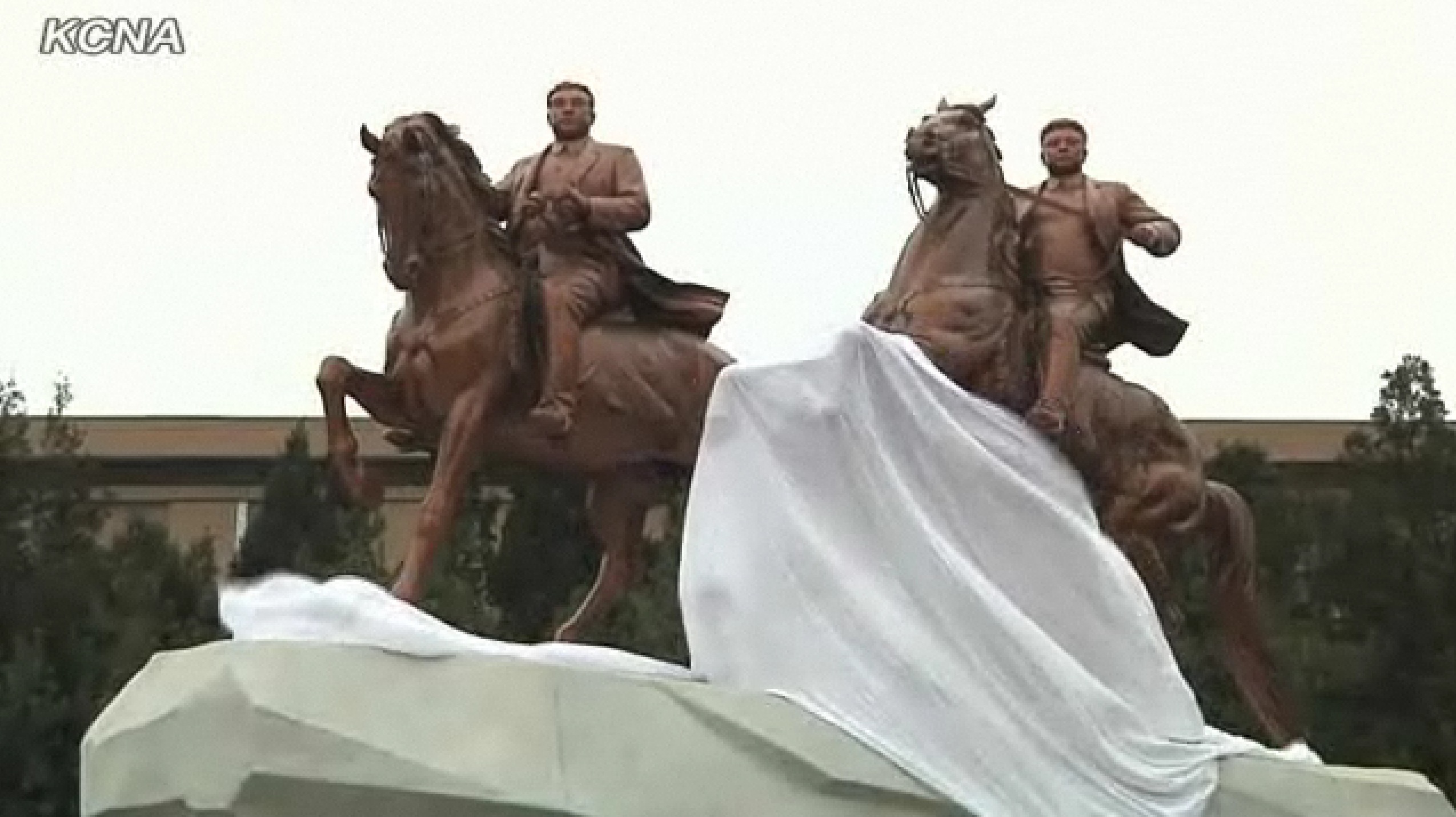
Meanwhile, all the talk of modernity fits well with efforts to promote the youthful vigor of successor Kim Jong Eun, especially as it surrounds the statue of Kim Il Sung on Mansudae Hill, which is itself said to be undergoing a facelift.
In yesterday’s piece, Rodong Shinmun went on, “According to the Party’s grand capital construction plan, a fire of new Pyongyang creation is blazing violently in the ongoing Mansudae area construction,” adding, “According to this warlike strategy, in a short time, less than a month after it began, the groups taking part in the construction had achieved innovative results, digging the vast foundations of the new homes and laying the concrete.”
However, rumor has it that the reality does not meet the heights of this official propaganda, with the authorities having only managed to construct some 500 new residences in the period to the end of 2010.
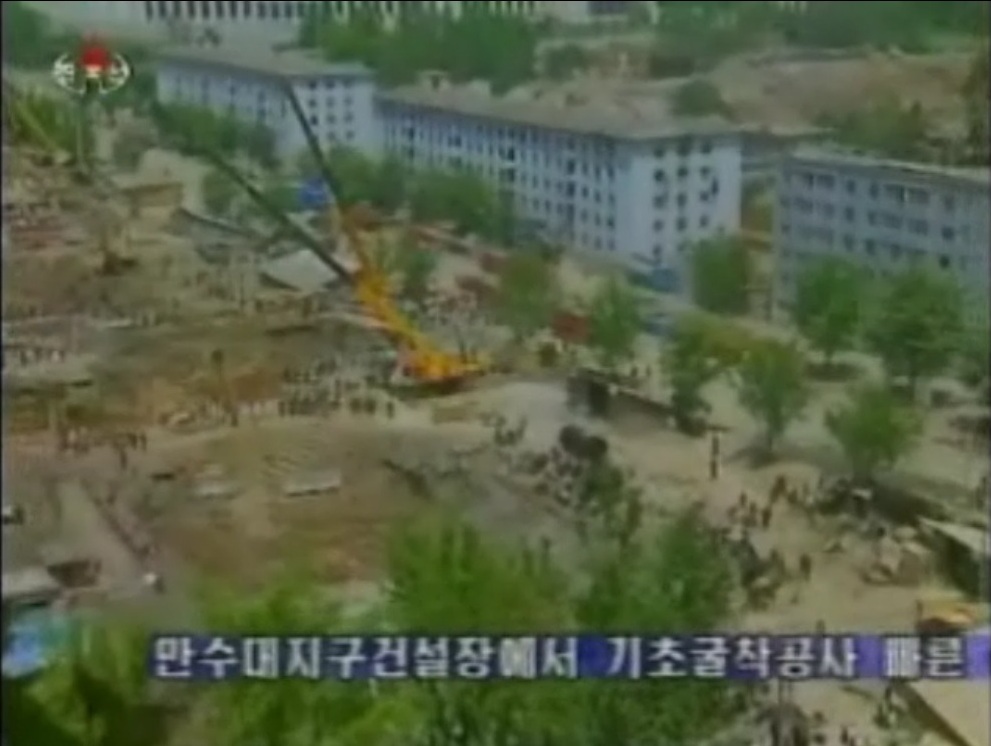
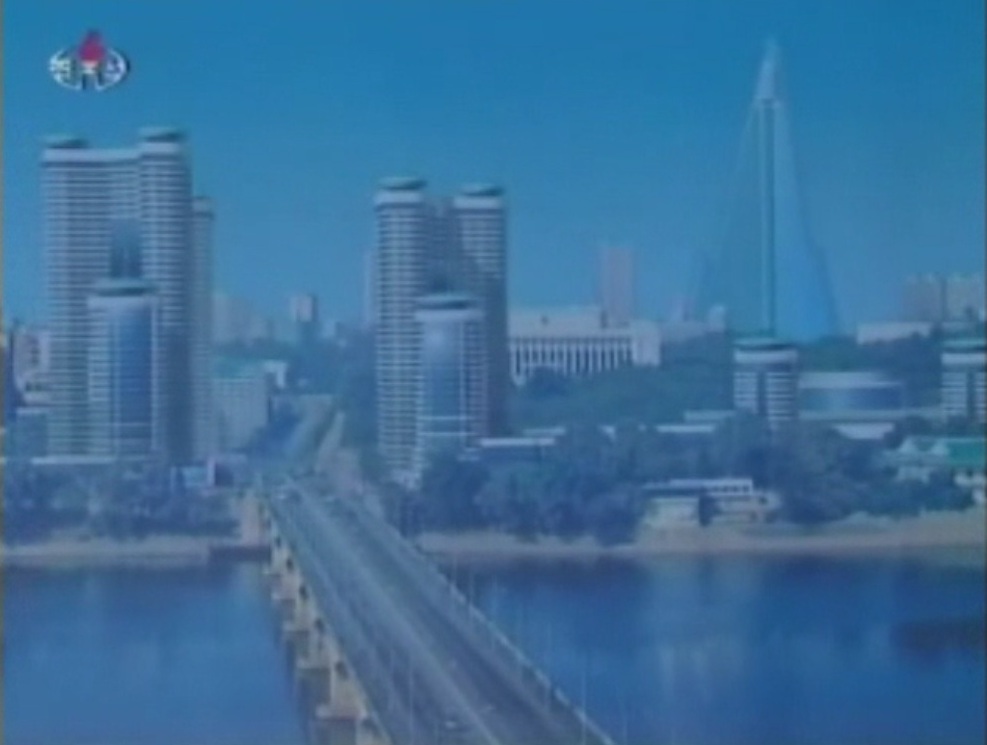
UPDATE 4 (2011-6-8): KCTV has braodcast new footage of the construction zone and explained what a few of the new buildings will be. I have uploaded the particular video clip to YouTube, and you can watch it here.
Below are screen shots. In the picture on the left, we can see that many of the older buildings in the area have already been removed and holes have been dug for the new foundations. In the picture on the right we can see another conceptual shot of the area from the other side of the Taedong River.
UPDATE 3 (2011-6-8): According to the Pyongyang Times:
A huge construction project has been undertaken to renew the looks of the Mansudae area of Pyongyang on the occasion of the 100th birthday of President Kim Il Sung (April 2012) as part of the grand capital construction plan of the Workers’ Party of Korea.
The project includes the construction of modern dwelling houses and a monumental structure in the area in central Pyongyang where the statue of President Kim Il Sung stands and the development of parks in the surroundings to meet the requirements of the new century. It will be a big stride forward to building Pyongyang magnificently as the world-level city.
The ground-breaking ceremony took place on May 22.
It brought together Premier Choe Yong Rim, Minister of the People’s Armed Forces Kim Yong Chun, Vice-Premiers Jon Ha Chol and Ro Tu Chol, officials from ministries, national agencies and municipality and tens of thousands of builders.
Premier Choe Yong Rim made a keynote speech.
He noted that leader Kim Jong Il saw that monumental structures were built everywhere in the capital to glorify the President’s revolutionary exploits for all ages. He then referred to the facts that the leader initiated the construction of Changgwang and Kwangbok Streets and other large projects and led them in the van to bring about a radical turn in building the capital and improving the people’s livelihood.
He said that under his wise guidance modern houses including those in Mansudae Street and at the foot of Haebang Hill, cultural and public service facilities, parks and recreation grounds were built in recent years and gigantic housing development and city landscaping projects are now dynamically pushed forward in Pyongyang.
More recently the leader suggested the development of the Mansudae area and took drastic measures to push the project from design to mobilizing the builders and supply of materials, he noted, and added that all the officials and builders should be well aware of the importance and significance of this construction, strictly observe the instructions of the designs, building operations and construction methods and work hard to create a new building speed.
He stressed the need to finish the construction of houses in Ryongsong, Sopho and Ryokpho areas in time together with the construction in the Mansudae area.
He called on the whole Party, the entire nation and all the people to turn out to support the construction in the Mansudae area.
He was followed by other speakers.
UPDATE 2 (2011-6-3): KCNA has finally published a story about the new construction in the Central District:
There started the project to build on the best level the Mansudae area in Pyongyang where President Kim Il Sung’s statue stands in the run-up to the centenary of his birth.
A monumental edifice, high-rise apartment houses, skyscraping buildings, public buildings and cultural and service facilities will appear as required by the new century in the vast area covering dozens of hectares where its old appearance will be no longer to be seen.
A new street will make its appearance as required by the modern sense of beauty, completely free from the existing mode of urban construction.
It will be unique in the formative artistic representation of architecture and the whole area will turn into a huge park. This is a new idea in the lay-out of the street in the area.
A round-shape big people’s theater will spring up in the area of Mansu-dong.
Trees of good species and flowering plants will be planted in the more than ten hectare area around the theater facing the Mansudae Assembly Hall. Promenades and public service facilities will keep in good harmony.
The height of the high-rise apartment houses to be built in the area covering hundreds of thousands of square meters in Kyongsang-dong, Jongro-dong and Taedongmun-dong is expected to gradually increase and twin tower buildings will be concentrated in the area near the Changjon Intersection so that one can enjoy a bird-eye-view of rhythmic distribution of huge buildings on the street.
A catering street will rise to face Okryu Restaurant and public buildings and cultural and service facilities of unique styles will be distributed to the convenience of the residents. They will be decorated with peculiar street lamps and diverse lights.
What draws attention in the lay-out of the streets is the fashionable appearance of high-rise and skyscraping apartment houses of peculiar styles, a harmonious combination of circular, semi-circular and angle style architecture.
The houses will have de luxe flats which will meet the cultural need of Pyongyangites.
When the construction of the Mansudae area completed, it will best match the monumental edifices including the Chollima Statue, the Tower of the Juche Idea, the Monument to Party Founding, the Grand People’s Study House and the Moranbong Theater and structures in the era of the Workers’ Party including An Sang Thaek, An Sang Thaek Street, Munsu, Mansudae and Changwang streets. This will change the appearance of the capital city beyond recognition.
Conceptual images of the construction area can be seen below.
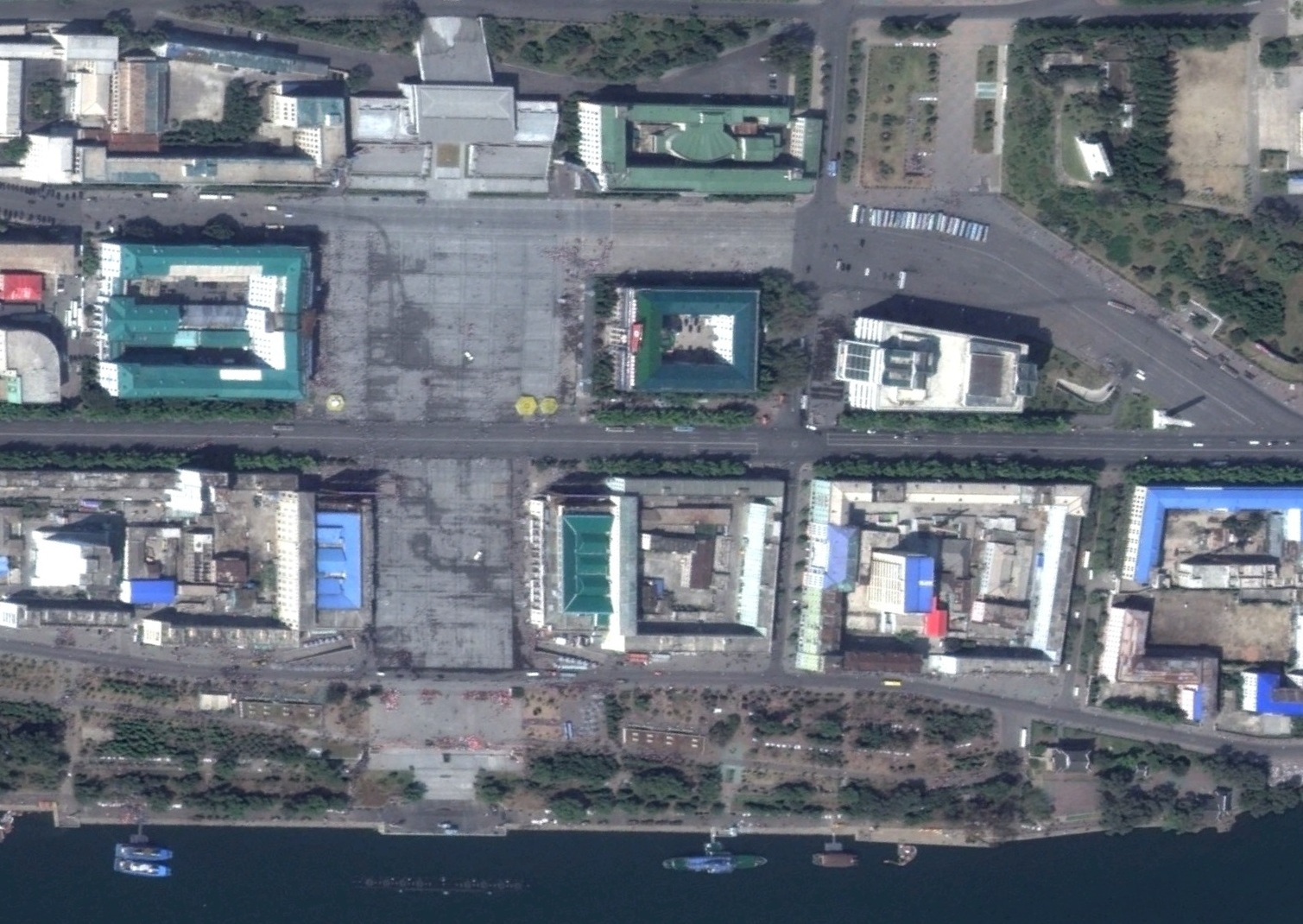
UPDATE 1 (2011-5-24): In the comments, a reader points out a photo by a recent visitor to Pyongyang. See a LARGE version of the photo here. The photo (2011-4-24) shows that renovation of the Mansudae area began over a month ago. As of April 24, area families and all of their belongings had already been relocated (to where?); shops had been closed and emptied; and building destruction had begun.
ORIGINAL POST (2011-5-23):
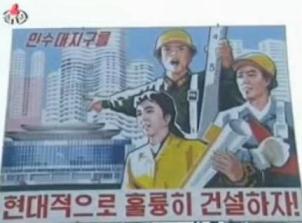
The May 22 episode of the DPRK’s evening news (via elufa.net) featured a ground-breaking ceremony for a re-development project in the Mansudae area of Pyongyang’s Central District (만수대지구, 중구 역). You can see a clip of the evening news broadcast (with English translation) here.
I used the project overview map in the evening news to map out the construction area on Google Earth:
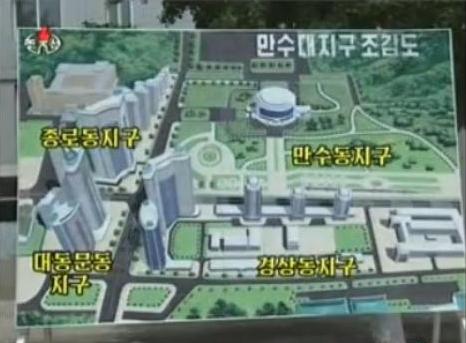
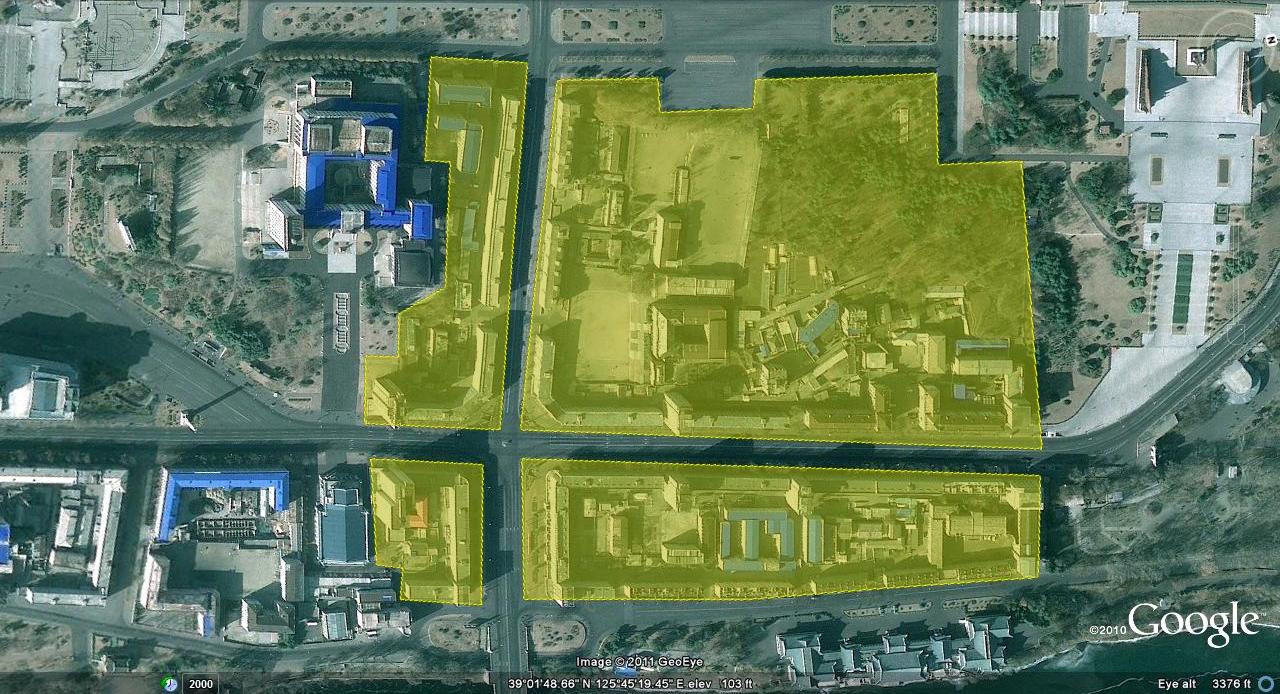
In Jongro-dong (종로동) the Pyongyang School Children’s Palace (평양학생소년궁전) will be spared destruction. It looks as if the exclusive Kumsong Middle School No. 1 next door (굼성제1 중학교–not to be confused with the Kumsong School in Mangyongdae) will be torn down, but I bet it will be spared.
In Mansu-dong (만수동) we will see the destruction of the historical Changjon Primary School (평양창전소학교) and the DPRK’s central bank. Maybe the central bank will get a home in the new facilities, but I have no idea.
In Kyongsang-dong (경상동) the Pyongyang Kyongsang Kindergarden (for musically gifted youngsters) as well as the Pyongyang Children’s Department Store will be torn down. These too may receive a new home in the reconstructed neighborhood facilities.
Additional information:
1. This project comes immediately after the first Mansudae Area redevelopment project near the Potong Gate (just to the west of this one). Read about the first Mansudae Street renovation project here.
2. This residential construction project, though unlikely to be completed by April 2012, is probably part of the DPRK’s 2012 Kangsong Taeguk (강성대국) campaign. As part of the campaign, Pyongyang is to receive 100,000 new housing units. Read more about 2012 construction projects here, here, and here.
3. One report says that the KPA has been put in charge of the DPRK’s renovations.
4. Pyongyang just held an architecture exposé. See some of the work here.
5. These projects appear to be priorities as well.