Archive for the ‘Construction’ Category

KPA in charge of fulfilling 2012 Pyongyang construction

Wednesday, February 9th, 2011

According to the Joongang Daily:

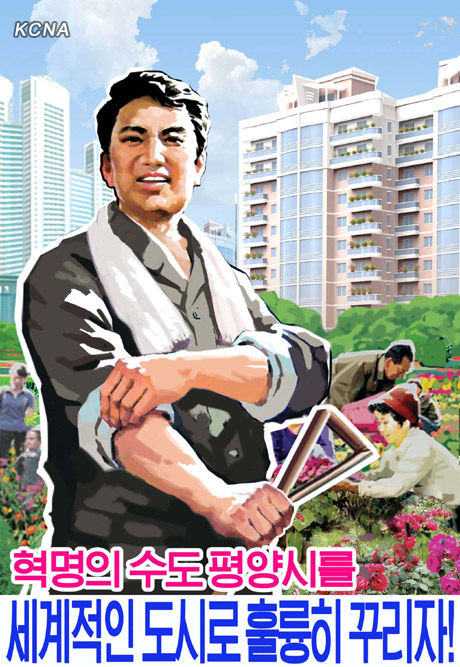
North Korea’s leadership wants “renovations” of its capital city of Pyongyang, a South Korean government source said yesterday, and much of the so-called renovations will reflect the rising power of the military.

The source said that leader Kim Jong-il and heir-apparent Kim Jong-un had given orders to hand the Ministry of Capital City Construction Development over to the military.

The source also said military men took over key positions in the ministry.

The modernization of the capital is a long-term project that began in 2001. The Ministry of Capital City Construction Development was included in the cabinet in that year.

In 2006, Kim Jong-il’s brother-in-law Jang Song-thaek, often called the second-most powerful man in North Korea, took charge of the ministry.

It is unclear, however, whether Jang will continue to head the ministry after the military takes over.

The change is being seen as part of North Korea’s often stated goal of becoming a “strong and prosperous country” by 2012.

That will also include improving Pyongyang and the economy as a whole, with the military controlling much of the activity.

Temporary youth brigades were mobilized last September to help with construction throughout the country. They were assigned to military brigades as regular soldiers.

North Korea analysts have said that the change in the ministry was for “mobilization and stronger control.”

“North Korea has recently stopped calling laborers and farmers the ‘leaders of the revolution,’ and said the soldiers are,” said Jung Chang-hyun, a professor of North Korean studies at Kookmin University in Seoul.

“Assigning civilian groups to the military means that the leadership aims to mobilize the people and gain effective control to create a strong and prosperous country by next year,” Jung added.

Kim Jong-il said in October 1996, during a speech honoring the 50th anniversary of Kim Il Sung University: “Only the military can be trusted.”

Kim’s reliance on the military and the mobilization of civilians into the military reflects his songun, or “military-first,” ideology.

The moves also aim to solidify Kim Jong-un as the next leader of North Korea, with his name on the orders along with his father’s. If the projects improve people’s lives, the positive results can be attributed to Kim Jong-un, said Lee Jo-won, professor of political science at Chung-Ang University in Seoul.

The number of facilities in Pyongyang that have been renovated over the past 10 years are too numerous to mention here.  Most showcase factories, schools, theaters and restaurants have been renovated.  Some more than once.

Additionally, the North Korean government has sought to boost the quantity of housing in the city.  A high-profile project near the Potonggang Gate has already been completed, and labor units are busy trying to complete 100,000 new housing units by next February.

Here are previous posts on: Real estate and Construction.

Read the full story below:
Kims want to ‘renovate’ Pyongyang for people
Joongang Daily
Jeong Yong-soo
2/9/2011

Share

Friday Fun: where KJI watches football–and recovers from adverse health events

Friday, January 7th, 2011

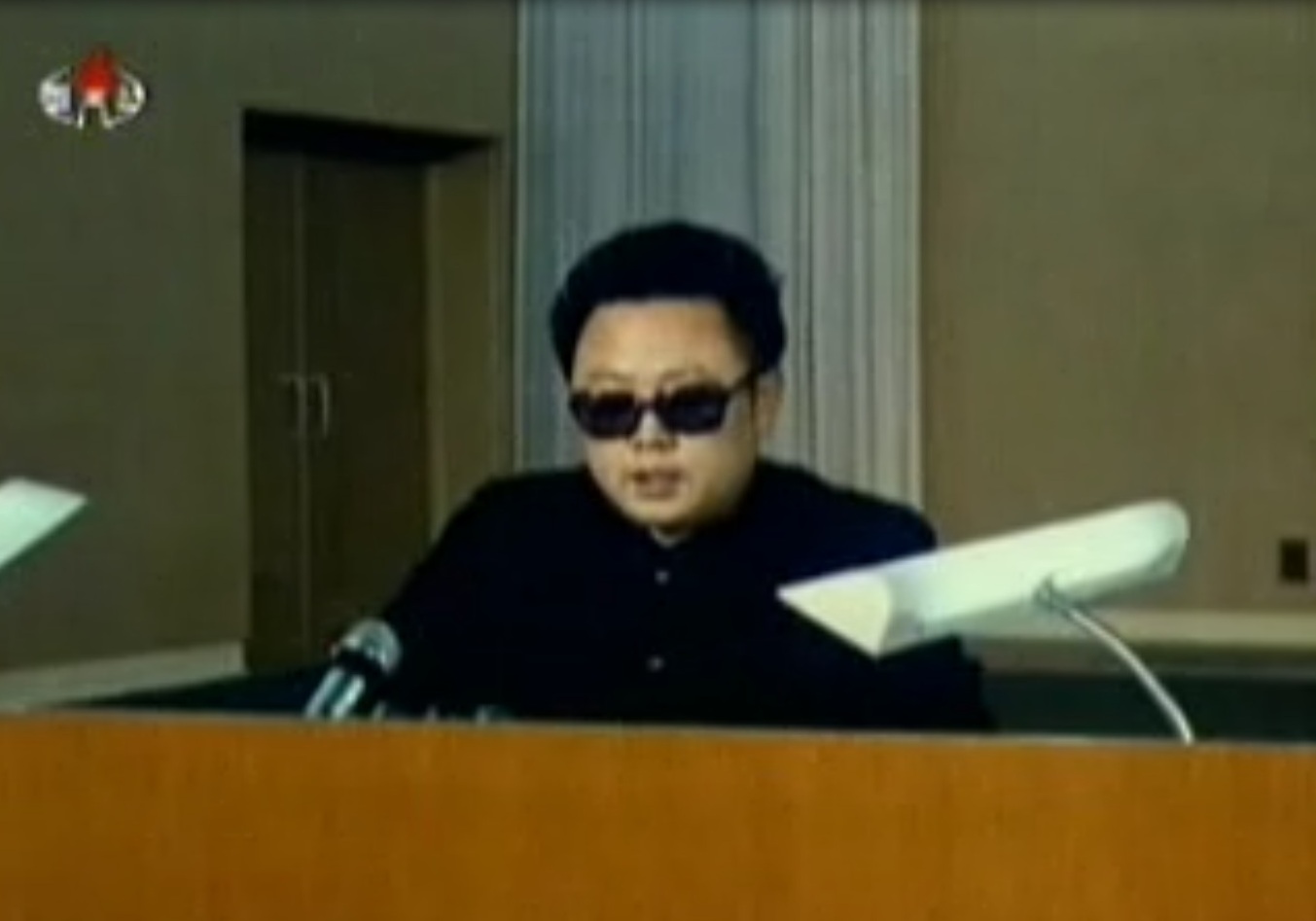
Back in the autumn of 2008 the North-Korea-watching-world was abuzz with speculation about Kim Jong-il’s health since he had vanished from public view in August (see more here). Fueling the speculation, Kim Jong-il missed the country’s 60th anniversary celebrations in September–which everyone expected him to attend (read more here). KJI marked his return to “public life” on October 4th of that year when he attended a student football match (read more here).  According to KCNA:

Pyongyang, October 4 (KCNA) — General Secretary Kim Jong Il enjoyed a student football match on the occasion of the 62nd anniversary of Kim Il Sung University, the highest institution of Juche-based education and science.

There was the football match between teams of Kim Il Sung University and Pyongyang University of Railways that day, at which the former beat the latter 4-1.

KCNA released several pictures of the match, but I post the most important below along with a satellite image of the location from Google Earth:

In both Google Earth images I have marked off the respective image locations using red arrows.  The top images are the most convincing: The fence, the covering, the field, and hilltop in the background are all spot-on matches .  There is a viewing stand as well (shown in the bottom pictures).  The other official photos, which I did not post, match the satellite imagery as well. You can see them all in the original KCTV broadcast on YouTube.

Just to be safe, I checked out the football fields at Kim Il-sung University and the Pyonyang University of Railroads and neither come close to matching the photographs:

I also checked the hundreds of football fields that I have tagged on my Google Earth file.  None of those match either.

So I think it is fair to say that Kim Jong-il watched the football match from his home in the Kangdong compound (39.200045°, 126.020564°) and this is where he recovered from his surgery, or stroke, or whatever befell him, in the fall of 2008.  Or maybe this is just what they want us to think and he was actually in Wonsan or Hamhung?  It is also worth noting that this compound received a new helipad sometime between March 6, 2004 and December 17, 2006 (39.204600°, 126.014662°).

Share

Pyongyang 1946 and today

Sunday, January 2nd, 2011

I recently came across this map of Pyongyang printed in 1946:

Click map to see full size version

According to the map, it is “For use by War and Navy Department Agencies only.  Not for sale or distribution”.

I thought it would be fun to add the map to Google Earth so I could compare the pre-Korean War city infrastructure with what we see today.  Some interesting information emerges:

1. The Omura Silk Mill is now the Kim Jong Suk Pyongyang Silk Mill. Satellite image here.

2. The Kanegajuchi Spinning Mill is now the Pyongyang Textile Mill.  Satellite image here.

3. Fuji Iron Works is now the Pyongyang Cornstarch Factory. Satellite image here.

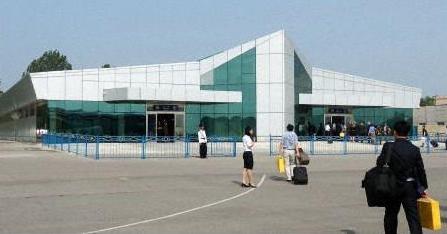
4. What was the Pyongyang Airport is now Taedonggang-district in East Pyongyang.

5. Much of what we call the  “Forbidden City” (Korean Workers Party Offices) were military barracks.

6. The former Pyongyang Medical College is now … the Kim Il-sung University College of Medicine. Satellite image here.

7. The Supreme People’s Assembly sits on the grounds of the former Pyongyang Women’s Prison.

8. The Namsan School was torn down and is now either the Organization and Guidance Department (according to one defector) or the Democratic Women’s Union Hall. Satellite image below:

I also might have discovered several Japanese colonial-era prisons that may very well still be prisons and/or factories. According to the map, this was the shape of the Pyonysang (Heijo) Prison:

There are a handful of buildings in the DPRK which still retain this distinctive shape (or the obvious remnants of this shape)—as well as walls and guard towers.  They are in Phyongsong, Hamhung, and Sariwon:

I have made the 1946 map available as a Google Earth download. You can obtain the KMZ file by clicking here. Please let me know if you make any interesting discoveries of your own.

By coincidence, Andrei Lankov wrote an article about the history of Pyongyang last week in the Korea Times (as I was comparing the maps). According to the article:

Pyongyang enjoyed boom in colonial era
Korea Times
Andrei Lankov
12/30/2010

This city is long gone. No, it is still on the maps, and all our readers know its name ― Pyongyang, the capital of the Democratic People’s Republic of Korea.

But the Pyongyang of the Kims’ dynasty does not have much to do with the old city, wiped out in the social turmoil of the late 1940s and inferno of the American bombing of the early 1950s.

People who nowadays inhabit the North Korean capital, are overwhelmingly newcomers, and not much physical evidence is left from the city past.

It was once a capital of Goguryeo, one of the three ancient kingdoms which fought over the domination of the Korean Peninsula in the first centuries of the Christian era. Pyongyang remained important for centuries. During the Joseon Kingdom (1392-1910) it was the second or third largest city in the entire country.

The city remained surrounded by the stone walls which by the 1890s had been in a state of disrepair for a long time (they had lost any military significance since a much earlier date, one has to admit). The majestic Taedong Gate, facing the river, was seen as a masterpiece of traditional architecture.

Throughout the colonial period, the city’s population increased from 40,000 around 1910 to 285,000 in 1940. It was roughly one third of the then size of Seoul, but this still made Pyongyang one of the largest cities in the nation.

As was the case with nearly all major cities of both the to-be North and to-be South, the railway was instrumental in Pyongyang’s growth.

Pyongyang was located straight on the Busan-Seoul-Sinuiju line, built in the early 1900s. This line became a backbone of the country’s transportation network, and old cities which were bypassed by this railway, eventually went into decline. Pyongyang was lucky to avoid such a fate.

Nowadays Pyongyang Station is located close to the center of the North Korean capital. However, in the early 1900s it was located some distance away from the old walled city, so the space between the station and walls became a new part of Pyongyang, with rectangular grid of streets and the numerous houses of the Japanese settlers who comprised about 13 percent of the city population in 1945.

The army barracks and a large military area appeared near the station as well. Meanwhile, the Koreans were left within the space once occupied by the old walled city.

The fast growth of the city made public transportation necessary, and indeed in May 1923 a tram service ― or “streetcars” as Americans would say ― was introduced, to remain in operation until the autumn of 1950 (the present-day tram system was built anew in the early 1990s, and has no continuity with the old trams of the colonial era).

Since time immemorial and until the late 1920s, Pyongyang was located on the eastern (left) bank of the Taedong River, but from the late 1920s the city crossed to the opposite bank as well.

In 1921, an airfield was built there, to be used by both the Japanese air forces and civilian planes which landed there for re-fueling on their way from Japan to China and back. This airfield, located roughly where the “embassies quarter” is now, remained in operation until the late 1950s, if not longer.

Pyongyang underwent a major industrial boom in the colonial era. Huge coal deposits were discovered around the city, so by the 1920s the mines of the Pyongyang area provided about a half of all coal produced in Korea. This economy of the era was largely an economy of coal and steel, so these mines attracted heavy industry.

The Mitsubishi Group built a large steel mill in Nampo, not far away from Pyongyang. Another major consumer of high-quality coal was the Imperial Navy ― and the ship engines of the era were very demanding when it came to the coal quality.

Pyongyang itself also had a number of smaller businesses, including textile and footwear factories. Their presence also meant a presence of powerful labor unions, so Pyongyang was a place of some of the largest strikes of the period.

For the Koreans of the colonial time, Pyongyang was a city of Christianity. Indeed, Protestants constituted up to 25-30 percent of its population.

In a time when nationwide the share of Christians did not exceed 1 percent, this was a truly remarkable figure. This implied a large missionary presence but also existence of first-class educational facilities: Protestant schools played a major role in introducing modern science and technology to Korea.

The result was strength of the nationalist movement then closely associated with Christianity. Contrary to what one might expect, prior to 1945 Pyongyang was a stronghold of the nationalist Right while the Communists position appeared much stronger in Seoul.

The city also boasted a number of museums, including a large archeological museum with the findings made during the excavations of the 1920s.

Not much is left of that city. Most of Pyongyang’s population left in 1945-53, fleeing either religious persecution by the new regime or U.S. bombing raids. These raids virtually wiped the city off the face of earth, so in the mid-50s Pyongyang was built anew without any references to the then rejected past.

A few historical monuments of ancient times have been restored (or rather built), but almost nothing has survived from the colonial era Pyongyang. Only the old Taedonggyo Bridge still crosses the river, handling a large part of very heavy Pyongyang traffic.

Share

New Pyongyang management law aims at modernization

Tuesday, November 30th, 2010

Institute for Far Eastern Studies (IFES)
NK Brief No. 10-11-30
11/30/2010

North Korea has recently revised the Pyongyang City Management Law in order to support ongoing modernization efforts by increasing the management and operational authority of the Cabinet and of the State Planning Committee. On October 21, the Cabinet newspaper ‘Minju Chosun’ ran an article emphasizing the need to ensure that necessary capital and supplies were guaranteed for the construction of 100,000 new residences in Pyongyang and now it appears the North is backing up this modernization drive with the law.

The legal code was revised in accordance with Order No. 743, passed down by the standing committee of the Supreme People’s Assembly on March 30 of this year, but was just recently made public in South Korea. What stands out in this newly revised law is that the central government has strengthened its hold on management and operations within the city.

Article 47 of the city management law states, “The Cabinet must naturally take control of and supervise Pyongyang management operations,” and Article 48 stipulates that the State Planning Committee and the Pyongyang People’s Committee establish and strictly follow detailed plans for each sector of management operations within the capital city. Article 47, of the former law (enacted on 26 Nov. 1998), which covered management projects within Pyongyang, was removed while five new articles were added. Article 17 covers housing construction, Article 27 covers management of street lighting, Article 43 covers the delivery of publications, Article 46 stipulates basic working conditions, and Article 51 guarantees that goods will be produced for Pyongyang markets.

Article 17 stipulates that “the construction of housing must completely guaranteed,” and Article 51 states that planning for and production of commercial goods for Pyongyang must be ensured “without fail.” Housing, goods, electricity, capital and other necessities for the modernization of Pyongyang have now been essentially legally guaranteed. New housing in the capital has been a priority for the North, with construction already underway and plans for 30,000 additional units next year and 35,000 more in 2012. In order to show off these new renovations day and night, Article 27 calls for the “logical installation of street lights” to brighten walkways, roads, and national monuments. The new legal revision appears to be yet another step toward shoring up the framework for establishment of a ‘Strong and Prosperous Nation’ and transition of power to yet a third generation of Kims.

The new law reinforces Pyongyang’s centrality in North Korea’s revolutionary ambitions, referring to the capital as “the home of Juche,” “the heart of the Korean people,” and “the face of the nation.”

Share

DPRK workers in Angola

Saturday, November 20th, 2010

According to the Choson Ilbo:

The Agostinho Neto Center of Culture is a massive national park that the Angolan government is building on 12,000 sq. m of land in the capital city Luanda in memory of its first president. On Oct. 24, the entrance was firmly shut with a black iron gate. Through barred windows, three or four Asian workers could be seen: they are staff of North Korea’s Mansudae Overseas Project Group of Companies, which earns much-needed foreign currency for the regime from massive construction projects and monumental sculpture in the developing world.

Initially, the Agostinho Neto Center was commissioned to a Brazilian construction company, but work came to a halt until the North Koreans took over at the end of 2007.

The North Korean workers are living together in temporary wooden accommodation in a corner of the construction site. There are reportedly 100 to 120 of them in Angola. North Korea supported independence movements and civil wars of some African countries, and has been involved in some large construction projects there based on the diplomatic ties built this way. The North provided military aid to the side currently in power during the Angolan civil war and is reportedly building other parks and peace monuments in Cabinda and Huambo, one or two hours away by plane from Luanda.

The Daily NK reported North Korea has earned at least US$160 million in construction projects in Africa since 2000. A South Korean resident in Angola said, “Although North Korean workers only get minimum living cost from their government, they make additional money by working on smaller-scale projects locally when they have some spare time waiting for equipment or materials to arrive.”

One North Korean worker said, “When we go to the site for work, we sometimes get Angolan traditional congee called Fungi. It’s delicious. We eat better here than in North Korea because we can get rice from Chinese construction firms.”

In a predominantly black residential area in Luanda, there is a pharmacy run by a North Korean doctor in a shabby one-story building. “I work at a national hospital in the morning, and run this pharmacy privately in the afternoon. This is the only way I can make the ends meet,” he said.

According to a local source, there are about 180 North Korean doctors across Angola, including about a dozen in Luanda. There are also North Korean doctors in Mozambique and Congo, and some practice oriental medicine. At the pharmacy, acupuncture costs $80 for the first treatment and $40 thereafter.

Read the full story here:
N.Koreans Struggle for Hard Currency in Africa
Choson Ilbo
11/20/2010

Share

6 new industrial parks worth 44 billion Won for construction industry

Saturday, November 13th, 2010

Institute for Far Eastern Studies (IFES)
NK Brief No. 10-11-13-1
11/13/2010

The construction cost for six inter-Korean cooperative industrial parks like the Kaesong Industrial Complex would carry a construction bill of 44 billion Won. According to “Analysis of Examples of Inter-Korean Cooperation in the Construction Field and the Direction of Industrial Park Development within North Korea,” a recent report by the Construction Economy Research Institute of Korea, “Promotion of the North Korean construction market by the [South Korean] construction industry would not only increase the limited demand for the South Korean construction [field], but will also provide new growth to our economy.”

According to the report, there has been almost no cooperative construction project within the construction field since 1988. On the other hand, tourism, industrial parks, physical fitness and religious projects have provided opportunities for construction companies. These projects generally call for construction equipment, materials, technicians and designs from South Korea, and land, labor, aggregate, etc. from the North. If six industrial parks on the same scale as the KIC were to be built, it would cost 43.09 billion Won. Of this, 4.07 billion won would cover government costs, while the actual cost of construction would be 39.02 billion won.

If the KIC, currently undergoing the first phase of construction, were to complete all three phases of the original plan, the 19.9 square-kilometer complex would house 2,000 businesses. The research institute calls for the completion of phases 2 and 3 in the KIC, as well as the construction of industrial parks at Rajin-Sonbong, Sinuiju, Haeju, Nampo, and Wonsan.

Rajin-Sonbong and Sinuiju are both ‘Free Economic Trade Zones’, and as special administrative zones, they offer large-scale industrial plots in an effort to attract foreign capital. In addition, it was agreed at the second inter-Korean summit, in October 2007, that Haeju would be developed. Furthermore, a light-industrial complex in Nampo, on the West Sea, and a heavy and chemical industry in Wonsan have been established.

The industrial zones, however, constitute only part of the construction demand. Roads and rails connecting the complexes, port facilities, power generation plants, cities to support production workers, and other derivative projects would also need to be constructed. In other words, the building of an industrial zone would lead to significant peripheral construction demand, as well.

Assuming that inter-Korean tensions were eased and North Korea decided to open itself up to the South, if construction on the six industrial zones could begin by the middle of next year, it is expected that they could all be completed by 2021. In addition, the construction and operation of the six zones could provide the impetus for quickly improving the North Korean economy, while also boosting the importance of South Korea to the North’s economy.

In order to see this accomplished, the research institute found that the government needs to boost activity in the KIC; expand the distribution network between the KIC, Kimpo, and Kangwa; guarantee free management authority in the KIC; iron out customs and transportation procedures; ensure a steady supply of North Korean laborers; and strengthen the ties between the KIC and North Korea’s domestic economy.

If, in the future, North Korea is to open its doors to cooperation, it is expected that foreign companies will also participate. Therefore, when considering long-term profits, it is necessary to spur interest in North Korea’s construction market. The research institute suggested that it was also necessary to construct a training center to teach North Korean construction workers the technical skills needed to ensure maximum potential.

Share

KJU and the realignment of patronage

Tuesday, November 9th, 2010

According ot the Daily NK:

The rapid ascent of Kim Jong Eun and the building of a new ruling cast in Pyongyang is causing ripples to be felt in North Korea’s foreign currency earning apparatus. In Beijing, it is clear that anyone considered a supporter of Kim Jong Nam or Oh Keuk Ryul faces a rough ride.

One of the most prominent cases is that of Kang, a pro-Kim Jong Nam foreign currency earner who has distinguished himself in various ways, including by installing air conditioning in the Mansudae Assembly Hall. He is noteworthy among North Korea trade workers in China, and was mentioned in articles released by The Daily NK in June on the subject of emergency inspections over North Korean trade departments.

According to the testimony of Kang’s acquaintances, Kang was supposedly summoned to Pyongyang in early July, whereupon he was violently beaten by agents of the National Security Agency. The alleged reason behind the summons was that Kang was guilty of embezzling national assets and corruption; however, trade workers in China generally assume that it was a part of systematically “taking care” of Kim Jong Nam‘s closest associates.

In North Korean diplomatic circles in Beijing, the general interpretation is that Kim Jong Nam‘s outspoken negativity towards North Korea‘s third generation succession has helped to bring trouble upon his supporters.

One Chinese building contractor, Jwa, who sells construction materials to North Korean traders, commented, “Kang pledged allegiance to Kim Jong Nam and received a lot of favors as his affiliate. But a battle between Kim Jong Eun and Kim Jong Nam is taking place, and trade workers are suffering.”

However, the more surprising fact was the return of Kang to Beijing in October. It is highly unusual for someone from a privileged office to be so severely “investigated” by the National Security Agency but then return to their former seat in a foreign trade office.

According to one of Kang’s acquaintances, this was down to the fact that he is actually the person in charge of the North Korean Liaison Office in Beijing.

One Chinese trader who has done business directly with Kang told The Daily NK, “Kang, who is well known as a famous trade worker, was really in charge of North Korean maneuvers for more than ten years while maintaining the identity of a trade worker. This fact has been confirmed through several sources.”

However, South Korean intelligence has neither confirmed nor denied Kang’s true role.

The North Korean Liaison Office is an organization said to be responsible for maneuvers against South Korea, and is thought to have pulled the strings in the South Korean Chosun Workers‘ Party incident of 1992, in which the largest spy ring since the liberation was uncovered, that of Kim Dong Sik, an armed espionage agent arrested in 1995, Choi Jung Nam and Kang Yeon Jung, an agent couple who committed suicide in 1997, the assassination of Lee Han Young, Kim Jong Il’s nephew, in 1997, and the 2006 Ilsimheo spy ring incident.

Mr. Kang also owns a well-appointed villa, recent sedan and VIP membership of the fitness center at a five-star hotel.

Generally, North Korean employees abroad have to leave one of their children in Pyongyang as what can only be described as hostages to loyalty. However, the testimony of Kang’s acquaintances states that he is permitted to live in Beijing with his wife, daughter and son, who has studied in England. This is due to Kim Jong Nam’s full support, an extraordinary level of operational funding and the superior status of a person in charge of a covert operation.

He has avoided being outright purged, despite the fact that he is an affiliate of Kim Jong Nam, thanks to the fact that he is the person in charge of operations against the South. However, other trade workers in China who are also affiliated with Kim Jong Nam are desperate to forge new connections in Pyongyang to secure their positions, and, as such, many seem to have been absorbed by the Jang Sung Taek camp.

Other overseas officials are also on the back foot. Not only are affiliates of Kim Jong Nam being called into Pyongyang, but affiliates of Oh Keuk Ryul, a Vice Chairman of the National Defense Commission who is also actively involved in bringing foreign capital into North Korea in de facto competition with Jang Sung Taek, are also being summoned. Oh Keuk Ryul was shut out of the recent process of realigning the Chosun Workers’ Party and has lost a lot of his former influence as a result.

North Korean foreign trade departments are a target of veneration within North Korea. However, trade workers must strive to preserve their status with bribes like supplies which are hard to find within North Korea or large amounts of money. Now the dynamic is changing, so it is proving difficult to preserve their desirable positions.

Read the full story here:
Traders Living in Fear of Pyongyang Summons
Daily NK
Shin Joo-hyun
11/8/2010

Share

Samsu Dam construction disrupts local electricity service

Thursday, November 4th, 2010

According to the Daily NK:

Although it is just 10 kilometers from Hyesan, the capital of Ryanggang Province, no electricity has been supplied to Nojoong-ri since construction began on the Samsu Power Plant in 2004. In fact, there are no longer any transmission cables connected to the village at all.

The North Korean authorities, in preparation for the construction of the power plant in 2002, put in place relocation plans for the residents of the Unchong River Basin in areas they designated as “probable watersheds” for the lake which would form behind the proposed dam. District Four of Nojoong-ri was one of those areas, and as a result had all of its power cables removed.

However, in a follow-up plan completed right before groundbreaking on the project in 2004, the water storage capacity of the Samsu Power Plant was reduced on account of analysis that cautioned against over-filling the reservoir. This resulted in District Four of Nojoong-ri being re-designated as outside the flood zone, but none of the services were resumed, including the provision of electricity

After a year of living without power, the residents, who were still waiting to be assigned new homes, eventually pleaded their case to have the village’s power lines restored to the “Standing Committee on Flooding”, a special organ of government in charge of the relocation of flood-area residents. However, the response was that they were ineligible for aid because their village was not in a flood zone. The villagers then filed petitions with the Party at Hyesan City and provincial level, but to no avail. They were only to hear the same repeated response, “We were not the ones who removed the power lines.”

If electricity were to be provided to the area, quite a few power lines would need to be installed. But the only place where electricity for the village could be obtained is “Military Supplies Factory No. 95”, located four kilometers from the village on the other side of a hill. The 50-megawatt Samsu Power Plant stands adjacent to the village, but the electricity generated there is supplied exclusively to “Kim Jong Il Birthplace Heritage”, otherwise known as the “Baekdu Hideout”, in Samjiyeon. At one point there was talk of the residents putting their money together to provide for their own power cables, but the plan was prohibitively expensive.

Thus, the residents of this part of Nojoong-ri have been living without electricity for nearly seven years. They depend entirely on candlelight and firewood as they scrape a living off potato farming and alluvial mining.

“It is hard to say that it is even a place where people should live. People from as far away as South Pyongan and North Hamkyung come here to mine alluvial gold, but are shocked to find the state that the village is in,” according to an anonymous Yangkang Province source.

Of course, with the original designation came many more changes, including work and schooling. The one-way commute that the village’s men take every morning is seven to eight kilometers, while the women cannot easily reach the market to sell their produce. Children are also suffering the consequences; having to walk 15 kilometers a day to attend Nojoong-ri Middle School has led to a rising number of student dropouts.

Here are previous posts about the Samsu Dam: here, here, here and here.

Read the full story here:
Seven Years of Blackness
Daily NK
Kang Mi Jin
11/4/2010

Share

Wonsan leadership compound upgraded

Wednesday, November 3rd, 2010

Several days ago, the Daily NK reported on the reconstruction of a few elite compounds in the DPRK.  See the previous post here.  Satellite imagery on Google Earth also reveals that a compound in Wonsan has been refurbished.

Wonsan compound 2002
(click image to enlarge)

Wonsan compounf 2009
(click image to enlarge)

Although the satellite imagery for 2009 is not particularly clear, it is easy to observe that the main complex, in the center of the screen, has been rebuilt and modernized.  There is no more lake.  It also appears that several beach guest houses or cabanas have been built on the eastern shore.

Given the sum of my knowledge about this particular location (which is minimal), I believe this compound is intended for use by KPA officials.  This is because it is located across the Wonsan Bay from a much larger elite complex for members of the Worker’s Party. See the map below:

Additionally, this site has been the location of two high-profile artillery tests by KPA units 681 and 851. See here and here.

If you are aware of any publications which discuss this compound, please let me know.

Share

Leadership compound reconstruction continues

Tuesday, October 26th, 2010

The Daily NK reports that construction is afoot at numerous DPRK leadership compounds.

Residence 15 in the Central District (중앙구역):

The residence is located at 39° 0’56.39″N, 125°44’45.45″E.  The first photo is dated March 23, 2009.  The second is dated December 20, 2009.  The third image is from the Daily NK story overlaid onto Google Earth.

Onpho Spa in Kyongsong County (경성군):
The Daily NK also provides a new image of the elite compound at the Onpho Spa.  Here is the original low resolution image from Google Earth and the new high resolution image:

This compound is located at 41°39’26.91″N, 129°30’29.57″E.  Even though the “before” image is in low resolution, we can see that the compound has been drastically rebuilt.  It bears resemblance to the Sinchon Elite Compound (satellite image here) which also is built on a spa.    Barbara Demick mentioned this facility in her recent Nothing to Envy.

The Daily NK also mentions that here is construction taking place at the leadership compound in Songdowon, north of Wonsan. Satellite image here.

The reconstruction of leadership compounds has been underway for some time.  I blogged about some other projects in February 2009. Read about them here.

Here is the text from the Daily NK story:

An unusual level of remodeling and reconstruction of official buildings and special villas is going on across North Korea, according to sources.

One such source inside North Korea reported today that after demolishing the No. 15 Official Residence, located in vicinity of Kim Jong Il’s current office in Pyongyang, the authorities began construction of a new building in July, a claim which has been confirmed by satellite images.

The No. 15 Official Residence was where Ko Young Hee, Kim Jong Eun’s mother, used to live. The location is linked to Kim Jong Il’s office and other official buildings by underground tunnels fitted with an electronic train. When Kim Jong Eun was a child, he also lived there.

However, the source said he believes that the prime real estate may be undergoing a change of use.

The source also reported that in December, 2009, Kim Jong Eun ordered the destruction of another special villa in Kyungsung, North Hamkyung Province, a place famous for hot springs, and the building of a new conference hall and villa with imported construction materials in its place.

Approximately ten kilometers of road and rail construction has also been going on so that the area can be reached more conveniently, the source added.

According to the source, around 1,200 soldiers have been mobilized alongside residents of Chongjin and Hoiryeong for the work. In addition, each household in the area has had to provide ten buckets of rocks for construction and pay 500 won for their delivery.

Regarding this work, North Korea Reform Radio reported in July, “During construction of Kim Jong Eun’s special villa in Kyungsung, the authorities diverted the flow of a stream flowing through Haonpo-ri in Kyungsung, burying farms and angering residents.”

Reconstruction of another villa and conference hall at the coastal Songdowon Resort in Wonsan, Kangwon Province is also ongoing. This construction is reportedly a gift for Kim Jong Il on the orders of Kim Jong Eun.

The construction consists of two large, circular buildings. One of them has a lot of separate rooms, while the other has just one big hall, according to rumors.

Therefore, the source assumed that the finished building might be a similar to Kim Jong Il’s Seoho Villa, the No. 72 Villa in Nakwon, South Hamkyung, which is rumored to have one room extending 100m below the ground.

A South Korean architect estimates that the construction of the three facilities and railroad will cost a total of around $180 million dollars, an amount which, according to the current international market price of corn, $300/ton, is enough to buy 600,000 tons of corn, enough to feed 2.3 million North Koreans for two months.

According to documents the South Korean military and intelligence authorities provided for submission to a hearing of the Diplomacy, Commerce and Unification Committee of the National Assembly by lawmaker Yoon Sang Hyun, there are 33 luxurious villas in beautiful mountainous areas and along the coasts of North Korea. Since 2008, 13 out of 33 sites have been under maintenance work, according to intelligence.

There are also 28 stations for the exclusive use of Kim Jong Il across North Korea.

In North Korea, in general, around two or three facilities are remodeled per year, but the current degree of widespread construction and remodeling suggests that Kim Jong Eun may be set to use the villas in the future.

On this, an anonymous expert with a national policy institute suggested that it does not portend a scaling back of the Kim family ruling style. “Seeing Kim Jong Eun’s luxurious life pattern,” he said, “he seems set to follow his father’s conventional method of dictatorship.”

You can see satellite imagery of 19 leadership  train stations here.

Read the full sotry here:
Luxury Villa Construction Booming
Daily NK
Kim Tae Hong
10/26/2010

Share

An affiliate of 38 North