North Korea enacts new tax regulations in Mt. Kumgang tourist zone

March 21st, 2013

Institute for Far Eastern Studies (IFES)
2013-3-21

North Korea announced that it has instituted a new law to begin levying tax in the Mount Kumgang Tourist Zone which has been — until now — a tax-free zone. In addition, a personal protection regulation for tourists was also added to its tourism regulations. North Korea has been modifying laws pertaining to the Mt. Kumgang area in order to develop it as a special tourism zone.

Last week, Yonhap News reported that it had obtained from North Korea a book that was released last November on North Korea’s laws and regulations on international economic policy. According to the book, North Korea adopted in June 2012 a new tax regulation for the Special Zone for International Tour of Mount Kumgang. The law was passed by the Presidium of the Supreme People’s Assembly.

The new tax regulation stipulated that any companies or individuals (foreigners and oversees Koreans) who conduct business transactions or make profit from the Special Zone for International Tour of Mount Kumgang are subjected to tax.

The business income tax applied in the Mount Kumgang zone are on average about 14 percent of one’s yearly profit (infrastructure projects including airport, railways, roads, and port construction only pay 10 percent) and individual income tax ranges from 5 to 30 percent when monthly income is 300 euros (approximately 430,000 KRW).

The tax regulation also covers property, inheritance, transaction, business, and local tax. This comes as a subordinate law under the Special Law for International Tourism in Mount Kumgang, which was enacted in May 2011 and subsequently revoked the monopoly rights of Hyundai Asan.

As such, this law likely will impact South Korean investment in the Mount Kumgang tourism industry.

In the past, working closely with Hyundai Asan, North Korea designated the tourist area as a tax-free zone. There were also no separate laws regarding the levying of taxes on foreigners except for South Korean tourists, who were required to pay 50 USD per person.

In the ‘Tourism Regulations of Mount Kumgang International Tourism Zone,’ a clause was added that specified the special travel bureau for international tourism was responsible for the protection of personal safety and property of tourists in Mount Kumgang. The special travel bureau for international tourism is under the jurisdiction of the Guidance Bureau of the Special Zone of Mount Kumgang International Tourism.

North Korea’s decision to insert a clause ensuring the safety of tourists is likely due to the fact that this issue has continually been raised as a main concern since the death of a South Korean tourist in the zone in July 2008 and subsequent halt of inter-Korean cooperation in the Mount Kumgang project.

In addition to the new tax and tourism regulations, North Korea also made new regulations pertaining to the foundation and management of enterprises; customs; access, visitation, and housing; insurance, and environmental protection, among others.

Share

Chinese oil exports to DPRK

March 21st, 2013

Reuters reports on Chinese oil exports to the DPRK:

China did not export any crude oil to North Korea in February, customs data showed on Thursday, marking the first absence of deliveries since the same month in 2012.

Crude oil is the largest commodity by value that is supplied to North Korea under Beijing’s aid programme. It was not immediately clear if the lack of supply represented a unilateral action by China to punish North Korea for its nuclear test on Feb. 12.

Customs data showed the last time China missed monthly supply shipments was in February 2012. There were also no exports in February 2011.

Beijing normally supplies between 30,000 to 50,000 tonnes of crude oil to North Korea every month (222,000 to 370,000 barrels). Exports in 2012 totalled 523,041 tonnes, China General Administration of Customs data shows.

At $100 per barrel, China’s annual crude oil supplies last year would have been worth about $380 million.

Officials at the Ministry of Commerce were either not aware of the customs figures or declined comment. The ministry is a key agency that oversees the aid programme, which includes supplying commodities such as crude oil and diesel fuel.

Oil trading officials with knowledge of China’s oil aid to North Korea told Reuters last week that the ministry had some internal discussions about how to respond following Pyongyang’s latest nuclear test.

One of them said there may be “some kind of curb” in supplies but declined to elaborate.

The customs data showed a small quantity of diesel fuel flowed to North Korea in February amounting to about 4,000 tonnes (31,200 barrels). For the whole of 2012 China supplied 31,050 tonnes of diesel and 56,093 tonnes of gasoline to North Korea, customs data shows.

Prior to 2011, China suspended crude sales to North Korea in early 2007 and in September 2006, which also coincided with a nuclear test in October that year.

Read the full story here:
China did not export any crude in Feb to N.Korea (CORRECTED)
Reuters
Chen Aizhu
2013-3-21

Share

Kim Cheol Woong performance in Virginia

March 20th, 2013

Apologies to readers outside the DC area, but I am posting a “local” event. I hope to see you there.

North Korean pianist, Kim Cheol Woong, who now lives in Seoul, will be performing at an event in Burke, VA. You can learn more about Mr. Kim in this New York Times article.

Here is the marketing flyer with the date, time, and location:

MaJoong-Poster-EN

Here is the flyer in Korean (한국)

Here is a, invitation letter (PDF) from NKUS, North Korean Refugees in the USA (Homepage, Facebook).

Share

DPRK National Nutrition Survey final report

March 19th, 2013

The official UN web page is here.

Here is the description:

Conducted in all provinces of DPRK from September 17th to October 17th, 2012, the National Nutrition Survey was a joint collaboration between DPRK Government, involving the Central Bureau of Statistics (CBS), the Child Nutrition Institute, the MOPH and the National Coordination Committee as well as WHO, WFP and UNICEF.

Amongst others, the results of the survey show that Stunting remains an area of great concern in DPRK. About 28% of Korean children are stunted (Chronic Malnutrition) with provincial disparities. Acute malnutrition (4%) is present and varies according to provinces but even if the prevalence is not alarming, support is still needed to treat these children because of the high mortality risk associated with acute malnutrition. The survey also provides detail on children’s and women’s feeding practices.

You can download a PDF of the report here.

I have added this report to my “DPRK Economics Statistics Page”.

Share

DPRK “Centrifuge Rods” seized from Singapore ship

March 19th, 2013

UPDATE 4 (2013-3-27): Myanmar leader denies the materials were bound for his country. According to Yonhap:

Ko Ko Hlaing, chief political advisor to Myanmar President Thein Sein, explicitly denied the allegations, reaffirming his government has no intention of building nuclear weapons.

“We have no great interest to broker such items like aluminium alloy rods,” Ko Ko Hlaing told Yonhap News Agency in an interview in Seoul on the sidelines of a forum on Myanmar’s reform and its implications on North Korea.

“We understand that the result of clandestine arms trafficking is quite treacherous,” he said. “So the reported destination may be elsewhere and the real destination will be in another position. So we can confirm that the real destination is not Myanmar.”

Mynamar had been suspected of pursuing nuclear cooperation with North Korea during decades of its military junta rule that ended in 2011.

..

Ko Ko Hlaing, a former army officer, said Myanmar has no interest in expanding military ties with other nations, including North Korea.

“With the new government, we have opened to the international communities and also we have achieved a very encouraging peace process,” he said.

“So, we are trying to reduce our defense expenditure and focus our resources on economic and social development rather than army and military development,” he said. “There is no potential to expand military cooperation with North Korea or any other countries.”

UPDATE 3 (2013-3-19): The Japan Times press follows up on the aluminum rods:

Japan has seized aluminium alloy rods that can be used to make nuclear centrifuges from a Singapore-flagged ship found to be carrying cargo from North Korea, the government said Monday.

The five rods were discovered on the ship during its call at Tokyo port last August and were confirmed to be aluminium alloy through tests conducted over the past six months, said Chief Cabinet Secretary Yoshihide Suga.

“The aluminium alloy is extremely strong and can be used in centrifuges, which are products related to nuclear development,” Suga said at a regular news briefing.

The rods were being stored at a private warehouse and the government on Monday ordered the firm to hand them over.

The items are the first to be confiscated under a special law passed in 2010 that allows Tokyo to inspect North Korea-related ships suspected of carrying materials that can be used in nuclear and missile programs.

The ship was reportedly on its way to Myanmar when it arrived in Tokyo via the Chinese port of Dalian. Suga confirmed the ship arrived via Dalian but said its cargo was bound for a “third country.”

UPDATE 2 (2012-11-26): Sen. Lugar has written a letter to the Burmese government regarding the shipment.  Read more here.

UPDATE 1 (2012-11-26): More information at the Wall Street Journal.

ORIGINAL POST (2012-11-26): According to the Choson Ilbo:

The Japanese government confiscated what appeared to be North Korean aluminum alloy bars from a Singaporean cargo ship at the end of August, the Asahi Shimbun reported Saturday. They were apparently bound for Burma and could have been used in centrifuges for uranium enrichment.

The Wan Hai 313 belonging to a Taiwanese shipping company docked in Tokyo Port. The paper said authorities confiscated 50 metal pipes and 15 high-specification aluminum alloy bars marked “DPRK” for North Korea, “at least some of them offering the high strength needed in centrifuges for a nuclear weapons program.”

Prior to U.S. President Barack Obama’s visit to Burma on Nov. 19, the Burmese government pledged to sever military ties with North Korea and open up for nuclear inspection. North Korea makes hundreds of millions of dollars a year by exporting armaments.

The cargo was initially on a different ship in Dalian, China on July 27 and moved to the Wan Hai 313 in Shekou, China on Aug. 9. It was to reach Burma via Malaysia on Aug 15, but the ship entered Tokyo Port on Aug. 22 at the request of the U.S. government.

The aluminum alloy bars were exported by a company based in Dalian, which said it did so at the request of another company. The newspaper wrote, “Authorities concluded that the shipment originated in North Korea because the bars were found to be inscribed ‘DPRK,’ although investigators were unable to confirm the origin from cargo documents or from the ship’s crew, the sources said.”

Read the full story here:
N.Korean Aluminum Shipment to Burma Foiled
Choson Ilbo
2012-11-26

Share

Kim Jong-un gives speech on light industry

March 19th, 2013

According to Yonhap:

North Korean leader Kim Jong-un called for concentrated efforts to build up the country’s light industrial sector that has direct bearing on the lives of everyday people, state media reported Tuesday.

The (North) Korean Central News Agency (KCNA) monitored in Seoul said Kim stressed the importance of the sector in a speech given at the national meeting of light industrial workers held on Monday in Pyongyang.

“Kim Jong-un in his speech said that the light industrial front along with the agricultural front are the main fronts on which efforts should be focused in the drive for building an economic power and improving the people’s living standards,” the official news wire service reported.

It also said that Kim pointed out that light industry is the main target for the concentration of the country’s resources, even under heightened tensions surrounding the Korean Peninsula, the media report said.

The KCNA said Kim emphasized the goal of the country is to prevent a new war from breaking out on the Korean Peninsula and to strive for economic growth under peaceful circumstances to highlight the superiority of Pyongyang’s socialist system and hasten eventual unification of the two Koreas.

The news report said the leader pointed out that there is a pressing need to locally produce materials and parts for the light industrial sector and ordered the development of the chemical sector and build-up of regional manufacturing capabilities.

“It is necessary to make the most effective use of existing production potential to radically increase the production of consumer goods and push forward with the modernization of light industry, and make it the world’s standard,” the leader told people gathered at the meeting.

Kim, moreover, called for creating up-to-date managerial and corporate strategies, and doing away with the inflexible attitudes of workers and managers in the light industry field.

North Korea watchers in Seoul said the North Korean leader’s latest remarks on light industry mirrors what he said in the New Year’s address on Jan. 1. The light industry gathering is the first to be held in 10 years. The last time such a gathering was held was in late March 2003.

Chang Yong-seok, senior researcher at the Institute for Peace and Unification Studies at Seoul National University, said the emphasis on light industry at a time when Pyongyang has placed the country in battle mode is a sign that the North does not want to ignore the economy or its impact on the people.

Others such as Yang Moo-jin, political science professor at the University of North Korean Studies, claimed that the KCNA report and the sudden holding of the meeting may be a sign that Pyongyang wants to end the current confrontational stance with the outside world and focus on its economy.

“This may be an indirect message (of reconciliation) sent to South Korea, the United States and China,” the expert said.

Reflecting this view, an official at the unification ministry, who declined to be identified, said Kim’s interest in light industry may be due to the lack of progress made so far, and the need to invite foreign capital to get various commercial projects moving.

“The North can’t do this by itself so it may be seeking outside cooperation,” he said.

KCNA commentary here and here. Rodong Sinmun has coverage here.

NK Leadership Watch has some more information here.

Daily NK has coverage of the speech here.

The Daily NK also reports that light industrial production has been hampered by recent military mobilizations:

The mobilization of factory workers for military training exercises is having a considerable effect on economic activity in North Korea, Daily NK has learned. In particular, much light industrial production capacity has already been idle for around a month.

A source from Chongjin in North Hamkyung Province told Daily NK on the 18th, “The only factory work teams that are operational right now are those making stuff for the military; almost everyone else has been mobilized for the military exercises. Since other teams are not producing anything, workers in them are not being given food, not even for just a few meals each, and this is making life even harder for them and their families.”

In North Korea, most factories and enterprises are so-called ‘self-sustaining’ entities, in practice meaning that they are sustained through the selling of goods to wholesalers or directly in the ’jangmadang’ (state-sanctioned market). Income from sales is used to finance the purchase of additional production inputs. There are some differences across regions and types of enterprise, but on average enterprises are permitted to allocate around 30% of production to this purpose.

The source went on, “For example, all the staff in Chongjin Shoe Factory have been mobilized apart from the ones doing military footwear, and the workers in that section are also having a hard time because they have not been mobilized precisely in order to make excessive amounts of that product,” before explaining, “Normally that work team would produce its quota of military footwear and then turn to civilian production and sustain itself by selling the output, but for the last month all they’ve been doing is making military goods.”

In North Korea, it is not only ‘military factories’ that produce military goods; rather, every factory has a work team dedicated to the production of one military item or another. According to the source, for a month there has been no production on other lines, while only the military lines are operational.

“In the case of Chongjin Wood Processing Factory, they’ve been producing nothing but ammunition boxes for a month, where they were previously accustomed to producing chairs, wardrobes, and cupboards for storing bedding,” the source said. “The workers had been living reasonably well, but right now they are complaining about how tough it is.”

In the case of Kimchaek Iron and Steel Complex, one of the largest industrial entities in the region, among many tens of work teams only the personnel required for weapons production are still working; the remaining thousands of workers have been mobilized for military training.

The source noted, “Workers in any and all enterprises are used to receiving a share of production with which to maintain themselves and their families, but right now, with having to spend days in the mountains or down in underground tunnels, their hardships are being significantly exacerbated.” There is a trickle down effect in the wider economy, he added, saying, “The problems extend down to traders, who are accustomed to getting the factory distribution to sell.”

Read the full article here:
N. Korean leader calls for concentrated efforts to build up light industry
Yonhap
2013-3-19


Share

DPRK running a current account surplus

March 18th, 2013

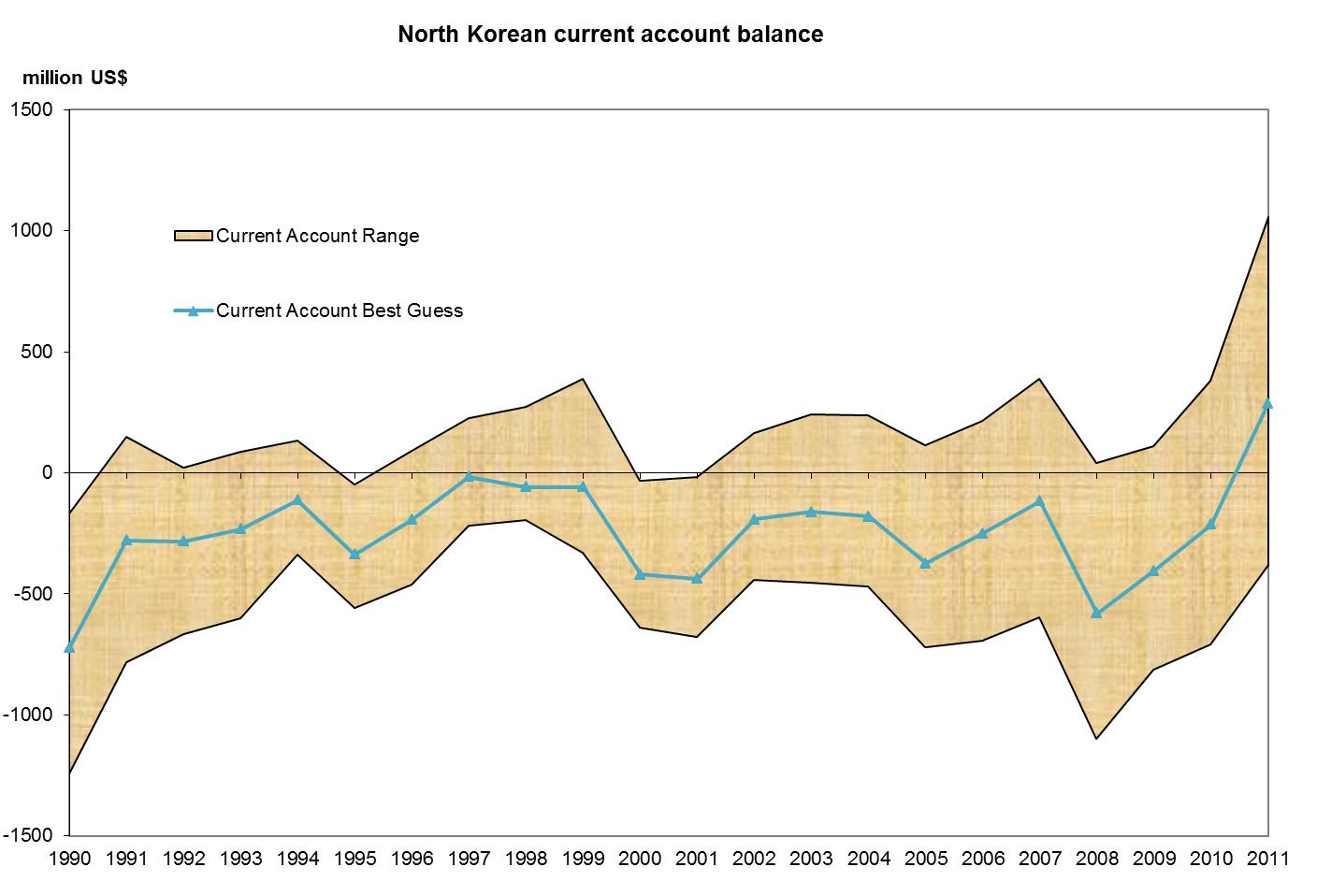
The Bank of Korea has long reported that the DPRK has been running a current account deficit (see their summary report of the DPRK economy in 2011 here).

While working on their own statistics, however, Marcus Noland and Stephan Haggard assert that the DPRK may be running a current account surplus:

DPRK-trade-surplus-Noland

According to Noland:

[In all likelihood],  North Korea has run current account deficits for most of its history. That meant that the country was consuming more than it was producing, and the difference had to financed from abroad. However, on our calculation, largely on the back of expanding trade with China, the current account went into surplus in 2011. Our preliminary calculations suggest that the country probably also ran a surplus in 2012.

This is bad news, both for North Korea and the rest of us. It is bad news for North Korea because as a relatively poor country, they should be running a current account deficit, importing capital, and expanding productive capacity for future growth. Instead, our calculation suggests that they are exporting capital. Consumption at home is being needlessly compressed (the recent UNICEF survey documents continuing chronic food insecurity for some significant part of the populace) and instead, money is flowing abroad, presumably to finance the future consumption of the elite. Steph Haggard, in a post last week, pointed to evidence that this capital may be flowing into accounts in China.

It is also bad news for us. If North Korea is running current account surpluses, then they are less vulnerable to foreign pressure.

The Wall Street Journal offered additional information:

Messrs. Noland and Haggard said that taking a pulse on North Korea’s economy is inevitably speculative. Pyongyang doesn’t release trade figures, so estimates are made based on data provided by third parties.

According to South Korean estimates, North Korea’s total trade with its only major ally, China, nearly tripled to around $5.6 billion between 2007 and 2011, and in 2011 it showed a deficit of $700 million in goods trade—a major component of its current account. For there to be an overall surplus, as the research of Messrs. Noland and Haggard suggests, other components in the current account would have to be more than enough to offset that goods-trade shortfall.

“If there were massive dollar remittances back home by overseas North Koreans or a sharp increase in foreign tourists to the North, it would be possible for North Korea to run a current-account surplus despite a trade deficit,” said a Bank of Korea official in Seoul. “But you never know the exact reasons unless you see the full data.”

Share

Deforestation in the DPRK

March 18th, 2013

Yohnap reports on the UNDP’s 2013 Human Development Report. The report apparently mentions some statistics on the DPRK.  You can read the report here. The interface is awful.

Here is the report from Yonhap (via Global Post):

North Korea saw its forests shrink by nearly 31 percent in the past 20 years, a report by an international organization said Tuesday.

The size of forestlands in North Korea is down 30.9 percent as of 2010, compared to 1990, the 2013 Human Development Report by the United Nations Development Program said. The report ranked about 40 developing countries in terms of human development. It disclosed the North Korean data without including the country in its ranking.

The report also said that as of 2011, 8.6 percent of its animal and plant species are in danger of extinction.

The average life expectancy in North Korea is 69 while an average North Korean woman gives birth to two children in her lifetime as of last year, according to the report.

The average infant mortality rate — the number of babies who die within one year of their birth per 1,000 babies — reached 26 as of 2010 while the corresponding death rate for children under the age of five stood at 44, the report also noted.

A total of 6.6 North Koreans out of 100 used fixed-line or mobile telephone services as of 2010, according to the organization. Recent data from other sources have shown that the country with a population of about 25 million people had 660,000 mobile service subscribers in mid-2010. The number is believed to have soared to 1.5 million in late 2012.

Share

DPRK promoting more cabinet involvement in economic affairs

March 18th, 2013

According to Yonhap (via Global Post):

North Korea revised its trade and customs laws last year to give its cabinet more power over the economy, a copy of the revised laws showed Monday.

The booklet on North Korea laws concerning external economic activities, secured by Yonhap News Agency, showed that the country revised its trade laws in April last year, a first since the previous revision in March 2007.

The revision newly requires trade institutions and other sub-trade groups to have their monthly plans reviewed and approved by the central trade supervision agency, according to the copy of the booklet.

The country’s customs law, also revised in April 2012, indicate that the government has increased its supervision of the customs sector compared with 2007 when the corresponding law was last modified.

The government is also said to be seeking to foster customs specialists and establish an ad hoc committee to review customs affairs.

Analysts said the latest law change suggests that the cabinet’s role in the economic sector has been enhanced compared to the military, which is known to have exerted a strong hold over state affairs reflecting late leader Kim Jong-il’s military-first ideology.

The timing of the revision coincides with incumbent leader Kim Jong-un’s emphasis on the importance of the cabinet in leading national policies. Kim Jong-un took power after the sudden death of his father in late 2011.

“North Korea’s trimming of the trade and customs laws indicates its intention to fasten up the central (government’s) previously loose supervision of trade and customs affairs,” said Im Eul-chul, a research professor of Far Eastern Studies at Kyungnam University. “It is also related with strengthening the role of the cabinet in the economic sector.”

The monthly management of trade performance, envisioned in the revision, reflects the leader’s plan to boost the trade sector as a means of earning more foreign currency, local experts also said. The military’s and the governing Workers’ Party of Korea’s tight hold on economic affairs are widely believed to have posed obstacles in the country’s economic performance.

The booklet, meanwhile, showed that the country rewrote its immigration law last April, doing away with the clause requiring state permission for foreign travelers wanting to travel outside of the capital of Pyongyang. Such a move could allow more freedom of movement by foreign tourists inside the communist country.

Read the full story here:
NK trade-cabinet
Yonhap (Via Global Post)
2013-3-18

Share

China signs first offshore processing agreement with North Korea

March 16th, 2013

By Michael Rank

China has signed its first offshore processing agreement with North Korea, under which four companies in the border city of Hunchun will export textiles which will be made up into shirts in the DPRK, a Chinese website reports.

Under the two-year agreement from January 2013, the textiles will be made up into 8,000 shirts, the report said, adding that the companies will be relieved of some export and import taxes. It gave no further details.

The report said the deal reflected low labour costs in North Korea as well as severe labour shortages in Hunchun, where there is a deficit of 3,500 workers. It said it was the first such agreement not just for Jilin province but for China as a whole, and had the approval of customs headquarters in Beijing.

Share