KPA asset data

March 29th, 2013

KPA-data-2013

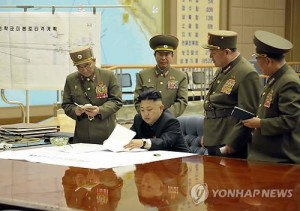
In the kerfuffle that followed James’ NK News post about the North Korean targeting Austin, TX, Yonhap reports on KPA asset data that was also on display in the official KCNA photos:

Media coverage of an emergency military meeting convened by North Korean leader Kim Jong-un on Friday shows an overview of its major weapons system, giving a rare glimpse of the isolated communist country’s armed forces.

The list shows that North Korea has 40 submarines, 13 landing ships, six minesweepers, 27 support vessels and 1,852 aircrafts [sic], with some of the numbers covered by senior officials.

Military officials in Seoul said the figure is similar to the defense ministry’s estimation of North Korea’s weapons system, though there are some differences.

According to the 2012 defense white paper, the North is estimated to have 70 submarines and midget subs, 260 landing ships, 30 mine sweepers, 30 support vessels, 820 fighter jets, 30 surveillance aircrafts, 330 parachute drop aircrafts and 170 training jets.

While there are some disparities between the list and Seoul’s assessment, the number of midget subs seems to have been excluded from the list disclosed in the photo, military officials said.

As Pyongyang has never disclosed its weapon system in the past, outside watchers speculate that the North Korean military has mistakenly disclosed the confidential information.

“It may have been leaked accidently,” said a senior military official, who asked to remain anonymous. “It could have been unveiled as the North hurriedly reported the emergency meeting.”

Others said the photo may be aimed at stoking tensions by showing that Kim is mulling ways to strike the U.S., considering the operational map that has several lines between the Korean Peninsula and the U.S. Its details were not recognizable in the photo.

The Washington Post has offered some additional data in a follow up article on 4-25-2013:

South Korea says North Korea has more than 13,000 artillery guns, and its long-range batteries are capable of hitting the capital Seoul, a city of more than 10 million people just 30 miles (50 kilometers) from the border.

“North Korea’s greatest advantage is that its artillery could initially deliver a heavy bombardment on the South Korean capital,” Mark Fitzpatrick, a former U.S. State Department official now with the International Institute for Strategic Studies, said in an email.

South Korea’s defense minister estimates that 70 percent of North Korean artillery batteries along the border could be “neutralized” in five days if war broke out. But Sohn Yong-woo, a professor at the Graduate School of National Defense Strategy of Hannam University in South Korea, said that would be too late to prevent millions of civilian casualties and avert a disastrous blow to Asia’s fourth-largest economy.

Seoul estimates North Korea has about 200,000 special forces, and Pyongyang has used them before.

In 1968, 31 North Korean commandos stormed Seoul’s presidential Blue House in a failed assassination attempt against then-President Park Chung-hee. That same year, more than 120 North Korean commandos sneaked into eastern South Korea and killed some 20 South Korean civilians, soldiers and police officers.

In 1996, 26 North Korean agents infiltrated South Korea’s northeastern mountains after their submarine broke down, sparking a manhunt that left all but two of them dead, along with 13 South Korean soldiers and civilians.

North Korea has 70 submarines while South Korea has 10, according to Seoul’s Defense Ministry. The most menacing threats from the North’s navy are small submarines that would deposit commando raiders along the South Korean coast, said John Pike, head of the Globalsecurity.org think tank.

North Korea also has 820 warplanes, more than South Korea, though Seoul is backed up by American air power. The South says most of the North’s aircraft are obsolete. North Korea also suffers chronic fuel shortages that have forced its air force to cut sorties, experts say.

“North Korea would not be able to prosecute a full-fledged war for very long,” Fitzpatrick said. “Its biggest problem is that North Korea would quickly lose control of the skies because of the vastly superior (South Korean) and U.S. air forces. The reported number of North Korean aircraft is meaningless, because many of them cannot fly, and North Korean pilots have little training in the air.”

Pyongyang is believed to have enough weaponized plutonium for four to eight nuclear bombs, according to Siegfried Hecker, a nuclear expert with Stanford University’s Center for International Security and Cooperation.

But he doubts Pyongyang has mastered the technology to tip a missile with a nuclear warhead. “I don’t believe North Korea has the capacity to attack the United States with nuclear weapons mounted on missiles and won’t for many years,” he said on the website of Stanford University’s Freeman Spogli Institute for International Studies this month.

orth Korea denies it runs any chemical and biological weapons programs. South Korea claims that Pyongyang has up to 5,000 tons of chemical weapons.

The IISS says that although the figures are “highly speculative,” the North probably does possess chemical and biological arms programs.

“Whatever the actual status of North Korea’s chemical and biological capabilities, the perception that it has, or likely has, chemical and biological weapons contributes to Pyongyang’s interest in creating uncertainties in Washington, Seoul and Tokyo and raises the stakes to deter or intimidate potential enemies,” it said on its website. North Korea is not a signatory to the Chemical Weapons Convention, but it has acceded to the non-binding Biological and Toxin Weapons Convention.

Read the full stories here:
N. Korea’s photo offers glimpse of major weapons
Yonhap
Kim Eun-jung
2013-3-29

A look at the strengths and weaknesses of North Korea’s military
Washington Post (Associated Press)
2013-4-25

Share

Some new retail developments in Pyongyang

March 28th, 2013

Instagram is no longer an option for regular tourists to the DPRK, but expats and regular visitors are still allowed access to the service. So Koryo Tours has used mobile access to photograph some recent changes in Pyongyang. I thought I would post a couple of their interesting images below and match them with satellite imagery to give a little more perspective.

Taedonggang Bar No. 3 (대동강제3술집):

Taedong-gang-bar-no-3

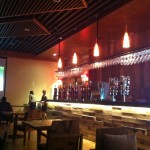
Renovation on this bar began sometime after Feb 2012. The interior (pics by Koryo Tours) looks like any of the bars in Dupont Circle:

Taedonggang-bar-3-1 Taedonggang-bar-3-2

According to Koryo Tours, beer costs 1.5 Euros (per pint/half litre). There are seven taps along the bar. I assume they serve various brands of Taedonggang Beer.

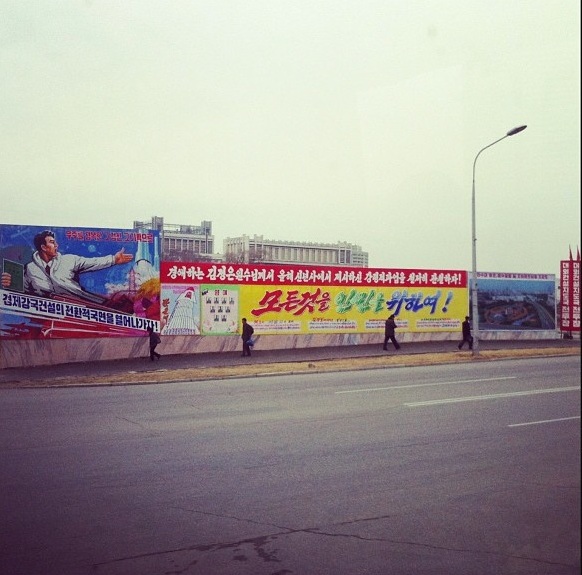
Koryo Tours also posted this image of a new shopping center under construction in downtown Pyongyang:

mansudae-shopping-center-construction

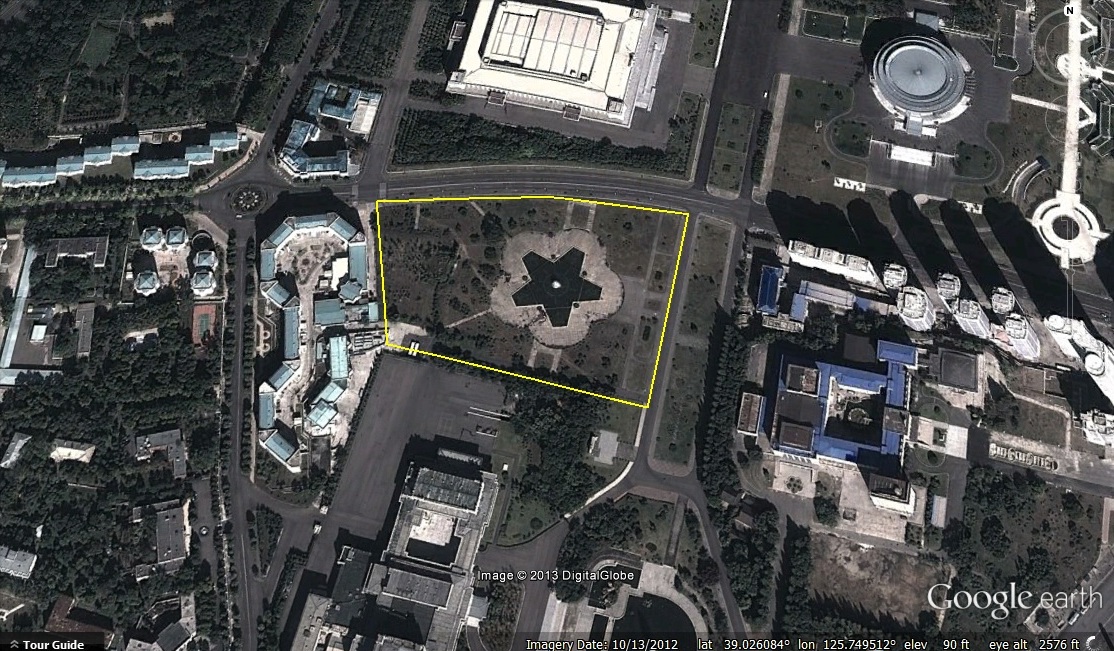
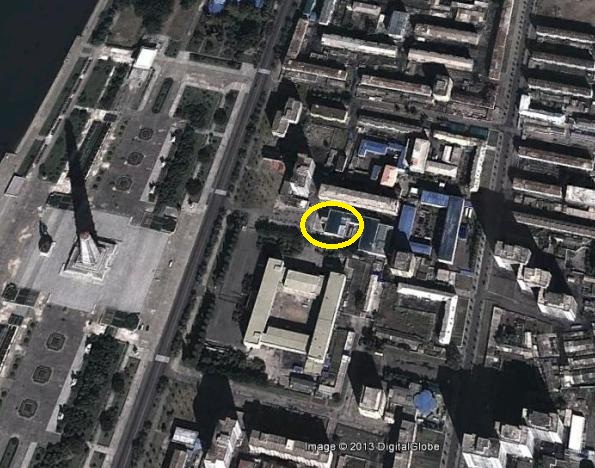
Plastered to the wall is a map of what the site will look like when construction is completed, however, it is too small to make out with any specificity with this image.  Currently we do not know any details about this facility (or even its proper name), but hopefully it will appear in the official North Korean media before too long. Here is the location of the new facility:

New-park-mansudae

The construction site sits on the former star-shaped fountain of the Mansudae Fountain Park….between the Mansudae Assembly Hall (Supreme People’s Assembly), Pyongyang Student’s and Children’s Palace, Mansudae Art Theater, and new Mansudae Street housing.

Share

Kempinski claims to [not] be taking over management of Ryugyong Hotel

March 28th, 2013

UPDATE 1 (2013-3-28): NK News reports that Kempinski has officially pulled out of the deal:

“Kempinski Hotels confirms that KEY International, its joint venture partner in China with Beijing Tourism Group (BTG), had initial discussions to operate a hotel in Pyongyang, North Korea, however no agreement has been signed since market entry is not currently possible”, Regional PR Director Hilary Philpott told NK NEWS by email.

ORIGINAL POST (2012-11-1): According to Bloomberg:

The 105-story, pyramid-shaped Ryugyong Hotel, whose foundations were poured almost three decades ago, will open partially in July or August, Kempinski AG Chief Executive Officer Reto Wittwer said today at a forum in Seoul. The German luxury-hotel manager will be the first western hospitality company to operate in North Korea, he said.

“This pyramid monster hotel will monopolize all the business in the city,” Wittwer said. “I said to myself, we have to get this hotel if there is ever a chance, because this will become a money-printing machine if North Korea opens up.”

Kempinski, based in Munich, is handling management while Egypt’s Orascom Telecom Media & Technology Holding SAE (OTMT) funds the hotel as part of a $400 million mobile-phone license it won from the North Korean government in 2008, he said. Cairo-based Orascom has spent $180 million on completing the hotel’s facade.

The top floors of the hotel will house guests in 150 of the originally planned 1,500 rooms, which “will be developed over time” to remodel the insufficiently designed spaces, Wittwer said. Shops, restaurants, a ballroom and Orascom’s offices on the ground and mezzanine floors will also open next year.

Additional Information:

1. Koryo Tours published the first photos taken inside the building.

2. The Choson Ilbo reports that the South Koreans tried investing in the hotel during the Noh Administration.

Read the full story here:
Kempinski to Operate World’s Tallest Hotel in North Korea
Bloomberg
Sangwon Yoon
2012-11-1

Share

DPRK imports of Chinese silver surge

March 28th, 2013

According to Yonhap:

North Korea imported an unusually massive amount of silver from China in January, possibly in relation to leader Kim Jong-un’s birthday that month, sources and China’s customs office said Thursday.

Data from China’s customs office showed that North Korea imported 661.71 kilograms of Chinese silver for US$653,128 in January.

The monthly import is unusually enormous given that the North took in only $77,593 worth of precious metal and other jewels for the whole of 2012. The corresponding amount for 2011 was $57,000.

Before January this year, the North had hardly spent more than $10,000 on monthly imports of such goods, according to the data.

Given the leader’s birthday on Jan. 8, North Korea watchers said the massive amount of imported silver may have been used to produce silverware souvenirs to celebrate the leader’s birthday.

“It’s difficult to assume the exact purpose of the silver imports,” a source said. Given that late leader Kim Jong-il used to bring in foreign brand luxury sedans and expensive watches to treat the country’s top echelon on major holidays, the bulk of silver imported in January may have been used for similar purposes, the source said.

Backing this assumption, the customs data also showed that the North imported an unusually large amount of costume jewelry worth $10,447 in the same month.

A reader points out this Daily NK story hypothesizing that the silver could have been used in batteries:

As such, there are suspicions that the recent North Korean decision to import more than 600kg of silver through China was done to facilitate the production of batteries for submersible production.

A North Korean military source told Daily NK on the 4th, “The [North Korean] Navy has been producing submersibles at every shipyard on their east and west coasts ever since the attack on the Cheonan in 2010.”

According to the inside source, prior to the Cheonan sinking such vessels were produced at one shipyard, the disguised ‘Bongdae Boiler Factory’ in Sinpo, South Hamkyung Province, at a rate of five per year. However, following the sinking of the Cheonan that rate went up four times to 16 per year, as the vessels started being produced across multiple shipyards including Yongampo, Chongjin and Rajin.

The source explained, “The reason why the North Korean authorities are increasing production of this kind of submersible that can fire torpedoes is to maximize their underwater attack capacity. The subs can take 12 to 15 soldiers yet still sink destroyers weighing thousands of tons with their twin torpedoes.”

“The engines noise on the submersibles is very quiet, making them able to approach their targets underwater in secret, while it is impossible to trace crimes such as the Cheonan incident,” the source went on, adding that during North Korean military training exercises they also emphasize the essential nature of the subs.

The rising production is pushing up demand for batteries, the source then went on to add, saying that this required the bulk production of both silver and zinc. “All the silver produced in North Korea is supplied to the shipyards,” he claimed.

The source admitted to being confused, therefore, at North Korea’s recent decision to import 660kg of silver from China, declaring, “There is lots of silver being produced in North Korea, so it’s hard to say why they are importing it from China…I suppose it may have been just that more batteries were being produced so they needed more silver.”

Read the full stories here:
N. Korea imports massive amount of Chinese silver in Jan.: data
Yonhap
2013-3-28

NK Producing More Silvery Subs
Daily NK
2013-4-5

Share

Hacking…

March 28th, 2013

Today I discovered someone trying to hack into this web page.

So everyone out there, keep a close eye on your systems and be safe.

Share

Fatherland Liberation War Memorial Hall

March 27th, 2013

FLWM-satellite

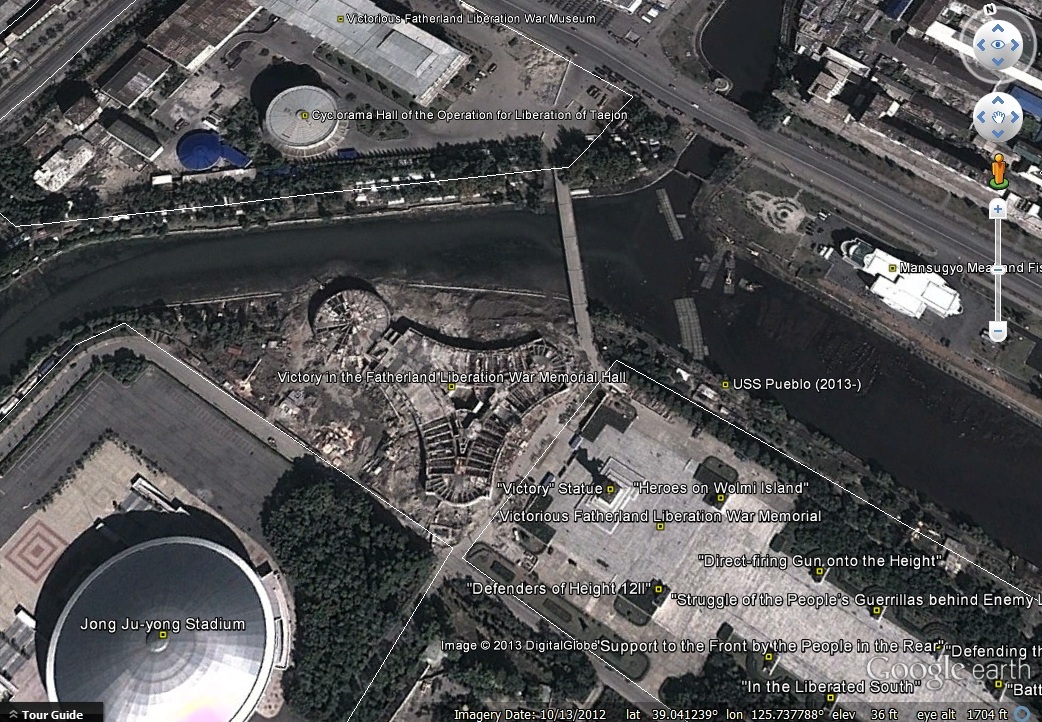
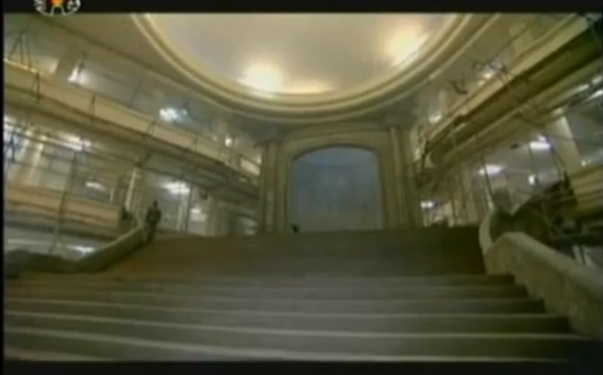
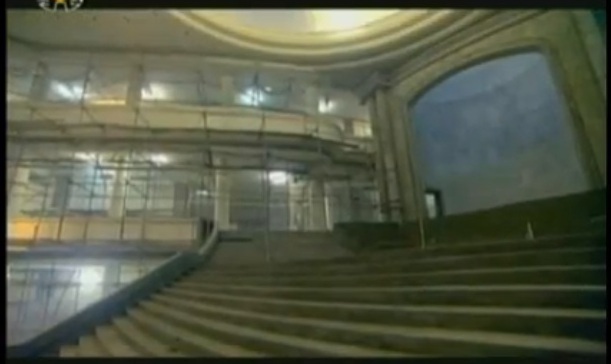
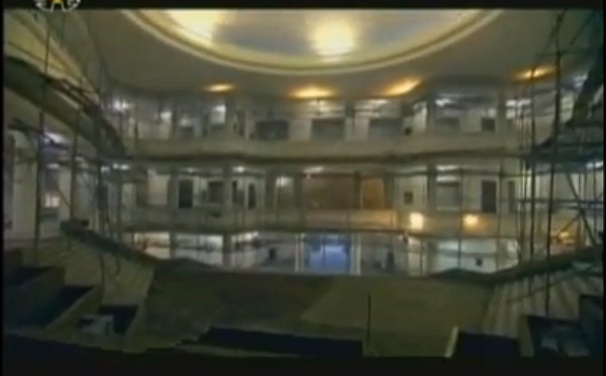
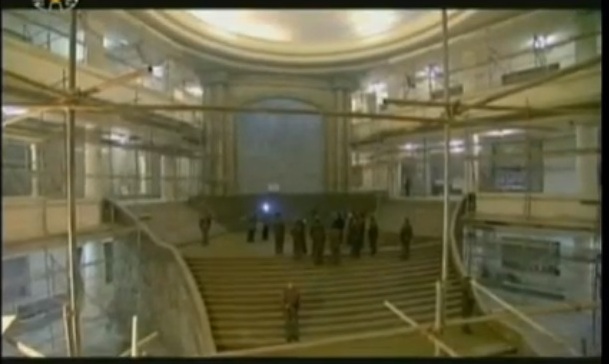
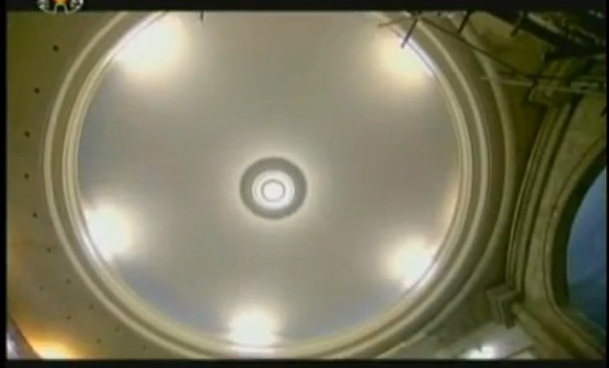
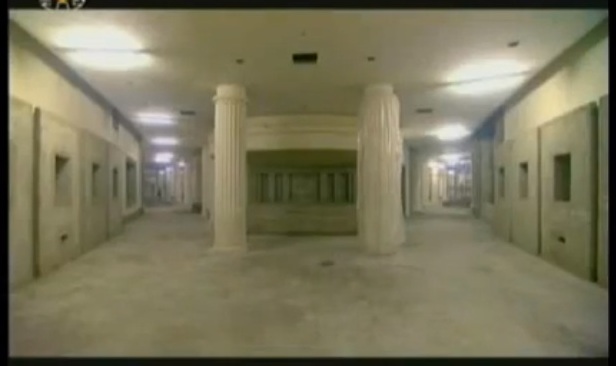
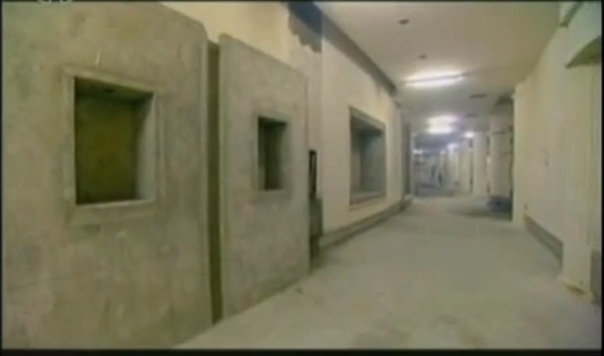
Today NK News ran this story on the unfinished “Victory in the Fatherland Liberation War Memorial Hall” (조국해방전쟁승리기념관). I thought I would add some images of the interior of the building that were shown on North Korean television:

FLWM-interior-1 FLWM-interior-7

FLWM-interior-6 FLWM-interior-2

FLWM-interior-3 FLWM-interior-4

FLWM-interior-5


In addition to the construction of this building, the “Victory in the Fatherland Liberation War Museum” and the “Victory in the Fatherland Liberation War Memorial” are all under renovation. As previously reported (in December 2012), the Pueblo has also been moved here.

Share

Collection of DPRK laws and regulations

March 27th, 2013

A much-appreciated colleague has sent me a PDF document published by the DPRK’s Committee for the Promotion of External Economic Cooperation in 2003. It that contains hundreds of pages of DPRK laws and regulations.

Compilation-of-laws-and-regs-for foreign-investment

Click here to open the PDF document

Here is a list of the contents:

1. The Law of the Democratic People’s Republic of Korea on Foreign Investment

2. The Law of the Democratic People’s Republic of Korea on Equtiy Joint Venture

3. Regulations for the Implementation of the Law on Equity Joint Venture

4. The Law of the Democratic People’s Republic of Korea on Contractual Joint Venture

5. Regulations for the Implementation of the Law on Contractual Joint Venture

6. The Law of the Democratic People’s Republic of Korea on Foreign Exchange Control

7. Regulations for the Implementation of the Law on Foreign Exchange control

8. The Law of the Democratic People’s Republic of Korea on Foreign-Invested Bank

9. The Law of the Democratic People’s Republic of Korea on the Leasing of Land

10. The Law of the Democratic People’s Republic of Korea on Foreign-Invested Business and Foreign Individual Tax

11. Regulations for the Implementation of the Law on Foreign-Invested Business and Foreign Individual Tax

12. The Customs Law of the Democratic People’s Republic of Korea

13. The Law of the Democratic People’s Republic of Korea on the Protection of Environment

14. The Insurance Law of the Democratic People’s Republic of Korea

15. The Law of the Democratic People’s Republic of Korea on External Economic Arbitration

16. The Law of the Democratic People’s Republic of Korea on External Civil Relations

17. The Notary Public Law of the Democratic People’s Republic of Korea

18. The Civil Proceedings Act of the Democratic People’s Republic of Korea

19. The Law of the Democratic People’s Republic of Korea on Processing Trade

20. The Law of the Democratic People’s Republic of Korea on Bankruptcy of Foreign-Invested Enterprises

21. The Law of the Democratic People’s Republic of Korea on the Rason Economic and Trade Zone

22. The Law of the Democratic People’s Republic of Korea on Wholly Foreign-Owned Enterprises

23. Regulations for the Implementation of the Law on Wholly Foreign-Owned Enterprises

24. Regulations on the Financial Management of Foreign Invested Enterprises

25. Regulations on the Introduction of Latest Technologies by Foreign-Invested Enterprises

26. Regulations on the Naming of Foreign-Invested Enterprises

27. Regulations on the Registration of Foreign-Invested Enterprises

28. Labor Regulations for Foreign-Invested Enterprises

29. Regulations on the Resident Representative Offices of Foreign Enterprises in the Rason Economic and Trade Zone

30. Regulations on Entrepot Trade in the Rason Economic and Trade Zone

31. Regulations on Contract Construction in th Rason Economic and Trade Zone

32. Regulations on Forwarding Agency in the Rason Economic and Trade Zone

33. Regulations on Statistics in the Rason Economic and Trade Zone

34. Regulations on Tourism in the Rason Economic and Trade Zone

35. Regulations on Financial Management of Foreign-Invested Enterprises in the Rason Economic and Trade Zone

36. Regulations on Foreigner’s Immigration Procedure and Stay in the Rason Economic and Trade Zone

37. Customs Regulations For the Rason Economic and Trade Zone

38. Regulations on Finding in the Rason Economic and Trade Zone

Share

China-North Korea railway links to undergo upgrade

March 26th, 2013

Tumen-namyang-rail-2011-9-23

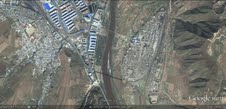
Pictured Above (Google Earth): The Namyang (DPRK) – Tumen (PRC) rail and bridge crossings. I suspect that this is the specific area that will see renovation

According to the Global Times:

The government of northeast China’s Jilin Province announced Tuesday plans to upgrade railways links to neighboring North Korea, aiming to boost cross-border economic and trade ties.

The China Tumen-North Korea Rajin Railway and China Tumen-North Korea Chongjin Railway will be upgraded under the Jilin government plan. A special highway passenger line linking Tumen to North Korea is also set to be opened in coming years.

The plan aims to improve the industrial cooperation between China and North Korea’s Rason and push the development of the Tumen Korean Industrial Park to a higher level.

Jin Qiangyi, director of the Asia Research Center of Yanbian University, told the Global Times that the industrial cooperation between China and North Korea has been going on for many years and does not breach international sanctions against Pyongyang.

Such cooperation could improve employment in border areas of both countries and contribute to development and stability in the area amid heightening tensions, said Jin.

Read the full story here:
China-North Korea railway links to undergo upgrade
Global Times
2013-3-27

Share

Chrome blocking Naenara

March 25th, 2013

Naenara-malware-screenshot

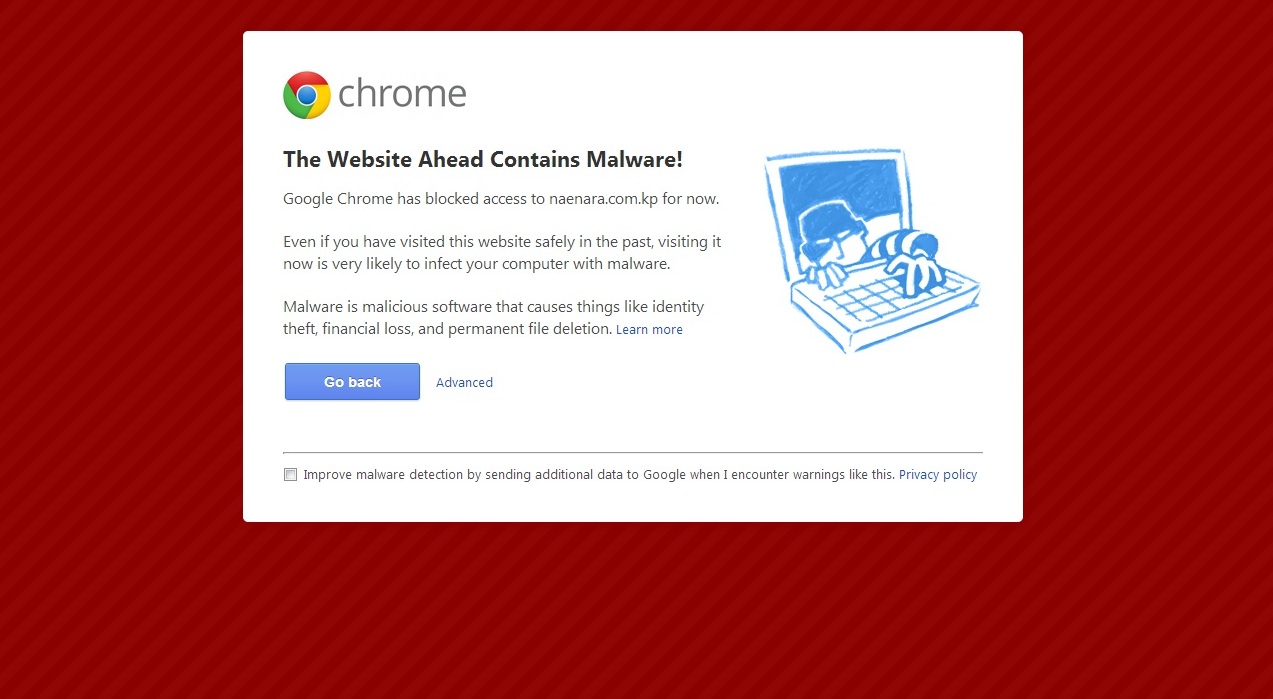
Above: What I see when I try to log onto Naenara.kp

For several days now, Google Chrome has blocked access to the DPRK’s Naenara portal because it contains malware.

Here is the information that Chrome provides about the site:

What is the current listing status for naenara.com.kp?
Site is listed as suspicious – visiting this web site may harm your computer.

Part of this site was listed for suspicious activity 2 time(s) over the past 90 days.

What happened when Google visited this site?
Of the 5628 pages we tested on the site over the past 90 days, 18 page(s) resulted in malicious software being downloaded and installed without user consent. The last time Google visited this site was on 2013-03-19, and the last time suspicious content was found on this site was on 2013-03-15.
Malicious software includes 143 exploit(s), 9 trojan(s). Successful infection resulted in an average of 16 new process(es) on the target machine.

Malicious software is hosted on 3 domain(s), including zief.pl/, ecpage.sakura.ne.jp/, chura.pl/.

This site was hosted on 1 network(s) including AS131279 (STAR).

Has this site acted as an intermediary resulting in further distribution of malware?
Over the past 90 days, naenara.com.kp did not appear to function as an intermediary for the infection of any sites.

Has this site hosted malware?
No, this site has not hosted malicious software over the past 90 days.

How did this happen?
In some cases, third parties can add malicious code to legitimate sites, which would cause us to show the warning message.

Other sites on the .kp domain appear to be functioning normally.

Are there any brave souls with a spare computer that want to investigate this?

Share

RoK approves private aid to DPRK

March 22nd, 2013

According to Yonhap:

Under the approval, Eugene Bell, a South Korean charity group, will ship tuberculosis medicine worth 678 million won (US$606,500 to eight tuberculosis clinics run by the South Korean group in North Korea. The shipment is expected to be delivered in April, the official said.

This marks the first aid package approved by the ministry since Park took office on Feb. 25. The last aid request was granted in November last year under President Lee Myung-bak.

“The approval is strictly for humanitarian purposes and should not be read as a message to condone North Korea’s recent provocations,” Kim said.

“The planned medicine aid can help cure about 500 multidrug-resistant tuberculosis patients in the North whose lives would be at serious risk without the medicine,” the spokesman said. It is difficult for North Korea to produce quality medicine to cure the difficult type of tuberculosis, he added.

President Park has repeatedly said despite relations with the North, she will continue to allow humanitarian aid to less-privileged North Koreans as part of her signature North Korean policy to build trust with the country. She, however, pledged to sternly respond to any provocations by the North.

“The spread of multidrug-resistant tuberculosis is so serious that North Korea is judged to have missed the crucial ‘golden time’ to root out the tuberculosis,” Stephen Linton, the chairman of Eugene Bell, said in a news conference in November following a two-week visit to the country.

The charity foundation has been running a medical service program for tuberculosis patients in the North since 2000 and sends drugs on a regular basis to the impoverished country.

Read the full story here:
Seoul approves first private-level aid provision to N. Korea under new administration
Yonhap
2013-3-22

Share