Cyber attacks…

March 15th, 2013

Some of the DPRK’s web pages went down for a couple of days. According to North Korea Tech:

North Korea’s state-run news agency accused the U.S. and its allies of being behind a series of cyberattacks that have forced its web sites offline for much of the last two days.

The report represents the first recognition by North Korean state media of the cyberattacks.

The handful of web sites based in the country became difficult or impossible to connect to two days ago with no explanation. North Korean web sites routinely go offline for periods of a few hours or up to a day, but this was the first time that all of the country’s web sites went offline at the same time.

Here is what KCNA had to say:

KCNA Blasts US and Its Allies’ Cyber Attacks

Pyongyang, March 15 (KCNA) — There are very disturbing developments against the backdrop of the ever mounting moves of the U.S. and its allies to stifle the DPRK.

Intensive and persistent virus attacks are being made every day on internet servers operated by the DPRK. These cannot be construed otherwise than despicable and base acts of the hostile forces consternated by the toughest measures taken by the DPRK after launching an all-out action.

What should not be overlooked is that such cyber attack is timed to coincide with the madcap Key Resolve joint military exercises being staged by the U.S. and other hostile forces.

It is nobody’s secret that the U.S. and south Korean puppet regime are massively bolstering up cyber forces in a bid to intensify the subversive activities and sabotages against the DPRK.

The DPRK will never remain a passive onlooker to the enemies’ cyber attacks that have reached a very grave phase as part of their moves to stifle it.

It is ridiculous, indeed, for the hostile forces to mount such virus attacks on the DPRK’s internet servers, much upset by the all-out action of its army and people to defend the sovereignty of the country and the nation.

They are seriously mistaken if they think they can quell the DPRK’s voices of justice through such base acts.
The U.S. and its allies should be held wholly accountable for the ensuing consequences.

Just what kind of cyber attack was launched? Renesys offers some data (via North Korea Tech):

We observed disruptions in North Korean Internet connectivity beginning at 00:59:30 UTC on 13 March 2013. At this time, North Korea’s four networks were very briefly removed from the global routing table (chart lower left). When the routes were restored, one of the four networks was routed over Intelsat, while the other three were routed over China Unicom. After a few hours, all networks were once again routed over China Unicom. For about two hours starting at 22:40 UTC on 13 March, all four networks disappeared for a second time from the global routing table. Later on 14 March, we saw Intelsat again appear as a provider for one of the networks for several hours.

Despite such routing instabilities, North Korean networks were generally available in the global routing table. However, when we look at our active measurements (i.e., traceroutes) into North Korea during this time, we see a significant drop-off in successful responses, suggesting a loss of connectivity not visible in routing data alone (chart lower right).

See the Renesys web page for charts.

Share

North Korea stressing science and technology in agricultural sector

March 15th, 2013

Institute for Far Eastern studies (IFES)
2013-3-14

North Korea is emphasizing the importance of science and technology in the agricultural sector.

The Rodong Sinmun, the official newspaper of the Workers’ Party of Korea (WPK), recently featured an article written by Ri Yong Gu, director of the Ministry of Agriculture, titled “Key Issues to Pay Attention for Introducing Technology Products in Farming Operations.” The article emphasized the importance of science and technology in the WPK’s policies and claimed technology products, such as farm machineries, fertilizer, pesticides, and soil conditioners must be introduced to promote agricultural production.

In addition, the article called for accurate assessment of economic benefits to be gained by introduction of technology products and for evaluation of scientists, technicians, and farmers to mobilize the public and to integrate science and technology with production in all units of the agricultural sector.

Technology products were explained as an important factor for reducing agricultural production costs, making crucial the selection of appropriate technology based on the experience and skill level of farmers and soil conditions of each farm.

Choson Sinbo, the Japan-based pro-North Korean newspaper, featured an article on February 27 that scientific farming methods were incorporated in the Samji River Collaborative Farm that linked with the Center for Agricultural and Technology Dissemination through a computer network.

It is not new for North Korea to emphasize the use of science and technology in agriculture; however, in recent years, more emphasis is being placed on this factor.

In the 2013 New Year’s speech by North Korean leader Kim Jong Un, agricultural and light industries were named as the frontline industries for economic construction. In the speech, Kim stressed that “incorporating science and technology into agricultural production and increasing the level of integration must be accomplished in order to reach wheat production target for this year.”

In time for rice planting season in May, North Korea is hoping to increase fertilizer production and to promote agricultural technology in order to boost production countrywide.

This emphasis is in line with the successful launch of the long-range rocket launch last December, preferential atmosphere toward scientists, and promotion of science and technology in the economic sector.

Increased grain production last year may be due to improved fertilizer supply. Production is expected to improve this year as scientific farming continues to be emphasized.

Share

Pueblo moved to war museum

March 14th, 2013

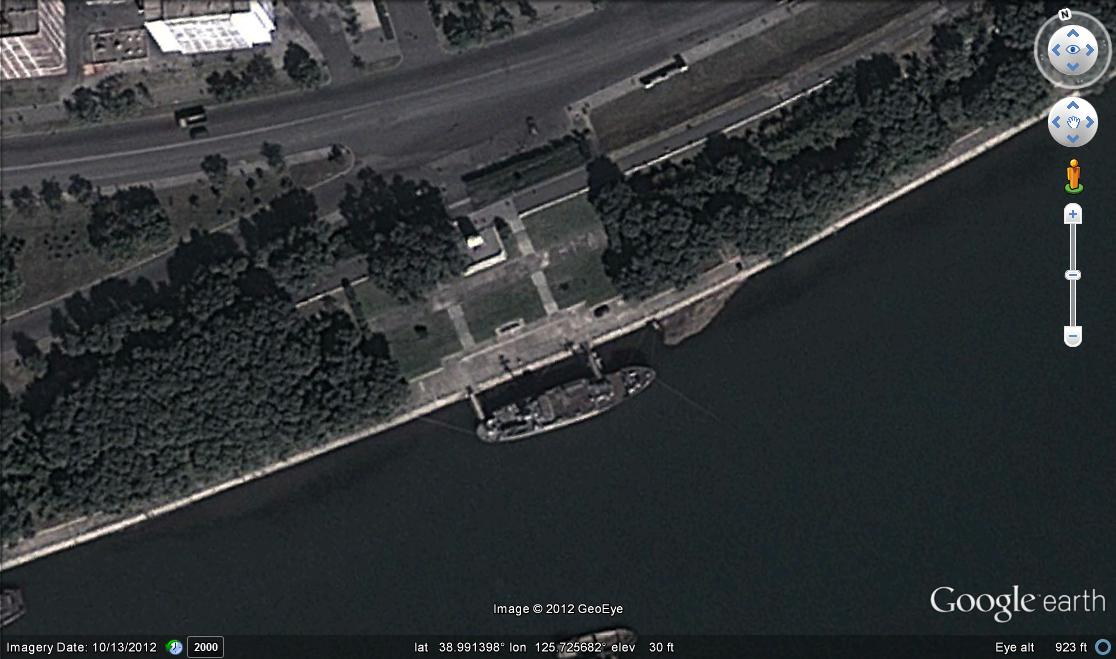
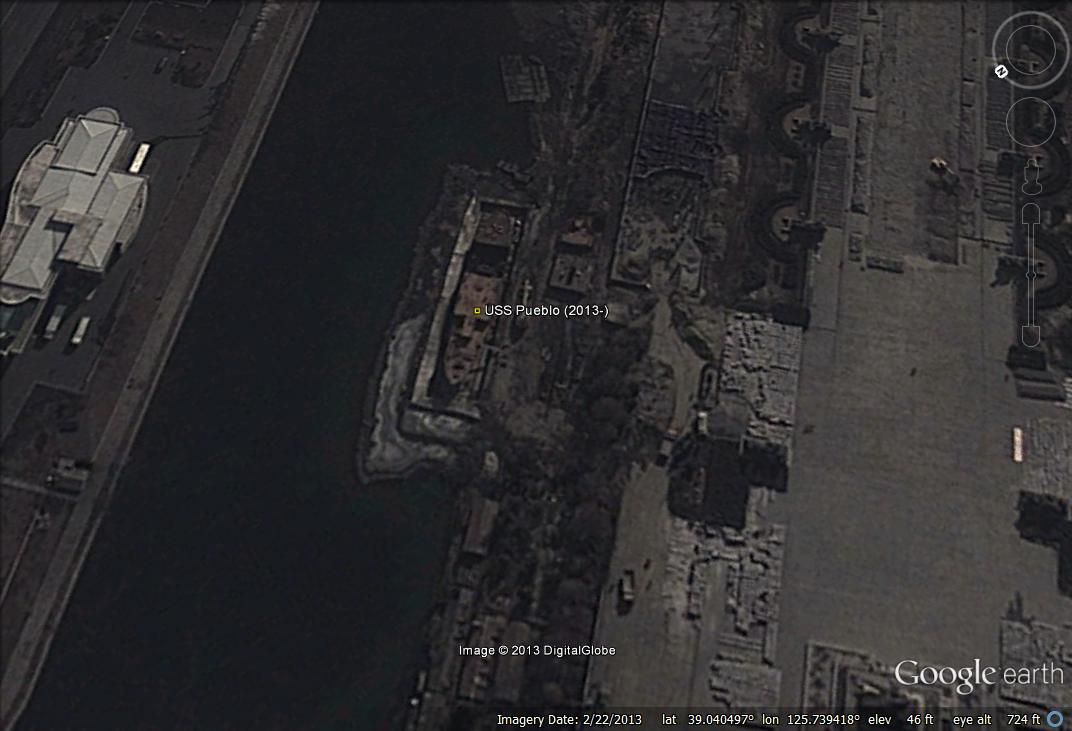
UPDATE 9 (2013-4-11): Here is a satellite image of the Pueblo in its new location:

Pueblo-2013-Google Earth

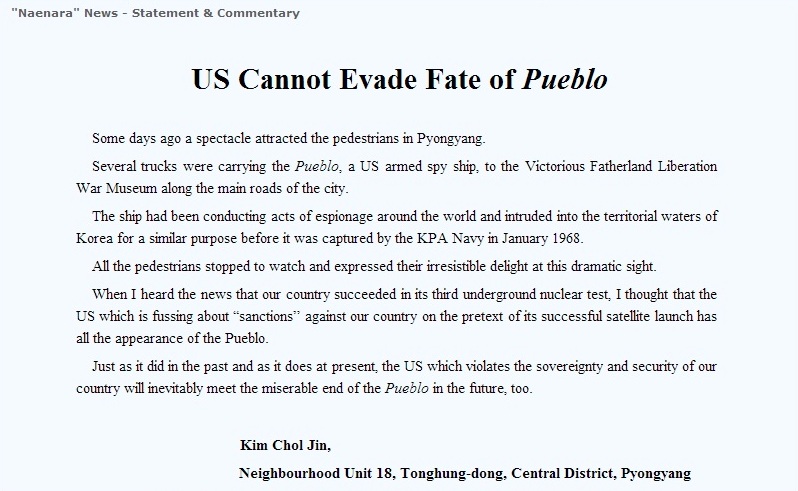
UPDATE 8 (2013-4-11): Naenara provides basic information on how the Pueblo was moved:

Pueblo-moved-bu-truck-naenara

UPDATE 7 (2013-3-18): Koryo Tours has posted a photo of the ship on Instagram. The ship is not part of tourist itineraries just yet, but it is visible from the Mansu Bridge.

UPDATE 6 (2013-3-14): North Korean television has showed the pueblo for the first time since it was moved from its position on the Taedong River. It appears to have been painted Orange. You can see the ship in this video clip:

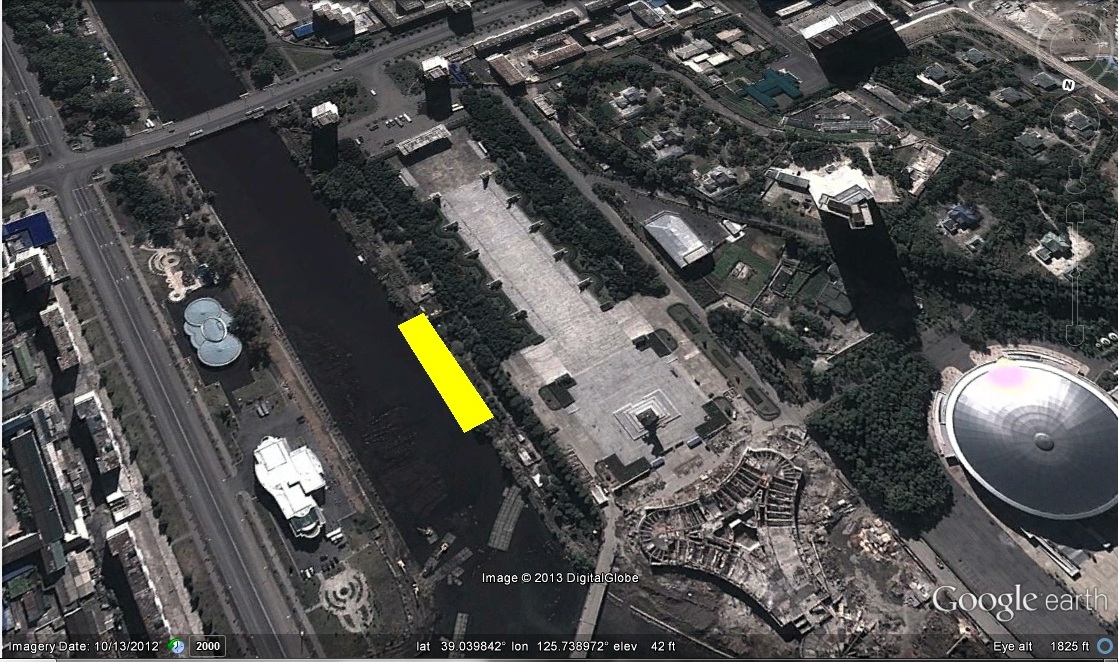
Here is a Google Earth satellite image showing the approximate location of the USS Pueblo as of 2013-3-14:

Pueblo-location-2013-3-14

UPDATE 5 (2012-12-4): Koryo Tours has also posted video to their Facebook Page of the spot where the Pueblo used to be. You can see the video here.

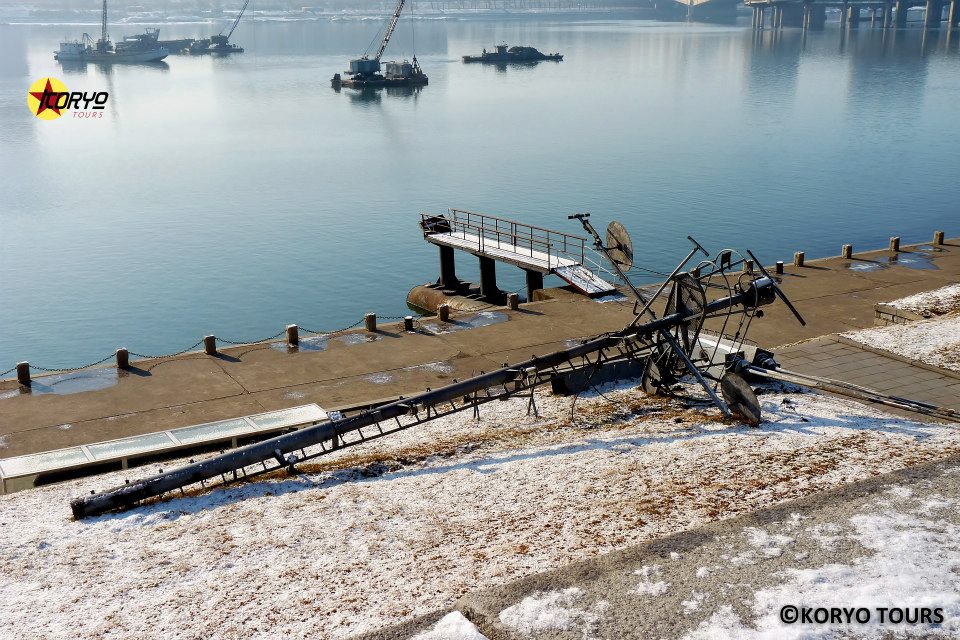
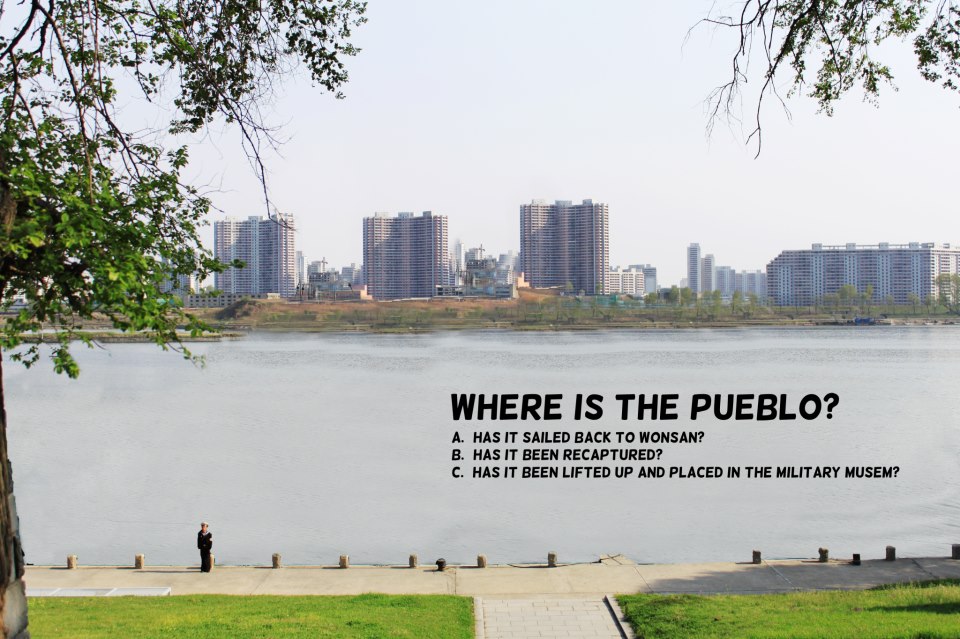
UPDATE 4 (2012-12-4): Koryo Tours has posted images of the empty dock where the Pueblo Used to be. Here is one:

You can see the other two photos here.

UPDATE 3 (2012-12-4): Thanks to the Wall Street Journal!

UPDATE 2 (2012-12-2): I was wrong.  It looks like the Pueblo is being moved to the Fatherland Liberation War Museum/Memorial Hall.

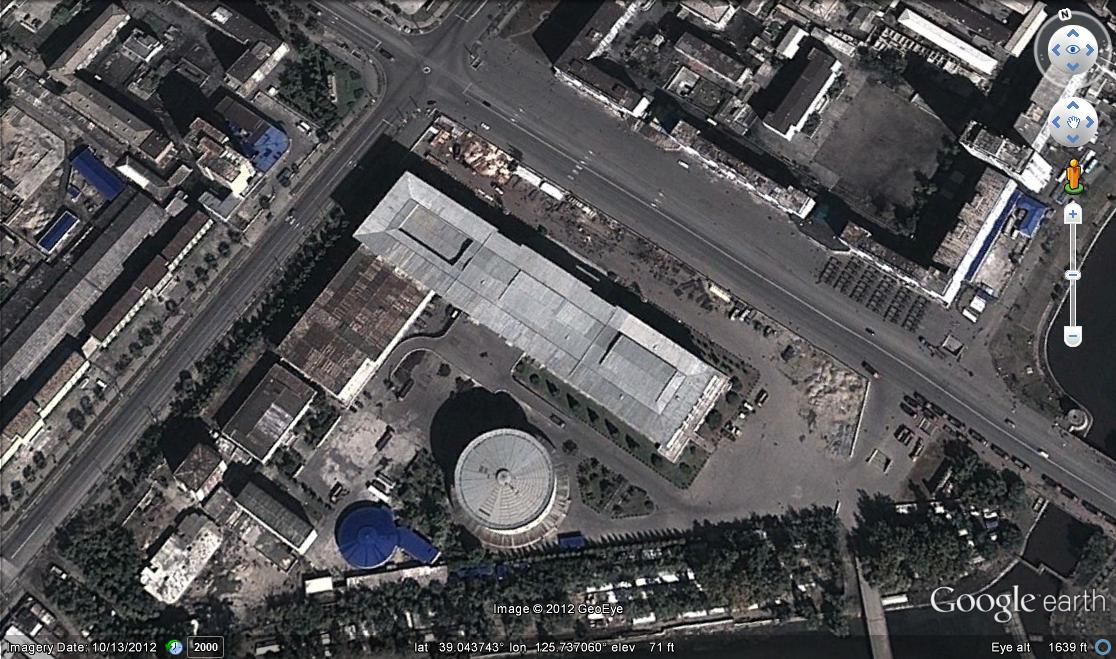
This weekend North Korean television ran footage of a new building being constructed next to the Fatherland Liberation War Memorial. Here is a Google Earth satellite image of the the building construction:

Here is the footage from North Korean television:

A much appreciated reader  informs me that at the 1:59 mark in the film an officer says USS Pueblo will be docked here (next to the new building).

UPDATE 1 (2012-11-29): NK News offers more info on the history of the ship.

ORIGINAL POST (2012-11-29): Koryo Tours, who this year published the first interior images of the Ryugyong Hotel, reports another scoop from Pyongyang: The Pueblo has been moved from its dock on the Taedong River in Central Pyongyang. The observation was made sometime between November 19 – 24.

The image below (from the Koryo Tours Facebook Page) is photo-shopped, but it gives an idea of what the space looks like now:

The most recent Google Earth imagery of the site (2012-10-13) shows the Pueblo safely docked in Pyongyang, so the ship was moved sometime after this date.

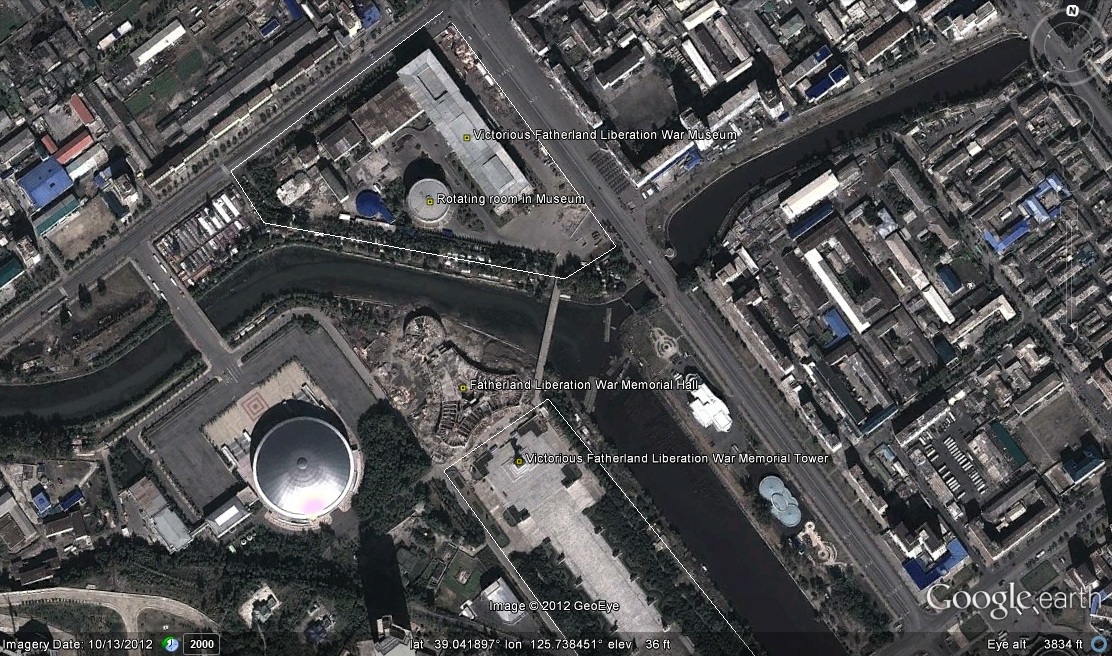
As the Koryo Tours photo suggests, the ship could have been moved into the Fatherland Liberation War Museum. It is currently under renovation:

The above satellite image (Google Earth) was taken 2012-10-13. You can read about the renovations in KCNA here.

However, I consider the likelihood that the Pueblo has been moved into the museum to be very small for a number of reasons.  We will see over the next few months whether the DPRK has new plans for the ship or whether it has just been temporarily moved for maintenance reasons.

Share

Kiribati issued passports to North Korean

March 13th, 2013

According to the Choson Ilbo:

The tiny South Pacific island nation of Kiribati issued passports to North Korean businessmen until 2004 as a “means of generating revenue,” its president has admitted.

There had been speculation for some time that North Koreans engaged in illicit activities such as arms deals were illegally obtaining passports from small countries.

Appearing recently on Australian radio, Kiribati President Anote Tong said he was embarrassed that the passports were reportedly related to international crime. “I can assure you that we had corrected that situation in 2004 when we stopped issuing these passports,” he said.

Late last year, a Japanese activist group said two agents from North Korea, Han Chol [한철] and Ju Ok-hui [주억희), used passports issued by Kiribati and the Seychelles.

They are board members of North Korea’s Tongsin International Trading Corporation, an agency suspected of illegally exporting weapons to Burma and other countries, the group added.

Both Han and Ju were given passports by the Kiribati government in 1996 and by the Seychelles in 2007. The countries reportedly sold passports to foreign businessmen but abandoned the practice due to mounting worries about illicit activities.

A Foreign Ministry official in Seoul said, “Kiribati has been neutral since it won independence from the U.K. in 1979. “It would have been easier for the North Korean agents to travel with those passports rather than with North Korean ones.”

Read the full story here:
South Pacific Island Admits Selling Passports to N.Koreans
Choson Ilbo
2013-3-13

Share

US imposes new sanctions on DPRK

March 11th, 2013

These new sanctions are in response to the DPRK’s third nuclear test. Here is a link to information on UNSC resolution 2094, which the UNSC passed in response to the same test.

Here is the full statement by the Treasury Department:

___________________

Treasury Sanctions Bank and Official Linked to North Korean Weapons of Mass Destruction Programs 3/11/2013

​WASHINGTON – To impede North Korea’s ballistic missile and weapons of mass destruction (WMD) programs, the U.S. Department of the Treasury today designated the Foreign Trade Bank (FTB), North Korea’s primary foreign exchange bank, pursuant to Executive Order (E.O.) 13382, which targets proliferators of weapons of mass destruction (WMD) and their supporters. Treasury is also designating Paek Se-Bong, the chairman of North Korea’s Second Economic Committee (SEC) under E.O. 13882.

North Korea’s nuclear and missile proliferation activities violate the UN Security Council regime, comprised of resolutions 1718 (2006), 1874 (2009), 2087 (2013), and 2094 (2013), destabilize the region, and undermine the global nonproliferation regime. The international community has condemned North Korea’s WMD proliferation activity, most recently in last week’s UN Security Council Resolution 2094. Today’s designations of FTB and a senior member of the North Korean government linked to the DPRK missile program, follow actions taken March 7, 2013 by the Treasury Department against China-based representatives of the Korea Mining Development Corporation (KOMID) and Tanchon Commercial Bank (TCB).

“North Korea uses FTB to facilitate transactions on behalf of actors linked to its proliferation network, which is under increasing pressure from recent international sanctions. The United States will take strong measures to protect its financial system from this type of illicit activity, and we urge financial institutions around the world to be particularly wary of the risks of doing business with FTB,” said Under Secretary for Terrorism and Financial Intelligence David S. Cohen.

The U.S. Department of State is today also designating Pak To-Chun, Chu Kyu-Chang, and O Kuk-Ryol. To view the release, click here.

By designating FTB, the Treasury Department is targeting a key financial node in North Korea’s WMD apparatus, and cutting it off from the U.S. financial system. FTB is a state-owned bank established in 1959. FTB acts as North Korea’s primary foreign exchange bank and has provided key financial support to the Korea Kwangson Banking Corporation (KKBC). KKBC was designated under E.O. 13382 in August 2009 for providing financial services in support of the previously designated entities TCB and the Korea Hyoksin Trading Corporation (Hyoksin). Hyoksin used its connections to KKBC to purchase dual-use equipment in 2008.

FTB has also facilitated millions of dollars in transactions that have benefited KOMID—North Korea’s premier arms dealer—and its financial arm, TCB. North Korea’s Second Economic Committee oversees the production of North Korea’s ballistic missiles and directs the activities of KOMID. TCB, KOMID and Hyoskin were designated by the UNSCR 1718 Committee in April 2009.

Paek Se-Bong is the chairman of the SEC. The SEC, which oversees the production of North Korea’s ballistic missiles and directs the activities of KOMID, was previously designated by the U.S. State Department in August 2010. Paek Se Bong is also an alternate member of the Central Committee of North Korea’s Workers Party and a member North Korea’s National Defense Commission.

This designation generally prohibits transactions between the designees and any U.S. person, and freezes any assets they may have under U.S. jurisdiction.

Identifying information:

Name: Foreign Trade Bank of the Democratic People’s Republic of Korea
AKA: North Korea’s Foreign Trade Bank
Location: FTB Building, Jungsong-dong, Central District, Pyongyang, North Korea
SWIFT/BIC: FTBD KP PY

Name: Paek Se-Bong
AKA: Paek Se Pong
DOB: 21 March 1938
Title: Chairman, Second Economic Committee

ADDITIONAL INFORMATION
1. Here is a summary in the Daily NK.

2. Here is the Treasury Departments DPRK Resource Center Page.

3. Here is the State Department press release which includes additional sanctioned individuals.

4. Here is coverage in the Hankyoreh.

5. Stephan Haggard on the sanctions.

6. The EU also imposed sanctions. The US wants them expanded to cover the DPRK’s Foreign Trade Bank.

Share

DPRK illicit trade activities

March 11th, 2013

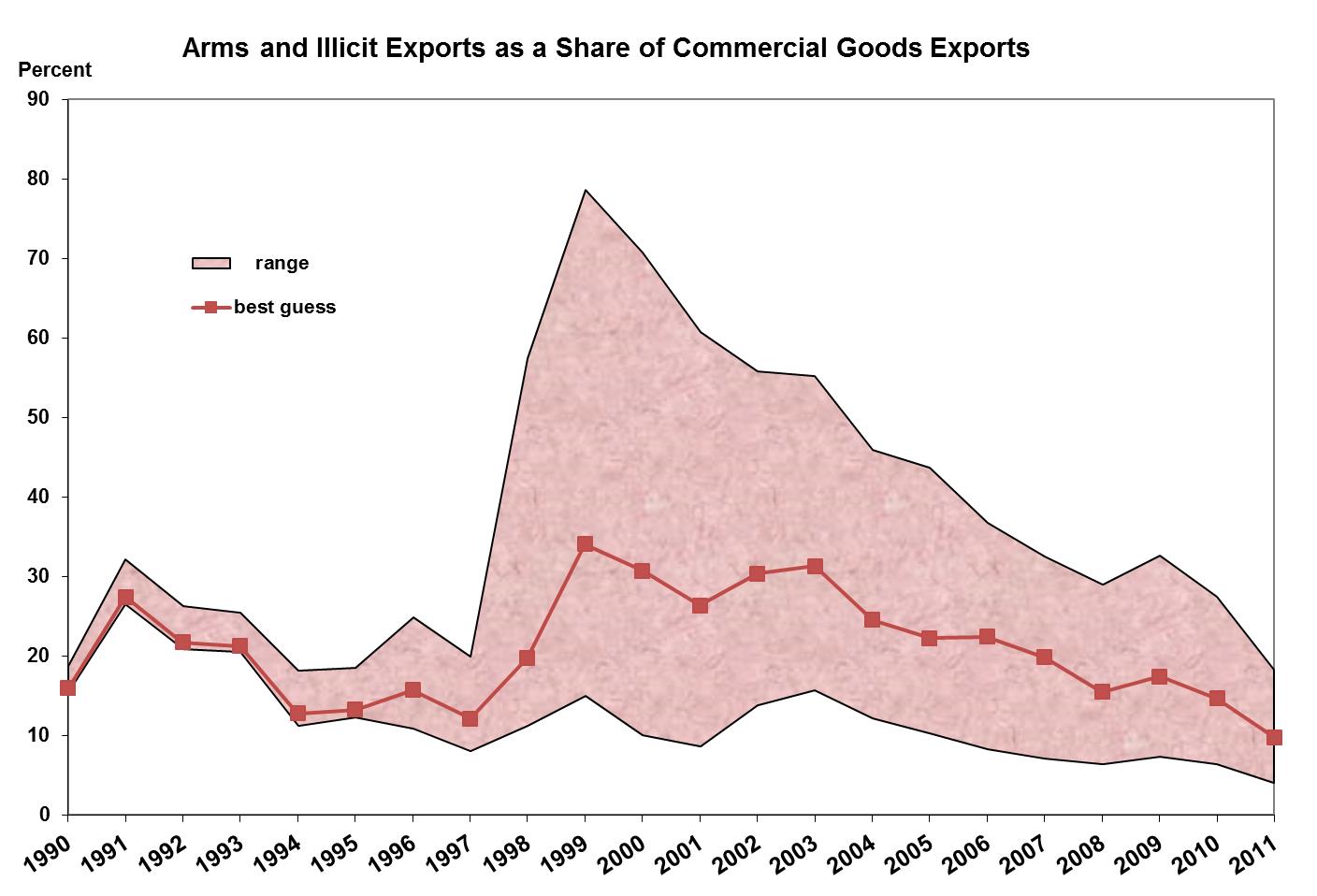
Marcus Noland offers a new estimate of the DPRK’s illicit trade activities:

DPRK-Illicit-Trade-2013

According to Marcus Noland:

The chart above shows our estimates of illicit revenues (inclusive of arms sales) as a share of merchandise exports. These are admittedly highly speculative and as a consequence we include high and low estimates as well as a best guess. As one can see, this share has been drifting down for more than a decade as both legitimate trade has expanded, and intensified interdiction efforts have crimped criminal activities. We estimate that in 2011, the illicit share of exports was in the range of 5-20 percent, with our best guess at roughly 10 percent. During the hearings, one of the witnesses, Professor Sung-yoon Lee, claimed that illicit activities account for up to 40 percent of the country’s trade; that statement was probably true in the past, but on our calculation, probably no longer true—though again, all this is highly speculative and anyone who claims that they know the real answer is, in the words of former Vice President Mondale, “a liar or a fool.”

A related issue is the degree to which central authorities exercise control over these activities. Some activities are almost surely subject to central control; some are probably conducted by state entities but without direction from central authorities (or perhaps without even their specific knowledge); some of these activities may well be conducted by what amount to local criminal gangs (which may include state, military, or party officials as participants); some of these activities may be organized by Chinese or other foreign gangs with the acquiesence of North Korea officials. Several years ago, for instance, when their was a crackdown no intellectual property rights theft in China, some of the counterfeiting activity allegedly moved across the border into North Korea where control was more lax.

The message is not that we should slack off in our attempts to eradicate these activities. Even they account for a declining share of the North Korean economy, they are still objectionable. But by the same token, we should not make the analytical mistake of thinking that shutting down these activities will halt the North Korean nuclear program or bring down the regime. The real message here is that the expansion of legitimate trade in recent years has made North Korea less dependent on criminal activities and less vulnerable to their disruption.

Share

Koryo Tours reports the [probable] end of Arirang performance [but not really]

March 11th, 2013

UPDATE 1 (2013-3-11): Koryo Tours reports that the mass games will take place this year…and it will be “Arirang” themed.  The DPRK had earlier reported that Arirang had been consigned to history.  So it appears that management of the mass games is handled in much the same way as the management of economic policy. Here is what the Koryo Tours email had to say:

Today, Koryo Tours received confirmation of the mass games dates for this year. They are scheduled to run from JULY 22nd to SEPTEMBER 9th. These dates incorporate two of the biggest holidays in the DPRK this year – the 60th anniversary of the end of the Korean War on 27th July (Victory Day) and the 65th anniversary of the founding of the DPRK on September 9th (National Day) .

Despite claims last year that 2012 would be the last ever Arirang-themed performance, it seems that this is not the case and this year the theme will again be Arirang but we expect to see new scenes added in to make it bigger and better than ever before.

ORIGINAL POST (2012-7-11): I have relocated to the DC area and have begun clearing out the backlog of posts and emails. I should be caught up by the end of the week.

This morning, however, I wanted to point out a marketing email sent out by Koryo Tours:

Word from our sources in Pyongyang is that the Arirang Mass Games of 2012 will be the last – so we suggest you sign up now to ensure that you can see this remarkable event while it is still running。

While mass games have been performed since the 1940s in the DPRK the Arirang show is the largest and most impressive they have ever produced. Born in 2002, since 2007 it has been an annual event, but 2012 will be Arirang’s 10th anniversary, and it seems the powers that be have decided to close the curtain. As for the reason, our Korean partners suggest that the narrative needs to change with the times. Combining dance, gymnastics, propaganda, politics, music, and even unicycling, this spectacular performance chronicles the struggles of the Korean people suffering under Japanese occupation, moving into the independent era and building a modern country – basically the period linked to the first 100 years since the birth of North Korea’s Eternal President Kim Il Sung.

However, since 2013 marks the 65th anniversary of the foundation of the republic (Sept 9th) as well as the 60th anniversary of the signing of the armistice that ended the Korean War (July 27th), organisers are reportedly planning a whole new performance for next year – for more news on this, please stay on our mailing list!

So if you haven’t seen Arirang yet, or if you want to see it one last time, this is your chance.

Koryo Tours is also repeating its Ultimate Frisbee Tour and Pyongyang’s first ever DJ set! Email them at [email protected] if you are interested.

You can read the full Koryo Tours newsletter here.


Share

2013 International Narcotics Control Strategy Report

March 7th, 2013

It has been a while since much attention was focused on the DPRK’s capacity to produce narcotics for export, however, the DPRK did get a mention in the US Department of State’s 2013 International Narcotics Control Strategy Report.

Here is what the report had to say (Source here):

Democratic People’s Republic of Korea (DPRK or North Korea)

Drug use may be rising within the Democratic People’s Republic of Korea (DPRK or North Korea), according to reports from DPRK refugees and travelers to North Korea. Chinese and South Korean press reports indicate that a substantial volume of methamphetamine continues to be produced within DPRK territory, mainly for transshipment to China. There are also reports of transactions between DPRK traffickers and large, organized criminal groups along the DPRK-China border, and of Chinese police enforcement targeting drugs entering China from the DPRK by way of enhanced patrols, periodic arrests, and drug seizures. However, the Chinese government rarely identifies the DPRK as the source of illicit drugs.

The proximity and availability of precursor chemicals in China likely contribute to the production of methamphetamine within North Korea. Reliable information is difficult to obtain regarding illicit activities within the DPRK territory, but drug production and other criminal activities, such as the counterfeiting of cigarettes, appear to have continued in 2012. There is insufficient current information, however, to confirm official DPRK state involvement in drug trafficking. There have been no confirmed reports of large-scale drug trafficking involving DPRK state entities since 2004. This suggests that state-sponsored drug trafficking may have ceased or been sharply reduced, or that the DPRK regime has become more adept at concealing state-sponsored trafficking of illicit drugs.

Despite the absence of reports of drug seizures linked directly to DPRK state institutions, the United States cannot entirely rule out the possibility of official DPRK state involvement in the manufacturing and trafficking of illicit drugs. A relatively large investment in precursor chemicals is necessary to produce the volume of methamphetamine trafficked from North Korea, and it is unclear how individual criminals could independently organize such activity within such a tightly-controlled state. It is likely that some official corruption on both sides of the DPRK-China border facilitates drug trafficking.

Share

Competition stressed at collective farms

March 7th, 2013

Institute for Far Eastern Studies (IFES)
2013-3-7

According to Choson Sinbo, the Japan-based pro-North Korean newspaper, on February 22 in Pyongyang, a self-criticism session focusing on socialist competition was held among model collective farms of the “Songun era.” At this meeting, results of agricultural production at these farms were discussed, and the year 2013 was also officially declared as the year for the “December 12 Space Conquest Award.”

The award was created to commemorate the December 2012 launch of the Kwangmyong-3 satellite and to spur production and competition among organizations in various sectors including science and technology and agriculture.

According to an official from the Union of Agricultural Workers of Korea’s Central Committee, this self-criticism session was conducted to negotiate and make overtures to modernize and incorporate science and technology in the agricultural industry.

The main farms competing in the agriculture sector are Samji River Collective Farm (South Hwanghae Province), Migok Collective Farm (North Hwanghae Province), Sinam and Unhung Collective Farms (North Pyongan Province), and Dongbong Collective Farm (South Hamgyong Province). Among these farms, Samji River Collective Farm received awards from the Central Committee of the Workers’ Party of Korea and the Cabinet last year.

The news added, “The competitive self-criticism and evaluation session has provided an understanding that unsuccessful farming cannot be imputed to only poor seed selection or weather conditions. Modernization and reorganization efforts in the farms must be elevated to encourage competition among organizations in order to meet the production goal.”

On the other hand, North Korea has announced a new policy that limits the individual usage of paddy fields (in the mountains) and vegetable gardens from 30 pyong (99 square meters) to 10 pyong (33 square meters), and requires the remaining 20 pyong (66 square meters) of land to be reverted to collective farms. This would seem to go hand in hand with the June 28 economic measures announced in 2012. These recent measures appear to be a state-level effort to improve the production capacities of collective farms by diverting attention from private farming.

Last year, North Korea delivered the new economic management policy measure (June 28 Measures) nationwide to every region and province. On several occasions, North Korea has attempted to enforce similar measures to limit private farming, attributing the poor production of collective farms to private farming. However, faced with backlashes from its residents, food distribution shortages, and the realities of enforcement forced the government to withdraw from such measures.

North Koreans are not allowed to farm on farmland over 30 pyong (99 square meters) in size; however, many are believed to be farming on pieces of land even larger in size. In the farming villages, some people are believed to be farming on 1,500 pyong (4,959 square meters) of land per household, while some are said to be using over 3,000 pyong (9,917 square meters) of land. The grains produced in these farmlands are mostly corns (1 to 1.5 tons) and other crops including beans, cabbages, radishes, sesame, and wheat.

Share

UNSC Resolution 2094: Response to DPRK’s third nuclear test

March 7th, 2013

UPDATE 6 (2013-3-11): Here is the DPRK Ministry of Foreign Affairs response to the UNSC Resolution 2094. As you can imagine, they do not approve.

UPDATE 5 (2013-3-8): The full official resolution can be read here.  Here is the DPRK response to 2094. Here is some information on the Chinese response. Here is some more analysis/commentary from Scott Snyder in The Diplomat. Choson Ilbo reports that large North Korean bank accounts exempt from sanctions.

UPDATE 4 (2013-3-7): The resolution has passed 15-0.  Read more at the BBC, Washington Post, New York Times. Marcus Noland commentary here and here. Victor Cha hereNK Leadership Watch has more on the events in Pyongyang

UPDATE 3 (2013-3-7): Once made public, the resolution will be posted here. Steve Herman (via Adam Cathcart) tweeted a link to the draft resolution which has been uploaded to Scribed. It is dated yesterday (2013-3-6).

UPDATE 2 (2012-3-7): Here is a Press Release from the US mission to the UNSC that went out this morning on the new sanctions (Resolution 2094). Thanks to Aidan Foster-Carter.

For reasons of brevity, I have put the entire document into this PDF for download.

UPDATE 1 (2013-3-7): Yonhap offers details on the unpublished sanctions proposal put forth by the US and China:

The three North Korean arms dealers are: Yon Chong-nam, the chief representative for the Korea Mining Developing Trading Corp (KOMID); Ko Chol-chae, the deputy chief representative for the KOMID; and Mun Chong-chol, an official at Tanchon Central Bank, the resolution showed.

KOMID is described by the resolution as North Korea’s “primary arms dealer and main exporter of goods and equipment related to ballistic missiles and conventional weapons,” while the North Korean bank is the “main DPRK (North Korea) financial entity for sales of conventional arms, ballistic missiles, and goods related to the assembly and manufacturing of such weapons.”

The two North Korean entities are the Second Academy of Natural Sciences, which is responsible for research and development of the North’s advanced weapons systems, including “missiles and probably nuclear weapons,” and the Korea Complex Equipment Import Corp. linked to the North’s “military-related sales,” according to the draft.

The Security Council is set to vote on the draft resolution on Thursday in New York.

The new sanctions will also focus on the DPRKs shipping, air, and “financial” industries:

The Security Council “decides that all states shall inspect all cargo within or transiting through their territory that has originated in the DPRK, or that is destined for the DPRK,” the draft said.

It also “calls upon states to deny permission to any aircraft to take off from, land in or overfly their territory, if they have information that provides reasonable grounds to believe that the aircraft contains items” banned by previous U.N. resolutions, the document said.

It also makes it difficult for North Korea to move in and out “bulk cash,” in an effort to squeeze the North Korean elite’s access to hard currency.

The Security Council also calls on all states to “exercise enhanced vigilance over DPRK diplomatic personnel so as to prevent such individuals from contributing to the DPRK’s nuclear or ballistic missile programs,” it said.

The U.N.’s powerful body “expresses its determination to take further significant measures in the event of a further DPRK launch or nuclear test,” the draft warned.

The DPRK’s Uranium enrichment program also gets a mention:

Apparently mindful of the North’s uranium concerns, the draft resolution includes Pyongyang’s uranium enrichment program for the first time, condemning “all the DPRK’s ongoing nuclear activities, including its “uranium enrichment.”

The North claims its uranium enrichment program is for peaceful energy development, but outside experts believe that it would give the country a new source of fission material to make atomic bombs, in addition to its widely known plutonium-based nuclear weapons program.

The DPRK, has of course, issued a response

In response to the proposed U.N. sanctions and ongoing Seoul-Washington joint military drills, the North’s military threatened to scrap the Korean War cease-fire.

Kim Yong-chol, a hard-line North Korean general suspected of involvement in a series of provocations against the South, read the statement on state TV, saying the North “will completely declare invalid” the Armistice Agreement that ended the 1950-53 Korean War.

The North also said it will cut off a military phone line at the truce village of Panmunjom.

South Korea’s military responded to the North’s bellicose threats with a verbal salvo, warning it would strike back at the North and destroy its “command leadership,” if provoked by Pyongyang.

ORIGINAL POST (2013-3-5): According to the New York Times:

The United Nations Security Council moved closer on Tuesday to expanding sanctions on North Korea for its nuclear and ballistic missile activities. The United States and China introduced a resolution that would target North Korean bankers and overseas cash couriers, tighten inspections of suspect ship and air cargo, and subject the country’s diplomats to invasive scrutiny and increased risk of expulsion.

Passage of the measure, drafted in response to the third North Korean underground nuclear test three weeks ago, seemed all but assured, in part because China — North Korea’s major benefactor — participated in drafting the language. It would be the fourth Security Council sanctions resolution on North Korea, which has defied the previous measures with increasing belligerence. A vote was expected on Thursday.

Infuriated, North Korea vowed to scrap the 1953 armistice that halted the Korean War and threatened to attack the United States with what the North Korean government news agency called an arsenal of diverse “lighter and smaller nukes.”

American officials played down the North Korean warning, which echoed bombastic admonitions that have become part of the standard fare from the North. Still, the threat of a North Korean nuclear attack seemed all the more provocative, coming two days after North Korea conveyed a message of friendship to a visiting American group that included Dennis Rodman, the former basketball star.

Susan E. Rice, the United States ambassador to the United Nations, who introduced the resolution in a closed session of the 15-member Security Council, told reporters afterward that it “builds upon, strengthens and significantly expands the scope of the strong U.N. sanctions already in place.”

For the first time, she said, the resolution would target “the illicit activities of North Korean diplomatic personnel, North Korean banking relationships, illicit transfers of bulk cash and new travel restrictions.” In the past, North Korea has been accused of running extensive counterfeiting and illegal drug enterprises, to raise much-needed hard currency.

Ms. Rice declined to predict whether the North would respond with another nuclear test or other retaliation. “All I can tell you is that the international community is united and very firm in its opposition to North Korea’s illicit nuclear and missile programs,” she said. “And the more provocations that occur, the more isolated and impoverished, sadly, North Korea will become.”

The Americans did not publicly release the resolution text. But a Security Council diplomat familiar with the measure, who spoke on the condition of anonymity because the language may still be subject to revision, said it broke new ground with restrictions and prohibitions on North Korean banking transactions, new travel restrictions and increased monitoring of North Korean ship and air cargo.

The diplomat also said that the resolution added a special lubricant and valve, needed for uranium enrichment, to items that North Korea cannot import.

The resolution would also place greater scrutiny on North Korean diplomatic personnel who are suspected of carrying proscribed goods and cash under the guise of official business, exposing them to possible deportation. “We know there are diplomats out there cooking up deals and moving funds around,” the Security Council diplomat said.

Among the other provisions, the diplomat said the resolution also included new language aimed at enforcement that had been absent from the earlier resolutions. It requires, for example, that if a North Korean cargo vessel crew refuses a host country’s request for inspection, the host is under a legal obligation to deny the vessel port access.

If a cargo plane is suspected of carrying prohibited goods to or from North Korea, the resolution would urge, but not require, that it be denied permission to fly over any other country — a new provision that could affect China, which routinely permits North Korean flights over its territory.

Previous rounds of sanctions have blacklisted trading and financial firms believed to be directly involved with nuclear and missile work. The sanctions have also restricted the importation of luxury goods, an effort directed at the country’s ruling elite.

American officials said privately that the latest resolution did not go as far as they would have liked, reflecting China’s insistence that the punitive measures remain focused on discouraging North Korea’s nuclear and missile behavior and avoid actions that could destabilize the country and lead to an economic collapse.

But the text was stronger than what some North Korean experts had anticipated, particularly the measures that could slow or frustrate the country’s banking activities and extensive dependence on cash payments in its trade with other countries.

“Going after the banking system in a broad brush way is arguably the strongest thing on this list,” said Evans J. R. Revere, a former State Department specialist in East Asian and Pacific affairs, and now senior director at the Albright Stonebridge Group, a Washington-based consulting company. “It does begin to eat into the ability of North Korea to finance many things.”

Mr. Revere attributed North Korea’s reaction on Tuesday to an accumulation of perceived affronts: China’s cooperation in drafting the sanctions, the annual military exercises under way between the United States and South Korea, and a hardened attitude by the South’s newly elected president, Park Geun-hye.

“This is North Korea’s way of saying, ‘We know you guys are doing several things, and here is our response,’ ” Mr. Revere said.

Here is coverage in The Guardian.

Here is coverage in the Washington Post.

Here is coverage of the DPRK’s response in CNN.

Here is my archive post on the DPRK’s third nuclear test.

Here is a statement (in Korean) by the North Korean military.

Read the full story here:
U.N. Resolution to Aim at North Korean Banks and Diplomats
New York Times
Rick Gladstone
2013-3-5

Share