Archive for the ‘Uncategorized’ Category

(Updated) Kumgang/Kaesong update

Thursday, November 13th, 2008

UPDATE: Marcus Noland discussed this subject with the Daily NK.  Joshua has some thoughts at One Free Korea.

ORIGINAL POST: Hyundai Asan (HA) was having a good year up through July 2008.  At that point, inter-Korean trade volume had experienced a 23% year-over-year  increase—reaching US$880 million.   Commercial trade comprised 94% of this volume, up from 78%, and the number of firms conducting inter-Korean trade reached 526, up from 324.

…and then a South Korean tourist was shot by North Korean soldiers at HA’s flagship project, the Kumgang tourist resort.  Shortly after the shooting, the South Korean government halted tourism to Kumgangsan until the DPRK agreed to launch a joint investigation into the shooting and guaranteed the safety of tourists—which never happened.  As a result, the newly constructed six-star “Kumgang Ananti Golf and Spa Resort” desigend by Korean- American architect Min Sung Jin, sits unused, and revenues at HA are likely to fall to as low as 220 billion won (US$165 million), from about 300 billion won last year (Yonhap).

Despite the troubles at Kumgangsan, the joint-Korean projects on the west coast (Kaesong Industrial Zone and Kaesong tourism) remained unaffected.  The Kaesong Industrial Zone, the most ambitious and risky project, has continued to receive support from both the North and South Korean governments, and the Kaesong tours have grossed the North Korean government nearly $10 million since the project was launched in December 2007

Since I operate on the assumption that people will never turn down free money, even communist governments, I have been skeptical that the DPRK would jeopardize these investments.  As of this week, however, it looks like my assumption is wrong.  It seems the DPRK remains intent to cut off its nose to spite its face.  On November 9, 2008:

A North Korean military team visited an inter-Korean industrial complex in Gaeseong, North Korea, last week to check personnel and facilities there.

Local experts speculated that the unprecedented survey is aimed at putting pressure on the South, whose civic groups continue to send propaganda fliers containing criticism of the North’s dictatorship.

Five military officials looked around the industrial park, Moon Moo-hong, chairman of the Kaesong Indutrial District Management Committee (KIDMAC), said.

“They made the rounds of 11 companies in the complex in the morning and asked about the amount of investment, capital, the number of workers, their salaries and working conditions,” he said.

The officials, in military uniforms, asked about how long it would take to empty the complex several times during the six-hour inspection, he added.

They did not show an amicable attitude either, saying they were not visiting to give out business cards and they had nothing to talk about.

A government official asking to remain anonymous said the visit can be read as a threat to drive out South Korean companies from the complex. (Korea Times)

Who was leading the military delegation? Lt. General Kim Yong Chol:

Kim is widely known as Pyongyang’s chief delegate to inter-Korean general-level talks in South Korea, but this time, he assumed the title of policy chief of the National Defense Committee, the most powerful organization in the North. While inspecting infrastructure and companies at the complex, he reportedly asked, “How long would it take for South Korean companies to pack up and go home?” (Donga Ilbo)

Economically, this is a terrible move:

The complex employs 35,000 North Korean workers who earn 55 dollars a month (63 dollars including social insurance), an amount considered extremely high by North Korean standards. Though the communist regime deducts a significant sum from their salaries, workers there are clearly healthier and better fed than their malnourished neighbors. If each of these workers is assumed to be part of a family of four, the complex feeds 140,000 North Koreans. (Donga Ilbo)

Yet yesterday, the implicit threat to close the border was made explicit:

[On] Wednesday, North Korea’s military threatened to “strictly restrict and cut off” all overland passage through the military demarcation line starting Dec. 1 in protest over Seoul’s “confrontational” policy. (Yonhap)

and

A Red Cross office in the North with the only civilian phone link will shut. (BBC)

Hyundai Asan Corp. said that it has yet to receive an official notice from North Korea on the suspension of its tour program to a historic city in the North, despite Pyongyang’s announcement to restrict border crossings. (Yonhap)

So what has made the DPRK so angry that its leaders are willing to take such drastic action?  Judging only from the public statments by the DPRK’s military spokesmen, it seems to be the proliferation of balloons and anti-Kim Jong il leaflets that human rights groups are sending across the DMZ.   

This seems bizarre because balloons have been crossing the DMZ for decades.  The North Korean villages along the DMZ know exactly how to deal with these leaflets and it is fairly routine for work groups to be organized to go pick them up.  Additionally, North Korea’s leaders are smart enough to know that the South Korean government has no legal authority to prevent its citizens from undertaking these activities.  So the DPRK’s ultimate goals here must be greater than stopping human rights groups from sending the balloons.

Ironically, it is the same human rights groups that are sending the balloons across the border who are most vocal about closing down the Kaesong Industrial Zone and ending the Kaesong tourism project. This is because they believe that the revenues generated by these projects are diverted to support the government with little going to the actual workers.  If the North Korean government ends these inter-Korean projects it will be delivering its most vocal opponents a double victory—the DPRK will end up with more balloons and less South Korean money.  If I was in the business of sending balloons across the DMZ, I would be sending out fundraising letters right now telling potential donors how effective my strategy is. 

Anyhow, if all of this was not strange enough, North Korea has slowed dismantling of the Yongbyon reactor (again), claiming the US owes it energy aid, and asserted that they never agreed to a nuclear verification deal which gives inspectors permission to collect samples and remove them from the country for analysAre they just trying to squeeze more concessions out of the Six-Party talks? Or is this a calculated political strategy?

Share

Earthquake off coast of Chongjin

Wednesday, October 22nd, 2008

According to the USGS:

An earthquake with magnitude 4.8 occurred [73 miles east of] Chongjin, North Korea at 16:18:36.15 UTC on Oct 22, 2008. (This event has been reviewed by a seismologist.)

View epicenter of quake on Google Maps here.

More details can be found here.

Share

The Relationship between the Party and the Army under the Military-First Policy

Tuesday, October 21st, 2008

Daily NK
Choi Choel Hee
10/21/2008

With Kim Jong Il’s condition an issue, there has been a lot of talk about North Korea’s government system in the post-Kim Jong Il era.

Due to the strengthened military influence caused by the military-first policy, one prediction is that a military-based collective leadership system may take power after Kim Jong Il.

However, a defector who used to be a high-ranking official in North Korea pointed out that this prediction comes from an incorrect understanding about the relationship between the Party and the military.

Hwang Jang Yop, who is a former Secretary of International Affairs of the Workers’ Party, has said that not military authorities but the Party would likely grasp power after Kim Jong Il’s death.

I. Chosun (North Korea) People’s Army Is the Army of the Party

According to the Regulations of the Workers’ Party, the Chosun People’s Army is defined as “the revolutionary military power of the Workers’ Party.” Separate from the regular chain of command in the Army, Party members are assigned to each unit to command them. That is, there are two command structures: a military chain of command and the Party’s organizational system.

The People’s Army is controlled by the Party Committee of the Chosun People’s Army under the Military Committee of the Central Committee of the Workers’ Party. The chief secretary of the Party Committee of the Chosun People’s Army is Cho Myung Rok, who also holds the position of Director of the General Political Bureau of the Ministry of the People’s Armed Forces. His roles are to inform the Army of the Party’s instructions and regulations and to monitor and supervise the Army to make sure it adheres to the Party’s will and regulations.

At the same time, the highest political apparatus in the military, the General Political Bureau, is under surveillance of the Guidance Department of the Central Committee of the Party. Therefore, a Vice-Director of the Guidance Department of the Central Committee presides over the military while the military command system is always subordinate to the Party command system.

Regarding this relationship between the Party and the military, Hwang Jang Yop, the former Secretary of International Affairs of the Party, gave as an example “the Sixth Corps’ Coup d’état case,” and said that, “The suspected leaders of the coup were shot at once in a hall. The figure who ordered and carried out the massacre of the conspirators was Kim Young Choon, the Vice-Director of the National Defense Commission, but the political manager behind everything was Jang Sung Tae, Director of the Ministry of Administration, one of the departments under the Central Committee of the Party. This implies that there are different management systems overseeing the military — those of the military itself and those of the Party.”

II. The Right of Personnel Management and of Inspection Over the Military

The reason why the Director of the Guidance Department holds such a powerful influence is that the Director has the right to manage personnel and inspect the military.

Even the right to implement personnel management within the Army goes to the Secretariat of the Central Committee of the Party. The members of the Secretariat are the Director of the Ministry of the People’s Armed Forces, the Army Chief of Staff, the Director of the General Political Department, the Director of the Operations Department, and, in some cases, the commander of the Defense Security Command of the Army is included.

The Guidance Department of the Party maintains the right to inspect the Army. The scariest inspections for the military are the ones by the Guidance Department. On a rumor that the Guidance Department is coming, a few military officials are usually purged.

The fact is well known that Kim Jong Il himself also holds power over the military through controlling the Guidance Department.

The posts in charge of the military within the Guidance Department are the No. 13 Life Guidance Department and the No. 4 Cadre Department. Department #13 directly controls and instructs the operations of the Army Committee of the Central Committee of the Party and General Political Department of the Party.

III. Department #13 and Department #4 of the Guidance Department

The roles of these two departments are to monitor how well the Army follows the ideology and the leadership of Kim Jong Il, and whether or not party organizations and political organizations within the Army are operated well by the Party leadership. The Army Committee of the Party and the General Political Bureau doesn’t have the authority to make decisions, so it has to consult with Department #13 before taking action.

The Vice-Director of the Guidance Department is in charge of Department #13. The offices of Department #13 are located in the building of the Ministry of the People’s Armed Forces due to its association with the General Political Department of the People’s Army.

It also oversees the Army Committee of the Central Committee, the General Political Department, and the Army Committee. Department #13 participates in the major military meetings including the ideological struggle meeting. It hosts an annual fifteen-day-long Guidance Department lecture of the Party for military officials.

The No. 4 cadre department has the final say over personnel matters regarding high military officials. Officials whose rank is higher than brigadier general must be approved by the Guidance Department. After the Guidance Department signs off, posts and military title can be granted by the order of the supreme commander of the People’s Army. Therefore, the Guidance Department of the Party holds absolute control over the Army through exercising its right of personnel management of the officials.

Share

Petrov on DPRK-Australian relations

Wednesday, September 24th, 2008

The Nautilus Institute has published an aritcle by Leonid Petrov on 60 years of Australian/DPRK relations.

Topics covered: on again/off agian diplomatic history, Australian foreign policy, bilateral relations, DPRK engagement with Australia, Pong Su (drug smuggling), denuclearization, economic sanctions, DPRK canberra embassy closing.

You may read the article on line here.

You may download a PDF of the article here: petrov-australia-dprk.pdf

Share

Venerable Pomnyun at Johns Hopkins

Tuesday, September 23rd, 2008

UPDATE:Here is V. Pomnyun’s outline: pomnyun.pdf

NKeconWatch notes:
Agriculture: April – June are the lean months.  In July 2008 potatoes helped alleviate food shortage.  Also aid from West. Things began to get worse in August and September.

Earlier this year, the price of rice was up to 5x higher than a year ago.  In June-July it fell to 3x higher.  Now it is creeping back up.

Arduous March: In the 1990s, urban residents of North Hamgyong Province was the worst affected by famine.  Today, the worst affected are the farmers and rural residents of Hwangae (he did not specify north or south).  Shortage as bad as 1st arduous march, but fewer consumers and markets feed cities now.

Markets: protests in Chongjin.  People chanted, “Give us food or let us trade.”  None of the protests are political, just expressions of frustration.

Nukes:Nuclear weapons are a domestic propaganda weapon as well. Not just a matter of foreign policy.

Original Post:
Program details here
Wednesday, September 24
2:00 – 4:00 pm
Rome Auditorium at SAIS
1619 Massachusetts Ave., NW
Washington, DC 20036
RSVP here

The Venerable Pomnyun Sunim, Chairman of Good Friends and The Peace Foundation, will discuss the current political and social climate in North Korea, including the spread of the black market economy and the increase in political control over North Korea’s elite. Joining his discussion, is Dr. Cho Seong-ryoul, Director of the New Security Studies Program at the Institute for National Security Strategy (INSS), who will offer his insights on current and future inter-Korean relations.

Share

A look inside Pyongyang’s Central Market

Tuesday, September 16th, 2008

Jerry Guo, a Yale University economics student who recently traveled to Pyongyang, wrote some interesting articles this week detailing his illicit adventures into Pyongyang’s Central Market (pictures below).


jerryswalk.JPG

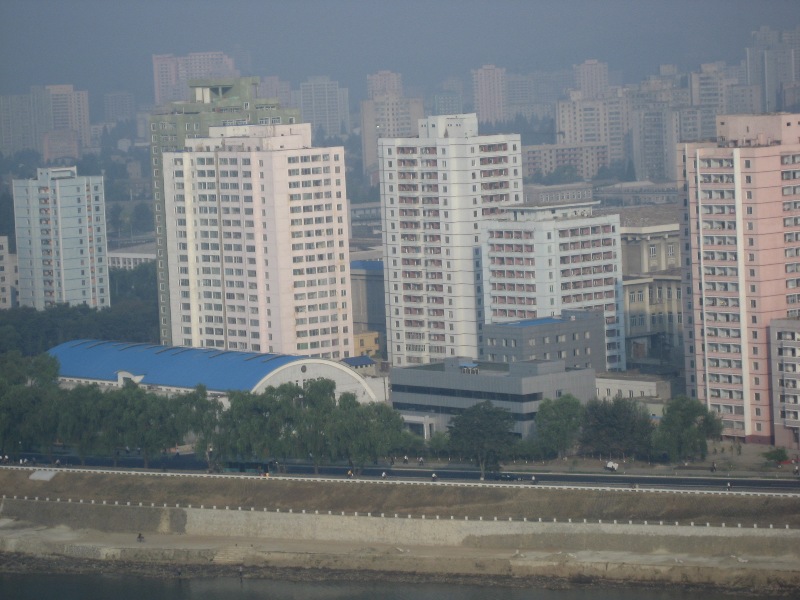
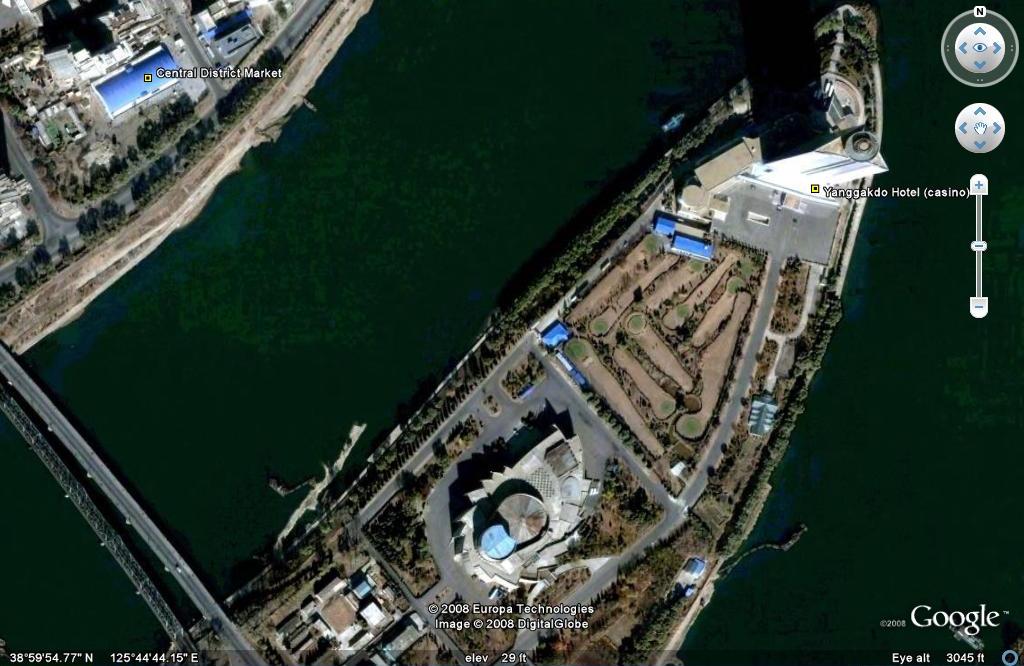
Pyongyang’s Central Market is located along the shore of the Taedong River and is visible from the Yanggakdo Hotel.  Unlike the larger Tongil Market located on the south side of town, the Central Market does not receive tourists or foreign visitors—and given the location, its customers would probably prefer to keep it that way.  So in a sense, an impromptu stroll to the Central Market offers every visitor to the DPRK exactly what they are looking for: a spontaneous glimpse at every-day life in Pyongyang.

According to Guo, that is exactly what he received:

But I wanted to catch a real glimpse of Pyongyang nightlife, so late one afternoon, I sneaked off unsupervised and hit the city streets. And much to my surprise, I didn’t see a single People’s Army cadet goose-step past me with those missile-launchers-on-wheels that appear on the nightly news. What I did witness: a mother buying a soda for her daughter from a sidewalk snack cart; two older women sitting on a bench, gossiping and eating pears; businessmen coming out of the subway, sans Bluetooth headsets; a grimacing teenage boy getting a haircut at a salon. (Washington Post)

Eventually he meandered into the Central District Market:

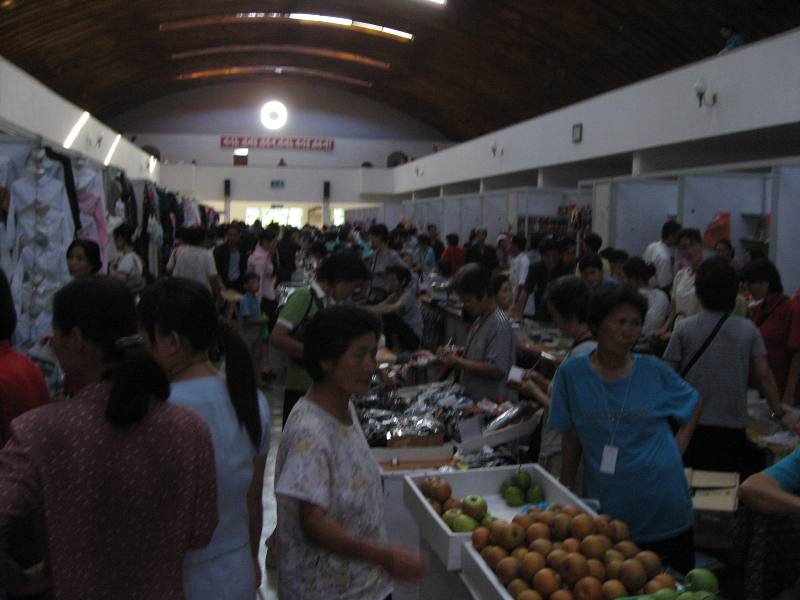
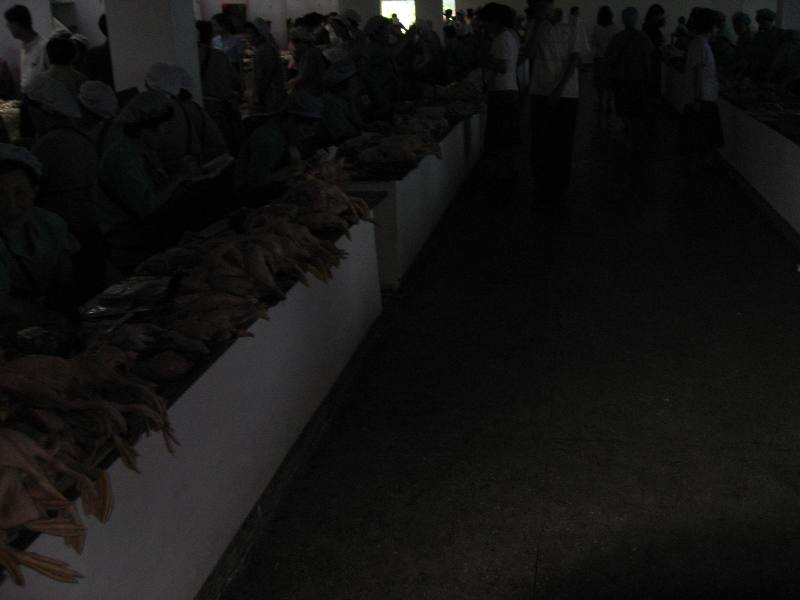
I had found myself in the North Korean version of Macy’s, but here, every day is the Friday after Thanksgiving. There were delicate blouses and dresses for around 15,000 won (roughly $4 at black market exchange rates), all sorts of fruit — thought to be nearly impossible to find in this mountainous hermit kingdom — and enough varieties of mystery meats to make my high school cafeteria green with envy.

…and he took some pictures (These pictures belong to Mr. Guo, and I thank him for letting me post them):

guo1small.JPG guo2small.JPG

Above: Fruits and chickens for sale

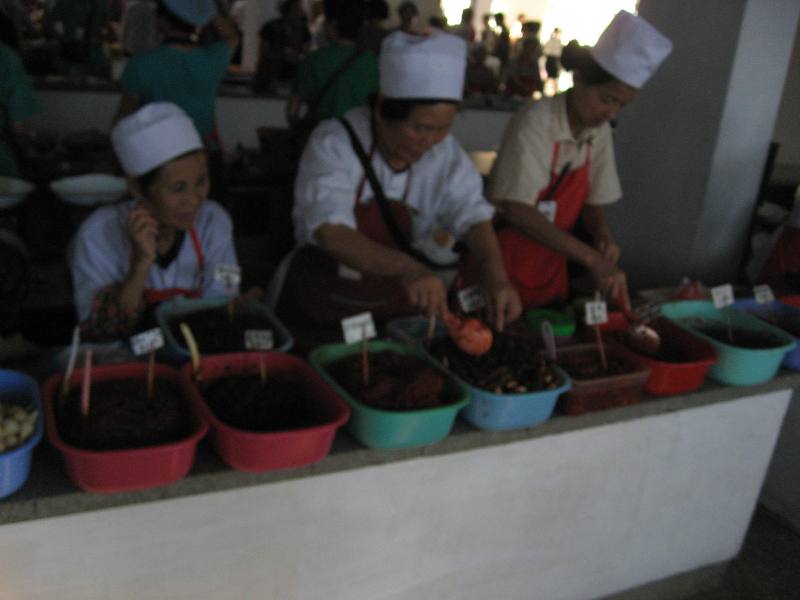
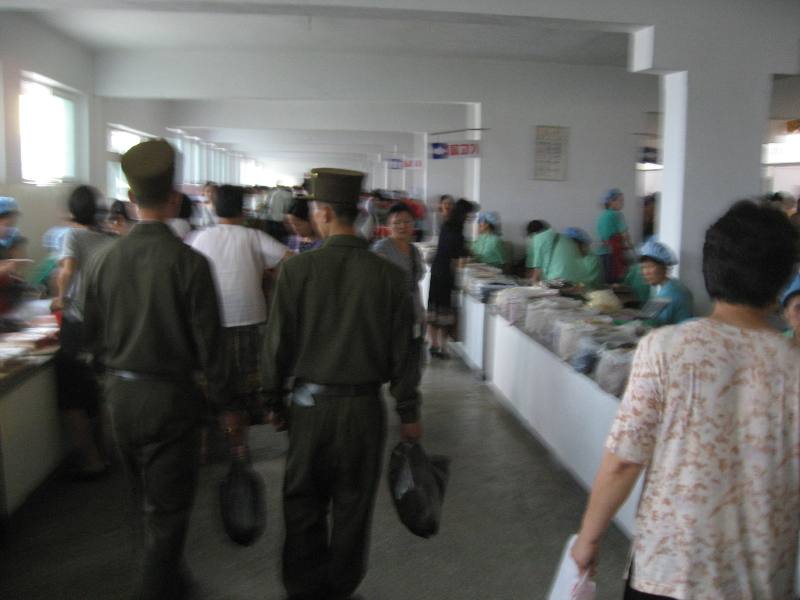
guo3small.JPG guo4small.JPG

Above: Side dishes/Sauces and clothing for sale

guo5small.JPG

Above: View of the Central Market from the Yanggakdo Hotel

Taking these pictures, however, ushered in an unpleasant afternoon:

No one paid much attention to me, until I stopped to snap a few photos. Then a group of stocky women in pink dresses magically appeared. They half-wrestled me to a second-floor office while blowing fiercely on blue whistles, as if to announce, “Look at me! My first American spy!” For the next six hours, I was questioned and scrutinized by a procession of Public Safety Bureau officers, their rank identifiable by the quality of their outfits: the first wore an undershirt, the last what seemed to be a custom Italian suit.[…]

Eventually, they forced me to write a hyperbolic but harmless self-criticism, describing myself as “an American student,” “an incompetent trouble-maker” and “a genuine lover of the Korean people.” Then they booted me back to my five-star hotel.

Mr. Guo’s adventures have been chronicled in the following publications and they are well worth checking out:

My Excellent North Korean Adventure
Washington Post
Jerry Guo
9/14/2008; Page B02

A writer journeys into North Korea with Chinese tourists
Christian Science Monitor
Jerry Guo
9/16/2008

Yale Senior Enjoys Uncensored Day in N. Korea
National Public Radio
9/15/2008

And a caveat for future visitors: Although I personally appreciate knowing this type of information about the DPRK, I do not recommend other tourists take this course of action for numerous reasons!

Share

Tickle, hammer and caligraphy brush

Sunday, September 14th, 2008

UPDATE:  Thanks to Mr. Kuslan for the additions in the comment section!

ORIGINAL POST: Humor was an important coping mechanism for people living in communist societies. Sadly, the expression of some humor could be interpreted as subversive behavior and land the joke-teller in serious trouble. 

This reality still exists for people in a number of current and former socialist republics, so they adopt practices that mitigate the risk of telling jokes.  For instance, in Turkmenistan people tell jokes about “Stalin” but implicitly understand they are (were) about Turkmenbashi.  

Last year, I received a copy of the documentary Tickle and Hammer, which is a collection of Soviet-era jokes. What a treasure. ( You can buy the book version hereHere is an interview with the project director. )  After seeing this film, I wondered how many of these jokes were popular in the DPRK. Well, this week Radio Free Asia reports on some North Korean jokes collected from defectors now living in the South:

Happy days
An Englishman, a Frenchman, and a North Korean are having a chat. The Englishman says: “I feel happiest when I’m at home, my wool pants on, sitting in front of the fireplace.”

The Frenchman, a ladies’ man, says: “You English people are so conventional. I feel happiest when I go to a Mediterranean beach with a beautiful blond-haired woman, and we do what we’ve got to do on the way back.”

The North Korean man says: “In the middle of the night, the secret police knock on the door, shouting: Kang Sung-Mee, you’re under arrest! And I say, Kang Sung-Mee doesn’t live here, but right next door! That’s when we’re happiest!”

Long Live Kim Jong Il!
Chang Man Yong works on a collective farm in North Korea. He goes fishing, gets lucky, and brings a fish home. Happy about his catch, he tells his wife: “Look what I’ve got. Shall we eat fried fish today?”
The wife says: “We’ve got no cooking oil!”
“Shall we stew it, then?”
“We’ve got no pot!”
“Shall we grill it?”
“We’ve got no firewood!”
Chang Man Yong gets angry, goes back to the river, and throws the fish back into the water. The fish, happy to have had such a narrow escape, sticks its head out of the water and cheerfully yells: “Long live General Kim Jong Il!”

Move over, comrade!
Two men are talking on a Pyongyang subway train:
“How are you, comrade?”
“Fine, how are you doing?”
“Comrade, by any chance, do you work for the Central Committee of the Workers’ Party?”
“No, I don’t.”
“Have you worked for the Central Committee before?”
“No, I haven’t.”
“Then, are any of your family members working for the Central Committee?”
“Nope.”
“Then, get away from me! You’re standing on my foot!”

Bear hug
Kim Jong Il and Vladimir Putin are having a summit meeting in Moscow. During a break, they’re bored, and they decide to take a bet to see whose bodyguards are more loyal.

Putin is on the 20th floor and calls on his bodyguard Ivan, opens the window, and says: “Ivan, jump!”

Sobbing, Ivan says: “Mr. President, how can you ask me to do that? I have a wife and child waiting for me at home…”

Putin sheds a tear himself, apologizes to Ivan, and sends him away.

Next, it’s Kim Jong Il’s turn. He calls his bodyguard Lee Myung Man and yells: “Lee Myung Man, jump!” Not hesitating for a split second, Lee Myung Man is just about to jump out the window. Putin hugs Lee Myung Man to prevent him from jumping and says: “Are you out of your mind? If you jump out this window, you’ll die! This is the 20th floor!” Nevertheless, Lee Myung Man is still struggling, trying to escape Putin’s embrace and jump out the window: “President Putin, please let me go! I have a wife and child at home!”

Out of the mouths…
At High School No. 1 in Pyongyang, a girl brags to her teacher about the cat she’s got at home: “Our cat has just given birth to seven kittens. All of them just stick close to their mother, they feel really comfortable, and sleep all the time. They’re all true communists.”

A few days later, the teacher asks the girl: “Are the communist kittens at home growing up nicely?”

The girl says: “Comrade teacher, big trouble! They’ve all opened their eyes, and they’ve all renounced communism!”

Looking at the sun and saying it is the moon
Child: “Mom, I’m hungry. I want rice.”
Mother: “I’m sorry, child. There’s no rice left.”
Child: “No rice! Why is there no rice? Our kindergarten teacher told us that if General Kim Jong Il points his finger to sand, it turns into rice. So, why is there no rice in our house?”
Mother: “Well, that’s a lie. No, what I actually meant to say was that’s a matter of deeply rooted belief.”
Child: “Mom, what’s deeply rooted belief?”
Mother: “Well, it’s a lie you’re supposed to believe.”

Another country
A woman living in North Hamgyong province comes back home after a hard day at the open market. While she was working hard, the husband spent the whole day at home, daydreaming. As soon as she returns home, they start talking, and the husband says: “Sweetheart, I’d love to go to some place I’ve never seen before, and do something I’ve never done before…”

The wife retorts: “That’s a great idea. Go to the kitchen and wash the dishes!”

Black cats, white cats, large mice
Chinese, Russian, Japanese, American, and North Korean police officers gather and decide to assess their investigative capacity. Under the watchful eye of their supervisors, each team gets a mouse, then lets it loose, and the mouse runs up a big mountain. The winning team is the one that manages to catch and bring back the mouse in the shortest time.

The Chinese police employ human wave tactics, combing every square inch on the mountain in their thousands.

They capture and return the mouse after only one day’s search.

The Japanese policemen use a smell detector, and after only half a day, they detect the mouse hole, search it, catch the mouse and bring it back.

The Russian cops send a robot equipped with a heat-seeking device up the mountain. The robot locates all the mammals on the mountain and after only three hours the Russians capture and bring back the mouse.

The only ones left now are the American and North Korean police officers. The Americans use a satellite signal device to locate the mouse, and then send in a mechanical gadget that looks like a snake gliding up the mountain.

The gadget gets into the mouse hole, catches the mouse and brings it back after only one hour.

The North Koreans are last. Although the supervisors are watching, none of them makes a move, there is no brainstorming, and no one comes up with a plan of action, nothing at all. After only about 10 minutes, a few North Korean police officers show up dragging a dog before the supervisors, saying they’ve found the mouse.

All the supervisors are puzzled: “What are you doing? It is not a dog you were supposed to catch! Weren’t you supposed to catch a mouse?” Instead of answering, the North Korean cops drag the dog through the dirt and repeatedly kick it in the ribs. The sobbing dog suddenly starts to talk: “Stop, stop, please stop! Yes, I confess, I’m a mouse! I’m a mouse, please concede that I’m a mouse, or else they’re going to kill me!”

Food for thought
Professor: “Comrade students, how many economic-political systems are there in the world?”

Student: “There are three such systems: The capitalist economic-political system, the North Korean socialist economic system, and the Chinese eclectic system.”

Professor: “Then, among these three systems, which one is the greatest?”

Student: “Well, it might be rather difficult to answer that question.”

Professor: “What kind of an answer is that? There is only one clear answer! Our style of socialist economic-political system is the greatest, as this is the system that’s destined to conquer the entire world and spur eternal economic development!”

Student: “Professor, that is great, indeed… But if our system takes over the world and all of the other countries and economic-political systems, then whom are we going to ask for food aid?”

Black and white
A member of the Chinese Communist Party goes to study in North Korea, where he gets to learn about juche, the official state ideology of North Korea and the political system based on it.

The Chinese Communist Party member wishes to let his friends back home know what life in North Korea is like.

However, he knows for sure that all the letters he sends are opened by the North Korean authorities, so he thinks of a way to bypass censorship.

The Chinese decides to write words meaning precisely what they say in blue ink, words conveying neutral meaning in black ink, and words intended to convey the very opposite meaning in green ink.

After a while, his friends back home in China receive a letter from North Korea. The letter was written entirely in black ink, meant for words carrying neutral meaning.

The conclusion they draw is that North Korea is not as good as the North Korean authorities’ propaganda says it is, and it is not as bad as the critics of the North Korean regime say it is. However, at the bottom of the letter, they come across a note from their friend: “My friends, I apologize. Green ink is unavailable here….”

The Workers’ Paradise
At an art museum in Europe, an Englishman, a Frenchman, and a North Korean stand before a painting of Adam and Eve holding an apple in the Garden of Eden.

The Englishman says: “The man has something tasty to eat and is eager to share it with the woman. Based on that, I would conclude that they’re rather obviously English…”

The Frenchman says: “I disagree. They’re walking around entirely naked, so they must be French…”

The North Korean says: “There is no doubt in my mind that they’re North Korean. They have no clothes to wear, barely anything to eat, and they still think they’re in heaven!” (Radio Free Asia)

If any readers from former/current socialist countries know any jokes they can contribute (especially jokes from the DPRK), please add them in the comments section. 

Share

Marcus Noland to speak at Sejong Society tonight

Thursday, September 11th, 2008

Unfortunately I will be in class this evening, but if you live in the DC area and wish to learn more about North Korea issues, I recommend you make the effort to attend.  Details below:

The Sejong Society of Washington, D.C. Event
North Korea Opens
Thursday, September 11, 2008
6:45 – 8:00 pm
 
Location:
Kenney Auditorium
Nitze Building, Johns Hopkins SAIS
1740 Massachussetts Ave., NW
Washington, DC
(Closest Metro: Dupont Circle)
Please RSVP here

The Sejong Society is pleased to host a talk by Marcus Noland, Senior Fellow with the Peterson Institute for International Economics.  Dr. Noland will speak on the events and policies that have contributed to a largely unplanned and unintended process of marketization of the North Korean economy.

Reckless policies, international provocations, bad weather, and global economic trends have once again brought the DPRK to the precipice of disaster, and the outcome will be conditioned on the country’s external relations.  Specific initiatives could emerge from the Six Party Talks, but not all forms of engagement are equally desirable.  Dr. Noland will highlight ways in which the nuclear and aid deals are linked and how greater external security could ultimately encourage greater reform.

This event is free of charge and refreshments will be served. Please RSVP here.

Share

The strange saga taekwondo and politics

Monday, September 8th, 2008

When I was much younger, I began martial arts training in taekwondo (TKD) and Brazilian jiu jitsu (BJJ).  Eventually I gave up taekwondo for kickboxing, and eventually just decided to specialize in BJJ. 

Although I was part of the International Taekwondo Federation (ITF), I really had no idea about its origins, or its part in the history and development of taekwondo.  So today I was surprised to read about the history of this organization and its relationship to the DPRK and even an assassination attempt on South Korean President Chun Doo hwan!

The beginning…

The ITF was founded in 1955 by General Choi Hong-hi, who is considered by the group to be the father of TKD.  Choi moved to Canada (from South Korea) in 1972, complaining that the Park government, among other things, allegedly forbade him from teaching TDK in the DPRK.  Shortly after he left, the South Korean government formed the World Taekwondo Federation (now recognized by the IOC).   

Choi’s final years were marked by his efforts to return to North Korea. He introduced taekwondo there in 1980, and won further favour with the government by changing the name of one solo practice form from kodang (after a North Korean democratic Christian moderate, presumed slain by the Red Army in 1946) to juche (after the isolationist policy of “self-reliance” advocated by North Korean leader Kim Il-Sung). Though Choi’s intention had been reconciliatory, unfortunately South Korea saw it as treasonous. (Guardian)

General Choi died and was buried in Pyongyang in 2002.  His death gave the DPRK the opportunity to name its IOC member, Jang Ung, as ITF leader, prompting Choi’s son, Choi Jung hwa, to resign as secretary-general and move back to Canada to set up a separate governing body there.  The ITF leadership is now claimed by three groups in the DPRK, Austria, and Canada who each purport to be successors to General Choi.

Choi Jr…

It seems that Choi Jr. moved to North Korea (from Canada) in 1981 after Canadian police discovered his role in plotting the assassination of then South Korean President Chun Doo-hwan, who was scheduled to visit Canada the following year.

In 1991, however, he surrendered to Canadian authorities and was sentenced to six years in prison, but was released after one year for good behavior. (AP)

“I was unintentionally involved” in the assassination attempt case, Choi told a news conference Monday. “I think that’s because of my political naivety or spirit of adventure. I made such a mistake due to this combination of factors.” (AP)

Now Choi Jr., after 34 years, has returned to South Korea to undergo questioning about the incident. Choi Jr. maintans that North Korea infiltrated the ITF, using it as a front to send out spies and plot the killing of a South Korean president who ruled for much of the 1980s:

“After taking control of the ITF, the North trained spies and sent them overseas, disguising them as taekwondo masters,” (Reuters)

Choi Jung-hwa, however, was expected to be cleared of most of the allegations against him because he voluntarily returned and the statue of limitations on many of them have expired.(AP)

Share

DPRK 2008 Olympics round-up

Monday, August 25th, 2008

Well the Olympics have wrapped up, and the DPRK made headlines for several notable reasons:

1.  The Chinese government made things harder for the North Koreans living in China

2. Two DPRK athletes test positive for doping.  This results in Kim Jong Su being stripped of his silver and bronze medals in shooting.

3.  If these medals had not been taken away, the DPRK would have seen their most succesful Olympic showing ever.  Still, their medal count has been relatively impressive: 2 golds, 1 silver, and 3 bronze.  Mostly in weightlifting and Judo.

4.  Despite these results, the victories are not being touted back in Pyongyang.  According to Bloomberg:

At home, few Olympic events are shown live on television and press reports barely mention the reclusive nation’s haul of seven six medals, including two golds — the second-best in history.

Delivering news of a first gold medal since 1996, the national news agency, KCNA, carried a three-sentence report listing the weights that Pak Hyon Suk lifted for the title.

“She thus came first in the 63kg category final competition,” the story concluded.

Hardly the splurge of propaganda that might be expected in a state that misses few chances of self-promotion to a population experiencing its worst food shortages in a decade. The lack of Olympic hype is a deliberate exercise in keeping people from looking beyond their borders, said Mike Breen, author of “Kim Jong Il: North Korea’s Dear Leader.”

5.  North Korea’s Olympic sponsors made the news.  Turns out the DPRK’s athletes need to learn to thank their sponsors on camera, not “you know who:”

“When I was about to do the third (lift), I kept in my mind that the Dear Leader would be watching,” Pak said after her Aug. 12 win. “That thought was real encouragement to me and that is how I was able to lift the last weight.”

She stopped short of emulating Cha Kum Chol’s celebration at the world weightlifting championships in Thailand in September. Then, the 56-kilogram winner burst into a rendition of “If you didn’t exist, we wouldn’t exist” — a eulogy to Kim Jong Il — at a news conference.

“A lot of people give much pleasure to the Dear Leader and I’m happy to be one of them,” Cha said in Chiang Mai. (Bloomberg)

6. The DPRK’s Olympic athletes spent most of the time confined to the Olympic Village. According to a reporter with the Oregonian:

There are 63 athletes from the Democratic People’s Republic of Korea staying in a private compound inside the Olympic Village.

Literally.

Staying.

Inside.

The athletes get to go outside when they practice, or when they compete in the 11 sports they’ve come here to win medals in. But that’s about it. And I know this because I went to the Water Cube on Tuesday and talked with North Korean synchronized swimmers Kim Yong Mi and Wang Ok Gyong.

Well, I talked with an interpreter who spoke English and Mandarin. And he talked with a second interpreter who spoke Mandarin and Korean. And the five of us huddled at one end of the swim complex, against a steel rail that blocked off the back door, understanding each other, one clumsy sentence at a time.

Kim and Wang finished 15th in the preliminaries and didn’t qualify for today’s finals, which means they’ll probably be back in communist North Korea by the time you read this. There will be no trip to the Great Wall. No shopping excursion to the Silk Market. There will be no tours, or temples, or taking the subway.

The Forbidden City?

Forbidden.

Said Wang: “We’re not allowed to see places of interest.”

North Korean athletes are not allowed to mingle with athletes from other nations inside the village. And they refused to talk with reporters after their performance on Tuesday until their coach — a woman named Jong Ae Ryu — gave her blessing. It’s protocol, and the whole contingent hurried off after a few minutes and polite explanation that they didn’t come to Beijing to be tourists or make friends.

“No mixing with others,” Jong said.

Read more here:
North Korea Heads for Best Olympics; Don’t Say It in Pyongyang
Bloomberg
Grant Clark and Heejin Koo
8/21/2008

A lonely Olympics experience
The Oregonian
John Canzano
8/19/1008

Share