I am returning to graduate school to upgrade my MA in economics to a PhD. Since this is my last week at work, time is tight. I am already behind in posting and will not be able to pick up the slack until next week (August 25th).

I am returning to graduate school to upgrade my MA in economics to a PhD. Since this is my last week at work, time is tight. I am already behind in posting and will not be able to pick up the slack until next week (August 25th).
I had never heard of fellow American Zang Gi Hong, the first US citizen naturalized from the DPRK, until a few days ago when a colleague relayed his story to me. I have been unable to find much information on him via the Internet, except from one article (here) and the Google archive version (here).
Excerpts from the article:
It was Vienna, Austria, in late December of 1956. Two months earlier, heroic Hungarians next door to the east had erupted against their Soviet oppressors, and for ten glorious days Hungary was in Hungarian hands.
The Kremlin feared that one satellite turned into a shooting star could infect and unravel their whole communist empire. The Red Army rolled back into Hungary with 200,000 troops and 2,000 tanks and flattened the uprising. Hordes of Hungarians fled west to freedom in Austria.
…
After two years at the University of Budapest this young “enemy” soldier began to view communism not as a submissive North Korean but more as a repressed Western European. When the fighting started, he and 200 other North Koreans helped the Freedom Fighters.
Hungarian youths had not yet had military training. The North Koreans knew how to work every piece of captured and donated communist ordnance, from a hand grenade to a tank!
After the Soviet putdown of the uprising, special squads of Soviet troops helped the Hungarian communist police round up every Korean in Budapest. It’s hard to disguise a Korean in Budapest. Of the 200 young Koreans, only four made it to freedom. The others were shipped back to certain doom in North Korea.
When he and I and a young Hungarian woman interpreter went to the American Embassy the next day, I would have bet even money that President Eisenhower would send the Columbine (His presidential plane, before they thought of Air Force One) over to Vienna to take him and me both back to America. I was stomp-down certain they’d find a quick way to let him into America.
We were led into an upstairs office at the Embassy and I started telling the story to the official behind the desk. Do you know how a comic feels when the laughter doesn’t come through early in the act? Or when the young woman arranges for her hand to be unholdable when you reach out? That’s the feeling I got early in the narrative.
The Embassy official looked on like a zombie. No comments. No questions. If there’d been a little strip-screen across his forehead, it would have read “Non-Reacting!”
Even absent the euphoria of the Hungarian Revolution, as you read this I expect you to feel what I felt. When I finished this incredibly fortunate story for our side, the diplomat-zombie impassively opened his desk drawer and pulled forth a little booklet.
“Your friend can’t come to America as a Hungarian refugee,” he intoned, leafing to a page of rules, “because he’s not Hungarian. And he can’t come in as a North Korean because we’re at war and there’s no quota!”
At least the 200,000 Hungarian refugees in Vienna would be processed and admitted to a free country. My Korean friend was now diplomatically stateless and weightless.
Thanks to the subsequent intervention of broadcaster Tex McCrary and the supposedly villainous immigrant-hating Congressman Francis E. Walter of Pennsylvania, we got that young man into America with a scholarship to Syracuse from which he graduated with honors and became a millionaire architect and builder.
Sejong Society Event Details:
Perspectives on North Korea’s Financial System
Wednesday, June 25, 2008
6:45 – 8:00 pm
Location:
Johns Hopkins University SAIS
Kenney Auditorium (ground floor)
1740 Massachusetts Ave., NW
Washington, DC 20036
(Closest Metro: Dupont Circle)
Bradley O. Babson is a consultant on Asian affairs with a concentration on North Korea and Northeast Asia economic cooperation. He presently is consultant for the Stanley Foundation Project on Future Multilateral Economic Engagement with the DPRK and chair of the DPRK Economic Forum at the John’s Hopkins School for Advanced International Studies. He worked for the World Bank for 26 years before retiring in 2000, serving as a Senior Loan Officer on Indonesia from 1983-87, Division Chief for Education and Health for eight Asian countries from 1997-92, Regional Representative in Bangkok, Thailand from 1993-94, and the first Resident Representative to Hanoi, Vietnam from 1994-97. From 1997-2000 he served as Senior Advisor in the office of the Regional Vice President for East Asia and the Pacific where he began his studies of the North Korean economy.
He has participated in projects on North Korea sponsored by the Center for Strategic International Studies, U.S. Institute for Peace, National Bureau for Asian Research, and the Stanley Foundation. He serves on the Advisory Council of the Korea Economic Institute of America and Executive Committee of the National Committee on North Korea, and is Vice President of the World Affairs Council of Maine. Mr. Babson received his BA degree from Williams College in 1972, and MPA degree from the Woodrow Wilson School of International and Public Affairs at Princeton University in 1974. He lives in Brunswick, Maine.
This Sejong Society event is free and will begin at 6:45 pm, and light Korean food will be served. Please RSVP here.
North Korean Economy Watch would like to welcome our first reader from Turkmenistan today! If you are interested in visiting Turkmensitan, talk to Koryo Tours.
In case you are wondering, this web site is frequently accessed from Chinese cities along the North Korean border, but we have yet to get a hit from inside North Korea.
Anyone who has spent time visiting North Korea on Google Earth will have noticed the acute shortage of trees. I am not alone in this observation. Dr. Lankov recently reported that South Korean tourists to Kaesong also sense this.
Donating trees to the North might sound like a particularly harmless form of aid–all the symbolism of inter-Korean cooperation without the messy politics of monitoring food aid or investment. But the reality is far more pragmatic:
[H]elping North Korea to plant more trees is one of President Lee’s campaign pledges.
He said the South will send seedlings to the North but no details were given as to whether or when the two Koreas will meet for the forestry project.
The spokesman said when the Kyoto Protocol takes effect, the South can buy the right to emit CO2 from North Korea.(Korea Times)
The South Korean government is not alone in hoping to make money off increasing North Korea’s stock of trees. Singaporean entrepreneur Richard Savage started a tree farm in the DPRK back in 2002:
Richard Savage kneels in the rich brown earth of a field on the outskirts of Pyongyang and reverentially spreads out the broad, green leaf of a young paulownia tree. The saplings have been in the ground for only a month but already they are a meter high; the first harvest could take place in just five years. Eyes shaded by his black cowboy hat, the Singaporean native gazes down the rows of juvenile trees, each worth thousands of dollars at maturity, with a satisfied grin. The experimental lumber crop has survived the harsh North Korean winter and is flourishing in the loamy soil. “The paulownia loves this,” he says. Glancing at another leafy plant, a new hybrid, he confides, “We’re going to let the Dear Leader name it.” (Time)
UPDATE 2002 (Via Werner Koidl):
The IHT wrote on Oct. 27th, 2006:
“Richard Savage, executive director of Maxgro, a company based in Singapore, is probably one of the most ambitious foreigners in North Korea. He is developing a hardwood plantation on 1,500 hectares, or 3,700 acres, manufactures Snow Pine cigarettes for the local market and is building an eight-story financial center in Pyongyang in a joint venture with the government and other investors.”
Even the North Korean government, though, has noticed that the forests are not as dense as they used to be. Bradley Martin reported in Bloomberg that Kim Jong il has been pushing a reforestation program for some time:
North Korea’s deforestation program dates back to a 1961 speech by Kim Il Sung. In a mostly mountainous country, he proclaimed, “it is necessary to obtain more land through the remaking of nature.” Not only tidelands but “hills throughout the country and plateaus” should be “brought under the plough,” he said.
“The hills and mountains still had trees, and I never heard of floods,” said Hiroko Saito, a Japanese woman who moved with her Korean husband to North Korea in 1961. Her husband joined one of Kim’s vast mountain work teams in the early 1970s, said Saito, now 66 and back in Japan.
…
Following Kim’s death in 1994 — just before a flood-linked famine gripped the nation — his son and successor Kim Jong Il continued the sacrifice of forest cover until 2000, when he began encouraging reforestation. But the shift hasn’t reversed the damage, and some analysts warn that another famine, close to the scale of the 1990s disaster that may have killed millions of people, might occur as soon as next year.
The government’s agricultural policies launched a cycle of events that lead to greater and greater numbers of trees being culled. Clearing the forests contributed to seasonal flooding. The floods exacerbated the food shortage, and pushed people to adopt coping mechanisms to meet their minimum caloric intake for survival. These coping mechanisms take a toll on what remains of the forests–which exacerbates the flooding. Repeat annually. This cycle of destruction has seemingly frustrated Mr. Kim’s plans to bring back the forests:
“For the past few years, I have been telling you to work hard afforestation and have encouraged you at every opportunity.”
“However, an forestation has not met the criteria of authorities and is not going according to plan.”
What Kim Jong Il is trying to say is that, “The reason afforestation is not working is because of the people’s reckless slash-and-burn cultivation, as well as the inefficiency of officers unable to block it.”
After the food crisis in ’95, people uprooted vines and trees to suffice their underfed diets, as well as cultivating illegal farms for food. Further, to save themselves from freezing to death, people used trees as firewood.(Daily NK)
Spontaneous coping mechanisms aside, efforts at increasing forrest cover might prove more difficult than the government expects. Even if it resolves the food shortage (which does not seem likely in the near term), it has seemingly lost control of its technocrats who have no problem selling DPRK lumber overseas:
…Oh Moon-hyuk, branch manager of the Ruengra 888 trading company in Yunsa, North Hamkyung Province, was executed after being implicated in the smuggling of timber. The trading company was responsible for the export of timber, and operates under the control of the Party’s accounting bureau. The inside contact stated that because of this incident, North Korean authorities carried out further inspections, leading in October of last year to the dismissal of one official receiving vice-minister pay, and the broadening of the inspections nationwide. (Institute for Far Eastern Studies)
The full articles can be found here:
S. Korea to Help N. Korea Plant More Trees
Korea Times
Kim Yon-se
3/5/2008
Kims’ Clear-Cutting of Korean Forests Risks Triggering Famine
Bloomberg
Bradley Martin
Hideko Takayama
11/21/2007
Cause of Barren Mountains: Imperialism-Natural Disaster-Officers
Daily NK
Han Young Jin
3/16/2007
Institute for Far Eastern Studies (IFES)
NK Bfrief No. 08-2-5-2
2/5/2008
Light from the North?
Time
Donald MacIntyre
8/11/2002
When looking at North Korea’s cities on Google Earth one can’t help but notice the number of monuments to the Great Leader. But if you are looking for the true heart of the cities, in other words where all the people are, you need to look closely for North Korea’s markets. They do have them–in all of the major cities visible on Google Earth:
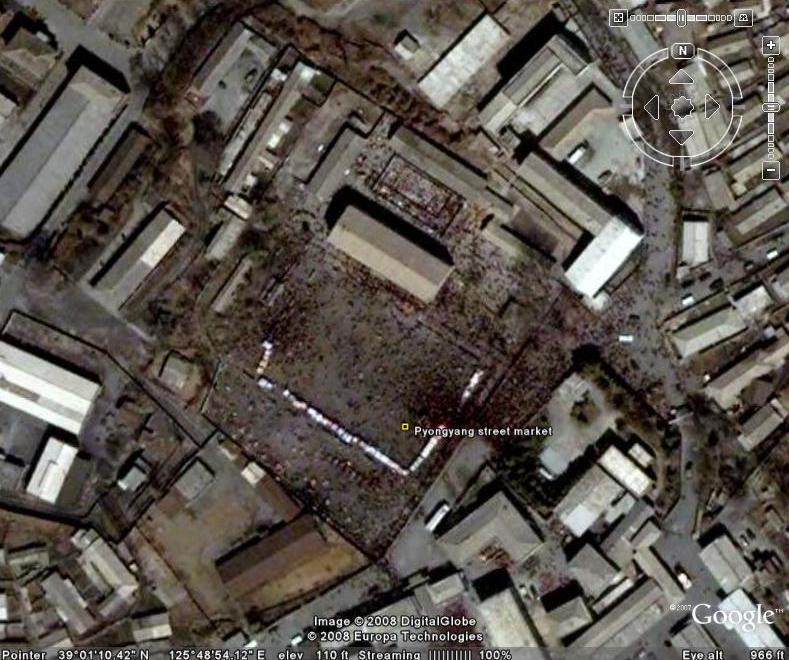
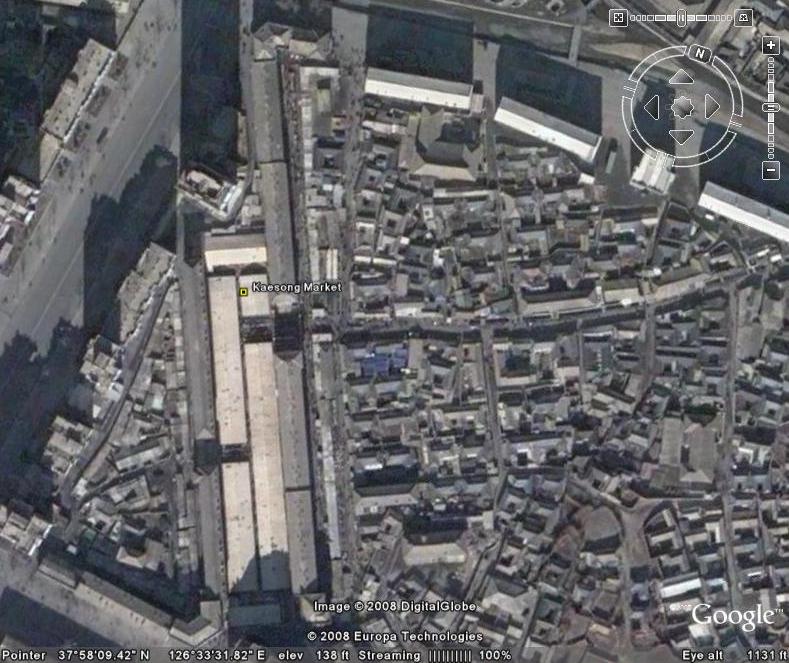
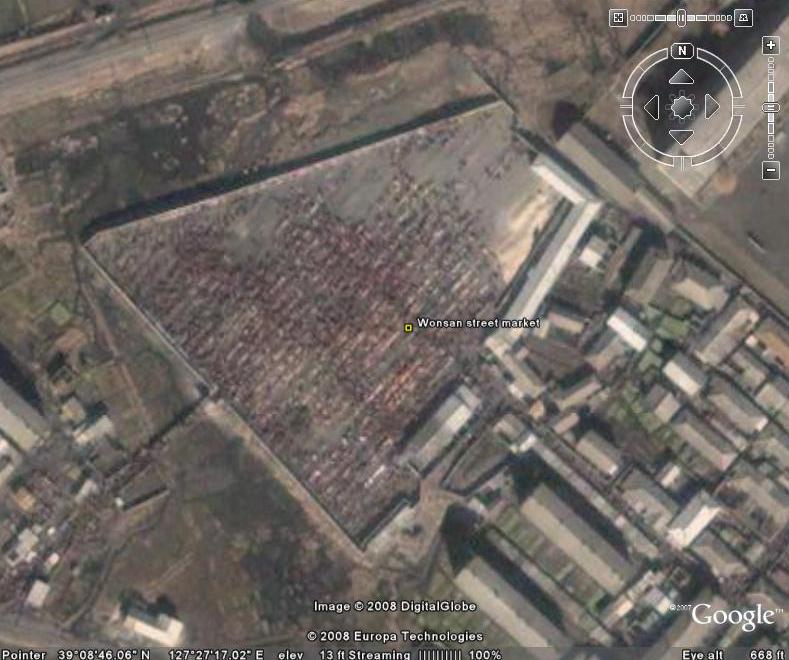
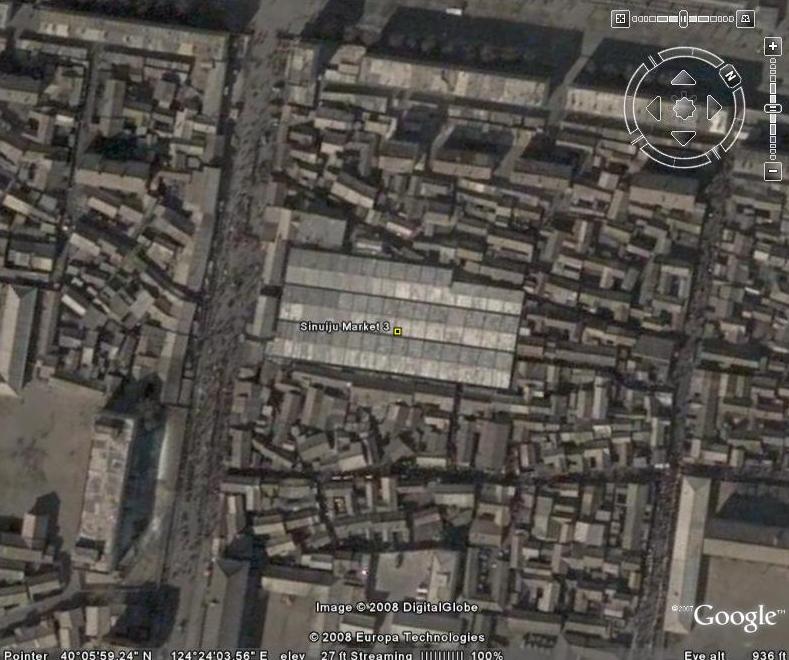
(Clockwise from upper left) Markets in Pyongyang, Kaesong, Sinuiju, and Wonsan
This week, the Daily NK reported that the new regulations and crackdowns on market activity are meeting with resentment in Pyongyang.
What happened? Supposedly Pyongyang’s new Party Chief Secretary suggested to Kim Jong Il the idea of converting the jangmadang into farmers markets (in other words only selling agricultural goods from the countryside as in the past), and Mr. Kim approved it.
As of January 15, public announcements were placed on the entrances of marketplaces detailing what could/could not be sold in the market. Violators are subject to having their goods confiscated by inspection units (these sorts of policies are ripe for promoting corruption).
Ever entrepreneurial, North Korean sellers simply adapted, shifting location from inside the marketplaces to back-alleys. Seemingly, they are still subject to inspection and confiscation in these local neighborhoods, but apparently the risk is lower. Several of these street markets are also visible on Google Earth:
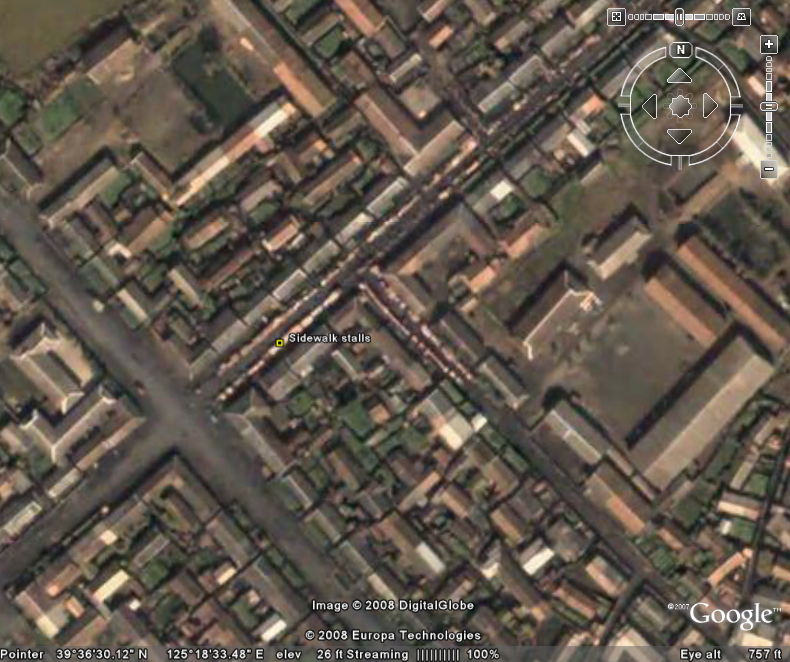
But others have decided to stay put in the markets and simply hide their goods:
A portion of the people still secretly trade in the jangmadang. Simultaneously avoiding the inspection units, they refrain from putting out the goods and bargain with customers by holding up signposts. When they tell the passing-by customers, “This is what I have,” a bargain is reached. Of course, the goods are temporarily stored at a nearby residence and taken out after the bargain. (Daily NK)
Lankov also discussed the regulations and games people play to avoid the market inspection units here.
The full article can be found below:
Jangmadang Will Be Converted to Farmers Markets
Daily NK
Jung Kwon Ho
2/13/2008
Below are three video’s recently posted on YouTube which portray North Korea’s national mourning in 1994 when Kim Il Sung passed away. Although we do not know what people really think of the deceased leader, we do know that the public displays of sadness and eternal loyalty were scripted for television (and probably planned out in advance): Large crowds were mobilized at politically symbolic locations throughout the country, people were lined up in formations, given black arm bands, and placed in front of well-positioned television cameras to make sure they gave their best performances (which were strangely identical).
The cameramen were also composed enough to carry out their tasks: Not only would they have to be dispatchted from Pyogyang to record the mass sadness, but they would have to arrive early to the scene, plan out their shots, record each scene several times, conduct multiple interviews, travel back to Pyongyang, and finally edit the footage into the final product. This would all take a fair amount of time because travel conditions between the different locations would have been less than stellar.
Click on the images below to see the three part video:
Part 1. 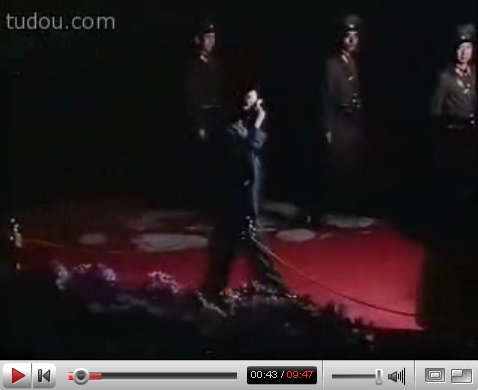
Part 2. 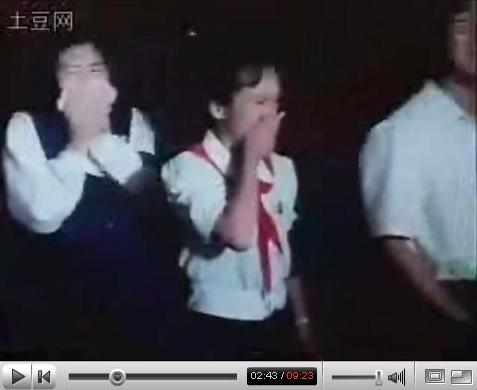
Part 3. 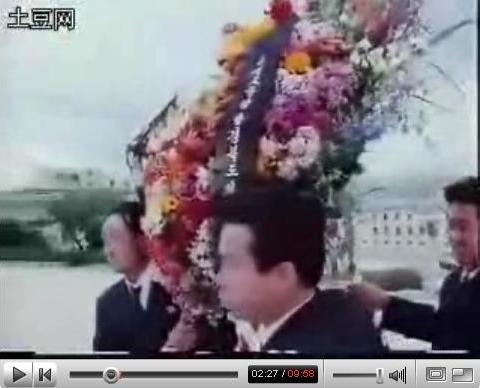
This should not be a surprise to anyone who is familiar with how socialist and highly regulated economies actually function. If there is a profit opportunity to be had by breaking a regulation, there will generally be a bureaucrat there willing to pocket some of the earnings to look the other way.
The fact that ordinary North Koreans are willing to pay to get access to Kaesong jobs should send a powerful signal to those who call for the zone’s abolition. Wages and working conditions at the complex, though not popular with Western activists, are relatively better than those on the local collective farm. When the average Kaesong resident figures out that working there will lead to a better life, baksheesh is inevitable.
Claudia Rosette covered a similar phenomenon with North Korean loggers in Russia.
The Daily NK covers the Kaesong phenomenon specifically:
Known as a “dream place of employment” among North Koreans, citizens of the North are paying hundreds of thousands of won in the form of bribes to gain employment in the facility.
“They say that one can find a job in the Kaesong Industrial Complex by giving 700,000 North Korean won in bribes for males and 200,000 won for females. If I had used the 200 USD (approximately 700,000 won) spent in obtaining a passport as a bribe, I could have entered the Complex.”
As for the why the Kaesong Complex is so popular, Kim explained, “Commodity provision tickets, equivalent to a worker’s salary, are given to laborers in Kaesong and if one uses these tickets well, he or she can make a huge profit.”
Currently, the official salary for laborers at the Kaesong Industrial Complex is around 60 USD, a small amount of which is distributed as cash and the rest in the form of “commodity provision tickets.”
In the Kaesong Industrial Complex, there are several shops that can only be frequented by Kaesong laborers and the prices at these stores are at inexpensive compared to prices in the jangmadang.
Laborers at the Kaesong Industrial Complex use their “commodity tickets” to purchase products at a cheap price and can make a huge profit by selling the goods, giving the difference to middlemen (currency traders who mediate deals).
Recently, there have even been cases where the middlemen had specific orders for certain items from the Kaesong laborers, asking them to procure a certain amount of rice, oil, and so on. The middlemen can easily make an exorbitant amount of money by selling these goods at the jangmadang.
ADDENDUM REVISITED (The Daily NK is transalted into English and as a result is even less clear than my writing somethimes, so I have revised this post several times to clarify the text):
Opinions of the complex seemingly hinge on one’s policy goals. If the primary goal is to raise living standards in the North and open the people up to outside influences, then Kaesong seems like progress (although maybe not the most cost effective). If the primary goal is to minimize the income of the DPRK government, then the Kaesong zone probably is not a good idea….
Taking the latter point of view, Joshua at OneFree Korea emphasises the point that the North Korean government keeps most of the cash wages paid to the workers, and that zone employees survive on the supplemental “commodity tickets”–either consuming the goods they purchase in the company store or selling them to local markets for cash.
Theoretically, though, if the thousands of workers employed in Kaesong were re-selling subsidized goods to the Kaesong public markets, this would have the (short run) effect of lowering or stabilizing food prices for the general public (since Zone employees do not need to purchase food at local markets and their clandestine re-selling of commodities to the markets increases the supply of cheaper goods). This also means that in general re-selling to the market is not terribly profitable to any zone employee, except when there is a temporary mismatch beteen supply and demand (which might be common depending on the reliability of the DPRK’s market supply chains). How the price decrease would affect domestic food producers (and the long term price) is probably a bit more complicated since we are not sure how much North Korean farmers respond to price changes.
Additionally, even though the North Korean government keeps most of the cash wages, the commodity coupons still give the worker approximately $60 in purchasing power –a decent income in North Korea.
However, given that the South Koreans pay all cash wages go to the North Korean government and the workers themselves receive an additional $60 in script to use at the company stores, means that the average economic cost of a North Korean worker in Kaesong is closer to $120/month!
The whole article can be found here:
Bribery Required to Work at the Kaesong Complex
Daily NK
Jung Kwon Ho
2/4/2008
North Korean Economy Watch has been named Most Specialised Niche Newcomer by Aaron Schiff on his list of top 200 economics blogs.
Thanks to all the readers out there.
Daily NK
Yang Jung A
1/3/2008
Through its publication “North Korea is Changing” the Korea Institute for National Unification (KINU) highlighted numerous changes and reforms that have occurred in North Korea due to the 2002 “July 1st Economic Maintenance Reform Policy” (Hereon referred to as the “July 1 Policy”). This publication deals with the changes the North Korean economy is undergoing following the economic crisis of the 1990s, and expounds on the country’s prospects for future economic reform.
The following is a summary of the main points introduced in the publication.
The “Invisible Hand” at Work in North Korean Markets
Following the enactment of the July 1 Policy in 2002, agricultural markets transformed into general markets. Soon, industrial products were being sold alongside agricultural products as the free market spirit spread to the country’s distribution system.
Along with the rise of general markets, street markets, and individualized commercial activities, a new merchant class is emerging. People who are able to put to use business acumen and an understanding of market principles are able to accumulate personal wealth. This demonstrates that aspects of Western-style rationalist thinking, including the pursuit of profit-seeking are being instilled in the minds of the North Korean people.
It is difficult to say if this experiment in free market economics will be successful in the long run. More than anything, due to the rigidity of the North Korean regime, the realm in which the “Invisible Hand” can operate is greatly restricted. This is the fundamental paradox facing North Korea’s prospects for reform and opening.
“Hardworking Heroes” Become “People with Two Jobs”
As the economic difficulties became severe, work opportunities evaporated. Living off of the wages provided by the state became impossible. North Korean laborers responded to this by taking on side jobs or engaging in independent sales.
According to defectors living in South Korea, after the July 1 Policy, there has been an increase “People with Two Jobs.” These are people who are engaging in economic activities additional to their primary occupations. People are beginning to accept the notion that it is better to work for personal benefits than to receive the title of “Hardworking Hero.”
Such phenomena have also changed people’s perceptions about occupations in general. For example, the elite classes now prefer diplomatic positions and jobs where they can make international connections, rather than working in party or government positions. The common people prefer agricultural jobs with the benefits of access to the food distribution system and the ability to earn side profits by being a merchant. In addition, common people also prefer being personal drivers, photographers, workers at the Food Distribution Office, servicepersons, or fishermen.
Business Conglomerates Are Emerging in North Korea
With the implementation of the July 1 Policy, North Korea has witnesses the creation of its first business conglomerates. A case in point is the Korea Pugang Corporation, which has expanded to include 9 subsidiaries and 15 foreign offices engaging in various lines of work. The website of the “Korea Pugang Corporation” reveals that the company has around $20 million in capital and does an average of $150 million of business each year.
The executives in charge of the company’s growth are brothers Jon Sung Hun and Young Hun. President Jon Sung Hun is in his early 50s and studied abroad in Tanzania before returning home to teach English at Kim Il Sung University. He later became a businessperson. His English skills are among the top 10 in North Korea. Young Hun is in his 40s and is the president of a company affiliated with the Finance and Accounting Department of the Workers’ Party. His company dominates North Korean diesel imports.
If the Jon brothers are the representative examples of conglomerate-based new capital, Cha Chul Ma ranks high among those who earned capital due to their power in North Korean society. With his focus on doing business with China, Cha is known for his ability to earn foreign currency and dominates the foreign currency earning businesses belonging to the Standing Committee of the Supreme People’s Assembly. His personal wealth is said to be over $10 million.
As the son-in-law of Lee Jeh Gang, the First Vice Director of the Guidance Department of the Workers’ Party, Cha gets some support from his father-in-law. Cha, who is known to live so freely that he was seen wearing Bermuda shorts on the streets of Pyongyang, is said to be a “Representative Case of a North Korean who succeeded in business on his merits, regardless of assistance from surrounding figures”.
The Number One Worry is Sustenance
North Koreans are said to live three different lives: their family lives, their working or school lives, and their political lives. Their lives are organized by politics from “cradle to grave,” and they must attend various political meetings, organizations, and study sessions. However, there are many people who are unable to participate in regular meetings of their political units due to economic difficulties. As they do not receive sufficient food distributions and their wages are too low, they must seek their food independently through individual economic activities.
Because the transportation infrastructure in the country is not advanced, it takes at least half a month to one month to go into the countryside to search for food and then they must return and sell the food or daily-use items they acquired, leaving little time for any other activities. Ninety percent of North Koreans engage in some form of business, and as a result, only an estimated 30% to 60% participate in required political activities.
Marriage Culture
These days, in North Korea, the ideal spouse is the one who makes the most money. Previously, when North Korean women chose their spouses, they considered the social status of their potential suitor. However, after the economic crisis, they started to prefer businesspersons and people who earn foreign currency, instead of discharged soldiers and cadres. For men as well, they now prefer money to looks as society increasingly revolves around the economy. As a result, an overwhelmingly higher proportion of men marry older woman than before.
Marriage customs are simplifying as well. Before the economic crisis, women usually provided the domestic items for the household and men provided the estate. However, after the economic crisis, dowries have downgraded into simple things like clothes. Because the allocation of estates has been delayed, more and more people are living at their parents’ homes.
Especially for women, there have been some phenomenal changes. Many women consider marrying late or not marrying at all. Reasons for this include the fact that woman cannot marry men just because the men can’t work and needs a woman to bring home money. Even in such a patriarchal culture, such complaints are becoming increasingly common.
