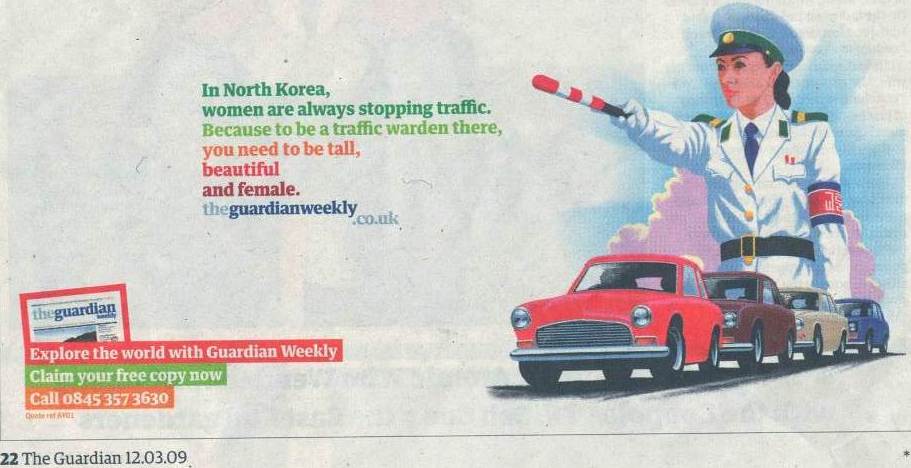
(h/t Michael Rank) The Guardian published this image yesterday:
Click on image for full size

North Korea Uncovered v.16
Download it here
The most recent version of North Korea Uncovered (North Korea Google Earth) has been published. Since being launched, this project has been continuously expanded and to date has been downloaded over 32,000 times.
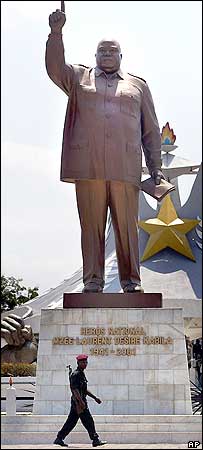
Pictured to the left is a statue of Laurent Kabila of the Democratic Republic of Congo. This statue, as well as many others identified in this version of the project, was built by the North Koreans. According to a visitor:
From the neck down, the Kabila monument looks strangely like Kim Jong Il: baggy uniform, creased pants, the raised arm, a little book in his left hand. From the neck up, the statue is the thick, grim bald mug of Laurent Kabila (his son Joseph is the current president). “The body was made in North Korea,” explains my driver Felix. In other words, the body is Kim Jong Il’s, but with a fat, scowling Kabila head simply welded on.
This is particularly interesting because there are no known pictures of a Kim Jong il statue. The only KJI statue that is reported to exist is in front of the National Security Agency in Pyongyang. If a Kim Jong il statue does in fact exist, it might look something like this.
Thanks again to the anonymous contributors, readers, and fans of this project for your helpful advice and location information. This project would not be successful without your contributions.
Radio Free Asia
Jung Young
3/10/2009
See also: Daily NK 2007, NK goes after busses
Authorities in North Korea have begun enforcing a ban on the use of foreign cars in the isolated Stalinist state, putting further pressure on a population already struggling to survive.
Beginning in early February, Pyongyang’s National Defense Commission began enforcing a directive banning imported cars and ordered a crackdown.
According to a cross-border Chinese merchant, those targeted by the crackdown are primarily officials who take bribes to fraudulently register cars to state-owned enterprises or military bases.
Authorities also want to stop North Korean mechanics from rebuilding and modifying imported cars by changing them from right-hand-drive Japanese vehicles—the Japanese drive on the left—to left-hand-drive vehicles for use on North Korean roads.
“The National Defense Commission regards failure to enforce its directive banning imported cars as a provocative act,” said the Chinese merchant, who is a frequent traveler to North Korea.
“Various officials have been instructed to let go of the imported used cars, and many of those who failed to comply with that directive are in trouble now. In particular, officials working for the Forestry Department appear to have been reprimanded,” he added.
Deadlines expire
In February 2007, the National Defense Commission issued a nationwide directive to eliminate imported cars.
Foreign passenger cars were to be removed within three months, while foreign freight vehicles were to be phased out within two years.
National Defense Commission officials were clamping down in particular on right-hand-drive used cars imported from Japan, ordering that they all be scrapped.
Sources said this could be because supreme leader Kim Jong Il dislikes the sight of Japanese cars, most of which are smuggled into the country and given fake military license plates, on North Korean roads.
But they also note that the North Korean military is experiencing shortages both of fuel and of the hard currency needed to buy it.
One expert suggested that the National Defense Commission may want to prevent imported cars from burning the fuel that keeps military vehicles on the road.
Conversion of used cars
The order to scrap right-hand-drive Japanese cars prompted a rush by the owners of imported cars to convert their vehicles to left-hand drive, a complicated and expensive process.
In Songpyong, a district of Chungjin city in Northern Hamgyong province, mechanics at the Soosong Tractor Plant and bus factories are switching steering wheels from right to left, sources said.
Owners of the modified cars then have them registered to military bases or factories that are authorized to operate the cars, paying their officials about 300,000 North Korean won (U.S. $100) monthly for the favor.
But even converted vehicles are no longer slipping through the net, North Korean car owners say.
“We’re pretty much done for,” one such car owner said. “From here on, the only vehicles allowed on the roads of North Korea are military vehicles.”
“Life is already very hard, but if our cars are taken away and scrapped, the situation will be terrible, and our very survival in jeopardy,” the car owner said.
Currently, Japanese cars make up around 80 percent of imported vehicles in North Korea.
UPDATE: Hat tip to Stafford who provides a link to the Henley Visa Restrictions Index.
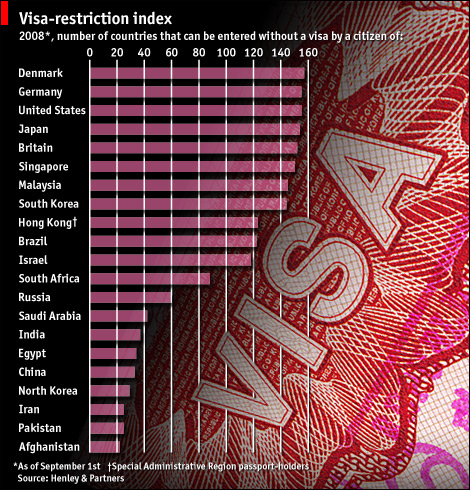
ORIGINAL POST: (Hat tip to Will Wilkinson) How many countries can you visit on your passport without obtaining a visa? According to a recent table compiled by The Economist, Denmark, Germany, and the USA offer the most opportunities. According to the story, “South Koreans could visit 144 countries, whereas North Koreans could visit just 29 countries—if only their government would let them out.”
Below is the table taken from The Economist.
The Institute for Far Eastern Studies (IFES) published an interesting paper (with the above title) on legal reform in the DPRK. Below are some highlights. Links to the entire paper at the bottom.
As citizens have been left without state provisions for subsistence since the state did not have the material resources to supply the people through its central rationing system, the vast majority of individuals and organizations had to support themselves. Legitimizing commercial and market activity and expanding the scope of private ownership were a part of this effort. One of the most important laws reflecting this transformation is the Damage Compensation Law (sonhae bosang-beop), which is the North Korean version of a general torts law. This law holds an individual or any legal entity liable for its tort when damage is inflicted. Monetary compensation is the rule, while restoration is allowed when possible.
Under the socialist system, where the state is responsible for the provision of a citizen’s livelihood, tort law was of little use. Even in the case of death, one’s family would not suffer economically since the state provided sustenance rations. However, with the collapse of the public distribution system, the North Korean authorities could no longer maintain their socialist system. Since an individual now has to rely on his or her own devices, the loss of the employment, for example, directly inflicts a financial burden on the individual or family. Therefore, damage to property or person should be compensated for by the responsible party. Therefore, the new damage compensation law acts as a new mechanism for the protection of private property, and strengthens individual responsibility for negligent acts that inflict damage on others.
and…
Relaxation of law and order, along with the laxity of organizational control due to economic difficulties, changed individual attitudes toward government authorities and organizations in which these individuals were members. Individuals became more independent from the state and its organizations, since both the state and more directly engaged organizations lost important means of control over individuals in society due to the lack of resources and the inability to provide basic necessities to the people.
Under these circumstances, individual victims had no appropriate method to seek compensation for damage through an official dispute resolution process. This has led to an environment in which self-remedy has become the rule, rather than the exception. Although new criminal law punishes those who have used force in asserting their rights, there is no effective means of dispute resolution outside of taking advantage of officials willing to look the other way in exchange for favors, or hiring thugs to more directly resolve disagreements. Citizens can buy justice through bribes, and law enforcement officials are especially helpful in these endeavors when their palms are greased. This is much more economical as well as effective than bringing a case to the relevant official agency, which is generally incapable of resolving problems and instead further exploits the situation.
On courts and lawyers…
For example, the most prominent role of the court in North Korea, where other types of lawsuit are very unusual, was to handle divorce settlements, since divorce through simple agreement of the two parties was not allowed. Ordinary citizens went so far as to perceive settlement of divorce to be the most important role of the court. Criminal cases were also unusual. Political crime is handled through a non-judicial process, while many deviances are resolved through unofficial processes within more local organizations. The role of the court in resolving disputes was negligible, aside from divorce. Since the role of law enforcement agencies is to protect the state and secure the socialist system, the most important qualification for them is not legal expertise, but rather, loyalty and devotion to the North Korean ideology and system.
On the other hand, the Lawyer’s Act of 1993 prescribes the required qualifications of a lawyer. Those who are eligible to work as lawyers are those who are certified legal professionals, those who have working experience of no less than 5 years in legal affairs, or those who have a professional license in a certain area and have passed the bar examination after a short-term course in legal education. This qualification for working as a lawyer signifies that the state wants to equip the judicial system with legal professionals. Although there is no explicit professional qualification for a judge or prosecutor, we may assume that legal professionals have been elected or recruited in practice. This trend is likely to be reinforced as these social changes continue to unfold.
New provisions were also introduced to reinforce the judicial system. For example, interference with a law enforcement official’s performance of duties is now a punishable offence ; Threatening a witness or exacting revenge has been criminalized ; Non-execution of judgment will now be punished. Although the introduction of these provisions was an expression of the government’s effort to bring in a more effective judicial system, it would not be an easy task under the vague status of transformation. The state is very cautious and reluctant to undertake bold or fundamental changes due to concerns about political instability. Therefore, it takes time for various coherent mechanisms to fully support a market system.
You can download the entire paper in PDF format here.
You can read it on the IFES web page here.
The end of sunshine?
According to Yonhap (here and here), Friday, November 28, was the last day of the Kaesong day tours (210 tourists made the trip) and the last day the “train to nowhere” made its inter-Korean trip.
As for the Kaesong Industrial Zone (KIZ)…According to (Bloomberg), on December 1 the DPRK cut the number of “windows” available each day for South Korean vehicles to enter and leave the KIZ from 19 to 6 (though the Donga Ilbo claims just 3), and limited the number of South Koreans allowed in the complex to 880—about 20% of the 4,200 previously permitted to enter the complex.
According to the Donga Ilbo, Pyongyang delivered notice at 11:55pm Sunday saying those allowed to stay in Kaesong are 27 staff of the management committee; four from the (South) Korea Land Corp.; 40 from Hyundai Asan Corp.; five at restaurants and living quarters; two at shops and hospitals; and 800 from South Korean companies. Border crossings are also limited to 250 staff members and 150 vehicles each time.
Jeopardizing more than Kaesong
As previously discussed (here and here), South Korea and Russia are interested in building oil and natural gas pipelines which would cross the DPRK. If these projects went through, the DPRK government would benefit from construction and “rental” fees—in effect taking a cut of all the energy resources that cross their borders. North Korea, is now telling the Russians that the project is not too palatable at the moment.
Still more red than green it seems.
What now?
So while the DPRK chases away investment from the South, they solicit more from Kuwait and Singapore (where Chris Hill is due to stop by):
North Korean Foreign Trade Minister Ri Ryong Nam, now in Singapore, has urged Singapore companies to invest in the isolated country, the Singapore government said Monday.
The North Korean minister “briefed…on economic developments in North Korea and possible investment opportunities for Singapore companies,” in a meeting with Singapore’s former Prime Minister Goh Chok Tong, now a senior minister in the Cabinet, a government statement said.
Goh said, “Singapore would be glad to explore ways to strengthen bilateral cooperation, including in the areas of trade and investment, once international concerns were assuaged and the environment improved.”
Singapore Foreign Minister George Yeo made a trip to North Korea in May, accompanied by a business delegation, in what was the first official visit to North Korea by a Singapore Cabinet minister.
On that trip, Yeo met North Korea’s No. 2 political leader Kim Yong Nam and Ri.
Yeo said at the end of his visit North Korea might be keen to learn from some aspects of the Singapore development model and that Singapore is ready to offer help and ideas. (Kyodo-Japan Economic Newswire)
Chewing gum manufacturers beware!
The Asia Sentinel offers an update on Pyonghwa Motors’ production and sales numbers:
Does it make economic sense to build or invest in a car factory for a country with 23 million people but fewer than 30,000 vehicles, a city where cars are so scarce that in the warmer months, traffic ladies swinging their stop signs act in place of electric lights, where hardly anybody knows how to drive? And why is Sun Mymung Moon, owner of an international business empire and a virulent anti-communist, investing in North Korea?
Pyeonghwa Motors invested around US$55 million to build the factory on a one-time rice paddy near the port city of Nampo, about 50 kilometers southwest of Pyongyang. In 2003, the JoongAng Daily quoted an executive from the Seoul-based Pyeonghwa, saying he expected the factory, with capacity to build 20,000 cars a year, to eventually turn a profit. However, a spokesman based in Seoul says Pyeonghwa has produced only 2,000 cars and pickup trucks in their first five years of operation.
How many cars have they actually sold? For North Korea, any statistics, much less accurate ones, are “very difficult to come by,” said Erik van Ingen Schenau, an Asian car analyst and author of the book “Automobiles Made in North Korea.” He quotes a French newspaper article that claims the factory sold around 400 vehicles, including SUVs, pickups, and sedans, in 2006. He estimates the factory sold anyone from 400 to 1000 cars in 2007 and 2008, including the cars they exported to Mekong Auto, a Vietnam-based Moon company, and including the vehicles that they produced with the Shenyang-based China Brilliance.
The Pyeonghwa factory produces cars with names such as Whistle, Cuckoo, and Three Thousand Li, which refers to the national territory of Korea, both North and South peppering the empty streets of Pyongyang, “You see these cars a lot, especially the Cuckoo,” said Simon Cockerell, general manager of Koryo Tours, one of the few western tour companies licensed to operate in North Korea.
“It took drivers some getting used to because they were used to driving Japanese cars, with steering wheels on the right,” Cockerell said.
Like most items produced in North Korea, the Pyeonghwa vehicles are not known for their quality. “They are probably nearly all hand-assembled, and based on a model from a factory in China that does not have a good reputation,” van Ingen Schenau said. “They make cars that no one is interested and in that they cannot export to Japan or South Korea. Maybe it is a prestige item to have a car factory in the country, but it does not seem to have worked out at the moment.”
The Whistle, based on the Fiat Siena, is one of the Pyeonghwa vehicles featured on billboards. It sits on a field next to a superimposed image of the Pyongyang Arch of Triumph. Built to commemorate Kim Il Sung and the Korean nation’s resistance to the Japanese occupation, the arch stands 60 meters tall, more than 10 meters taller than its model, the Arc de Triomphe in Paris. A boy stands next to the car one hand holding a trophy, while waving a hand, a smile on his face and a medal around his neck. The billboard reads: “Whistle. A Strong and Beautiful Automobile.”
It is important to remember the target audience of the billboard. It is not only for the few thousand European tourists who visit the country for six days at a time, or the few hundred businessmen and embassy staff who live in one of the few foreigner hotels isolated from the city. The billboards also exist for the residents of Pyongyang, to show them that their country, despite the harm done to it by the entire capitalist world, is still able to go its own way and produce a strong and handsome car.
The full article can be found here:
North Korea in the Slow Lane
Asia Sentinel
Isaac Stone Fish
10/31/2008
North Korea Uncovered: Version 12
Download it here
 About this Project: This map covers North Korea’s agriculture, aviation, cultural locations, markets, manufacturing facilities, energy infrastructure, political facilities, sports venues, military establishments, religious facilities, leisure destinations, national parks, shipping, mining, and railway infrastructure. It is continually expanding and undergoing revisions. This is the 12th version.
Additions include: Tongch’ang-dong launch facility overlay (thanks to Mr. Bermudez), Yongbyon overlay with destroyed cooling tower (thanks to Jung Min Noh), “The Barn” (where the Pueblo crew were kept), Kim Chaek Taehung Fishing Enterprise, Hamhung University of education, Haeju Zoo, Pyongyang: Kim il Sung Institute of Politics, Polish Embassy, Munsu Diplomatic Store, Munsu Gas Station, Munsu Friendship Restaurant, Mongolian Embassy, Nigerian Embassy, UN World Food Program Building, CONCERN House, Czech Republic Embassy, Rungnang Cinema, Pyongyang University of Science and Technology, Pyongyang Number 3 Hospital, Electric Machines Facotry, Bonghuajinlyoso, Second National Academy of Sciences, Central Committee Building, Party Administration Building, Central Statistics Bureau, Willow Capital Food House, Thongounjong Pleasure Ground, Onpho spa, Phipa Resort Hotel, Sunoni Chemical Complex (east coast refinery), Ponghwa Chemical complex (west coast refinery), Songbon Port Revolutionary Monument, Hoeryong People’s Library, Pyongyang Monument to the anti Japanese martyrs, tideland reclamation project on Taegye Island. Additionally the electricity grid was expanded and the thermal power plants have been better organized. Additional thanks to Ryan for his pointers.
I hope this map will increase interest in North Korea. There is still plenty more to learn, and I look forward to receiving your contributions to this project.
Version 12 available: Download it here
UPDATE: Looks like the show was drastically scaled down in P’ang. According to the Associated Press:
Efforts shifted to trying to stage a rock concert in Pyongyang, and Cooper said possible artists included Eric Clapton or Roger Waters. But he said no corporate sponsor was found willing to pay the high production cost to bring such acts to the North.
It would have been the highest-profile performance in Pyongyang since the New York Philharmonic’s historic concert in February.
In the end, the rally ended up making the short stop in Pyongyang without the cars to watch the North Koreans’ “mass games” propaganda spectacle featuring 100,000 people performing synchronized gymnastics and acrobatics.
After the performance, the group had a banquet at the Koryo Hotel that a guide boasted was “one of the most luxurious hotels in our country.” Toasts were raised to the health of Kim Jong Il, and to Cooper.
Tattooed rally entrants wearing designer T-shirts and jeans mixed alongside North Korea’s vice culture minister clad in a dark suit.
And according to Simon (in the comments):
I was at Arirang the same night as these guys and went to the Koryo Hotel afterwards to see if they were having a party or anything like that – no party, no Hoff and the biggest star I saw was Carlton from the Fresh Prince of Bel Air. Don’t know who Travis Barker is so he may have been there. All in all I don’t know if they would consider the visit a success as they just flew in, went to the Games (spectacular as ever, a few changes as well this time so better than last years) and then flew out again – no concert, no party (unless it was hidden away or very small scale) but at least Carlton was there, and a guy carrying a skateboard who could conceivably have been a skater.
ORIGINAL POST: I had no idea what the Gumball 3000 was until I read the article below. The story seems so surreal it has to be true.
From the article:
This Saturday, August 9, superstars and super cars converge in San Francisco for the official kick-off of the 10th Anniversary Gumball 3000 Rally. More than 100 of the most amazing cars, driven by film stars, musicians, athletes and billionaires, will take an incredible eight-day journey from San Francisco to Los Angeles, San Diego, Las Vegas, North Korea and China. The “Gumballers,” driving by day and reveling at VIP parties by night, will witness the Mass Games celebration in North Korea as part of a “global friendship initiative” as well as attend the Olympic finals in Beijing.
“This year’s rally is our most historic and spectacular to date,” said Maximillion Cooper, Gumball Founder. “Fuelled by adrenaline, amusement and amity, the 2008 route from the West to the East, including the city of Pyongyang, North Korea, will be a real once in a lifetime adventure.”
The Gumball 3000 entrants include David Hasslehoff driving K.I.T.T., the Trans AM “Official Knight Rider,” Travis Barker and more in the world’s hottest cars from Ferrari Enzos to Bugatti Veyrons, low riders and electric cars.
Learn more about the Gumball 3000 here.
Read stories below:
Gumball 3000 10th Anniversary Rally Kicks Off Saturday, August 9 in San Francisco
Market Watch
08/08/08
Partytown Pyongyang? Global tour comes to NKorea
Associated Press
Burt Herman
8/15/2008
The most authoritative map of North Korea on Google Earth
Download it here
 This map covers North Korea’s agriculture, aviation, cultural locations, markets, manufacturing facilities, railroad, energy infrastructure, politics, sports venues, military establishments, religious facilities, leisure destinations, and national parks. It is continually expanding and undergoing revisions. This is the eleventh version.
Additions include: Mt. Paegun’s Ryonghung Temple and resort homes, Pyongyang’s Chongryu Restaurant, Swiss Development Agency (former UNDP office), Iranian Embassy, White Tiger Art Studio, KITC Store, Kumgangsan Store, Pyongyang Fried Chicken Restaurant, Kilju’s Pulp Factory (Paper), Kim Chaek Steel Mill, Chongjin Munitions Factory, Poogin Coal Mine, Ryongwun-ri cooperative farm, Thonggun Pavilion (Uiju), Chinju Temple (Yongbyon), Kim il Sung Revolutionary Museum (Pyongsong), Hamhung Zoo, Rajin electrified perimeter fence, Pyongsong market (North Korea’s largest), Sakju Recreation Center, Hoeryong Maternity Hospital, Sariwon Suwon reservoir (alleged site of US massacre), Sinpyong Resting Place, 700 Ridges Pavilion, Academy of Science, Hamhung Museum of the Revolutionary Activities of Comrade Kim Il Sung, South Hamgyong House of Culture, Hamhung Royal Villa, Pork Chop Hill, and Pyongyang’s Olympic torch route. Additional thanks go to Martyn Williams for expanding the electricity grid, particularly in Samjiyon, and various others who have contributed time improving this project since its launch.
Disclaimer: I cannot vouch for the authenticity of many locations since I have not seen or been to them, but great efforts have been made to check for authenticity. These efforts include pouring over books, maps, conducting interviews, and keeping up with other peoples’ discoveries. In many cases, I have posted sources, though not for all. This is a thorough compilation of lots of material, but I will leave it up to the reader to make up their own minds as to what they see. I cannot catch everything and I welcome contributions. Additionally, this file is getting large and may take some time to load.
