Archive for the ‘Automobiles’ Category

Interview with Ken Frost, CFO, Phoenix Commerical Ventures

Monday, July 28th, 2008

Interview Blog, Germany
(click here for all their North Korea-related interviews)

Phoenix Commercial Ventures Ltd is a venture capital company that offers investors business and investment opportunities in the DPRK” – Interview with Ken Frost (CFO of Phoenix)

Klaus-Martin Meyer: Mr. Frost, you are member of the Board of Phoenix Commercial Ventures Ltd, a company that offers investors business and investment opportunities in the Democratic People’s Republic of Korea (DPRK) otherwise known as North Korea. Would you mind introducing yourself and your company as well to our readers?

Ken Frost: Phoenix Commercial Ventures Ltd is a venture capital company that offers investors business and investment opportunities in the DPRK, enabling them to take advantage of the economic reforms that are taking place there.

Phoenix is owned and run by four experienced professionals, who are based in London, Paris and the DPRK. The Board has between them many years of international business experience, and an invaluable network of well placed contacts. Phoenix offers a unique service, by being able to offer direct access to the DPRK.

Phoenix Commercial Ventures Ltd specialises in project finance in the DPRK. As is well known, the business environment is difficult, and the company targets very specific investment projects; these are small enough to manage and have the capacity to generate foreign currency, either through export or import substitution.

Phoenix Commercial Ventures Ltd maintains an office in Pyongyang, almost the only European company to do so, and operates with the following specific aims:

• Identify commercially viable investment projects in the DPRK, on a case by case basis
• Identify reliable local partners for all forms of business in the DPRK, either trade or investment
• Seek overseas investment sources for such projects
• Minimise the risk in such projects, by taking responsibility for supervision of the local set-up procedures and management of the projects

The Board of Phoenix Commercial Ventures Ltd consists of nationals of the UK, France and the DPRK. The European flavour is enhanced by the fact that most of the counterparties and suppliers in the various projects are also European, and the DPRK government views Phoenix Commercial Ventures as a prime conduit for European business and investment in the DPRK.

One of the directors of Phoenix Commercial Ventures is also General Manager and CEO of the Daedong Credit Bank, the only western-invested foreign bank in the DPRK. Based in Pyongyang, this is a 70-30 joint venture between a UK financial management company based in Hong Kong and the Korea Daesong Bank, one of the main DPRK banks.

Phoenix Commercial Ventures is unique in having this connection with a reliable, locally based financial institution. The synergy benefits include a wider exposure to local business contacts in differing fields; as well as an additional degree of control, made possible by the fact that the various joint venture projects have to maintain their accounts with the bank.

We have a number of projects within DPRK, including two 50/50 joint ventures:

– Hana Electronics JVC, a consumer electronics company now ranked as one of the top three best performing joint ventures in DPRK, as assessed by the Ministry of Finance.

– Sinji JVC, whose main areas of operations are retail, software and bonded processing.

Full details about our company can be found on our website www.pcvltd.com

I am the CFO of Phoenix and am a chartered accountant with over twenty years international experience of FMCG industries, consumer electronics, rough diamond distribution and the Internet. I have worked in KPMG, Philips Electronics, De Beers and run my own Internet company. I am also a Scholar on Gerson Lehrman Group Councils.

In November 2007 I reached the finals of Accountant of the Year held by the Association of International Accountants at the President’s Awards Dinner 2007. This award is designed to recognise organisations’ accountancy stars.

In January 2007 I was awarded, based on recommendations from fellow members of the ICAEW, a New Year’s Honour by AccountingWeb. The award was for my services to the accountancy profession in opposing the merger of the ICAEW with other accountancy bodies.

In November 2006 I was awarded an honorary fellowship of the Institute of Professional Financial Managers (IPFM), for my services to the accountancy profession.

In January 2006 Accountancy Age placed me on their Financial Power List for 2006. I was 11th on their list of the top 50 of “The Ones To Watch”. The list identified the “most influential names to look out for” in the world of finance for 2006.

Klaus-Martin Meyer: We read on your website “offers investors business and investment opportunities in the Democratic People’s Republic of Korea (DPRK), enabling them to take advantage of the economic reforms that are taking place there.” Can you tell us what kind of opportunities this could be?

Ken Frost:There are three main areas of investment opportunities open to investors, which we can facilitate within the DPRK:

1 Small scale investments ($500K or less) yielding good levels of return (20% or more).

These investment opportunities are in local production (consumer goods, bonded processing, software etc) for domestic market consumption and export. These utilise the advantages that DPRK has over all the other countries in the region namely:

– 99% literacy
– skilled/disciplined/hard working workforce
– well educated workforce, many speak a good level of English
– lowest wage rates in the region

Phoenix has a number of opportunities that it can offer investors in this area; eg bonded processing, consumer manufacturing, clothing manufacturing and software development.

2 Natural resources

DPRK has proven abundant natural resources worth several trillion dollars; eg coal, gold, copper, titanium, lead, zinc, nephelite, nickel, magnesia, graphite etc.

The investment required would be of a higher order than the small scale investments above, $1M plus. The money would be used to bring existing mines back to production, by pumping out flood water and renewing worn out capital equipment.

Phoenix has, via its working relationship with CPEEC, a number or opportunities in the natural resource sector that it can offer genuine investors.

3 Infrastructure development

Clearly investment in infrastructure is the costliest form of investment. However, given the dilapidated state of the roads, railways, ports, electricity grid etc it is necessary if the economy is to be revived.

DPRK also has a keen interest in infrastructure development focussed on green/renewable energy areas.

Phoenix has on it books a profitable renewable energy project that would suit a serious, well financed and experienced green energy investor.

The DPRK is the final economic frontier and is a “green field” site. Its primary advantages are:

– Location (physical position between Russia, South Korea, China and in AP)
– Location (historical, all the major players now want to move forward)
– Location (resources, it has abundant rich resources both mineral and human capital – high literacy, well educated etc)

Klaus-Martin Meyer: What are the main differences between your company and a conventional venture capital company that is investing for example in internet our biotech companies?

Ken Frost: Companies such as those you mention are industry-specific, whereas ours is location-specific. Our company is relevant to people who might want to invest in the DPRK.  We work in the DPRK and have a physical presence in the DPRK, other “conventional” venture capital companies do not.

Klaus-Martin Meyer: Are there any differences to other investment companies?

Ken Frost: We apply the same principles to potential investments as any other professional investment company, we look at:

– the risk
– the returns
– the quality of the local management
– the quality of the business plan
– the size of investment
– the share offered for that investment etc

We also pay very close attention to corporate governance issues such as; financial reporting, management structure and ethics etc. We have a code of conduct which can be seen on our website.

Phoenix Commercial Ventures Ltd is committed to being a responsible corporate citizen and to the pursuit of a sustainable future, both economic and social.

Phoenix Commercial Ventures Ltd adheres to three fundamental ethical principles:

– Integrity
– Competence
– Courtesy

To this end Phoenix Commercial Ventures Ltd has developed a Code of Conduct, which sets out to ensure that these principles are followed in its operations. The Code of Conduct governs Phoenix’s business decisions and actions. The Code applies equally to corporate actions, and to the behaviour of individual employees when conducting business on behalf of Phoenix.

We work very hard with our local management teams and business partners to ensure that international standards re reporting, corporate governance and ethics are understood and followed.

Klaus-Martin Meyer: What are your plans for the company’s future? How do you see Phoenix Commercial Ventures in five years time?

We see the coming period for Phoenix as that of being continued growth.

In our view there will be a major upswing in economic relations between the DPRK and other countries over the coming months/years. Phoenix Commercial Ventures is uniquely placed to take advantage of, and to respond to, that upswing.

We are one of the very few organisations to have made successful joint ventures in the DPRK. We are also one of the very few organisations to have people with many years’ experience, and cultural sensitivity, actually on the ground in Pyongyang. You cannot run a business by email!

Share

Rajin SEZ electrified perimeter on Google Earth

Friday, July 25th, 2008

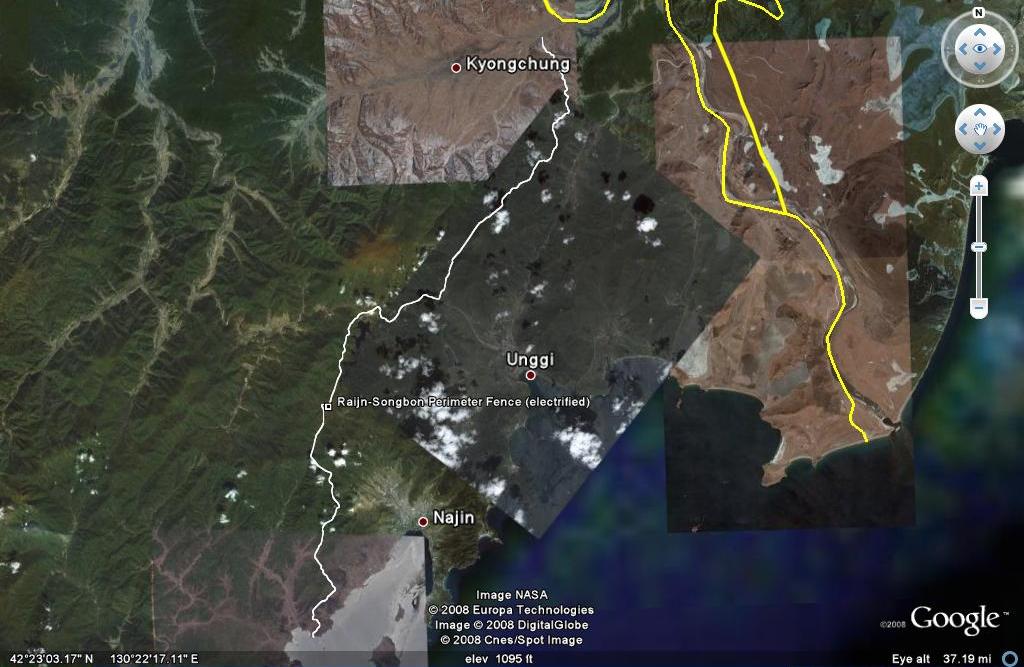
According to Lankov and Kim’s “North Korean Market Vendors: The Rise of Grassroots Capitalists in a Post-Stalinist Society” there is an electrified perimeter fence surrounding North Korea’s first  “special economic zone,” Rajin Songbon.

I have spent a lot of time looking at this area on Google Earth, but never seen the electrified fence.  Last night, however, I found it.  Before reading Lankov’s article, I thought it was a highway, or highway construction, on account of its approximate 35 mile/56 km length (as calculated using the Google Earth ruler).  The image of the perimeter (shown below) will be added, along with a few other new locations, to the next version of North Korea Uncovered (due in early August).

raijinperimeterfence.JPG

Click on image for larger version

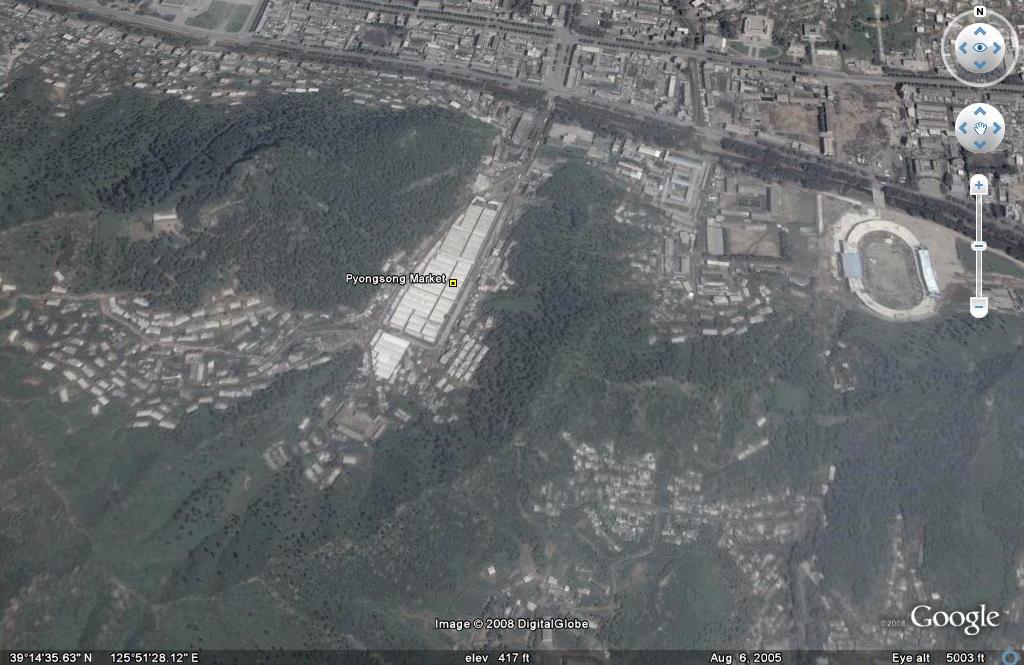
And in case you missed it, Lankov’s article mentions North Korea’s largest market in Pyongsong.  Satellite imagery of this location is below.

 pyongsongmarket.JPG
Click on image for larger view


Share

Lankov and Kim on North Korean market vendors

Wednesday, July 23rd, 2008

“North Korean Market Vendors: The Rise of Grassroots Capitalists in a Post-Stalinist Society”
Andrei Lankov and Kim Seok-hyang
Pacific Affairs, Vol. 81 Iss.1 
(subscription required)

Abstract:
The article deals with the social changes that have taken place in North Korea [from 1994-2002], when the collapse of the centrally planned economy led to the growth of private commercial activity.  This activity remains technically illegal, but the relevant bans and restrictions have rarely been enforced due to endemic corruption and disorganization of the state bureaucracy.  The article is largely based on in-depth interviews with North Korean black market operators [who have defected to South Korea].  It traces their origins, the type and scale of their business, and changes in their mode of operation.

The article demonstrates that the “second economy” came to dominate North Korean economic life by the late 1990s, since authorities’ attempts to limit its scale were largely ineffective.  The growth of the “second economy” produced new grassroots capitalists who sometimes came from underpriveledged social groups, but more typically represented people with good official connections.  It is also remarkable that foreign connections (usually with China) played a major role: to a large extent, merchandise sold at the North Korean markets either came from overseas or was exported overseas eventually, and in many cases the merchants’ initial capital was also provided by relatives residing overseas.

Some highlights:
1. Changsa is the North Korean word for “dealings in the marketplace.” Tonju is the word for money changers/lenders meaning “master of money”. 
2. Public Distribution System (PDS) rations were cut for the first time in 1973.
3. The DPRK system restricted market activity primarily through three mechanisms: limited size of family farming plots, inminban surveillance system, and travel permits.
4. Before the arduous march, North Koreans were not inclined to resort to market trade.  These transactions were seen as ethically suspect.  Once the famine hit, people took up market trading remarkably quickly.
5. Before the arduous march, bribery was rare, even though patronage and indirect forms of corruption were rampant.  Mid-level bureaucrats had to vie for preferred access to poor-quality consumer goods, better schools, and study trips abroad.
6. At the height of the arduous march (1997), production was at 46% of capacity.
7.  North Korean traders seldom if ever have to deal with the protection racket.  When asked directly, respondents did not mention threats from mobsters as one of their security concerns (I wonder if this is still the case).
8. Pyongsong market is reputed to be the largest in the country.  It is just outside Pyongyang, making it accessible to citizens inside the capital as well as those who cannot get permits to enter the city (Pictured below with Google Earth coordinates).

pyongsongmarket.JPG

Click on image for larger view

9. Financial services such as money-changers and private loan sharks offer loans at 5%-30%/month.
10. Most North Korean merchants know South Korea is a rich country.  They also avoid surveillance since these activities are done at state-owned enterprises and study sessions.

Share

Russian auto plant KamAZ in DPRK

Thursday, March 6th, 2008

A couple of days ago, we had an interesting exchange in the comments that I want to make sure readers have an opportiunity to see:
———————–

Werner Koidl Says: 
 
In that Asia Times report Dr. Petrov wrote:
“… Last year the Russian auto plant KamAZ opened its first assembly line in North Korea, specializing in the production of medium-size trucks named “Taebaeksan-96″. …”

I would be interested in more details about that KAMAZ truck assembly line in North Korea ! Where ?, joint venture ?, size ?
———————–

Leonid Petrov Says: 
 
Concerning the “Taebaeksan 96″ truck assembling plant, the KamAZ set it up last year (2007 or Juche 96) in the town of Pyeongseong. The terms of this deal with NK were really “friendly” and last year KamAZ was having no or very little profit. The production volume last year was very limited (45 or 48 trucks). However, it’s just the beginning of such cooperation.

There is one technician-representative from KamAZ who manages the assembling process. He stays in Pot’onggang HTL and commutes to Pyeongseong. Many North Korean drivers and technicians seem to be technically ignorant (i.e. not knowing how to change the engine oil, etc.), so they need a new technological culture to be introduced. Russians train them well and the North Koreans are grateful.
———————–

Gag Halfrunt Says:

Now that explains the brochure for the Taebaeksan 96 I’d noticed on the Korean Friendship Association’s exports page. I was wondering how anyone could be making money from sticking badges on KamAZes and trying to sell them on. In any case, the export potential for the Taebaeksan 96 must be close to zero, since anyone outside the DPRK who wants a KamAZ can buy one assembled by KamAZ itself.

Trying to drum up interest in the DPRK as an investment destination, the KFA say, “All business made directly with the government, state-owned companies. No middle agents.” This is amusing, because, on the Pyeonghwa car brochure on the KFA website, they’ve sneakily deleted Pyeonghwa’s own contact details and replaced them with the KFA’s email and web addresses. I think this qualifies them a “middle agent” standing between Pyeonghwa and any potential export customers…
———————–

Werner Koidl Says:
 
The link “brochure for the Taebaeksan 96″ given by Gag Halfrunt seems to indicate that the KamAZ Taebaeksan-96 is assembled in a joint venture with Ryongwang [Ryongbong] Trading Company of North Korea. Ryongwang Trading is also the joint venture partner of Pyeonghwa Motors (Unification Church) to assemble the “Whiparam” in Nampo. And Ryongwang Trading company is also business partner of “Kohas” company from Switzerland. And because of its connections to Ryongwang this Swiss company got in troubles with the US administration.

Share

Stratgeic alliances in North East Asia: Railways, ports, and energy

Tuesday, March 4th, 2008

Writing in today’s Asia Times, Dr. Leonid Petrov analyses the complexity of Russia, Rok, DPRK, and Chinese relations:

Russia and North Korea:

Territorial claims, in one form or another, involve almost all countries adjacent in this region with the exception of Russia and Korea. The Joint Russian Federation-DPRK Commission for the Demarcation of State Borders has recently completed its work by documenting and marking the 17-kilometer frontier. This strip of uninhabited and swampy land in the mouth of the Tumannaya (Tuman-gang) River plays an exceptionally important geopolitical role. It not only provides the two countries with land access to each other, but also prevents Chinese access to the East Sea (Sea of Japan).

China and North Korea: 

Here, some 50km north of the small port that forms the core of North’s Rajin-Seonbong Special Economic Zone, the interests of Russia and China are now at stake. Russia is rapidly repairing the railroad track, and China (in a similarly speedy manner) is constructing a new automobile highway, both leading from their respective borders to the port of Rajin. Russia, investing at least 1.75 billion rubles (US$72 million) into this project, seeks to strongly connect Rajin (and the rest of northern Korea) to its Trans-Siberian Railroad. China, in turn, hopes to divert the growing cargo traffic to its own territory, offering the efficient network of railroads for delivery of South Korean and Japanese goods to Central Asian and European markets. What position will the government of North Korea take in this clash of ambitions?

Russia and South Korea (energy and trade):

In 2007, the volume of the export of “black gold” from Russia to South Korea reached 38.13 million barrels (2.7 times more than in the previous year). The relative proximity of the Russian oil and gas fields is an attractive factor for Korean companies who actively search for alternatives to Middle East oil suppliers. This year South Korea will for the first time start importing natural gas from Russia. The expected volume of delivery during 2008 is 1.5 million tons (or 5.1% of South Korea’s annual demand).

and

Trade relations between Russia and Korea are steadily growing. According to customs statistics, last year Russia recorded the sharpest increase of South Korean imports (56.2% more than in 2006). Due to the inflow of “petro-dollars” the new class of nouveaux riches in Russia began actively buying Korean automobiles, cell phones, television sets and LCD monitors. South Korea exported to Russia goods worth US$8.1 billion (including $3.296 billion of automobiles, $859 million of mobile phone equipment, motor vehicles and spare parts worth $659 million). As for trade with North Korea, in 2006 Russia occupied third place after China and South Korea and absorbed 9% of the total $3.18 billion spent by the North on imports.

More on Russia/South Korea energy talk here. 

The whole article deserves reading here:
Russia lays new tracks in Korean ties
Asia Times
Leonid Petrov
3/5/2008

Share

DPRK tries to increase “taxes” on bus (coach) market

Monday, February 18th, 2008

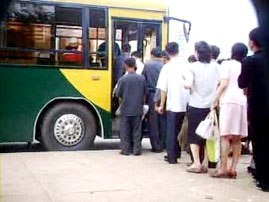
bus.jpgDuring the late 1990s, North Korea suffered a terrible economic collapse which resulted in famine and massive social dislocation.  During this time, most ministries and state-owned companies  were cash-strapped and unable to maintain their operations.  Out of desperation they turned to private investment for much needed revenues by outsourcing many basic services. (Individuals who were capable of taking up such opportunities were probably small in number at the time, but apparently now compose a healthy sub-section of the population.)

Outsourcing has benefited both the government and private entrepreneurs.  Outsourcing allows state-owned companies to receive capital financing from private individuals as well as a share of joint-venture revenues (tax revenues).  Private entrepreneurs need a legal business environment where they know they will not be subject to ex-post expropriation of profits.  Leasing the name of a government body gives them some of this legal cover.  This system is no doubt tolerated because it allows the government create space for entrepreneurship (and tax revenue) within the existing state structure while still maintaining de jure control of the means of production.   

According to the story in the Daily NK, the regulations for establishing a legitimate passenger bus company under this system (or “coach” company for readers in Her Majesty’s Commonwealth) are fairly strict.  Once an individual acquires a bus (appx US$6,000-10,000), he has to register it with the government body for whom he is working.  Revenues are then split 70/30 (the government taking 30%) for three years, after which the individual is required to “donate” the privately acquired bus to the state-owned enterprise.  This policy literally gives North Korean entrepreneurs just three years to recoup their investments!

The response of the North Korean business community was predictable:  investors sell the buses before the three years are up or they forge registration papers.  This is not hard to do in the DPRK.  In fact if you have just one other associate who owns a bus in similar condition, all you need to do is trade with him every three years and re-register the new vehicle. 

Word of this game has finally reached the top and they have responded by increasing their share to 70% of passenger bus revenues–leaving just 30% for the purchaser of the vehicle.  It is unclear from the story if investors are still required to “donate” their busses after three years, but realizing that the confiscation of buses was not enforceable, the North Korean government probably just opted for a larger share of the revenue over time.

The good news is that it is not likely that many people pay 70% of revenues either.  After-all, someone has to collect these taxes and he has needs too.  Sounds like some kind of arrangement could be reached…

You can read the full story here:
North Korea Regulates Operation of “Service Car”
Daily NK
2/18/2008

Share

ROK business optomistic about inter-Korean cooperation after nuke resolution

Tuesday, February 12th, 2008

Institute for Far Eastern Studies (IFES)
NK Brief No. 08-2-12-1

2/12/2008

South Korean businesses currently involved in inter-Korean economic cooperation are facing many difficulties, both due to and in spite of the system in place, so that at the moment, investment in North Korea does not look much more appealing than in Vietnam or China.

The Korea Chamber of Commerce carried out a survey, titled “Business Perspective on the Direction of South-North Economic Cooperation Policy”, targeting 300 successful businesses (170 companies responded) and 200 companies currently involved in inter-Korean economic cooperation (132 companies responded). According to the results of the survey, 79.4 percent of companies involved in inter-Korean cooperation responded that they are “currently facing systemic and procedural difficulties.”

More specifically, 44.7 percent pointed to the “3-C” (commute, communication, and customs) issues, 22.4 percent pointed to “claim resolution procedures,” 14.3 percent highlighted “difficulties with financial transactions,” 11.8 percent chose the “ban on the import of strategic materials,” and 5 percent indicated that “limited markets” were the main issue.

In addition, 58 percent of responding companies noted issues not related to the system set up for inter-Korean cooperation. 36.6 percent pointed to difficulties resulting from the “lack of understanding of market economics,” 28.7 percent noted a “lack of supervision by managers,” 24.8 percent chose “uncooperative, highly tense attitudes,” and 8.9 percent pointed out “demands for quick production.”

When asked about the relative attractiveness of investment in North Korea if the current situation were maintained, as compared to Vietnam and China, only 27 percent responded, “more attractive”, while 53.7 percent, or twice as many companies, responded that investment was “impossible.”

However, 58 percent responded that, in the event the North’s nuclear issues were resolved, investment in North Korea would be “more attractive than China and Vietnam”, while only 21.7 percent responded that investment in the North would still be “impossible.”

The overall impression of these companies regarding inter-Korean cooperation is that “improvement of inter-Korean relations offers opportunities for new enterprises and is a positive influence on the South Korean economy” (65.3 percent), and 19 percent felt that cooperation would “in the future, serve as a springboard for the relaunch of the South Korean economy.” 15.7 percent of responding companies felt, however, that “there would be no substantial positive influence on the economy.”

Currently, a resolution to the North Korean nuclear issues is the most important factor, but it is imperative that pledges of the incoming ROK administration such as strengthening investment security, preparing claim resolution measures and other issues to placate business interests, and nurturing North Korean exporters, are institutionalized.

Share

Forced Construction of Kim Jong Il Road in Bitter Cold

Monday, January 21st, 2008

Daily NK
Moon Sung Hwee
1/21/2008

Tens of thousands of a Shock Brigade (state construction workers) of North Korea are forced to build roads under minus 20 degree Celsius weather to prepare for Kim Jong Il’s unforeseen visit to the area, an inside source told the Daily NK.

The informer said, on the 3rd of January, “Since mid December, thirty thousands of Shock Brigade for the Propaganda of the Party Ideology (shortly June 18 Shock Brigade) had been poured into building road in Samsoo, Yangkang Province.”

He added that the Shock Brigade was connecting road between Wangduk Station in Hyesan (exclusively for Kim Jong Il) and Samsoo Power Plant. Kim Jong-Il was rumored for planning on surprise visit to the power plant. The road would be 22 km in length.

There was actually a road built in 2003 between Wangduk and Samsoo Power Plant. However, the road was ordered to be renovated due to Kim Jong Il’s dissatisfactory remark on it in his March 2006 visit to the area.

During the 2003 road construction, the Hyesan city government mobilized tens of thousands of residents plus June 18 Shock Brigade to finish it on time. Nevertheless, as Kim Jong Il showed discontent, Yangkang Provincial party officials and June 18 Shock Brigade officers were criticized harshly.

The problem was that the road was through downtown Hyesan, and a section of it was to meandering, thus dangerous to protect “the Comrade General.”

“After that, June 18 Shock Brigade, who just finished constructing Hyesan-Dancheon road, were reinforced and put to refurbish the Kim Jong Il’s private road,” the informant added.

The road currently under construction is to connect Wangduk and Samsoo Power Plant while circumventing populated area of Hyesan. And, of course, since the road is built as a “Number 1 Road,” it is solely for Kim Jong Il’s use, not even for party officials let alone ordinary people.

According to the informant, condition of road construction is harsh. Workers of the Shock Brigade are forced to work in bitter cold. When asked about disgruntlement of the workers, the informant replied, “This sort of hardship happens every time the General visits a certain area. Who can argue with the General’s order?”

Share

The Dreams of North Korea’s Youth Is to Succeed as Merchants

Friday, December 28th, 2007

Daily NK
Park Hyun Min
12/28/2007

The future dream of North Korea’s teenagers is no longer to become party leaders or soldiers, or even join the Party, but to become “merchants.”

Good Friends,” an aid organization for North Korea, said through “Today’s News on North Korea” No. 104 on the 27th, “Most of the elementary and senior middle school students nowadays, upon being asked what they would like to do post-graduation, say they would like to be merchants.”

The source relayed, “Many of their peers have stopped going to school and have started doing business. It is too burdensome for some students to attend school, so they sell noodles or vegetables by sticking around the jangmadang (markets) and contribute to their families’ livelihoods.”

(more…)

Share

Wireless Comms, Internet in Kaesong Industrial Complex and Kumgang Mountain Tourist Resort

Monday, December 17th, 2007

Institute for Far Eastern Studies (IFES)
NK Brief No. 07-12-17-1

12/17/2007

North and South Korea are poised to allow Internet, telephone, and cellular services to be available in the Kaesong Industrial Complex (KIC) and at the Kumgang Mountain Tourist Resort beginning next year. The 7th Defense Ministerial Talks opened on December 12 at the ‘Peace House’ on the South Korean side of Panmunjum, and at the meeting, North and South Korea reached an agreement regarding communications, transportation, and customs.

According to the agreement, Pyongyang has given permission for the use of Internet landlines and cellular phones in the two largest inter-Korean cooperative projects. However, while the South Koreans pushed for the inclusion of “mobile phones” in the agreement, the North insisted on “wireless telephone communications”, suggesting that they hope to use dual-use wired telephones rather than mobile cellular phones.

In addition, under the agreement, North and South Korean rail and road traffic will be allowed to cross the border daily from 7:00am to 10pm, with the exception of Sundays and official holidays. Currently traffic in the area is limited to 7am~6pm in the summer, and 8am~5pm in the winter months.

The two sides also agreed to new procedures aimed at simplifying customs inspections and reducing delivery delays. From now on, the two sides will exchange lists of goods being moved, after which time any specific good that is flagged will be inspected. Currently, both sides are required to supply a list of goods to be pass through the area three days in advance, and every piece is individually inspected, complicating customs procedures.

The agreement was signed ROK Defense Minister Kim Jang-soo and Kim Il-chul, minister of the DPRK People’s Armed Forces, and went into effect on December 13. With this agreement, exchange and cooperation in the KIC and Kumgang Mountain resort are expected to even more actively grow.

Share