Archive for the ‘Automobiles’ Category

DPRK imports hundreds of cars in last week

Wednesday, April 14th, 2010

According to the Choson Ilbo:

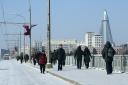
A North Korean source saw around 30 identical vehicles crossing the bridge across the Apnok (or Yalu) River into Sinuiju at around 9 a.m. The vehicles were the Chinese compact sedan F3 manufactured by BYD, referred to as the “people’s car” in China due to its popularity. Around 100 cars reportedly crossed the border into North Korea on Tuesday alone. Starting last week, North Korea brought in more than 200 cars, including luxury foreign cars, jeeps and large vans. The total value of the imported cars is believed to be around US$5 million.

The North Korean regime often seeks to ensure the loyalty of senior officials by handing out the latest foreign-made cars on Kim Il-sung’s or Kim Jong-il’s birthday, but the Chinese-made cars imported this time are believed to be gifts for the middle ranks. “To my knowledge, the latest cars are gifts for mid-level officials at North Korea’s prosecution and state security agency and have been allocated to specific people in different regions,” the source said.

North Korea watchers believe the cars were bought to boost the morale of such officials, who were hit hard by the botched currency reform in December. “Failing to take care of mid-ranking officials could jeopardize the transfer of power to Kim Jong-il’s third son Jong-un,” said one North Korea expert. “The purpose of the gifts is to appease discontent.”

Judging from the pictures, it looks like the cars were driven across the Sinuiju/Dandong Sino-DPRK Friendship Bridge.  Satellite image here

So it appears the Kim Jong il uses automobiles in the same way foreign governments use international aid in North Korea–to “purchase” influence and support.  If the strategy works on a domestic level (within the DPRK), why does it have so much trouble on an international level?  Feel free to discuss.   

Read the full story here:
Kim Jong-il Imports Hundreds of Cars for Loyal Officials
Choson Ilbo
4/14/2010

Share

Jin Hualin, Yanbian University, on Chinese investment in DPRK.

Sunday, April 4th, 2010

Jin Hualin, dean of the College of Economics and Management at Yanbian University, talks about Chinese investment in Rason in China’s Global Times.  Here is an excerpt:

GT: If China does continue to rent Rajin harbor for another 10 years, what will the effects be?

Jin: China has reached an agreement to rent a pier at Rajin Port for another decade. A Dalian-based Chinese company has invested 26 million yuan ($3.8 million) in the reconstruction of Rajin Port No.1 Pier. Park also said that China may enjoy more favorable conditions there, such as more berths.

I think Chinese companies’ participation is good for promoting the North Korean economy and building logistical infrastructure in the area, which is beneficial to China, North Korea and the Northeast Asian countries.

When the Sino-Mongolia route is finished, raw materials and natural resources from Mongolia can be shipped to Japan and South Korea via Rajin harbor, and then China’s northeastern regions and North Korea can both benefit.

GT: What should China do to promote Northeast Asian cooperation and devel-opment?

Jin: I suggest Chinese governments at all levels consider the following issues. They should accelerate trade and tourism and build cooperation on logistics, and support Chinese companies going global and investing in North Korea.

Actually, China now has many companies capable of investing abroad. The point is foreign countries’ investment environment.

We should strengthen cooperation on education with North Korean universities and colleges, sending students to study there and exploring research in new areas together.

We can also strengthen regional cooperation. We can designate China’s Hunchun city and North Korea’s Rason city as pilot cities and permit China’s commercial banks to open yuan-based accounts in Rason’s commercial banks.

Relations between Northeast Asian countries are subtle and complicated because of geopolitical contradictions, different political systems, the influence of the Cold War, historical issues, territorial disputes and sentiments caused by historical and territorial issues.

Mutual distrust fundamentally hinders cooperation. China needs to take the responsibility to promote regional cooperation and make it institutionalized and legally guaranteed as soon as possible.

GT: How do you evaluate the political and economic risks for Chinese companies going into North Korea? What advantages do Chinese companies have?

Jin: There are always political and economic risks involved in trade between different countries. The first major solution is to establish a mutual investment guarantee agreement, so that the two countries’ economic cooperation will be protected legally.

We hope that North Korea can keep the stability and consistency of its policies and issue development policies that is in line with international conventions. As long as North Korea adopts consistent policies, Chinese companies won’t encounter great political and economic risks there.

China and North Korea are believed to enjoy good mutual trust. China has experience from its reform and opening-up and plenty of investment capability. North Korea has a good educational foundation, low labor costs, and rich natural resources.

Chinese companies are active participants in investing in North Korea and I believe they’ll do well there.

Read the full interview here. Hat tip to Adam.

Share

Border crossing more expensie

Friday, February 19th, 2010

According to the Daily NK:

Since the redenomination on November 30 last year, the cost of crossing the Tumen River has risen as high as 10,000 Yuan on the back of tighter border regulations.

A source from North Hamkyung Province told the Daily NK on Thursday, “Since border security was strengthened in February, it has cost at least 10,000 Yuan to cross the border into China.” This is equal to around 400,000 North Korean won at the black market exchange rate, or $1400.

In 2006, the cost of crossing the Tumen River around Musan and Onsung in North Hamkyung Province was just 500 Yuan.

The reason is because now there is an alliance of brokers monopolizing the crossing business, and a number of regulations designed to both circumscribe the ability of citizens to cross and limit the relationship between guard companies and local citizens.

In the distant past, if people wanted to cross the river, they approached guards and haggled over the price directly. However, now people have to rely on professional brokers who put them in contact with guards and guides in China. One pays a price to the broker, who shares it with North Korean border guards and Chinese guides respectively at a ratio of 4:3:3.

The North Korean authorities designated the period from February 5th until Kim Jong Il’s birthday on the 16th as a period of “special vigilance,” handing down special instructions to strengthen the border guard and regulations covering migration in border cities.

According to a Daily NK source, this measure is primarily intended to limit the ability of those suffering since the redenomination to smuggle or cross the border to make money in China, as well as to regulate citizens in advance of Kim Jong Il’s birthday, which is customary.

The source emphasized, “Since December last year, the number of citizens using human networks in China to make money has been increasing. Therefore, agents of the National Security Agency and the People’s Safety Agency have been watching those people closely.”

The source further explained, “Now, the authorities are forcing border guards to observe each other in order to track down those doing business with brokers and border crossers. In January, in Yusun-dong, Hoiryeong, one company commander was dismissed after a platoon commander informed on him for assisting border crossers.”

In the mid-2000s, along the border near settlements such as Namyang, Sambong, and Jongsung in North Hamkyung Province, the authorities set up nail boards and extra barbed wire along the Tumen River in order to inhibit defection. However, as these physical measures were not as effective as hoped, in 2006 the authorities took to switching guard posts between different guard companies without notice and awarding a prize, membership of the Party, to guards who caught people crossing the border. These measures were designed to break down connections between individual guards and the local populace

Therefore, the source added, “These days, no border guards are helping people cross the river, and the cost is soaring.”

Read the full story here:
Tight Rules Make Border Costs Soar
Daily NK
Lee Sung Jin
2/19/2010

Share

Friday Fun Smörgåsbord

Thursday, January 21st, 2010

Item 1: Koryo Credit Development Bank. This bank is located in the Yangakdo Hotel and is accessible to foreign visitors.  Here are the marketing materials they provide to “encourage” foreigners to set up hard currency accounts: Folder (PDF), Inserts (PDF).

Item 2: DPRK Customs Form (PDF)

Item 3: The Ryugyong Hotel is looking more like a spaceship (Source here. Date: 12/2009)

py-winter10.jpg
Click for larger version

Too bad it will never take off

Item 4: DPRK Transportation. Last September I linked to a collection of vehicles manufactured in the DPRK.  See them here.  This month Kernbeisser posted a great collection of photos he has taken of vehicles on the DPRK’s roads.  Seem them here

Share

China approves Tumen border development zone

Monday, November 23rd, 2009

UPDATE:  China plans development zone on North Korean border
By Michael Rank

China is planning a major new development zone along the North Korean border aimed at boosting trade with its reclusive neighbour and throughout northeast Asia, a Chinese-language website reports.

The plan is to come to fruition under two separate deals: the border cities of Dandong in Liaoning province and Tonghua in Jilin province have signed an (unpriced) “development and opening up vanguard zone cooperation agreement” as well as a 440 million yuan ($64 million) “six-party cooperation agreement” with the Shenyang Railway Bureau, Changchun Customs, Dandong Port Group and Tonghua Steel (Tonggang) to build a “Tonghua inland port” with a duty-free zone, warehouses and international transit facilities that will be ready in 2012.

The Tonghua-Dandong Economic Zone will apparently stretch over most of the western half of the Chinese-North Korean border, a distance of around 350 km. The city of Tonghua is in fact some 80 km north of the border, but the report says the new zone will include the border post of Ji’an which is administered by Tonghua.

It gives few further details, but notes that when Premier Wen Jiabao visited North Korea last month he signed an agreement on building a new bridge across the Yalu river which would further boost Chinese-North Korean trade.

It also quotes the acting mayor of Tonghua, Tian Yulin, as saying that the new zone will transform the city from “inland” to “coastal” and “will promote trade between the inland cities of the northeast and North Korea and with the whole of northeast Asia.” The report adds that almost 60% of China’s trade with North Korea passes through Dandong.

This is not the only new development zone in China’s rustbelt northeast, which has been in severe economic decline in recent decades: a separate Chinese report announces the creation of another zone in Jilin, stretching from the capital Changchun in the centre of the province to the city of Jilin (or rather just part of it, for some unstated reason) as far as Yanbian on the North Korean border. This report does not mention North Korea directly but says the new zone will make the eastern border city of Hunchun an “open window” for regional trade, with Changchun and Jilin city “important supports.”

One-third of Jilin’s 26 million population live in the zone and it accounts for half of the province’s economic output, the report adds. See also this English-language report.

State-owned Tonghua Steel’s involvement in the Tonghua-Dandong zone is somewhat surprising as the ailing company has been rocked by unrest following an abortive attempt at a takeover deal by rival company Jianlong earlier this year. There was strong opposition to the deal on the part of workers who feared they would lose their jobs, and their fears turned to violence last July when a senior manager was murdered in mysterious circumstances.

The Chinese business magazine Caijing told how “the man’s death at the hands of unidentified killers uncovered an often antagonistic network of competing business interests and investors involved in Jianlong’s botched attempt to buy Tonggang.”

Tonghua Steel was in 2005 planning to sign a 7 billion yuan ($865 million), 50-year exploration rights deal with a North Korean iron ore mine, said to be the country’s largest iron deposit. The Chinese company was hoping to receive 10 million tonnes of iron ore a year from the Musan mine as part of its plans to increase steel production from a projected 5.5 million tonnes in 2007 to 10 million tonnes in 2010.

Tonggang boss An Fengcheng said at the time that agreement had already been reached with China Development Bank on 800 million yuan worth of soft loans and 1.6 billion yuan of hard loans, while “the remaining investment will come in in stages”. But it seems that the deal was never signed.

Caijing told how An, the steel mill’s chairman and Communist Party secretary, had “basically unlimited managerial control of Tonggang” and that the takeover by Jianlong was cancelled just a few hours after the murder of the manager Chen Guojin, who had come from Jianlong and was one of two Jianlong representatives on the board of Tonghua.

“There is no evidence to suggest An’s involvement in Chen’s death. But two weeks after the incident, he was sacked and stripped of all power by the Jilin provincial government. No other details of his removal were announced,” the magazine added.

ORIGINAL POST: According to the P.R. of China’s Global Times (Xinhua) via Adam Cathcart:

The Chinese government has approved a border development zone in the Tumen River Delta to boost cross-border cooperation in the Northeast Asian region, the provincial government of Jilin announced on Monday.The information office of the government said the pilot zone covering 73,000 square kilometers involved the cities of Changchun and Jilin as well as the Tumen River area.

Han Changbin, governor of Jilin, said the Changchun-Jilin-Tumen pilot zone was China’s first border development zone.

It is expected to push forward cross-border cooperation in the Tumen River Delta.

The delta, a 516-kilometer-long river straddling the borders of China, Russia and North Korea, was set up as an economic development zone in 1991 by the United Nations Development Program (UNDP) to promote trade.

In 1995, five countries – China, Russia, North Korea, South Korea and Mongolia – ratified the agreement on the Establishment of the Cooperation Commission for the Tumen River Economic Development Area (web page here). Japan participated in the program as an observer.

In 2005, the five signatories agreed to extend the agreement for another 10 years.

They also agreed to expand the area to the Greater Tumen Region and to further strengthen cooperation for economic growth and sustainable development for the peoples of Northeast Asia.

“Before the Changchun-Jilin-Tumen pilot zone was initiated, the Chinese part of the Tumen River area was mainly Huichun, a port city in Jilin, that has involved in the cross-border cooperation,” said Zhu Xianping, director of the Northeast Asia Research Institute of Jilin University in Changchun.

The 5,145-square-kilometer port city with a 250,000 population had limited industrial development capacity to develop infrastructure projects that will match the cross-border cooperation, he said.

Du Ying, deputy director of the National Development and Reform Commission, said that by bringing the two cities of Changchun and Jilin into the border zone, the zone could serve as a strategic platform to support the cross-border cooperation in the Greater Tumen Region.

Zhao Zhenqi, an assistant to the Jilin governor, said the central government has allowed the pilot zone to try new land use and foreign financing methods, such as sharing ports and sea routes with other countries in the region and setting up free trade zones.

Under the initiative of the pilot zone, local governments in the region could better interact to tackle development bottlenecks, he said.

The Northeast China region, rich in natural resources including coal and oil, is China’s traditional heavy industry base and granary. However, it also faces the challenges of industrial upgrading, resource depletion and financing bottlenecks.

Random thoughts and links:
1. The challenge facing north east China (as they see it) is the lack of a port city on the East Sea (or the Sea of Japan if you prefer).  This is where North Korea comes in.  China and Russia have long been trying to establish  use rights and/or control of Rason and Chongjin.  Russia recently built a “Russia-gague” railroad line from Rason to the DPRK-Russian border. The Chinese have been busy building roads.

2. (speculation) China is the DPRK’s largest trading partner.  International sanctions have given China monopsony power vis-a-vis the DPRK.  This means the Yuan goes farther in the DPRK than in other countries and it gives the PRC a financial incentive in the continued economic isolation of the DPRK.

3. Here is CCTV video.

4. Forbes covers this story here.

Share

Autos manufactured in the DPRK

Monday, September 7th, 2009

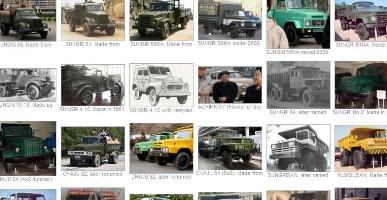
dprk-cars.JPG

(h/t DPRK Studies) Erik van Ingen Schenau of the China Motor Vehicle Documentation Centre has posted a collection of photos of vehicles manufactured in North Korea.  Check them all out here.

Other links:
1. Background on Sungri Motors here.  This is the location of the Sungri Motor Plant.

2. Some background on Pyonghwa Motors here.  This is the location of the Pyonghwa Motors plant.

3.  I am not sure of the location of Pyongyang Auto Works or the Kamaz (Russian company) factory in Pyongsong.

Share

Umbrellas of Pyongyang (Update below)

Wednesday, August 19th, 2009

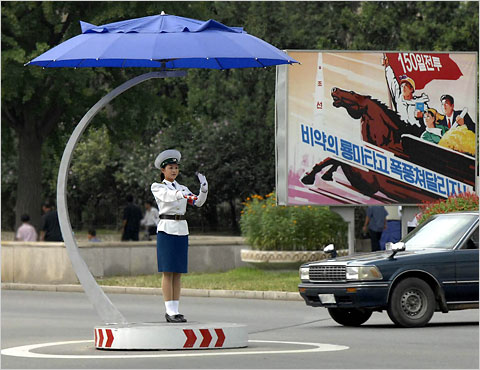
umbrellas.jpg

(click for larger version)

Traffic Control Platform beneath Umbrella Installed at Intersections of Pyongyang

Pyongyang, August 13 (KCNA) — Unique platforms under umbrellas are being set up in traffic control posts at intersections of Pyongyang these days, attracting attention of people.

The round platform under well-shaped large umbrella is clearly seen at far distance.

The umbrella shields the traffic controllers from sunrays and rain and the platform shuts out heat from the heated asphalt.

The female traffic controllers are commanding the traffic with a bright face on the platform under the umbrella even in the hottest period of summer.

Passers-by stop walking for a while to see the new scene.

They say it can be seen only in the country led by Kim Jong Il.

The traffic controllers are moved by the warm affection shown for them by General Secretary Kim Jong Il who saw to it that the platforms with umbrellas are being set up this time after raincoats, rain boots, sunglasses, gloves and cosmetics as well as seasonal uniforms were provided to them.

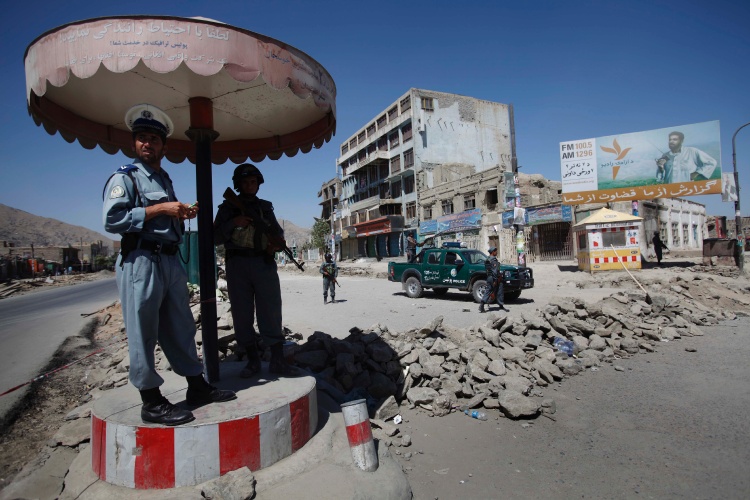
UPDATE: MarkT seems to have discovered similar technology (though much older) in Afghanistan:

afghanistan.jpg

Image from Military Photos

Share

2012 plan extends to Sungri Motors

Thursday, July 16th, 2009

According to Yonhap:

North Korea’s sole home-grown automaker seeks to expand its annual production capacity to 10,000 units by 2012, a level not reached since its peak in the 1970s, a pro-Pyongyang paper said Tuesday.

The Sungri Motor Complex, which started production in 1958, has gone downhill as the country suffered economic downturns and severe famine in the decades following the 1970s.

The Choson Sinbo, a Tokyo-based newspaper that relays Pyongyang’s position to the outside world, said the automaker is aspiring to return to its record production capacity by 2012, the target year for the country to become a “strong, prosperous and powerful nation.”

“As production decreased from the 70s, the workforce of the motor company fell to 75 percent of the peak years,” the paper said.

“During economic hardships in the late 90s, the company was close to not breathing. But now, anyone active in production is talking about the ‘promised revival,'” it said.

The paper noted North Korean leader Kim Jong-il’s trip in March to the complex, located at the foot of Mt. Sungni in South Phyongan Province, during which he stressed that the “modernization and scientification of the complex” is the most important factor in increasing output.

Kim then “guaranteed” state support to introduce computer numerical control machines to the complex, it said.

The automaker started producing hundreds of trucks named “Sungri 58-type,” “Sungri 61-type” or “Jaju (independence) 64-type” in late April, but output is “still in their early stage,” the paper said.

North Korea seeks to build a “strong, prosperous and powerful nation” by 2012, the centenary of the birth year of Kim Il-sung, the nation’s founder and father of North Korea’s current leader, Kim Jong-il, who will turn 70 that year.

Read the full story here:
N. Korean automaker aims to return to peak production by 2012
Yonhap
Kim Hyun
7/14/2009

Other links:
1. Background on Sungri Motors here.

2. I believe this is the location of the Sungri Motor Plant.  If anyone has evidence to the contrary, please let me know.

3. Read about another DPRK auto manufacturing plant here.

Share

Friday Fun: “Do not overtake (pass)”

Friday, July 10th, 2009

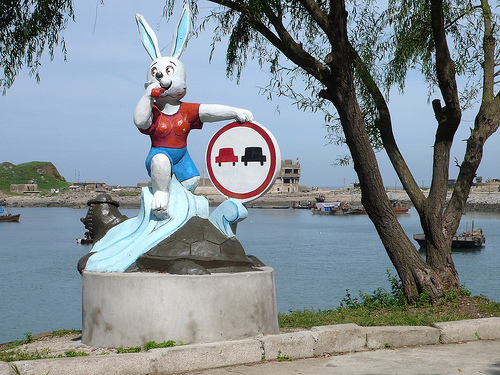
A valued reader points out this gem by Kernbeisser:

kernbeisser-roadsign.jpg

The above road sign is supposed to remind drivers not to overtake those ahead of them.  A powerful lesson the leadership would prefer to instill in all officials–not just those with cars.

You can see this rabbit yourself if you visit this summer! How about that for an incentive?

Here are more great photos by fellow traveler Nayan Sthankiya including one featuring yours truly.

Share

North Korea on Google Earth v.18

Thursday, June 25th, 2009

North Korea Uncovered version 18 is available.  This Google Earth overlay maps North Korea’s agriculture, aviation, cultural locations, markets, manufacturing facilities, railroad, energy infrastructure, politics, sports venues, military establishments, religious facilities, leisure destinations, and national parks.

This project has now been downloaded over 140,000 times since launching in April 2007 and received much media attention last month following a Wall Street Journal article highlighting the work.

Note: Kimchaek City is now in high resolution for the first time.  Information on this city is pretty scarce.  Contributions welcome.

Additions to this version include: New image overlays in Nampo (infrastructure update), Haeju (infrastructure update, apricot trees), Kanggye (infrastructure update, wood processing factory), Kimchaek (infrastructure update). Also, river dredges (h/t Christopher Del Riesgo), the Handure Plain, Musudan update, Nuclear Test Site revamp (h/t Ogle Earth), The International School of Berne (Kim Jong un school), Ongjin Shallow Sea Farms, Monument to  “Horizon of the Handure Plain”, Unhung Youth Power Station, Hwangnyong Fortress Wall, Kim Ung so House, Tomb of Kim Ung so, Chungnyol Shrine, Onchon Public Library, Onchon Public bathhouse, Anbyon Youth Power Stations.

Share