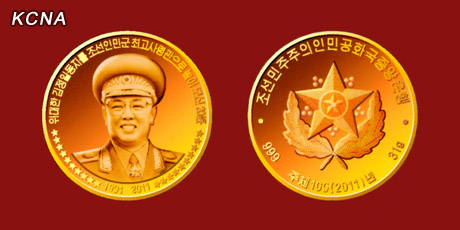
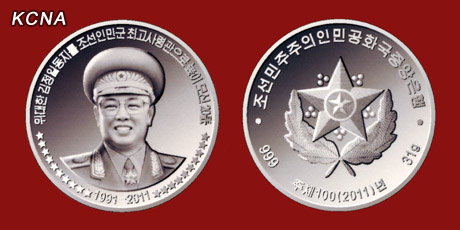
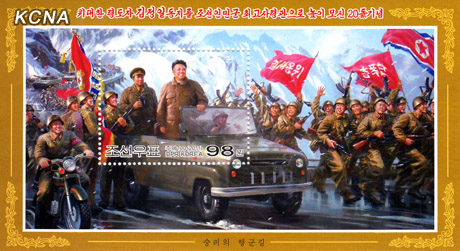
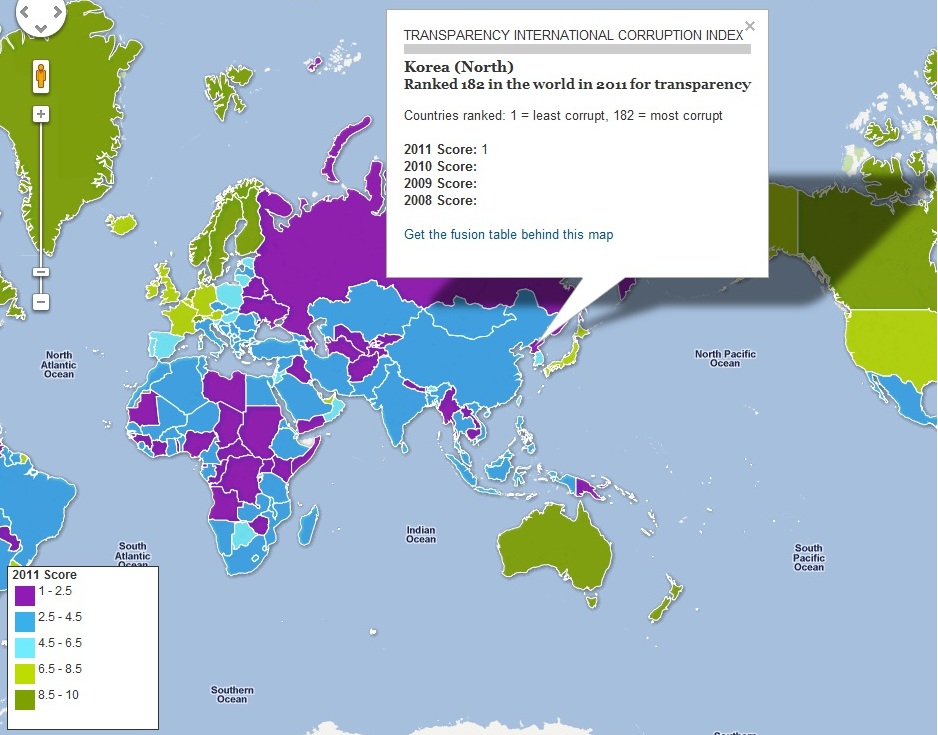
In the post below I kept a running list of news/events/analysis related to the death of former North Korean leader, Kim Jong-il, and the political rise of his son, Kim Jong-un. I believe I have been pretty thorough, but if there is something I missed, please let me know.
_________________
UPDATE 72 (2012-3-24): North Koreans observe end of 100-day mourning period following death of leader Kim Jong Il
UPDATE 71 (2012-2-16): RFA–Kim Jong-il’s Hoeryong memorial displaces homes
UPDATE 70 (2012-2-14): A Kim Jong-il statue was unveiled at the Mansudae Art Studio in Pyongyang.
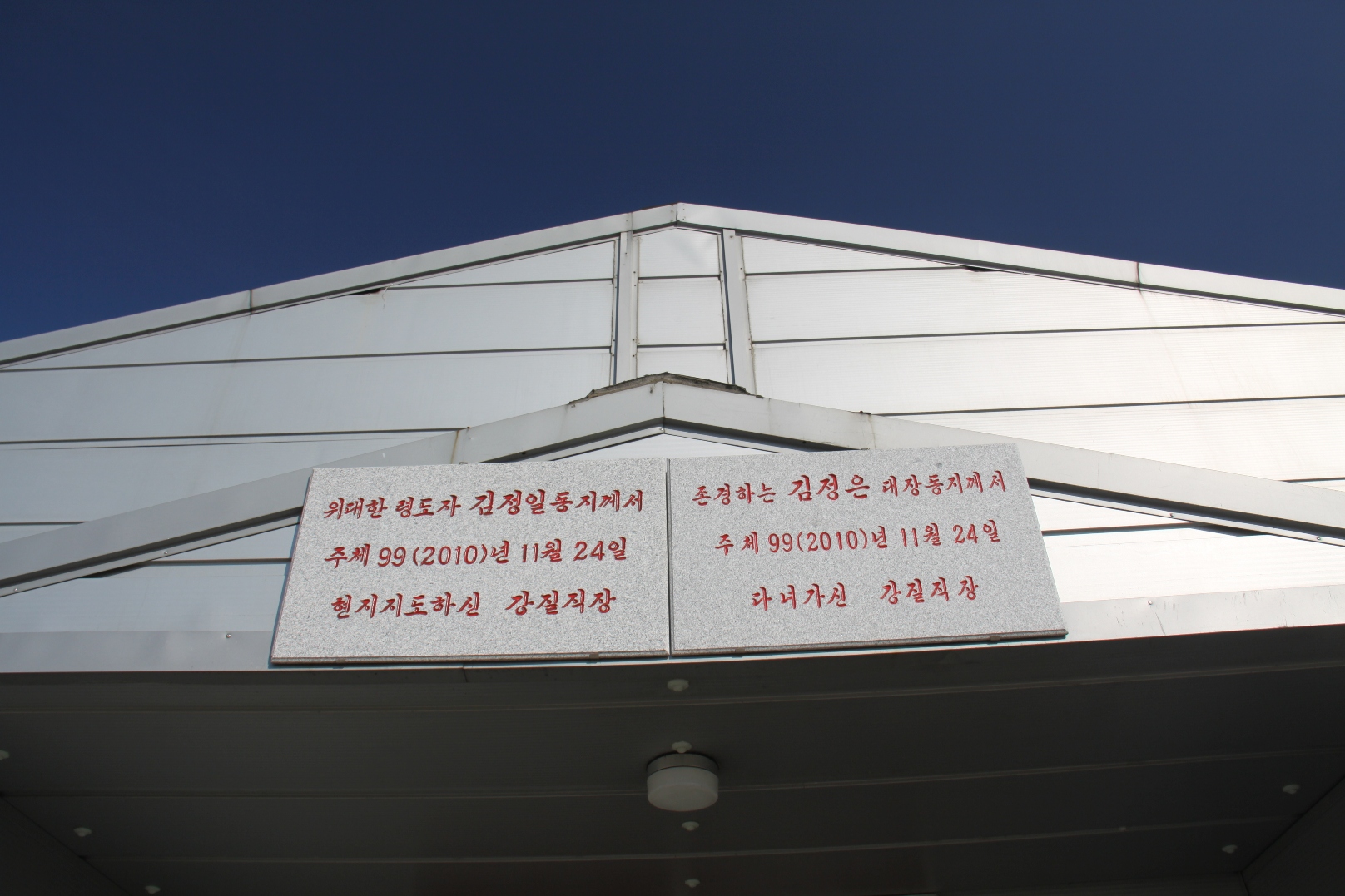
UPDATE 69 (2012-2-9): Kim Jong-il’s name has been carved into a mountain in South Pyongan Province.
UPDATE 68 (2012-1-28): Daily NK–North Korean construction costs incurred through the creation of statues of Kim Jong Il and the eternal tower is a burden to the people, multiple internal sources say.
UPDATE 67 (2012-1-12): Kim Jong-il’s body to be preserved for posterity. Andrei Lankov writes in the Asia Times about the history of the tradition–citing even “economies of scale” in the business.
Yonhap reports that a Kim Jong-il statue and immortality towers will be built.
Kim Jong-il’s birthday to be named “Day of the Shining Star”.
The Daily NK has more here and here.
UPDATE 66 (2012-1-10): DPRK troops swear loyalty to new leader Kim Jong-un in rally at Kumsusan Palace.
UPDATE 65 (2012-12-30): Here is video of mass rallies, cannon shots, and a moment of silence held across the DPRK for Kim Jong-il.
UPDATE 64 (2012-12-29):
1. Kim Jong-un named supreme leader. Quoting the New York Times:
“Respected Comrade Kim Jong-un is now supreme leader of our party, military and people,” Kim Yong-nam said, adding that Kim Jong-un “inherits the ideology, leadership, courage and audacity of Comrade Kim Jong-il.”
2. The Kim Jong-il era is over. The Kim Jong-un era begins.
3. North Koreans vow allegiance to new leader.
4. Ri Myung Hun (Michael) was seen at the funeral.
5. Here is the two-hour funeral video as seen on NK television.
6. Adam Cathcart found some Kim Jong-un propaganda in a Chinese magazine.
7. Ju Kyu-chang, the man in charge of the DPRK’s missile program and maybe the nuclear program attended paid last respects to Kim Jong-il. Officially, Ju is director of the KWP Machine-Building Industry Department, which he has been associated with since the 1960s. But his power stems from the NDC post and also his being named to the Workers’ Party Central Military Commission in 2010.
8. Some South Koreans mad an illegal (under South Korean law) visit to the DPRK for the funeral.
UPDATE 63 (2012-12-28): On this day Kim Jong-il’s funeral was held and Kim Jong-un was named “supreme leader” of the party.
1. The funeral procession: Yonhap published a helpful map of the funeral procession here. It was incorrect, however, so I posted a corrected version here.
2. Kim Jong-il’s body will remain preserved in Kumsusan Palace.
3. KEI coverage of the funeral.
4. Kim Jong-il carried to the grave in a US-made Lincoln Continental.
5. The DPRK doctored photos of the funeral procession that were given to Kyodo and the Associated Press. See more here.
6. Russian Scientists who preserve the corpses of Lenin, Ho Chi Minh, and Kim Il-sung are in Pyongyang working on Kim Jong-il.
7. Nick Frisch on the funeral music.
8. The Daily NK and IFES report prices are high but stable. According to the Daily NK:
Prices in North Korea’s jangmadang are much the same now as they were when the markets were shuttered immediately after news of Kim Jong Il’s death was made public on December 19th.
Rice, often employed as a barometer for North Korea’s overall market conditions, was trading for around 4,500 won/kg in cities along the Sino-North Korean border yesterday. Having reached a high of 5,000 won in the weeks before Kim’s death but then falling back to 4,000 won nearer the 19th, the latest price is well within the levels which might have been expected, and certainly does not suggest much fear in the market going into today’s funeral for the former dictator.
According to sources, the modest fall back to 4,500 won is just a natural result of product circulation in the market, something that is also reportedly reflected in other products.
And according to IFES:
After the death of Kim Jong Il, the shaky political situation has destabilized prices in North Korea. The price of rice is reported to have doubled recently. Immediately following the news of Kim Jong Il’s death, travel between China and North Korea and the gathering of people were strictly prohibited. In addition, markets in certain areas were temporarily closed. The price insecurity and closure of markets are adding to the dissatisfaction of the people. Merchants are selling food items secretly in black markets.
Recently in North Hamgyong Province and North Korean cities that border China, the price of one kilogram of rice has exceeded 5,000 KPW. The price of rice that sold for 4,000 KPW at the end of November has risen by 1,000 KPW in less than a month. The Chinese yuan–North Korean won exchange rate has also changed, from 700 KPW to 800 KPW in Haesan and Musan, and to 1,000 KPW in Hoeryong. With continuous escalation of prices with the stronger regulations and crackdowns being enforced, the voices of discontent seem to be growing. Rumors are quickly spreading that the price will continue to rise, adding further confusion for the people. After the failed currency reform, confidence in the North Korean currency continued to decline, leading to the soaring of the Chinese yuan, which consequently caused the price of rice to rise.
While the rice supply in the markets has remained relatively steady, the price continued to rise from the rising value of the yuan. Among the North Koreans, the yuan has become the currency of choice for trading and for private hoarding. An increasing number of people are buying rice to store.
Even the North Korean authorities are believed to be buying foreign currency, mostly USD and CNY from domestic trading companies at a higher exchange rate. Recently, North Korea is exchanging foreign currency brought in by domestic trade companies with its domestic currency at a much higher rate through the Foreign Trade Bank of Korea.
It is speculated that this is being done in effort to accumulate enough foreign currency necessary to carry out various events in 2012, including the completion of the construction of 100,000 housing units in Pyongyang.
As the confidence for the North Korean currency declines, the US dollar and Chinese yuan seem to be the preferred currency in the markets. Similarly, most trading companies are choosing to keep foreign currency for operating funds.
This is not the first time that North Korean government has attempted to obtain hard currency through its domestic trading companies and money brokers. Whenever the government took such measures to attain foreign currency, exchange rates would soar, which consequently caused prices to rise and affected the lives of its people negatively. The cause of the recent inflation is also blamed on the recent government measure to obtain more hard currency.
The DPRK government is forcing businesses and trading companies to deposit all the foreign currency earned in the trade bank. However, most companies prefer to hold on to their foreign reserves in cash to avoid complex deposit and withdrawal processes. They also seem to be using private money brokers to exchange money. Recognizing this, North Korean authorities have been cracking down on such illegal “private money exchangers” every year.
9. Uriminzokkiri uploaded nine videos of people mourning Kim Jong-il: one, two, three, four, five, six, seven, eight, nine.
UPDATE 62 (2012-12-27):
1. South Korean mourners return home.
2. Yonhap on the natural phenomenon related to Kim Jong-il and Kim Jong-un.
3. NKs paint a picture of stability.
4. Intellligence and security agencies demonstrate loyalty to the new leader.
5. North Korean markets re-opened on Christmas day.
7. Power Dynamics (38 North)
8. Uriminzokkiri videos: Mourning in Pyongyang, Pyongyang gymnasium, Kim Il-sung Square, Hungnam Fertilizer Complex, Namdok Coal Mine, Sinchon, Pukchang power plant, Janggang County, Koryo academy, Songchon Complex, Mangyongdae District, Sopho Chicken Farm, Kim Il-sung Square, Pyongyang Gymnasium, Kang Pan-sok Revolutionary School, Kim Il-sung Square, Tongil Street, 4.25 House of Culture, Kim Il-sung Square, 4.25 House of Culture, Party founding Monument, Pyongyang Gymnasium, Kumsusan one, two, three, four, 4.25 House of Culture, Pyongyang Meat Shop, Kim Il-sung Square, mourning, foreign news coverage, natural phenomenon, foreign news coverage, foreign news coverage, Russian Orthodox church.
9. South Korean funeral delegation relays DPRK desire to restart scuttled inter-Korean projects.
UPDATE 61 (2012-12-26):
1. South Korean Unofficial Delegation in North as Son Elevated: BusinessWeek, Bloomberg, BBC, Yonhap, New York Times.
2. KCNA: People Regrettable for Not Having Set up Kim Jong Il’s Statue.
3. Kim Jong-un visited Japan as a child.
4. Uriminzokkiri videos: Mourning at 4.25 Palace of Culture and Kim Il-sung Square, people mourning at home, mourners at Kim Il-sung Square, Kim Il-sung Square, Rason, Namhung Youth Chemical Complex, National Academy of Science, Kumsusan, Chinese news coverage.
UPDATE 60 (2012-12-25):
1. Uriminzokkiri uploaded the following videos: Womens’ Uion and Paektusan employees, Kim Il-sung Political University, KPA Unit, Pyongyng Indoor Gymnasium, Kim Il-sung Military University, Taedonggang Fruit Farm, KPA Unit, Kumsusan, Foreign press coverage, people mourning.
2. Yonhap reports that China and North Korea are holding a meeting over the DPRK situation this week:
South Korea and China will hold high-level talks in Seoul this week to discuss the situation on the Korean Peninsula and North Korea’s nuclear program following the death of its leader Kim Jong-il, the foreign ministry here said Sunday.
The one-day annual meeting, scheduled for Tuesday, will be led by South Korean First Vice Minister Park Suk-hwan and his Chinese counterpart Zhang Zhijun, the ministry said.
This year’s meeting, the first to be held after Kim’s abrupt death last week, is expected to touch on future plans regarding the communist state and discuss how to continue diplomatic efforts to revive the six-party talks on Pyongyang’s nuclear weapons program, according to officials.
The death of the secretive leader put a brake on a flurry of renewed diplomatic efforts to resume the long-stalled six-party talks, which have been dormant since the last session in late 2008. The nuclear talks involve the two Koreas, China, Japan, Russia and the U.S.
Before Kim’s demise, North Korea had been expected to announce that it would suspend its uranium enrichment program and accept U.N. nuclear monitors in exchange for food aid. Such North Korean moves are preconditions set by the U.S. and South Korea for resuming broader six-party talks.
3. Jang Sung-thaek seen in military uniform.
4. Kim Jong-un apparently named as supreme commander.
UPDATE 59 (2011-12-24):
1. Uriminzokkiri uploaded many videos of people mourning: Academy of Social Science, Rason, Chongjin, Chongsan Farm, Kangso water Factory, Munchon Middle School, Kumsusan Memorial Palace, Kim Il-sung Square, Okryu Restaurant, KPA unit (huchon Dam construciton workers), Kim Il-sung Square, Rakwon Machine Tool Factory, Construction Planning Office, South Hwanghae Party office, Kim Il-sung Square, 4.25 House of Culture, Phyongsong, Sariwon, Haeju, Kumsusan 1, Kumsusan 2, Kumsusan 3, Kumsusan 4, Kim Jong-un visits bier, foreign press coverage.
2. Uriminzokkiri also uploaded some videos of Kim Jong-il’s revolutionary activities. Video 1, Video 2, Video 3.
3. Some South Korean’s entered the DPRK on the 24th. Their visit was not reported until February 2012. According to the Donga Ilbo:
South Korea’s Unification Ministry belatedly confirmed Friday that another group visited North Korea via land route in December last year to pay condolences over the death of the North`s late leader Kim Jong Il. The government had said that it allowed just the widow of former President Kim Dae-jung and the family of the late Hyundai Group Chairman Chung Mong-hun to go to Pyongyang to pay their respects to Kim Jong Il.
The ministry said three Korean Americans — Moon Hyung-jin, international president of the Unification Church; Park Sang-kwon, CEO of Pyeonghwa Motors; and Douglas D.M. Joo, chairman of The Washington Times — crossed the inter-Korean border Dec. 24 to go to Pyongyang, which came two days prior to the visit by Kim Dae-jung’s widow and Hyundai Group Chairwoman Hyun Jeong-eun.
“Since all three people had U.S. citizenship, they could always visit the North through a third country,” a Unification Ministry spokesman said. “The South Korean government cooperated with them because they wished to visit North Korea from South Korea,” adding, “Back then, we didn`t think it is necessary to announce their visit to the North via land route.”
Those wishing to visit North Korea via land route are required to get prior approval from the ministry under an inter-Korean agreement. The visit request is relayed to North Korea after approval from the U.N. Command via the South Korean Defense Ministry. If Pyongyang accepts, they can cross the border.
UPDATE 58 (2011-12-23): News and Analysis:
1. NK Leadership Watch posts pictures of a woman presumed to be Kim Jong-un’s sister.
2. Andrei Lankov: “Successor Failure” in the Wall Street Journal.
3. The Economist on the DPRK consulate in Dandong, China.
4. Wall Street Journal: Did Chinese have to cry to catch a train out of the DPRK?
5. Ken Gause: Decision-making in post-Kim Korea.
6. Nautilus Institute research
7. Stratfor on the death of Kim Jong-il (via ROK Drop).
8. Princess Tenkohas been invited to Kim Jong-il’s funeral. Here is her Wikipedia page.
UPDATE 57 (2011-12-23): North Korean media wrap up:
1. KCNA posted over 30 stories about the Death of Kim Joong-il today. You can download them all on PDF here. Among the more notable articles:
Plenary Meeting of [United Nations General Assembly] Mourns Demise of Kim Jong Il
Plenary Meeting of UNGA Mourns Demise of Kim Jong Il
Pyongyang, December 23 (KCNA) — The participants in the plenary meeting of the 66th UN General Assembly on Dec. 22 mourned over the demise of Kim Jong Il, leader of the Democratic People’sRepublic of Korea.
Nassir Abdul Aziz Al-Nasser, president of the UNGA, proposed to all those present at the meeting to express condolences over the demise of Kim Jong Il, general secretary of the Workers’ Party of Korea, chairman of the DPRK National Defence Commission and supreme commander of the Korean People’s Army.
The attendants paid one minute’s silent tribute to the memory of the leader.
Here is the video.
Rev. Billy Graham, Rev. Franklin Graham, and Gov. Bill Richardson join President Carter in sending condolences:
Americans Mourn Demise of Kim Jong Il
Pyongyang, December 23 (KCNA) — U.S. Rev. Billy Graham, Rev. Franklin Graham who is president of Samaritan’s Purse, a non-governmental organization, and Robert Springs, president of Global Resource Services, a non-governmental organization, and his wife Babara Springs sent a floral basket and wreath to the DPRK permanent mission at U.N. Wednesday on the demise of leader Kim Jong Il.
Bill Richardson, former governor of New Mexico State, requested the U.S. government to express condolences over the demise of Kim Jong Il.
He in a Tuesday TV show including ABC TV said the U.S. government should express official condolences to the DPRK.
Kim Jong Un, vice-chairman of the Central Military Commission of Workers’ Party of Korea, made sure that special transport measures were taken and let officials in Pyongyang and local areas take charge of the supply in the field, saying the loving care of Kim Jong Il should reach the people as soon as possible even though it is a mourning period.
Officials and commercial service workers are now making sure that those fishes are supplied to every household in the city.
Salespersons and citizens burst out sobbing at fish shops in the capital city Friday.
Officials in the commercial service field in the city pledged their loyalty for Kim Jong Un, saying the history of loving care for the people continues and no people on earth are blessed with leaders and generals as the Koreans.
And for some strange reason KCNA posted two stories about fish distributions in Pyongyang:
Pyongyang Citizens Supplied with Fresh Fish
Pyongyang, December 23 (KCNA) — Fresh fish associated with leader Kim Jong Il’s deep concern began to be supplied to the Pyongyang citizens seized with grief at his demise.
Great Comrade Kim Jong Un took a special measure to transport fresh fish to Pyongyang in time and supply them to the citizens.
Both salespersons and inhabitants were deeply moved by Kim Jong Il’s deep care for the citizens.
Ku Ok Sun, a 62-year-old woman, told KCNA:
“I did not know that leader Kim Jong Il had paid deep concern to the fish supply to the Pyongyang citizens until his last days when he was staying in train. This fish makes me sorely miss him. I will get over the grief at his demise and do something to relieve respected Comrade Kim Jong Un of his heavy burdens.”
A saleswoman, Kim Ran Hui (32), said, “I am deeply moved by leader Kim Jong Il’s deep concern for the fish supply to Pyongyang citizens.”
An inhabitant, Kim Suk Yong (32), said:
“When receiving these pollacks and herrings, I was sorely missing leader Kim Jong Il. I feel my heart rent because he passed away during his uninterrupted field guidance tour for the happiness of our people. I will not give way simply to sorrow. I will never forget his deep care for our people. I will try to contribute to the building of a thriving nation, remaining faithful to respected Comrade Kim Jong Un.”
Supply of Fishes to Pyongyang Citizens Begins
Pyongyang, December 23 (KCNA) — The supply of fishes to Pyongyang citizens began Thursday at this sad time of national mourning.
Leader Kim Jong Il worked heart and soul to supply the people with fresh fishes the year round while giving tireless field guidance to fisheries bases on the eastern and western areas, commercial service centers and related units during his lifetime.
Earlier this year he made sure that pollacks and herrings were supplied to the Pyongyang citizens. At sandfish season this November he instructed officials to swiftly catch sandfish and send them to the people.
On the evening of Dec. 16, just a day before his demise, he took a step for the fish supply.
2. KCNA also uploaded a video of North Koreans crying in the Kwangbok Street Curcus Plaza. The video also showed “volunteers” sweeping the snow from the plaza. You can see the video here.
3. Uriminzokkiri uploaded three videos of Kim Jong-il to their Youtube Page. Video 1, video 2, video 3. They also uploaded nine more crying videos which I cant be bothered to add here.
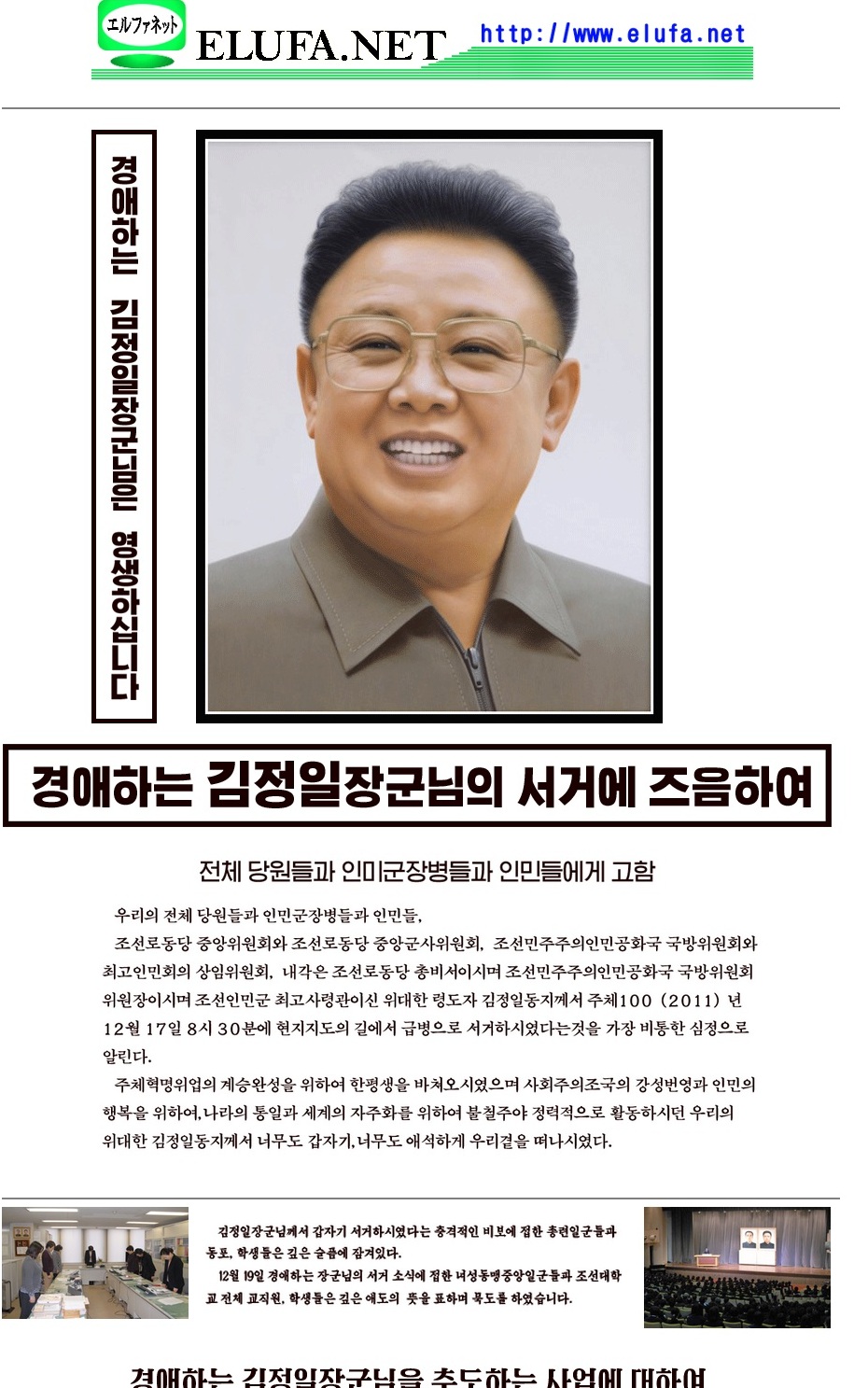
4. Elufa.net, a web page hosted by the Chongryon (Chosen Soren), pro-DPRK ethnic Koreans living in Japan, has been redesigned to mourn the death of Kim Jong-il:
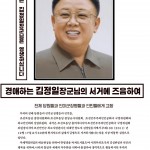
Click image for larger version.
UPDATE 56 (2011-12-22): News and Analysis:
1. Luke Herman compares the Kim Jong-il funeral committee list with the Jo Myong-rok committee.
2. Reforms of North Korea’s economy may languish as new, young leader consolidates power.
3. China wants to preserve Korean interests post-Kim
4. Even Land and Sky Seem to Grieve Demise of Kim Jong Il
5. The Council on Foreign Relations has posted a few items as well:
Kim’s Death Brings Fears of North Korea Hot Potato
Scott A. Snyder
Deciphering North Korea’s Transition
Paul B. Stares
North Korea After Kim Jong-Il
Scott A. Snyder, Paul B. Stares
North Korea’s Uncertain Succession
Scott A. Snyder
UPDATE 56 (2011-12-22): The Dow Jones Newswire reports a small uptick in the value of old North Korean bonds:
The defaulted bonds, which were created in 1997 when French bank BNP repackaged a series of non-performing syndicated bank loans that were granted to North Korea in the seventies, have suddenly sparked interest among speculators. The sporadically traded bonds, which trade at a deep discount to their face value, saw a tick up this week and were recently quoted at between 14 and 18 cents on the dollar, compared with 13 to 15 cents, according to London-based sales and brokerage house Exotix.
UPDATE 55 (2011-12-22): DPRK media roundup:
1. KCNA has published 24 more pages (single spaced) of Kim Jong-il stories. You can download them all here (PDF). Among the more humorous items are the return of “natural phenomenon” stories:
Even Nature Seems to Mourn Demise of Great Man
Pyongyang, December 22 (KCNA) — More natural wonders have been observed in different parts of the country since it was shocked by the sad news of the demise of leader Kim Jong Il.
On Wednesday people in the villages near the Military Demarcation Line including Sinhung, Ryongjong, Haephyong, Phungdok and Ryongsan-ris in Kaesong City observed natural wonders.
There were a series of blinding blue flashes accompanied by thunder with an interval of five minutes in the air south of the city wrapped with heavy fog from around 04:00 when heavy snow began falling down to 05:00.
This is something unusual in mid winter.
Witnessing this, citizens of the city said that the demise of Kim Jong Il was so heart-rending that even the sky seemed to writhe in grief. He was, indeed, a great saint born of Heaven, they added.
There was a similar story yesterday (2011-12-21):
Natural Wonders Observed
Pyongyang, December 21 (KCNA) — Peculiar natural wonders were observed on Mt. Paektu, Jong Il Peak and Tonghung Hill in Hamhung City where the statue of President Kim Il Sung is standing at a time when all Korean people are mourning the demise of leader Kim Jong Il in bitterest sorrow.
On the morning of Dec. 17 layers of ice were broken on Lake Chon on Mt. Paektu, shaking the lake with big noise.
The Group for Comprehensive Exploration of Lake Chon on Mt. Paektu said it was the first time that such big noise was heard from the ridge of Janggun Peak and the lake.
The temperature on Mt. Paektu that day registered 22.4 degrees centigrade below zero and there was strong wind accompanied by snowstorm measuring 18 meters per second.
The snowstorm stopped blowing all of a sudden from dawn of Tuesday and heavy clouds were seen hanging around Hyangdo Peak.
At around 8:05 a.m. the sky began turning red with sunrise on the horizon. The peaks looked like a picture for wide and thick glow.
Kim Jong Il’s autographic writings “Mt. Paektu, holy mountain of revolution. Kim Jong Il.” carved on the mountain, in particular, were bright with glow.
This phenomenon lasted till 5:00 pm.
Glow was seen atop Jong Il Peak for half an hour from 16:50 on Dec. 19 when the nation was shocked by the news of the leader’s demise. This was the first of its kind in dozens of years since the observation of the area was started.
A natural wonder was also observed around the statue of the President standing on Tonghung Hill.
At around 21:20 Tuesday a Manchurian crane was seen flying round the statue three times before alighting on a tree. The crane stayed there for quite a long while with its head drooped and flew in the direction of Pyongyang at around 22:00.
Observing this, the director of the Management Office for the Hamhung Revolutionary Site, and others said in union that even the crane seemed to mourn the demise of Kim Jong Il born of Heaven after flying down there at dead of cold night, unable to forget him.”
2. KCNA also published several more videos: People overcome with grief (9) at the Pyongyang Circus, People overcome with Grief (10) at the Monument to the Party Founding, Korean People Change Sorrow into Strength (Chollima Steel Complex/Taean Heavy Machine Complex), and Korean People overcome with grief (11)–Pyongyang indoor stadium.
3. Uriminzokkiri uploaded dozens of videos to their YouTube account: Mourning in provincial capitals, Children’s Foodstuff Factory, Crying in Kamsusan Palace (including Kim Jong-un receiving line) here, here, here and here, Sonhung Foodstuff Factory, Monument to Party Founding, Kim Il-sung Socialist Youth League Headquarters, Kim Il-sung Square, 4.25 Palace of Culture, Kwangbok Supermarket, a DPRK rebroadcast of Chinese Central Television, and a documentary of Kim Jong-il’s life.
UPDATE 54 (2011-12-21): Reports and analysis.
1. The Korea Society hosted a panel discussion with Thomas Hubbard, Charles Armstrong, Gordon Flake, and Dr. John Park. Watch it here.
2. Nicholas Eberstadt writes a summary of Kim Jong-il’s political career in the Los Angeles Times.
3. Barbara Demick , writing in the Los Angeles Times, interviews North Korean defectors who discuss the public mourning process in the DPRK.
4. This Korea Herald article speaks with representatives of PSCORE, Choson Exchange, the Fuller Center, and Tim Peters, and Network for North Korean Democracy and Human Rights.
5. This Reuters article, citing a super-secret source, has been picked up by other news agencies. Quoting from the article:
North Korea will shift to collective rule from a strongman dictatorship after last week’s death of Kim Jong-il, although his untested young son will be at the head of the ruling coterie, a source with close ties to Pyongyang and Beijing said.
The source added that the military, which is trying to develop a nuclear arsenal, has pledged allegiance to the untested Kim Jong-un, who takes over the family dynasty that has ruled North Korea since it was founded after World War Two.
The source declined to be identified but has correctly predicted events in the past, telling Reuters about the North’s first nuclear test in 2006 before it took place.
This clam is similar to analysis provided by the South Korean NIS (see update 47 below)
UPDATE 53 (2011-12-21): Internal.
1. The Daily NK posted two stories on how the death of Kim Jong-il is different than the death of Kim Il-sung. Here is article one. Here is article two.
2. The Daily NK also reports that soem limited unofficial trading is being tolerated–at least in the distant Ryanggang province. According to the article:
The North Korean authorities have apparently decided to allow a limited number of ‘grasshopper traders’, people who sells their goods without a stall in the streets around official markets and other busy locations, to operate in the aftermath of the death of Kim Jong Il.
The authorities closed the official markets immediately following Monday’s announcement, chasing away all the grasshoppers in the process.
However, the closure of the market would have been a huge blow for the public, given that it has been the main source of most people’s food and daily essentials in modern-day North Korea for more than ten years. As such, the toleration of grasshoppers is very welcome.
A source from Yangkang Province told The Daily NK on Wednesday, “There was no official order to go out and trade, but they aren’t cracking down on those people working in front of the train station or in alleyways, either.” According to the source, the grasshopper traders are selling small amounts of food and cigarettes.
Prices are high, though, the source explained, saying, “There are lots of people who want to buy, but because the number of sellers is so limited the prices have jumped even higher than before. The price for 1kg of rice is 4,800 to 5,000 won and packs of ‘Gohyang’ cigarettes are selling for 4,500 won.”
While rice prices had reached 5,000 won/kg in places a week or so prior to Kim’s death, they had begun to fall again; just before the death of Kim Jong Il was announced, local rice was around 4,000 won/kg and 3,000 won bought a packet of cigarettes. However, the death has seen both spike significantly.
The previous alternative following the closure of the markets had been to live day to day on necessities bought from unsanctioned, small-scale sales locations known as ‘village stalls’.
These locations are similar in scale to a convenience store and, like a convenience store, they trade on convenience at high prices. Based in private homes, they only advertize themselves in very furtive ways but local residents all know where they are and can buy what they need in an emergency, such as when the authorities close the markets. Ordinarily, they only serve those elderly, infirm or incapable of travelling to cheaper, but more distant, official markets.
One source said of the village stalls, “People have always gone to them under the cover of darkness to buy necessities whenever the state has done things like shut down the official market or intensify inspections.”
According to one source, however, village stallholders were and are being extremely careful because they fear having their goods confiscated and then being punished after the mourning period is over. As a result, they are only selling to people they know.
Update 52 (2011-21-21): South Korea.The DPRK has expressed an interest in pushing forward with the Manwoldae restoration project (Yonhap). See background here and here. Yonhap also reported that South Korean President Lee Myung-bak expressed his hopes that North Korea will overcome the death of Kim Jong-il so that peace will be maintained. See the article here. See previous South Korean responses below in Update 47 and 36.
UPDATE 51 (2011-12-21): DPRK media wrap up for the day (Part1 in update 44 below):
1. Here is the remainder of KCNA posts that were added this afternoon (PDF–nearly 7 pages single spaced).
2. KCNA also added two more videos of North Koreans crying: Video 1 (Kim Il-sung Square), Video 2 (Hana Joint Venture Co. where Kim Jong-il made one of his last public appearances).
3. Urimonzokkiri also uploaded too many videos for me to watch today–all of Koreans crying: video 1, video 2, video 3, video 4, video 5, video 6, video 7, video 8.
UPDATE 50 (2011-12-21): Some more publications and analysis:
“The Party as the Kingmaker: The Death of Kim Jong Il and its Consequences for North Korea”
38 North
Ruediger Frank
“North Korea’s Choice: Collapse or Reform”
Foreign Affairs (CFR)
Andrei Lankov
“North Korea: new opportunities in a post-Kim Jong-il landscape”
East Asia Forum
Geoffrey See, Choson Exchange
See previous articles and analysis in UPDATE 43 and UPDATE 23 below.
UPDATE 49 (2011-12-21): Some humor: The capitalists cash in on Kim’s legacy. Kim Jong-il T-shirts go on sale (I don’t get any of the proceeds)
UPDATE 48 (2011-12-21): Some time ago, I posted Kim Jong-ils only public address to YouTube. This is the only time most North Koreans ever heard his voice. You can see it here.
UPDATE 47 (2011-12-21): Seoul’s intelligence service makes a public prediction about the succession (Yonhap):
A caretaker leadership led by a Workers’ Party commission under the control of the chosen son of late North Korean leader Kim Jong-il is expected to handle pressing issues in the communist nation until the successor takes full control, South Korea’s main spy agency has forecast.
The National Intelligence Service made the forecast in a report to parliament Tuesday, saying Pyongyang is expected to focus on a smooth power transition to Kim’s youngest son, Kim Jong-un, according to participants.
The Washington Post also reported on this claim.
UPDATE 46 (2011-12-21): Defectors attempt to break into N. Korean embassy in London (Yonhap) and South Korean activists launching balloons across the DMZ (BBC)
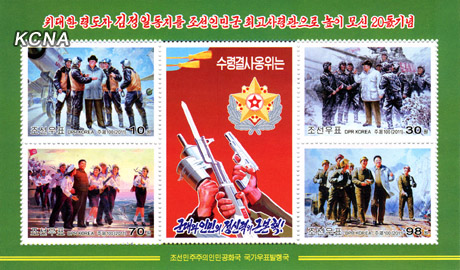
UPDATE 45 (2011-12-21): KCNA (2011-12-21) reports that the DPRK issues two new stamps in Kim Jong-il’s honor:
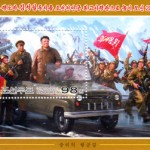
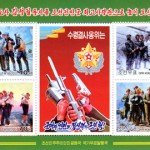
These two stamps along with four others were announced on the evening news on 2011-12-18:
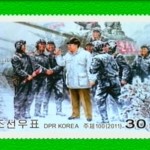
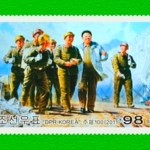
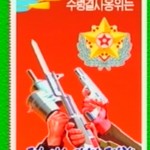
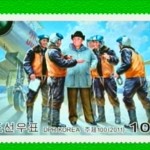
UPDATE 44 (2011-12-21): Here is a DPRK media wrap up as of 11:20am:
1. KCNA news for the day in PDF (nearly 19 pages–single spaced).
2. KCNA uploaded another video of people mounring at Kim Il-sung Square, and construction workers on Mansudae Street who vow to continue building a thriving nation.
3. Uriminzokkiri uploaded several videos: This documentary on Kim Jong-il’s orders, this documentary of his life and work (Chol Pass), People crying at the Pyongyang Indoor Stadium (satellite image here).
UPDATE 43 (2011-12-20): Some recent events and publications revolving around the recent news:
“After Kim Jong Il: Will There Be Change or Continuity In North Korean Economic Policy?”
38 North
Bradley Babson
“The Korean Peninsula after Kim Jong-Il: Uncertainties, Challenges and Opportunities”
Korea Economic Institute
Jack Pritchard, Victor Cha, Scott Snyder
The Death of Kim Jong Il and Implications for East Asia
Foreign Policy Research Institute
Gilbert Rozman
Articles and commentary by other policy analysts and North Korea experts can be found in “UPDATE 23” below.
UPDATE 42 (2011-12-20): Some more Humor…”Kim Jong-un Looking at Things”
UPDATE 41 (2011-12-20): The 15 pages of KCNA stories published this morning (Update 35) was just the first installment. Here are another seven pages of KCNA (2011-12-20)stories that I have converted to PDF for you. These are the headlines:
Former Anti-Japanese Revolutionary Fighter Laments Demise of Kim Jong Il
People Mourn Demise of Kim Jong Il
Foreigners Express Condolences to Bier of Kim Jong Il
Message of Condolences to Kim Jong Un from Qatari PM
Message of Condolences to Kim Jong Un from Emir of Qatar
Koreans in U.S. Mourn Demise of Kim Jong Il
Overseas Koreans Express Condolences to Bier of Kim Jong Il
Message of Condolences to Kim Jong Un from Finnish Party Leader
Russian FM Mourns Demise of Kim Jong Il
Message of Condolences to Kim Jong Un from IIJI Director-General
Message of Condolences to Kim Jong Un from Governor of Amur Region, Russia
Message of Condolences to Kim Jong Un from Party Leader of Egypt
Message of Condolences to Kim Jong Un from Heir Apparent of Qatar
Cuba Proclaims Period of Mourning for Demise of Kim Jong Il
Message of Condolences to Kim Jong Un from Son of Chinese Martyr
Canadian Party Leader Expresses Condolences to C.C., WPK
Message of Condolences to Kim Jong Un from Secretary General of IIJI
Foundation of S. Korea to Dispatch Mourning Group
And here are the final 4 stories published by KCNA on 2011-12-20 (PDF):
Message of Condolences to Kim Jong Un from Chongryon Central Standing Committee
Chongryon Central Standing Committee Adopts Decision
Senior Party and State Leaders of China Mourn Demise of Kim Jong Il
Kim Il Sung Square, Pyongyang Indoor Stadium Crowded with Mourners
UPDATE 40 (2011-12-20): KCNA publishes official statistics on the number of mourners:
At Least Five Million Pyongyangites Mourn Demise of Kim Jong Il
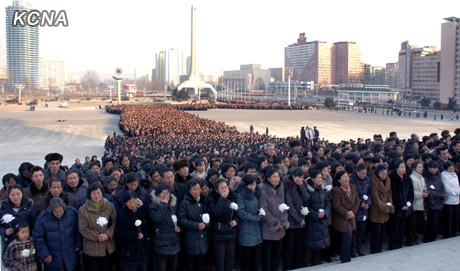
Pyongyang, December 20 (KCNA) — From noon on Dec. 19 when the sad news of leader Kim Jong Il’s demise was reported to the noon next day a total of more than five million citizens of Pyongyang visited the statues and portraits of the peerlessly great persons and mosaics depicting them and other places to mourn his demise.
An endless stream of people from all walks of life visited the statues of President Kim Il Sung standing on Mansu Hill [Satellite image here], Ryongnam Hill [Kim Il-sung University, satellite image here], Jangdaejae Hill [Pyongyang Students and Children’s Palace, Satellite image here] and other places to express condolences over his demise.
Those engaged in the construction of Mansudae area, officials of ministries and national institutions and students of Kim Il Sung University and Kumsong Secondary School No. 1 rushed there in bitter grief.
The number of mourners thronging to Mansu Hill increased as time went by. Around 3 p.m. they packed not only the ground before the statue of the President but the road stretching to it from the construction site.
The mourners’ number reached 450 000 at dawn on Tuesday and it went beyond 800 000 at noon.
They were grieving over his demise in bitter sorrow. Among them were those who could not stand to their feet.
Countless women, young and old, were in their mourning clothes with white ribbons on their heads.
According to the most recent census of the DPRK (2008), the population of Pyongyang was only 3,255,288 (significantly less than the 5 million reported above–unless people were visiting more than one grieving party. Additionally, since the census was conducted, Pyongyang’s land area has shrunk by nearly 1/3, so the population is officially smaller than in 2008.
UPDATE 39 (2011-12-20): AP video from Pyongyang can be found here. It features Rafael Wober, whom I have not seen since I visited the DPRK in 2005!
UPDATE 38 (2011-12-20): According to the Korea Herald, workers at the Kaesong Industrial Zone left work early on Monday:
North Korean workers at the factories in Gaeseong went home early at 3 p.m. Monday upon the North’s request, but are to come to work as usual Tuesday, Seoul’s Unification Ministry spokesperson Choi Boh-seon said, citing a North Korean official.
The ministry on Monday banned South Koreans’ visits to the North, with the exception of the industrial complex.
South Korean staff returning home from Gaeseong on Monday afternoon said the North Korean employees were greatly shocked at the news of Kim’s death.
Most North Korean workers gathered around 2 p.m. to mourn his death and went home early, according to a South Korean employee.
“We are preparing to run the factory as usual tomorrow, but we don’t know for certain whether there might be some impediment in production,” an official of a company operating in Gaeseong said.
Kim Ki-mun, chief of the Korea Federation of Small and Medium Business, said companies in Gaeseong were expected to do business normally, although there is the possibility of tighter control on entrance to the complex.
“I don’t think there will be a major commotion in the Gaeseong industrial park,” said Kim, who is also the chief executive of Romanson, a South Korean watchmaker that runs a factory in Gaeseong.
“Our companies were not seriously hurt when there was major news in North Korea in the past such as the nuclear tests.”
Kim had visited the Gaeseong complex last month with 14 vice chairmen of the federation.
Companies in Gaeseong called on Kim to take steps to ease their shortage of funds and manpower, prompting him to deliver their requests to South Korean government officials, according to Kim.
“The federation will keep watching the situation and do our best to assist the companies,” he said.
An official of a company that entered the complex five years ago said if the North Korean regime’s instability intensifies, it could deal a blow to the South Korean firms in Gaeseong in the short-term.
Another story in the Donga Ilbo assters that it was pretty much business as usual on Monday:
“We were surprised to see the response among North Korean workers, who were unexpectedly calm.”
This is what the head of a company operating a plant at the Kaesong industrial complex in North Korea said after hearing news of the death of North Korean leader Kim Jong Il from a staff member who entered the North from South Korea at 5 p.m. Monday. According to the heads of multiple companies, North Korean workers learned belatedly of Kim`s death at 1 p.m. the same day given the lack of TVs installed in their production lines.
According to the company head, North Korean workers were considerably shocked to hear of Kim`s death but continued their daytime shift until the end of the business day. Workers gathered in groups of three or four and held chats with a serious look during breaks, but did not cry or show marked signs of indignation.
A company source said, “We don`t know if the response was taken due to the special education of senior workers or other reasons, but our workers weren`t agitated and didn`t push up the close of business.”
The head of another company with a plant at the Kaesong complex, upon entering South Korea, also said, “I heard no news about Kim Jong Il`s death at the Kaesong industrial complex at all or saw any signs or moves that looked extraordinary,” adding, “I was totally shocked to hear related news after returning to South Korea.”
The companies, however, instructed staff from the South to use “caution in speech and action” to not provoke North Korean workers, who could get mentally agitated. The head of another company in the complex said, “I stressed that South Korean workers should avoid making inadvertent remarks such as `Kim Jong Il died,` and anger North Korean workers,” adding, “I`ll check the real situation in the North by calling in our staff who are entering the South this evening.”
Apart from this, the association of companies operating in the complex held a meeting of senior staff presided over by association chief Bae Hae-dong at its Seoul office around 5 p.m. Monday. If North Korean authorities request that they stop operations through the day of Kim`s funeral on Dec. 28 to allow workers to attend memorial events, the companies will approve.
Companies in the complex and experts also predicted no major change any time soon at the facility after Kim`s death. Yang Mu-jin, a professor of the University of North Korean Studies in Seoul, said, “Since the structure for the power transfer to Kim Jong Un has been consolidated over the past year, chances of a civilian revolution or military coup are slim,” adding, “Kim`s death will have a limited impact over the short term.”
The head of another company operating in Kaesong said, “The Kaesong industrial complex didn`t stop operations even when North Korea conducted nuclear tests,” in expressing cautious optimism.
UPDATE 37 (2011-12-20): Aisan financial markets partially recover Monday’s losses. According to the Asian Wall Street Journal:
South Korea’s Kospi rose 0.9% to 1793.06, after sinking 3.4% Monday. Japan’s Nikkei Stock Average gained 0.5% to 8336.48 and Taiwan’s Taiex added 0.4% to 6662.64.
“We’re seeing a little position-driven buying back and some rebound after Monday’s Kim Jong Il news,” Jefferies Japan strategist Naomi Fink said. “The recent declines weren’t necessarily fundamentally driven—more sentiment and position driven.”
Elsewhere, Australia’s S&P/ASX 200 index fell 0.2% to 4053.10, China’s Shanghai Composite dropped 0.1% to 2215.93 and Hong Kong’s Hang Seng Index rose 0.1% to 18,080.20, after each index changed direction a few times.
UPDATE 36 (2011-12-20): We now have an official South Korean reaction to Kim’s Death. According to Yonhap:
South Korea expressed sympathy to the people of North Korea over the death of leader Kim Jong-il, but decided not to send an official condolence delegation to the communist nation, an official said Tuesday.
The government will, however, allow the families of late South Korean President Kim Dae-jung and late Hyundai Group chairman Chung Mong-hun to pay condolence visits to the North because Pyongyang sent delegations to Seoul when Kim and Chung died, Unification Minister Yu Woo-ik said.
“Regarding the death of Chairman Kim Jong-il, the government conveys sympathy to the people of North Korea,” Yu said while briefing reporters on the outcome of a security ministers’ meeting that President Lee Myung-bak presided over to discuss the aftermath of Kim’s death.
The expression of sympathy to the people of the North was a carefully chosen phrase aimed at reconciling conflicting demands from conservatives and liberals in South Korea over whether to offer condolences over the death of the leader of a nation South Korea is still technically at war with.
The wording is aimed at separating the North’s leadership and its hunger-stricken population.
The government does not want to anger either side at a time when general elections are just months away.
The government will allow the families of late President Kim and late Hyundai chief Chung to visit the North for reciprocal condolence calls.
Kim held the first-ever inter-Korean summit with the late North Korean leader in 2000, and Chung pushed aggressively for joint economic projects with the impoverished North. Pyongyang sent condolence delegations to Seoul when Kim died in 2009 and Chung died in 2003.
Yu said that South Korea has been working closely with friends and allies to make sure that “peace on the Korean Peninsula is not shaken.” The South’s military is maintaining high vigilance and is prepared for all kinds of situations, he said.
“So far, no unusual signs whatsoever have been detected in North Korea,” he said.
Yu also said that the government is asking religious groups to withdraw their plans to light Christmas tree towers on the border with North Korea. The request reflects concern that the lighting could provoke Pyongyang and spike tensions.
Later Tuesday, the defense ministry said religious groups accepted the government’s request to keep the towers dark this year. A ministry official said Yoido Full Gospel Church and the Military Evangelical Association of Korea, which had organized the lighting ceremony, agreed not to light the Christmas towers, after the ministry verbally notified them of the government’s stance. The ministry will send a written request later Tuesday or early Wednesday, the official added.
However, Yonhap also reports that the South’s intelligence chief has publicly questioned the official North Korean narrative of Kim Jong-il’s death:
The head of South Korea’s National Intelligence Service (NIS) on Tuesday expressed cautious doubts over the time and location of North Korean leader Kim Jong-il’s death, parliamentary officials said, raising questions over whether the communist North tried to beautify Kim’s death.
North Korea previously said Kim died early Saturday while on a train in motion during a field guidance tour.
Attending a special session of the National Assembly Intelligence Committee, NIS chief Won Sei-hoon said a special train used by the late North Korean leader was spotted stationary at Pyongyang’s train station at the time of his death announced by the North, according to the parliamentary officials.
“There were no signs the train ever moved,” he was quoted as telling the parliamentary committee.
The time and place of Kim’s death may be very sensitive to North Korea’s remaining leadership, which is apparently trying to ensure successful succession of power to Kim’s youngest son Jong-un on the late leader’s legacy.
The North’s Korean Central News Agency reported Tuesday that North Korean people, “young and old, men and women, are calling Kim Jong-il, who gave tireless field guidance, making total dedication day and night to the happiness of the people.”
The NIS chief pointed out that there had been no public appearances made by the late Kim since Friday.
He refused to comment, however, on what a ruling party legislator on the parliamentary committee called a rumor about Kim’s death at his official residence in Pyongyang, saying it was a report that has yet to be confirmed.
This Choson Ilbo story asserts the train is still parked at the Ryongsong compound. I have previously posted location’s of Kim’s train station including the main station in Ryongsong. See them all here.
UPDATE 35 (2011-12-20): True to Form, KCNA (2011-12-20) has published a plethora of stories (nearly 15 pages–single spaced!) commemorating Kim Jong-il’s life and accomplishments. I have put them all in a PDF which you can download here. Here are the headlines:
Brilliant Life of Peerless Patriot
Foreign Media Report about Demise of Kim Jong Il
Young Koreans Vow to Be Loyal to Kim Jong Un
Press Review
People in S. Hamgyong Province Grieve over Loss of Father of Nation
Kim Jong Un Is Mental Mainstay of Korean People
Kim Jong Il, Great Father of People
Kim Jong Il′s Field Guidance Associated with Loving Care for People
Kim Jong Il′s Feats for National Reunification
Kim Jong Il Was Defender of Justice
Korean People in Grief at Loss of Their Leader
Kim Jong Il′s Wish
Korean People Overcome Sorrow with Courage
Kim Jong Il′s Life, One of Heroic Great Man
Korean People′s Wailing Voices Rock Heaven and Earth
Country, Veritable Sea of Mourners
Chairwoman of S. Korean Hyundai Group Expresses Deep Condolences over Demise of Kim Jong Il
Cambodian Government Expresses Condolences over Demise of Kim Jong Il
Local Inhabitants of DPRK Express Resolve to Remain True to Kim Jong Il′s Intention
North Hamgyong Province Grieves over Demise of Kim Jong Il
Former Indonesian President Mourns Kim Jong Il′s Demise
Russian Party Leader Expresses Condolences over Demise of Kim Jong Il
Indonesian Foreign Ministry Issues Statement on Demise of Kim Jong Il
Kim Jong Il′s Preoccupation
Yearning for Leader Grows Stronger in DPRK
People in Jagang Province Vow Loyalty to Kim Jong Un
Vietnamese FM Expresses Condolences over Demise of Kim Jong Il
Message of Condolences to Kim Jong Un from Raul Castro
S. Korean Civic Organization Praises Kim Jong Il′s Exploits
Figures of Opposition Party of S. Korea Mourn Demise of Kim Jong Il
Philippine Foreign Ministry Issues Statement on Demise of Kim Jong Il
S. Korean Organization Mourns Demise of Kim Jong Il
Kim Jong Il′s Life, One of Heroic Great Man
Korean People′s Wailing Voices Rock Heaven and Earth
Venezuelan President Expresses Condolences over Demise of Kim Jong Il
Egyptian Association Mourns Demise of Kim Jong Il
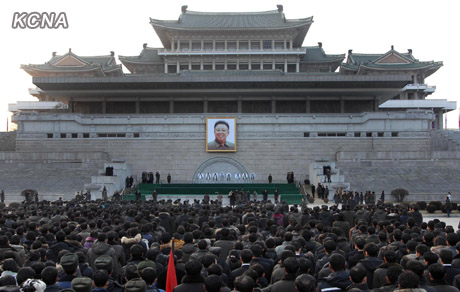
UPDATE 34 (2011-12-20): In Updates 21 and 32 below, we see several places where North Koreans are going to make a public show of their grief. KCNA has released photos which show two additional locations (Kim Il-sung Square and the April 25 House of Culture) which have been transformed into public grieving sites. At these gathering spots, large Kim Jong-il photos have been hung on the buildings:
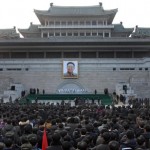
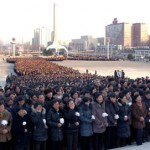
A later KCNA story reveals the locations in which portraits have been hung in this manner:
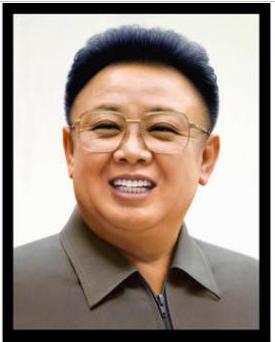
Portraits of Smiling Kim Jong Il Displayed in Various Parts of Pyongyang
Pyongyang, December 20 (KCNA) — Portraits of smiling leader Kim Jong Il were displayed at Kim Il Sung Square, the plaza of the April 25 House of Culture, the Party Founding Memorial Tower, the plaza of the Pyongyang Indoor Stadium and other places of Pyongyang Tuesday.
They were crowded with an endless stream of people carrying with them wreaths, bouquets and flowers prepared with sincerity. Roads leading to those places and residential areas contiguous to them became crowded with mourners in a minute.
These places turned into a veritable sea of mourners who bitterly wept, looking up to portraits of smiling Kim Jong Il.
Similar portraits were also displayed on the front walls of the Pyongyang Circus Theater and the Hana Music Information Center.
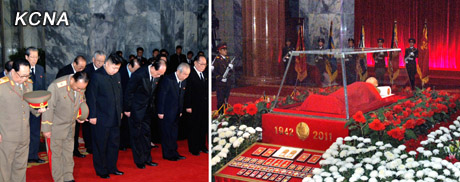
UPDATE 33 (2011-12-20): Kim Jong-un paid a visit to Kim Jong-il’s body on Tuesday. According to KCNA:
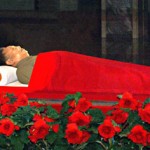
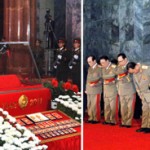
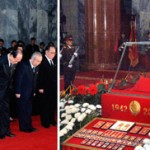
Kim Jong Un Pays Condolences to Bier of Kim Jong Il
Pyongyang, December 20 (KCNA) — A solemn ceremony took place in Pyongyang Tuesday to mourn before the bier of Kim Jong Il, general secretary of the Workers’ Party of Korea, chairman of the DPRK National Defence Commission and supreme commander of the Korean People’s Army at a time when the whole country is in the bitter sorrow at the unexpected sad news of his demise.
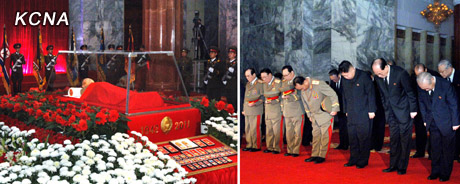
Kim Jong Un, vice-chairman of the Central Military Commission of the WPK, together with senior officials of the party, state and armed forces organs, visited the bier of Kim Jong Il to express deep condolences with the bitterest grief.
The Kumsusan Memorial Palace, the mourning place, was in a solemn atmosphere.
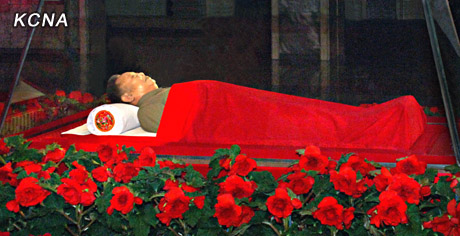
The bier of Kim Jong Il was seen lying among flowers, covered by the red flag.
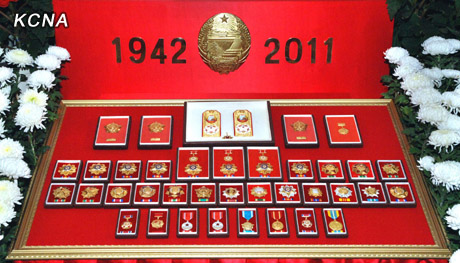
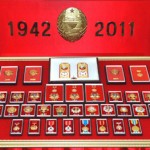
Marked on the front of the bier were the years of “1942-2011” as well as the national emblem of the DPRK.
Seen before the bier were shoulder straps of the DPRK Marshal, Kim Il Sung Order, Kim Il Sung Prize, medals of the DPRK hero and labor hero and lots of other orders and medals the army and people of the DPRK presented to him in recognition of his great feats.
Seen beside the bier was a wreath from Kim Jong Un, vice-chairman of the Central Military Commission of the WPK.
Members of the National Funeral Committee were standing guard by the side of the bier and guards of honor of the three services of the Korean People’s Army and the Worker-Peasant Red Guards were standing on either side of the bier.
Amid the solemn playing of funeral music, Kim Jong Un entered the hall where Kim Jong Il lies in state.
Kim Jong Un observed a moment’s silence in the bitterest grief together with leading officials of the party, state and armed forces organs before going round the bier.
The participants remained long before the bier, wailing over the sudden and grievous death of Kim Jong Il, outstanding leader of the party, state and army, peerlessly illustrious commander of Songun and benevolent father of the people.
They included Kim Yong Nam, Choe Yong Rim, Ri Yong Ho, Kim Kyong Hui, Kim Yong Chun, Jon Pyong Ho, Kim Kuk Thae, Kim Ki Nam, Choe Thae Bok, Yang Hyong Sop, Ri Yong Mu, O Kuk Ryol, Kang Sok Ju, Pyon Yong Rip, Jang Song Thaek, Kim Jong Gak, Kim Yang Gon, Kim Yong Il, Pak To Chun, Choe Ryong Hae,
Kim Rak Hui, Thae Jong Su, Kim Phyong Hae, Mun Kyong Dok, Ju Kyu Chang, U Tong Chuk and Kim Chang Sop.
The imagery is of course similar to Kim Jong-il’s visit with the body of hist father Kim Il-sung in the very same building.
The New York Times also covered the event.
UPDATE 32 (2011-12-20): KCNA has posted two more videos of employees at the Kwangbok Supermerket (Kim Jong-il’s final official guidance destination) and the 4.25 Palace of Culture wailing and crying. See the videos here and here. Other similar videos can be found below in “Update 21”. Despite all the crying captured on film, the KCNA reporters, photographers and producers seem utterly unaffected. How professional of them.
Also, The New York Times published a piece on all the crying.
UPDATE 30 (2011-12-20): Martyn Williams has posted the latest issue of Rodong Sinmun on KJIs demise. See it here.
UPDATE 29: Apparently emails to the North Korean embassies are getting through!
UPDATE 28: The DPRK appears to have close off communication with the outside world. According to the Los Angeles Times:
An official at the Seoul embassy of a nation with a mission in Pyongyang said it was impossible to reach colleagues there Monday, suggesting that the regime had tried to block links with the outside world.
“There hasn’t been anything coming out of Pyongyang,” said the official, who requested anonymity because of the sensitivity of the situation. “It’s not surprising the land lines and other communication is overloaded or shut down.”
In South Korea, defector groups were also unsuccessful in reaching contacts north of the demilitarized zone. “The North is refusing to accept any foreign guests because the world is watching and will try to analyze the regime’s next move by what kinds of guests come to pay respects,” said Sohn Jung-hoon, director of the North Korean Defectors’ Vision Network.
UPDATE 27: Xinhua, the PRC’s official news outlet, has created an English-language web page featuring all of its coverage of Kim’s death. Among the stories is an official condolence message to the DPRK:
BEIJING, Dec. 19 (Xinhua) — China on Monday sent condolences to the Democratic People’s Republic of Korea (DPRK) over the death of DPRK top leader Kim Jong Il.
“We are shocked to learn that general secretary of the Workers’ Party of Korea (WPK), chairman of the DPRK National Defense Commission and supreme commander of the Korean People’s Army (KPA) comrade Kim Jong Il passed away and we hereby express our deep condolences on his demise and send sincere regards to the DPRK people,” said the condolence message.
The late DPRK leader passed away from a great mental and physical strain at 08:30 on Dec.17 (2330 GMT Friday), on a train during a field guidance tour, the DPRK’s official KCNA news agency reported Monday.
The condolence message, sent by the Central Committee of the Communist Party of China (CPC), the National People’s Congress Standing Committee, the State Council and the Central Military Commission to the DPRK’s WPK Central Committee and its Central Military Commission, DPRK National Defense Commission, Presidium of the Supreme People’s Assembly and the DPRK Cabinet, called Kim Jong Il a great leader of the DPRK people and a close friend of the Chinese people.
The message said comrade Kim Jong Il had dedicated the whole of his life and rendered immortal service to the DPRK’s socialist revolution and construction.
It noted that the late DPRK leader, a close friend of the Chinese people, had carried on and further developed the traditional friendship between China and DPRK. The Chinese government and people were deeply saddened by the demise of Kim Jong Il, who will be remembered forever by the Chinese people.
The Chinese side believed that the DPRK will remain united as one with the leadership of the WPK and comrade Kim Jong Un, and turn their sorrow into strength, continuously advance towards the goal of building a strong and prosperous socialist nation and achieving sustained peace on the Korean Peninsula.
China and the DPRK are close neighbors and stand together in good or bad times. The CPC and the Chinese government have always adhered to the policy of continuously consolidating and developing their traditional friendship with the DPRK, said the condolence message.
The message added that the traditional party-to-party, state-to-state and people-to-people friendship between the two countries will be carried on and further developed.
Xinhua also reports that Hu Juntao visited the North Korean embassy in Pyongyang, where it appears a memorial meeting was held for North Korean expats.
UPDATE 26: The Korea Economic Institute posted a list of the ten names you should be aware of in the North Korean political power transfer.
UPDATE 25: The DPRK border was closed before the announcement. According to the Daily NK:
North Korean border guard units received orders at 1AM on the night of the 18th to close the border with China with immediate effect.
An inside military source told Daily NK this morning, “At 1AM on the night of the 18th a ‘Special Guard’ order was handed down to the unit. All officers who had finished work were recalled to the base and have been on emergency duty ever since.”
“At the time even commanding officers did not know about the contents of the order, and as per the order to completely close the border, normal patrols in groups of two were stepped up to groups of four. We only learned that the General had died from special broadcasts,” the source added.
Thus, it is clear that the North Korean authorities took steps to avert civilian unrest and potential mass defection attempts by shutting down the border and reinforcing patrols prior to announcing Kim’s death.
The Daily NK also reported on procedures the party took to carry out the public mourning of Kim Jong-il:
Ever since the North Korean authorities broke the news of Kim Jong Il’s death, they have been working through Party and administrative organs to establish an atmosphere of mourning.
Workplaces and local government offices have, without exception, organized meetings to set in place the appropriate atmosphere. People’s Units have been emphasizing the ‘Last Instructions of Kim Jong Il’, and groups from schools and workplaces have been visiting statues of Kim Il Sung other major memorials to pay their respects.
One Yangkang Province source commented to Daily NK late this afternoon that the streets of Hyesan were packed with people heading to a local monument to pay their respects, while not a single person was anywhere to be found near the market.
There was an emergency summons issued at 2PM which required workers to return to their assigned workplaces, while People’s Unit meetings were held at local government offices, he said.
According to the source, “In the People’s Unit meeting, they talked about the diary for the period of mourning and so on, stating, ‘Follow comrade General Kim Jong Eun to turn sadness to strength and bravery and complete the work of comrade Kim Jong Il’.”
“People in the People’s Unit meeting cried and wailed, and then from 5PM elementary school students, upper middle schoolers and the people downtown are all attending a mourning event.”
UPDATE 24: Although I added it below, this afternoon Uriminzokkiri finally posted video of mourning North Koreans which was filmed outside of Pyongyang (Hamhung, Chongjin, Wonsan, Kaesong). You can see the video here.
UPDATE 23: Here is some context, description, and predictions by prominent analysts:
1. Peter Beck’s CNN clip.
2. Marcus Noland’s Bloomberg clip and his comments on NPR.
3. Simon Cockerell from Koryo Tours was on CNN.
4. Here and here is commentary by Nick Eberstadt.
5. Here is a piece by Aidan Foster-Carter.
6. Scott Snyder wrote a piece for CNN.
7. Andrei Lankov on CNN.
8 Victor Cha in the New York Times.
UPDATE 22: Some levity while I duck out for lunch: The Onion remembers Kim Jong-il.
UPDATE 21: The Crying Game! Uriminzokkiri has uploaded footage of crying North Koreans to their You Tube account. There are eight videos. See them here (Mansudae Art Sudio), here (Committee for Cultural Relations with Foreign Countries–I actually know a few people in this video!), here (State Theater), here (Chollima Steel Complex), here (older revolutionaries), here (undetermined department store), here (Pyongyang Department Store No. 1, Hamhung, Chongjin, Wonsan, Kaesong), and here (Pyongyang Textile Factory). KCNA has posted four videos. See them here (Mansu Hill / Pothong Gate), here (Mansudae Art Studo), here (Pyongayang Middle Shool No.1, Mansudae Children’s Palace, 326 Electric Wire Factory), and here (Mansu Hill).
Very much the same behavior we saw when Kim Il-sung died.
UPDATE 20: KCNA has finally gotten around to translating some of their earlier Korean-only stories into English. I have converted them to PDF and posted them here. These are the headlines:
Kim Jong Il Will Always Live
KPA Servicepersons and People of DPRK Vow to Remain True to Leadership of Kim Jong Un
Korean People Fully Determined to Win Final Victory under Leadership of Kim Jong Un
Idea and Exploits of Kim Jong Il Are Immortal
S. Koreans Express Deep Condolences over Demise of Kim Jong Il
Widow of Former S. Korean President Expresses Deep Condolences over Demise of Kim Jong Il
Chinese FM Spokesman Mourns Demise of Kim Jong Il
We Are under Respected Kim Jong Un
UPDATE 19: Kim Jong-il’s economic legacy (via the Washington Post):
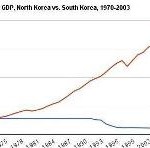
UPDATE 18: Martyn Williams has posted the Voice of Korea (Radio broadcast) of the Dear Leader’s death. Listen here.
UPDATE 17: (Washington Post)
North Korea conducted at least one short-range missile test Monday, the same day it announced the death of leader Kim Jong Il, South Korea’s Yonhap news agency reported.
Two South Korean military officials said they couldn’t immediately confirm the report, saying to do so would breach a policy of not commenting on intelligence matters.
Both said any firing would be part of a routine drill and have little relation to Kim Jong Il’s death. They both spoke on condition of anonymity, citing policy.
UPDATE 16: KCNA has published some additional information in English:
Notice of National Funeral Committee
Pyongyang, December 19 (KCNA) — The National Funeral Committee released a following notice on Saturday:
It notifies that it decided as follows so that the whole party, army and people can express the most profound regret at the demise of leader Kim Jong Il and mourn him in deep reverence:
His bier will be placed at the Kumsusan Memorial Palace.
Mourning period will be set from Dec. 17 to 29, Juche 100 (2011) and mourners will be received from Dec. 20 to 27.
A farewell-bidding ceremony will be solemnly held in Pyongyang on Dec. 28.
A national memorial service for Kim Jong Il will be held on Dec. 29.
Mourning guns will be boomed in Pyongyang and in provincial seats timed to coincide with the national memorial service in Pyongyang and all the people will observe three minutes’ silence and all locomotives and vessels will blow sirens all at once.
All institutions and enterprises across the country will hold mourning events during the mourning period and all provinces, cities and counties will hold memorial services timed to coincide with the national memorial service in Pyongyang.
The institutions and enterprises will hoist flags at half-mast and musical and all other entertainments will be refrained.
Foreign mourning delegations will not be received.
UPDATE 15: Yonhap offers a translation/summary of a KCNA story (조선의 군대와 인민들 김정은동지의 령도를 받들것을 맹세) not yet published in English:
N. Korean military, people pledge to follow Kim Jong-un’s leadership: KCNA
SEOUL, Dec. 19 (Yonhap) — The North Korean military and people have pledged to follow the leadership of the late leader’s heir apparent Kim Jong-un to carry on the legacy of the communist state, its state media said Monday, amid growing uncertainty over the power transition.
The North’s state media reported earlier in the day that 69-year-old Kim Jong-il died of a heart attack two days earlier. Following that announcement, regional powers are paying close attention to whether Kim’s youngest son and heir apparent Jong-un, aged in his late 20s, would successfully take the helm of the impoverished communist state.
“Ten million (North Korean) soldiers and the people are in indescribable grief, after receiving the sad news that comrade Kim Jong-il has died,” the North’s Korean Central News Agency (KCNA) said. “At this point, faithful belief, optimism and a determined pledge for victory are taking firm root in people’s hearts.”
The report came hours after Pyongyang urged North Korean soldiers and citizens to remain loyal to the guidance of the new leader and turn “sorrow into strength and courage to overcome the present difficulties and work harder for a fresh great victory.”
UPDATE 14: The Daily NK offers some news from Musan:
Following on from news of the closure of North Korea’s border with China, Daily NK has learned that armed soldiers have been deployed en masse to the center of the city of Musan.
A source from the border city in North Hamkyung Province told Daily NK this lunchtime, “Troops were mobilized from 9AM this morning and they chased out all the grasshopper traders from the alleyways around the market here. The people, who didn’t know the reason for it, all withdrew to watch and wait.”
Grasshopper traders are those traders who operate in the alleyways outside officially sanctioned markets in North Korea. As reported earlier this afternoon by Daily NK, official markets have been shuttered by the North Korean authorities.
“Now there are armed troops standing guard at four meter intervals downtown, and every available National Security Agency and People’s Safety Ministry agent is out there on guard duty,” the source added.
According to the source, a number of long sirens rang out immediately after the news of Kim Jong Il’s death was reported by state media, and it was after this that troops and the security forces emerged onto the streets and ordered everyone to return to their homes.
“Not even children are allowed to go out,” the source said.
UPDATE 13: Uriminzokkiri is still uploading videos to YouTube as they do every day…business as usual. The Korean Friendship Association web page was down, but seems to be back up. Neither organization has posted any information on the death of the Great Leader.
UPDATE 12: From the Daily NK:
North Korea has announced that it has entered a period of formal mourning following the death of Kim Jong Il lasting from the 17th, the day of his passing, until the 29th.
The news was released in a brief communiqué in the name of the ‘State Funeral Committee’,
Chosun Central News Agency announced the news, stating, “The body of National Defense Commission Chairman Kim will lie in state at Kumsusan Memorial Palace during the period of mourning from the 17th to the 29th. Visitors will be received between the 20th and 27th. The ceremony for his parting will be performed on the 28th in Pyongyang.”
“Central memorial meetings to honor Chairman Kim will open on the 29th,” it went on. “At that time in Pyongyang and sites in every province there will be an artillery salute and 3 minutes silence, and all official vehicles and vessels will sound their horns.”
The Daily NK is also first (as far as I can tell) to relay unofficial information from within the DPRK:
Following the official announcement of Kim Jong Il’s death today, North Korea has imposed rigid social controls, including the complete closure of markets.
An inside source told Daily NK this lunchtime, “The jangmadang is closed and people are not allowed to go outside. Local Party secretaries are issuing special commands through local Union of Democratic Women unit chairwomen, and the chairwomen have been gathered at district offices for emergency meetings.”
According to the source, National Security Agency and People’s Safety Ministry agents have been deployed in streets and alleyways to control civilian movements. There have not been any signs of public unrest to date.
Kim Jong Il’s sudden death has apparently caught people off-guard, the source revealed, commenting, “Nobody had the slightest idea about the General’s death even right before they saw the broadcast. You can hear the sound of wailing outside.”
UPDATE 11: (via Luke) The day that Kim Jong-il’s death was announced (Dec 19th) is South Korean President Lee Myun-bak’s birthday!
UPDATE 10: Michael Madden has posted a family tree, residency photos, as well as some other infomation on Kim Jong-il. See it all here.
UPDATE 9: Peter Beck is on CNN. Funeral will be on December 28. Foreign delegations are not invited to the funeral.
UPDATE 8: The Korean version of the KCNA web page contains several additional stories that are not on the English version (Thanks, Luke).
One story lists Kim Jong-il’s funeral committee:
김정은, 김영남, 최영림, 리영호, 김영춘, 전병호, 김국태, 김기남, 최태복, 양형섭, 강석주, 변영립, 리용무, 김경희, 김양건, 김영일, 박도춘, 최룡해, 장성택, 주규창, 김락희, 태종수, 김평해, 김정각, 우동측, 김창섭, 문경덕, 리태남, 오극렬, 김철만, 리을설, 전하철, 강능수, 로두철, 조병주, 한광복, 백세봉, 리영수, 최희정, 오일정, 김정임, 채희정, 김기룡, 장병규, 김병률, 홍인범, 리만건, 주영식, 곽범기, 오수용, 로배권, 박태덕, 김히택, 강양모, 림경만, 김경옥, 김명국, 김원홍, 현철해, 한동근, 조경철, 박재경, 변인선, 윤정린, 정명도, 리병철, 최상려, 김영철, 강표영, 김형룡, 리용환, 김춘삼, 최경성, 리명수, 전희정, 리영길, 현영철, 최부일, 양동훈, 리봉죽, 김송철, 박광철, 리병삼, 전창복, 오금철, 김인식, 김성덕, 려춘석, 박승원, 리용철, 박의춘, 김형식, 김태봉, 전길수, 리무영, 안정수, 리룡남, 류영섭, 박명철, 김용진, 장 철, 성자립, 김정숙, 강동윤, 김병호, 차승수, 량만길,윤동현, 고병현, 리봉덕, 박종근, 최영덕, 정인국, 전룡국, 리형근, 황순희, 백계룡, 김동일, 김동이, 리재일, 박봉주, 정명학, 강관일, 황병서, 권혁봉, 홍승무, 김우호, 한창순, 리춘일, 리태섭, 조성환, 동영일, 리창한, 고수일, 리국준, 신승훈, 리태철, 양인국, 리히수, 리 철, 현상주, 리명길, 로성실, 동정호, 강민철, 김희영, 조영철, 황학원, 안동춘, 백룡천, 홍광순, 리수용, 김영호, 방리순, 최춘식, 리제선, 리상근, 리홍섭, 차용명, 강관주, 태형철, 김병훈, 김계관, 한창남, 김창명, 전창림, 오철산, 손청남, 정운학, 차경일, 강기섭, 최대일, 최영도, 리용주, 전광록, 리찬화, 서동명, 전성웅, 지재룡, 김영재, 리용호, 홍서헌, 김동일, 김동은, 김봉룡, 조재영, 최찬건, 렴인윤, 김천호, 장호찬, 송광철, 리기수, 리종식, 최 현, 장명학, 강형봉, 김충걸, 김용광, 최관준, 장영걸, 김명식, 허성길, 노광철, 정봉근, 박창범, 최봉호, 정몽필, 전경선, 리성권, 최 용, 김태문, 김영숙, 차진순, 리민철,리일남, 김창수, 박명순, 최배진, 김 철, 심철호, 오룡일, 계영삼, 류현식, 고명희,방용욱, 장정주, 허광욱, 지동식, 정봉석, 최권수, 김영대, 류미영
I have provided an English translation of these names here (Excel). Kim Jong-un is number 1 on the list. Kim’s sister, Kim Kyong-hui is number 14. Her husband, Jang Song-thaek, is number 19. (And after I did all that work, KCNA published a list of names in English).
The Choson Ilbo offered some analysis of the list:
The North Korean regime on Monday issued a list of 232 people who make up the funeral committee for dead leader Kim Jong-il. Experts believe the order more or less matches their rank in the pecking order.
Kim’s son and designated heir Jong-un is at the top of the list.
Kim Keun-sik, a North Korean expert at Kyungnam University, said, “The list is in the order of members of the standing committee of the Politburo, then members and candidate members. It shows that the party will be stronger power than the military,” because Kim Jong-il’s brother-in-law Jang Song-taek or O Kuk-ryol, the vice chairman of the National Defense Commission, are listed further down.”
One reason could be that Kim Jong-un is not yet a member of the commission, unlike his father, who ruled the country through it.
Kim Jong-un’s aunt Kim Kyong-hui and her husband Jang Song-taek are in 14th and 19th in the list, even though Jang was widely believed to be the eminence grise behind Kim Jong-il. Kim’s exiled eldest son Jong-nam is not listed, nor are his middle son Jong-chol and virtually exiled half-brother Pyong-il, the perpetual North Korean Ambassador to Poland.
One expert on North Korea said, “It’s natural for their names to be excluded from the funeral committee as it is mostly filled with people with official titles.”
UPDATE 7: KCNA has published a memorial photo:
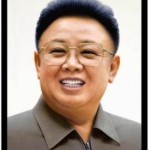
UPDATE 6: South Korean stock market down 3.34% on the same day (CNN). Stocks in military equipment manufacturers are up. Rating agencies keeping a close eye on the situation. According to Yonhap:
Global rating agencies said Monday that the death of North Korean leader Kim Jong-il would not immediately affect ratings assigned to South Korea despite increased market uncertainties and geopolitical risks.
According to Seoul’s finance ministry, Standard & Poor’s, Moody’s Investor Service and Fitch Ratings said they would not adjust ratings on South Korea given its strong economic fundamentals and the soundness of the financial sector.
UPDATE 5: Japan has issued a public statement of regret about KJI’s death. Also (via CNN), the flag at the North Korean embassy in Beijing has been lowered to half-staff.
UPDATE 4 (23:30): The Onion: “Kim Jong-Un privately doubting he’s crazy enough to run North Korea.”
UPDATE 3 (23:30): The US dollar is up in Asian trading. The Daily NK reports:
The South Korean Won-U.S. Dollar exchange rate has been rising rapidly following news of Kim Jong Il’s death.
Starting at 1,160 Won, the South Korean Won had struck 1,199 by lunchtime, although it subsequently declined to 1,185 Won.
A foreign exchange official commented to Yonhap, “The geopolitical risk of the Eurozone crisis and subsequent death of Kim Jong Il are causing the dramatic rise in today’s exchange rate.”
UPDATE 2 (23:14): Via Ray Cunningham: Here is Japanese television coverage of the announcement made on Korean Central Television (dubbed in Japanese):
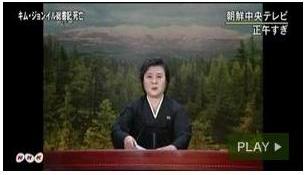
Here is the video on YouTube (via Uriminzokkiri). Here is the announcement with an official voice over in English.
UPDATE 1 (22:33): KCNA has posted more official information:
Medical Analysis of Kim Jong Il′s Demise
Pyongyang, December 19 (KCNA) — Leader Kim Jong Il had received medical treatment for his cardiac and cerebrovascular diseases for a long period.
He suffered an advanced acute myocardial infarction, complicated with a serious heart shock, on train on December 17, Juche 100 (2011) for a great mental and physical strain caused by his uninterrupted field guidance tour for the building of a thriving nation.
Every possible first-aid measure was taken immediately but he passed away at 08:30 on December 17.
An autopsy on December 18 fully confirmed the diagnosis of his diseases.
Kim Jong Il Passes Away (Urgent)
Pyongyang, December 19 (KCNA) — Kim Jong Il, general secretary of the Workers’ Party of Korea, chairman of the DPRK National Defence Commission and supreme commander of the Korean People’s Army, passed away from a great mental and physical strain at 08:30 December 17, 2011, on train during a field guidance tour.
The WPK Central Committee and Central Military Commission, DPRK National Defence Commission, Presidium of the Supreme People’s Assembly and Cabinet released a notice on Saturday informing the WPK members, servicepersons and all other people of his passing away.
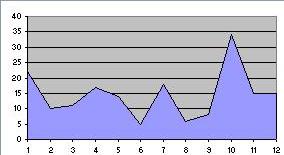
And just to be a little nerdy, here is a graph of KJI’s 2011 public appearances grouped by month:
ORIGINAL POST (22:17): Really. See this story in Yonhap (2011-12-19):
North Korea says its leader Kim Jong-il has died.
This was preceded by this story (2011-12-19):
N. Korea to make ‘special’ broadcast at noon
SEOUL, Dec. 19 (Yonhap) — North Korea will make a “special” broadcast at noon Monday, its state television and radio said, without giving any further details.
North Korea has aired special broadcasts in the past when leader Kim Jong-il was re-elected as the chairman of the powerful National Defense Commission.
As of right now (2011-12-19, 22:17) KCNA has not posted anything except this:
Important Notice to Be Released
Pyongyang, December 19 (KCNA) — An important notice will be released at this noon.
NK Leadership Watch posted a link to the Xinhua report which claims Kim passed away on Saturday the 17th.
Kim Jong-il’s last public appearance was at the Hana Music Information Center (a joint venture with Phoenix Commerical Ventures) and a remodeled Kwangbok Department Store which was reported on Dec 15. See a satellite image of the Hana building here and the Kwangbok Supermarket here.
Major media coverage (updated periodically): Washington Post (and here), BBC, New York Times (and here), Los Angeles Times, Business Week, Xinhua.