Archive for the ‘International Organizaitons’ Category

Teaching English in Pyongyang

Sunday, February 14th, 2010

The British Council arranges for English teaching opportunities in the DPRK (see here, here, and here).  Chris Lawrence has been teaching at Kim Il Sung University and his experiences there were recently covered by the BBC

According to the article:

It was a freezing cold February morning and Chris’s new classroom at the elite Kim Il-sung University in the capital Pyongyang wasn’t much warmer than the streets outside.

These days even the children of the party faithful can’t escape some of the hardships of everyday life in North Korea.

“The main problem is a lack of heating,” he said.

“Most of us in here are wearing our outdoor clothes as we work.”

Chris is one of a small team of English teachers forming a joint project between the British Council and the Government in Pyongyang.

In a sign that it may one day open up to the Western world, North Korea has gradually shifted a lot of its language training away from Chinese and Russian and towards English.

This is Chris’s first day in the job but his new class has already made an impact.

“I’m quite impressed by the level of English in this particular group” he told me.

“I expect the students will go on to occupy some quite important positions within Korean society.”

I asked one student what he hoped to do with his English.

“I hope to achieve speaking English so that I can go abroad and do some business because I want to be a businessman,” he said.

Another said he was going to be a diplomat.

They seemed, at the moment anyway, quite willing to engage with the outside world.

I asked one student who his favourite English authors were.

He hesitated and then said “Shakespeare… and Dickens”.

I asked him if he had read anyone more recent. There was a long embarrassed pause and then he replied: “Um… Jane Eyre… or Hamlet…”

The government wasn’t only keeping a close eye on their reading list.

Everything the students said to me was being listened to by government officials who were there the entire time I was in the country, travelling on a journalist’s visa.

But despite their presence, none of the students felt the need to include in their answers to me the usual rhetoric of “studying for the glory of the party and the dear and great leaders.”

They were quite happy to talk about what they wanted to achieve in life as individuals.

It was in marked contrast to their faculty head who went into a long monologue about the virtues of the “dear leader” President Kim Jong-il as soon as I switched on my microphone.

Heated debate

Across town at the nearby Pyongyang University for Foreign Studies, the staff were much more progressive.

They told me they were very pleased to have someone from the BBC because “we record the BBC News everyday to help the students improve their language skills”.

They played me some of their archive including news bulletins from the World Service that were almost a year old, so I knew they hadn’t been recorded just for my benefit.

I found the final year class next door having a heated debate in very good English about whether it was fair to keep animals in zoos.

The students were sophisticated, knowledgeable and engaging.

They quizzed me about the on-going Iraq inquiry in Britain and then 21-year-old Ri Ji-hye asked me if she could be frank.

“It’s so good that we can listen to [the] BBC,” she said.

“It helps us a lot learning English. I so much want my country to be one of those leading in the economy.”

“We’re already a leading nation in politics and other stuff. Well, it’s no offence but I want to learn English so that the other people get to learn [about] Korea.”

She smiled and said “Look at our faces – are we depressed, are we unhappy, are we hungry? No.”

That was certainly true of Ji-hye and her classmates.

But one of the challenges for her generation will not just be opening up to the rest of the world but opening their eyes to the world just beyond their city limits.

The British Ambassador to Pyongyang, Peter Hughes, is one of those who believes the country will have to wait for another generation before there’s any prospect of real change.

And he says few of people in the capital have any idea what life is like for the majority of North Koreans living beyond Pyongyang.

“I think it’s important to remember that Pyongyang is totally different from anything that’s outside of the city.”

“Only certain people can live here and one of the punishments for doing something wrong is actually to be banished outside of the city.”

“If you go out to the regional centres there is very little out there. The cities are in a bad state of repair. There are a large factories that are standing empty.”

Proud and patriotic

Back in the classroom at the Foreign Studies institute, another British Council teacher was showing North Korea’s “Generation next” how to run a brand campaign for Harley-Davidson, while on the streets outside people often stood more than a 100-strong waiting for a bus.

Pyongyang may be the country’s showcase city but even here it’s pretty obvious that the economy isn’t working.

Like their parents, the young North Koreans I met are proud and patriotic.

They have high hopes for their country even if they don’t yet understand just how far they’ve fallen behind their neighbour China.

But at least they may now be starting to learn enough about the real world to make sure they don’t repeat the same disastrous mistakes.

Read the full article here:
Meeting North Korea’s ‘Generation next’
BBC
Paul Danahar
2/13/2010

Share

North Korea’s Failed Currency Reform

Sunday, February 7th, 2010

Marcus Noland wrote an op-ed for the BBC which is posted on the Peterson Institute web page.  There are some differences in the two (the BBC piece is shorter), so you can read whichever you prefer.  Below, however, I have posted the graphs from the Peterson Institute web page with some commentary:

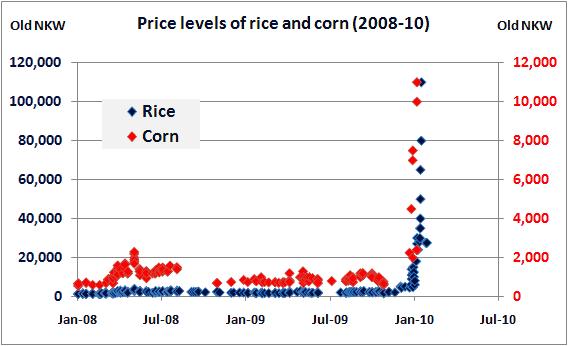
noland-rice-corn-2008.JPG

This chart indicates the market for rice was surprisingly efficient before the currency conversion.  Over a two year window, the observed price seems remarkably stable (although the scale of the graph makes it hard to see the the actual level of price volatility).  Still, it seems fair to say that North Korean rice producers, vendors, and smugglers are quick to spot and eliminate regional price differentials through arbitrage. The supply of rice must also be highly highly elastic.  If the North Korean economy was experiencing inflationary pressures in this time, productivity gains and competition would have to have kept the nominal price essentially flat and caused the real price of rice to fall!

The price of corn is somewhat more volatile and I would be interested in hearing theories as to why this is. 

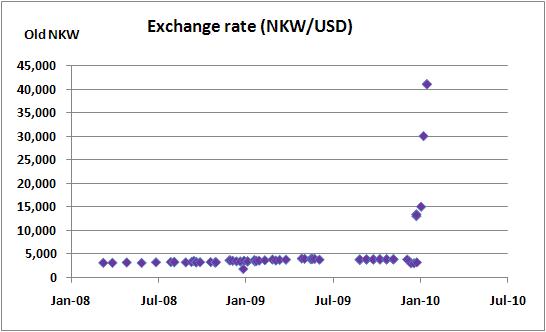
noland-dollar-2008.JPG

This chart is surprising as well. We see a highly stable US Dollar/DPRK won black market exchange rate (though again, the scale of the graph makes it difficult to determine just how stable).  Although the DPRK has not published its monetary policy goals (as far as I am aware), I think it is fair to say that the North Koreans practice exchange rate targeting. Most likely the target is not the US dollar, but the Chinese yuan–which trades at a nearly constant level with the US dollar.  Since China is the DPRK’s largest trading partner, it would make sense that the authorities would aim for exchange rate stability.  This would suggest, however, that the DPRK’s monetary authorities are well aware of the black market value of their currency and have the tools to  affect the exchange rate (i.e. lots of RMB reserves to sell on the black market).  I am not sure how plausible this is, but I am not sure how else we can explain this level of exchange rate stability.

Share

DPRK launches all-out offensive to meet 2010 economic goals

Wednesday, February 3rd, 2010

Institute for Far Eastern Studies (IFES)
NK Brief No.10-02-03-1
2/3/2010

In order to meet this year’s economic goals, North Korean authorities are calling on the people to launch an “all-out offensive”. Day after day, North Korea media outlets are calling for “continuing reform” and “continuing improvements,” even introducing a new motivational song titled, “It’s a war of attack.”

The slogan “all-out offensive” is designed to encourage the people of North Korea to pour all efforts into attaining the best results in each area of the economy. It is not uncommon for the North to use military terms such as this to motivate its citizens for non-military mobilization drives.

According to the (North) Korean Central News Agency (KCNA), the front page of the January 29 issue of the Rodong Sinmun carried an editorial titled, “Raise the fighting spirit of 10 million soldiers, and advance the all-out fighting spirit of this year,” while the second page of the same paper carried a political commentary titled, “Let’s practically demonstrate.”

The editorial called on citizens of the North to work toward improving the standard of living and improving the lives of the people, and stressed, “The on-going ideological campaign is an all-out offensive for remarkably increasing the speed of the advance for effecting a great surge with the might of the perfect unity of the leader and all the service personnel and people and a charge for giving fullest play to their mental power so that events adding luster to the era of Songun may take place one after another,” and, “The on-going general offensive is sure to triumph when all the people live and struggle as the brave, staunch and devoted vanguard in the advance for effecting a great surge.” On January 20 and 22, the same paper had run similar articles, calling for the “spirit of victors” and “marching forward as quickly as possible.”

That North Korean authorities have gone so far as to launch the song “It’s a war of attack” gives the impression that there is an air of urgency surrounding these ongoing efforts to mobilize the people. Also reflecting this urgency is the fact that this year, Kim Jong Il has carried out more public activities than during January 2009. As of January 26, Kim Jong Il had made 14 public appearances. This was 56% more than the first month of last year, during which Kim had made the most visits since launching the 1st Kim Jong Il regime in 1998.

Of those 14 appearances, 7 were on-site inspections of enterprises and other economic sites, while only 6 visits were military-related. The remaining visit was to the central court; There were no meetings with foreign dignitaries or other foreign diplomacy-related activities. One military-related visit of interest was to a self-sufficient pig farm run by the army. January’s visit was Kim’s third to the farm, where he advised managers to “raise more pigs and provide more pork and pork products to the soldiers,” an indirect reference to the seriousness of food shortages among the North’s military.

Share

Koryolink reaches 100,000 subscribers

Wednesday, February 3rd, 2010

According to the Financial Times:

Orascom Telecom, the Egypt-based mobile network operator, says its subsidiary in North Korea, Koryolink, has acquired 100,000 subscribers in its first year and expects to add millions more in the next five years.

The expansion plans come as the isolated country of 24m, which says it wants to be considered a “mighty and prosperous nation” by 2012, steps up efforts to attract foreign investment.

Pyongyang’s economic ambitions come in the face of tough international sanctions on its nuclear arms programme.

“We see that there is a very big plan for an economic boom,” said Khaled Bichara, chief executive of Orascom. “They are really looking to have, by 2012, a much stronger economy. We believe that mobiles and eventually international communication will definitely be part of this.”

Koryolink, a pre-pay system, has been available in Pyongyang and Nampo, the capital’s port, since December 2008. To help expand the network from there, Mr Bichara said North Korea was laying fibre-optic cables in the provinces.

Orascom was installing its most technologically advanced 3G network in North Korea, he said. The 2010 target for user numbers was ambitious but Mr Bichara declined to put a figure on it.

“I think if we achieve the target of this year, that will be a big milestone,” he said. “The number will be big enough to make Koryolink look like a significant company for us because the revenues per customer are interesting and we believe that this business will have customers in the millions within the next four or five years.”

Mr Bichara said the subscription figures showed that mobile phones were not limited to elite members of the military and communist party, as many observers had speculated.

However, the handset price of €140 ($195) put a mobile phone out of most people’s grasp.

So far, Koryolink offers only a basic voice and text messaging service. International calls and roaming services are not provided but Mr Bichara said starting them would be simple given the sophistication of the network being installed.

Koryolink is a joint venture in which Orascom has a 75 per cent stake. The rest is owned by Korea Post & Telecommunications Corp, the state fixed-line provider.

Thanks to a reader for sending this to me. 

Read the full article here:
N Korea operator looks to millions of 3G users
Financial Times
Christian Oliver and Heba Saleh
2/3/2010

Share

DPRK currency reform: rice and dollars

Sunday, January 24th, 2010

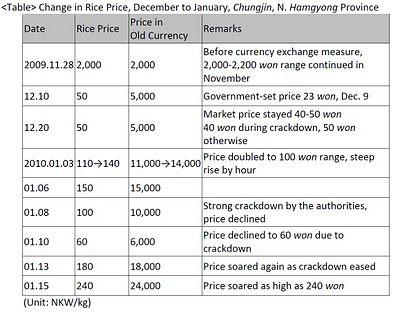
(H/T Josh) The price of rice has reportedly skyrocketed since the “anti-inflation” currency reforms.  According to Good Freinds:

gf-priceofirce-1-2010.jpg

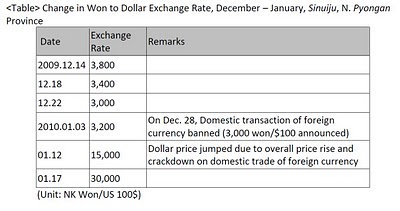
The “inflation fighting” reforms have also caused a devaluation of the new won realtive to foreign currencies:

gf-exchangerate-1-2010.jpg

You can read the full Good Friends report here

The Daily NK keeps a running graph of price and exchange rate information.  See it here.

As with all hyperinflation economies, North Koreans are reportedly turning to barter.  According to the AFP:

Seoul-based Internet newspaper DailyNK also reported last week that bartering has made a comeback.

“For now, state-designated prices are still not public, so people think that selling goods for cash now would mean making a loss,” it quoted a defector who talked to his family in the North as saying.

“Therefore, bartering has become the main method of trading for the people.”

The defector said the barter value of products is decided according to their value in old money, with trade carried out privately to avoid detection.

Before the redenomination, one fish was worth 1,500 won and a kilogram of corn was 900 won, so people barter one fish for a little less than two kilograms of corn, DailyNK said.

Share

GPI 2010 business delegations to DPRK

Wednesday, January 20th, 2010

From GPI:

In the current financial and economic situation, companies face many challenges. They must cut costs, develop new products and find new markets. In these fields, North-Korea might be an interesting option. Since a few years, it is opening its doors to foreign enterprises. The labor costs are the lowest of Asia, and its skilled labor is of a high quality. It established free trade zones to attract foreign investors and there are several sectors, including textile industry, shipbuilding, agro business, logistics, mining and Information Technology that can be considered for trade and investment.
 
European Business Mission (May 2010) & Pyongyang Spring International Trade Fair
Information Flyer Here(PDF)

In order to explore these business opportunities, we are organizing again a business mission to North-Korea (15 – 22 May). We will also visit the annual Pyongyang Spring International Trade Fair. This fair can be used by European companies to come in contact with potential buyers and suppliers in North-Korea. Information abouth both events has been attached.
 
North-Korean investment mission to visit The Netherlands (February)
There are investment opportunities in several areas, such as textiles; agro business (e.g. export of vegetables, fruit and flowers to South-Korea); mining (e.g. zinc, mica, tungsten, rare metals); real estate (e.g. office buildings); renewable energy (e.g. windenergy, batteries); Information Technology; electronics; chemicals and tourism. A high-ranking delegation from North-Korea will visit The Netherlands at the end of February, in order to discuss these opportunities in detail and to present specific investment projects. We can be contacted for further details.
 
New book on European – North Korean relations
Information Flyer Here (PDF)
This spring, the Hanns Seidel Foundation (Germany) will publish a new book about the relations between Europe and North-Korea. The publication: “Europe – North Korea: Between Humanitarianism and Business?” also contains two chapters about trade development and business issues – including my article on IT-cooperation. Its Table Of Contents has been attached.     

With best regards, Paul Tjia (director) 
GPI Consultancy, P.O. Box 26151, 3002 ED Rotterdam, The Netherlands
E-mail: paul@gpic.nl tel: +31-10-4254172  fax: +31-10-4254317 Website: www.gpic.nl

Share

DPRK aims to re-establish 10-day markets

Tuesday, January 19th, 2010

According to the Choson Ilbo, the DPRK government has not given up trying to re-implement the 10-day rule:

“The North Korean Cabinet has told agencies under each ministry and provincial and municipal chapters of the Workers Party that it will replace urban marketplaces with farmers markets that will open every 10 days starting Jan. 14,” the Group Good Friends said in a newsletter. “The cabinet also released market operating rules and a list of items that can be sold, adding that market traders will be permitted to sell only agricultural produce and indigenous local products but not Chinese goods or domestically produced industrial products.”Large markets began sprouting in the North in 2004, increasing to an estimated 300 by 2007. North Korean authorities decided to crack down on black-market traders who move around all the time to dodge the authorities, and back-alley deals for fear that the practices would run rampant if unchecked, it said.

I have located approximately 200 markets in the DPRK using Google Earth.  Links to locations of the Pyongsong, Chongjin and Hamhung wholesale markets can be found in this post.

Share

First DPRK-RoK joint venture in Rason announced

Tuesday, January 19th, 2010

According to the AFP:

A South Korean company said Tuesday it is planning a joint-venture factory in a free-trade zone in northeastern North Korea, the first such investment by Seoul in the faltering project.

Food processor Merry Co said Pyongyang last month approved its partnership with state-run Korea Gaeson General Trading Corp in the Rason zone near the North’s border with China and Russia.

“We’re going to have a first joint venture between the two Koreas in Rason,” Merry president Chung Han-Gi told AFP.

The North this month upgraded the status of the zone in an attempt to invigorate anaemic foreign investment there.

Chung said his company would invest 60 percent of the 7.5 million dollar cost of the new plant while its North Korean partner would put in 40 percent.

He said he would this week ask the South’s unification ministry, which must authorise all cross-border contacts, to approve the joint venture.

The communist state designated the Rajin-Sonbong Economic Special Zone — later renamed Rason — in 1991, its first such project. But little foreign investment materialised and senior officials who headed the project were reportedly sacked.

In recent years the North has begun trying to revive it, signing an accord with Russia to rebuild railways and the port there. China has also been exploring investment opportunities in the city.

The North’s leader Kim Jong-Il paid his first visit to the zone last month and state media said later that parliament has designated Rason as a municipality to upgrade its status.

South and North Korea have a joint-venture industrial estate at Kaesong near their border. Its operations have often been hit by political tensions, but the two sides were to start talks Tuesday on ways to develop it.

Chung said his firm’s joint venture at Rason, which would have some 200 North Korean employees, plans to produce canned and processed food including tuna for exports.

Merry, which also has a factory in Shanghai, will send Chinese engineers to Rason next month to install production facilities.

The Choson Ilbo adds some interesting details:

This is the first time that Pyongyang has allowed for direct business collaboration, set to take place between North Korea’s Gaeson General Company and the South’s Chilbosan Merry Joint Venture.

The firms are slated to split investment 60/40 and will work together to process and export canned marine and agricultural products starting in March.

UPDATE 1: As reader Gag Halfron points out, this is not the first DPRK-RoK joint Venture. Remember Pyonghwa Motors and Pyongyang’s fried chicken restaurant?

UPDATE 2: In the comments, Werner notes the following: http://www1.korea-np.co.jp/pk/149th_issue/2000101405.htm

Read the full articles below:
N.Korea OKs joint venture with South in trade zone
AFP
1/18/2009

First Inter-Korean Joint Venture to Be Established
Choson Ilbo
1/20/2010

Share

Swiss aid agency to leave DPRK

Monday, January 18th, 2010

According to this SDC web page:

Following a decision made by the Swiss Parliament, the SDC’s special programme in North Korea will be discontinued at the end of 2011.

There was not much in the media on this, but a reader pointed me to this article:

Switzerland is standing by a decision to stop development aid to North Korea, which has focused on improving food security in the internationally isolated country.

The foreign ministry says it now has a strategy for the withdrawal of Swiss development workers from the communist country by the end of 2011.

In 2008 the government approved a motion by parliamentarian Gerhard Pfister demanding a halt to development aid in response to North Korea’s continuing nuclear ambitions.

“The atomic weapon programme violates international agreements. North Korea has shown itself to be utterly uncooperative, despite international efforts. It threatens to destabilise the region,” the motion said.

Although Switzerland has no official representation in the communist country, diplomatic relations were established in 1974.

The Swiss Agency for Development and Cooperation (SDC) has had an office in the capital, Pyongyang, since 1997 [Possibly located here]. According to the motion, the SDC justified its work there by saying that “supporting the reform process” should improve food security. The SDC cited a “tentative opening” of the country as a success.

Pfister maintains that today North Korea is no longer showing a “tentative opening” – rather the opposite.

The SDC’s main priority in the country has been aid projects aimed at improving the efficiency and sustainability of North Korean agriculture.

Consistent policy?

The central question is whether it is wiser to isolate a totalitarian regime or to cooperate with it. The attitude of the Swiss parliament and government is clear: stop development aid.

But is the issue simply black and white? On December 21 Switzerland celebrated – in the presence of the North Korean foreign minister – the 35th anniversary of diplomatic relations.

On December 28 Blaise Godet, the Beijing-based Swiss diplomat responsible for North Korea, told the Neue Zürcher Zeitung that Switzerland had nurtured a consistent policy of engagement and political dialogue. “We want to contribute to solutions,” he said.

As for the ending of aid at the end of 2011, foreign ministry spokesman Erik Reumann told swissinfo.ch that “the SDC would follow the decision of the government and parliament. A dismantling plan exists that will guarantee a well-organised withdrawal from North Korea”.

Similarities with Switzerland

While the Swiss government and parliament want to end development aid to North Korea, former justice minister Christoph Blocher, a leading figure in the rightwing Swiss People’s Party, has written in detail about his visit to the country – on a hiking holiday.

The self-confessed anti-communist noted in the Weltwoche weekly magazine in November that “one thing North Korea and Switzerland have in common is that both countries want to keep their autonomy and are working for a safe future”.

In Pyongyang Blocher said he came across “normal conditions”, but admitted that “we only had access to those areas and streets considered presentable”. Nevertheless, he continued, “the streets are tidy and the Korean people are all clean and decently dressed, and go everywhere on foot. People walk”.

But Blocher agreed that the food situation was unsatisfactory.

The Swiss Agency for Development and Cooperation (SADC) web page is here.Here is a report they helped produce: Tools for building Confidence on the Korean Peninsula.

Share

2009 Inter-Korean trade tops US$1.6 billion

Monday, January 18th, 2010

Institute for Far Eastern Studies (IFES)
NK Brief No.10-01-19-1
2010-01-19

Last year, despite the impact of the economic recession, North Korea’s second nuclear test and other issues hindering inter-Korean exchanges, the previously sharply shrinking value of North-South Korean trade appeared to steady.

According to a report from the South Korean Customs Administration released on January 18, inter-Korean trade last year was down 8.5 percent from the previous year, amounting to 1.66608 billion USD. Exports to North Korea were worth 732.62 million USD, while 933.46 million USD worth of goods were brought into South Korea, giving Seoul a 200 million dollar trade deficit. Inter-Korean trade hit its lowest point last year in February (100.89 million USD), but since then showed slow-but-steady growth, hitting 173.18 in September.

In the aftermath of last year’s economic recession, together with the North Korean nuclear test, naval clashes in the West Sea in the area of the Northern Limit Line, etc., there were many difficult issues in 2009, but as inter-Korean trade numbers recovered in the fourth quarter, tensions eased slightly. Despite strained political tensions between the two Koreas, trade seemed not to be seriously affected, as DPRK goods were offloaded from a North Korean ship at Incheon Harbor and replaced with silica used for metal casting just six days after a clash between North and South Korean naval ships.

While growing trade is positive, this is the second year in a row South Korea has recorded a trade deficit with the North. In 2008, Seoul’s cross-border imports exceeded imports by 53.96 million USD. With Lehman Brothers’ collapse in September 2008 and the economic stagnation that followed, the South continued to record trade deficits for 15 straight months, until November of last year.

In December 2009, South Korean trade was back in the black (23.91 million USD) for the first time in 16 months. Looking back over time, it can be seen that inter-Korean trade has improved considerably over the years, recording a mere 705.68 million USD in 2004, 1.08872 billion USD in 2005, climbing to 1.3796 billion in 2006 and 1.79494 billion USD in 2007, and 1.82078 billion USD in 2008.

The import of North Korean sand, mushrooms, and smokeless charcoal briquettes in October 2009 required the permission of the South Korean government. This reflects Seoul’s more strict controls over management and oversight of inter-Korean trade following the sanctions and heightened concerns over cash deliveries to Pyongyang after its second nuclear test on May 25, 2009. Since the nuclear test, the South Korean government has limited the import of North Korean goods to only those that could ease losses being suffered by South Korean manufacturers.

According to the South Korean Ministry of Unification, among North Korean exports to the South in 2008, sand was the largest (according to value) export, with charcoal ranking ninth and (pine) mushrooms ranking eighteenth. 

Yonhap offered a short blurb: 

Trade between South and North Korea declined 8.5 percent on-year in 2009 due mainly to the worldwide economic slowdown that sapped demand and investments, a government report said Monday.

The Korea Customs Service (KCS) said inter-Korean trade reached US$1.66 billion last year, down from a record high of $1.82 billion tallied for 2008.

Read the full article here:
Inter-Korean trade falls off 8.5 pct in 2009
Yonhap
1/18/2009

Share

An affiliate of 38 North