Archive for the ‘Economic reform’ Category

6 new industrial parks worth 44 billion Won for construction industry

Saturday, November 13th, 2010

Institute for Far Eastern Studies (IFES)
NK Brief No. 10-11-13-1
11/13/2010

The construction cost for six inter-Korean cooperative industrial parks like the Kaesong Industrial Complex would carry a construction bill of 44 billion Won. According to “Analysis of Examples of Inter-Korean Cooperation in the Construction Field and the Direction of Industrial Park Development within North Korea,” a recent report by the Construction Economy Research Institute of Korea, “Promotion of the North Korean construction market by the [South Korean] construction industry would not only increase the limited demand for the South Korean construction [field], but will also provide new growth to our economy.”

According to the report, there has been almost no cooperative construction project within the construction field since 1988. On the other hand, tourism, industrial parks, physical fitness and religious projects have provided opportunities for construction companies. These projects generally call for construction equipment, materials, technicians and designs from South Korea, and land, labor, aggregate, etc. from the North. If six industrial parks on the same scale as the KIC were to be built, it would cost 43.09 billion Won. Of this, 4.07 billion won would cover government costs, while the actual cost of construction would be 39.02 billion won.

If the KIC, currently undergoing the first phase of construction, were to complete all three phases of the original plan, the 19.9 square-kilometer complex would house 2,000 businesses. The research institute calls for the completion of phases 2 and 3 in the KIC, as well as the construction of industrial parks at Rajin-Sonbong, Sinuiju, Haeju, Nampo, and Wonsan.

Rajin-Sonbong and Sinuiju are both ‘Free Economic Trade Zones’, and as special administrative zones, they offer large-scale industrial plots in an effort to attract foreign capital. In addition, it was agreed at the second inter-Korean summit, in October 2007, that Haeju would be developed. Furthermore, a light-industrial complex in Nampo, on the West Sea, and a heavy and chemical industry in Wonsan have been established.

The industrial zones, however, constitute only part of the construction demand. Roads and rails connecting the complexes, port facilities, power generation plants, cities to support production workers, and other derivative projects would also need to be constructed. In other words, the building of an industrial zone would lead to significant peripheral construction demand, as well.

Assuming that inter-Korean tensions were eased and North Korea decided to open itself up to the South, if construction on the six industrial zones could begin by the middle of next year, it is expected that they could all be completed by 2021. In addition, the construction and operation of the six zones could provide the impetus for quickly improving the North Korean economy, while also boosting the importance of South Korea to the North’s economy.

In order to see this accomplished, the research institute found that the government needs to boost activity in the KIC; expand the distribution network between the KIC, Kimpo, and Kangwa; guarantee free management authority in the KIC; iron out customs and transportation procedures; ensure a steady supply of North Korean laborers; and strengthen the ties between the KIC and North Korea’s domestic economy.

If, in the future, North Korea is to open its doors to cooperation, it is expected that foreign companies will also participate. Therefore, when considering long-term profits, it is necessary to spur interest in North Korea’s construction market. The research institute suggested that it was also necessary to construct a training center to teach North Korean construction workers the technical skills needed to ensure maximum potential.

Share

Kim Jong-un’s prison amnesty

Saturday, November 13th, 2010

According to the Daily NK:

A number of criminals judged to have committed their crimes due to poverty were granted an amnesty in commemoration of the 65th anniversary of the Workers’ Party founding in September, in a move characterized as being a result of Kim Jong Eun’s boundless consideration for the North Korean people. However, this has led to serious adverse effects.

A Daily NK source reported on the 12th that, upon a decision of the Standing Committee of the Supreme People’s Assembly, the North Korean authorities reduced the prison terms of around 150,000 criminals across the country in the amnesty, entitled “On the reduction of prison terms for prisoners in commemoration of the 65th anniversary of the Party founding and the Party Delegates’ Conference.”

For example, around 1,500 out of 2,100 prisoners in No. 12 Reeducation Camp under the Reform Department of the People’s Safety Ministry in Pungsan-ri, formerly Jeongeo-ri, Hoiryeong, North Hamkyung Province had their sentences reduced.

According to the source, “Around 250 prisoners were released and three special contributors had their sentences reduced by four years, 20 model prisoners by three years, and around 1,500 other general prisoners by two years.”

He added, “Only violent offenders (robbers, murderers and rapists) sentenced under article 141 of the Penal Code and human trafficking offenders (defector-related offences) under article 117 of the Penal Code were excluded.”

After the head of the camp announced the list of prisoners who would benefit, he reportedly added, “Those who are being released and having their sentences reduced should feel deeply the consideration of the Youth Captain,” going on to say, “The consideration given by the Party is not a gift sent equally to everybody, but only to those who have done well, and gives more consideration to them.”

Generally, amnesties in North Korea are undertaken on every fifth birthday of Kim Il Sung and Kim Jong Il and the founding day of the Party, ratified by Kim Jong Il after the Standing Committee of the SPA submits a proposal to him. The 12 reeducation camps under the PSM then decide the scale of the amnesty, depending on the size of the prison population.

However, the amnesties can have undesirable consequences, and this one is no different; the PSM has been reportedly devoting itself to filling up the empty camps, because each camp contains production units.

The source said, “The PSM was concentrating on criminal investigations even before the official announcement of the amnesty, because they had received indications of the decree. With the help of the Prosecutors’ Office, they caught a lot of people and kept them in detention centers, then after the announcement they started putting them in camps.”

“In 2002, commemorating the 60th birthday of the General (Kim Jong Il), although around 30 percent of the prisoners in each camp were released, the same amount of prisoners filled the former prisoners’ places.”

The 12 reeducation camps in North Korea each have unique production facilities. In the No. 12 Camp in Hoiryeong, for example, there is a wooden goods factory, copper mine, dressing plant, limestone mine and farms. Defectors suggest that the profits from these factories cover 80% of the management costs of the PSM.

The camps can be found all over the country including Pyongyang, Kaechoen and Sariwon in South Pyongan Province, Deokwon in Kangwon Province, Hamheung and Hoiryeong.

Read the full story here:
Kim Jong Eun’s “Magnanimous” Amnesty
Daily NK
Im Jeong Jin
11/13/2010

Share

Food and the winter of 2010-11

Wednesday, November 10th, 2010

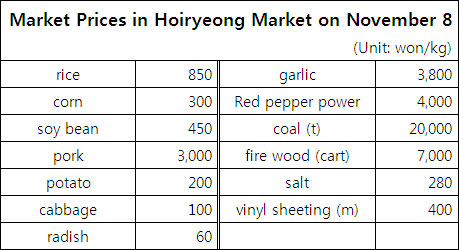
Click image to see all the prices

According to the Daily NK:

Winter is a tough time for average North Koreans, with a number of demanding economic issues to deal with. This year, as the traditional season for making “kimchi”, the indispensible side dish on any Korean dining table, approaches, ingredient prices in the market are become a focus for concern.

This is only the second winter since the currency redenomination of November 30th, 2009. Since then, prices have fluctuated unpredictably throughout the year due to various economic and political uncertainties. As a result, the overall situation now is not radically different from the period of high prices before the redenomination.

According to one inside source from North Hamkyung Province who spoke with The Daily NK on November 9th, “Wealthy people will have already finished preparations for heating and kimchi by the end of October; however, those belonging to underprivileged groups have not even prepared the kimchi for winter yet.”

According to the source, Chinese cabbage, the core constituent of the most popular form of kimchi, was being sold for as much as 100 won/kg and white radish for 60 won/kg in the market in Hoiryeong in North Hamkyung Province in recent days. The core seasonings for many forms of kimchi, garlic and dried red chili pepper powder, were being sold for 3,800 and 4000 won/kg respectively.

On October 25th, 2009, shortly before the currency redenomination, Chinese cabbage was being sold for 200 won, white radish for 150 won, garlic for 3,000 won and dried red pepper powder for 7,000 won in the same market. Thus, many of the effects of the currency redenomination appear to have been disguised by price inflation.

For a family of four, 500kg of Chinese cabbage and 300kg of white radish is needed to see them through the winter. To meet that requirement in full would, at current prices, require 50,000 won for cabbage and 18,000 won for white radish. Add in the price of the seasonings, including salt and green onion in addition to garlic and red pepper powder, and the total price is close to 100,000 won.

Other aspects of winter life are no less problematic. Heating is one example. For a household burning coal, a couple of tons are burnt between November and March. Currently, the price of coal in Hoiryeong market is around 20,000 won per ton. Meanwhile, houses which are heated with wood need roughly enough to fill two ‘Seungli-58’ trucks, or approximately five tons. Such a quantity costs 50,000~60,000 won (7,000 won/cart in Hoiryeong) at the current market price.

Another key factor in a comfortable winter is vinyl for shielding houses against the winter wind. This is now selling for 400 won/m. Most North Korean houses have three windows, to which people living in North Hamkyung and Yangkang Province apply two layers of vinyl, meaning that each household needs ten meters on average, including that to cover the door.

Therefore, taking Hoiryeong market as the average, people need a minimum of 150,000 won to prepare for the winter. When the average North Korean worker’s salary is between 1,500~3,000 won, it is clearly very hard for most to endure the winter in comfort.

According to the source, “The conditions in a household are revealed by the amount of dried red pepper powder in their winter kimchi. An affluent family’s kimchi is red and appetizing, but an poor family’s kimchi is like white kimchi with a few pieces of dried red pepper powder on the top.”

Read the full story here:
The Chilly Economic Wind of Winter
Daily NK
Yoo Gwan Hee
11/10/2010

Share

DPRK cabinet discusses 4th quarter projects as Chinese participation grows in the Pyongyang International Trade Fair

Monday, November 8th, 2010

Institute for Far Eastern Studies (IFES)
NK Brief No. 10-11-8-1
11/8/2010

North Korea held an extended meeting of the entire Cabinet in order to discuss the types of projects to be pursued in the last quarter of the year, and to strategize on how these projects should be implemented.

On October 28, the CHOSUN SHINBO reported on an article in the MINJU CHOSUN, which is under the control of the North Korean Cabinet. According to the article, efforts are being made to strongly construct the foundation upon which exemplars of the ‘military-first’ era will be erected. Production lines and facilities in all realms of the People’s Economy need to come into alignment with CNC, and efforts need to be made toward modernization, environmental protection, and reforestation. In particular, the Cabinet has pledged to decisively improve city management and restore socialism in cities and agricultural villages. Efforts will be focused on restoring socialist principles to economic management and ensuring that the centrally planned national economy is implemented.

The newspaper also reported that the North’s Cabinet held discussions on how to successfully fulfill all the goals set for the third quarter while creating a strategy to meet all of the targets set for the annual People’s Economy. It is unknown exactly when this meeting was held, but Premier Choi Yong-rim and other Cabinet members were all in attendance, as were city and town People’s Committee representatives, committee members from factories and farming communities, economic planners, and managers from critical factories and organizations.

As officials discuss economic reforms, the sixth annual autumn Pyongyang International Trade Fair was held from October 18-21, and it saw a greater Chinese presence than the thirteenth annual spring trade fair held last May. This could be the result of Kim Jong Il’s August visit to China. According to the newspaper, seventeen countries were represented by over 140 companies (48 from North Korea, 93 from abroad) — This was three countries and over twenty companies more than were at the spring fair. India participated for the first time this fall.

An official from the trade fair told the newspaper that the increased participation from Chinese companies was a direct result of Kim Jong Il’s recent visit to China’s northeastern region and the improved economic relations between Pyongyang and Beijing that came out of that visit. From machinery and equipment to steel products, electronic goods and light industrial products, food, pharmaceuticals, traditional herbal medicines and chemical products, over 57,000 products in over 2,300 different categories were on display. This is more than 600 categories of goods not seen last year.

Foreign companies participating in the fair signed contracts with North Korean offices for sales, technology exchanges, joint ventures, and investment opportunities, building on the ‘Introduction and Negotiations on the Investment Environment of the Democratic People’s Republic of Korea’ held on October 18.

Share

Rimjingang, Imjingang, and the Sunchon Vinalon Complex

Monday, November 8th, 2010

Writing in the Wall Street Journal, Evan Ramstad notes the following information about Rimjingang and Imjingang:

Japanese publisher Jiro Ishimaru has gotten a lot of attention over the past month for his new English-language book of articles from Rimjingang – the magazine about North Korea that’s written by North Koreans.

Over the past six years, he’s worked closely with a few dozen North Koreans to get insiders’ stories published.

Less well known is the North Korean defector in Seoul, Choi Jin-i, who worked closely with him until recently. She published a Korean version of the magazine while he handled Japanese.

They split earlier this year over funding differences. Mr. Ishimaru’s magazine is commercially-funded while Ms. Choi’s is supported by charitable contributions. Ms. Choi’s magazine now has a slightly different name. It’s called Imjingang.

Their writers are mainly North Koreans with the political and financial ability to visit China, where they can communicate freely.

For both Ms. Choi and Mr. Ishimaru, the biggest challenge is getting contributors to verify the information they report.

Mr. Ishimaru’s favorite scoop came last year. It was a video report that showed a 20-year-old textile factory in the North Korean city of Suncheon, long touted as a showplace industrial plant by North Korea’s state media, is actually unused and crumbling.

“The factory might have only run on opening day when the Great Leader (Kim Jong Il’s father Kim Il Sung) was there,” Mr. Ishimaru says. “There had been rumors inside the country that the factory never ran, but nobody outside the nation confirmed that. Our reporter went there and for the first time filmed the factory in ruins.”

Ms. Choi says her favorite article appeared in the magazine’s first issue in 2007. It was an analysis of North Korea’s economic situation by a high-ranking government official. She said she worked for more than a year to persuade the official to give an interview.

The quality of information in that interview surprised North Korea watchers. “Many South Korean scholars said they didn’t know there was an intellectual in North Korea,” Ms. Choi said.

And the surprise for me: The factory in Sunchon mentioned in the story is the Sunchon Vinalon Complex (not to be confused with the 2.8 Vinalon Complex in Hungnam).  I actually used the video mentioned in this story and matched it up with Google Earth Satellite imagery to confirm it was shot in the DPRK.  You can see the blog post and video here.

Read the Wall Street Journal article here:
North Korea by North Koreans; How the Magazines Work
Wall Street Journal
Evan Ramstad
11/8/2010

Share

Collapse unlikely in the near term

Sunday, November 7th, 2010

Andre Lankov writes in the Korea Times:

Recently one cannot help but notice an important change in the mood of Pyongyang watchers ― well, some of them. Over last year one began to hear again talk which has not been heard for 15 years or so ― serious people, many of whom are potential or actual decision makers, once again are discussing the probability of North Korea’s collapse.

Back in the early 1990 such a collapse was widely ― almost universally ― expected. Indeed, the communist bloc was falling apart, so it seemed only logical that North Korea, arguably the least efficient of all communist states, would go the same way as East Germany or Rumania. To a large extent, in the early 1990s the U.S. policy towards North Korea was based on assumption that its days were numbered. However, the much anticipated collapse did not happen, and since then the idea of it was discredited, so among the experts talks of collapse came to be seen as a sign of non-professionalism. Only in recent years has this talk begun anew.

The reason seems to be clear: the botched 2009 currency reform produced a serious crisis. The irritated North Koreans began to express their dissatisfaction even when talking to foreigners ― an unprecedented development. For a while in February it seemed that the situation was getting out of control ― so, even the habitually cautious Chinese for a while privately expressed their concerns about North Korea’s future.

On one hand, this revival of collapse theory is good news. It seems that in the long run a regime collapse is indeed highly probable, almost unavoidable, and it is good that decisions makers at least discuss such a probability, since it will prompt them to do some useful contingency planning. However, the present author is afraid that these recent talks are, above all, another example of wishful thinking. An immediate collapse is not impossible, no doubt, but it does not look very likely.

There are seem to be two reasons which might trigger the regime’s sudden disintegration ― a popular uprising and an open power clash within the elite, and neither appears likely right now.

The North Korean elite understand perfectly well that unity is the major condition for their survival (“if we do not hang together, gentlemen, we would be hanged separately” seems to be their most favorite dictum). In the peculiar case of a divided Korea, a clash within the elite is likely to trigger the disintegration of the state. Of course, there must be powerful internal rivalries and feuds within the elite, but their shared fear of instability helps to keep these disagreements under control. It is possible that Kim Jong-il’s death will create a new situation, and some of the old feuds will surface, but as long as the “Dear Leader” remains in control, this is not likely.

An outbreak of a popular revolution is highly improbable, too. The North Koreans are poor, but people do not start revolutions simply because they are poor. Revolutions happen when people believe that there are better ways of living. Nowadays, thanks to the spread of information about the outside world, many North Koreans are beginning to suspect that life indeed might be better. However, the sheer dissatisfaction about the current system alone is not sufficient for a revolution. Two other conditions must be present in most cases: people should have some organization, even rudimentary, and they should believe that their efforts are not futile, that the resistance has at least some chance to succeed. Neither condition is met in North Korea so far.

To start with, the North Korean authorities are very good in breaking all horizontal connections between their subjects. Unlike other communist regimes, North Korea does not tolerate even the obviously non-political activities if such activities are not directly supervised by the authorities. So, people are isolated and very distrustful of one another.

The fear is great, too. People do not start rebellions if they are certain that their rebellion has no chance to succeed. But North Koreans still tend to believe that any resistance is futile, since the regime would crush it in no time. There are closet dissenters in North Korea, to be sure, but they have to keep their mouths shut, since any challenge to the regime means certain death.

Things are changing, no doubt. Kim Jong-il’s North Korea is more liberal and permissive than it was when Kim Il-sung ruled the place. The officials prefer to take bribes and are ready to overlook minor irregularities. The booming private markets create an environment where some interaction is possible and people began talking between themselves. However, it might take a long time before these changes will produce conditions suitable for a revolution. Talks of a coming collapse are not a complete fantasy but might be seriously premature.

Read the full story here:
Revival of ‘collapse’ theory
Korea Times
11/7/2010

Share

DPRK presents vision of Rason

Friday, November 5th, 2010

According to the Choson Ilbo:

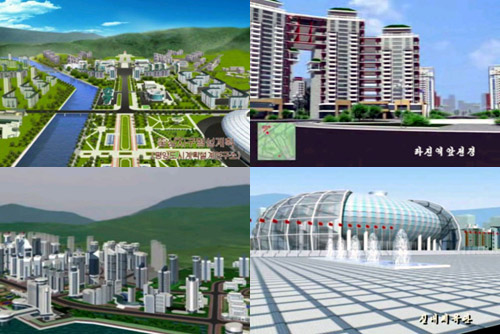
North Korea is pushing the implausible dream of turning the city of Rajin-Sonbong in North Hamgyong Province into an international freight brokerage, export processing and finance hub. A 3D video elaborating on a blueprint for the development of the city was made right after leader Kim Jong-il visited China in May.

The video, obtained by the Chosun Ilbo from a North Korean source in China, says the North worked out a plan in June to develop the city by giving distinctive roles to each of its six districts. “The video was made as material for reporting to Kim Jong-il,” the source said. “Discussion on the blueprint started right after Kim’s visit to the city in December last year and it was then hastily completed when people were talking about possible Chinese aid to the North after Kim’s visit to China in May.”

In December, Kim reportedly reprimanded senior officials there for making no progress in two decades since it was designated a development zone.

The regime upgraded Rajin-Sonbong to a special city in January. Rumor has it that Kim’s brother-in-law Jang Song-taek, the influential director of the Workers Party’s Administration Department, is pushing for development there.

The narrator in the video says, “In the future, Rajin-Sonbong will turn into a world-class economic and trade zone based on international freight brokerage, export processing and finance business and into a beautiful cultural port city in the era of the Songun (military-first) ideology.”

The narrator quotes regime founder Kim Il-sung as saying, “Rajin-Sonbong must become a better city than Singapore when you establish an economic and trade zone there.” Kim Jong-il is quoted as saying, “To build Rajin-Sonbong well, we must carry out the construction project according to an urban development plan.”

The video says the regime made a detailed plan to develop the city. A Kim Il-sung statue and public buildings such as an exhibition hall will be built in the Jungsim District. Changpyong District, which lies close to Rajin-Sonbong Port, will become a residential area. Anju District will become a finance center with hotels, banks and a department store will be built. High-risers including a 40-story office building will be built in Sosan and Dongmyong, and light industry will be built on both sides of Rajin Railway Station in Yokjon District.

Six design research centers in Pyongyang and Rajin-Sonbong were tasked with producing the blueprints.

But experts say chances that the project will come to fruition are near zero. “If Rajin-Sonbong is to be developed according to the blueprint in the video, the North would have to reform and open up. It can’t become an international trade and finance center without huge investment from South Korea, the U.S. and Japan,” a South Korean government official said.

So far, only a road linking the Chinese city of Hunchun with Rajin-Sonbong Port is being built in accordance with Chinese plans to ship goods from there.

Cho Bong-hyun, a researcher at the Industrial Bank of Korea’s economic research center, said an estimated 5 million tons a year of grain, coal and timber from northeastern China are being transported to southern China, and China can save up to US$10 per ton or $50 million a year in transport costs if it uses Rajin-Sonbong Port instead of railways.

The port could also be of help to China for exports. There are also rumors of a joint industrial complex in the area where North Korea would provide the labor for Chinese firms.

But a Chinese businessman operating in the North said the North and China have different ideas about the development plan, so nobody knows if and when development will get under way.

The video can be seen at the Choson Ilbo web page below.

Read the full story here:
N.Korea Pursues Dream of Int’l Business Hub
Choson Ilbo
11/5/2010

Share

DPRK premier courting Chinese investment

Wednesday, November 3rd, 2010

According to Yonhap:

North Korea’s Cabinet premier is visiting northeastern China to meet with ranking officials there and speed up joint economic projects between the communist allies, sources here said Wednesday.

Choe Yong-rim arrived in the city of Harbin in Heilongjiang Province earlier this week and visited the city of Changchun in a nearby province on Wednesday, the diplomatic sources said.

Choe, promoted by North Korean leader Kim Jong-il at a parliamentary convention in June, is seen as trying to consolidate the ties between Pyongyang and Beijing as the two countries seek to develop a joint economic bloc that draws from resources in China.

His visit comes after Kim visited the area in late August. During a summit between the North Korean leader and Chinese President Hu Jintao, the countries promised to boost their political and economic cooperation.

Choe’s trip, also reported by a local daily here, comes after 12 of the highest-ranking North Korean mayoral and provincial chiefs visited the same region in October, touring food, chemical and agricultural factories along with other major facilities.

Believed to be a key aide to North Korea’s next leader, Kim Jong-un, the premier inspected electronics and medicine companies and a agricultural research center in Harbin on Tuesday, the sources said.

Choe, 79, formerly chief of the Pyongyang department for the ruling Workers’ Party, has been noted for his rise to power in the past several months. He gave a speech at a mass rally on May 30, where as many as 100,000 North Koreans reportedly denounced South Korea and the United States for blaming Pyongyang for the sinking of a South Korean warship in March.

Read the full story here:
DPRK premier in northeastern China for economic cooperation
Yonhap
11/3/2010

Share

DPRK restricts private car use, rattles markets

Monday, November 1st, 2010

Institute for Far Eastern Studies (IFES)
NK Brief No. 10-11-01-1
11/1/2010

The North Korean Ministry of People’s Security (MPS) recently issued an order restricting the use of automobiles and warning that any car or truck used to earn private income would be confiscated by the State. There were a few cases of authorities cracking down on the use of private buses in the mid-2000s, but this is the first time there has been a widespread crackdown on the private use of all vehicles.

According to a report from the Daily NK, a source from North Hamgyeong Province has revealed that “on an order from the MPS, a crackdown on privately-owned cars, buses, and 1.5-2 ton small trucks began last month,” and, “all traffic police were mobilized and are checking all registrations, car-use permits, and driving licenses.” According to the source, each regional transportation authority is filing comprehensive situation reports, which show that with the exception of cars used by the elite, all illegally-used cars are being confiscated. Even cars used by military-run foreign capital organizations are subject to inspection by police.

In North Korea, the lack of electricity has led, since the mid~2000s, to the sharp drop in the use of trains and a rise in reliance on the so-called ‘service car’ as the primary method of moving people and goods around the country. This crackdown on service cars will be carried out in two phases: Phase 1 will run until the end of the year, then Phase 2 will be carried out until April 2011. The ownership and use of cars by organizations and businesses will also be investigated, while other cars will be inspected one at a time as they travel the roads. If any illegal use is discovered, the car will be impounded.

This kind of measure appears to be one aspect of North Korean authorities’ on-going battle against “anti-socialism.” Cars and other government property being put to private use is problematic, but a crackdown of this size indicates that organizations and government workers are abusing the rules on such a scale that the government can no longer tolerate their corruption. In order for these service cars to exist, authorities must break laws, forge documents, and pay bribes to get a car registered, purchase gas, and handle profits.

However, a crackdown on these cars is expected to have many side-effects. Service cars began replacing trains in 2004, but the people’s reliance on them grew so quickly that they are now the primary means of transportation throughout North Korea.

Ultimately, the North can not avoid significant aftershocks of the measure; without service cars, not only will businesses suffer production problems, those people who make their living through wholesale and retail markets will suffer, and the standard of living for people across the country will take a hit.

Previous posts on this topic cna be found here and here.

Share

Daily NK: DPRK worried about prostitution/drugs

Monday, November 1st, 2010

According to the Daily NK:

The North Korean authorities consider both prostitution and drugs to be serious problems and are actively seeking ways to combat them, according to an internal document obtained by The Daily NK.

Obtained on the 28th, the document, “Measures against Young Women Earning Money through Prostitution,” produced internally by the People’s Safety Ministry (PSM), reveals that the PSM has instructed local offices to crackdown on prostitution and drug-related crimes more vigorously.

This document was reportedly distributed to provincial committees of the Party and local PSM offices in July this year.

According to the document, “Anti-socialist phenomenon, young women and college students taking part in prostitution included, are appearing,” adding, “Strong measures to overcome this situation must be prepared.”

“At commuting times, women in large groups have been seen taking part in prostitution around bus stops or train stations,” the document states. “Law enforcement officials must not yield to these actions.”

The PSM document also focuses on drug crimes, reporting that, “The circulation and use of illegal drugs is increasing. We must establish measures to overcome drug-related activities.”

The document represents a tacit admission by the PSM that both prostitution and drug use have expanded to the point of becoming social problems in North Korea, a fact which the authorities have never admitted publicly.

As in many other countries, economic difficulties in North Korea tend to lead to an increase in the number of young women entering prostitution, because it represents one of the few ways to make ends meet. Inside North Korea sources say that the March of Tribulation led to a significant increase in prostitute numbers, and last year’s confiscatory currency redenomination is said to have had a similar effect.

As a result, sources say that regardless of the authorities’ will to crack down on prostitution and other illegal activities, it will be impossible because they are now an ingrained part of North Korean society.

Furthermore, even though public trials of persons accused of prostitution-related offences are held regularly in provincial areas, the law is unable to reach the most powerful prostitution rings because they are tacitly protected by paid-off PSM officials.

Read the full story here:
PSM Admits to Seriousness of Social Ills
Daily NK
Shin Joo Hyun
11/1/2010

Share