Archive for the ‘Economic reform’ Category

$1m won to secure job as Hyesan police officer

Friday, October 29th, 2010

According to Good Friends:

Hyesan City police officers in the Ryanggang Province are still doing well amidst North Korea’s economic chaos which has been further exacerbated by the government’s recent currency reform. Illegal trade in Hyesan, which is close to the national border, is rampant and particularly connected to the sale of drugs as well as rare metals, such as gold, silver, copper, iron, et cetera that are under tight government control. While some smuggling operations are managed by individual venders, most are large-scale enterprises. Bribery has thus become customary since sending and receiving prohibited items requires the aid of police or security officers. As a result, obtaining such positions in Hyesan has become very competitive; in particular, many Ryanggang Province officers have been applying for transfers, with bribes being exchanged in the process.

In order to become police or security officer in Hyesan a candidate must offer a bribe of at least one million won in the new currency. This may be a large sum of money; however, it’s only a matter of time before officers recoup their investment by taking in bribes from the smugglers. A smuggling or drug case that may be considered big in other regions can be resolved fairly easily if the right security officials are involved. Last September, a reputed drug trafficker who was arrested on drug related offenses was released within days after being declared innocent of charges. Although an order for intensifying drug regulations had been issued across the country, money clearly had priority.

Such corruption is encouraged by a society-wide permissiveness that doesn’t make a big deal out of anything unless it has to do with ideology issues. Simply speaking, if an incident is not “related to espionage,” then it is not a big deal. Rather, releasing culprits in exchange for money is regarded as a way of surviving during difficult times. Since corruption has become routine, neither officers nor smugglers seems to have a sense that what they are doing is wrong. The same goes for the people at large. For example, although officers are prohibited from possessing and riding personal motorbikes, those who do not own their own are often looked down upon by citizens; they believe that such officers must be slow-witted for not having one being in the position that they are. Along with the jeering is a healthy dose of envy.

If the officers take bribes from smugglers to look the other way, the wives of officers use their husbands’ status to actually join in the fray. They send articles to and receive prohibited items from China; they money they earn from such smuggling activities actually surpass the amount their husbands earn through bribes. Even if the wives are caught, the husbands step in to make the problem go away. The money a husband-wife team earns in this way surpasses the imagination of ordinary people. In Hyesan, there is a saying that only police officers have withstood the currency reform tsunami without breaking a sweat. Others say that “all the laws enacted by the government only serve to fill the bellies of the police officers.”

Share

Information on the DPRK’s informal transport market

Thursday, October 28th, 2010

According to the Daily NK:

With North Korea’s domestic security forces having been engaged in inspecting and confiscating vehicles being used for private gain since October 18th, the question of whether the so-called “servi-cha” industry will stay the course has become a central issue for many. This is because the presence or absence of the “servi-cha” can make or break the North Korean domestic economy, much like last year’s currency reform.

What is a “servi-cha”?

There are two types of “servi-cha”. The first are vehicles, mainly buses and trucks, owned by state organs and enterprises, which transport people and supplies in exchange for money. Enterprises use the money earned from the service to provide rations for the workers, cover transportation costs or obtain further raw materials for production.

The second type of “servi-cha” is those owned by individuals but registered as being owned by an enterprise; they are used for private gain. Collusion among three parties; the owner of the vehicle, the driver and the enterprise under whose name the vehicle is registered, is necessary in such cases. The owner of the vehicle acquires a car from, predominantly, China or Japan, whereupon cadres of a certain enterprise or local unit register the vehicle under the name of the enterprise or unit. A driver is hired thereafter, who then gets a drivers’ license from the cadre and sets about earn a profit by providing public transportation to residents or moving supplies. A portion of the money earned is given to the cadre, who will usually take a fraction for personal gain and register the remainder as company profit.

In general, two people man a “servi-cha”; the driver and his assistant. Alongside them, the owner of the freight being transported is present, and thereafter empty seats are taken by other passengers. If the car meets an inspection on the way to its destination, there is no problem; on paper, the vehicle is legitimate; it belongs to a unit, and the owner of the freight carries a transportation permit that he/she has received from the car owner. With a bit of alcohol and tobacco on hand to bribe the inspector, even the people occupying the empty seats are free to pass.

A North Korean license plate contains information on the institution the vehicle belongs to. As most people do not have a travel permit, they tend to prefer “servi-cha” that display the license number of a powerful institution. Transportation fees differ according to the type of license plate on the “servi-cha”. “Servi-cha” with plates from powerful groups charge higher fees than those with plates from food factories and agricultural offices, for example.

Vehicles are assigned numbers based on certain rules; license plates that reflect an auspicious date are deemed best; either 216 (February 16th; Kim Jong Il’s birthday) or 727 (July 27th; Victory Day). The license plate of a car given as a gift by Kim Jong Il to someone on the Central Committee might be assigned a number such as 216-11-101.

Furthermore, each department of the Party uses its own license plate number in order to distinguish ownership of vehicles. For example, the Party’s Finance and Accounting Department uses the number 02; 11 and 12 is reserved for Party offices; 12 to 14 for administrative units; 15 to 17 for the People’s Safety Agency; 18 to 20 for the National Security Agency; 21 for judicial branches; 22 for a unit under Party Department No. 39, 90 for the Central Party liaison office, and 46 for passenger transport services.

Inspections are stricter for those “servi-cha” with less impressive license plates. Travel permit checks become more thorough, and the inspectors ask more questions about the cargo. Thus, vehicle owners with “weaker” plates tend to have to give more bribes.

Origins of the “Servi-cha”

Public transportation virtually stopped in North Korea during the economic collapse which began in 1995, bringing about shortages of fuel and electricity. The country was incapacitated to the point that the government issued a decree calling on cadres to walk.

The first people to break the logjam were from foreign-currency earning units. They were able to use imported fuel to transport freight for other companies, at a price. Many enterprises quickly spotted the rising demand for freight logistics services, and started earning considerable profits by importing Chinese Dongfeng or Japanese second-hand trucks.

Demand for this was not limited to institutions and enterprises. Vendors also wanted to move their supplies around the country. The importing of Chinese products to the Rajin-Sonbong Special Economic Zone beginning in 1997 was followed by a rise in long distance cargo transportation to cities as far as away as Pyongyang, Hyesan, Sinuiju, Kaesong and Haeju.

The Different Types of “Servi-cha”

In general, trucks are a popular choice. This is because they can transport cargo and people at the same time. Buses, which are more readily owned by institutions and enterprises than trucks, are also often utilized for long-distance trips. A regular 45-person bus will often be full to capacity, with the central aisle lined with makeshift seats.

Party and military cadres also use their vehicles as “servi-cha”. It is commonplace for them to order drivers to look out for long-distance travelers as a means of earning extra money when the car is not in use. This also applies to the case of military cadres.

Sometimes, the seats of Japanese second-hand vehicles or Chinese second-hand jeeps are removed in order to take a maximum of eleven passengers.

Earning Money through “Servi-cha”

Use of “servi-cha” has vastly increased the quantity of goods and number of people crossing provinces, with goods smuggled in across the Tumen and Yalu Rivers in the north spotted in locations as far away as South Hwanghae and Kangwon Province, both of which border South Korea. Therefore, it can be said that production and trade between enterprises and vendors owes a great deal to the “servi-cha”.

For example, in 2001 the price of sweet potatoes peaked in the Rajin-Sonbong Zone. Demand for sweet potatoes was high in places north of Hamheung because climate conditions in that northern region are not favorable for cultivating the crop. While sweet potatoes were priced at 7 won per kilogram in South Hwanghae Province, in the Rajin-Songbong Zone the price exceeded 45 won per kilogram.

Vendors from Rajin-Sonbong were therefore able to increase profits 50% by selling Chinese everyday goods in Hwanghae province, and then make seven times more money selling southern sweet potatoes in the north.

It goes without saying that initial expenditure is required to pull this off. The cost of changing tires, of filling up the vehicle with gas, of bribing officials for travel permits and drivers’ permits, all added up to about 70,000 won. However, a round-trip could earn the “servi-cha” crew a net profit of 60,000 to 70,000 won. At the time, it was very good money.

Kim Kyung Hee’s “Servi-cha” Experiment

On her way to Kangkye in Jagang Province, Kim noticed a throng on the street, and approached, concealing her identity. They were people waiting for a “servi-cha”. Leaving her assistant and vehicle behind, Kim quietly stood in line with the other people.

Eventually, a 10-ton “servi-cha” arrived and people began scrambling for seats on the platform normally reserved for cargo. Paying her fare, 50 won, Kim also tried to board, but the driver noted her less than ordinary appearance and gave her the passenger seat.

After a few minutes of travel, a strange voice could be heard;

“Comrade, our time is up.”

The source of the sound was Kim’s watch. It was a message from her assistant, who was following the “servi-cha”. The driver, concerned for any number of reasons, immediately stopped and asked Kim to descend from the cab. In the end, the “servi-cha” left her behind on the road. It has been said that Kim went back to her vehicle and told her assistant that the “servi-cha’s are rather fun”.

Read the full story here:
Servi-Cha: the Lifeblood of the People’s Economy
Daily NK
Im Jeong Jin
10/28/2010

Share

China to lease two DPRK islands (update)

Thursday, October 28th, 2010

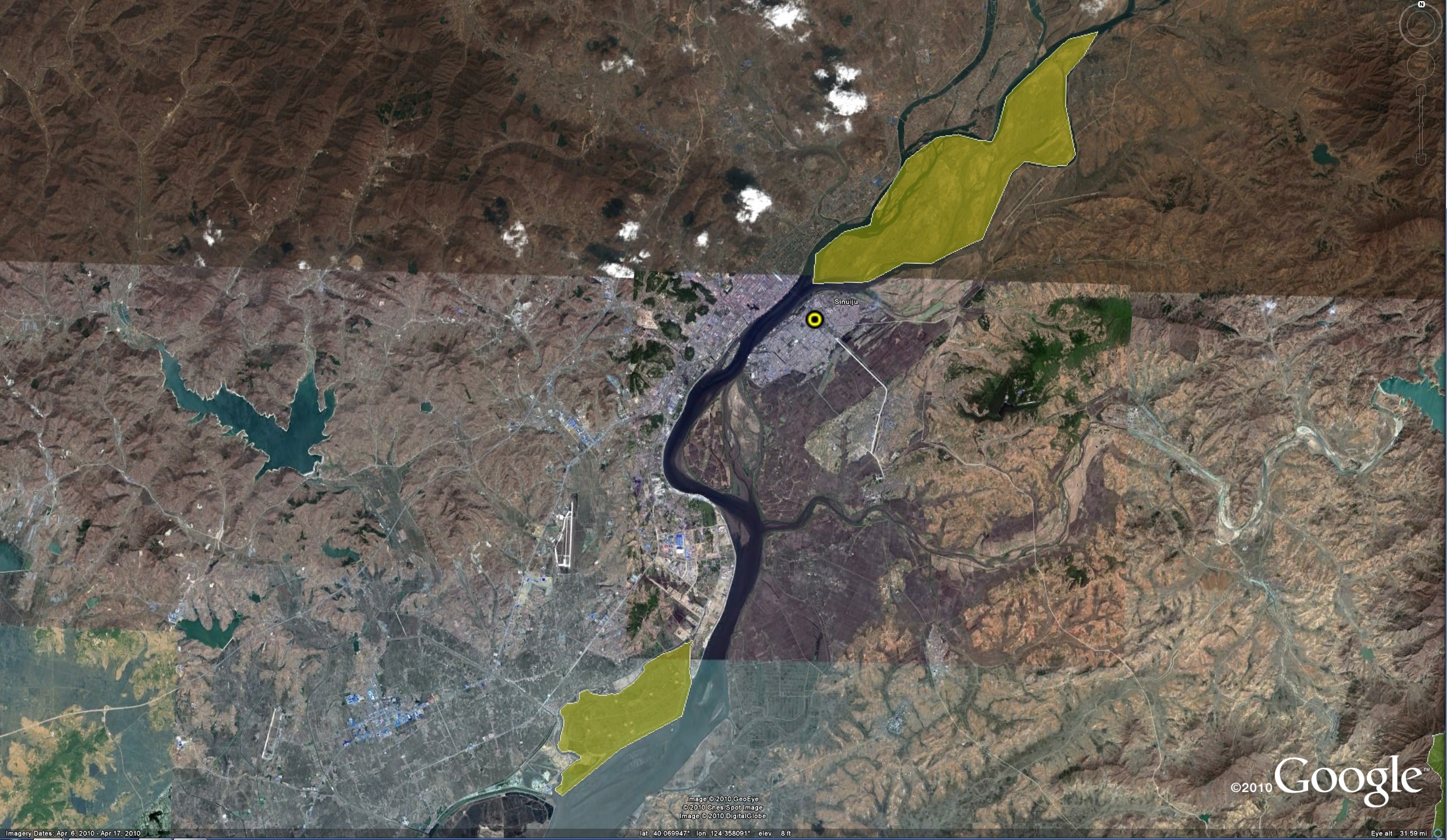
(via One Free Korea) Global Times reports (in Korean) that the DPRK is leasing two islands (황금평 and 위화도) to China.

Here is a satellite image of the two islands (highlighted):

According to the article:

South Korea’s Hankook Ilbo daily newspaper reported Thursday that North Korea has decided to extend the lease terms of two islands to Chinese companies for the establishment of a free trade zone.

However, analysts say the zone will more likely be developed as a trade area to facilitate business with China.

Both islands are located on the Yalu River, which constitutes the northwestern boundary between North Korea and the northeast region of China.

Hankook Ilbo reported that North Korean leader Kim Jong-il agreed to establish a free trade zone of 50 square kilometers on the two islands during his visit to China in May, and foreigners won’t need a visa to visit the islands.

The extension of the lease term by 100 years – starting this past May – to Chinese companies is unusual because Pyongyang generally leases land to foreign companies for 50 years, the report said.

By press time, state-run media in North Korea hadn’t confirmed the report.

South Korea’s Yonhap News Agency reported earlier this year that in order to attract foreign investment to North Korea, Pyongyang will set up a free trade area, located near the Sino-North Korean border city of Dandong, Liaoning Province, to be developed by a Chi-nese enterprise.

The report quoted an informed source as saying the scale of investment in the two islands will total $800 million.

“I don’t think North Korea will establish a free trade zone in the border areas that soon,” said Lü Chao, director of the Korean Research Center at China’s Liaoning Academy of Social Sciences. “But it is likely that the two islands will be developed into a border trade zone that can help improve the lives of the locals and be conducive to regional stability.”

Lü told the Global Times that developing a free trade zone in North Korea’s border areas with China might take longer.

Separately, Japan’s Yomiuri Shimbun newspaper reported Monday that Kim Jong-un, the third son of Kim Jong-il, recently said his country needs food more than bullets.

“In the past, it was all right to have bullets and no food, but now we must have food, even though we don’t have bullets,” the newspaper quoted him as saying.

The paper said Kim Jong-un made the remarks during a visit to Kimchaek city in Ham-gyong Province in late September, and the comments are confirmed in documents recently disseminated to party officials.

Kim Jong-un was promoted to a four-star general and vice chairman of the ruling Workers’ Party’s Central Military Commission last month during an important meeting of the party.

The White House said Thursday that North Korea appeared to be in the early stages of a leadership transition, and it would still take some time to discern the final outcome.

“We’re watching the transition closely,” Jeff Bader, US President Barack Obama’s Asia adviser, told reporters.

The idea of building a special economic zone near Sinuiju has been proposed several times but it never seems to take hold.  Given the level of economic growth in Dandong over the last five years, and China’s growing clout in the DPRK, maybe things will be different this time.

Read the full aticle here:
NK leases islands to Beijing: report
Global Times
Wang Zhaokun
10/29/2010

Share

Canada to adopt DPRK sanctions

Thursday, October 28th, 2010

UPDATE (10/31/2010): According to CTV News:

The head of the Canadian Security Intelligence Service quietly told a crowd of insiders he’s worried about North Korea and Iran surreptitiously trolling Canada for components to build an atomic bomb.

In a speech to academics and former intelligence officials, CSIS director Dick Fadden spoke of the spy service’s “active investigations” of people trying to procure nuclear materials.

The threat of weapons of mass destruction is an “area where we have to worry far more than we did not too long ago,” Fadden said.

“North Korea and Iran being people that we worry about the most.”

Fadden made the unusually candid comments in a previously unreported — and still partly secret — address to a late May gathering in Ottawa of the International Association for Intelligence Education.

The CSIS director also elaborated on his concerns about foreign interference in Canadian politics, as well as the threat of cyberterrorism. In addition, Fadden mused aloud on whether simply jailing homegrown terrorists is a real solution to the problem of radicalization. And he told the audience India has more influence in Afghanistan than Canada and its major coalition partners combined.

ORIGINAL POST: According to CTV:

Canada is adopting tough new sanctions against North Korea intended to demonstrate to Pyongyang that “its aggressive actions will not be tolerated.”

Foreign Affairs Minister Lawrence Cannon announced the new restrictions Thursday.

Under the new controlled engagement policy Canada’s relations with North Korea will be restricted to just a few areas, Cannon said.

Regional security concerns, human rights and humanitarian issues, inter-Korea relations and consular issues are now the only acceptable topics of contact between the two countries, Cannon said.

“All government to government co-operation or communication on topics not covered under the controlled engagement policy have now stopped,” Cannon said.

Cannon also announced new economic sanctions that will soon be put into place.

He said all imports from and exports to North Korea will be halted, apart from certain humanitarian exceptions.

There is also a ban on investment in North Korea by Canadians or people in Canada.

The sanctions also restrict the provision of financial services and the transfer of technology to North Korea.

All North Korean ships and aircraft are also banned from either landing in Canada or passing through its airspace, Cannon said.

“Canada takes a principled stand against those who recklessly commit acts of aggression in violation of international law,” Cannon said.

“The adoption of a controlled engagement policy and the imposition of special economic measures send a clear message to the North Korean government that its aggressive actions will not be tolerated.”

Canada has taken a tough stance with North Korea following the sinking of the Cheonan, a South Korean navy ship, earlier this year.

Forty-six sailors were killed when the ship went down. A multi-national investigation concluded the warship was sunk by a North Korean torpedo.

In the wake of the attack, Ottawa announced tougher diplomatic and trade restrictions, suspended high-level visits from officials and joined in the international condemnation of the attack.

Cannon on Thursday called on Pyongyang  to “improve its behaviour in complying with its obligations under international law.”

“These sanctions are not intended to punish the North Korean people. The sanctions we are announcing today are aimed directly at the North Korean government,” he said.

The level of trade between the DPRK and Canada is minimal, so these actions are more symbolic than anything else.

Though the two countries exercise diplomatic relations, there is no DPRK embassy in Canada and vice-versa.

Read the full story here:
Ottawa drafting ‘tough’ new sanctions for North Korea
CTV
10/28/2010

Share

Can North Korea embrace Chinese-style reforms?

Thursday, October 28th, 2010

According to China Economic Review:

Could North Korea be saved by Chinese-style reforms? In return for its continued support, China is pushing the rogue state to liberalise its economy, and Chinese firms are making inroads into various sectors, especially infrastructure and mining. Earlier this week, I interviewed Felix Abt, a Swiss business consultant who was appointed managing director of a pharmaceutical joint venture in Pyongyang with a brief to turn around the loss-making company, about his experiences over the last eight years.

How open is North Korea to foreign investment, and how many foreign companies are operating on the ground?

In 1992 the Supreme People’s Assembly adopted three laws allowing and regulating foreign investment — the Foreign Investment Law, the Foreign Enterprise Law, and the Joint Venture Law.

Since then, foreign investors have become active in a variety of industrial and service industries. There are a few hundred foreign-invested companies operating at present, mainly smaller sized ventures ($100,000 to $3 million) and of Asian origin (with China ranking No.1).

There are a few very large foreign investments, mainly in the telecom and cement industries. Western multinationals have been shying away from North Korea for fear of ending up on a sanctions list in the world’s largest economy. BAT sold its highly profitable tobacco factory due to political pressure in Great Britain to a Singaporean company a few years ago.

What sort of person sets up business in North Korea? What sort of industries have arrived and what sectors are not represented?

The domestic market is still very small and limited and and not much growth can be expected in the foreseeable future. So to talk about a promising emerging market at present would be a silly exaggeration.

However, North Korea is a very interesting location for the processing of products from garments to shoes to bags where you send the cloth or the leather and the accessories and they send you the finished products back.

The same goes for the extraction of minerals and metals, abundantly available in North Korea, in which case you would send equipment and get the mining products.

In addition, the manufacturing of low to medium technology items is very competitive and such products are already being made with foreign investment in North Korea from artificial flowers to furniture to artificial teeth. I was involved in making the business plan for the artificial teeth joint venture and know therefore that such products can be manufactured with a much better profit margin than for example in the Philippines where the artificial teeth had been produced before.

A particularly promising industry is IT due to the extraordinary quantity and quality of mathematicians unmatched by other countries. The first and only software JV, Nosotek, has seen remarkable successes within a very short time from its foundation and could become a subject of interest to investors who would never have thought of putting any money in North Korea until now.

How easy is it to do business there? Are most foreigners concentrated in Pyongyang or are they spread around?

It depends on the expectations, on the choice of the local partner and on the expatriate staff a company sends there. You need to thorougly select the most suitable local partner and an expatriate manager that is not only professionally competent but also can adapt to and cope with a demanding business environment.

The success of the pharmaceutical joint venture I was running in the past depended on a fast capacity building of the Korean members of the board of directors, managers and staff. I brought them to China where they visited the first foreign and Chinese invested pharmaceutical JV and I convinced its Chinese octogenarian architect to become a member of our company’s board of directors.

Since he faced very similar problems decades earlier he could convince the North Koreans quite easily why certain things had to be done in a certain way to make the business successful. We visited a great number of pharmaceutical companies, wholesalers, pharmacy chains in China and some of our staff even worked in a Chinese factory for some time.

When I wanted to set up the marketing and sales function I was first told that “companies in the DPRK usually don’t have a sales dept.”. I was asked to send a letter to the cabinet to explain my reasons to get the permit for doing so. The visits in China were surely important eye openers and helped getting things organised like in any other country.

The Korean managers and staff quickly acquired all the necessary skills and were able to run the day to day business (factory, import and wholesale of pharmaceuticals, pharmacies) alone when my term ended as managing director.

Many foreign business people are based in Pyongyang, but there are also many working in different places throughout the country, e.g. near mines in the mountains.

Hu Jintao has urged North Korea to speed up its economic reform, using China as a model. Could North Korea open up in the same way over the next few years?

The Chinese are better informed than the scholar and North Korea expert who recently wrote in the Wall Street Journal that the country’s elite would never agree to reform its economy as they fear the system would then collapse.

Together with the Chinese, I believe the risk of a collapse is much bigger if no reforms are carried out than if there are slow and controlled changes.

Once the economy starts taking off and people’s living standards rise the people will hardly challenge the system and the leadership even though the North Korean people know that South Korea’s economy is much more advanced.

Read the full story here:
Can North Korea embrace Chinese-style reforms?
China Economic Review
Malcolm Moore
9/23/2010

Share

Prices and exchange rates increase following currency re-denomination

Thursday, October 28th, 2010

According to the Korea Times:

In North Korea, the price of rice and currency exchange rates have been on a roller coaster ride since the failed currency reevaluation last November, a ruling party lawmaker said Thursday.

In a booklet, titled “Collection of National Assembly’s Annual Audit: North Korea 2010,” Rep. Yoon Sang-hyun of the Grand National Party claimed that creating a thriving market is the key to resolving economic problems in the Stalinist society.

North Korea watchers said the presence of a free market was the result of the communist party’s halt of the public food distribution system after the devastating famine hit the impoverished economy in the wake of massive floods in the mid 1990s.

The lawmaker released the booklet based on data and reports from the Ministry of Unification.

According to him, the price of one kilogram of rice was approximately 20 won before the currency reform. But it skyrocketed after that and hit 1,000 won early this year.

The range in the price of rice in late July reached between 1,300 and 1,500 won.

Along with rice prices, Yoon said foreign exchange rates were on a volatile up and down fluctuation as well.

The exchange rate for the North Korean won against the U.S. dollar was 30 won per dollar. But the dollar rate was rapidly appreciated to 1,000 won per dollar this March and rose further to 1,300 won per dollar.

Citing a unification ministry’s report, Yoon said some 300 to 350 markets were open in the North and there are one or two markets for every country [sic:  “county”].

North Korean authorities implemented the currency reform last year in order to repress the markets, but the failed results proved their bold miscalculations, he said.

Read the full story here:
Rice prices on a roller coaster ride in N. Korea
Korea Times
Kang Hyun-kyung
10/28/2010

Share

China and DPRK signaling greater cooperation

Thursday, October 28th, 2010

Aidan Foster-Carter wrties about the recent increase in China-DPRK “friendship” activities in the Asia Times

Over a month ago, in an article in these columns, I suggested a number of reasons why North Korea may well become a quasi-satellite of China.

Well, it’s happening even faster than I expected. In all the excitement about Kim Jong-eun’s coming-out for a second time, at the 65th birthday of the ruling Workers’ Party of Korea (WPK) on October 10, we risk missing another key aspect of that big Pyongyang parade.

The “reptile press” – one of my favorite North Korean phrases; yup, I’m a lizard and proud – all oohed and aahed at their first glimpse of the “young general”. Most paid less attention to a middle-aged chap also standing on the podium, not far from the clearly ailing Kim Jong-il. The one without a badge – meaning he isn’t North Korean. A rare privilege for a foreigner.

How now, Zhou
Meet Zhou Yongkang. Hardly a household name, yet ranked ninth in China’s politburo. A former minister of public security (2002-2007), he still has responsibilities in that key area.

Now Zhou has a new role too: he is China’s point man on North Korea. This seems to have been his first trip there, but it won’t be his last. Barely a week later, back in Beijing, he was on the job again, this time hosting a large visiting North Korean delegation (of which more below).

Zhou has been parachuted in above Wang Jiarui, the head of the Chinese Communist Party’s international liaison department, who in recent years had been China’s most frequent flyer to Pyongyang. Wang is still on the case: he was part of the October 10 delegation too, but clearly ranked below Zhou.

This seems less a demotion for Wang than a broadening of Beijing’s agenda. Wang’s main task, a thankless one, was and is to try to chivvy the Kims into line on the nuclear issue. That remains a key goal, but now in a wider context. China wants to deepen its overall relations with North Korea. To that end, bringing in a new more senior figure to take charge flatters the Kims, while Zhou’s background in public security is doubtless meant to reassure them.

China means business
Who else did Zhou bring along? Not the usual cross-section of the great and the good, but the neighbors: meaning senior figures from the three Chinese provinces – Jilin, Liaoning and Heilongjiang – which border or are close to North Korea. This trio had a special dinner with a quartet who are their North Korean equivalents: the party secretaries – provincial governors in all but name – from North Pyongan, Jagang, Ryanggang and North Hamgyong, the four provinces which adjoin China across the Yalu (Amnok in Korean) and Tumen rivers.

Not only dinner, but a deal. On the eve of Pyongyang’s parade, the two sides signed a trade agreement. No details were given, but again each side’s border bigwigs were in evidence.

Nor did it end there. A week later, one of North Korea’s rising stars led a big delegation to China, with provinces again prominent. Aged only 53, much younger than most of North Korea’s gerontocratic elite, Mun Kyong-dok is a new alternate politburo member. He also holds the key job of party secretary for Pyongyang. As such, on September 30 he gave a keynote speech in front of 150,000 people, congratulating Kim Jong-il on his re-election as leader.

October 16 saw Mun on the road, shepherding all 11 of North Korea’s provincial or big city party secretaries to – where else? – Beijing. Welcoming them, Zhou Yongkang – who else? – noted that this was “the first time that the secretaries from all the WPK provincial and municipal committees have visited China”, adding, “I wish that you will expand exchange with various Chinese regions you’re visiting and achieve success from your tours.” Mun replied that “We will study and learn the successful experiences from China.”

Maybe this time?
We’ve heard that before, even from Kim Jong-il – who forgets all about it as soon as he gets back home. But as Sally Bowles sings in Cabaret: “Maybe this time.” Sending such a large team – a full house, indeed – on the road in this way, including several younger and newly appointed provincial party bosses, looks like a real effort to take things forward. China won’t be impressed if its mendicant neighbor merely rattles the begging bowl again.

Mun’s team went on to – where else? – the northeast, visiting factories in Heilongjiang and Jilin. These provinces have in the past had bones to pick with their unneighborly neighbor, which too often fails to pay for coal or other goods – and sometimes doesn’t even return the railway wagons used to deliver them. That sort of tiresome trickery will have to stop. Time will tell whether North Korea has really turned over a new leaf in its business dealings.

Blood brothers
On another front, by a convenient coincidence October 19 was the 60th anniversary of China’s entry into the Korean War. The massed ranks of Chinese People’s Volunteers (CPV) – old British army joke: “I want three volunteers: You, you and you!” – turned the tide, saved Kim Il-sung’s bacon and stopped General Douglas MacArthur wiping the Democratic People’s Republic of Korea (DPRK) off the map.

Cue yet more love-ins. The state-run Korean Central News Agency (KCNA) ran a stirring headline: “Friendship Forged in Blood in Anti-US War.” Special events included a photo exhibition, a Chinese film week and performances by a visiting art troupe from the People’s Liberation Army (PLA). A delegation from the Korean People’s Army visited China, led by vice minister of the People’s Armed Forces Pyon Il-son: a hitherto obscure general, but evidently another name to watch.

China reciprocated by sending a better-known bigwig. (Speaking of which, he wears one – or so says Wigipedia.) Unlike Zhou Yongkang, who is new to this patch, General Guo Boxiong – vice chairman of China’s Central Military Commission – has had North Korean links for at least a decade; he visited in 2001 with then-president Jiang Zemin.

Usually the CPV anniversary is marked by a low-key wreath-laying and a few press articles. But 60 is a big one, and this time Pyongyang pulled out all the stops. There was a mass rally – “held with splendor”, gushed KCNA – with Kim Jong-il and Kim Jong-eun in attendance and much stirring rhetoric. The dear leader also hosted a dinner, again with his son present.

Even Arirang has got in on the act. North Korea’s striking yet introverted mass games have finally admitted (pace juche) that the Kims didn’t go it alone; they got by with a little help from their friends. KCNA on October 22 described a newly added scene, “Friendship Arirang”. This highlights the role of the CPV, portrayed with “drums of different sizes, ribbons, red flags and other hand props … several-dozen-meter-long dragons, pandas and lions.”

We helped you first
One wonders what Chinese visitors who are the mainstay of North Korea’s thin tourist trade make of such cliches – or the fact that, the way Pyongyang tells it, that is only half the story. For Arirang also, and first, depicts “the Korean People’s Revolutionary Army and Chinese armed units fighting together against the Japanese imperialists”. The implication is that this was somehow reciprocal: Korea helped China out, and then China repaid the compliment. Note also the disrespect: Korea had an army, China merely “armed units”. What, no PLA?

Pull the other one, comrades. True, a small but gallant band of Korean communists under Mu Chong, a veteran of the Long March, were with Mao Zedong in Yanan. Separately, the young Kim Il-sung was one of a few guerillas – under Chinese command – who skirmished with the Japanese in Manchuria before being chased across the border into the Soviet Union. Kim came back in Soviet uniform and set about purging rivals – including Mu Chong, who had to flee to China. All quite a can of worms, which it seems unwise of North Korea to risk opening.

CPV casualty figures tell their own story. This year Beijing quantified these. A staggering three million Chinese troops fought in what China still calls the “War to Resist US Aggression and Aid Korea”. Over 180,000 never came back. PLA statistics show 114,084 killed in action or accidents, with another 25,621 missing. A further 70,000 died from wounds, illness or other causes. There are 183,108 registered war martyrs. Others put China’s losses as even higher. With all respect to Mu Chong, a few Koreans’ sacrifices for China don’t begin to compare.

Nuclear hopes and fears
China’s many and mixed motives vis-a-vis North Korea now include never to get dragged into war like that again. To that end, Beijing still professes faith in the six-party talks on North Korea’s nuclear program which it hosts, even though these achieved little tangible – despite many hopes, and much talking-up – over five long years. (They began in 2003 and have been stalled since 2008.)

Here too there is fresh activity. Hardly had the cheers echoing in Kim Il-sung Square died away than the North’s long-time nuclear negotiator Kim Kye-gwan, newly promoted to first vice minister, led a delegation to Beijing on October 12. There followed four days of what KCNA called “an exhaustive and candid discussion on DPRK-China relations, resumption of the six-party talks and the regional situation, etc.” It added: “The DPRK is ready for the resumption of the above-said talks but decided not to go hasty [sic] but to make ceaseless patient efforts now that the US and some other participating countries are not ready…”

True. South Korea and Japan, like the United States, see no point in dusting off the six-party circus without clear signals from Pyongyang on two fronts: a serious will to give up nuclear weapons, as against playing games; and an admission that it sank the South Korean corvette Cheonan in March.

That is a hard gap for Beijing to bridge – especially if there is any basis to recent rumors that North Korea, so far from disarming, may be planning a third nuclear test. Somehow I doubt this. China’s fresh embrace of its tiresome neighbor is not unconditional. I would expect its price for propping up the Kims to be twofold: Market reforms – and no more nuclear tests.

Another bang would sorely tax China’s patience with this tiresome thorn in its northeastern flesh. Beijing is still sheltering number one son Kim Jong-nam, who on October 12 rained (or an earthier verb springs to mind) on little brother’s parade by declaring that he personally was against a third-generation succession. Might anyone try to change his mind? Jong-nam may look ghastly, but he is pro-reform. If Jong-eun proves a pest or a dud, China has alternatives.

Read the full story here:
North Korea: Embracing the dragon
Asia Times
Aidan Foster-Carter
10/28/2010

Share

British bakeries a lifeline in North Korea

Tuesday, October 26th, 2010

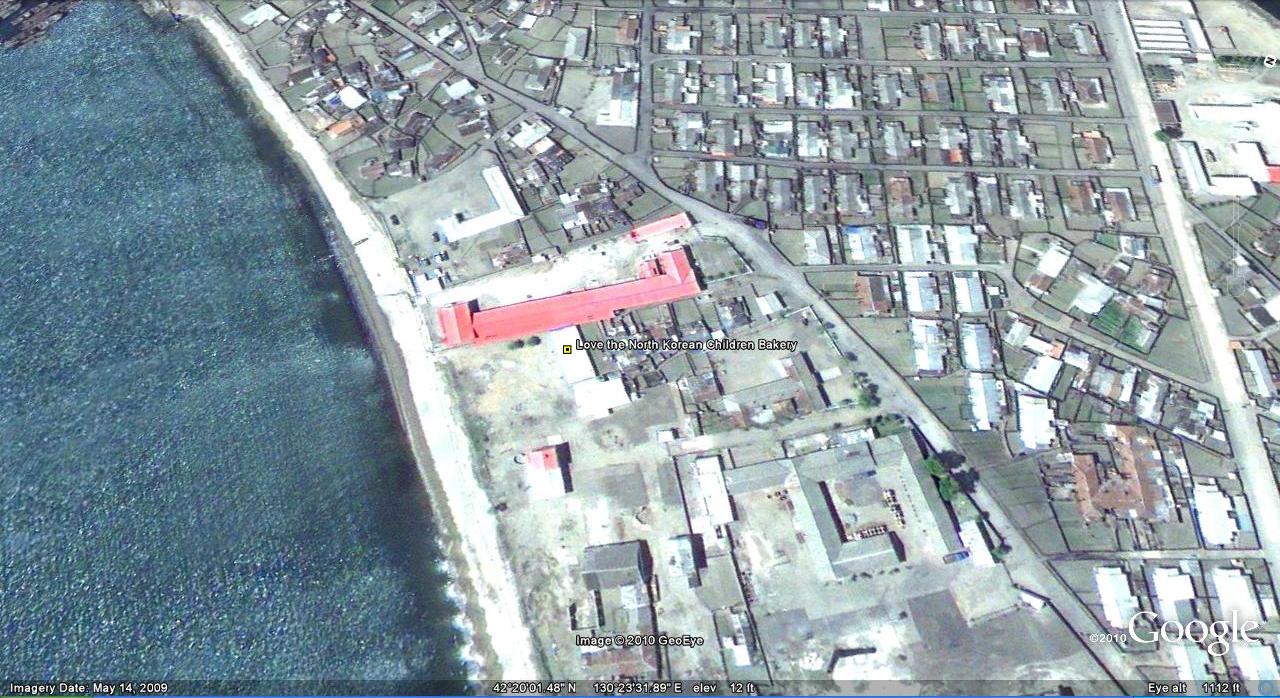
Pictured Above: Love North Korean Children Bakery (Sonbong, DPRK)

Michael Rank writes in the Asia Times:

North Korea is a land of hunger and poverty but the children of Hahyeon primary school look reassuringly healthy, thanks to a small, British-based charity that runs three bakeries in this isolated and highly secretive country.

The children receive their midday meals courtesy of Love North Korean Children, [1] which bakes 2,500 mandu or steamed buns each day for pupils in 20 schools in and around the northeastern coastal city of Sonbong, near the Chinese border.

“If we did not provide these buns the children would go hungry,” said the charity’s founder and powerhouse, South Korean-born George Rhee.

Rhee works indefatigably to make sure that his bakeries have sufficient supplies of flour and other essential items, all of which have to be imported from China, something of a logistical and bureaucratic nightmare.

“All of our food gets to the children. None goes to the North Korean army or government,” said Rhee, and as he travels to North Korea from London up to 10 times a year, he is in a position to know.

Rhee, 52, told how he was inspired to found Love North Korean Children as a result of his own childhood experiences. He was one of eight children – he has six brothers and a sister – and when his father’s land reclamation business went bust, it left the family penniless. His parents were forced to put him and his twin brother in a children’s home.

The home was a cruel place and the children often went hungry, and it was this experience that made Rhee decide that he wanted to help the children of North Korea.

“At first I was thinking of opening an orphanage, but the government wouldn’t allow that. They say North Korean leader Kim Jong-il is our father, so there is no need for orphanages. So then I decided to open a bakery,” Rhee recalled.

Rhee first visited North Korea in 2002, and opened the charity’s first bakery the following year, in Rajin, close to Sonbong. I visited him there last month. He recently handed over responsibility for the Rajin bakery to a Korean-American group, but he also runs a bakery in Pyongyang, and this year opened a new bakery In Hyangsan, about 150 kilometers north of the capital.

He puts the cost of flour and equipment for the Sonbong and Pyongyang bakeries at about US$6,300 each per month, and for the Hyangsan bakery at almost double that, as it feeds twice as many children.

Rhee is a minister in the Assemblies of God Church and has its backing for his charity. Most of the costs are borne by three Dutch Christian foundations, the Barnabas Fund, Stichting Ora and Dorcas Aid International, but Rhee hopes to build more bakeries in North Korea and recently went on a fundraising trip to South Korea to talk to local companies and churches.

“There is a lot of interest in what we are doing. I am hopeful that we will be able to raise more money to open more bakeries,” he said.

Rhee said he hopes to open a fourth bakery in Haeju, the hometown of his late father, who escaped by boat to South Korea at the height of the Korean War in 1951.

“The North Korean government says we can. The only question is money,” he added.

Although the children at the Sonbong school looked healthy and well fed, they are among the lucky ones. Rhee said some of the children whom his bakeries feed are thin and pale, even with the extra food they receive from Love North Korean Children.

“I have even seen dead children in the streets. The situation for children in North Korea is terrible,” he stressed.

The United Nations World Food Program (WFP) bears this out. It says 33% of the population is undernourished and 23% of children under five are under-weight for their age.

“Public rations are reportedly far from sufficient and daily food consumption for most households is poor”, the WFP reports. Many people are forced to survive by cutting down on the number of meals per day, eating more wild foods – grass and bark in some cases – and less maize and rice, and reducing portion sizes for adults so that children can eat.

Although conditions have improved since the mid-1990s, when hundreds of thousands, possibly millions, of people died in a terrible famine, North Korea remains one of the world’s poorest countries.

Aid workers and diplomats say the government bears much of the blame, with an inflexible, highly centralized food-distribution system that results in a large proportion of the population going permanently hungry.

The WFP tactfully avoids blaming the government, referring to “a lack of arable land, poor soil management, insufficient water reservoirs to combat drought, shortages of fuel and fertilizer, outdated economic, transport and information infrastructure, and a general vulnerability to natural disasters”.

It quotes the Food and Agriculture Organization as saying North Korea needs to import 25% of its grain requirements, “but economic constraints mean the DPRK [Democratic People’s Republic of Korea] will struggle to meet its food import needs.”

All this means that small organizations like Rhee’s do a valuable job in feeding people who would otherwise go hungry, although the paranoid, xenophobic nature of the regime makes their work extremely challenging.

Until recently, a number of South Korean charities were active in North Korea, but the Seoul government ordered them out after the sinking of the naval ship the Cheonan in March in which 46 South Korean sailors died.

The South Korean government blamed North Korea for the sinking, and relations between the two countries, cool at best, went into the deep freeze.

Surprisingly perhaps, Rhee strongly supports the Seoul administration’s tough line, as he believes most of the South Korean charities were naive and were unable, or unwilling, to prevent the North Korean government from diverting much of the food they provided to the million-strong army.

“I support President Lee Myung-bak in this,” Rhee said. “These South Korean organizations were foolish” in not monitoring where food and other supplies were going.

Love North Korean Children was not affected by the ban, however, as it is a British-registered charity and Rhee, who has lived in the UK for 20 years, is a British citizen.

“The North Koreans cooperate well with us. It isn’t easy but we help to make sure that people get fed,” he said.

I had unexpected proof that the North Koreans appreciate Rhee’s efforts. During my visit to North Korea, officials constantly complained to me about photographs I was taking and at one point deleted some pictures on my camera.

I was concerned that they would delete more photographs when I left the country, as frequently happens.

I need not have worried, however. The customs officer who checked my camera at the North Korean-Chinese border was well disposed towards us, as his children were fed by Love North Korean Children. He took just a quick look at my photographs and waved us through.

You can see the author’s photos from Rason here.

Read the full story here:
British bakeries a lifeline in North Korea
Asia Times
Michael Rank
10/27/2010

Share

3.6% of South-North cooperation fund spent in 2010

Monday, October 25th, 2010

Institute for Far Eastern Studies (IFES)
NK Brief No. 10-10-25-1
10/25/2010

There has been a sharp drop in inter-Korean exchanges resulting from the chill in relations on the peninsula. This has led to a mere 3.6 percent of the inter-Korean cooperation fund being tapped as of the end of September. In 2009, 8.6 percent of the allocated funds were spent, but this year, even at the end of the third quarter, not even half that much has been allocated.

The National Assembly’s Unification, Foreign Affairs and Trade Committee found in an audit of the Ministry of Unification’s public documents that almost 1.2 trillion Won had been allocated for inter-Korean cooperative projects, but a mere 41.7 billion Won had been spent. 1.4 billion Won was spent on socio-cultural exchanges, while 13.1 billion Won was spent on humanitarian aid, 10.7 billion Won supported economic cooperative projects, and 16.7 billion Won was advanced in support of those companies and groups planning additional projects. On the other hand, the Ministry of Unification is loaning 60 billion Won from the inter-Korean cooperation fund to South Korean companies invested in economic cooperative projects that are suffering losses due to the May 24 measures, which restrict exchanges due to the sinking of the Cheonan.

In 2008, the first year of Lee Myung-bak’s administration, only 18.1 percent of the inter-Korean cooperation fund was spent, and this percentage has fallen every year since. Now at an all-time low, it appears that the rate of spending will continue to fall in the future. With the May 24 measures, the Kaesong Industrial Complex was exempted from trade restrictions. In addition, other inter-Korean trade worth approximately 80 million USD (90 billion Won) has been permitted. This includes 639 different cases of imported goods manufactured from raw materials or parts sent to the North prior to the May 24 restrictions, amounting to 31.15 million USD, and 269 cases of pre-ordered exports amounting to just over 49 million USD.

On the other hand, losses due to the halt of tourism to Mount Keumgang and Kaesong have amounted to 628.5 billion Won over the last two years. According to a report submitted to the National Assembly by the Korea Tourism Association on the impact of halting these tourism projects, losses of 548.2 billion Won had been incurred by August, and that is expected to grow to 628.5 billion Won by the end of the year.

Mount Keumgang tours were halted in July 2008, while Kaesong tours were stopped in November of the same year. Since then, the Korea Tourism Association has lost 10.5 billion Won in profits, while private-sector companies including Hyundai-Asan and its partners have lost 465.2 billion Won. In addition, restaurants, rest stops, visitor centers and other businesses in the border town of Koseong, Kangwon Province have lost 72.5 billion won due to the lack of tourists travelling across the border to Mount Keumgang, pushing total losses by the government and private sector to over 500 billion Won.

Share

Prices and DPRK/$USD exchange rate

Thursday, October 21st, 2010

According to Bloomberg:

The two sides of Chang Gwang Street (Satellite image here) in North Korea’s capital of Pyongyang show the gap between the Stalinist country’s elites and its capitalist-minded citizens. On one side, English-speaking officials mingle with Dutch traders at the Koryo Hotel. There, those with foreign currency can buy Heinekens for about a buck a can at the official exchange rate of 100 North Korean won to the U.S. dollar.

Across the street, a saleswoman at one of the private markets still allowed by the authorities giggles when a foreign guest says he doesn’t have the 200 won needed to buy a steamed vegetable bun. She flips the placard to reveal the cost in dollars, the currency of a country that doesn’t have diplomatic ties with North Korea. The price: 20 cents, implying an unofficial exchange rate of 1,000 won to the dollar.

Old Asia hands say this is one of the biggest spreads between the official and unofficial currency rate they have ever seen in the region. Back in the 1980s the gap between the official and market rates in China was not nearly as great as in North Korea today, says Ken Dewoskin, a director of Deloitte’s China Research and Insight Center in Beijing, who began his career watching China in the mid-1960s and first traveled there in 1977. “Even closed economies like Cambodia in the 1960s had only a 2-to-1 pricing discrepancy,” he says.

President Kim Jong Il moved late last year to revalue the won and limit the amount of cash that North Koreans could exchange for newly printed bills. The policy was designed to clip the wings of the private merchants who were increasingly creating an economy beyond the control of the authorities, according to the University of Vienna’s Rüdiger Frank, a political scientist who specializes in North Korea. The impact of the abrupt policy shift extended far beyond the merchants. “The revaluation not only wiped out people’s savings, but their trust in the government and their currency,” says Ha Tae Keung, founder of Open Radio for North Korea. “There’s a widespread belief among North Koreans that their money is going to get further devalued and they’ll get poorer just by holding onto it.”

The currency turmoil came amid mounting speculation that Kim Jong Il’s health was failing. Last month he promoted his son, Kim Jong Un, to four-star general, setting the stage for the country’s second hereditary power transfer. The government extended an unprecedented invitation to international media to witness the Oct. 10 anniversary celebrations marking the 65th anniversary of the Workers’ Party of Korea.

The next day, Pyongyang residents queued up as usual to spend their won at the Chang Gwang Street market. Twenty-four shoppers patiently lined up to buy a small cone of vanilla ice cream at 20 won each. A similar number waited for shaved ice with sweet bean paste at 5 won a bowl. Fifteen were there to buy sweet potatoes at 60 won per kilo. No one was seen lining up to purchase sausages, which at 1,700 won each were priced at the equivalent of 16 cans of Heineken beer at the Koryo Hotel.

While price tags at the hotel are in won, the national currency isn’t accepted there. That wasn’t a concern for guests and shoppers buying foreign goods—Scotch whisky and Syrian olive oil were on offer—with dollars, euros, and Chinese yuan.

One hotel worker, who said he made about 2,500 won a month, said the government provided people with food and other necessities such as clothing and housing. The free markets like the one across the street were there to supplement their diets, he said, adding: “We don’t operate like a capitalist country.”

Read the full story here:
In Pyongyang, the Dollar Commands Respect
Bloomberg
Michael Forsythe, Bomi Lim, Frances Yoon and Zeb Eckert
10/21/2010

Share