Archive for the ‘Economic reform’ Category

ROK government to leave Kaesong office unstaffed

Tuesday, January 11th, 2011

According to KBS:

South Korea says it will not re-station personnel at the inter-Korean economic cooperation office inside the Gaeseong Industrial Complex in North Korea.

An official from the Unification Ministry in Seoul said Tuesday that the decision was made as there is no work to be done at the office.

Seoul banned inter-Korean economic cooperation and trade in May of last year as part of its retaliatory measures for Pyongyang’s sinking of South Korea’s “Cheonan” naval vessel in March.

North Korea notified the South on Monday that it plans to resume operations at the economic cooperation office in the business park.

Meanwhile, the South accepted North Korea’s proposal to reopen the Red Cross communication channel at the truce village of Panmunjeom. The ministry official said that a South Korean liaison officer will answer the phone if North Korea attempts to contact the office Wednesday morning.

Read the full story here:
Seoul Will Not Send Officials to Gaeseong Office
KBS
1/11/2011

Share

Chinese to boost investment in Rason

Friday, January 7th, 2011

UPDATE  1 (2011-1-19): According to the Wall Street Journal:

A Chinese firm has signed a letter of intent to invest $2 billion in a North Korean industrial zone, representing one of the largest potential investments in Kim Jong Il’s authoritarian state and a challenge to U.S. policy in the region.

The agreement was signed with little fanfare in Pyongyang on Dec. 20—a day otherwise marked by pitched tension on the Korean peninsula following the North’s shelling of a South Korean island—according to documents viewed by the Wall Street Journal. Confirmation of the deal comes as Chinese President Hu Jintao visits Washington this week in a bid to forge closer security and economic ties with the U.S.

U.S. officials said the administration is aware of the possible Chinese investment, but noted that previous projects haven’t gone anywhere. “No investment project will enable North Korea to meet the needs of its people as long as its government continues its destabilizing behavior,” said a senior administration official.

The letter of intent involves China’s Shangdi Guanqun Investment Co. and North Korea’s Investment and Development Group. An assistant to the managing director of Shangdi Guanqun, who identified himself only by his surname, Han, said his company’s planned investment is focused on the Rason special economic zone, situated near North Korea’s border with Russia.

The zone was called Rajin-Sonbong when it was established in 1991, but failed to attract sufficient investment. It was revived, and re-named Rason, following a visit there in 2009 by Mr. Kim.

Mr. Han said the plan is to develop infrastructure, including docks, a power plant and roads over the next two to three years, followed by various industrial projects, including an oil refinery, over the next five to 10 years. He said the company was waiting for a response from the North Korean government before applying for approval from China’s Ministry of Commerce.

“It’s all pending at this stage, and it’s really up to the Korean side to make the decision,” Mr. Han said. He added that the $2 billion figure was what the North Korean side had hoped for, not necessarily what his company could deliver.

The company’s Web site says the company was “under the administration” of a state-owned enterprise, Shangdi Purchase-Estate Corporation. Mr. Han, however, said his company was “100 percent private.”

For the Obama administration, securing China’s cooperation in restraining North Korea’s military and nuclear-proliferation activities is a cornerstone of a warmer bilateral relationship. But the potential investment is a reminder of possible limits of Chinese cooperation.

The U.S. wants to step up sanctions to force Kim Jong Il to give up his nuclear-weapons arsenal and military activities. China, meanwhile, is increasingly promoting business projects and direct investment to influence the North, say Chinese and American analysts, arguing financial pressure hasn’t worked.

China is North Korea’s biggest trading partner and aid donor, but the scale of this deal raises concerns in Seoul that Beijing is running its own version of the “Sunshine” policy under which the South boosted investment in the North from 1998 to 2008.

This policy disconnect is expected to be one of the issues Chinese and U.S. officials discuss this week. “These types of deals pursued by China generally present a real challenge to the sanctions” being effective, said Victor Cha, a North Korea expert who helped oversee Asia policy in George W. Bush’s National Security Council. “The net effect is that it does make it more difficult for these sanctions to have the desired effect.”

Such deals have emerged in the past and have come to nothing, analysts said, and it is possible this one, too, could peter out. A number of similar North Korean economic zones have failed to live up to their billing because of poor infrastructure and corruption, and a lack of economic reform. News of the deal was first reported in the Korean-language press, including the Voice of America’s Korean service.

It is unclear how long the agreement has been in the works. But its Dec. 20 signing came on the day South Korea conducted a closely watched artillery test from Yeonpyeong Island near North Korea.

The test marked a high point in tensions after North Korea’s surprise late November shelling of Yeonpyeong, which killed four South Koreans. Pyongyang had threatened a swift military response should Seoul carry out an announced artillery test on Dec. 20. But the day’s drill came and went amid high security in the South, with the North saying in a statement it “did not feel any need to retaliate.”

Top administration officials have recently both praised and chided the Chinese over the North. On a trip to China last week, Defense Secretary Robert Gates commended the Chinese for their “constructive” role in reducing tensions on the peninsula after Pyongyang’s recent shelling of a South Korean island. Secretary of State Hillary Clinton in a Friday speech pressed China to be more aggressive in helping tamp down the North’s nuclear program.

The proposed investment is among the strongest evidence yet of China’s strategy of using direct investment rather political pressure to push for change in North Korea. Chinese experts say that after North Korea’s first nuclear test in 2006, China tried to make improved bilateral relations dependent on Pyongyang dismantling its nuclear program. But after a second test in 2009, China changed tack.

Beijing now believes, according to Chinese experts, that the North Korean regime won’t respond to political pressure and could collapse completely if China cuts off aid and investment, triggering a flood of refugees into northeastern China, and bringing U.S. troops right up to the Chinese border.

The investment strategy was cemented when China’s Premier Wen Jiabao visited North Korea in October 2009 and signed a slew of economic and trade agreements. One of those agreements was for China to fund construction of a $250 million bridge across the Yalu River that separates the two countries.

Construction of the bridge, which would link China with another North Korean special economic zone, had been slated to start in August. Local officials said in November it appeared to have been put on hold indefinitely. Now they say a ground-breaking ceremony was held Dec. 31.

U.S. officials are particularly concerned about how China’s financial links to North Korea may be facilitating Pyongyang’s weapons programs. In November, Pyongyang showed a visiting American scientist 2,000 centrifuges stationed at a cover site, drastically raising fears about the North’s ability to expand its nuclear-weapons arsenal.

“China’s increased economic support undercuts the rest of the region’s efforts to convince Pyongyang that there will be consequences for further belligerence, nuclear weapons development or transfer of nuclear capabilities,” said Michael Green, who also served as a senior official on Asia during the Bush administration.

Read the full story here:
Chinese Firm to Invest in North Korea
Wall Street Journal
Jay Soloman and Jeremy Page
2011-1-19

ORIGINAL POST (2011-1-7): According to the Joong Ang Ilbo:

A Chinese state-run company recently agreed to invest $2 billion in North Korea’s Rason free trade zone, the JoongAng Ilbo learned yesterday from documents related to the deal.

Shangdi Guanqun Investment Co., Ltd. signed a 10-point memorandum of understanding with Pyongyang’s Investment and Development Group on Dec. 20 in Beijing, the documents showed.

The signing ceremony was attended by Mi Chang, president of Shangdi Guanqun Investment, and Kim Chol-jin, president of the Investment and Development Group.

The goal of the investment, stated in the documents, is to build Rason, a northeastern North Korean city on the East Sea that borders both China and Russia, into the “biggest industrial zone in Northeast Asia” in around 10 years.

The project calls for coal-fired power plants, roads, piers and oil refineries in the North Hamgyong Province city, the documents said.

According to the documents, the deal is “a strategic joint project based on trust between high-level figures” in China and North Korea, which suggests it may have been negotiated by North Korean leader Kim Jong-il during two visits to China last year, on which he met Chinese President Hu Jintao.

The North’s economy has suffered under international sanctions on trade and financial services overseas, imposed after its nuclear weapon tests, and is desperately seeking foreign investment.

China is investing in Rason as an export base to serve markets in Japan, southern China and Southeast Asia.

Rason is a merger of two towns, Rajin and Sonbong, and was designated the first free trade zone in the North in 1991. It was promoted to a “special city,” which means it has fewer restrictions on businesses.

“We have a deep interest in North Korea’s ample natural resources,” an official of Shangdi Guanqun Investment Co., Ltd. told the JoongAng Ilbo. “To facilitate the export of natural resources [from the region], we will invest $300 million first and construct a coal-fire power plant at the coal mine and build a railway, roads, and harbors and piers [near it].”

The Chinese firm’s official said the company opened an office in Pyongyang at the end of last month.

Shangdi Guanqun Investment, established in 1995 by the Chinese government, is a trading firm specializing in oil processing, natural resources and international financial services. It is one of the key companies in China’s 12th five-year economic development plan that starts this year.

North Korea’s Investment and Development Group is in charge of developing the country’s four free trade zones. The other economic special zones are in Kaesong, Mount Kumgang and Sinuiju.

The Shangdi Guanqun Investment official said the company will build an oil refinery in Rason, where it plans to refine crude imported from the Middle East and Russia and sell the output to China or other countries.

I believe this Chinese story also relates to the same project.

Read the full story here:
China backs North’s Rason project
Joong Ang Daily
Ko Soo-suk
2011-1-7

Share

New ROK firm begins Kaesong operations

Thursday, January 6th, 2011

According to Yonhap:

Despite persisting political woes, a new South Korean company has begun operating in North Korea’s border industrial complex that combines superior South Korean capital and know-how with the North’s cheap local labor, a government official said Thursday.

The company, known as DSE, completed building its factory in Kaesong in early May and is therefore exempt from the investment ban on North Korea that Seoul imposed later that month over the sinking of a South Korean warship, the Unification Ministry official said.

The ministry official, who spoke on customary condition of anonymity, said DSE began operating on Jan. 3 and is employing 160 North Korean workers, part of the 44,000 workforce in the Kaesong complex, to produce lighting apparatuses and other metallic products.

The number of South Korean companies operating in Kaesong now stands at 122, the official added.

South Korea has since sharply cut down on the number of its workers allowed to stay in Kaesong. The North, in an apparent act of desperation to revive its economy, has since called for lowering tension and holding cross-border dialogue. South Korean officials are demanding that the North first show “sincerity,” indicating Pyongyang must apologize for the series of provocations blamed on it.

Read the full story here:
New S. Korean company begins operating in N. Korean factory park
Yonhap
Sam Kim
1/6/2011

Share

Rason port facilitates intra-China coal distribution

Tuesday, January 4th, 2011

rajin-ports-thumb.jpg

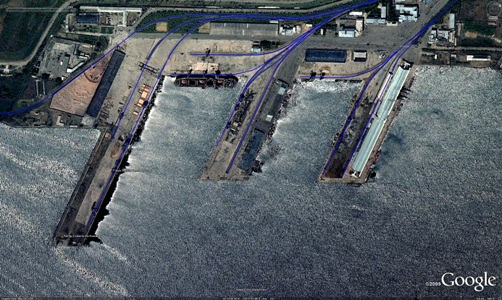
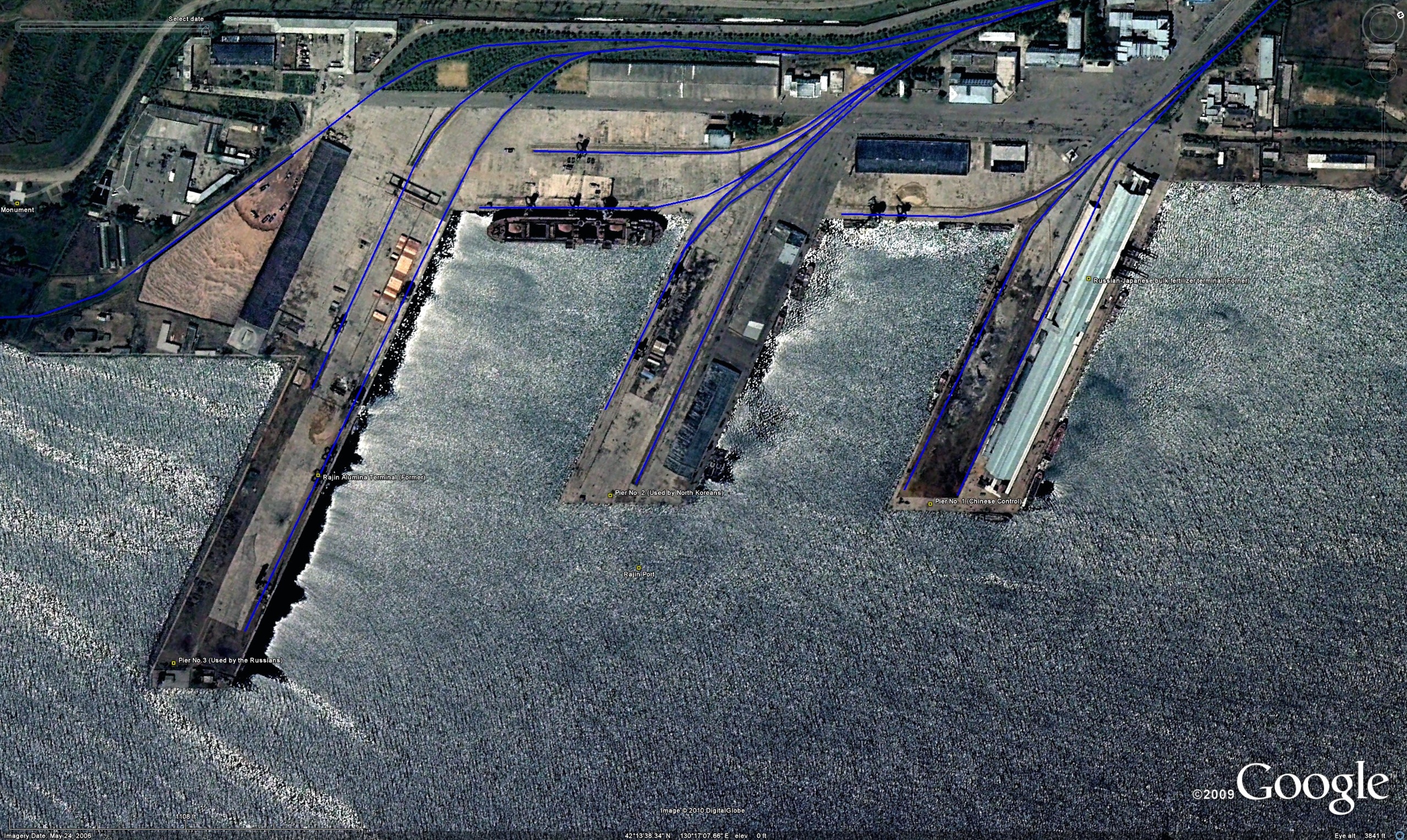
Click image to see the Chinese, Russian, and North Korean piers

UPDATE 5: No more intra-Chinese coal shipments  through Rason have been reported following this 2011 experiment.

UPDATE 4 (2011-6-4): KCNA reports some additional details on the coal being shipped from Hunchun to Shanghai via Rason. According to the article:

It was against this backdrop that China was in the process of transporting 20,000 tons of coal to Rason Port via Hunchun from May 14 and then transporting it to Shanghai by a cargo ship.

Yanbian Ribao, conveying this news on May 18, reported that the Shanghai branches of the Hunchun Mining Group and the Chungjiang Group would transport 500,000 tons of coal to Shanghai by this method this year. This would be tantamount to more than 14,000 truck loads. An official concerned of the Mining Group said that transport of loads to various provinces of Southern China by this method would help sharply cut down the time and transport charges, etc. as compared with the inland transport.

So apparently the 20,000 tonne pilot project what supposed to pave the way for a 500,000 tonne project that never materialized.

UPDATE 3 (2011-1-25): China ships coal from North Korean port for first time. According to Michael Rank:

China has for the first time shipped coal from the North Korean port of Rajin following a deal by a Chinese company to renovate the port, a Chinese website reports.

The 20,000 tonnes of coal, mined in Hunchun, about 80 km north of Rajin, was shipped to Shanghai last month. After going through customs inspection at Hunchun, it was transported by road via the Wonjeongri border post near Dumangang, the report said.

It noted how shipping the coal from Rajin saved the cost of transporting it to the nearest suitable Chinese port of Yingkou or further afield by train and how the deal to renovate and expand Rajin’s no 1 dock would help to boost trade from northeast China more generally.

It said the Dalian-based Chuangli Group reached a deal to lease the dock in 2008 and the following year agreed to renovate it and expand its capacity to one million tonnes a year, although news was not announced until last spring.

But when this reporter visited Rajin last September there was no sign of the port being renovated and expanded, and although a couple of small North Korean vessels were moored at the port, there was little sign of any activity and the area was largely deserted.

China does have ambitious hopes for Rajin, however, and last month a Chinese company, Shangdi Guanquan Investment Co, was reported to have signed a letter of intent to invest $2 billion in an industrial zone in the region.

The Wall Street Journal quoted an assistant to the managing director to Shangdi Guangqun as saying the plan was to develop infrastructure, including docks, a power plant and roads over the next two to three years, followed by various industrial projects, including an oil refinery, over the next five to 10 years. He said the company was waiting for a response from the Pyongyang government before applying for approval from China’s Ministry of Commerce.

“It’s all pending at this stage, and it’s really up to the Korean side to make the decision,” the assistant, named only as Han, said, according to the WSJ. He added that the $2 billion figure was what the North Korean side had hoped for, not necessarily what his company could deliver.

North Korea has implausible dreams of turning the city into an international freight brokerage, export processing and finance hub, and has even made a computerised promotional video about its plans to build glitzy skyscrapers along the seafront.

Photo of Rajin port here.

UPDATE 2 (2011-1-14): According to Every China:

As the first cross-border cargo ship for domestic trade in China, 10,000 tonner “Jinbo”, loaded with 21,000 tons of coal, arrived safely at Shanghai and docked steadily at the pier of Waigaoqiao Terminal at 4 p.m. on January 14. This marked the success of the maiden sail for cross-border domestic trade in our nation.

It is introduced that this 10,000 tonner Jinbo is a freight ship serving for Hunchun Chuangli Shipping Logistics Co., Ltd. of Jilin Province. There was totally 20,000 tons of coal in this cross-border transport produced by Hunchun Mining Group, departing from Hunchun Quanhe Port on December 7, 2010 to Rajin Port of North Korea and cargo concentration in port was accomplished there after one month. Special purpose vessel Jinbo ship docked at No.1 pier of Rajin Port of North Korea at 15 o clock on January 6 this year. The shipment began on 7th and the ship departed from Rajin Port at local time 10:30 on January 11 and arrived safely at the pier of Waigaoqiao Terminal, Shanghai after over 3 days voyage. Currently, related procedures for customs and inspections are in process.

Successive notices on pilot cross-border domestic trade transport in Jilin Province have been issued by General Administration of Customs, Ministry of Transport and General Administration of Quality Supervision, Inspection and Quarantine of the People s Republic of China since last year. Now, the successful arrival of the first cargo ship at the destination is an important achievement gained by Hunchun City or even Yanbian Autonomous Prefecture from implementing the forerunning policy of The Planning Outline of Cooperation in the Exploitation of Tumen River Zone, China. It is also a significant breakthrough in new international land-sea joint transport passage of Hunchun City or even Jilin Province, marking a crucial progress in the Launching out to sea through borrowed port strategy of Jilin Province.

Not only the coal resource of Hunchun City, but also that of Heilongjiang Province, closely adjacent to Yanbian area, can be transported to South China after Rajin Port exit is available. Because of the relatively low transport cost compared with that of other ports at home, this sea passage may become the Golden Passage for transporting coal from the north to the south until then.

UPDATE 1 (2011-2-22): According to the China Daily:

A city in Northeast China is aiming to import coal from the Democratic People’s Republic of Korea (DPRK) as part of its effort to establish an international coal production base in the border area.

Hunchun, a city wedged between the DPRK and Russia, has coal reserves of 1.2 billion tons, and supplies the fuel to Jilin, Liaoning, Jiangsu and Shangdong provinces. It currently produces about 6 million tons of coal annually.

“We plan to raise our production to more than 10 million tons a year by importing and exploiting coal both from the DPRK and Russia,” said a senior Hunchun city official, who declined to be named.

In January, coal was shipped for the first time from Hunchun to Shanghai via the DPRK port of Rajin, following a deal made by a Chinese company to renovate that port.

The 20,000 tons of coal mined in Hunchun reached Shanghai in three days in the transportation trial. Normally, it takes more than 10 days to transport that amount of coal by train from Hunchun to Shanghai.

“We will try to deliver coal by this new shipping route in the future, because it saved a lot of money in transportation costs,” the government officer said.

The city government also intends to transmit the electricity power generated by its coal-fired power plant to the DPRK.

China has been striving to establish an international sea route through the two countries to boost bilateral trade.

Dalian-based Chuangli Group invested 30 million yuan ($4.6 million) in improvements to Rajin last year, according to officials.

The Dalian group expanded the port’s annual shipping capacity to 1 million tons last year, after reaching a deal to lease and reconstruct it in 2009.

Hunchun officials said the city’s foreign trade volume has quadrupled in the past three years, thanks to improved international shipping.

By taking advantage of cross-border energy production and transportation, Huchun expects its coal production to rise by 22 percent during the 12th Five-Year Plan (2011-2015).

The Seoul-based Yonhap News Agency reported earlier that the DPRK plans to cooperate with Chinese enterprises on exploiting mineral resources in Hamgyeongbuk-do in the DPRK, which has about 200 million tons in coal reserves.

ORIGINAL POST (2011-1-4): Rason is being used to transport coal from Hunchun to Shanghai. According to the Choson Ilbo:

In official confirmation that closer China-North Korea business ties have come to fruition, the state-run Xinhua news agency and local media in Jilin on Monday said China has transported 20,000 tons of coal from a mine in Jilin to Shanghai and Ningbo through North Korea’s Rajin-Sonbong Port since Dec. 7.

The coal produced in Hunchun was carried by some 570 35-ton trucks across the Duman (or Tumen) River and transported to the port along a 60 km unpaved road between Hunchun and Rajin-Sonbong.

A source in Hunchun said, “Since a month ago, dozens of trucks a day have been going to the North” through Quanhe Customs Office.

The abundant coal deposits in the northeastern China are mainly used for heating homes in southern China in winter, but with no access to the East Sea, China had to transport it overland to Yingkou Port in the Bohai Bay, some 800 km to the west, incurring logistical costs.

China has long tried to get the right to use Rajin-Sonbong and Chongjin ports in North Hamgyong Province in North Korea in a bid to secure an East Sea route.

In 2009, Chuangli Group, an environmental facilities manufacturer in Dalian, obtained the right to use a pier in the Rajin-Songbong port for 10 years in collaboration with a North Korean trading company. Another Chinese firm in Tumen is also reportedly seeking the right to use Chongjin Port.

Prof. Yoon Seung-hyun of Yanbian University said Chongjin Port, has better facilities than Rajin-Sonbong. “The North is more open and aggressive” because it is groaning under international sanctions and aid from South Korea has dried up, he added.

Recent posts on Rajin (Rason) can be found here.

Read the full story here:
Chinese Shipping Through N.Korean Port in Full Swing
Choson Ilbo
2011-1-4

Share

DPRK-ROK urbanization

Sunday, January 2nd, 2011

According to Yonhap:

South Korea’s level of urbanization first exceeded that of North Korea in the 1980s, and the gap may widen to 24 percentage points by 2015, data by the South Korean statistical office and the United Nations showed Sunday.

The South’s urbanization rate reached 83 percent as of 2010 while the corresponding figure for the communist North stood at 60.2 percent, giving South Korea a 22.8 percentage point lead, reports of global urbanization forecast by Statistics Korea and the U.N. showed.

The urbanization rate calculates the proportion of a country’s total population living in city areas and indicates its level of modernization or industrialization, which encourages more movement of population to cities.

North Korea showed a higher level of urbanization in 1975 with 56.7 percent, compared with the South’s 48 percent, but the difference has started to narrow since then, the reports showed. The South eclipsed the communist country in the 1980s.

The urbanization rate is forecast to reach 84.4 percent for South Korea by 2015 while the ratio for the North may only inch up to 61 percent, expanding the difference to 23.4 percentage points five years from now, according to the reports.

The growing urbanization gap is attributable to the two separated countries’ differing fates. While the South pushed for aggressive industrialization and export-led growth, the North remained closed to the global market and stayed underdeveloped.

The U.N. report also forecast the population of the South’s two major cities — Seoul and Busan — to reach 10,007,000 and 3,322,000, respectively, while the population of Pyongyang and Nampho, two main cities of the North, are expected to stand at only 2,859,000 and 1,187,000, respectively.

The two countries have technically remained at war since their 1950-53 Korean War ended in a truce, not a peace treaty.

Read the full story here:
Two Koreas’ urbanization gap likely to widen further by 2015: reports
Yonhap
1/2/2010

Share

DPRK has markets but still no market institutions

Friday, December 31st, 2010

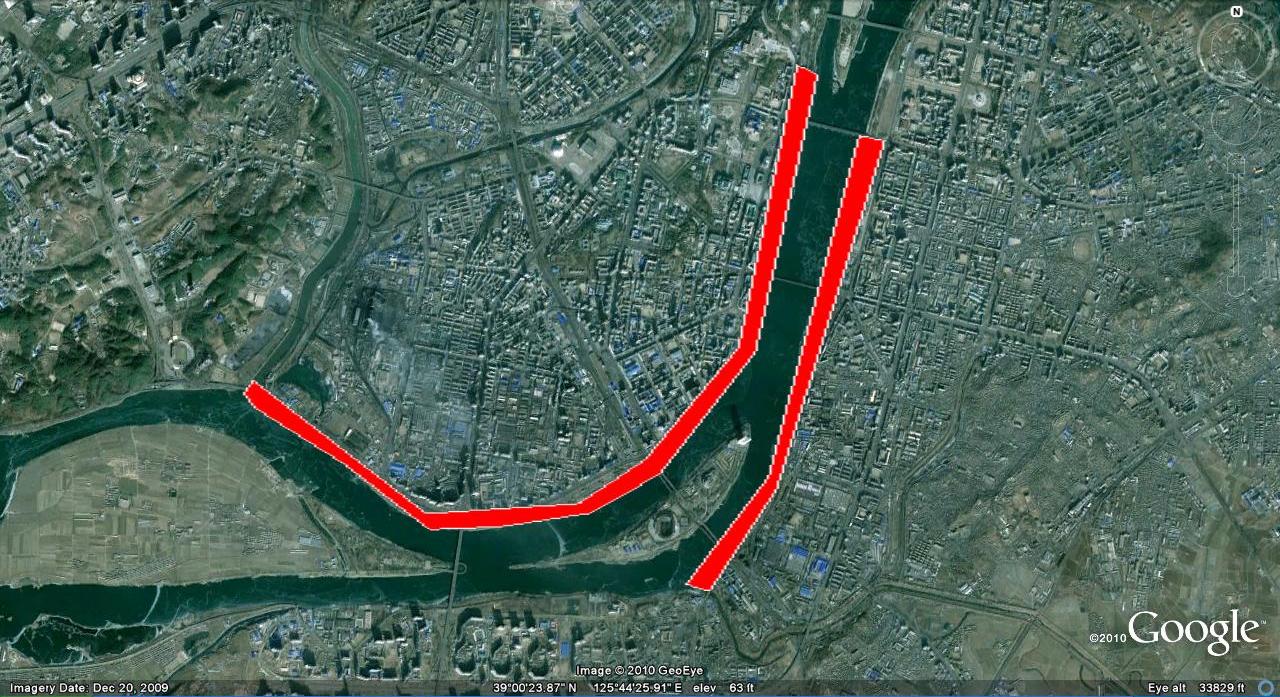
(Pictured above: Areas in Pyongyang where street stalls have reportedly become more numerous—via Google Earth)

Although we in the west note the proliferation of markets across the DPRK, the Daily NK reminds us that they still lack the institutions of capitalism: security of contract and property, rule of law, etc. According to the article:

Kim Sun Jung, who is a wholesaler in Pyongyang, talked to The Daily NK on Tuesday from the border region in North Korea. She said, “Wives of military officials and general workers should engage in trade in order to get by even in Pyongyang. Those who cannot get a stall in a permanent market (an allowed market, called jangmadang) sell goods in alley markets near the jangmadang, neighborhood alleys or on the banks of the Daedong River, but they always get trouble from PSM agents and community watchmen, who systematically squeeze money and goods from them.”

According to Kim, currently in the center of Pyongyang, the Pyongcheon and Jung districts on the west side of the Daedong River, and the Sunkyo, Dongdaewon and Daedong River districts on the east side, the number of street stalls set up along the river has been increasing greatly.

Traders selling goods along the river are chased every day by agents. If they are caught, they have to pay for the stalls. The cost is the same for a stall in permanent markets, 250 won per stall.

She said that, “In order to avoid paying the 250 won street tax, you often see traders clutching their goods while running this way or that way. Nowadays, agents use cell phones, so it is not so easy to get away.”

Besides the costs for a stall, agents regularly demand meat and alcohol in order to offer them to their cadres including the chairman of the PSM office. If they have not gathered as much as they want through bribes, they confiscate goods and impose fines, around 20,000 or 30,000 won, and offer the excuse that, “Trade is prohibited by those above.”

She said such despotism is directed not only at illegal trade but also at the jangmadang. She explained, “In a permanent market when the chief manager (of the market management office) comes to the site under the pretext of doing an inspection, after collecting as many goods as he wants, he leaves the market without having carried out any inspection.”

In addition, according to sources in the jangmadang, street vendors have been spreading recently. Agents help themselves to food and alcohol there without paying. The street vendors sell pork and alcohol until 11 in the evening and after agents eat there, they leave saying only, “Comrade, trade well.”

Lee Ok Rim, who sells goods in a market in Pyongsung, South Pyongan Province, explained another type of extortion, “Even though the authorities have been strictly monitoring the sale of South Korean goods, traders cannot give them up because they’re good. Accordingly, agents take advantage of this situation: they will confiscate all South Korean goods through a sudden crackdown, and then a few days later, if they get tens of thousands of won in fines, they give the goods back to the traders.”

She explained, “When wholesalers who smuggle South Korean goods through Shinuiju are caught, they must pay 100,000 won as a fine.” Once wholesalers are caught, they make the acquaintance of the agent in charge, offer bribes regularly, and then will not have any further problems in supplying South Korean goods. For agents who are in charge of monitoring wholesalers, this is a big business, so they generally put a lot of work into monitoring them because the scale of regular bribes from wholesalers is huge.”

Therefore, traders openly say that, “Agents are much higher than secretaries of the Central Committee of the Party,” according to Lee.

Read the full story here:
Bribery and Extortion Are Common in North Korean Commerce
Daily NK
Shin Joo Hyun
12/31/2010

Share

Friday Fun: New year’s close out

Thursday, December 30th, 2010

Item number one: the DPRK’s domestically produced film camera, Hakmujong-1 (학무정-1):

This picture comes via the Russian blog “Show and Tell Pyongyang”. You can read about this camera in the original Russian here.  You can read about it in English (via Google Translate) here. This is the same blog that informed us about the DPRK’s PDA device and the DPRK’s Linux OS, Red Star.  He also has some fabulous pictures of the Kim Jong-suk Pyongyang Silk Mill here.

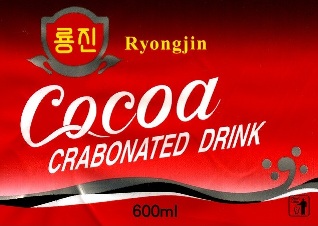
Item number two: DPRK’s domestic “Coke”:

This photo comes from the collection of Eric Lafforgue.  If you have not already seen his photos, please do yourself a favor and click over.

The soda is “Crabonated” which is a pretty funny typo.  Also worth noting are the lengths they have gone through to copy the Coca-Cola brand–as if they are trying to win back market-share from the foreign firm.  The colors, red, black, silver and white are the same.  The familiar cursive English “C” at the beginning of the word is a close copy.  They even tried to replicate the Coke “wave” by adding a literal wave in a similar curve along the bottom of the advert.

Item number three: DPRK caviar (Okryu Restaurant)

“Thanks to our leader Kim Jong-il we have managed to breed sturgeons.  People from Pyongyang and other provinces can come here to taste caviar and turtle meat.”

See the full video here. Here is a satellite image of the restaurant.

Item number four: Women’s fashion

Uriminzokkiri has posted a clip on DPRK women’s fashion to their Youtube account.  You can see it here.  I have blogged about women’s fashion before here and here.

Item number five: New Koryolink advert (Koryolink is the DPRK’s new 3-G mobile phone service founded by Orascom)

The video comes from this NK web page.  For South Koreans I posted it to my Youtube account.  You can see it here.

Item number six: DPRK verison of The Diary of Anne Frank

Michael Rank has scanned the introduction and uploaded it here.

Item number seven: Happy new year!

Share

Rumored $3.5b Chinese investment deal

Thursday, December 30th, 2010

The Choson Ilbo begins this story with “Rumor has it”….

Rumor has it that China is getting directly involved in the development of North Korea’s Rajin-Sonbong Port, once the center of the UN Development Programme’s Duman (or Tumen) River project in 1991. A source in Beijing said Wednesday, “As far as I’m aware, North Korea and China’s Commerce Ministry recently signed a memorandum of understanding outlining Beijing’s investment of US$3.5 billion over five years beginning next year” in the special economic zone there. The source said China is investing in roads, ports and gas facilities in the region.

The Rajin-Sonbong area, at the mouth of the Duman River, is a strategic point of economic cooperation between the two countries, but neither bank is Chinese territory. One side is in North Korea and the other in Russia, so to get to the East Sea China had to borrow a port from either side. China did nothing about the UNDP initiative in the 1990s, but since the mid-2000s, it has set its eyes on the area.

North Korea for some reason rented out the best equipped dock there to Russia in 2008 but since last year it has been seeking investment from China to overcome dried-up aid from South Korea amid international sanctions. North Korean leader Kim Jong-il urged Chinese President Hu Jintao when he visited China in May this year to invest in the region.

But the rumor of direct investment from the Chinese government has not been confirmed. One diplomatic source in Beijing said, “I’ve heard nothing about the Chinese Commerce Ministry’s direct involvement in negotiations. It’s just one of many rumors since North Korea became active in developing the Rajin-Sonbong area.”

UPDATE from the Choson Ilbo:

Chinese officials with close ties with North Korea say the North has used to demand hard cash for business deals but is now taking a more flexible approach. The Global Times, a sister publication of the People’s Daily, published a series of reports Saturday about the Rajin-Sonbong special economic zone of North Korea.

It said street lights and neon signs powered by windmills have appeared in the region, which had earlier been pitch dark at night, while the previously ubiquitous soldiers have vanished.

North Korea allowed 4,000 Chinese residents in the area to rent commercial property and agreed to designate an area in the Rajin-Sonbong special economic zone to be jointly administered by the two countries.

North Korea had offered China to develop one or two islands in the estuary of the Apnok River on a 50-year lease, but when China demurred it apparently offered a 100-year lease and even allowed construction of golf courses and other recreational facilities.

Many private Chinese companies are reticent about investing in North Korea. Not only is there a lack of business laws to protect their investment, there are also too many political uncertainties. As a result, the Chinese government is not playing a very active role. In the case of the bridge across the Apnok River, North Korea apparently wanted Chinese state-run companies to take part in construction, but Beijing declined.

One source in Beijing said some Chinese companies are showing great interest in developing the Rajin-Sonbong area, but most are biding their time. “Chinese businesses still don’t seem to trust the sincerity of North Korea’s desire to open up its economy,” the source added.

Additional Information:
1. The Chinese and Russians currently lease docks at Rajin. You can see a satellite image of them here.

2. Here is more information on China’s 10-year lease of Rajin.

3. Here is information on the Yalu Islands China is reportedly leasing.

4. The Russians are also building Russian gauge railway line from the Russian border to the port in Rajin.

5. Here are all previous Rajin (Rason)posts

Read the full stories here:
Beijing ‘Pouring Money into N.Korea’s Special Economic Zone’
Choson Ilbo
12/30/2010

N.Korea’s Cross-Border Business with China Picking Up
Choson Ilbo
12/30/2010

Share

DPRK rice price stubbornly high

Wednesday, December 29th, 2010

According to the Daily NK:

Even though the price of rice is over 1,300 won per kilogram in North Korean markets, cadres and the upper class are hoarding rice and grain. This is because a rumor is spreading saying that the international community may suspend food aid to North Korea next year due to the Yeonpyeong attack so the price of rice may not drop next year.

A source from Hoiryeong, North Hamkyung Province, said that, “In the Hoiryeong Jangmadang, rice sells over for 1,300 won per kilogram. Even though it is an unreasonably higher price than in previous years, the wealthy are hoarding the rice they will consume for the next year.”

Immediately after the Yeonpyeong attack, the price of rice soared to over 1,300 won and has stayed at that level. This is because the value of the Yuan has gone up since the currency redenomination last year.

The source explained, “Despite the high price of rice, people purchase it in bulk because they believe that next year the price may not decline considering the current trend.” He added, “A rumor that we won’t receive food aid next year due to being internationally isolated has been circulated by those who get international and domestic information via foreign radio or those who have visited China for private reasons.”

The source reported that, “Based on the experiences of the last decade, people know very well that there will be no food aid from the outside world when the situation is tense like it is this year.”

“Not only those who support themselves through commerce, but also family members of officials of the National Security Agency and People’s Safety Ministry, who primarily live off the national distribution system, are spending all the money they’ve saved to buy up food. They buy reserve provisions in order not to worry about a possible suspension of the distribution system.”

According to the explanation of the source, at the time of the November 30 currency redenomination last year, those who had goods to trade did not get hit hard. Therefore, wealthy people try to obtain more food despite the high price.

Read the full story here:
The Rich Hoarding Rice
Daily NK
Yoo Gwan Hee
12/29/2010

Share

DPRK trying to crack down on defections

Friday, December 24th, 2010

According to the Daily NK:

North Korea’s National Security Agency (NSA) is trying to use smugglers to crack down on defectors, an inside source has revealed to The Daily NK.

The source from Yangkang Province told a Daily NK reporter on Tuesday, “The Yangkang provincial NSA office has ordered smugglers investigated recently to report those who cross the river for the purpose of going to South Korea.”

In many border regions, smugglers play the role of brokers in river-crossing defections. As of late November this year, the commission earned by a smuggler for facilitating a river crossing was about 4000 to 6000 Yuan per person. For 500 to 1000 Yuan, the smugglers were willing to convey goods back across the Yalu River, too.

The source said, “About two hundred people convicted of smuggling were called in by the NSA,” explaining that they were told, “If they report river crossers to the NSA, the NSA promised to guarantee their smuggling activities.”

The reason for the new policy, the source also explained, is that “while the government keeps strengthening border controls and orders punishment for river crossers, the number of defections is not decreasing, so they have formulated a new plan. It has met with modest early success; on December 16th, three people who were crossing the Yalu River from Huchang to Changbai (China) were arrested by the NSA.”

However, the source pointed out, “Since some smugglers are cooperating with the NSA now, the number of river crossers might decrease for a while, but it will come back to normal. Those smugglers who report to the NSA will lose customers, and those who don’t will have more.”

Read the full story here:
Smugglers Told to Shop Defectors
Daily NK
Kang Mi Jin
12/24/2010

Share