Archive for the ‘Economic reform’ Category

Lankov on the state of the North Korean economy

Monday, January 31st, 2011

Andrei Lankov writes in the Korea Times about the state of the North Korean economy.  Excerpt below:

The existing statistics are remarkably untrustworthy, being essentially educated guesses by analysts. Nonetheless, these statistics indicate a moderate growth of the North Korean economy.

But the present author talks to North Koreans quite frequently. So I don’t need statistics to confirm what becomes clear from my talks with refugees, smugglers, migrant workers and those Koreans who have illegal Chinese mobile phones. Throughout the last ten years the economic situation in the country has improved, even though this improvement was very moderate.

What does “improvement” in this context exactly mean? First of all, few if any North Koreans now face the threat of starvation, though malnourishment remains a widespread problem. Many (perhaps, a majority) of North Koreans don’t have enough to eat in spring. This has a seriously negative impact on their health and is especially bad for children. Nonetheless, unlike the 1990s, it seldom leads to death.

The average North Korean meal is a bowl of boiled corn with a few pickles. Meat or fish are eaten only on special occasions or by affluent people.

Indeed the last decade was a time when material inequality increased in leaps and bounds. Some of the new rich are officials who take advantage of their positions while others are successful entrepreneurs running all kinds of private businesses.

A successful North Korean entrepreneur nowadays might even openly own a car. For instance in a relatively small borderland city with a population of some 90,000 people there are officially three private cars. Much more frequently well-to-do North Koreans prefer to register their cars with state agencies. At any rate, ten years ago a private car was almost unthinkable.

The less successful entrepreneurs or craftsmen are still doing quite well as indicated by significant increase in the number of consumer durables owned by North Koreans. Fifteen years ago a fridge was a sign of exceptional luxury, almost as rare as a private jet in the U.S. Now it’s a bit like a luxury car, an item that 10-20 percent of households can afford.

What is also interesting is the spread of computers, including privately owned ones. In most cases these are old, used computers which are imported or smuggled from China. They are quite outdated but they are computers nonetheless. Recently I interviewed a group of school teachers from the countryside, and they said that nowadays every high school, even in remote parts of the country, is likely to have at least one computer (admittedly, this wonderful contraption is seldom switched on).

This does not mean of course that North Korea has become a consumer paradise. In spite of some improvements, the gap between the North and its successful neighbors continues to widen. However in absolute terms the North Korean economy is not shrinking any more.

There have been serious setbacks, the currency reform early last year is a perfect example. For a while, this failure almost paralyzed the economy and created serious food shortages across the country.

But what brought about this moderate growth? It seems that there are three major contributing factors.

First, North Korea has been quite good at begging and blackmailing the outside world into providing aid. The aid was initially provided by South Korea and the U.S., but now it comes almost exclusively from China.

Second, North Korea’s technocrats have learned how to run the country in its new situation. They are not very efficient at this, but, to quote Marcus Noland, “they are muddling through.”

The present author is inclined to believe that it is the third reason which is the most important of all. Over the last decade a relatively powerful private economy has developed in North Korea. North Koreans did not merely learn how to trade privately, they now produce privately as well and this growth of industry invisibly and privately, seems to have contributed to the growth described above.

The growth is moderate, and no breakthrough is likely. Nonetheless, it is real and palpable.

Read the full story here:
Between myths and facts
Korea Times
Andrei Lankov
1/30/2011

Share

North Korean economy suffers in the new year: Power shortages and prices on the rise

Thursday, January 27th, 2011

Pictured above: Nampho Glass Bottle Factory visited by Kim Jong-il

Institute for Far Eastern Studies (IFES)
(NK Brief No. 11-01-26)
1/26/2011

According to North Korean media, Kim Jong Il began this year’s onsite instruction with a visit to the Nampo Glass Bottle Factory. The January 20th issue of the Choson Sinbo also ran an editorial stating that “These days, in our country, improving the lives of the people is especially emphasized.” It also noted that Kim Jong Il’s first onsite visit of the year was to a site important to improving people’s standard of living. The paper boasted that great efforts were being made in the development of light industry — especially factories producing daily-use goods and food products — and revealed that the bottle factory in Nampo will play an important role in meeting the increased countrywide demands for packaging from factories large and small.

Despite this praise, the reality is that the people of North Korea are suffering ever-worsening economic conditions. Just as South Korea is in the middle of a cold spell, the North has suffered chilling conditions ever since the end of December. The Korean Central News Agency reported on January 22, “The cold-weather conditions are expected to continue until the end of January,” and, “this cold spell is causing more than a little damage to the lives of the people and to spring farming preparations.”

As the cold spell drags on, their hardship will continue. North Korea is ill-prepared to deal with such cold weather; freezing pipes make it difficult for the people to access fresh water, while food and firewood are in short supply. Hunger and cold are exacerbated this winter because those without access to firewood or heating oil are also faced with an environment devoid of wild plants or animals.

Power shortages have also grown more severe in the new year. On January 20, Open Radio for North Korea (ORNK) reported that an area of the Yanggang Province has been without electricity since the first of the month. Even Pyongyang has been experiencing power difficulties, with electricity only available to most residents for 1~2 hours each day. ORNK reported that “recently in North Korea, students and parents have been burdened with supplying firewood for school heating, while the prices of coal and wood are skyrocketing in the markets.”

The cost of food has also shot through the roof. Rice, corn, pork, and other staple foods are becoming increasingly more expensive. Young-wha Lee, a spokesperson for the Japanese human rights organization Rescue the North Korean People! Urgent Action Network (RENK), announced on January 17 that a source inside North Korea had reported a 500 Won jump in the price of rice within Pyongyang, from 1,400 Won per kilogram on the January 7 to 1,900 Won within 3~4 days. Corn jumped from 750 to 950 Won, and pork was up from just under 4,000 Won to its current price at around 5,000 Won. Gasoline now costs 3,500 Won.

According to a South Korean online source for news on North Korea, Daily NK, one can see the impact of inflation by taking notice of the price gap of around 200 Won per kilogram of rice in Pyongyang and rice in rural areas (North Pyongan Province’s Sinuiju and Ryanggang Province’s Hyesan, in particular). It is noteworthy that prices are shooting up in January, rather than during the lean season of March and April.

Good Friends, a South Korean-based humanitarian organization, has also relayed reports of inflation from sources within North Korea. It has reported that rice was selling in Pyongyang for as much as 2,100 Won per kilogram on January 7, significantly more than the 1,600 Won per kilogram reported at the end of last year. Prices continued to hover around 2,000 Won until recent rations eased shortages and brought the price back down to around 1,500 Won. As North Korean organizations and social units distribute these overdue holiday rations, there has been a fall in food prices.

However, these rations were not seen in all areas of the North, and in those regions where residents were not provided food, prices remain high. Rice in Hamheung jumped from 1,500 Won per kilogram on January 1 to 1,800 Won just one week later. On January 7, similar prices were seen in Chongjin (1,750 Won) and Sinuiju (1,800 Won). Ten days later, rice in Chongjin had climbed to 1,980 Won, and was threatening to break the 2,000 Won barrier. Corn in Pyongyang was selling for 950 Won per kilogram on January 7, while it cost 780 Won in Chongjin and 850 Won in Hamheung, Sinuiju, and Pyongsong. By January 17, corn averaged between 750 and 800 Won. Only in Pyongyang, agricultural regions, and other areas receiving rations had prices fallen to 600 Won per kilogram.

According Good Friends, grain prices in the North have shot up this year because several Party officials in charge of grain imports are behind schedule with incoming shipments, and the rising value of the US dollar and Chinese yuan have driven up the cost of overseas purchases.

Share

Security agents raise money from defector families

Thursday, January 27th, 2011

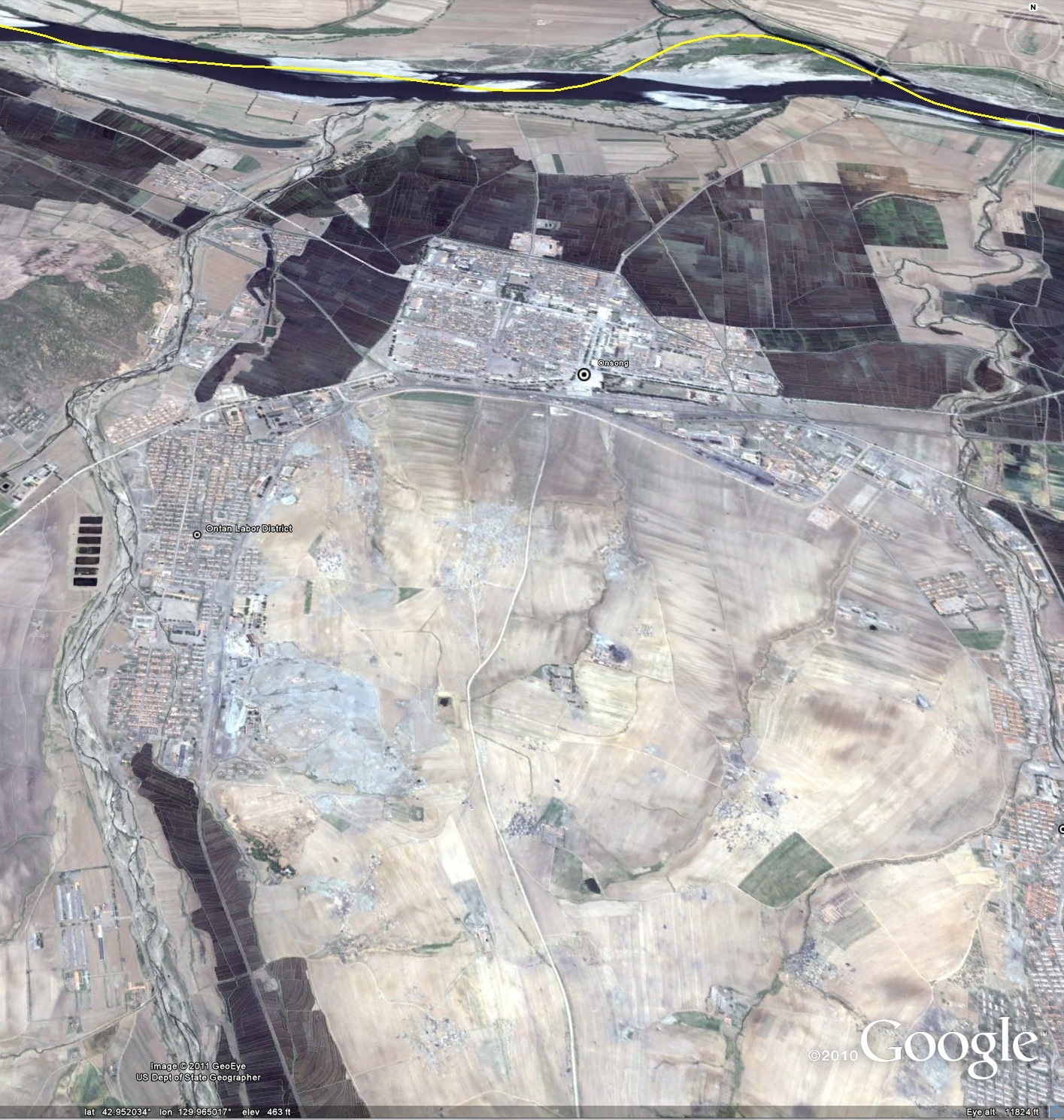
Pictured above: Ontan Worker’s District, Onsong (Google Earth)

According ot the Daily NK:

In advance of next week’s lunar New Year’s Day holiday, National Security Agency agents are concentrating on getting together things for the holiday from households of those whose family members have crossed into China or South Korea.

Exploitation by the NSA or other powerful state apparatus is exceedingly common, of course, and the obtainment of necessities for holidays such as Kim Il Sung and Kim Jong Il’s birthdays, the Korean thanksgiving day (Chuseok) and lunar New Year’s Day are often covered via exploitation of the people. The difference this time, however, is that the specific targets are the families of defectors.

A source from North Hamkyung Province told The Daily NK today, “NSA agents in charge of northern border regions including Onsung have been engrossed in preparations for the holidays and generating private benefits, targeting smugglers and households with family members who have crossed into China or South Korea.”

The source explained, “Modes of exploitation by agents of the NSA and People’s Safety Ministry and cadres of the Party or prosecutors have been varied of late. They win houses which have problems over to their side and then get them to give certain things.”

The source said that as the lunar New Year’s Day comes closer, these moves have become more active and transparent. “NSA agents visit all of these houses and force them, or sometimes beg for things. They are no different from thieves, just without a knife.”

According to the source, the Conspiracy Research Office of the NSC in Onsung, North Hamkyung Province, which employs 25 agents, has allotted each agent items to get from their district.

There are two sets of items: one set is ten bottles of liquor, 5kg of pork, 20 packs of expensive cigarettes called “Yeomyung,” and the other set contains 20kg of gasoline, a certain amount of fruit and candy, and bottles of oil. Each agent has to select one set.

According to Onsung Jangmadang standards, a bottle of liquor can be bought for 4,000 won, 1kg of pork for 5,000 won, a pack of “Yeomyung” for 6,000 won, 1kg of gasoline 3,000 won, and a bottle of oil for 5,000 won.

In Ontan workers-district within Onsung, there are three agents. The goods assigned to them are also unaffordable, but only defector families have to provide them, the source said.

The source explained, “When an agent visits one’s home, they won’t leave until the host has set up a table of drinks for him. After drinking some, the agent coaxes them, ‘Have you got some news from the South?’ ‘Are you getting money well?’ or ‘When you get a call next time, you should grumble that the situation is hard, so that they will send more money.’”

Sometimes, agents call for bribes for their own family events, too. The source said, “While talking, agents hint furtively that there will be a family event and call for something for that, saying, ‘There will be nothing bad for you if you help out.’”

“Agents say openly that, ‘If more money is delivered, we can live well; it’s is a good thing, and a way to maintain socialism.’ They only need so much as to smell money and they come running,” the source complained.

Due to possible revenge from agents, people cannot complain about the situation and have to provide them with the things they demand, according to the source, who added, “However, the effect works only at that moment when they get the goods. When a problem occurs for these defector families, they are nowhere to be seen.”

Read the full story here:
Defector Families Are Moneybags for NSA Agents
Daily NK
Im Jeong Jin
1/27/2011

Share

North Koreans traveling to Rason to gamble

Thursday, January 27th, 2011

According to the Daily NK:

High level North Korean cadres are visiting a casino in the far northeast of the country, disguising their identities so as to avoid government regulations which forbid them from entering, a defector-led NGO has revealed.

Reporting the news, an NK Intellectuals Solidarity inside source explained yesterday, “Recently, cases of high level North Korean cadres disguising their identities to enter Orakjang Casino, which is in the Emperor Hotel in Rasun City, have been occurring frequently.”

The Emperor Hotel was established in 2000 by Emperor Group, a Hong Kong-based property developer. With around 100 rooms, bars, cafes, an indoor swimming pool, sauna, night club, sports center and a fine sea view, the hotel, which cost $64 million to build, employs around 500 people, including a number of North Korean women.

According to the source, while the hotel was regularly frequented by Chinese tourists and officials when it opened, it closed down at the end of 2004 after one official, acting independently, squandered a fortune in public funds there.

However, seizing the opportunity presented by Kim Jong Il’s visits to China last year, the hotel reopened and, according to the source, has recently been doing well off Russian traders, among others.

On this, the source explained, “One of the conditions placed on the opening of the hotel was that North Koreans would not be allowed to enter, and at the beginning their entry seemed to have been thoroughly prohibited,” adding that therefore, “However, as the number of Chinese traders going to the casino increased, so high North Korean cadres doing business with the Chinese and wealthy North Koreans disguising their identities also entered.

The North Koreans apparently pretend to be Korean-Chinese when they enter the casino, where some reportedly gamble away as much as $10,000 per day.

Because North Korean enterprises and factories are unable to operate properly due to a lack of raw materials and capital, average cadres and staff go to gamble mostly to relieve their boredom, the source explained.

Read the full story here:
Casino Luring in Bored North Koreans
Daily NK
Cho Jong-ik
1/27/2011

Share

KJI and JST meet with Orascom president

Sunday, January 23rd, 2011

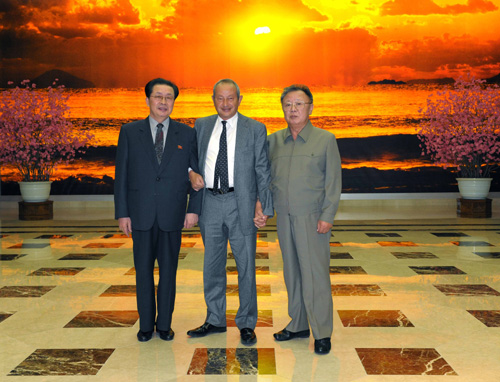
Pictured above (L – R): Jang Song-thaek, Naguib Sawiris, and Kim Jong-il

According to Martyn Williams:

The CEO of Egypt’s Orascom Telecom has been given a rare honor during his current trip to Pyongyang: an audience with Kim Jong-il and dinner hosted by the reclusive leader for the businessman whose firm owns a majority of North Korea’s only 3G cellular network.

Naguib Sawiris arrived in the North Korean capital on Friday and was received on Sunday by Kim Jong-il, the Korea Central News Agency reported on Monday.

Kim Jong-il, “warmly welcomed his DPRK visit taking place at a time when Orascom′s investment is making successful progress in different fields of the DPRK, including telecommunications,” the report said.

Orascom holds a 75 percent stake in Cheo Technology, which operates North Korea’s only 3G cellular network.

The network, the remaining stake in which is held by the government, uses the Koryolink service name. It has seen fast growth in subscribers and currently claims more than 300,000 accounts in just the two years since its launch.

After starting first in Pyongyang, the network has been expanded to cover provincial capitals and smaller cities and a 3G signal is now within reach of 75 percent of the population, the company said in November last year.

The Orascom group has made several other investments in the country. In 2007 it invested in a cement factory and in late 2008, at around the same time it launched the 3G network, it opened a local bank. The company has also been tied to renewed construction work at Pyongyang’s pyramid-shaped Ryugyong Hotel. The iconic building was halted in 1992 and has remained vacant ever since.

According to the AFP:

North Korean leader Kim Jong-Il has met the head of an Egyptian company that provides a mobile phone service in the impoverished communist nation, state media reported Monday.

Naguib Sawiris, chairman and CEO of Orascom Telecom Holding, has been visiting the North since Friday. His company has provided a mobile phone service in the North jointly with a local firm since late 2008.

Kim “warmly welcomed his DPRK (North Korea) visit taking place at a time when Orascom’s investment is making successful progress in different fields of the DPRK, including telecommunications,” the North’s state news agency KCNA said.

Kim had “a cordial talk” with Sawiris and hosted a dinner for him, it added.

Orascom said last year that mobile phone subscriptions in North Korea had more than quadrupled in the space of a year — to 301,199 by the end of September 2010 from 69,261 a year earlier.

However, it said overall “mobile penetration” remains at one percent in the country, which has an estimated per-capita GDP of 1,700 dollars and a population of 24 million.

North Korea strictly controls access to outside information and fixes the tuning controls of radios and televisions to official stations.

It began a mobile phone service in November 2002 but shut it down without explanation 18 months later and began recalling handsets.

But in December 2008 the country introduced a 3G mobile phone network in a joint venture with the Egyptian firm.

The Egyptian group in 2007 sealed a 115 million dollar deal to invest in a North Korean cement plant. It is also reportedly involved in completing construction of the 105-storey Ryugyong Hotel in the capital.

Martyn has more at North Korea Tech.

Share

Hankyoreh, Choson Ilbo, and Yonhap point to tough times at Kaesong Zone

Wednesday, January 19th, 2011

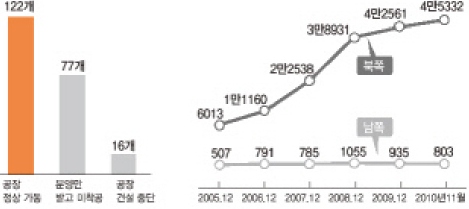
Image from the Hankyoreh: The left graph shows the number of South Korean tenant companies operating at Kaesong Industrial Complex. 122 companies are operating normally, 77 companies are not currently operating, and 16 have halted operations. The right graph shows the total number of workers: above, the number of North Korean workers and below, the number of South Korean workers.

According to the Hankyoreh:

… [Companies in the Kaesong Zone]  complained that they have lost hundreds of millions of Won (hundreds of thousands of dollars) with the suspension of factory construction due to administration measures forbidding new investment. They also said that the situation is growing bleaker by the day, with veteran employees quitting as the numbers of resident personnel at the complex drops due to concerns about personal safety. Despite all of this, they suffer without a word of formal complaint out of fears that they might draw the anger of North Korean and South Korean authorities.

In its May 24 measures last year, the Lee administration declared a suspension to trade and exchanges with North Korea in response to the sinking of the Cheonan. At the complex, only existing facilities were allowed to operate, while the resident workforce was halved to 500 people and the introduction of additional equipment was prohibited. Sixteen companies that were in the process of building new factories suffered a direct hit from these measures. At present, a total of 122 small and medium companies run factories in the complex.

Company “A,” a garment company that invested 5 million Won ($4,493) in inter-Korean economic cooperation funding to build a sewing factory, but were forced to suspended construction with approximately 90 percent of the process complete.

“Only the exterior and interior remain,” said the president of the company. “We could not bring in factory equipment, so we just gave up.”

The Export-Import Bank of Korea (EXIM) only stood surety for 90 percent of the loan, so Company A faces the immediate burden of principal and interest repayments in the hundreds of millions of Won. It also has to pay 16 million Won per year in interest on the EXIM-guaranteed loan until compensation money comes from the government.

The company’s president said, “We borrowed the money because they said to do an inter-Korean economic cooperation project, and then they just cause a loss by suspending exchange. Is the administration playing interest games with South Koreans?”

To date, a total of 1.26 trillion Won ($1.1 billion) has been invested in the complex, the bulk of which is facility investment paid by tenant companies, amounting to 730 billion Won.

Company “B,” another garment company, originally had seven South Korean employees working with 330 North Korean workers. But following the order from Seoul to halve the number of resident employees, there are now just three South Korean employees left. Two employees left the company. “The employees who left were heads of household in their forties who had worked with us for over a decade,” the president sighed. “They had a difficult time getting up at 6 in the morning for the 70 to 80 kilometer commute, and the government actually ended up fanning anxieties with its talk about ‘protecting employee safety,’ so their family members dissuaded them from working at the complex.”

Hiring new employees is not an option. In some cases, interviews were held and start dates were set before the new recruits abandoned their plans after the Yeonpyeong Island shelling occurred two months ago. Company B, which has its head office in Seoul, is in a slightly better position. Employees at businesses in Daegu, Gwangju, and Busan, for whom commuting is impossible, are forced to stay at motels in Munsan, Gyeonggi Province.

“They emptied out a perfectly good dormitory in the Kaesong complex, and employees have been wasting time, money, and strength for months now,” said the president of Company “C.” “It stands to reason that the departure rate is increasing.”

The president of Company “D” stated emphatically that there is no physical risk at the complex. In fact, the president said, North Korean authorities have added more productive labor on site since the Cheonan sinking and the bombardment of Yeonpyeong Island. The 45,332 North Korean workers as of November 2010 represented an increase of a full 2,771 over the 42,561 working in 2009. The president of Company D stressed that the government must increase the number of resident personnel if the physical safety of South Korean employees is to be guarded.

“If it is impossible to guarantee physical safety, they should not be leaving a single person at the Kaesong complex,” the president said. “Does it make any sense to say that 500 people is okay, but 1,000 is not?”

Some buyers have also fallen away because of anxieties. In late 2010, garment company “E” lost a buyer that had previously been purchasing 70 percent of its production output. “They got worried when it became difficult to bring in raw materials due to the sanctions against North Korea, and finally they halted transactions, saying that they thought the government had washed its hands of the Kaesong complex,” the president of Company E said. “Even if we suspend operations because there is no work to do, we still have to pay the workers’ wages, so the deficit is increasing by the day.”

With the decreased South Korean presence, six commercial facilities within the complex have also closed down, including a supermarket, restaurant, and singing room at “Songak Plaza.”

“If you look at the Gaeseong Industrial Complex Support Act, which the National Assembly passed unanimously, the government is to provide support and guarantees so that we can conduct business freely, like companies do in any other region,” said the president of Company F. “We are on the brink of withering away because of this idea of restricting property rights and company activities for administrative expedience, and through a minister’s order rather than any law.”

While they have been driven to the brink, the company presidents are adamantly opposed to closure of the complex. The president of Company G explained, “At first, things were rocky because of cultural and ideological differences, but now the North Korean workers understand the companies. They have realized by themselves why we need to meet the delivery deadline, why we need to improve quality, why we need to make so much. The Kaesong complex is performing the role of reducing the costs of reunification by restoring homogeneity between North Korea and South Korea.”

The president of Company H said, “The possibility of war is also being checked by the presence of North Korean and South Korean workers in the complex.”

“For the sake of peace and shared prosperity, we need to develop [the complex] into a special economic zone of peace where North Korea and South Korea can communicate,” the president added.

According to the Choson Ilbo:

Six of nine commercial [leisure] facilities in the joint Korean Kaesong Industrial Complex have closed, it emerged on Tuesday.

According to the Unification Ministry, a supermarket, a beer hall, a karaoke and a billiard hall in the Songak Plaza, the industrial park hotel operated by Hyundai Asan, closed on Dec. 1, right after North Korea’s shelling of Yeonpyeong Island. Already in February a massage parlor closed, and in August a Japanese restaurant.

Only a duty-free shop and Korean and Chinese restaurants managed directly by Hyundai Asan stay open. A staffer at the industrial park said the reason is that the number of South Korean staffers in the industrial park, who were the main customers of the facilities, has dropped sharply.

There were some 1,200 to 1,500 South Koreans at the industrial park until the North’s sinking of the Navy corvette Cheonan in March and its shelling of Yeonpyeong in November, but the number dropped to about 500 recently.

According to Yonhap:

Production at an inter-Korean industrial park dropped 15 percent in November last year when the North bombarded a South Korean island, raising bilateral tensions to the highest level in years, the Unification Ministry said Sunday.

The fall, however, contrasted with an increase in the number of North Korean workers at the Kaesong industrial park, located just north of the heavily armed inter-Korean border, the ministry said on its Web site.

Over 45,000 North Koreans were working as of November for more than 120 South Korean firms at the complex, the ministry said, adding that they produced US$25.1 million worth of products that month, compared to $29.4 million in October.

The factory park is considered the last remaining symbol of reconciliation between the two Koreas that remain divided by a heavily armed border after the Korean War ended in a truce in 1953.

After North Korea shelled the western South Korean island of Yeonpyeong on Nov. 23, killing four people, Seoul restricted the number of South Korean workers allowed to stay overnight in Kaesong.

The measure, which remains in place, led business managers to complain of difficulties in production. South Korea maintains it will continue to support manufacturing activities at the Kaesong industrial park despite the North Korean provocation.

Since May when a multinational investigation led by Seoul found the North responsible for the sinking of a South Korean warship earlier that year, South Korea has suspended all cross-border trade with North Korea.

Read the full stories here:
Kaesong companies on the brink as sanctions continue
Hankyoreh
Jung Eun-joo
1/19/2011

Leisure Facilities at Kaesong Close Down
Choson Ilbo
1/19/2011

Output at inter-Korean factory park falls amid tension
Yonhap
1/23/2011

Share

Marcus Noland on NK’s refugees and economy

Sunday, January 16th, 2011

Evan Ramstad at the Wall Street Journal: Korea Real Time interviews Marcus Noland:

Only a handful of outside economists spend the enormous time required to delve into the mysteries of North Korea.

Marcus Noland is one of them. With his research and writing partner Stephen Haggard, Mr. Noland has written several books about the North, including a definitive study on the famine that gripped the country from the mid- to late-1990s and resulted in the death of at least 1 million people and perhaps upwards of 2 million.

In a new book published this week, called Witness to Transformation: Refugee Insights into North Korea, Messrs. Noland and Haggard produce the results of interviews they and their researchers conducted with more than 1,600 North Koreans who fled the country. The interviews took place from 2004 to 2008 and involved people who left North Korea as early as 1991.

The book documents the remarkable changes inside the North through the eyes of people who lived through them. Of course, it’s a group that holds negative views of North Korea. But the economists do their best to take that into account.

Mr. Noland, who is based at the Peterson Institute for International Economics in Washington, discussed the book with us. Here’s an excerpt of the interview:

WSJ: Most books and studies on North Korea by people outside the country are focused on the nuclear weapons issue and the geopolitics around that. Why have you focused on refugees and the economy?

Mr. Noland: An understudied aspect of the North Korea story, we believe, is the really quite dramatic internal changes that have been going on in North Korea over the last 10 to 20 years. North Korea poses an analytical challenge in that access is limited and the conventional ways that one could go studying a country aren’t available. In this context, the diaspora of refugees leaving the country is an important source of information.

The refugees themselves constitute a first-order crisis. Most of these people, in a clinical setting, would probably be diagnosed with post-traumatic stress disorder. Their mental health issues appear to be related not only to the difficult circumstances they faced in China but their experiences in North Korea.

WSJ: What is the cause of those stresses?

Mr. Noland: Specifically the loss of family members and family separations associated with the famine. The sense among many of them that they were abandoned in their moment of greatest need. The feeling that they were not given access to international humanitarian aid, which many of them believe was diverted to the military. And the experience of many of them of having been arrested and incarcerated in North Korea’s vast and sprawling penal system.

So the refugees themselves are an issue. They also provide us a window into North Korea.

WSJ: What did you learn from them?

Mr. Noland: Our book addresses three broad issues, which they illuminate.

The first is the underlying economic changes in the country. What we find is the economy has essentially marketized over the last 15 years or so, not as any kind of planned reform but rather as a function of state failure. What is extraordinary is the degree of marketization that the refugees portray when describing their daily lives. They describe a situation in which doing business or engaging in corrupt or illegal activities is increasingly seen as the way to get ahead in North Korea. And positions in the state or the party are still highly desired and seen as a way to get ahead, but not out of patriotism because these positions increasingly provide a platform for extortion of the general population.

Which brings us to the second big theme of the book and that is the criminalization of economic activity and the use of this vast penal system not only for its traditional use as a tool of political intimidation but for economic extortion. What we find is that changes in the North Korean legal code have criminalized vast areas of economic life, the sort of economic life that real people actually lead. In their daily lives, most if not all of North Korea’s non-elites run afoul of some of these statutes, which in effects makes everyone a criminal.

The fact that everyone is running afoul of some statute is combined with the fact that the police are given extraordinary discretion in who they arrest and who they incarcerate and for what period of time. We find that the North Korean penal system has four components. The worst and best known are the long-term political prisons, the North Korean gulag that was set up by Soviet advisors. There’s also a set of institutions that are effectively felony prisons, where you put the murderers and the rapists. Then there are a set of institutions that correspond to misdemeanor jails in other societies. What has developed since the famine period of the 1990s is a fourth set of institutions that have been codified. Those primarily house people who have made economic crimes, such as hiring labor for money or selling things in the market that you’re not supposed to be selling. We go through the enormous expansion of articles in the North Korean legal code to cover these crimes, such as illegally operating a restaurant.

This is a fantastic instrument for extortion. It means if you were engaging in entrepreneurial behavior, the police can come to you and say ‘You’re engaged in illegal activity. We can take you, take your spouse, take your kid and put them in this institution where you know horrible things happen.’ So the penal system not only serves its traditional function as a platform for political corruption but we find it is now a platform for economic predation as well.

We discovered something that we call the ‘market syndrome.’ It is a series of characteristics that seem to be linked with engaging in market activities. People who engage in market activities are 50% more likely to be arrested than their counterparts. They are more likely to harbor more negative appraisals of the regime than their counterparts. And in a society where people are afraid to express their opinions, these guys who are engaged in the market, who have been to jail and been released, are more likely to express their views to others. That is to say that the market is emerging as a kind of semi-autonomous zone of social communication and potentially political organizing. And in that sense, the regime is right to fear the market.

And that brings us to the final theme, and that is the political attitudes of these people and nascent dissent. What we find is people have very negative appraisals of the regime. That’s not surprising. We’re sampling from a group of people that have voted with their feet and one would expect them to have negative views, though we go through fairly elaborate statistical exercises to try to control as best we can for the demographic characteristics of the people we’ve interviewed.

People have very negative views of the regime. They are increasingly disinclined to believe the regime’s meta-narrative, which rationalizes their misery as a function of being held captive by hostile foreign forces. Most of these people hold the government itself as responsible for their plight.

WSJ: You two previously wrote one of the seminal studies on the North Korean famine (Famine in North Korea: Markets, Aid and Reform), what did the refugees tell you about living through that?

Mr. Noland: Both Steph and I were really struck by was just how the famine experience reverberates. The famine was more than 10 years ago. It ended in 1998. A significant share of the people, I think about a third, reported separation from, or death of, family members during that process. You had people out scavenging to find food. People going to China. Family separation and death of family members just continued to reverberate.

We asked them: ‘Were you aware of the international food aid program?’ The numbers differ in our surveys, but significant numbers of people were unaware of the food aid program. It was astonishing to us.

Then, among the ones who were aware, we asked `Do you believe you were a beneficiary?’ Only a small minority responded yes. And when we run all the regressions, this status of knowing of the existence of the program but believing you were not a beneficiary, this is a profoundly demoralizing experience. These people feel they were abandoned at this time of need, when they were seeing their families and neighbors dying. They believe it’s going to the army and the elites. That group of people, when we run the psychological tests and ask them their views of the regime, this is an embittered group. The effect of that experience is bigger than being in the prisons.

We wrote a book on the famine, so obviously we’re interested in it. But we were surprised and we wouldn’t have guessed that this experience continues to reverberate among the people who lived through it.

Read the full story here:
Marcus Noland on NK’s Refugees and Economy
Wall Street Journal: Korea Real Time
Evan Ramstad
1/12/2011

Share

Daedong Credit Bank press release

Sunday, January 16th, 2011

The Daedong Credit Bank (Based in the Potonggang Hotel in Pyongyang) has issued a press release.

I have made a PDF of it available here.

Here is their web page.

Share

China seeks to station troops in DPRK?

Sunday, January 16th, 2011

UPDATE: China denies sending troops to the DPRK.  According to the Global Times:

A Chinese government official Sunday dismissed a report by a South Korean newspaper that China was sending troops to North Korea.

“China will not send a single soldier to other countries without the approval of the UN,” an official at the Chinese Ministry of Defense told the Global Times on condition of anonymity, citing China’s basic policy on troop deployment.

ORIGINAL POST BELOW: According to the AFP:

China is in discussions with North Korea about stationing its troops in the isolated state for the first time since 1994, a South Korean newspaper reported Saturday.

The Chosun Ilbo newspaper quoted an anonymous official at the presidential Blue House as saying that Beijing and Pyongyang recently discussed details of stationing Chinese soldiers in the North’s northeastern city of Rason.

The official said the soldiers would protect Chinese port facilities, but the location also gives access to the Sea of Japan (East Sea), while a senior security official was quoted as saying it would allow China to intervene in case of North Korean instability.

A spokeswoman for the Blue House said she had no information, while China’s defence ministry declined comment to AFP on the matter this week.

“North Korea and China have discussed the issue of stationing a small number of Chinese troops to protect China-invested port facilities” in the Rason special economic zone, the unnamed official was quoted as saying.

“The presence of Chinese troops is apparently to guard facilities and protect Chinese nationals.”

China reportedly gained rights in 2008 to use a pier at Rason, securing access to the Sea of Japan (East Sea), as North Korea’s dependence on Beijing continues to grow amid a nuclear stand-off with the United States and its allies.

The last Chinese troops left the North in 1994, when Beijing withdrew from the Military Armistice Commission that supervises the truce that ended the 1950-53 Korean war.

Seoul’s International Security Ambassador Nam Joo-Hong told the Chosun Ilbo that China could now send a large number of troops into the North in case of instability in the impoverished communist state.

“The worst scenario China wants to avoid is a possibly chaotic situation in its northeastern provinces which might be created by massive inflows of North Korean refugees,” Nam was quoted as saying.

“Its troops stationed in Rason would facilitate China’s intervention in case of contingencies in the North,” he said.

Here is the original report in the Choson Ilbo (in Korean).

UPDATE: The Choson Ilbo posted a story in English which claims the Chinese soldiers are already in North Korea:

Chinese troops have been stationed in the special economic zone of Rajin-Sonbong in North Korea, sources said Friday.

This would be the first time since Chinese troops withdrew from the Military Armistice Commission in the truce village of Panmunjom in December 1994 that they have been stationed in the North.

“Pyongyang and Beijing have reportedly discussed the matter of stationing a small number of Chinese troops in the Rajin-Sonbong region to guard port facilities China has invested in,” a Cheong Wa Dae official said. “If it’s true, they’re apparently there to protect either facilities or Chinese residents rather than for political or military reasons.”

How many of them are there is not known. The move is unusual since North Korea is constantly calling for U.S. forces to pull out of South Korea and stressing its “juche” or self-reliance doctrine.

A China-based source familiar with North Korean affairs said, “In the middle of the night around Dec. 15 last year, about 50 Chinese armored vehicles and tanks crossed the Duman (Tumen) River from Sanhe into the North Korean city of Hoeryong in North Hamgyong Province.”

Residents were woken up by the roar of armored vehicles. Hoeryong is only about 50 km from Rajin-Sonbong. Other witnesses said they saw military jeeps running from the Chinese city of Dandong in the direction of Sinuiju in the North at around the same time.

“The Chinese armored vehicles could be used to suppress public disturbances and the jeeps to round up on defectors from the North,” the source speculated.

Nam Joo-hong, the ambassador for international security, said, “What China is most worried about in case of a sudden change in the North is mass influx of defectors, which would throw the three northeastern Chinese provinces into confusion. With its military presence in Rajin-Sonbong, there is a likelihood that China could intervene in Korean affairs by sending a large number of troops into the North under the pretext of protecting its residents there in an emergency.”

The North and China have engaged in lively military exchanges since two visits to China by North Korean leader Kim Jong-il last year. Guo Boxiong, the top Chinese military officer and vice chairman of the Chinese Central Military Commission, visited the North in late October last year and met with leader Kim Jong-il and his son and heir Jong-un. In the meeting, Kim senior emphasized “blood ties” between the two countries.

A Chinese mission has been stationed in Rajin-Sonbong since last December. China is transporting natural resources from its northeastern region to the south via Rajin-Sonbong Port, which has recently been renovated.

According to China’s official Xinhua news agency on Jan. 3, China first used the port on Dec. 7, when it transported 20,000 tons of coal from a mine in Hunchun, Jilin Province to southern parts including Shanghai. There is speculation that China will supply its own electricity to Rajin-Sonbong from April.

Quoting an internal North Korean source, the online newspaper Daily NK said the North and China in December signed an investment pact on building three more piers at the port and building a highway and laying a railroad between Quanhe in Jilin and Rajin-Sonbong.

The number of Chinese people arriving in the special zone has grown as a result of the North’s quest for investment, observers said.

“The North Korean State Security has more or less stopped checking Chinese people,” another source said. “The North has apparently concluded that it is unavoidable to accept the Chinese military presence on its land to woo Chinese investment, even if it’s not happy about it.”

Read the full story here:
China to station troops in N. Korea: report
AFP
1/16/2011

Share

Troubling news of DPRK crackdown

Sunday, January 16th, 2011

According to the Choson Ilbo:

The North Korean regime appears to have started a new reign of terror to consolidate the succession of leader Kim Jong-il’s son Jong-un.

The South Korean government and a North Korean source on Wednesday said public executions more than tripled last year. And increasing numbers of North Koreans have been killed trying to cross the Apnok (or Yalu) or Duman (or Tumen) River after the regime gave a shoot-to-kill order. The party and military, meanwhile, are engulfed in a whirlwind of purges, observers believe.

Public Executions

A diplomatic source familiar with North Korean affairs Wednesday said there were 60 confirmed public executions in the North last year, more than triple the number of 2009. “Since last year, the regime has put a notice on bulletin boards warning that those who use Chinese-made mobile phones or illegally circulate dollars face public execution, the source said.

Another source familiar with North Korean affairs said, “It’s rumored that Kim Jong-un has called for ‘gunshots across the country.’ Kim Jong-il did exactly the same thing when he took power.”

Jang Se-yul of the North Korean People’s Liberation Front, a group of former North Korean soldiers and officers who defected to South Korea, said, “In Chongjin, North Hamgyong Province alone last year, at least six people were executed publicly on charges of human trafficking and robbery. People are executed publicly for crimes that would have sent them to prison for just a few years in the past.”

“The number of public executions had gradually dwindled in the North since the famine of the late 1990s,” said International security ambassador Nam Joo-hong. “But since last year, the regime has apparently relied increasingly on public executions to tighten control in the aftermath of the botched currency reform and complaints about the hereditary succession.”

‘Shoot-to-Kill’ Order Against Defectors

Observers believe the regime has issued a shoot-to-kill order against defectors. According to a high-level source in the Changbai region in the Chinese province of Jilin, five North Koreans were shot dead and two others wounded by North Korean border guards on the Chinese side of the border after they crossed the Apnok River on Dec. 14.

And the military is being purged of unreliable elements. Quoting an internal North Korean source last Saturday, Free North Korea Radio, a shortwave broadcaster in the South, said the number of inmates has soared at a labor camp under the Ministry of People’s Armed Forces in North Hamgyong Province. It said many of the inmates are former army generals who have been purged by Kim Jong-un.

The regime’s determination to tighten control is also reflected in the Workers Party’s new regulations, the first for 30 years. The regime recently added a new clause calling for all party members to abide by a new regulation requiring them “to oppose and fight against anti-socialist trends.”

A South Korean intelligence official said the phrase refers to elements of capitalism that have flowed in from South Korea. “The regime has paved the way to publicly execute even people who watch South Korean soap operas or dress in South Korean style, branding them as anti-party elements,” he said.

The Daily NK also reports some personnel changes:

North Korea has been replacing local Party officials with a younger generation since the Chosun Workers’ Party Delegates’ Conference on September 28th, in preparation for Kim Jong Eun’s ascent to power.

In particular, North Korea replaced a great many officials in November and December of last year, a source from Chongjin has revealed, bringing in new provincial, municipal, and district institution officials and industrial complex Party committee members to replace those over 60 with people in their 30s and 40s.

The source commented, “After each Party committee’s annual evaluation meeting, the replacement of officials took place,” continuing, “For the stated purpose of raising the quality of the Party to make it a ‘young, vigorous, and ambitious party’, they are replacing aged officials with younger ones. Thus, recently some officials that people wouldn’t know if they tripped over them have been appearing.”

The policy apparently stems from Kim Jong Il, who is pushing the succession process forward relatively swiftly for reasons said to include his own health and North Korea’s external political environment. Of course, it is also a strategic move on the part of Kim Jong Il, to strengthen unity around Kim Jong Eun by bringing in new blood which will henceforth owe a debt of gratitude to him.

According to the source, Party committees organized a one-month short course for such young officials in October of last year, during which instructors dispatched from Pyongyang or the provincial Party center promoted the idea that youth, vigor and ambition, alongside iron loyalty to the dictator, would be necessary tenets of future party operations.

According to the source, officials emphasized during the lecture course, “Obeying Youth Captain Kim Jong Eun and working well are the kind of faithful actions which repay the trust we receive from the General,” and, “Officials need to strengthen the Party, following on from their predecessors.”

Adding detail to the Party reshuffling; the source said that graduates of Communist Colleges older than 60 are being relieved of their positions, and graduates of Kim Il Sung Senior Party College are filling the ranks in behind.

Those who have at least two-year career as secretary of a Party cell can enter a Communist College, a provincial entity managed by the provincial committee of the Party; after graduation they can work on a provincial committee of the Party.

However, Kim Il Sung Senior Party College, the so-called Central Party College, is a more elite institution in Pyongyang charged with fostering the Party’s core workers; it admits officials with a good family background who have been working for more than two years on a provincial committee.

According to North Korean defectors, once one graduates from Central Party College, one is on the road to a comfortable life. For example, in the words of one defector with experience of the system, any North Korean official with access to a vehicle is almost certain to have graduated from Central Party College.

Accordingly, using North Hamkyung Province as an example, people in ‘powerful’ departments like factory guidance units, the Propaganda and Agitation Department of the Guidance Department of North Hamkyung Province Party Committee, the Ministry of Administration, factory and industrial complex Party committees (Guidance Department, Officials Department, Propaganda and Agitation Department, Party Member Registration Department and General Affairs Department) have been or are being replaced with graduates from the Central Party School.

Those who are being eased out are either destined for less powerful departments, the source said, citing the Party Inspections Committee or Labor Organization Department, or are being completely removed.

Quoting a common phrase relating to the holding of power, the source said that those about to be replaced are full of regret, saying, “If I had known this would happen, I would have done more to prepare for my future when I had glue on my hands.”

A similar process of replacing officials was conducted in the 1980s, prior to Kim Jong Il’s coming to power. In addition to which, this fits in with the overall propaganda rhetoric, which is justifying Kim Jong Eun’s succession by emphasizing youth and his regime’s concomitant ability to apply technology (CNC etc.) to solve North Korea’s chronic economic shortcomings.

The usual caveats apply.

Read the full story here:
N.Korean Regime Intensifies ‘Reign of Terror’
Choson Ilbo
1/13/2010

Youth, Vigor, Ambition, and Loyalty
Daily NK
Im Jeong Jin
1-12-2011

Share