Archive for the ‘Economic reform’ Category

Rason and the Chinese economy

Monday, February 28th, 2011

According to the Choson Ilbo:

But now sources say Beijing seems to think it is high time to persuade the North to reform and open up as the economy is on the verge of collapse. It is pressuring the regime to develop Rajin-Sonbong into a model of Chinese-style reform, and it needs to use Rason Port for its own Tumen River project. This is swiftly attracting Chinese investment to the area.

Beijing reportedly even plans to supply electricity to the Rajin-Songbong area. “The replacement of transformers aimed at getting electricity from China is underway, and Chinese electricity is expected to be supplied from April,” said a North Korean defector.

Beijing has already established an economic mission there that is to handle any conflict with the North Korean authorities. China pressured Pyongyang to sort out traffic, communication and customs issues, and the North apparently agreed to all demands. “Customs clearance took less than 5 minutes,” said a Chinese businessman who visited Rajin-Songbon recently. Previously it took more than three hours and customs officials would extort bribes with false charges. No mobile phone calls to China can be made yet, but landlines are working and mobile phone calls are to be possible soon.

Until last year, not even Chinese people were permitted to watch TV channels from abroad and there were tight limits on what they could say or do. But now Chinese are all but free to do as they please in Rajin-Songbon, and the security officials stationed there have been brought to heel and told not to interfere with Chinese business activities.

Rajin-Songbong used to have so many security officials that it was said the population was half traders and half police, and they frequently hauled people off for questioning on groundless charges.

The North is said to have started selling land in the city to Chinese business at US$50 per 3.3 sq. m downtown and $30 in the suburbs. The Chinese still don’t trust the North Korean regime and are reluctant to purchase, but the fact that the land is for sale at all is a momentous change.

Pyongyang is in negotiations with Beijing to build a massive industrial park in the area like the joint Korean Kaesong Industrial Complex.

Read the full sotry here:
Chinese Businesses Pour into N.Korea’s Rajin-Songbong
Choson Ilbo
2/26/2011

Share

Defectors remit US$10m a year to DPRK

Wednesday, February 23rd, 2011

UPDATE 3 (2/23/2011): According to Yonhap:

A recent survey of North Korean defectors in South Korea showed Wednesday that a large number of them use part of their resettlement money from the government here to help their families in the North.

In the survey conducted in November by the Organization for One Korea, a group run by unification activists, 71 percent of 350 respondents said they have sent money back to the communist country before. About 66 percent of the cash remitters said that they used part of their money received from the South Korean government.

In an effort to buffer the initial costs of resettlement, the government here provides each defector with a subsidy of 6 million won (US$5,330) and partly finances their housing.

More than 20,000 North Korean defectors have arrived in South Korea since the 1950-53 Korean War ended in a truce. The number does not account for the estimated tens of thousands hiding in China.

According to the survey that had a margin of error of 3.59 percentage points, about half of the cash remitters said brokers took away 30 percent of their money sent to the North as a fee, while only 65 percent believed the remainder was entirely delivered.

North Korean defectors are 17 times likelier to depend on government allowances, according to the Unification Ministry. Over 50 percent of defectors depend on a universal welfare program that pays them about 400,000 won (US$355) a month.

Defections began to accelerate after a massive famine swept through North Korea in the mid-1990s, killing an estimated 2 million people. North Korea considers defectors criminals punishable even by death.

Read previous recent stories about remittances below.
(more…)

Share

Trade in Kaesong drastically increases to $ 1.4 billion in 2010

Friday, February 18th, 2011

Institute for Far Eastern Studies (IFES)
NK Brief No.11-02-18
2/18/2011

Despite the severed inter-Korean relations, Kaesong Industrial Complex related trade reached USD 1,442,860,000, surpassing last year’s figure (USD 940 million) by 53.4 percent.

Trade at Kaesong continuously rose since 2004, almost reaching USD 1 billion by 2009. Then it sharply jumped over the one billion mark last year in 2010.

A closer look at the numbers is as follows: 2004 (USD 41.69 million); 2005 (USD 176.74 million); 2006 (USD 298.79 million); 2007 (USD 440.68 million); 2008 (USD 884.40 million); 2009 (USD 940.55 million); 2010 (USD 1.44 billion).

This rise in trade brought the total trade figure up to USD 1.912 billion by 2010, an increase of 13.9 percent against last year’s total of USD 1.679 billion.

The number of total workers in North Korea reached 42,397 in March 2010, steadily increased to 44,958 in October, and reached 45,332 by November.

However, after the Cheonan incident, South Korea issued a suspension on inter-Korean trade, causing a drop in general trade and processing on commission.

General trade declined by 54 percent from 2009 to USD 117, 860, 000 while processing on commission was down by 22.5 percent to USD 317, 560, 000.

Consequently, the composition of the inter-Korean trade changed, contributing to the proportion of the trade in Kaesong to increase to 75.5 percent from 56 percent in 2009. General trade on the other hand, fell from 15.3 percent to 6.2 percent and processing on commission dropped from 24.4 percent to 16.6 percent from 2009.

In addition, commercial transactions — such as general trade and processing on commission — in Kaesong comprised 98.8 percent of total inter-Korean exchange while noncommercial activities like humanitarian assistance only reached 1.2 percent.

Also in 2010, a total of 13,119 South Koreans visited North Korea, which is an increase of 7.9 percent from the previous year (12,616 people). This is due to the rise in the number of people visiting the Kaesong Industrial Complex.

According to the Ministry of Unification, 94.5 percent (123,023) of the total visitors to the DPRK had involvement with the Kaesong Industrial Complex. This is an increase of 7.9 percent from 2009 (111,811 people).

In comparison, most of the noneconomic related visits to the DPRK declined since the Cheonan incident including socio-cultural exchanges and humanitarian assistance. With the implementation of the May 24 sanctions against North Korea, noneconomic related visitation to North Korea decreased 23 percent from 2,313 people to 1,773 from the previous year.

Share

KJU supporter takes over Rajin-Sonbong (Rason)

Monday, February 14th, 2011

According to the Donga Ilbo:

North Korea has reportedly appointed Vice Trade Minister Jo Jong Ho as chairman of a civic committee for Rajin-Sonbong Special City, a major post in the North, to succeed Kim Su Yol, who was dismissed late last year.

Jo is a member of a group that supports Kim Jong Un, the youngest son of North Korean leader Kim Jong Il and heir apparent, and reportedly has helped set the North’s new economic policy.

A source on North Korean affairs said Sunday, “Jo Jong Ho has been named the new chairman of the people’s committee, a post which has remained vacant after the dismissal of former chairman Kim due to sluggish foreign investment.”

“Since Jo used to work with former Trade Minister Im Kyong Man, chief secretary of the ruling Workers’ Party for Rason City, he will likely enjoy a harmonious working relationship with Im.”

Pyongyang has apparently deployed a key member of the power elite among supporters’ groups of Kim Jong Un to an important economic region to lay the foundation for a successful power succession based on economic achievements.

The source said, “The North deployed a Kim Jong Un supporter at a time when Pyongyang is striving to establish the structure for power succession,” adding, “Since Jo is fluent in English, activities to attract foreign investment from overseas enterprises will likely gather momentum.”

Read the full story here:
NK appoints heir apparent`s supporter to key post
Donga Ilbo
2/14/2011

Share

Daily NK reports on DPRK food prices

Sunday, February 13th, 2011

According to the Daily NK:

Overall average prices in North Korea have doubled since the end of last year.

Sources say that the reason behind the price rises is insufficient supplies within North Korea coupled to the effect of relatively strict crackdowns on the smuggling of goods in from China.

Rice is now reportedly 2,000 won per kilo (as of the 11th). Late last year it was between 900 and 1,000 won.

In late January, rice even reportedly reached 3,000 won in some areas. A source explained why, “There were rumors that state rice stores were empty, because even those people who are targeted for state distribution didn’t get any food in late January in some areas.” So, he went on, “Around that time, wholesalers colluded to fixed the price at 3,000 won.”

Thereafter, the source said, “Now, rice has dropped to around 2,000won,” explaining that, “When the price went up, the supply increased, so the price was amended again.” According to the latest research by The Daily NK, rice is now selling for 2,000 won in Pyongyang and Shinuiju, while in Nampo it is 1,900 won and 1,800 won in Hyesan..

Corn, which generally costs half as much as rice, now sells for between 1,000 and 1,200 won, which is exactly double the price at the end of last year. Pork, which sold for 3,500 won per kilo in December last year, now goes for 6,500 won.

Sugar is even worse, having tripled: late last year it was 1,700 won per kilo, but has now reached more than 5,000 won. Red chilli pepper powder has also gone up from 7,000 won per kilo to 15,000 won.

Even though the North Korean authorities emphasized improving light industrial and agricultural production in the New Year’s Common Editorial, in reality the country is experiencing serious inflation due to a lack of goods in the markets. Therefore, it seems inevitable that people’s lives will get harder.

Read the full story here:
Inflation on the Rise in 2011
Daily NK
By Park Jun Hyeong
2/13/2011

Share

Chinese investment and trade with the DPRK

Sunday, February 13th, 2011

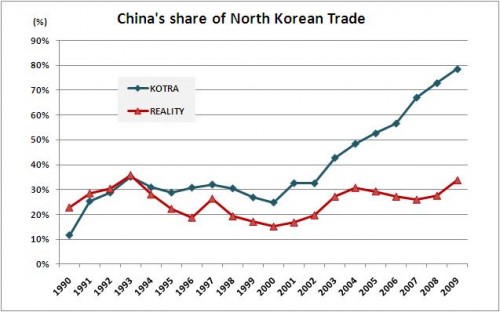
Writing at his new blog, Marcus Noland argues that KOTRA overstates the percentage of the DPRK’s trade coming from China.

According to Noland, there are several problems with KOTRA data that makes it less than ideal for drawing policy conclusions.  KOTRA counts DPRK-ROK trade as a domestic exchange, not international trade.  Once corrections are made for South Korean trade and a few other tweaks, China’s share of North Korean trade falls from appx 80% to 30%.

In a different but related story, Yonhap reports on research findings by Drew Thompson, director of China Studies at the Nixon Center.  According to the report:

China’s investment in North Korea was less than US$100 million between 2003 and 2009, indicating Beijing’s investment projects in the reclusive country are still relatively small, a U.S. scholar said Thursday.

Drew Thompson, director of China Studies at the Washington-based Nixon Center, said Chinese investment in North Korea totaled $98.3 million over the seven-year period, compared to $1.2 billion in South Korea during the same period.

It was also less than China’s investments in other neighboring states, including $273 million in Thailand, $473 million in Vietnam, $729.8 million in Myanmar and $890.7 million in Mongolia over the same period.

The majority of Chinese investors in North Korea are small and medium enterprises, though some smaller firms enjoy brand recognition, such as Nanjing Panda Electronics Co., China Minmetals Corp. and Wanxiang Group, the scholar said.

The majority of Chinese investors in North Korea are not state-owned enterprises (SOEs) controlled by the Chinese central government, but privately owned companies and provincial-, prefecture- and municipal-owned SOEs.

Of the 138 Chinese-North Korean joint ventures established between 1997 and August 2010, 41 percent engage in mining, 38 percent in light industry, 13 percent in services and 8 percent in heavy industry, he said.

Thompson said Chinese investors in North Korea are geographically concentrated in the two northeastern provinces bordering North Korea.

Twenty-eight percent of Chinese companies involved in joint ventures are from Jilin, with 34 percent from Liaoning. The rest are from other regions, including Beijing, Shandong and Shanghai.

Jilin and Liaoning share a 1,400 kilometer border with North Korea and are increasingly focused on foreign trade and on achieving competitive economic advantages through their proximity to North Korea.

“(North Korea’s) joint ventures with China are an important aspect of the bilateral relationship, because in addition to propping up the regime in Pyongyang, they contribute to economic development in China’s northeastern ‘rust belt,'” the scholar said in an emailed note.

China’s northeastern region is seen as the country’s rust belt, covered with obsolete and unprofitable factories.

Share

DPRK-Chinese mining deal

Monday, February 7th, 2011

According to Yonhap:

North Korea and China are expected to sign an agreement on joint development of the North’s underground resources in the middle of this month in Beijing, a source here said Sunday.

“It has been learned that Pyongyang and Beijing are expected to conclude a deal to jointly develop North Korea’s underground resources on Feb. 15, one day before the birthday of North Korean leader Kim Jong-il,” said the source, noting the accord will be signed in Beijing between China’s Commerce Ministry and the North’s Joint Venture Investment Committee.

“Specifically, the two sides may agree to jointly develop natural resources such as gold, anthracites and rare earths under the bilateral deal. Following the agreement, the two countries are likely to establish a joint venture company in Hong Kong,” said the source, asking to remain anonymous.

Trade between North Korea and China reached US$3.06 billion in the first 11 months of last year, which marked a rise of 9.6 percent from the 2008 annual volume of $2.7 billion. Mineral resources like coals and iron ores account for over 30 percent of the North’s exports to China.

Chinese mining investors have had mixed results in the DPRK despite geographical proximity and monopsony purchasing power (the Chinese can offer lower prices because in many cases they are the only purchaser/investor).

At one point, a Chinese firm had a controlling share of the DPRK’s Hyesan Youth Copper mine (Satellite image here).  As best I can tell, the mine is no longer operable because of flooding from nearby dam construction.

A Chinese firm had also invested in the Musan Mine, the DPRK’s largest, conveniently located on the Chinese border (Satellite image here). This deal also fell trough (see here).

I have heard informally that Chinese mining investors do not particularly like doing business in the DPRK because their North Korean business partners routinely violate contract terms and local officials need to be bribed repeatedly.  Today Chinese mining firms operate across the world in both developing and developed countries, so why bother with the DPRK?

The particular deal mentioned in this Yonhap article is interesting because it hints that the Chinese and North Korean central governments are setting the terms for mining investment in the DPRK for the first time.  This will give local officials less room for post-contractual rent-seeking behavior and could smooth the way for regular/predictable business operations in the DPRK.

Again, centralized corruption is preferable to decentralized corruption for investors.

Read the full Yonhap story here:
N. Korea, China likely to ink deal on joint resource development
Yonhap
2/6/2011

Share

New papers on the DPRK’s markets and Chinese investment

Friday, February 4th, 2011

In addition to the Haggard/Noland book release, there were a couple of other interesting North Korea events in Washington DC this week that I wanted to point out:

1. Korea Economic Institute: The Markets of Pyongyang
John Everard, UK Ambassador to the DPRK (2006-2008)

-Read his paper here (PDF).
-See his power point presentation here (PDF).
-See his full presentation in three parts: Part 1, Part 2, Part 3.

2. US-Korea Institute at SAIS: Silent Partners: Chinese Joint Ventures in North Korea
Drew Thompson, Director of China Studies and Starr Senior Fellow at The Nixon Center

-The event web page is here.
-Read an executive summary here
-Read the paper here.

Both papers are well worth reading.

Share

Witness to Transformation: Refugee Insights into North Korea

Monday, January 31st, 2011

I was in Washington today for the release of Haggard’s and Noland’s new book Witness to Transformation: Refugee Insights into North Korea. According to the Peterson Institute’s web page:

Despite its nuclear capability, in certain respects North Korea resembles a failed state sitting uneasily atop a shifting internal foundation. This instability is due in part to the devastating famine of the 1990s and the state’s inability to fulfill the economic obligations that it had assumed, forcing institutions, enterprises, and households to cope with the ensuing challenges of maintaining stability with limited cooperation between the Korean government and the international community. The ineffective response to the humanitarian crisis triggered by the famine resulted in the outflow of perhaps tens of thousands of refugees whose narratives are largely overlooked in evaluating the efficacy of the humanitarian aid program. Witness to Transformation: Refugee Insights into North Korea uses extensive surveys with refugees who now reside in China or South Korea to provide extraordinary insight into the changing pathways to power, wealth, and status within North Korea. These refugee testimonies provide an invaluable interpretation of the regime, its motivations, and its capabilities and assess the situation on the ground with the rise of inequality, corruption, and disaffection in the decade since the famine. Through the lens of these surveys, preeminent North Korean experts Stephan Haggard and Marcus Noland carefully document the country’s transition from a centrally planned economy to a highly distorted market economy, characterized by endemic corruption and widening inequality. The authors chart refugees’ reactions to the current conditions and consider the disparity between the perceived and real benefit of the international humanitarian aid program experienced by this displaced population. Finally, the book examines these refugees’ future prospects for integration into a new society.

I have read the book and found it tremendously helpful for understanding the changing dynamics within the DPRK.

In conjunction with the release of the book, the two authors have launched a new blog.  You can see it here. They have already posted some fantastic data—and we can also see a sense of humor as well!

UPDATE:

1. Here is a link to the presentation given at the event.

2. Here is coverage in the Daily NK.

3. Here is coverage in the AFP.

Share

DPRK food prices drop

Monday, January 31st, 2011

According to the Choson Ilbo:

The price of rice and foreign currency exchange rate in North Korea have both dropped drastically in a matter of a week, according to Radio Free Asia.

The radio station reported Saturday that rice in Hyesan, Yanggang Province was selling for 2,000 won per kg as of Friday, down from 3,300 won or nearly 40 percent from six days earlier. The Chinese yuan was trading for 400 North Korean won, down from 520.

A local source said that various rumors had prompted merchants to stockpile rice and then suddenly release it. The source also added that the rice requisitioned for the military, a key cause of recent price increases, is being siphoned off and sold, bringing the price down.

Read the full story here:
Rice Prices in N.Korea Plunge 40%
Choson Ilbo
1/31/2011

Share