Archive for the ‘DPRK organizations’ Category

PRC military exports to DPRK

Tuesday, August 23rd, 2011

The Choson Ilbo posts a video of dozens of military vehicles being shipped to the DPRK:

Left: Click image above to see video. Right: Dandong Customs House

According to the article:

Some 3,000 to 4,000 Chinese-made military trucks and jeeps entered North Korea last month, it was confirmed Monday. According to video clips obtained by the Chosun Ilbo, over 100 military trucks and jeeps made in China went to North Korea everyday last month after going through customs in Dandong.

There were eight video clips of varying lengths ranging from two minutes to 16 minutes. The footage shows Chinese-produced military vehicles standing in the 10,000 sq.m parking lot of the Dandong customs office waiting to be cleared along with other civilian cars, and two-story trailers loaded with military vehicles waiting on the side road to enter the customs office. A local source in Dandong said, “Normally, all Chinese-made vehicles going into North Korea were civilian, but in July, a massive number of military cars went to North Korea.”

A senior source in North Korea said that these cars were gifts to military officers by North Korea’s heir apparent Kim Jong-un in celebration of “Victory Day,” or the day the armistice in the Korean War was signed on July 27. “North Korean military vehicles produced in the 1970s and the 80s are too old to carry out drills, and many soldiers were dissatisfied. In order to buy the loyalty of the military and show what he can do, Kim Jong-un replaced the old vehicles thanks to the assistance of China,” the source added.

Jeeps were given to officers to be used to conduct operations, and the trucks were given to soldiers.

Analysis of the footage suggests the trucks were 6-ton trucks made by FAW Car Limited Company. North Korean leader Kim Jong-il visited the headquarters of this firm in Changchun, Jilin, during his visit to China in May. The military jeeps were manufactured by Beijing Automobile Works with engine capacity of 2,200 cc and 100 horsepower. BAW, which specializes in SUVs, trucks and military vehicles, is a subsidiary of Beijing Automotive Group, a partner of Hyundai Motor.

Dump trucks, large buses, sedans, oil trucks, agricultural machines and heavy machinery were also spotted in the video going into North Korea. In the windscreen, the name of the recipients is written. One is Korea Taesong Trading Company, a trading company under the Workers Party that manages Kim Jong-il’s slush funds. It was blacklisted by the U.S. as part of its economic sanctions against the North.

In one video clip, tourist buses pack one side of the parking lot. Another clip shows a queue of several dozens of LNG trucks. A South Korean government official commented, “North Korea depends on China for almost entire amount of fossil fuel it needs.”

Share

Yonhap on the DPRK’s Basic Medicine Research Center in Pyongyang

Monday, August 22nd, 2011

According to Yonhap:

Seok, 46, who defected to the South in 1998, is known for practicing North Korea’s “royal court medicine” that he learned while working at Pyongyang’s top medical research center devoted solely to caring for the health of leader Kim Jong-il.

The research institute is known in South Korea as the Kim Il-sung Longevity Research Institute after the name of the North’s late national founder and father of the current leader. Among North Koreans, it is simply called the “long life research institute,” Seok said, dressed in a white lab coat during a recent interview at his two-story clinic.

“Simply put, the long life research institute is to look after the general,” Seok said, referring to the North’s leader. “I was with the cardiovascular and anti-aging team at the institute.”

Details about the secrecy-shrouded Basic Medicine Research Center in Pyongyang are scarce, but the institute was believed to have hundreds of herbal doctors, physicians, biologists and other scientists working to make sure that the North Korean leader lives for a long time and in good health, Seok said.

Newly developed treatment methods, Seok said, were first tested on people similar to the leader in age and body type and with heart disease, an illness that killed late leader Kim Il-sung in 1994 and the current leader Kim Jong-il, now 68, is believed to be suffering from.

“These people were considered lucky because they were treated with good medicine,” Seok recalled.

Besides medical research, the longevity institute was also charged with growing high-quality organic rice, fruits and other agricultural products for the leader, even burying dogs in the farm fields as fertilizer, he said.

A top graduate from the North’s prestigious Pyongyang Medical College, Seok said he was plucked by authorities and assigned the research center regardless of his desires. Most graduates wanted to work at general hospitals where they could make more money.

“It’s not a place you can apply to work at. It’s a place you are dragged into,” Seok said with a chuckle that appears to imply a sense of relief that he is no longer in the totalitarian nation and lives a happy life in South Korea.

Read the full story here:
Oriental medicine doctor gives S. Koreans tastes of N. Korea’s ‘royal court medicine’
Yonhap
2011-8-22

Share

DPRK-China launch minerals – for – fertilizer program

Friday, August 19th, 2011

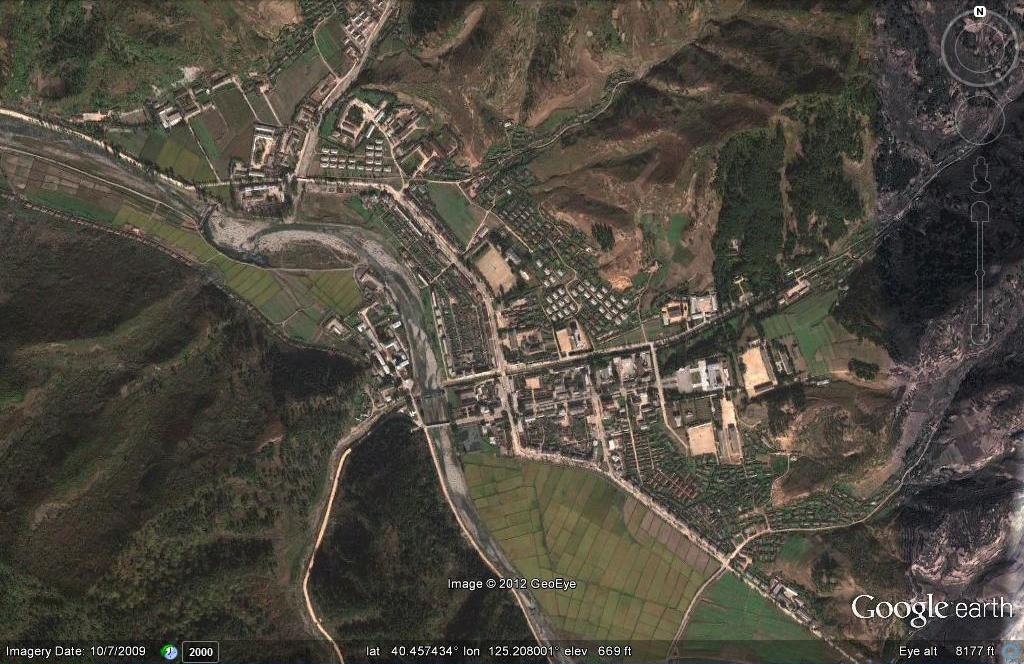
Pictured above (Google Earth): The Musan Mine, the DPRK’s largest.  See in Google Maps here.

According to the JoongAng Daily:

During his surprise May visit to China, North Korean leader Kim Jong-il secured free fertilizer and discounted food to help alleviate the impoverished country’s chronic food shortages.

A source in Beijing who monitors North Korea-China relations told the JoongAng Ilbo on Monday that Chinese officials agreed to provide 200,000 tons of fertilizer free of charge as well as 500,000 tons of corn at a discount in exchange for rights to North Korea’s abundant natural resources.

“When 200,000 tons of fertilizer is planted on North Korean soil, it can bring about a three-fold increase in the harvest,” the source said. “This can be the equivalent of giving 600,000 tons of food.”

The source added that China agreed to sell the 500,000 tons of corn for half of the international rate, which would be $30 per ton.

The corn, the source said, had already crossed the border into North Korea from northeastern China.

In exchange, Kim will allow China access to his country’s natural resources.

“The two parties agreed to participate in the extraction of buried rare earth minerals in Musan in Hamgyong Province,” the source said. “It’s quite a profit for China as it is thirsty for materials.”

North Korea is estimated to have around 20 million tons of rare earth minerals, which are vital in the production of high-tech goods.

The Beijing-based source said the agreement gives China the responsibility for the cost of building roads to transport the natural resources as well as lending equipment.

In exchange, North Korea will hand over 50 percent of the extracted rare earth minerals free of charge to China, with the rest to be sold to China at international market rates.

Meanwhile, other sources said that Kim also received a health checkup during his stay in China.

“When Kim Jong-il was visiting Yangzhou, he received a special examination from an oriental medicine doctor that the highest Chinese elite have gone to over the years,” a source familiar with North Korean issues said

The source added: “Kim Jong-il has never trusted China’s Western medicine. I heard from a Chinese official that Kim received an oriental medicine diagnosis by taking his pulse and that it did not involve drawing blood.”

Additional Information:

1. Here is a post linking to all the major DPRK food stories this year.

2. The media has reported on other DPRK food barter deals with Cambodia and Myanmar.

3. The role of the Musan Mine in DPRK-PRC relations has been quite interesting.  Here are previous posts on the mine.

Read the full story here:
North got fertilizer on Kim’s trip to China
JoongAng Daily
Chang Se-jeong
2011-8-19

Share

On the de-facto privatization of industry in the DPRK…

Wednesday, August 17th, 2011

Pictured above (Google Earth): A bus depot in Rakrang-guyok, Pyongyang.  See in Google Maps here.

According to the Daily NK:

Growth and improvement is evident in some areas of the private sector in North Korea, Ishimaru Jiro of ASIAPRESS revealed on the 16th, pointing to the growth of bigger, better private transit concerns and relatively productive coal mining operations as evidence of this trend.

In the past, trains were almost the only viable means of long-distance transportation in North Korea. Then, as private business began to grow and the railways fell into a deep malaise, vehicles such as trucks and cars belonging to military bases, state security and state enterprises were pushed into service to earn money for moving people; this, the so-called ‘servi-cha’ industry.

The servi-cha industry has long been fragmented and small scale; but now transportation companies run by rich individuals (‘donju’) which purchase several buses and hire drivers, guides and mechanics, are acting just as a transit company in a capitalist state would do.

With profit-sharing and bribery as the backbone, a large number of North Korean organs and enterprises have decided to lend their name to these individuals, fuelling the growth and development of a network of sorts.

“From the early 2000s, a high-speed bus network mostly between major cities began to emerge,” Ishimaru, revealing the latest research by ASIAPRESS internal North Korean sources, commented. “The companies are packaged as an enterprise affiliated to some state authority outwardly, but they are actually operated by individuals who pay kickbacks to that authority.”

The People’s Safety Ministry affiliated 116 Task Force Team is one such transportation company, Ishimaru says. It operates buses connecting Shinuiju, South Pyongan Province and Pyongyang. Ordinarily, the bus parks at a station or major public location, and then departs when it is full of passengers going to the next destination.

Here are previous posts on the servi-cha industry.

Read the full sotry here:
Green Shoots of Private Enterprise Growth
Daily NK
2011-8-17

Share

DPRK art merchant arrested in ROK

Wednesday, August 17th, 2011

Pictured above (Google Earth): The Mansudae Art Studio in Pyongyang. The blue roofs indicate that most of the buildings have recently been renovated. See the studio in Google Maps here.

According to Yonhap:

Seoul police said Wednesday that they have booked an ethnic Korean woman from China for allegedly smuggling North Korean paintings into South Korea, selling them to local consumers and sending some of the profits to the North.

The 46-year-old woman, surnamed Kim, was accused of bringing in about 1,300 paintings by some well-known North Korean artists in violation of a law regulating the flow of goods between the two Koreas, the Seoul Metropolitan Police Agency said.

Police also booked three others for allegedly helping Kim peddle the smuggled artworks.

Kim is suspected of smuggling in 1,308 artworks, mostly landscape paintings created by North Korean artists, between May last year and July this year, and pocketing 30 million won (US$27,943) after selling 1,139 of them to local galleries and over the Internet, police said.

Police said the North Korean artists include some famous names who were authorized by the Pyongyang regime and affiliated with the communist country’s top-notch Mansudae art community widely known to be peddling artwork overseas as a means of earning foreign currency.

Kim is believed to have obtained those paintings through her North Korean husband living in China who uses his membership in an expatriates’ support committee in North Korea to secure his supply, police said.

Kim’s husband is believed to have clinched the supply of artwork on the condition that he pays $8,000 won annually on top of half the sales proceeds to the art community, according to the police.

“It is the first case ever to confirm that North Korea is selling (artwork) abroad through the committee,” a police official said.

Police said that the artwork, smuggled personally or through international mail, was mostly sold to art galleries in Incheon, Daejeon and Gwangju for prices ranging from 30,000 won to 1 million won per unit.

Police said they plan to expand the investigation as more North Korean goods could be smuggled into the country.

The Atlantic also has a good blog post on the whole saga.

Share

On DPRK naming conventions

Monday, August 15th, 2011

Pictured Above (Google Earth): WPK Building No. 3 compound (Third Building) mentioned below.  See in Google Maps here.

Andrei Lankov has a great article in the Korea Times on the WPK’s naming conventions. I have attached the article below and supplemented it with related material taken from Helen-Louise Hunter’s Kim Il-Song’s North Korea and the Yonhap North Korea Handbook.

Lankov writes in the Korea Times:

Anybody who has ever dealt with North Korean officials or documents is aware that the nation’s bureaucracy loves number-based names and titles.

To a very large extent this is related to the deeply militaristic nature of the country’s culture. The military usually numbers units and often gives top secret armaments or projects numerical names. In North Korea, the same practice is applied to the society at large. The resulting names sound mysterious and this is probably part of its objective.

More or less every North Korean knows what the term ‘number-one event’ means. This is the name of all events in which the “Dear Leader,” Marshall Kim Jong-il, is expected to participate. When inhabitants of a town see their streets swamped with plain-clothes police, and when they are ordered to paint all fences anew, they understand: A number-one event is expected.

Everything related to the Kim family is “number one.” For example, painters who have a license to depict the members of the Kim family are known as number-one painters (and such a license is not easy to obtain). Predictably, an actor who is playing a member of the ruling family is known as a number-one actor.

Numbers are everywhere. If you need permission to go outside your native city or country, you should apply for a travel permit at Department 2 of the local municipal office. Of late, affluent North Koreans have become annoyed by the activities of Department 27. This department is responsible for the control of privately-owned electronic equipment. Now, as electric equipment is becoming increasingly common in North Korean homes, the officials of Department 27 are expected to conduct random checks of privately-owned computers. They are to ensure that no improper content is kept on hard-drives, and nowadays such visits must be time-consuming and stressful.

At the same time, North Koreans are (or at least used to be) quite happy to be number 65 distribution targets. North Korea, until the early 1990s, was a country of total rationing, where the government decided how much food and basic daily provisions were to be distributed to each citizen, depending on their perceived worth (admittedly food and goods were heavily subsidized and were essentially provided free). This is clearly an egalitarian approach, but, as Orwell once wrote, some are more equal than others. Members of the elite were given better rations and issued goods and services beyond the reach of the common people. They were referred to as number 65 distribution targets.

The place where they were issued special rations of pork and beer (luxuries by North Korean standards) were known as number 65 distribution centers.

Rations are long gone, so access to special distribution quotas is far less important than it was in the 1960s or 1970s. Money talks nowadays, so one should not be surprised that it is extremely prestigious to work for Bureau 38 or Bureau 39, the money-earning branches of the ruling ― and for all practical purposes, only ― party. The task of these bureaus is to earn hard currency which is then used to keep the Kim family and the upper crust of the regime sufficiently comfortable. There are some differences in their functions, but it’s not known exactly how these two agencies differ.

Another part of the central committee bureaucracy is the “Third Building.” This is a common name used to refer to all agencies that deal with South Korea. Actually the name is historic since, once upon a time, all South Korea related agencies and departments were once housed together in a building with the above designation.

Within the Third Building bureaucracy, a special role is played by Bureau 35. The bureau is essentially the intelligence-gathering branch of the ruling Korean Workers Party. Most countries worldwide have two intelligence services, one serving the military and the other gathering political intelligence. On top of that, North Korea also had a party intelligence service.

The initial role of Bureau 35 was to bring about revolution in the South. But with no revolution in sight, it gradually became just another intelligence bureaucracy. Recently North Korea conducted a major reshuffle of its spy agencies, and according to reports, Bureau 35 has had its functions either acquired by another agency or was at least downsized.

It was glamorous to work at Bureau 35 and/or be a number 65 distribution target. It is far less glamorous to be a “target 49.” This is what mentally handicapped people are called in the North. The “49 centers” are the agencies that take care of the needs of people with mental and psychiatric problems.

The list of North Korea’s mysterious numbers has many more interesting entries. Sometimes it seems that numbers are more frequently used there than real names. But what can we expect from a state which unabashedly models itself after the military?

On a related note, Helen-Louise Hunter wrote in Kim Il-song’s North Korea (p. 14–Order at AmazonGoogle Books):

The numerical identification of a factory or collective farm is derived from the date of Kim’s first visit . For Example, the 18 September Nursery School in Pyongyang is named for the day when Kim [Il-sung] visited it. Although this name for the most prestigious nursery school in North Korea, which caters to the crème de la crème in Pyongyang, seems unimaginative and unimpressive, it establishes Kim’s personal connection with the school.  In North Korea that is all-important.

Additionally, North Korean organizations are named after important political dates.  According to the Yonhap North Korean Handbook (p.675–Order at AmazonGoogle Book):

North Korea had declared the People’s Army Founding on February 8, 1948, and February 8 was commemorated as the People’s Army Fonding Day before 1978.  In February 1978, North Korea changed it to April 25 while arguing that “the People’s Army is the direct heir of Choson People’s Revolutionary Army” and the former president Kim Il-sung had organized Choson People’s Revolutionary Army (anti-Japan guerilla corps) on April 25, 1932.

Perhaps you have heard of the February 8 Vinalon Complex (2.8 Vinalon Complex) or the April 25th House of Culture?

Share

US sanctions Syrian bank for DPRK connection

Sunday, August 14th, 2011

UPDATE 1 (2011-8-17): The recently sanctioned bank denies it has ties to Iran and the DPRK. According to Lebanon’s Daily Star:

The Lebanese subsidiary of a Syrian bank sanctioned by the United States denied on Wednesday “unfounded political allegations” that it dealt with North Korea and Iran.

“Since the establishment of our institution, we have never had any operation with either a North Korean or an Iranian entity even before the existing sanctions,” the Syrian Lebanese Commercial Bank said.

“As a result, we deny all accusation of being involved in any illegal activity with any suspected country,” a statement added.

The United States Treasury has charged that the state-owned Commercial Bank of Syria allegedly supported Syria and North Korea’s efforts to spread weapons of mass destruction.

Washington last week imposed sanctions on the bank, the Syrian Lebanese Commercial Bank and telecoms company Syriatel over President Bashar al-Assad’s increasingly brutal crackdown on pro-democracy protests.

The move freezes the US assets of the businesses targeted and prohibits US entities from engaging in any business dealings with the two banks.

ORIGINAL POST (2011-8-14): The US has sanctioned a Syrian Bank for its involvement in DPRK proliferation activities.  According to Yonhap:

The Treasury Department said the Commercial Bank of Syria has provided financial services to North Korea’s Tanchon Commercial Bank and Syria’s Scientific Studies and Research Center, both of which were blacklisted for the proliferation of weapons of mass destruction.

The Syrian bank’s Lebanon-based subsidiary, Syrian Lebanese Commercial Bank, and Syriatel, the largest mobile phone operator in Syria, were also sanctioned under Wednesday’s measure.

“By exposing Syria’s largest commercial bank as an agent for designated Syrian and North Korean proliferators, and by targeting Syria’s largest mobile phone operator for being controlled by one of the regime’s most corrupt insiders, we are taking aim at the financial infrastructure that is helping provide support to (President Bashar) Asad and his regime’s illicit activities,” Under Secretary for Terrorism and Financial Intelligence David S. Cohen said in a press release.

The Commercial Bank of Syria also holds an account for Tanchon Commercial Bank, the primary financial agent for the Korea Mining Development Corp., North Korea’s premier arms dealer and main exporter of goods and equipment related to ballistic missiles and conventional weapons, according to the department.

The U.S. is stepping up efforts to isolate the Assad regime amid its brutal crackdown on anti-government protesters.

NTI has additional information here.

Other DPRK-Syria stories below:
1. Syria and the DPRK collaborated on the construction of Syria’s nuclear facility which was destroyed in 2007 by an Israeli air strike.

2. According to Joshua Pollock, over the last decade the DPRK and Syria have cooperated on missile development.

3. The UNSC was investigating a shipment of North Korean chemical safety suits to Syria.

4. Syria’s Tishreen War Museum was designed and built by North Koreans!

Share

KPA Journal Vol.2, No. 5

Thursday, August 11th, 2011

Pictured Above: The Taesung Machine Factory featured in the most recent issue of KPA Journal.

I have been pretty busy this week, but I wanted to put up a quick link to the latest issue of KPA Journal. This issue focuses on the Tae-sung Machine Factory. The issues also contains addendums, corrections and other publications of interest.

Have a good weekend!

Share

Kim Jong-il provides field guidance at the Pyongyang Department Store No. 1 product exhibition

Wednesday, August 10th, 2011

Institute for Far Eastern Studies (IFES)
2011-8-10

Kim Jong Il is stressing the importance of the production of commodities for the North Korean people through upgrading the country’s light industry.

On August 1, an editorial in the Rodong Sinmun, “Let’s Go Full Speed Ahead with the Light Industry to Maximize the Production of Commodities,” mentioned the second product exhibition at the Pyongyang Department Store No. 1 as an exposition of “the growing development of light industry.”

The article emphasized Kim Jong Il’s second visit to the exhibition of commodities at the department store, “With the 100th anniversary of the birth of Kim Il Sung, our fatherly leader, revolutionary transition to improve the production of daily commodities must be put into full effect.” Kim’s recent field guidance at the exhibition hint at the state’s increasing efforts to improve the living standards of the population.

The newspaper also reiterated the significance of the exhibition stating, “The second exhibition of commodities at the Pyongyang Department Store corroborated the policies and the legitimacies of the Workers’ Party of Korea (WPK), aimed at improving the living standards of the people through continuous revolution and progress in the light industry of the country.”

In addition, the news mentioned, “Under the leadership of the WPK, the light industry products at this exhibition displayed the spirit of Juche and modernization at the forefront in building an economically powerful nation.” It also explained a variety of about 1,400 “high quality” light industry products were manufactured by 350 central and regional light industry factories, companies, affiliated units, department stores in Pyongyang, and comprehensive industrial product shops.

The newspaper also praised the exhibition to provide an, “Important opportunity to improve the lives of the people while parading the great national spirit, creativity, and ability.” It added, “The product exhibition has become an important turning point to revitalize the production of daily commodities of the people and revealed brilliant prospects for the future development of the light industry of our country.”

Thus, this year was depicted as an important year for light industry. The development of light industry was described as an unwavering goal of the workers and the party members to succeed in the march for improving the lives of the people by 2012 and celebrate the 100th anniversary of the DPRK founding leader’s birthday.

Share

KCC finding creative ways to earn hard currency

Thursday, August 4th, 2011

Pictured above (Google Earth): Korea Computer Center

According to the Associated Press (Via Washington Post):

South Korean police said Thursday they have arrested five people who allegedly collaborated with elite North Korean hackers to steal millions of dollars in points from online gaming sites.

The five, including a Chinese man, were arrested and another nine people were booked without physical detainment after they worked with North Koreans to hack South Korean gaming sites, the Seoul Metropolitan Police Agency said in a statement.

Members of the hacking ring, which included North Korea’s technological elite, worked in China and shared profits after they sold programs that allowed users to rack up points without actual play, police said.

The points were later exchanged for cash through sites where players trade items to be used for their avatars. The police said the ring made about $6 million over the last year and a half.

A police investigator, who declined to be identified because the investigation was under way, said North Korean hackers were asked to join the alleged scheme because they were deemed competent and could help skirt national legal boundaries.

The police pointed to North’s Korea Computer Center as the alleged culprit. Set up in 1990, the center has 1,200 experts developing computer software and hardware for North Korea, the police said.

The National Intelligence Service, South Korea’s spy agency, was heavily involved in the investigation, the police said. Investigators suspect the hackers’ so-called “auto programs” could be used as a conduit for North Korean cyberattacks.

South Korean authorities have accused North Korea of mounting cyberattacks in the past few years. Prosecutors said earlier this year that the North hacked into a major South Korean bank’s system and paralyzed it for days. The North is also accused of mounting attacks on U.S. and South Korean websites. Pyongyang has denied the charges.

The New York Times adds the following details:

In a little less than two years, the police said, the organizers made $6 million. They gave 55 percent of it to the hackers, who forwarded some of it to agents in Pyongyang, the capital of North Korea. “They regularly contacted North Korean agents for close consultations,” Chung Kil-hwan, a senior officer at the police agency’s International Crime Investigation Unit, said during a news briefing.

Mr. Chung said the hackers, all graduates of North Korea’s elite science universities, were dispatched from two places: the state-run Korea Computer Center in Pyongyang and the Korea Neungnado General Trading Company. The company, he said, reports to a shadowy Communist Party agency called Office 39, which gathers foreign hard currency for Mr. Kim through drug trafficking, counterfeiting, arms sales and other illicit activities.

Read the full story here:
South Korean police say they’ve cracked down on ring working with North Korean hackers
Associated Press (Via Washington Post)
2011-8-4

Share

An affiliate of 38 North