North Korea is developing its tourism industry as a way to increase its foreign currency earnings. Recently, there appear an increasing number of tour packages targeted attracting Chinese visitors to the DPRK, with new tour packages actively being promoted.
The Korean Central News Agency (KCNA) reported on October 8 that there are new professional tour programs that are gaining international attention. In the article, new and creative tours were featured, including Mount Paektu tours with [Air] Koryo Airlines and bicycle tours. Mini-golf tours are also reportedly scheduled for next year.
Along with North Korea, Chinese tour companies are also taking interest in this effort and are developing various tour packages via air, land, and sea routes. In June, charted plane tours from Shenyang started, and now new tours from Dalian to Mount Kumgang are also being launched.
Across the border from the North Korean city of Sinuiju is the Chinese city of Dandong, where there are over ten travel agencies that operate daily train tours between the two cities. In fact, during holidays and weekends, more and more Chinese tourists are flocking to the China-North Korean Friendship Bridge that traverses the Yalu River, connecting the two cities.
The recent rise of Chinese tourists to North Korea is attributed to the aggressive marketing schemes of the North Korean government. The State Tourism Bureau teamed up with a Chinese travel company to run a tour to Mt. Paektu. North Korea, faced with international economic sanctions, has limited means to earn foreign currency. The new Kim Jong Un regime is actively seeking ways to earn foreign capital through the tourism industry. Chinese companies are responding positively and swiftly to this change and are coming up with new tourism programs.
North Korea is utilizing its image as ‘closed country’ and ‘hermit kingdom’ to stimulate curiosity among tourists. More and more Chinese are able to enter North Korea without a visa (requiring only their passports) and this is adding to the spike in Chinese tourists to the country. Most Chinese travel agencies are able to make all the necessary travel arrangements to North Korea in less than a week once the interested person submits his/her passport and photos.
However, there are comments from returning visitors that tours are limited to historic and famous sites and somewhat insular as contact with the locals is prohibited. North Korean national security agents accompany all tour groups. Despite this fact, many experts expect the number of Chinese visitors to the DPRK will continue to increase in the future.
The last nationwide survey including nutrition indicators was the Multiple Indicator Cluster Survey (MICS) carried out in 2009. It showed that 32.4% of children
The present survey was therefore needed to update the indicators for the population nutritional status. All 10 provinces have been included. Data collection was done from September 17th to October 17th 2012.
The methodology is based on SMART and MICS surveys. It is a clustered, stratified by provinces, two-stage sampling survey. The target population includes children under 5 and their mothers. The sample size per province is 400 children in Pyongyang municipality and 812 children in all other provinces for most indicators.
Chronic malnutrition, despite a modest drop since MICS 2009 (from 32.3% to 27.9% at national level) remains in the ranges labelled ‟medium‟. Stunting has irreversible impact on the development of children as a result on the Country development. The prevention of stunting in early life (starting during or even before pregnancy) as well as the prevention of anaemia in mothers and their children (mainly those under 2 years old) through different multi-sectoral interventions combining nutrition, health, WASH, social protection, food security and agriculture requires more efforts and resources.
The survey also shows a picture of the acute nutritional status of children modestly improved since 2009. The situation is not critical and does not suggest emergency operations. However, attentions need to be paid to such factors as essential medicines, WASH situation and food security which affect the vulnerable children. The presence of acute malnutrition in women is also of concern. Programmes like the management of acute malnutrition at hospital and community levels (CMAM) need to be continued and expanded. Provision of nutritious food for children at institutions should also continue. On-going monitoring of the nutritional situation is important to identify the trends and changes in the situation and bring support as soon as possible when the situation is negatively changing.
In reference to the MDG 1, the achievement in decreasing underweight over time (from 60.6% in 1998 (MICS1 to 15.5% in the actual survey), as well as chronic and acute malnutrition, are primarily due to concerted efforts between the Government, the UN Agencies and others partners in DPRK in addressing the different causes of malnutrition. But malnutrition still remains and requires continued and strengthened interventions on chronic and acute malnutrition in order to have more impact on the underweight prevalence and to ensure a more optimal growth to the children.
North Korea imported US$170,000 worth of firearms from Switzerland in the first half of this year, Seoul’s trade agency said Friday.
The communist country brought in about $100,000 of guns such as shotguns, air and gas rifles, and revolvers while importing around $70,000 worth of firearm components, according to the report by the Korea Trade-Investment Promotion Agency, or KOTRA.
The state-run agency said the North had no record of firearm imports from Switzerland since 2009 until last year when it started to ship them in the first half.
Some experts said the new trend may be due to the fact that North Korean leader Kim Jong-un spent his adolescence in the country.
Read the full story here:
N. Korea imports US$170,000 of firearms from Switzerland Yonhap
2012-10-26
Recently, eight companies in the Kaesong Industrial Complex (KIC) informed that they received tax collection notices, a unilateral decision made by the North Koreans.
The Ministry of Unification and KIC reported that out of the 123 companies, 8 companies were informed by the North Korean authorities to pay about 160,000 USD in total in taxes.
Two companies out of the eight notified companies already paid close to 20,000 USD to the North Korean tax authorities.
On top of taxation, 21 companies were notified to submit additional tax documents. This may be to collect additional information for future tax collection purposes.
The tax authorities are also requiring companies to submit documents related to show proof of purchase of raw materials, and submit cost analysis documents and a copy of bank statements showing the history transactions.
Last August, the Central Special Direct General Bureau (CSDGB) notified the Kaesong Industrial District Management Committee of new tax bylaws, which enforces a fine up to 200 times the amount of accounting manipulation and abolish the retroactive taxation system while increasing the number of documents for submission. Furthermore, the North is threatening to restrict access to the KIC, if companies fail to pay owed taxes or do not submit requested documents.
In addition to imposing fines for tax frauds, new tax bylaws demanded by the CSDGB included enforcement of additional taxes in the name of corporate income tax, sales tax, and other taxes.
The unilateral decision by the CSDGB to amend bylaws is a violation of Kaesong Industrial District Law, which requires any revision of the laws must be negotiated between the North and the South. Another problematic issue is that tax imposed on the companies is based on North Korea’s own estimation rather than tax reports submitted by the companies of the KIC.
For the first time last year, tenant companies in the KIC recorded an average operating profit of 56 million KRW, finally operating in the black after years in deficit.
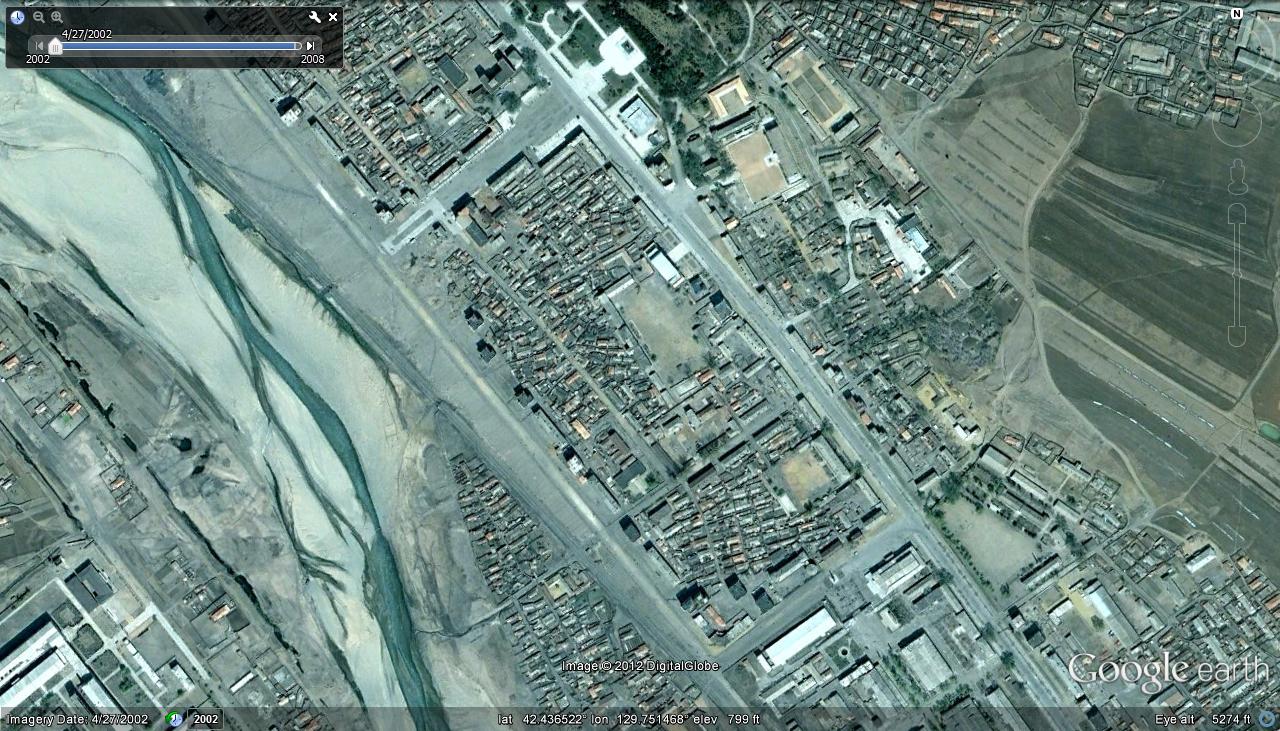
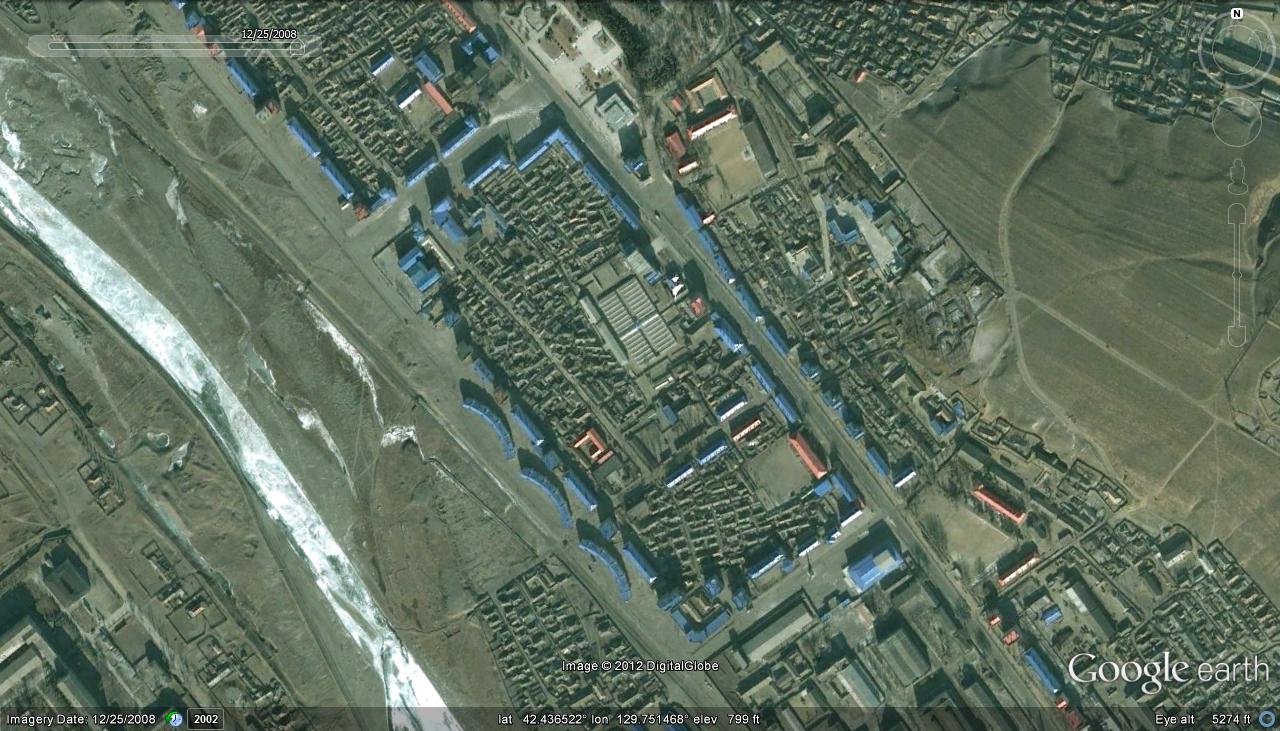
Pictured Above (Google Earth): Two Google Earth satellite images of Hoeryong (L: 2002-4-27, R: 2008-12-25) which show the construction of residential apartments buildings as well as the town’s new main market.
Hoeryong is a town in North Hamgyong Province that lies across the Tumen (Tuman) River from China. According to North Korean political narratives it is also the childhood home of Kim Jong-il’s mother, Kim Jong-suk. It has been the the site of a large construction boom in the last five years, and now, according to the Daily NK, Chinese tourists are being brought in on very limited itineraries. According to the article:
The Hoiryeong source explained, “North Hamkyung Province ‘shock troops’ and military unit construction teams have been here for three years on Kim Jong Il’s orders for the construction, and now it is finished.” Local households were asked to contribute 12,000 North Korean Won each to the construction effort, he added.
Hoiryeong used to have few buildings with five floors, but now it has a considerable number of new four and five floor apartment buildings built around the center of the city, as well as a number of newly built commercial facilities. Buildings in the downtown core have also been spruced up with external lighting, a project that began last April.
There are a number of new restaurants in the area. One, ‘Hoiryeonggwan’, has been decorated in the style of Pyongyang’s famous ‘Okryugwan’, something that Kim Jong Il is said to have ordered in December 2010 when he visited the construction site. Elsewhere, restaurants serving spicy marinated beef, duck, dog and Chinese food have also opened their doors.
However, these restaurants only currently open on the weekend or when Chinese tour groups make an advanced reservation, according to the source, who revealed that local people regard the construction effort more as an attempt to generate tourist revenue than to make it a real ‘model city’, as the official propaganda claims.
“Chinese tourists come, then they visit the statue of Kim Jong Suk and the place where she grew up, and then they are taken to one or other of the restaurants,” the source said. “They drink and make merry then go, all without visiting any scenic spots; thus, the authorities make money.”
As with other tourist operations, it is possible that this small step will lead to a softening of restrictive tourism regulations and potentially the arrival of Western tourists. But don’t hold your breath! Chinese tourists have been visiting Sinuiju on a regular basis, but westerners are generally still prohibited from touring the city
Despite the global economic slowdown, more than 6,000 business representatives from 20 countries signed agreements on more than 200 cooperative projects. Some 72 of the largest projects have a total combined value of $1.26 billion.
…
During the 11th Five-Year Plan period (2006-2010), total trade value between Dandong and DPRK amounted to $3 billion. Imports and exports between Dandong and the DPRK reached $1.86 billion in 2011.
So far, trade between Dandong and DPRK accounts for 40 percent of total China-DPRK trade, and the volume of the cross-border cargo trade via Dandong port makes up 80 percent of the total Sino-DPRK trade volume.
UPDATE 4 (2012-10-16):Xinhua reports on the closing of the expo:
The five-day 2012 China-DPRK Economic, Trade, Culture and Tourism Expo, held in the border city of Dandong, concluded on Tuesday with 72 agreements of cooperation intent signed. They have a combined value of 1.26 billion US dollars.
Pan Shuang, vice mayor of Dandong, said more than 6,000 Chinese and overseas people from over 20 countries and regions exhibited at and attended the expo. There were talks on 200 projects.
He said the projects related to industries ranging from aquaculture, clothes manufacturing, chemical production, wind power generation equipment, iron steel production to hotel construction.
AT THE EXPO
At the exhibition, the DPRK delegation exhibited ginseng products, food specialties, hand-made Hanbok, a traditional Korean costume, as well as mining and machinery equipment.
Ri Yong Chol, sales manager of Korea Roksan General Trading Corp., which is a ginseng supplier, said “I came to look for Chinese friends and potential business partners. Our company is also seeking opportunities to set up a subsidiary in China to get better access to the Chinese market.”
A Korean girl wearing brightly-colored Hanbok and traditional ornaments was selling costumes. “Our factory can make 20 such hand-made Hanboks a day. The clothes are for important occasions with exquisite workmanship and high-quality material,” she said.
Liu Songyu, chairman of a Korean garment firm from Yanbian Korean Autonomous Prefecture of Jilin Province, was interested in the business.
“Chinese labor costs have been rising fast. In Yanbian, a garment-factory worker’s salary has risen to 2,000 yuan (319 US dollars) a month. While, if the company had a factory in DPRK, it would save a considerable amount on labor costs. I would give a serious thought to that,” he said.
Yanbian is a heavily Korean ethnic populated region in China, where people also wear Hanbok during important occasions.
Elsewhere, Huang Zijun, an authorized dealer of Total Petrochemcial, was overwhelmed to obtain 20 orders from the DPRK delegation during the expo.
“I felt their enthusiasm in promoting business at the expo. I believe the DPRK is a big market for petrochemical products like lubricating oil,” he said.
An economic, trade, culture and tourism expo jointly initiated by China and the Democratic People’s Republic of Korea (DPRK) opened Friday in the border city of Dandong in northeast China’s Liaoning Province.
A delegation of 500 members from the DPRK is attending the 2012 China-DPRK Economic, Trade, Culture and Tourism Expo, which is scheduled to run from Friday to Tuesday, the event’s organizers said.
Over 400 Chinese companies from 12 industries are also attending the expo.
With the theme of “friendship, cooperation and development,” the expo consists of commodity exhibitions, trade fairs, DPRK art performances, craftwork exhibitions, a border trip to the Yalu River and an exhibition for the tourism resources of the two countries.
Supported by the China Council for the Promotion of International Trade, the event is being organized by the Liaoning Provincial Government.
China is DPRK’s biggest trade partner. Statistics show that bilateral trade volume went up 62.4 percent year on year to 5.64 billion U.S. dollars last year.
A source from Dandong described the unusually vibrant scene to Daily NK yesterday, saying, “The North Korean authorities have mobilized companies from Pyongyang and from here in China to sell goods and pitch for joint venture opportunities. There are loads of people; it’s standing room only.”
The source added that North Korean companies attending the event are pushing very hard to attract investment; notably, by distributing their own promotional literature expounding upon the given company’s superior virtues and providing exact contact details for follow-up inquiries. It is not hard to find meetings continuing in local North Korean eateries, as the North Korean side tries to woo potential sources of capital.
Chinese companies are keen to hear about the joint venture opportunities available, the source also said; and with most of the larger enterprises from China’s three northeastern provinces sending representatives to Dandong for the event, which runs until the 16th, most of the city’s hotels are apparently full to bursting.
However, due to past and present cases of lip service being paid to contractual obligations by North Korean companies whose only goal has been to attract funding rather than build business, Chinese representatives are still very cautious about actually signing on the dotted line.
One such representative from a Dandong-based company with a 10-year history of doing business with North Korea pointed out to Daily NK, “We have seen countless examples of companies making contracts and then there being little contact between the partners thereafter. Unbelievably, one manager I tried some minerals business with last year just changed the name of the company and came back again this year.”
UPDATE 1 (2012-6-7): The expo appears to have been pushed back to October 2012. According to KBS:
North Korea and China will jointly hold a fair on economy, trade, culture and tourism in the Chinese border city of Dandong for five days from October 12th.
A Dandong-based newspaper reports that this will be the first comprehensive fair covering several fields that the two countries hold. The paper said the fair will exhibit products, offer trade consultations, hold cultural and art performances and introduce both nations’ tourist attractions.
Roughly 400 Chinese companies exporting to North Korea will participate in the event. About 100 North Korean companies and cultural troupes will partake.
Dandong is China’s largest base for trade with North Korea, with 70 percent of its trade with North Korea running through the border city.
Read the full story here:
N.Korea, China to Hold Joint Industrial Fair in October KBS
2012-6-7
ORIGINAL POST (2011-12-3): Dandong to host Sino-DPRK economic and cultural expo. According to Xinhua:
The northeastern Chinese city of Dandong, which borders the Democratic People’s Republic of Korea (DPRK), will host a Sino-DPRK economic, trade and cultural exposition in June next year, a local Chinese official said Saturday.
A series of activities, including a commodity fair, investment and trade talks, tourism exhibition and arts exhibition, will be staged during the exposition, said a spokesman with the Publicity Department of the Dandong Municipal Committee of the Communist Party of China.
The Phibada Opera Troupe of the DPRK, an artists group well known to Chinese people, will give performances during the event, he said.
Adam Cathcart took the time to send me this interesting link to the official Dandong web page. It contains some videos (in Chinese) in which local officials promote the changes they expect to come to this city as it transitions into a regional trade hub.
Below I have added some links to recent blog posts that a re related to Dandong:
As is well known, North Korean embassies self-finance their operational revenue and salaries. They also remit funds back to Pyongyang. As far as I am aware, the DPRK may have the only foreign service that is not a drain on the treasury.
Many times, however, the operations in which DPRK officials get involved take palce in the gray and black markets. I have previously posted about this here, here, here, here, here, here.
This weekend, news surfaced that a North Korean was involved in trading elephant ivory in Africa. According to AllAfrica.com:
The Mozambican customs service on Thursday seized 130 items of carved ivory, valued at about 36,000 US dollars, that a North Korean citizen named Jong Guk Kim was attempting to smuggle out of the country.
According to a press release from the Mozambican tax authority (AT), Jong was returning to Korea, via South Africa, and had already checked in for his flight, when customs officers intercepted him in the departure lounge of Maputo International Airport, and demanded that he open his hand baggage.
The ivory was hidden in several plastic bags. The 130 carved pieces weighed about three kilos.
Ivory can only be exported with the authorisation of the Ministry of Agriculture – if, as seems more than likely, Jong Kim has no such authorisation, the ivory will be confiscated and revert in favour of the state.
The Korean was also carrying 133,300 US dollars in banknotes in his hand baggage. Under current Mozambican exchange regulations, the maximum that anyone can take out of the country without declaring it is 10,000 dollars.
Anything above this sum must be authorised by the Bank of Mozambique.
Jong Guk Kim must now explain how he obtained this money. If he can prove that it came from a legitimate source, he will be allowed to export it – but only through normal banking channels.
The AT also revealed that it had recently seized in Maputo, seven rhinoceros horns, and about a tonne of abalone. Abalone is a genus of marine mollusks, threatened with extinction, due partly to overfishing, and partly to acidification of the oceans arising from climate change.
The abalones seized in Maputo probably came from South Africa. Abalones occur along much of the South African coast, and the South African authorities require permits for any export of this shellfish.
A tonne of abalone is valued at about five million dollars. It is believed that the ultimate destination of the Maputo abalone was Hong Kong.
I tried to locate the press release by the Mozambique Tax Authority but was unsuccessful.
Read the full story here:
Mozambique: North Korean Caught Smuggling Ivory AllAfrica.com
2012-10-12
North Korea-China Economic, Trade, Cultural, and Trade Expo is scheduled to be held from October 12 to 16, 2012 at Dandong City, Liaoning Province. The expo will be jointly hosted by the China Council for the Promotion of International Trade, Liaoning Provincial Committee, Liaoning People’s Friendship Association, and Dandong Municipal People’s Government.
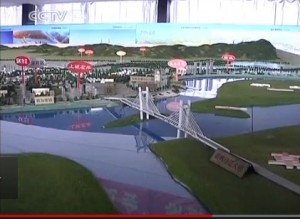
China accounts for 90 percent of North Korea’s foreign trade. Approximately 70 percent of this trade comes through Dandong. Currently, Dandong is gaining both domestic and international attention as the construction of the New Yalu River Bridge is nearing completion and progress on the Hwanggumpyong and Wihwa Islands Special Economic Zone is advancing.
North Korea-China Economic, Trade, Cultural, and Trade Expo will provide a place for not only product exhibits but will provide consultation for economic and trade cooperation, cultural exchanges and tourism. From the North Korean side, the largest trade investment company and government agency in charge of overseas labor export will be in attendance.
Over 500 booths and sections are ready for the expo and over 5,000 participants from foreign buyers are expected to attend. Over 100 companies and a 300-member economic-and-trade delegation will be coming from North Korea.
This event was an exclusive, invitation-only event, inviting major Chinese companies with investment interest in North Korea. There were over 100 officials from 30 different state-run corporations from North Korea present at the session to provide detailed information about 50 investment projects. The participants were required to pay an entrance fee and news media were prohibited from the event.
China’s Overseas Investment Federation (COIF) and North Korea Investment Office (NKIO) signed an agreementon September 22 to jointly launch the “Special Fund for Investment in North Korea.” NKIO is an overseas investment body subordinate to the Joint Venture and Investment Committee of North Korea (JVIC).
According to a Chinese media source, both states have set 3 billion RMB (476 million USD) as the goal for the fund; but in the initial stage, 1 billion RMB (159 million USD) will be utilized first to develop urgently needed urban infrastructure facilities focusing on mining, real estate, and port industries.
The UN believes that North Korea’s elderly population will double in the next 40 years, casting an economic shadow over the country’s future.
The United Nations Fund for Population Activities (UNFPA) revealed over the weekend that 13% of the population of the country, approximately 3.32 million, is currently over 60, but that it believes this will double to 23% of the population, 6.12 million, by 2050.
Meanwhile, the number of people over 80 will increase by more than 2.5 times, UNFPA believes.
At the same time, UNICEF announced last April that North Korea’s young population will greatly reduce, with just 3 million people in their teens by 2050, a reduction of 24% over today’s number.
Northeast Asia has the fastest-aging population in the world; more than 30% of the world’s population over 65 is said to be living in the Northeast Asian region encompassing South Korea, North Korea, China, Japan and Russia.
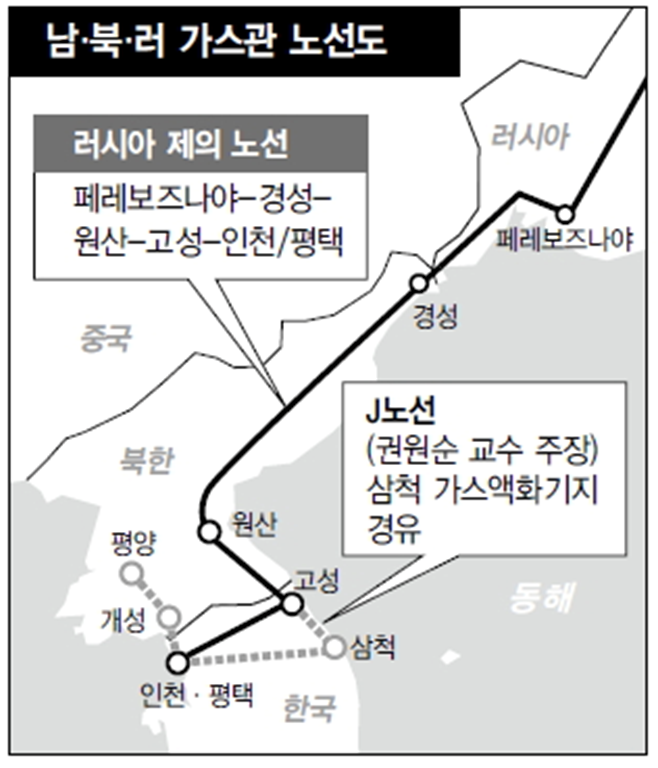
UPDATE 43 (2015-6-17): Gazprom official claims pipeline not feasible. According to NK News:
The deputy CEO of Russia’s Gazprom told reporters that connecting South Korea to Russian gas supplies is economically attractive but politically infeasible on Tuesday.
The long-gestating pipeline project would extend through the DPRK and provide natural gas to energy-hungry South Korea.
But Alexander Medvedev, speaking from a press conference in Moscow yesterday, said the project was too difficult in the current climate.
“The level of communications, the level of cooperation is not that which would make it possible to speak of advancing to the feasibility study stage, let alone implementing a project to supply gas via North Korea.”
Despite the political hurdles, the project is still interesting from an economic standpoint.
“From the economic standpoint, this would probably be the most efficient option for supplying gas to Korea … There is demand for pipeline gas,” Medvedev added.
…
Despite the numerous roadblocks, the deputy CEO of the world’s largest gas producer remained hopeful that political changes could move the project forward.
“The opportunity remains all the same, but it depends on a resolution of the political issues between the DPRK and the Republic of Korea. There are certain positive signals, but there are negative signals too,” Medvedev said at the press conference.
Post 42 (2014-6-18): According to Leonid Petrov, “Russian GAZPROM postpones Trans-Korean gas pipeline construction project ‘due to unstable political situation in South Korea'”. Here is the source (in Russian).
Post 41 (2014-3-29): According to Yonhap, the Russians and the North Koreans held talks on a number of issues including the Kaesong Industrial Complex, Iron Silk Road, and the gas pipeline. No information on the pipeline was made public.
Post 40 (2013-11-13): The Russians and South Koreans most recently discussed the Russia – South Korea gas pipeline at a presidential meeting in Seoul. No decisions were made. Read more here.
Post 39 (2012-10-4): The Choson Ilbo reports that the pipeline talks are delayed because DPRK is asking for transit rates above the international norm:
A South Korean government source said talks have dragged on because the North is demanding a transit fee that is two to three times more than international rates.
Based on a method of calculation used by Ukraine — about $2 per 1,000 cubic meters of natural gas for 1 km of pipeline — a reasonable fee would be about US$150 million a year given the estimated amount of gas South Korea would import from Russia and the 700-800 km of the gas pipeline running through the North. But the North reportedly demanded $300-500 million a year.
“It’s likely that the North asked for such a high price in the first place to gain the upper hand in future talks,” the source added. “There have been no full-fledged talks yet. At the moment, Pyongyang, Seoul and Moscow are just trying to read each other’s minds.”
Post 38 (2012-2-27): The Daily NK reports on details being discussed in the pipeline talks:
The Republic of Korea Ambassador to Russia, former chief nuclear negotiator Wi Sung Lac, says there has been progress on a gas pipeline connecting Russia, North Korea and South Korea.
“At the moment it is at the stage of enterprises discussing commercial conditions, and I am aware that there has been progress. North Korea and Russia are also discussing issues of transit and transit fees via working-level consultations,” he explained to reporters on a visit to Seoul today.
Wi would not be drawn on what kind of progress has been achieved, saying, “It’s about commercial details and so is hard to explain, but it appears there has been progress on supply quantities and supply conditions.”
Post 37 (2012-2-20): Gazprom reports “progress” in talks with North Korean government. According to Bloomberg:
OAO Gazprom, Russia’s natural gas exporter, said it made progress in talks to supply Korea Gas Corp. (036460) through a pipeline across North Korea, the Moscow-based company said today in an e-mailed statement.
Gazprom and Kogas, as the Korean company is called, plan to meet again in Moscow next month to continue talks, Gazprom said.