Archive for the ‘International Governments’ Category

DPRK “Centrifuge Rods” seized from Singapore ship

Tuesday, March 19th, 2013

UPDATE 4 (2013-3-27): Myanmar leader denies the materials were bound for his country. According to Yonhap:

Ko Ko Hlaing, chief political advisor to Myanmar President Thein Sein, explicitly denied the allegations, reaffirming his government has no intention of building nuclear weapons.

“We have no great interest to broker such items like aluminium alloy rods,” Ko Ko Hlaing told Yonhap News Agency in an interview in Seoul on the sidelines of a forum on Myanmar’s reform and its implications on North Korea.

“We understand that the result of clandestine arms trafficking is quite treacherous,” he said. “So the reported destination may be elsewhere and the real destination will be in another position. So we can confirm that the real destination is not Myanmar.”

Mynamar had been suspected of pursuing nuclear cooperation with North Korea during decades of its military junta rule that ended in 2011.

..

Ko Ko Hlaing, a former army officer, said Myanmar has no interest in expanding military ties with other nations, including North Korea.

“With the new government, we have opened to the international communities and also we have achieved a very encouraging peace process,” he said.

“So, we are trying to reduce our defense expenditure and focus our resources on economic and social development rather than army and military development,” he said. “There is no potential to expand military cooperation with North Korea or any other countries.”

UPDATE 3 (2013-3-19): The Japan Times press follows up on the aluminum rods:

Japan has seized aluminium alloy rods that can be used to make nuclear centrifuges from a Singapore-flagged ship found to be carrying cargo from North Korea, the government said Monday.

The five rods were discovered on the ship during its call at Tokyo port last August and were confirmed to be aluminium alloy through tests conducted over the past six months, said Chief Cabinet Secretary Yoshihide Suga.

“The aluminium alloy is extremely strong and can be used in centrifuges, which are products related to nuclear development,” Suga said at a regular news briefing.

The rods were being stored at a private warehouse and the government on Monday ordered the firm to hand them over.

The items are the first to be confiscated under a special law passed in 2010 that allows Tokyo to inspect North Korea-related ships suspected of carrying materials that can be used in nuclear and missile programs.

The ship was reportedly on its way to Myanmar when it arrived in Tokyo via the Chinese port of Dalian. Suga confirmed the ship arrived via Dalian but said its cargo was bound for a “third country.”

UPDATE 2 (2012-11-26): Sen. Lugar has written a letter to the Burmese government regarding the shipment.  Read more here.

UPDATE 1 (2012-11-26): More information at the Wall Street Journal.

ORIGINAL POST (2012-11-26): According to the Choson Ilbo:

The Japanese government confiscated what appeared to be North Korean aluminum alloy bars from a Singaporean cargo ship at the end of August, the Asahi Shimbun reported Saturday. They were apparently bound for Burma and could have been used in centrifuges for uranium enrichment.

The Wan Hai 313 belonging to a Taiwanese shipping company docked in Tokyo Port. The paper said authorities confiscated 50 metal pipes and 15 high-specification aluminum alloy bars marked “DPRK” for North Korea, “at least some of them offering the high strength needed in centrifuges for a nuclear weapons program.”

Prior to U.S. President Barack Obama’s visit to Burma on Nov. 19, the Burmese government pledged to sever military ties with North Korea and open up for nuclear inspection. North Korea makes hundreds of millions of dollars a year by exporting armaments.

The cargo was initially on a different ship in Dalian, China on July 27 and moved to the Wan Hai 313 in Shekou, China on Aug. 9. It was to reach Burma via Malaysia on Aug 15, but the ship entered Tokyo Port on Aug. 22 at the request of the U.S. government.

The aluminum alloy bars were exported by a company based in Dalian, which said it did so at the request of another company. The newspaper wrote, “Authorities concluded that the shipment originated in North Korea because the bars were found to be inscribed ‘DPRK,’ although investigators were unable to confirm the origin from cargo documents or from the ship’s crew, the sources said.”

Read the full story here:
N.Korean Aluminum Shipment to Burma Foiled
Choson Ilbo
2012-11-26

Share

US imposes new sanctions on DPRK

Monday, March 11th, 2013

These new sanctions are in response to the DPRK’s third nuclear test. Here is a link to information on UNSC resolution 2094, which the UNSC passed in response to the same test.

Here is the full statement by the Treasury Department:

___________________

Treasury Sanctions Bank and Official Linked to North Korean Weapons of Mass Destruction Programs 3/11/2013

​WASHINGTON – To impede North Korea’s ballistic missile and weapons of mass destruction (WMD) programs, the U.S. Department of the Treasury today designated the Foreign Trade Bank (FTB), North Korea’s primary foreign exchange bank, pursuant to Executive Order (E.O.) 13382, which targets proliferators of weapons of mass destruction (WMD) and their supporters. Treasury is also designating Paek Se-Bong, the chairman of North Korea’s Second Economic Committee (SEC) under E.O. 13882.

North Korea’s nuclear and missile proliferation activities violate the UN Security Council regime, comprised of resolutions 1718 (2006), 1874 (2009), 2087 (2013), and 2094 (2013), destabilize the region, and undermine the global nonproliferation regime. The international community has condemned North Korea’s WMD proliferation activity, most recently in last week’s UN Security Council Resolution 2094. Today’s designations of FTB and a senior member of the North Korean government linked to the DPRK missile program, follow actions taken March 7, 2013 by the Treasury Department against China-based representatives of the Korea Mining Development Corporation (KOMID) and Tanchon Commercial Bank (TCB).

“North Korea uses FTB to facilitate transactions on behalf of actors linked to its proliferation network, which is under increasing pressure from recent international sanctions. The United States will take strong measures to protect its financial system from this type of illicit activity, and we urge financial institutions around the world to be particularly wary of the risks of doing business with FTB,” said Under Secretary for Terrorism and Financial Intelligence David S. Cohen.

The U.S. Department of State is today also designating Pak To-Chun, Chu Kyu-Chang, and O Kuk-Ryol. To view the release, click here.

By designating FTB, the Treasury Department is targeting a key financial node in North Korea’s WMD apparatus, and cutting it off from the U.S. financial system. FTB is a state-owned bank established in 1959. FTB acts as North Korea’s primary foreign exchange bank and has provided key financial support to the Korea Kwangson Banking Corporation (KKBC). KKBC was designated under E.O. 13382 in August 2009 for providing financial services in support of the previously designated entities TCB and the Korea Hyoksin Trading Corporation (Hyoksin). Hyoksin used its connections to KKBC to purchase dual-use equipment in 2008.

FTB has also facilitated millions of dollars in transactions that have benefited KOMID—North Korea’s premier arms dealer—and its financial arm, TCB. North Korea’s Second Economic Committee oversees the production of North Korea’s ballistic missiles and directs the activities of KOMID. TCB, KOMID and Hyoskin were designated by the UNSCR 1718 Committee in April 2009.

Paek Se-Bong is the chairman of the SEC. The SEC, which oversees the production of North Korea’s ballistic missiles and directs the activities of KOMID, was previously designated by the U.S. State Department in August 2010. Paek Se Bong is also an alternate member of the Central Committee of North Korea’s Workers Party and a member North Korea’s National Defense Commission.

This designation generally prohibits transactions between the designees and any U.S. person, and freezes any assets they may have under U.S. jurisdiction.

Identifying information:

Name: Foreign Trade Bank of the Democratic People’s Republic of Korea
AKA: North Korea’s Foreign Trade Bank
Location: FTB Building, Jungsong-dong, Central District, Pyongyang, North Korea
SWIFT/BIC: FTBD KP PY

Name: Paek Se-Bong
AKA: Paek Se Pong
DOB: 21 March 1938
Title: Chairman, Second Economic Committee

ADDITIONAL INFORMATION
1. Here is a summary in the Daily NK.

2. Here is the Treasury Departments DPRK Resource Center Page.

3. Here is the State Department press release which includes additional sanctioned individuals.

4. Here is coverage in the Hankyoreh.

5. Stephan Haggard on the sanctions.

6. The EU also imposed sanctions. The US wants them expanded to cover the DPRK’s Foreign Trade Bank.

Share

2013 International Narcotics Control Strategy Report

Thursday, March 7th, 2013

It has been a while since much attention was focused on the DPRK’s capacity to produce narcotics for export, however, the DPRK did get a mention in the US Department of State’s 2013 International Narcotics Control Strategy Report.

Here is what the report had to say (Source here):

Democratic People’s Republic of Korea (DPRK or North Korea)

Drug use may be rising within the Democratic People’s Republic of Korea (DPRK or North Korea), according to reports from DPRK refugees and travelers to North Korea. Chinese and South Korean press reports indicate that a substantial volume of methamphetamine continues to be produced within DPRK territory, mainly for transshipment to China. There are also reports of transactions between DPRK traffickers and large, organized criminal groups along the DPRK-China border, and of Chinese police enforcement targeting drugs entering China from the DPRK by way of enhanced patrols, periodic arrests, and drug seizures. However, the Chinese government rarely identifies the DPRK as the source of illicit drugs.

The proximity and availability of precursor chemicals in China likely contribute to the production of methamphetamine within North Korea. Reliable information is difficult to obtain regarding illicit activities within the DPRK territory, but drug production and other criminal activities, such as the counterfeiting of cigarettes, appear to have continued in 2012. There is insufficient current information, however, to confirm official DPRK state involvement in drug trafficking. There have been no confirmed reports of large-scale drug trafficking involving DPRK state entities since 2004. This suggests that state-sponsored drug trafficking may have ceased or been sharply reduced, or that the DPRK regime has become more adept at concealing state-sponsored trafficking of illicit drugs.

Despite the absence of reports of drug seizures linked directly to DPRK state institutions, the United States cannot entirely rule out the possibility of official DPRK state involvement in the manufacturing and trafficking of illicit drugs. A relatively large investment in precursor chemicals is necessary to produce the volume of methamphetamine trafficked from North Korea, and it is unclear how individual criminals could independently organize such activity within such a tightly-controlled state. It is likely that some official corruption on both sides of the DPRK-China border facilitates drug trafficking.

Share

UNSC Resolution 2094: Response to DPRK’s third nuclear test

Thursday, March 7th, 2013

UPDATE 6 (2013-3-11): Here is the DPRK Ministry of Foreign Affairs response to the UNSC Resolution 2094. As you can imagine, they do not approve.

UPDATE 5 (2013-3-8): The full official resolution can be read here.  Here is the DPRK response to 2094. Here is some information on the Chinese response. Here is some more analysis/commentary from Scott Snyder in The Diplomat. Choson Ilbo reports that large North Korean bank accounts exempt from sanctions.

UPDATE 4 (2013-3-7): The resolution has passed 15-0.  Read more at the BBC, Washington Post, New York Times. Marcus Noland commentary here and here. Victor Cha hereNK Leadership Watch has more on the events in Pyongyang

UPDATE 3 (2013-3-7): Once made public, the resolution will be posted here. Steve Herman (via Adam Cathcart) tweeted a link to the draft resolution which has been uploaded to Scribed. It is dated yesterday (2013-3-6).

UPDATE 2 (2012-3-7): Here is a Press Release from the US mission to the UNSC that went out this morning on the new sanctions (Resolution 2094). Thanks to Aidan Foster-Carter.

For reasons of brevity, I have put the entire document into this PDF for download.

UPDATE 1 (2013-3-7): Yonhap offers details on the unpublished sanctions proposal put forth by the US and China:

The three North Korean arms dealers are: Yon Chong-nam, the chief representative for the Korea Mining Developing Trading Corp (KOMID); Ko Chol-chae, the deputy chief representative for the KOMID; and Mun Chong-chol, an official at Tanchon Central Bank, the resolution showed.

KOMID is described by the resolution as North Korea’s “primary arms dealer and main exporter of goods and equipment related to ballistic missiles and conventional weapons,” while the North Korean bank is the “main DPRK (North Korea) financial entity for sales of conventional arms, ballistic missiles, and goods related to the assembly and manufacturing of such weapons.”

The two North Korean entities are the Second Academy of Natural Sciences, which is responsible for research and development of the North’s advanced weapons systems, including “missiles and probably nuclear weapons,” and the Korea Complex Equipment Import Corp. linked to the North’s “military-related sales,” according to the draft.

The Security Council is set to vote on the draft resolution on Thursday in New York.

The new sanctions will also focus on the DPRKs shipping, air, and “financial” industries:

The Security Council “decides that all states shall inspect all cargo within or transiting through their territory that has originated in the DPRK, or that is destined for the DPRK,” the draft said.

It also “calls upon states to deny permission to any aircraft to take off from, land in or overfly their territory, if they have information that provides reasonable grounds to believe that the aircraft contains items” banned by previous U.N. resolutions, the document said.

It also makes it difficult for North Korea to move in and out “bulk cash,” in an effort to squeeze the North Korean elite’s access to hard currency.

The Security Council also calls on all states to “exercise enhanced vigilance over DPRK diplomatic personnel so as to prevent such individuals from contributing to the DPRK’s nuclear or ballistic missile programs,” it said.

The U.N.’s powerful body “expresses its determination to take further significant measures in the event of a further DPRK launch or nuclear test,” the draft warned.

The DPRK’s Uranium enrichment program also gets a mention:

Apparently mindful of the North’s uranium concerns, the draft resolution includes Pyongyang’s uranium enrichment program for the first time, condemning “all the DPRK’s ongoing nuclear activities, including its “uranium enrichment.”

The North claims its uranium enrichment program is for peaceful energy development, but outside experts believe that it would give the country a new source of fission material to make atomic bombs, in addition to its widely known plutonium-based nuclear weapons program.

The DPRK, has of course, issued a response

In response to the proposed U.N. sanctions and ongoing Seoul-Washington joint military drills, the North’s military threatened to scrap the Korean War cease-fire.

Kim Yong-chol, a hard-line North Korean general suspected of involvement in a series of provocations against the South, read the statement on state TV, saying the North “will completely declare invalid” the Armistice Agreement that ended the 1950-53 Korean War.

The North also said it will cut off a military phone line at the truce village of Panmunjom.

South Korea’s military responded to the North’s bellicose threats with a verbal salvo, warning it would strike back at the North and destroy its “command leadership,” if provoked by Pyongyang.

ORIGINAL POST (2013-3-5): According to the New York Times:

The United Nations Security Council moved closer on Tuesday to expanding sanctions on North Korea for its nuclear and ballistic missile activities. The United States and China introduced a resolution that would target North Korean bankers and overseas cash couriers, tighten inspections of suspect ship and air cargo, and subject the country’s diplomats to invasive scrutiny and increased risk of expulsion.

Passage of the measure, drafted in response to the third North Korean underground nuclear test three weeks ago, seemed all but assured, in part because China — North Korea’s major benefactor — participated in drafting the language. It would be the fourth Security Council sanctions resolution on North Korea, which has defied the previous measures with increasing belligerence. A vote was expected on Thursday.

Infuriated, North Korea vowed to scrap the 1953 armistice that halted the Korean War and threatened to attack the United States with what the North Korean government news agency called an arsenal of diverse “lighter and smaller nukes.”

American officials played down the North Korean warning, which echoed bombastic admonitions that have become part of the standard fare from the North. Still, the threat of a North Korean nuclear attack seemed all the more provocative, coming two days after North Korea conveyed a message of friendship to a visiting American group that included Dennis Rodman, the former basketball star.

Susan E. Rice, the United States ambassador to the United Nations, who introduced the resolution in a closed session of the 15-member Security Council, told reporters afterward that it “builds upon, strengthens and significantly expands the scope of the strong U.N. sanctions already in place.”

For the first time, she said, the resolution would target “the illicit activities of North Korean diplomatic personnel, North Korean banking relationships, illicit transfers of bulk cash and new travel restrictions.” In the past, North Korea has been accused of running extensive counterfeiting and illegal drug enterprises, to raise much-needed hard currency.

Ms. Rice declined to predict whether the North would respond with another nuclear test or other retaliation. “All I can tell you is that the international community is united and very firm in its opposition to North Korea’s illicit nuclear and missile programs,” she said. “And the more provocations that occur, the more isolated and impoverished, sadly, North Korea will become.”

The Americans did not publicly release the resolution text. But a Security Council diplomat familiar with the measure, who spoke on the condition of anonymity because the language may still be subject to revision, said it broke new ground with restrictions and prohibitions on North Korean banking transactions, new travel restrictions and increased monitoring of North Korean ship and air cargo.

The diplomat also said that the resolution added a special lubricant and valve, needed for uranium enrichment, to items that North Korea cannot import.

The resolution would also place greater scrutiny on North Korean diplomatic personnel who are suspected of carrying proscribed goods and cash under the guise of official business, exposing them to possible deportation. “We know there are diplomats out there cooking up deals and moving funds around,” the Security Council diplomat said.

Among the other provisions, the diplomat said the resolution also included new language aimed at enforcement that had been absent from the earlier resolutions. It requires, for example, that if a North Korean cargo vessel crew refuses a host country’s request for inspection, the host is under a legal obligation to deny the vessel port access.

If a cargo plane is suspected of carrying prohibited goods to or from North Korea, the resolution would urge, but not require, that it be denied permission to fly over any other country — a new provision that could affect China, which routinely permits North Korean flights over its territory.

Previous rounds of sanctions have blacklisted trading and financial firms believed to be directly involved with nuclear and missile work. The sanctions have also restricted the importation of luxury goods, an effort directed at the country’s ruling elite.

American officials said privately that the latest resolution did not go as far as they would have liked, reflecting China’s insistence that the punitive measures remain focused on discouraging North Korea’s nuclear and missile behavior and avoid actions that could destabilize the country and lead to an economic collapse.

But the text was stronger than what some North Korean experts had anticipated, particularly the measures that could slow or frustrate the country’s banking activities and extensive dependence on cash payments in its trade with other countries.

“Going after the banking system in a broad brush way is arguably the strongest thing on this list,” said Evans J. R. Revere, a former State Department specialist in East Asian and Pacific affairs, and now senior director at the Albright Stonebridge Group, a Washington-based consulting company. “It does begin to eat into the ability of North Korea to finance many things.”

Mr. Revere attributed North Korea’s reaction on Tuesday to an accumulation of perceived affronts: China’s cooperation in drafting the sanctions, the annual military exercises under way between the United States and South Korea, and a hardened attitude by the South’s newly elected president, Park Geun-hye.

“This is North Korea’s way of saying, ‘We know you guys are doing several things, and here is our response,’ ” Mr. Revere said.

Here is coverage in The Guardian.

Here is coverage in the Washington Post.

Here is coverage of the DPRK’s response in CNN.

Here is my archive post on the DPRK’s third nuclear test.

Here is a statement (in Korean) by the North Korean military.

Read the full story here:
U.N. Resolution to Aim at North Korean Banks and Diplomats
New York Times
Rick Gladstone
2013-3-5

Share

Rason – China – USA sea food trade

Tuesday, March 5th, 2013

According to the New York Times:

At the Red Sun restaurant, a short-order joint on Crab and Beer Streets, live crabs with plump legs wriggle in a cooled tank, fresh from the North Korean coast just two and a half hours away by road.

The cook and owner, Jin Yuansheng, douses the prized crabs in boiling water and adds them to the steaming platters of sea cucumbers, shrimp and squid, also from North Korean waters, that he brings to the table.

This border town in China’s cold and poor northeast abuts North Korea along the icy Tumen River, where a bridge serves as the gateway for a lively commerce in shellfish plumbed from the Sea of Japan off North Korea. It is an exotic niche business in the more than $11 billion annual trade between North Korea and China, which is dominated by China’s purchases of cheap North Korean iron ore and coal.

By encouraging trade with North Korea, China aims to prevent North Korea’s government from collapsing, an outcome that could result in a Korean Peninsula allied to the United States. And business with North Korea serves a domestic goal: it helps employment and incomes in needy Jilin Province, where an estimated two million ethnic Koreans live.

That is where the crabs come in. Scooped from 3,000-foot-deep waters by trawlers crewed by North Korea workers, they are first taken to the North Korean port of Rason, a special enterprise zone serving foreign investors and largely financed by China. The crabs are trucked in ice to the Chinese border town of Quanhe, and then brought to the market in Yanji, or flown to cities across China as a delicacy for the affluent.

“Getting the crabs here is a delicate operation,” said Mr. Jin. “If they are too hot en route, they can die, and if they are too cold, they can freeze to death.”

For Chinese traders, importing crab is a lucrative business. They sell not only to upscale restaurants around China, but also to banquet organizers. The sales pitch stresses what is called the purity of the waters around impoverished North Korea compared with the more polluted seas around industrialized Japan and South Korea.

“The fishermen capture the crab deep down, so it is high quality,” said Qu Baojie, whose company imports crab from Rason. “South Korea and Japan can’t compete.”

His crab, branded as Crab Earth, Crab Heaven, is featured at the buffet of the Golden Jaguar, a fashionable Beijing restaurant, and is sold in red boxes suitable for business gifts, he said.

The fishing operations in Rason, an ice-free port that gives year-round sea access to China’s northeastern provinces, work fairly smoothly, Mr. Qu said. Fishing trawlers equipped with South Korean gear ply the waters at night, returning to shore about 4 a.m.

Their catches are then transferred to a state-owned plant where some crabs are packed live and others are processed, he said. About 300 North Korean workers are employed during the peak September to December fishing season. Fishing during the breeding season of June to September is banned, he said.

His crab business flourishing, he recently bought a new processing factory in Yanji, Mr. Qu said.

Some of the crab meat was vacuum packed in clear plastic, and sold to other Chinese traders, who in turn dispatched it to the United States, he said. The brand name of North Korean crab meat sold in the United States? “They slap on their own brands,” he said of the American buyers.

Read the full story here:
Caught in North Korea, Sold in China, Crabs Knit Two Economies
New York Times
Jane Perlez
2013-3-4

Share

Grain imports from China fall in January

Monday, March 4th, 2013

According to Yonhap:

North Korea’s grain and fertilizer imports from China nosedived in January, Seoul’s Korea Rural Economic Institute said Sunday, citing data from the Korea International Trade Association.

North Korea imported 2,174 tons of grain and 2 tons of fertilizer from China in the first month of this year, the institute said. By product, flour imports totaled 1,172 tons and corn imports reached 540 tons.

The volume of imported grain marked a mere 9.2 percent of the North’s imports of Chinese grain in the previous month, while the corresponding figure for fertilizer amounted to 20 percent, the institute said.

Compared with the same month of last year, the figures reached 25.9 percent and 0.03 percent, respectively.

“The steep decline in the North’s grain imports from China is very unusual, even considering the past trend of grain imports decreasing every January,” said Kwon Tae-jin, a researcher at the institute.

Read the full story here:
N. Korea’s grain imports from China plunge in Jan.
Yonhap
2013-3-3

Share

Nuke test does not deter China’s economic interests in the DPRK

Thursday, February 28th, 2013

According to Reuters:

While Beijing has not made clear whether the test would disrupt its investment plans for the Rason economic zone, an official at the zone’s joint management office told Reuters that all previously announced Chinese projects for the zone remain on track, including a power line from China to ease acute electricity shortages there.

“All the people of the management office are still here working as usual… If there is any major impact (from the nuclear test), do you think we would still be here?” he said by phone from Rason, which lies near where North Korea, China and Russia converge. “All works are proceeding as planned.”

There are about 60 Chinese and North Korean people working at the management office, and the number may grow with the launch of more projects, said the official, who declined to be identified as he was not authorized to speak to the media.

China and North Korea jointly set up the Rason management committee in October to handle the planning, construction and development of the zone, also known as Ranjin-Songbong, one of the country’s highest profile economic projects.

“China has normal relations with North Korea. We will conduct normal trade and economic exchanges with North Korea,” Hua Chunying, China’s foreign ministry spokeswoman, said when asked whether China would continue to work with North Korea to develop its special economic zones after the nuclear test.

Led by China’s commerce ministry, Chinese firms, including State Grid Corp, Jilin Yatai (Group) and China Railway Construction Group and other state enterprises, have indicated interest in investing in power, building materials, transport and agriculture projects in the zone.

Yatai, a Shanghai-listed cement and coal producer, signed a framework agreement last year with the North Korean government to construct a 500,000-square-metre building materials industrial park, including a cement plant, in Rason.

State Grid finished the final review of the feasibility study of the 97.8-kilometre power line early this year, but has not started construction as it has not yet won all approvals, the official and a source close to the plan said.

The planned line would cut through a Siberian tiger natural reserve, and State Grid is awaiting a green light from China’s National Development and Reform Commission and coordinating with various other authorities, the source told Reuters.

There is no timetable for the project as State Grid is unsure when it would receive government approvals, he added. State Grid was not immediately available for comment.

Jilin Yatai may delay its cement project in Rason — which is critical to the construction of other projects such as the railway there — due to “issues on the North Korean side,” said an official at Yatai’s securities office.

But the likely delay of the project was not related to the nuclear test, the official said by phone from Changchun, capital city of Northeast China’s Jilin province, which borders North Korea. He declined further comment.

In a filing with the Shanghai bourse in August, Yatai said it planned to complete the construction of its first cement plant in North Korea by September this year only if there is sufficient power capacity available.

Read the full story here:
China moves ahead with North Korea trade zone despite nuclear test
Reuters
2013-2-28

Share

Yes, Dennis Rodman is in Pyongyang with the Harlem Globetrotters

Tuesday, February 26th, 2013

UPDATE 30 (2013-9-7): Dennis Rodman made his second visit to the DPRK in September 2013.

UPDATE 29 (2013-6-24): Uri Tours has uploaded three videos of the Globetrotters in Pyongyang to Youtube. Here they are: Video 1, Video 2, video 3.

UPDATE 28 (2013-5-31): NK News reports on Dennis Rodman’s autograph in the Kumsusan Memorial Palace guest book:

“This has been a second coming of life. Thank you, thank you.”

UPDATE 27 (2013-5-24): Uri Tours has uploaded the DPRK video taken from the DPRK that shows the lead up to the game. Apparently VICE is trying to keep it off the internet.

UPDATE 26 (2013-3-29): New Focus claims to have some “behind the scenes” information on the Rodman trip.

UPDATE 25 (2013-3-5): It appears Dennis Rodman was escorted from a New York hotel from rambling on about how great Kim Jong-un is. According to the New York Post:

Dennis Rodman, just back from visiting Kim Jong Un, was escorted out of the Time Hotel in Midtown on Sunday after spending hours at the restaurant bar loudly telling anyone who would listen what a great guy the North Korean dictator is.

“He was at the bar at Serafina for three hours,” says a spy. “He kept saying what a nice guy Kim is, and how Kim just wants to talk to President Obama about basketball. He was waving around a signed copy of the dictator’s huge manifesto, telling everyone they should read it.”

Added the witness, “Dennis was making a total jerk of himself. He wouldn’t leave, and he wouldn’t let anyone talk to him about shutting up, or what an oppressive country North Korea is. Eventually he had to leave the bar because the bartender was starting to get [bleep]ed-off.”

UPDATE 24 (2013-3-5): The Harlem Globetrotters were featured on the North Korean evening news again (March 4th).  This time they visited the Grand People’s Study House and the Golden Lane Bowling Alley:

Here is coverage in KCNA:

Harlem Globetrotters Players Tour Various Places

Pyongyang, March 5 (KCNA) — American basketball players of Harlem Globetrotters and their party visited the International Friendship Exhibition House.

The guests paid tribute to the wax replica of President Kim Il Sung.

They looked round the gifts Kim Il Sung, leader Kim Jong Il and the dear respected Kim Jong Un received from party, state and government heads and personages of many countries.

At the end of the visit Jeffrey Raymond Munn made an entry in the visitor’s book.

He wrote that the exhibition house is the greatest collective of national treasures in the world and he was pleased to see them, excellent wealth for the Korean people.

The guests also toured the E-library and Indoor Swimming Pool of Kim Il Sung University, Grand People’s Study House, Pyongyang Gold Lane and other places.

Earlier, basketball players of Harlem Globetrotters conducted a joint training with players of the Hwaebul basketball team of Korean University of Physical Education.

The guests flew back home Tuesday.

UPDATE 23 (2013-3-4): The White House has dismissed the Rodman trip as “a ‘celebrity sporting event’ for an oppressive regime”. Read more here.

UPDATE 22 (2013-3-4): The North Korean evening (March 3) news featured the Harlem Globetrotters visiting the new electronic library and indoor swimming pool of  Kim Il-Sung University:

UPDATE 21 (2013-3-3): Here is an Instagram image from Pyongyang of the Harlem Globetrotters entertaining some children in Pyongyang.

UPDATE 20 (2013-3-3): Dennis Rodman gave an interview to ABC News. You can see it here. Dennis Rodman says he is going back. Shane Smith is banned from the DPRK, but was still able to pull this off…

UPDATE 19 (2013-3-2): KCTV footage shows the Globetrotters visiting the International Friendship Exhibition in Myohyangsan.

UPDATE 18 (2013-3-1): Here is KCNA footage of Dennis Rodman leaving the DPRK:

Here is what KCNA had to say:

Pyongyang, March 1 (KCNA) — Ex-player of the NBA of the U.S. Dennis Rodman left here Friday. Seeing him off at the airport were Son Kwang Ho, vice-chairman of the DPRK Olympic Committee, and officials concerned.

The Harlem Globetrotters remain in the DPRK.

UPDATE 17 (2013-3-1): When Dennis Rodman left the DPRK, he complemented the Paektu blood line noting Kim Jong-un is an “awesome guy” and his father and grandfather were “great leaders”.  According to the Associated Press:

At Pyongyang’s Sunan airport on his way to Beijing, Rodman said it was “amazing” that the North Koreans were “so honest.” He added that Kim Jong Il and Kim Il Sung, North Korea’s founder, “were great leaders.”

“He’s proud, his country likes him – not like him, love him, love him,” Rodman said of Kim Jong Un. “Guess what, I love him. The guy’s really awesome.”

At Beijing’s airport, Rodman pushed past waiting journalists without saying anything.

Rodman’s agent, Darren Prince, sent a text message to The Associated Press saying Rodman will be in New York on Sunday “to do some major press interviews and talk about his trip in North Korea as well as discussing what’s accurate and inaccurate from the press the past few days.”

UPDATE 16 (2013-3-1): Rodong Sinmun reports on Rodman and Harlem Globetrotters visit to  the Rungra Dolphinarium. Here is coverage in KCNA:

U.S. Ex-NBA Star Tours Pyongyang

Pyongyang, March 1 (KCNA) — Dennis Rodman, ex-player of the NBA of the U.S., and his party toured the Rungna Dolphinarium on Friday.

The guests expressed deep impressions as they were briefed on the Dolphinarium on picturesque Rungna Islet.

They spent a good time watching dolphins dancing to the tune of cheerful music, jumping in group, spinning rings, jumping into the air and shaking hands with people.

Earlier, they also toured the Tower of the Juche Idea and the Arch of Triumph.

UPDATE 15 : Here is KCTV footage of the basketball game and dinner banquet:

Reminds me of the time I saw Kim Jong-il!

UPDATE 14 (2013-2-28): Here is the State Department Briefing for February 28th which features discussion of Rodman’s visit to the DPRK. Here is Washington Post coverage of the briefing.

UPDATE 13 (2013-2-28): The game with Kim Jong-un and Dennis Rodman did not make the evening news tonight, but it did feature Rodman and the team visiting the Arch of Triumph and Juche Tower. They make an appearance at the 8:07 mark:

The video of the Rodman/Jong-un game/dinner will come to the USA tomorrow.

KCNA has published 15 photos from the game and dinner, but because their web page is so poorly designed, I cannot link to them.  If you go to KCNA.kp, search for “American Players”. When the story appears, click on the camera icon to the left of the story.  You should be able to see the photos.

In the event that this is too much work for you, Yonhap has released some screenshots from North Korean television of the game and dinner (which has not made its way through the usual outlets to viewers in the Western hemisphere): one, two, three, four (the bow), five (the toast), six, seven, eight (the hug), nine.

UPDATE 12 (2013-2-28): This evening we will see how much of the performance ended up on North Korean television. In the meantime, KCNA reports on Kim Jong-un’s attendance of the game with Rodman:

Kim Jong Un Enjoys Basketball Game of DPRK, American Players

Pyongyang, February 28 (KCNA) — A mixed basketball game of the visiting American basketball players of Harlem Globetrotters and Korean players belonging to the Hwaebul basketball team of Korean University of Physical Education took place at Ryugyong Jong Ju Yong Gymnasium on Thursday. Among the American players was ex-player of NBA Dennis Rodman.

Sports fans and other Pyongyang citizens packed the gymnasium to watch the game with great interest.

Among the audience were foreign diplomatic envoys, representatives of international bodies, military attaches and other foreign guests here with their families.

The dear respected Marshal Kim Jong Un, together with his wife Ri Sol Ju, came to the gymnasium to watch the game.

The players and audience broke into thunderous cheers, greatly excited to see the game together with Kim Jong Un.

Dennis Rodman went up to the auditorium to bow to Kim Jong Un.

Warmly welcoming him, Kim Jong Un let him sit next to him.

Brett Dennis Meister and Jeffrey Raymond Munn also sat near him.

American basketball players first played a demonstration game amid great attention of the audience.

They showed a variety of special basketball skills to be highly acclaimed.

Then a mixed game of DPRK and American players took place amid elated atmosphere.

Divided into red and white teams, the players carried out fierce seesaw battle.

In the first and second rounds, the red team players won 60:47 with long-distance shooting, dunk shot and other skills.

The audience enthusiastically cheered the players as they showed amazing skills.

During breaks, women’s brass band presented glamorous rhythmic formations.

National dances by Korean women artistes and a demonstration performance of Taekwon-Do players added to the cheerful mood.

Korean basketball players played the game well with American players of their teams in a coordinated way by fully displaying their techniques. American players made a good job of the game to give good impressions to the audience.

The white team combined man-to-man defence and fast break. The game ended in a draw 110:110.

Kim Jong Un applauded both teams for their nice game.

Dennis Rodman expressed thanks to Kim Jong Un, saying over the mike with excitement that his impressive Pyongyang visit is quite satisfactory and it is a great privilege for him.

He said he was very pleased to mix with Pyongyang citizens, adding that it is regrettable that the relations between the U.S. and the DPRK are not good, but Korean people are his friends and in particular, he considers Marshal Kim Jong Un a close friend.

Kim Jong Un was presented with a uniform of the Harlem Globetrotters basketball team as a gift by the American guests.

This evening Kim Jong Un was invited to a dinner hosted by the DPRK Olympic Committee in honour of Rodman and his party.

He met and conversed with them in an amicable atmosphere.

He was pleased they visited Pyongyang to provide young people of the DPRK who are fond of basketball with an opportunity of enjoying the nice game, he said.

He expressed his expectation that such sports exchange would be activated, contributing to promoting mutual understanding between the peoples of the two countries.

He welcomed their visit to the DPRK, hoping that through the visit they would become familiar with the DPRK people, especially with basketball fans.

Rodman said that it was the greatest pleasure for him to meet with Kim Jong Un and his wife for the first time for Americans.

The American basketball star hoped the sports exchange would continue between the two countries.

He wished Kim Jong Un good health, heartily thanking him for warm hospitality.

The dinner proceeded in an amicable atmosphere.

Here is a satellite image of the school where the North Korean team studies:

Korean-Univ-of-Physical-education

A satellite image of the stadium can be seen below.

UPDATE 11 (2013-2-28): Some photo work:

Rodman-KJU-body-guard

A collegaue informs me that the individual outlined in green used to be one of Kim Jong-il’s top body guards. Maybe he has taken a new job with Kim Jong-un?

The individual outlined in yellow was Wolf Blitzer’s (CNN) interpreter and handler. It appears from footage on CNN that he is also Rodman’s interpreter.

There are a few other “suits” who appear to be security, but if anyone else can identify people in the crowd, please let me know.

Nicolas Levi also spotted some faces in the crowd….including the Polish Ambassador.

UPDATE 10 (2013-2-28): Jean Lee tweets that Rodman and Kim-Jong-un had dinner as well:

Jean-lee-tweet-2013-2-29

Now there is no way to know (yet) whether it was one of the official residencies or just a guest house (like the one President Clinton or Eric Schmidt visited). But I am sure the food was good.

Associated Press story here.

CNN reports that the theme to “Dallas” was playing over and over in the background…

UPDATE 9 (2013-2-28): Even though no photos, or mention of the encounter, have appeared in the North Korean media (KCNA, Rodong Sinmun, or domestic television broadcast), Vice has the visuals:

KJU-theworm-2013-2-28-vice

How many words is this photo worth?

According to Vice:

Earlier today former Chicago Bulls superstar Dennis Rodman presided over a mixed-match basketball game in Pyongyang alongside Supreme Leader Kim Jong-un. The teams consisted of VICE correspondent Ryan Duffy; Moose Weekes, Buckets Blakes, and Bull Bullard of the Harlem Globetrotters; and North Korea’s “Dream Team,” all of whom played their hearts out in what we have termed a “basketball diplomacy” mission. Following the game, Rodman gave a stirring speech that extended an olive branch to the Hermit Kingdom. The VICE crew is currently having a reception at the Supreme Leader’s house, and Duffy has invited Kim Jung-un to America and to tour the VICE offices. There isn’t much more to say other than that because our jaws are still on the floor. So while we pick them up and get more info from our team, enjoy these photos of the game. You can watch the highlights on VICE, our new HBO series that premieres April 5.

Alejandro Cao de Benos is jealous.

KCNA did report some of the American basketball player’s activities:

Ex-player of U.S. NBA Pay Respects to Kim Il Sung, Kim Jong Il
Pyongyang, February 28 (KCNA) — Ex-player of the NBA of the U.S. Dennis Rodman and his party Thursday visited the Kumsusan Palace of the Sun to pay respects to President Kim Il Sung and leader Kim Jong Il.

They paid high tribute to Kim Il Sung and Kim Jong Il before their statues.

They entered the halls where Kim Il Sung and Kim Jong Il lie in state and paid homage to them.

They went round the halls where orders Kim Il Sung and Kim Jong Il received are on display and the halls which house cars, an electric car, a boat and train coaches used by them during their field guidance and foreign trips till the last moments of their lives.

They made an entry in the visitor’s book.

UPDATE 8 (2013-2-28): No word yet in the North Korean media, but apparently Dennis Rodman and Kim Jong-un did meet, watched a basketball game, and conversed in English. Read more here: Washington Post, Associated Press, Xinhua.

Nate Thayer also wrote this piece on the Kim family’s basketball history. Max Fisher wrote a follow up piece at the Washington Post.

UPDATE 7 (2013-2-27): Dennis Rodman participated in his first event in the DPRK on the 27th. According to KCNA:

DPRK, U.S. Basketball Players Have Joint Training

Pyongyang, February 27 (KCNA) — Basketball players of the DPRK and the U.S. conducted a joint training in Ryugyong Jong Ju Yong Gymnasium here on Wednesday.

Participating in it were U-18 players of the DPRK and ex-player of the NBA of the U.S. Dennis Rodman and his party.

Match tactics, training mode and technique movement of the players of the two countries were exchanged at the joint training.

A workshop on basketball technique took place that day.

Here is the February 26 State Department Briefing that discusses the visit.

Here is a satellite image of the facility (Google Earth:  39.040180°, 125.734745°):

jong-ju-yong-stadium

 On the evening of the 27th, the DPRK evening news contained no information on the Rodman/Vice visit.

UPDATE 6 (2013-2-27): Koryo Tours reminds us of the first US basketball team to visit the DPRK in June 2012:

 According to the email newsletter:

“The team, Coaches International, conducted 2 training sessions for kids there – one at the Mangyongdae Schoolchildren’s Palace and the second at the Kang Bang Sok [Kang Pang-sok] Middle School. This trip was just the beginning of an ongoing exchange and we’re pleased to announce that Coaches will come back to DPRK in 2013!”

UPDATE 5 (2013-2-27): A couple of colleagues have sent along this image from Japanese media which purports to show a young Kim Jong-un playing basketball in Switzerland.  He is wearing Dennis Rodman’s number, 91. I have no idea if this is actually Kim Jong-un, but I thought the idea was interesting enough to post.

KJU-playing-basketball

If this is not Kim Jong-un, please let me know. But this Daily NK article from 2009 seems to make the case it is him. Nate Thayer says it is Kim Jong-chol, Kim Jong-un’s older brother.

UPDATE 4 (2013-2-27): In a New York Times article, Shane Smith also speaks about how the plan came together:

“It’s weird because when you go there, it’s all very anti-American,” Smith said. “North Korean kids are fed anti-American propaganda from pretty much the day they are born. But it’s O.K. to like American basketball.”

So Smith hatched a plan to take some of those Bulls players to North Korea for one of the installments of a series Smith will host on HBO, called “Vice,” featuring news and footage from around the world, which will make its debut April 5. Smith did not go through the State Department but received permission through his previous contacts and the North Korean ambassador to the United Nations. Smith said he was sure that Kim Jong-un’s love of basketball was why the trip was approved.

He quickly found that [Michael] Jordan was not likely to be a willing ambassador. “But Dennis is up for anything and everything, ” Smith said. He then recruited the Globetrotters to round out a team, and they offered up Anthony Blakes, known as Buckets; Alex Weekes, known as Moose; and Will Bullard, known as Bull. Ryan Duffy, a Vice correspondent who is on the trip, will also join in on the games to fill out the team.

“The Harlem Globetrotters are known worldwide as the Ambassadors of Goodwill, and we are proud to continue our storied heritage of entertaining families and breaking down social barriers worldwide,” the Globetrotters’ chief executive, Kurt Schneider, said in a statement. “Our aim is to entertain and inspire children everywhere. Every child deserves that opportunity.”

According to the Globetrotters, team members have traveled to 122 countries in the team’s 87-year history. This one might be the oddest trip of all, given North Korea’s isolation.

“It is a bizarre place,” Smith said. “And this is a bizarre idea.”

It appears that after presenting the idea to “the New York Channel”, they were issued an invitation. According to Rodman:

“We got invited and we just came over to have some fun,” Rodman said. “Hopefully, everything will be O.K. and the kids will have a good time with the games.”

UPDATE 3 (2013-2-26): The Rodman/Vice/Globetrotter arrival did not make the evening news in Pyongyang (on February 26th), but the group did get a mention in the Workers’ Party News Paper, Rodong Sinmun (로동신문). See the report here in Korean.

UPDATE 2 (2013-2-26): According to Max Fisher at the Washington Post, Dennis Rodman’s agent claims he will be meeting with Kim Jong-un.

We readers are instructed to take that with a grain of salt.

UPDATE 1 (2013-2-26): Dennis Rodman has tweeted this blog post.  I have to check, but I believe this is a first for NKeconWatch.

Hat tip to Michael Madden, who wrote a comprehensive piece on Rodman’s arrival.

**Seems he deleted the tweet. I guess I offended him?

ORIGINAL POST (2013-2-26): Here  is footage from KCNA:

Here is the announcement in KCNA:

Ex-Player of American NBA, His Party Arrive Here

Pyongyang, February 26 (KCNA) — Ex-player of the NBA of the U.S. Dennis Rodman and his party arrived here Tuesday.

They were greeted at the airport by Son Kwang Ho, vice-chairman of the DPRK Olympic Committee, and officials concerned.

Here is additional coverage in The Guardian.

Isaac Stone Fish has a fun addendum at Foreign Policy.

Associated Press.

Los Angeles Times.

Xinhua.

Share

Singaporean tourist ship “Royale Star” operating in DPRK

Tuesday, February 26th, 2013

Royale-star-2013-9

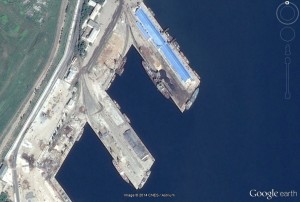
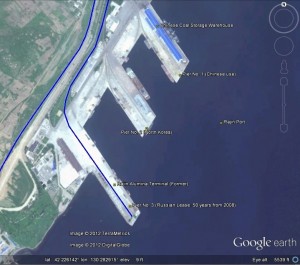
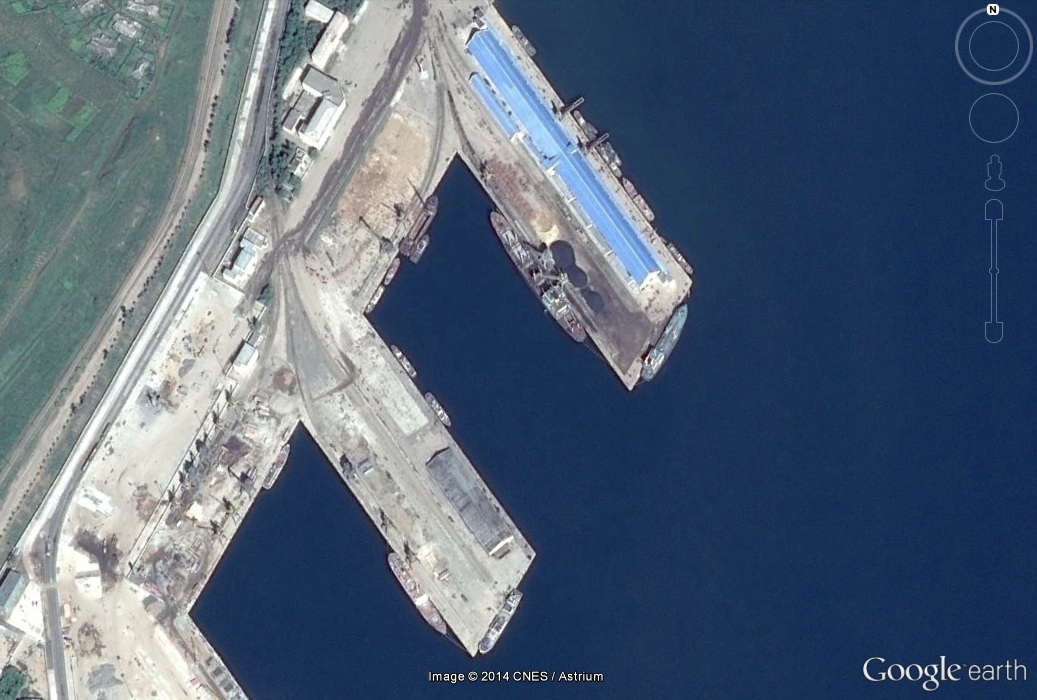
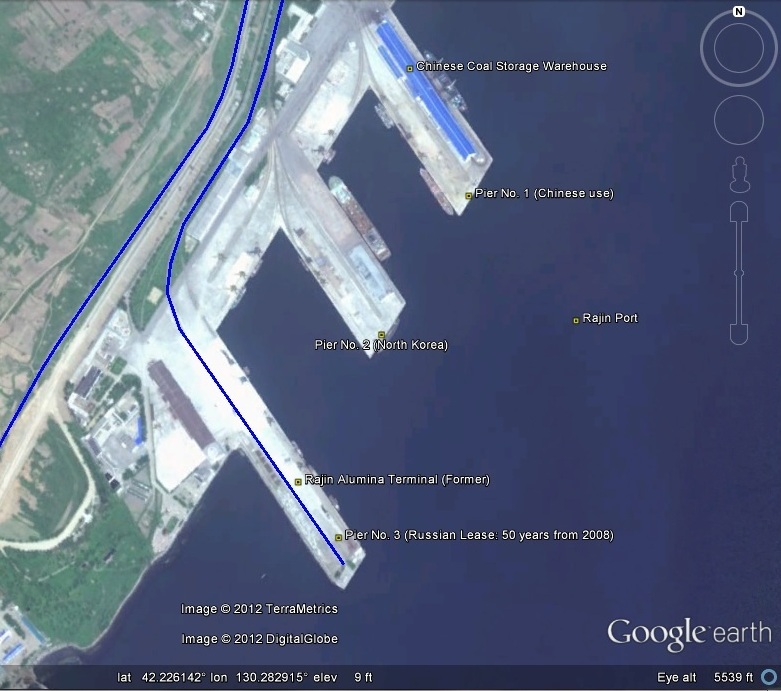
Pictured Above (Google Earth): The location of the Singaporean ship “Royale Star” at Rason Port (in Yellow).

UPDATE 2 (2013-5-19): The Royale Star has made its maiden DPRK voyage. Here is footage from KCTV. Here is footage from KCNA. Here is text from KCNA:

A departure ceremony of tour boat Royale Star for the first batch of Rason-Mt. Kumgang international tour makers took place at Rajin Port Saturday.

Present there were officials and other personages of the DPRK and Chinese institutions related to tourism, tourists and people in Rason City.

Jon Tong Chol, director of the Rason City Tourist Administration Bureau, and Zheng Yuanhui, owner of the boat, made speeches there.

The speakers congratulated the guests on having an opportunity to tour Mt. Kumgang, world famous mountain and a superb scenic beauty, as the first batch of makers of Rason-Mt. Kumgang international tour by the boat.

They wished the guests pleasant and happy days.

At the end of the ceremony the boat left the port.

UPDATE 1 (2013-3-6):  Yonhap offers more details on the ship and its mission in the DPRK:

Beijing-based Young Pioneer Tours said Pyongyang has authorized seven, four-day tours to the port and resort on its east coast from late April though mid October.

The Royale Star, a small cruise ship owned by a Singaporean shipping company, will be used to ferry foreign tourists, with the company claiming passengers will get a chance to see unique marine vistas off Rajin and Mount Kumgang, one of the top natural tourist destinations in North Korea.

The vessel is 138-meters-long, has a beam of 28 meters and is able to carry a large number of passengers and crew. The ship has a duty-free shop, hair salon, bar, rest areas and a restaurant-theater.

UPDATE 1 (2013-2-27): An update from the Institute for Far Eastern Studies (IFES):

North Korea trying to attract foreign tourists

North Korea is recently expanding its tourism industry, one of its major foreign currency earners.

North Korea is improving its tourism infrastructure to attract more foreign tourists, and recently introduced a new cruise ship to bring in tourists from China and other countries.

Workers’ Party of Korea’s mouthpiece Rodong Sinmun reported on February 21 that an opening ceremony for a Singapore cruise ship called the Royale Star was held at Rajin Port. The Rajin Port staff and government officials in the tourism sector from North Korea and China were in attendance. The new cruise ship is expected to revitalize the tourism in Rason and Mount Kumgang and the Rason Economic and Trade Zone.

Royale Star is expected to attract a large number of Chinese tourists.Although further details were not specified, Royale Star is also likely to travel between Rajin Port and Mount Kumgang in the Gangwon [Kangwon] Province, given the emphasis placed on Rajin-Mount Kumgang tours.

After a South Korean tourist was shot by a North Korean soldier at Mount Kumgang in July 2008, South Korean tours to the mountain resort came to a halt. Since then, North Korea has turned its attention to attracting Chinese and other foreign tourists. In August 2011, North Korea resumed operation of the Mangyongbong cruise ship (which was used to repatriate ethnic Koreans in Japan to North Korea in the late 1950s) as a pilot test for the operation of marine tourism to Rajin and Kumgang.

However, the pilot tour was rated poor due to the cruise ship’s old and substandard facilities. Passengers on the Mangyongbongfor the tour included foreign journalists from China, Russia, and the United States, and Chinese businessman. The ship set sail four times in 2011 from August to October. Four hundred Chinese tourists were said to have taken the tour. However, the cruise failed to attract tourists to operate on a regular basis.

North Korea explored the use of other luxury cruise ships from Hong Kong, as reported by Chinese media last year. North Korean authorities and Chinese travel agents seemingly came to the conclusion that cruise facilities and services must be drastically improved in order to attract more customers,and this has likely led to the recent introduction of the Singaporean cruise ship, Royale Star.

Royale Star is 138m in length and 28m in width, comprising a total of eight floors, and is supposedly equipped with a variety of facilities and services, including luxury rooms and bars, duty-free shops, a hair salon, lounge, and dining halls with live performances.A crew of more than 150 people was hired, including nationals from Singapore, Malaysia, India, Myanmar, Cambodia, Russia, Ukraine, and North Korea.

At the opening ceremony, the captain of the Royale Star announced, “We will accommodate our guests from many countries as a marine hotel. We will operate three days a week to allow our guests to enjoy the beautiful and unique scenery that North Korea has to offer and also sail to Mount Kumgang the last week of every month.”

Authorities also plan to open a hotel in Rajin Port to address the current lodging shortages in the Rason Special Economic Zone, which is under joint North Korea-China development. Last year about 600 to 700 Chinese visited the area during the peak season for tourism and business purposes,but reported to have experienced great difficulty finding accommodations.

As tourism to North Korea is gaining popularity in China, additional tours to Pyongyang, Kaesong, Panmunjeom, and Mount Kumgang are being considered, and new tourism infrastructure is being constructed in the border cities of Dongrim [Tongrim] (North Phyongan Province) and Kyongsong (North Hamgyong Province).

ORIGINAL POST (2013-2-26): According to KCNA:

Singaporean Tourist Ship Opens Business at Rajin Port of DPRK

Pyongyang, February 20 (KCNA) — The Singaporean tourist ship “Royale Star” opened its business with due ceremony at Rajin Port in the northeastern DPRK on Feb. 20.

Present at the ceremony were officials and other people of DPRK and Chinese institutions related to tourism and people in Rason City.

Kim Chun Hwa, director of the Rason International Travel Company, the director of the Yanbian Tianyu International Travel Company of China, and Zheng Yuanhui, owner of the ship, made speeches at the ceremony.

They said the start of business by the ship is of great significance in developing tourism in the Rason Economic and Trade Zone, adding it will contribute to bringing about a turn in the services for tourists.

They expressed thanks to the DPRK for its cooperation in the preparations for the start of the ship’s business.

They stressed the need to improve the services and inject fresh energy into Rason-Mt. Kumgang tour and the businesses in the zone.

At the end of the ceremony its participants toured cabins and other facilities of the ship.

A reception and an art performance were given on the same day.

Here is footage from KCNA:

Share

DPRK life expectancy declines

Wednesday, February 20th, 2013

According to Yonhap:

North Korea’s life expectancy backtracked after 60 years of free medicare services, local analysts of the communist country said Wednesday.

The claims by Pyongyang observers comes as the latest United Nations Population Fund data showed the combined average life expectancy for men and women in the country stood at 69 in 2012, five years lower than a tally taken in the early 1980s. The average North Korean man is expected to live just 65.9 years according to last year’s findings, while the life expectancy for women reached 72.1. Both numbers placed the country in 117th place among countries checked.

Despite the regression, North Korean media such as the Rodong Sinmun, an organ of the ruling Workers’ Party of Korea, said in an article carried on Tuesday that the free universal medical care system has become the envy of countries around the world.

It added that the service reflects the will of the people and leadership to build an economically strong nation. The system was implemented in 1953.

The daily newspaper said because of the service, the size of country’s medical related spending surged 112 fold from 1940 to 1980.

The paper also said there was a 15.7 year rise in the country’s average life expectancy during the cited period. It claimed that the country’s life expectancy reached 74 in 1980, which is a different figure from the data provided by the U.N. organization for roughly the same time period. North Kore generally does not release life expectancy data, with the paper giving no numbers regarding life expectancy during the 1990-2000 period.

Related to Pyongyang’s insistence on maintaining the system and hailing it as a success, North Korean analysts said that the communist country’s free medicare is part of the political landscape that sets it apart from capitalist countries.

They said that despite what North Korean news outlets are saying, many defectors have argued that they paid money to be looked after by medical personnel while in the communist country.

Read the full story here:
N. Korea’s life expectancy backtracks after 60 years of free medicare
Yonhap
2013-2-20

Share

An affiliate of 38 North