Archive for the ‘International Governments’ Category

DPRK asks Mongolia for food assistance

Monday, April 22nd, 2013

According to the Wall Street Journal:

At a courtesy call on the Mongolian president last week, Pyongyang’s new ambassador made a request for food aid, according to the official website for the head of state.

“North Korea may face (a) severe food shortage,” Ambassador Hong Gyu told President Elbegdorj, according to the account. Mr. Hong then asked for Mongolia to consider the possibility of delivering food aid to North Korea, the account said.

North Korea’s toughest part of the year for food begins in April and runs through September, when the annual corn harvest begins. Kwon Tae-jin, a scholar on North Korean agriculture in Seoul said that last year’s yield was moderate, but not sufficient to tide the country over.

“We’ve learned that while rations are being delivered, it varies region by region,” said Dr. Kwon, a director at the Korea Rural Economic Institute in Seoul. “But it isn’t sufficient to go around for everyone.”

Here is some information from the web site of the president of Mongolia:

Today, the Ambassador Extraordinary and Plenipotentiary from the Democratic People’s Republic of Korea to Mongolia Hong Gyu presented a letter of Credence to the President of Mongolia Ts.Elbegdorj. The ceremony of presentation of credentials was followed by brief reception organized in honor of new envoy. At the meeting President Elbegdorj said that this year is the 65th year anniversary of diplomatic relations between Mongolia and North Korea and noted that the bilateral relationship between the two countries will further strengthen. Mr. Hong Gyu conveyed the greetings of the Supreme Leader of North Korea, Kim Jong-un and mentioned of his invitation to visit North Korea. Also, Mr. Hong Gyu noted that North Korea is committed to intensify economic reform. In response, President Elbegdorj expressed Mongolia’s interest to share its experience of economic reform.

At the meeting, both sides exchanged opinion on enhancing partnership in sport and cultural sector and discussed possibilities to bring North Korean basketball, football team and judokas to Mongolia to prepare for the international competitions.

Mr. Hong Gyu said “North Korea may face severe food shortage. Therefore, we ask Mongolia to learn possibilities of delivering food aid to North Korea”.

Read the full story here:
North Korea Asks Mongolia for Food Aid
Wall Street Journal
Jeyup S Kwaak
2013-4-22

Share

US cuts subsidies to South Korean groups

Wednesday, April 17th, 2013

According to Yonhap:

The United States has virtually stopped funding anti-North Korean civic groups in South Korea due to its financial downturn, sources here said Wednesday.

Organizations such as the North Korea Intellectuals Solidarity (NKIS) and the North Korea Reform Radio said in a seminar in Seoul that Washington’s financial assistance for groups that support liberty and human rights has all but dried up this year.

“At its peak, the U.S. provided US$5 million in support annually, but the general lack of similar support from the Seoul government may have played a role in the latest cutbacks,” said NKIS executive director Kim Heung-kwang.

He also speculated that current economic troubles in the U.S. and the implementation of across-the-board budget cuts are affecting overseas financial support.

Kim Seung-chul, head of the radio station, said that his organization had relied on assistance from the National Endowment for Democracy, which is controlled by the U.S. State Department.

“With the drying up of subsidies from other U.S. sources, there is a pressing need for the Seoul government to take action,” he said.

Read the full story here:
U.S. cuts off subsidies to anti-N. Korea groups in S. Korea
Yonhap
2013-4-17

Share

Chongjin’s Wongang Beer…almost

Sunday, April 14th, 2013

Reuters offers a cautionary tale of investing in the DPRK:

Setting up a brewery in North Korea seemed like a good idea to Harry Kim and his Chinese friends two years ago. Everyone likes beer, even in one of the world’s most closed and least understood countries, they reckoned.

Kim and his partners even got the beer flowing after workers strapped equipment onto a truck in the Chinese border town of Tumen and drove it to the North Korean coastal city of Chongjin. Chinese engineers taught the locals how to brew. City officials loved the taste, he said.

But the small Chinese-North Korean venture ran aground within months after failing to get final approval from authorities in Pyongyang.

Kim’s experience is an illustration of both the challenge and the potential of doing business in North Korea, which has grabbed global attention in recent weeks with its threats to wage nuclear war on South Korea and the United States.

“It wasn’t rejected. We just waited. The central government didn’t come and say ‘no’, but the documents were just never issued and so we eventually gave up,” said Kim, a Chinese national of Korean descent living in Tumen in China’s northeastern Jilin province.

There is little public information on North Korea’s beer market but one thing seems clear – demand outstrips supply.

Troy Collings, a director at Young Pioneer Tours, a travel operator based in China which takes groups into North Korea and has organised brewery visits, said there were probably less than a dozen locally made beers available in the country.

In Pyongyang, two hotels concoct their own microbrews. The Rakwon department store creates its own eponymous beer, too, he said.

“They can’t produce enough for the domestic market,” said Collings.

The opportunity was clear – and reinforced for Kim when he saw the elite in Chongjin drinking a lot of Heineken and Corona.

So, in mid-2011, Kim and two friends joined up with a North Korean businessman to put the brewery plan in motion.

Approval from Chongjin city came easily, he said. The province, North Hamgyong, gave the green light too. And the first of three investments in equipment and supplies – the initial one worth about 200,000 yuan – was made.

Since North Korea has no system of credit and the risks of investing were high, Kim and his partners tied the beer project to seafood exports.

Before each investment was made, they were allowed to buy a cargo of North Korean seafood to sell in China. The first was about 50 tonnes of squid, he said.

It took about nine hours to drive from Tumen to Chongjin with the brewery equipment, including stops at customs.

The equipment was installed quickly and Chinese engineers showed the North Koreans how to brew. Soon, suds were flowing. The product was dubbed Wongang, or ‘river source’, beer.

On the first day of business the investors invited senior city and provincial leaders to the brewery for a sample. All approved, Kim said.

But the new brewery could not ramp up production without authorisation from Pyongyang, which never came despite months of waiting. There was never a response and the investors never got an explanation.

“If you push too hard it could raise suspicions,” Kim said.

It was a pity, because the North Koreans were good workers, he said, citing how the investors overcame the frequent power cuts which made it hard to use a computer to monitor the brewing process.

Instead, the investors stationed North Korean workers at each of the pressure gauges on the brewing equipment in 12-hour shifts. The workers were told if the dial reached a certain level they should turn a knob to let off pressure.

“They got chairs and sat there looking at the gauges, not sleeping all night, one person at each position,” said Kim.

Thanks to the squid hedge, the Chinese investors basically broke even. Kim now runs his restaurant in the space where the brewing equipment was stored before it was hauled to Chongjin.

Some day Pyongyang may give the green light, Kim says, but he is not holding his breath.

“As I was leaving they said ‘It’s not that we don’t want to do it, and it’s not that our senior leaders or the central government don’t want to do it, but we just don’t have practical experience with this kind of thing’.”

UPDATE: Simon notes in the comments:

There are not about a dozen locally brewed beers in the DPRK, there are literally dozens, if not many more. A great many restaurants and bars brew their own beer. The number quoted in the article isn’t close to the reality that small brewing set-ups are quite widespread in Pyongyang and other cities too.

Read the full story here:
Nuclear threats to squid hedges: it’s hard to get a beer in N.Korea
Reuters
John Ruwitch
2013-4-14

Share

Concern (Irish NGO) suspends DPRK operations

Monday, April 8th, 2013

According to the Irish Times:

Irish NGO Concern has temporarily suspended its aid work in North Korea due to the increasing threat of war. The suspension takes place with immediate effect due to fears over staff safety.

The non-governmental organisation has 14 workers in the area. Eleven of them are from North Korea, while there are also three international workers from Nepal, India and Sweden. The only Irish Concern employee in the area left a number of months ago.

Concern’s overseas director of aid Paul O’Brien said the organisation had a meeting with the Department of Foreign Affairs last week, where the decision was made.“Two of our international staff are outside the area now and we can’t really function without them. We will return to work once it settles down there,” he said.

Mr O’Brien said he hopes things will settle in the country by the time former leader Kim Il-Sung’s birthday takes place on April 15th. The birthday is celebrated as a public holiday where North Koreans celebrate the life of their “Eternal President”, who died in 1994.

Read the full story here:
Concern suspends North Korea operations
Irish
Jason Kennedy
2013-4-8

Share

DPRK – Cuba relations in 1974

Sunday, March 31st, 2013

The Wilson Center’s North Korea International Documentation Project has posted a number of diplomatic cables from formerly fraternal socialist nations on the DPRK’s efforts to compete with South Korea for influence in the developing world. Below is a specific cable referring to DPRK – Cuban relations. It speaks volumes with masterful brevity (an art sorely lacking in public discourse today):

JANUARY 22, 1974
HUNGARIAN EMBASSY IN THE DPRK, TELEGRAM, 22 JANUARY 1974. SUBJECT: CUBAN-DPRK RELATIONS.

According to the Cuban ambassador accredited to this country, the DPRK asked Cuba to supply 300.000 metric tons of sugar in 1974. The Cubans replied that they could supply only 80.000 metric tons, and even this amount could be supplied only in quarterly items. If there was any delay in the [Korean] disembarkation of the delivered goods at the end of the quarter, the Cubans would halt the shipments next in line. The Korean trade officials declared that this Cuban measure was incompatible with the policy of mutual assistance that socialist countries pursued toward each other. The Cubans responded that they also needed assistance, and it would greatly help them if they could receive payment for the sugar shipments in a timely manner.

You can read all of the cables in the series here.

Share

Kempinski claims to [not] be taking over management of Ryugyong Hotel

Thursday, March 28th, 2013

UPDATE 1 (2013-3-28): NK News reports that Kempinski has officially pulled out of the deal:

“Kempinski Hotels confirms that KEY International, its joint venture partner in China with Beijing Tourism Group (BTG), had initial discussions to operate a hotel in Pyongyang, North Korea, however no agreement has been signed since market entry is not currently possible”, Regional PR Director Hilary Philpott told NK NEWS by email.

ORIGINAL POST (2012-11-1): According to Bloomberg:

The 105-story, pyramid-shaped Ryugyong Hotel, whose foundations were poured almost three decades ago, will open partially in July or August, Kempinski AG Chief Executive Officer Reto Wittwer said today at a forum in Seoul. The German luxury-hotel manager will be the first western hospitality company to operate in North Korea, he said.

“This pyramid monster hotel will monopolize all the business in the city,” Wittwer said. “I said to myself, we have to get this hotel if there is ever a chance, because this will become a money-printing machine if North Korea opens up.”

Kempinski, based in Munich, is handling management while Egypt’s Orascom Telecom Media & Technology Holding SAE (OTMT) funds the hotel as part of a $400 million mobile-phone license it won from the North Korean government in 2008, he said. Cairo-based Orascom has spent $180 million on completing the hotel’s facade.

The top floors of the hotel will house guests in 150 of the originally planned 1,500 rooms, which “will be developed over time” to remodel the insufficiently designed spaces, Wittwer said. Shops, restaurants, a ballroom and Orascom’s offices on the ground and mezzanine floors will also open next year.

Additional Information:

1. Koryo Tours published the first photos taken inside the building.

2. The Choson Ilbo reports that the South Koreans tried investing in the hotel during the Noh Administration.

Read the full story here:
Kempinski to Operate World’s Tallest Hotel in North Korea
Bloomberg
Sangwon Yoon
2012-11-1

Share

DPRK imports of Chinese silver surge

Thursday, March 28th, 2013

According to Yonhap:

North Korea imported an unusually massive amount of silver from China in January, possibly in relation to leader Kim Jong-un’s birthday that month, sources and China’s customs office said Thursday.

Data from China’s customs office showed that North Korea imported 661.71 kilograms of Chinese silver for US$653,128 in January.

The monthly import is unusually enormous given that the North took in only $77,593 worth of precious metal and other jewels for the whole of 2012. The corresponding amount for 2011 was $57,000.

Before January this year, the North had hardly spent more than $10,000 on monthly imports of such goods, according to the data.

Given the leader’s birthday on Jan. 8, North Korea watchers said the massive amount of imported silver may have been used to produce silverware souvenirs to celebrate the leader’s birthday.

“It’s difficult to assume the exact purpose of the silver imports,” a source said. Given that late leader Kim Jong-il used to bring in foreign brand luxury sedans and expensive watches to treat the country’s top echelon on major holidays, the bulk of silver imported in January may have been used for similar purposes, the source said.

Backing this assumption, the customs data also showed that the North imported an unusually large amount of costume jewelry worth $10,447 in the same month.

A reader points out this Daily NK story hypothesizing that the silver could have been used in batteries:

As such, there are suspicions that the recent North Korean decision to import more than 600kg of silver through China was done to facilitate the production of batteries for submersible production.

A North Korean military source told Daily NK on the 4th, “The [North Korean] Navy has been producing submersibles at every shipyard on their east and west coasts ever since the attack on the Cheonan in 2010.”

According to the inside source, prior to the Cheonan sinking such vessels were produced at one shipyard, the disguised ‘Bongdae Boiler Factory’ in Sinpo, South Hamkyung Province, at a rate of five per year. However, following the sinking of the Cheonan that rate went up four times to 16 per year, as the vessels started being produced across multiple shipyards including Yongampo, Chongjin and Rajin.

The source explained, “The reason why the North Korean authorities are increasing production of this kind of submersible that can fire torpedoes is to maximize their underwater attack capacity. The subs can take 12 to 15 soldiers yet still sink destroyers weighing thousands of tons with their twin torpedoes.”

“The engines noise on the submersibles is very quiet, making them able to approach their targets underwater in secret, while it is impossible to trace crimes such as the Cheonan incident,” the source went on, adding that during North Korean military training exercises they also emphasize the essential nature of the subs.

The rising production is pushing up demand for batteries, the source then went on to add, saying that this required the bulk production of both silver and zinc. “All the silver produced in North Korea is supplied to the shipyards,” he claimed.

The source admitted to being confused, therefore, at North Korea’s recent decision to import 660kg of silver from China, declaring, “There is lots of silver being produced in North Korea, so it’s hard to say why they are importing it from China…I suppose it may have been just that more batteries were being produced so they needed more silver.”

Read the full stories here:
N. Korea imports massive amount of Chinese silver in Jan.: data
Yonhap
2013-3-28

NK Producing More Silvery Subs
Daily NK
2013-4-5

Share

China-North Korea railway links to undergo upgrade

Tuesday, March 26th, 2013

Tumen-namyang-rail-2011-9-23

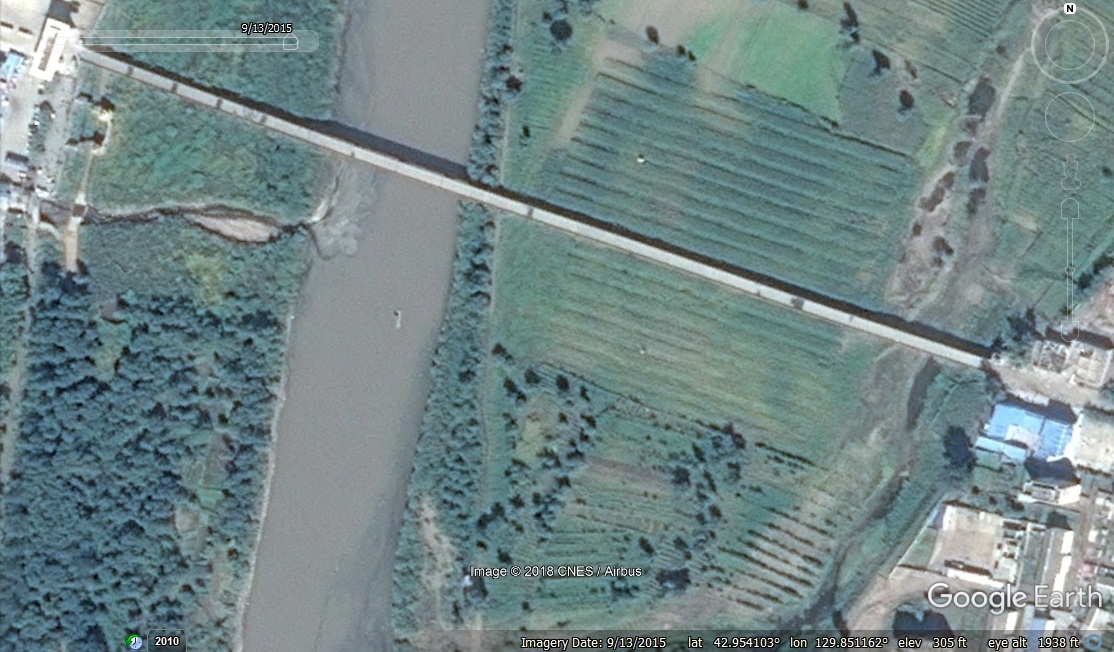
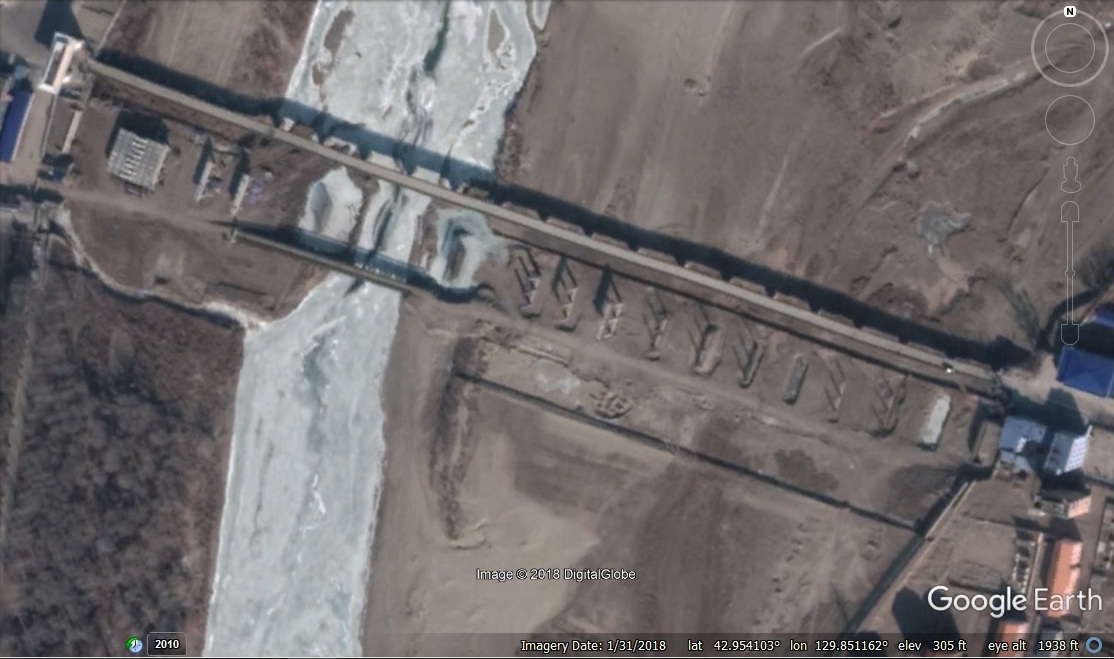
Pictured Above (Google Earth): The Namyang (DPRK) – Tumen (PRC) rail and bridge crossings. I suspect that this is the specific area that will see renovation

According to the Global Times:

The government of northeast China’s Jilin Province announced Tuesday plans to upgrade railways links to neighboring North Korea, aiming to boost cross-border economic and trade ties.

The China Tumen-North Korea Rajin Railway and China Tumen-North Korea Chongjin Railway will be upgraded under the Jilin government plan. A special highway passenger line linking Tumen to North Korea is also set to be opened in coming years.

The plan aims to improve the industrial cooperation between China and North Korea’s Rason and push the development of the Tumen Korean Industrial Park to a higher level.

Jin Qiangyi, director of the Asia Research Center of Yanbian University, told the Global Times that the industrial cooperation between China and North Korea has been going on for many years and does not breach international sanctions against Pyongyang.

Such cooperation could improve employment in border areas of both countries and contribute to development and stability in the area amid heightening tensions, said Jin.

Read the full story here:
China-North Korea railway links to undergo upgrade
Global Times
2013-3-27

Share

Chinese oil exports to DPRK

Thursday, March 21st, 2013

Reuters reports on Chinese oil exports to the DPRK:

China did not export any crude oil to North Korea in February, customs data showed on Thursday, marking the first absence of deliveries since the same month in 2012.

Crude oil is the largest commodity by value that is supplied to North Korea under Beijing’s aid programme. It was not immediately clear if the lack of supply represented a unilateral action by China to punish North Korea for its nuclear test on Feb. 12.

Customs data showed the last time China missed monthly supply shipments was in February 2012. There were also no exports in February 2011.

Beijing normally supplies between 30,000 to 50,000 tonnes of crude oil to North Korea every month (222,000 to 370,000 barrels). Exports in 2012 totalled 523,041 tonnes, China General Administration of Customs data shows.

At $100 per barrel, China’s annual crude oil supplies last year would have been worth about $380 million.

Officials at the Ministry of Commerce were either not aware of the customs figures or declined comment. The ministry is a key agency that oversees the aid programme, which includes supplying commodities such as crude oil and diesel fuel.

Oil trading officials with knowledge of China’s oil aid to North Korea told Reuters last week that the ministry had some internal discussions about how to respond following Pyongyang’s latest nuclear test.

One of them said there may be “some kind of curb” in supplies but declined to elaborate.

The customs data showed a small quantity of diesel fuel flowed to North Korea in February amounting to about 4,000 tonnes (31,200 barrels). For the whole of 2012 China supplied 31,050 tonnes of diesel and 56,093 tonnes of gasoline to North Korea, customs data shows.

Prior to 2011, China suspended crude sales to North Korea in early 2007 and in September 2006, which also coincided with a nuclear test in October that year.

Read the full story here:
China did not export any crude in Feb to N.Korea (CORRECTED)
Reuters
Chen Aizhu
2013-3-21

Share

Kim Cheol Woong performance in Virginia

Wednesday, March 20th, 2013

Apologies to readers outside the DC area, but I am posting a “local” event. I hope to see you there.

North Korean pianist, Kim Cheol Woong, who now lives in Seoul, will be performing at an event in Burke, VA. You can learn more about Mr. Kim in this New York Times article.

Here is the marketing flyer with the date, time, and location:

MaJoong-Poster-EN

Here is the flyer in Korean (한국)

Here is a, invitation letter (PDF) from NKUS, North Korean Refugees in the USA (Homepage, Facebook).

Share

An affiliate of 38 North