Archive for the ‘International Governments’ Category

Goldman Sachs on Korean Unification

Monday, September 21st, 2009

UPDATE: Some interesting follow up from a member of Phoenix Commercial Ventures at the Gerson Lehrman Group web page:

Analysis
My colleagues and I are directors of a number of businesses (Phoenix Commercial Ventures) that have been based in the DPRK (aka North Korea) for a number of years. Goldman Sachs is correct to highlight the upside of business opportunities with the DPRK.

The DPRK (North Korea) represents one of the last “green field” economies in the world with exceptional investment opportunities. As such it provides an unparalleled opportunity for business professionals who know and understand the risks, the people and the country. As estate agents are fond of saying, it is a case of “location, location, location”.

1 Physical Location
The DPRK (North Korea) physically borders Russia, China and ROK; as such it is in a prime location in this most important of trade routes. Additionally, its location in Asia Pacific gives it access to one of the world’s wealthiest and most vibrant regions.

2 Resource Location

The DPRK has abundant mineral resources including; coal, gold, magnesium, nickel, copper, graphite, nephelite, zinc etc. The total value of which is estimated at being around $2.5 Trillion (IHT 21 Dec 2007).

The DPRK has a well educated (99-100% literacy), intelligent, hard working population whose wage rates are highly competitive.

The DPRK has a forward looking environmental policy that offers green investors opportunities to generate environmentally friendly power for supply locally and export elsewhere.

3 Historical Location
The recent improvements in geopolitical issues demonstrates that the time is right, in terms of historical context, for progress to be made with regard to the DPRK entering the world financial community and to benefit from world trade.

Practicalities
It is not difficult to set up shop, if you approach the DPRK with a well thought through serious business proposal/well researched business plan and are a professional with reputable/professional local contacts.

It should be emphasised that businesses in the DPRK are no more fond of having their time wasted than businesses anywhere else in the world, local businesses having had their time wasted tend to prefer to deal with professionals that they trust.

When setting up a business within the DPRK remember that you cannot manage solely by email and need people on the ground, as is the case with Phoenix Commercial Ventures. Organisations that do not have people on the ground in DPRK will fail.

One of the major challenges facing a newcomer to the local market is a very practical one – how to find a way to balance the need for pre-start-up feasibility studies requiring possibly large amounts of information from the local Korean partner, against the need to demonstrate to the local authorities that the investor is serious.

There have been many cases over the years of potential foreign investors making promises they cannot fulfil, and the Koreans have consequently become somewhat sceptical. It is therefore essential to promise only what you know you can deliver, and to deliver within the timeframe agreed.

The DPRK Government is actively encouraging foreign investment in areas such as mining, energy, agriculture and IT.

Investors in the DPRK are accorded generous tax concessions:

1. A reduced rate of tax of 10% (standard rate – 25%)
2. An additional tax exemption – whereby the investor is fully exempt from paying tax from the year of investment for 3 years, and 50% exempt for the subsequent 2 years
3. Any tax paid will be returned, if a subsequent investment is made

The DPRK is also undertaking small experiments with free market economy principles that would have been unthinkable a couple of years ago. There are now 24-hour stores operating in Pyongyang, several places providing computer access and a series of adverts on the TV.

Kim Yong-sul, DPRK Vice Minister for Trade, is quoted as saying at a Pyongyang meeting of overseas ethnic Korean businessmen October 25 2004:

“In the past, we only allowed foreign companies entry into specialized economic zones, but now, we will allow them to set up in other places around the DPRK.”

Misconceptions
There are a number of misconceptions harboured by some in the West about doing business in the DPRK. The one that we most frequently encounter is that people do not believe that it is possible, as a Westerner, to set up and run a company in the DPRK. This is patently untrue, the DPRK allows Western companies to set up and run joint ventures (JV’s) with a majority shareholding, with local partners and to remit profits;  the government encourages foreign investment.

One of our (Phoenix Commercial Ventures Ltd) aims is to demystify the business environment, demonstrate that people can make successful and ethical joint ventures in the DPRK that provide a decent return, employ local people, engage with local professionals; thereby encouraging others of good repute to come and do the same.

Another misconception is that communications from outside the DPRK with people working in the DPRK are impossible. This is untrue. I can call via phone and email my colleagues directly from London.

Starting and running a JV in the DPRK requires the same approach as it would in any other country – it is the fact that it is a JV that is important, not that it is in the DPRK.

That means you have to have the good judgement to size up and choose a good partner with whom you are going to work well together, but then you have to do just that – work well together, with emphasis on each of those words.

If you start a joint venture where you are always suspicious of the joint venture partner, then you shouldn’t have started the JV in the first place, it will never succeed – that is exactly the same in any country.

It is absolutely essential to have resident foreign management, a joint venture cannot be run remotely from abroad. The quality of, and relationship with, the local staff is essential; as is that of the foreign management. The aim of the JV should be to bond the personnel into an independent unit, who are striving for the success of the JV, and to remove entirely any idea of ‘our side’ and ‘their side’ within the JV.

The Barclays Report
Goldman Sachs are not alone in viewing the future positively. In 2004 Barclays Capital Research issued an upbeat report about the DPRK:

“The North Korean economy does not seem about to collapse” (contrary to what many might think).

1. As time goes by we are likely to see “the development of an uneasy coexistence with the US”.
2. There are some signs of improvement in the North Korea’s economy, thanks to recent reforms. The growth will remain very slow, but the regime has built in “coping mechanisms” that will prevent collapse.
3. “A slow income growth could be supportive of political stability, because it would make it easier for the regime to control popular expectations.”
4.What the Chinese would call peaceful evolution is possible:

“Political and economic stability would, over the longer term, see the completion of the transition from a planned to a market economy and greater integration of North Korea into the global economy. This in turn, could support a long-term normalisation of North Korea’s diplomatic relations with the external world.”

Plus Ca Change
When we were exhibiting at the Pyongyang Spring International Trade Fair in May 2008, our CEO was at our stand and was approached by a young Korean lad who in perfect English said “Excuse me, am I disturbing you?”

It turned out that he wanted his photo taken.

The above may not seem much of an anecdote to those who have little understanding of the DPRK. However, those who do will realise the significance of that.

We are also attending the current four day international trade fair which opened this Monday in Pyongyang, with 120 companies from the DPRK and 14 other economies taking part.

The DPRK offers an unparalleled opportunity for business professionals who know and understand the risks, the people and the country.

ORIGINAL POST: (Thanks to a reader: Paper link at the bottom) A new paper by Goohoo Kwon at Goldman Sachs argues that the economy of a reunified Korea could be larger than France and Germany by the middle of this century.  The paper is not available on line yet, but according to to an article about the GS paper in the Wall Street Journal:

Since the reunification of West and East Germany 20 years ago, South Korean leaders and economists have convinced many people here that reuniting with North Korea will be costly and disruptive. In the latest gloomy forecast, a government think tank last month said that the tax burden ratio, or proportion of tax revenue to gross domestic product, would need to rise by two percentage points and stay that way for 60 years to pay for reunification.

In the study released Monday, Goldman Sachs economist Kwon Goo-hoon says the risks of reunification need to be re-evaluated, particularly in the wake of the rapid development of countries like Vietnam and Mongolia that also had state-run economies like North Korea’s.

His study contains North Korean data that he acknowledges may not be accurate and assumptions about future behavior that may not pan out. Even so, its tone is more optimistic than previous studies that contributed to South Koreans’ ambivalence about unification.

In an interview, Mr. Kwon said he believed for a long time that unification would be too costly for the South. He based that view largely on what happened with the newly united Germany, where the currencies were quickly equalized, the border opened and huge transfer payments made from the former West to the former East Germany.

“People always look at Germany when they discuss unification of the Koreas, but if you look at China and Hong Kong, or more properly Eastern Europe, Mongolia or Vietnam, you see there are better ways of doing this,” Mr. Kwon said. “I think it’s a matter of education and dialogue.”

In March, the Bank of Korea published a report that said Hong Kong’s gradual integration with China beginning in 1997 and France’s handling of its former colonies after World War II were better models. Both that study and Mr. Kwon’s suggest the two Koreas maintain separate currencies and restrict crossings at the inter-Korean border, perhaps for decades as North Korea’s currency appreciates and its people grow wealthier.

Mr. Kwon’s study goes several steps further by suggesting that the huge growth potential of North Korea could help offset the slowing growth of South Korea, which is burdened by limited natural resources and a fast-aging population. By contrast, North Korea has huge mineral deposits and a population that is younger and growing twice as quickly as South Korea.

Using long-term growth forecasts Goldman Sachs has previously published for industrialized countries, Mr. Kwon concluded that the gross domestic product of a united Korea would be the world’s eighth-largest in 2050 at $6 trillion, surpassing France around 2040 and Germany and Japan later that decade.

Today, South Korea’s GDP is about $800 billion and North Korea’s is believed to be around $20 billion, though no data has been collected inside the North since the 1960s. Some economists believe its economic output is considerably less, while others note that most estimates tend to leave out the North’s well-known illicit activities such as narcotics production and currency counterfeiting.

Nearly all previous economic reports on Korean unification focused on the costs that South Koreans will face and ignore or play down investment and business opportunities that may also occur. Mr. Kwon said the tone of the discussion will change as economic and demographic pressures grow in the South and he wanted to produce an analytical framework ahead of that.

Further information:
Goldman Sachs Has a Different View of Korean Unification
Wall Street Journal
Evan Ramstad
9/21/2009

Global Economics Paper No. 188: A United Korea? Reassessing North Korea Risks
Goldman Sachs Slobal ECS Asia research
Goohoon Kwon, CFA
September 2009

Lots of North Korean economic info here.

Share

2009 bad year for Kaesong Zone

Wednesday, September 16th, 2009

UPDATE 9/16/2009: Despite the downward trajectory that business in the Kaesong Zone seemed to be taking this year, things appear to have bottomed out.  According to Yonhap, the Koreas have signed a Kaesong wage increase.  According to the article:

South and North Korea agreed to a 5 percent wage hike at a joint industrial park on Wednesday, the Unification Ministry here said, in the latest sign of inter-Korean projects returning to normal.

North Korea earlier demanded a 400 percent raise in monthly wages for its workers at the South Korean-run park in Kaesong, just north of the border.

South Korea’s management office in Kaesong “signed an agreement on a 5 percent wage increase” with its North Korean counterpart, ministry spokesman Chun Hae-sung said in a brief statement.

The North voluntarily withdrew its earlier demand last week in a striking shift from its unyielding attitude in four rounds of negotiations from April to July. The demand called for monthly wages be raised to US$300 from the average $70-80, apparently in retaliation against Seoul’s hard-line policy toward Pyongyang.

The Kaesong park opened in late 2004 as an outcome of the first inter-Korean summit four years earlier. It houses 114 mostly small-sized South Korean firms producing clothing, electronic equipment, kitchenware and other labor-intensive goods with about 40,000 North Korean workers.

The venture is seen as a much-needed source of dollar income for the North, which is currently under U.N. sanctions for its May nuclear test that bans cash flows to the country.

The 5 percent rate hike will increase the minimum wage to about $58 from the current $55.

Separately, North Korea was conducting a door-to-door survey on South Korean businesses at the joint park, said ministry spokeswoman Lee Jong-joo.

North Korea asserted that the two-day survey that continues until Thursday was to examine the firms’ output and “listen to their complaints and difficulties regarding tax and accounting,” Lee said. Such on-site surveys have been done sporadically, she added.

Although tensions might have eased, it remains to be seen whether the business community can be coaxed into making serious capital investments in the DPRK.

Read previous Kaesong Industrial Zone news below:

(more…)

Share

Italy Seizes Liquor Bound for DPRK

Monday, September 14th, 2009

According to the Choson Ilbo:

Italian customs recently confiscated 420 bottles of expensive liquor on their way to North Korea. Italian newspaper Vivere Ancona said customs in the eastern port city seized 150 bottles of brandy and 270 bottles of whisky in containers destined for North Korea at the end of last month.

The confiscation follows a UN Security Council ban on the export of arms, high technology and luxury goods to North Korea after the communist country’s nuclear test in May. The liquor is reportedly worth 12,000 euro, but the brands were not identified.

In July, Italian customs seized two luxury yachts worth W23 billion ordered by North Korea (US$1=W1,222). At the time, the order was disguised as coming from a Chinese company, but the investigation revealed it had actually been made by North Korean leader Kim Jong-il.

Here is a post about the yachts.

Here is a post about DPRK weapons seized by UAE.

Read the full story here:
Italy Seizes Luxury Liquor Bound for N.Korea
The Choson Ilbo
9/14/2009

Share

UAE Seizes North Korean Weapons Shipment to Iran

Thursday, September 10th, 2009

UPDATE: According to Yonhap, Chinese and Australian ships were shipping the arms:

North Korean cargo carrying arms exports to Iran left a western port five days after Pyongyang’s nuclear test in May and was transferred aboard Chinese and Australian freighters before being seized by the United Arab Emirates (UAE) in July, according to an Italian company that handled the delivery.

Mario Carniglia, head of the international freight-forwarding firm Otim, said the containers, reportedly loaded with rocket launchers, detonators, and munitions, were shipped via the Chinese cities of Dalian and Shanghai and were transferred to an Australian vessel just after the U.N. Security Council adopted Resolution 1874 which bans the North from engaging in arms trade.

“(The containers) left the Nampo Port on May 30,” he said in a recent interview with Yonhap News Agency in Rome on Wednesday. A North Korean ship carrying the 10 containers arrived in Dalian two days later and a Chinese cargo ship moved them to Shanghai on June 13, he said.

“The containers were placed on (the Australian freighter) ANL-Australia in Shanghai,” he said, flipping through related documents.

The cargo was on its scheduled course until the UAE intercepted the ANL-Australia on July 22. The U.S. Navy had been focusing on trailing another North Korean vessel, the Kangnam 1, which appeared to be headed to Myanmar also carrying weapons exports.

The seizure was the first made under Resolution 1874 that calls upon all states to inspect cargo to and from North Korea if they have “information that provides reasonable grounds to believe the cargo contains” illicit weapons.

The Australian government said earlier, based on its own probe, that there were rocket-propelled grenades and other weapons in the seized containers, though Carniglia said his firm did not know the contents of the cargo.

He said North Korea provided documents identifying the content as “Oil Pumping Equipment.”

“We couldn’t see the contents as the containers were sealed when shipped from Nampo,” he said in the interview conducted in Italian. He refused to identify the exporter in North Korea, citing business ethics.

“All we were responsible for was handling the shipping from China to Iran,” Carniglia said.

He added that North Korea has not filed a complaint or asked for the return of the cargo, held at the UAE now for more than 50 days.

The UAE is reportedly in consultation with the U.N. sanctions committee on how to handle the seized shipment.

In a related move, the U.N. committee demanded an explanation from North Korea last month for the apparent arms export attempt.

The head of the North’s mission to the U.N., Sin Son-ho, sent a reply letter reiterating his country’s position that it is not bound by any U.N. resolution.

Sin also said that North Korea’s experimental uranium enrichment program is in a “completion phase,” claiming the country has made advancements in mastering an alternative route to producing nuclear weapons apart from its plutonium-based program.

ORIGINAL POST: According to Bloomberg:

The United Arab Emirates has seized a ship carrying North Korean-manufactured munitions, detonators, explosives and rocket-propelled grenades bound for Iran in violation of United Nations sanctions, diplomats said.

The UAE two weeks ago notified the UN Security Council of the seizure, according to the diplomats, who spoke on condition they aren’t named because the communication hasn’t been made public. They said the ship, owned by an Australian subsidiary of a French company and sailing under a Bahamian flag, was carrying 10 containers of arms disguised as oil equipment.

The council committee that monitors enforcement of UN sanctions against North Korea wrote letters to Iran and the government in Pyongyang asking for explanations of the violation, and one to the UAE expressing appreciation for the cooperation, the envoys said. No response has been received and the UAE has unloaded the cargo, they said.

he Security Council voted on June 12 to adopt a resolution that punishes North Korea for its recent nuclear-bomb test and missile launches through cargo inspections and enforcement of restrictions on financial transactions. The measure calls for the interdiction at seaports, airports or in international waters of any cargo suspected of containing arms or nuclear or missile-related materials going to or from North Korea.

According to the Wall Street Journal:

According to the Security Council diplomat, the weapons were carried on an Australian vessel, the ANL-Australia, which was flying under a Bahamian flag. According to an Aug. 14 letter sent to the U.N. sanctions committee, the exporting company was an Italian shipper, Otim, which exported the items from its Shanghai office.

“The cargo manifest said the shipment contained oil-boring machines, but then you opened it up and there were these items,” the diplomat said. ANL and Otim officials couldn’t immediately be reached to comment.

A spokeswoman for the Australian Department of Foreign Affairs and Trade said the Australian government is aware of the incident and is investigating to determine whether any Australian laws may have been broken.

The seizure could also raise fresh questions about North Korea’s intentions. After taking an aggressive stance against the West earlier this year, Pyongyang appears to have softened its rhetoric, releasing two captive American journalists and sending a delegation to meet with South Korea’s president.

Read more here:
UAE Seizes North Korean Weapons Shipment to Iran
Bloomberg
Bill Varner
8/28/2009

Cargo of North Korea Matériel Is Seized en Route to Iran
Wall Street Journal
Peter Spiegel and Chip Cummins
8/29/2009

Share

Chinese police report finding bodies of 56 North Korean would-be refugees in Yalu river

Thursday, September 10th, 2009

UPDATE: This story was picked up by Yonhap, the Korea Herald, and the Choson Ilbo  (twice).–probably because of Joshua.

ORIGINAL POST:
By Michael Rank

Chinese police have reported how the bodies of 56 North Koreans attempting to flee to China, including seven children, were found floating in the Yalu river in 2003.

An official notice issued by police in the border town of  Baishan in Jilin province describes how 53 corpses were discovered by local people on the morning of October 3, 2003, followed by three more at 5 a.m. the following day.

“An examination found that the dead were all citizens of the Democratic People’s Republic of Korea. Postmortems showed that the 56 bodies had all been shot. The evidence suggests that they had been shot by Korean armed border guards when attempting to cross illicitly into China,” says the document, dated October 7, 2003.

The dead consisted of 36 males and 20 females, including five boys and two girls.

The bodies were cremated locally on October 6, and township officials are “awaiting instructions from higher authority” on what to do with the ashes and with possessions found on the bodies. The document was issued by Badaogou police station in Baishan, a town in Changbai Korean Autonomous County which covers a large area on the North Korean border.

I am grateful to “treasuresthouhast” who posted the document here. He took it from an unnamed Chinese blog which apparently reposted it from bbs.163.com.

Share

US sanctions more DPRK organizations

Tuesday, September 8th, 2009

According to Reuters (via the New York Times):

The United States moved on Tuesday to freeze the assets of two North Korean entities believed to be involved in atomic and missile programs, raising pressure on Pyongyang to resume disarmament talks.

Despite a recent charm offensive by North Korea, the State Department moved against its General Bureau of Atomic Energy, which oversees the nuclear program, and Korea Tangun Trading Corp, believed to support its missile programs.

Both were targeted under a presidential executive order that allows the White House to freeze the U.S. assets of people and entities suspected of developing weapons of mass destruction or the means to deliver them, including missiles.

“These designations continue U.S. efforts to prevent North Korean entities of proliferation concern from accessing financial and commercial markets that could aid the regime’s efforts to develop nuclear weapons and the missiles capable of delivering them,” the State Department said in a statement.

The action requires U.S. individuals, banks and other institutions to block the assets of the North Korean entities.

It was unclear whether either actually had any assets under U.S. jurisdiction but American officials said Washington hoped the move would discourage other countries from doing business with North Korea.

“Are we hoping for a spillover effect? Of course,” said one U.S. official.

These two organizations were targeted by the UNSC earlier this year.

Here is information and (links to information) taken by the US and UN in 2009.

Read the full story here:
U.S. Acts to Freeze Assets Of Two N.Korean Entities
Reuters (via New York Times)
9/8/2009

Share

The Hwanggang Dam incident (2009)

Tuesday, September 8th, 2009

UPDATE 3 (2009-9-17): South Korea rules out “water attack”.  According to AFP:

South Korea’s new defence chief said Thursday there was no evidence that the sudden discharge of water from a North Korean dam which killed six southerners was a deliberate attack.

“We have no solid information to say the discharge was for a water attack,” Kim Tae-Young, appointed defence minister on September 3, said in a report to parliament.

He said the dam’s floodgates were opened after it was full of water.

The report tallies with accounts by the North, which said a sudden surge in the dam’s water level prompted an “emergency” release. Seoul officials had previously questioned the explanation of the incident which has strained cross-border relations.

In a related development Thursday, North Korea accepted a protest letter sent by South Korea’s parliament speaker Kim Hyong-O to his northern counterpart, Choe Thae-Bok, calling for a “sincere” apology from its neighbour and a full explanation.

He also suggested that Pyongyang should allow South Korean lawmakers to visit the site for an investigation. There was no immediate response from the communist country.

UPDATE 2 (2009-9-12): North Korean soldiers scouted the Imjin area before the water release.  According to the AFP:

North Korean soldiers scouted the inter-Korean border a day before the North released millions of tonnes of water from a dam, killing six South Koreans, news reports said on Saturday.

Military officials have told legislators that about 10 North Korean soldiers left their observation post and came south close to the military demarcation line dividing the two countries, Yonhap news agency said.

“They reconnoitred the area for about two hours before they returned to the North,” a lawmaker told Yonhap.

UPDATE 1 (2009-9-10): According to Yonhap, South Korean  Unification Minister Hyun In-taek said the incident appears to have been deliberate, although it was still not clear whether it was a “water attack.”  South Korea said Thursday that it will soon decide whether to take legal action against North Korea for its unleashing of water from the dam.

ORIGINAL POST (2009-9-8): Several innocent North and South Koreans were tragically drowned this week along the banks of the Imjin River when the DPRK released approximately 40 million tons of water from its Hwanggang Dam.

According to Yonhap:

The Hwanggang Dam, some 40km north of the border, was reportedly completed in 2007 and can hold up to 400 million tons of water. More than 340mm of rain fell on the region in late August, according to the North’s state television.

The victims were about 25km south of the border when the floodwaters came.

South Korea’s alert system was also faulted. The military detected rising water levels but failed to notify the local government, leaving the campers unattended. Flood alert equipment along the riverside also failed to operate.

The Koreas have no formal accord on controlling the floodgates. Seoul has asked for pre-notification at inter-Korean talks in recent years but the two sides have not been able to settle on technical procedures.

There have been no consultations on the matter since the conservative Lee Myung-bak government came to power in Seoul last year.

If Yonhap and the BBC are correct, this is the Hwanggang Dam’s location (Google Maps). The satellite imagery is old.  More interestingly, there is another dam on the Imjin River just above the DMZ.  It is here. This adds an interesting wrinkle to the story. This means that either the second dam down river from the Hwanggang Dam was either overrun or it was also opened.

Share

Association No. 2 – North Korean loggers in Russia

Wednesday, September 2nd, 2009

tynda-bbc.JPG

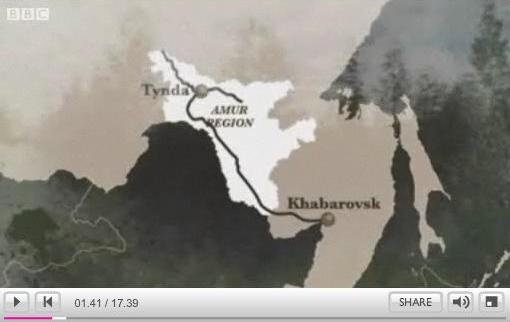
The BBC ran an interesting video story on North Korean loggers felling trees in Russia.  Of course this has been going on for a long time. However, this is the first video footage of the logging facilities that has appeared in the Western media.

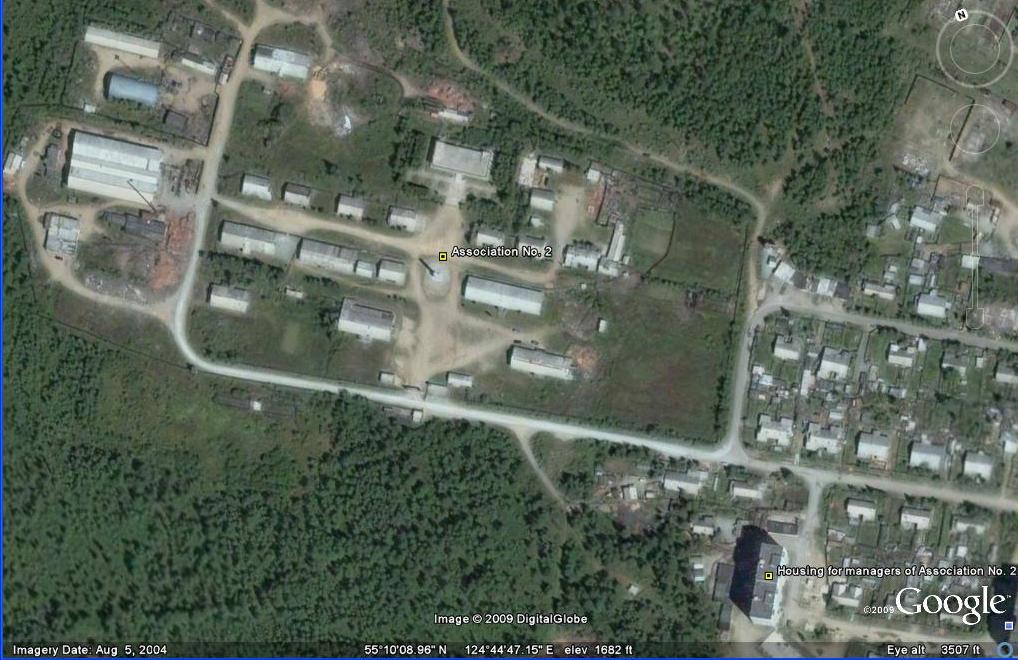
According to the video, North Korea’s logging concessions are managed by a company called “Association No. 2,” which is housed in a compound in northern Tynda, Russia.  According to the story, Association No. 2 receives 35% of proceeds of logging (appx $7m) some fraction of which is repatriated to the DPRK’s Ministry of Forestry.  Using the video, I located the Association No. 2 compound on Google Earth. Here is an image:

assn2.JPG

(Click on image for larger version.  You can see it in Google Maps here.)

Additional Notes:

1. I have not been able to locate the other North Korean logging camps in Russia.  If any readers can find them, please let me know.

2.  The DPRK appointed a new Minister of Forests last October.

3. Bertil Lintner on North Koreans working in Russia.

4. Andrei Lankov on the loggers.

5. Claudia Rosette on the loggers.

6. YouTube video on NKs in Russia.

Share

NKoreans on quiet US trip on food aid

Saturday, August 29th, 2009

According to the AFP:

North Korean officials quietly visited Los Angeles last week to talk about resuming food aid, which the impoverished state cut off five months ago during a standoff, participants have said.

The move comes as tensions gradually ease with North Korea, which stunned the world by conducting a nuclear test earlier this year but in recent weeks has made overtures for dialogue.

Five North Korean officials received special US permission to visit Los Angeles where they met representatives of non-governmental organizations that provide relief worldwide, according to the groups.

Richard Walden, president of Operation USA, said the charity picked up the North Koreans at the airport as a goodwill gesture and took them on a tour of its warehouse stocked with medicine and medical equipment to be sent overseas.

“They were very open, very nice and very cordial,” Walden told AFP. “They looked like they were from any other aid ministry in any country.”

he delegation, which also met with other relief groups, included four members of the Korea-US Private Exchange Society, the North Korean body charged with handling relief goods from US non-governmental organizations.

A fifth delegation member came from North Korea’s mission at the United Nations and received special permission to travel beyond the New York area, Walden said.

I also read the North Koreans made a pit stop in Los Vegas

Read the full story here:
AFP
NKoreans on quiet US trip on food aid
8/29/2009

Share

DPRK rocket tests benefit Rusian military interests

Saturday, August 29th, 2009

Although the foreign policy implications of US missile defense plans with regards to Russia lie outside the scope of this blog, it is worth pointing out that the Russian government has very cleverly found a way to use North Korean rocket and missile tests to its strategic advantage–by claiming that the North Korean missile tests pose a potential danger to citizens of Eastern Russia.  The potential North Korean threat gives political cover for a build up of the Russian military capacities near Vladivostok where not only the Russian military but also the US, South & North Korean, Japanese, and Chinese forces are also strategically positioned.  According to the Times of London:

The Kremlin ordered troops to deploy Russia’s most advanced missile defence system, the S-400, to intercept any threats from North Korea’s nuclear programme. General Nikolai Makarov, the head of the Russian army, said that a mobile battery of 32 surface-to-air missiles had been put into operation in anticipation of any Korean tests.

“We are taking these preventative measures as a security guarantee against faulty launches of the missiles and to guarantee that fragments of these missiles never fall on Russian territory,” he said. “We are concerned by the fact that the site in North Korea where it carries out its nuclear tests is located quite close to the Russian border.”

A senior Russian senator said that use of the S-400 system could not be ruled out, but he rejected any comparison between Moscow’s actions and the decision by the United States to build a missile defence shield in Eastern Europe. The US argues that the shield is necessary to deter attacks by rogue nations such as Iran and North Korea, but Russia has denounced the plan as a threat to its national security.

Mikhail Margelov, chairman of the Federation Council’s International Affairs Committee, said that the US was responding to “non-existent” dangers, while Russia was defending against “the emergence of real sources of threat”.

Russia’s Far Eastern city of Vladivostok is just 93 miles from its narrow border with North Korea. Six missiles test-fired by North Korea in 2006 reportedly fell in Russian waters in the Sea of Japan.

North Korea fired 11 short-range rockets with a range of up to 500km in two separate launches last month, defying a United Nations ban on ballistic missile activities linked to sanctions against its nuclear programme.

The regime in Pyongyang carried out a second underground nuclear explosion in May at the same time as it test-fired another series of short-range missiles. It also test-fired a long-range missile in April that is said to be capable of reaching Britain and the US.
[…]
The S-400 “Triumph” system has a range of up to 400km and is said to be capable of bringing down cruise and tactical missiles as well as aircraft using stealth technology.

Who will move next?

Read the full story here:
Russia deploys missiles along border with North Korea
Times of London
Tony Halpin
8/29/2009

Share