Archive for the ‘International Governments’ Category

Preliminary DPRK census numbers

Thursday, August 27th, 2009

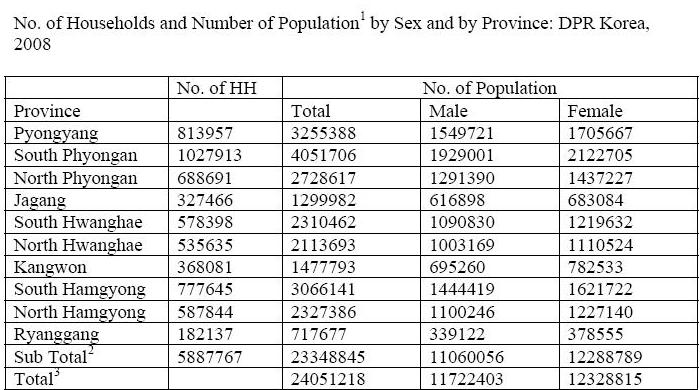
(h/t to H. Williams) Preliminary numbers from the UN-funded and administered DPRK census have been published.  According to the UN, the DPRK’s population as of October 2008 breaks down as follows:

census-data.JPG

Click on image for larger version, or better yet, see the results in the original PDF here.

Here is some more information from the Choson Ilbo:

The United Nations Population Fund announced a few days ago that a two-week census study conducted on North Korea in October of last year showed the country’s population as being 24.05 million people. That finding went against the forecasts of experts that North Korea’s population would have dropped from 21.21 million in 1993 to less than 18 million, due to a prolonged economic slump. Until 1993, North Korea had suppressed childbirth. But starting in 1996, when more and more people began starving to death, North Korea has been promoting childbirth by prohibiting abortions and offering special support payments to families that have many children.

North Korea also suffered from a concentration of its population, with 40 percent of its total population living in the Pyongan provinces. More than 4 million people live in South Pyongan Province, 3.26 million in the capital Pyongyang, and 2.73 million in North Pyongan Province. Unlike South Korea, there were 600,000 more women than men. But North Korea is said to have requested the UNFPA to keep the data under wraps. That was because of the breadth of the information contained the latest study, from details on individuals to data on incomes, the items owned by households, and even the availability of bathrooms, heating, tap water and sewage processing facilities.

The reason why North Korea had no choice but to agree to the information being unveiled was because South Korean capital and know-how was used to conduct the survey. According to a request by the UNFPA, South Korea footed $4 million of the $7 million spent to conduct the census, while the South’s National Statistical Office offered the method and technique used to conduct the census. As a result, the UNFPA mobilized 35,200 North Korean census takers and conducted house-to-house surveys on 5.89 million homes.

The UNFPA considered it “interesting” that North Korea had unveiled the results of the census to the world. Sultan Aziz, head of the UNFPA’s Asia-Pacific division, appeared on Voice of America and said North Korea unveiled itself to the world because it knew that it must first take a close look at itself in order to develop its own economy. That is why there are forecasts that North Korea will soon turn to the international community for help. The results of a detailed census, including the infant mortality rate and average life expectancy, due out in the first half of this year, will deliver more of a shock to North Korea than anyone else.

Share

Tesco reports drop in sales to North Koreans in Dandong

Wednesday, August 19th, 2009

According to Bloomberg, North Koreans in the Chinese city of Dandong have slashed purchases of ham, shirts, and candy at UK-owned Tesco:

At the Tesco store, Zhao said fewer North Koreans are coming in, and they’re spending less. Most North Koreans can’t freely cross the border, and only those with the ability to travel abroad shop in Dandong.

“Before this year, they would buy over 10,000 yuan in goods, now they typically only spend thousands,” she said. (10,000 yuan is about $1,460.)

Shopkeepers working within sight of the Sino-Korean Friendship Bridge spanning the Yalu River that separates the countries said traffic is down by as much as half since May.

Fan Bo said he sells about 10 generators a month to North Korea, all to Chinese companies doing business there. “The North Koreans don’t need generators,” he said. “They don’t use electricity.” Mao Yifeng, a tire seller, blames the global financial crisis for the slowdown.

Over the course of half an hour on Aug. 12, two empty blue Chinese trucks crossed the bridge into Dandong. One diesel freight train, also Chinese, crossed to China from North Korea. The open door on one of its two cars revealed there was nothing inside.

Over 45 minutes the next morning, two empty trucks and three empty North Korean buses crossed into China. No trucks were seen heading into the North.

A souvenir salesman who only gave his surname, Huang, said he’s seen road and rail traffic on the Friendship Bridge fall by about half since North Korea’s nuclear test in May. “It was never busy, now it’s even less,” Huang said.

….Trade Aid

China is the North’s biggest trading partner. Its support for the regime can be gauged by the trade surplus it runs with the country, according to Nicholas Eberstadt, a Korea specialist at the American Enterprise Institute in Washington. That fell to $386 million in the first half of this year from $1.27 billion in all of 2008, as China’s imports of coal from North Korea hit the highest level in at least five years, China’s Ministry of Commerce data show.

“China is Kim Jong Il’s patron of last resort,” said Eberstadt. “If net transfers from China continue to shrink, it will be ‘back to the 1990s’ for North Korea. That can only be an alarming prospect for Kim Jong Il and his would-be successors.”

Official trade statistics, incomplete and not including goods smuggled by sea or across the 1,415-kilometer (880 mile) border, show two-way trade between China and North Korea fell 2.5 percent in the first six months of this year to $1.12 billion, according to China’s Commerce Ministry. Trade between China and South Korea during the same period was $67.6 billion.

Read the full artilce here:
North Koreans Spurn Tesco Ham as China Trade Withers
Bloomberg
Michael Forsythe
8/19/2009

Share

Chinese tourists stay away from North Korea after nuclear test

Sunday, August 16th, 2009

By Michael Rank

Far fewer Chinese tourists are visiting North Korea from the border towns of Yanbian and Yanji due to nerves over the country’s recent nuclear and missile tests, a Chinese website reports.

This is normally the height of the tourist season, the report notes, but this year hardly any tourists taking tours to visit the nearby North Korean port city of Rajin (Najin) 라진/나진. “In previous years there have been about 300 or 400 tourists a day [crossing into North Korea] at this time, but recently there have been only about 20,” it quotes a Yanbian travel agent as saying.

Two-day trips from Yanji cost only 800 yuan ($117) per person but because the nuclear testing and rocket launch sites are nearby most tourists are keeping away, the report adds.  Rajin is in fact about 250 km north of the nuclear testing site near Gilju (Kilchu) 길주 but who know what is safe…?

The report claims that things are different in the biggest border city Dandong and that tourists are crossing the frontier at normal levels there.

But this was contradicted by a surprisingly frank report in the China Daily earlier this month which quoted Li Peng, general manager of the Dandong branch of the State-owned China International Travel Service (CITS), as saying: “The revenues from four-day tours and business trips to the DPRK have plunged at least 50 percent compared to last year.”

He said about 30,000 tourists have traveled with his company to the DPRK from Dandong in the past two years, with a four-day visit costing around 2,400 yuan ($350) per person.

“But during the first seven months of this year, we have seen 2,000 make the trip. Many canceled because of safety concerns,” he said, adding that the recent capture and imprisonment of two journalists from the United States had done nothing to ease those concerns.

The journalists have since been released, but it’s unlikely this will result in a massive rebound in China-North Korea tourism.

Another China Daily report was remarkably frank about smuggling which has also been badly hit by the nuclear furore. It also quoted Dandong Federal Business Corp Chairman Shan Jie, who said: “Most of the nearly 1,000 legal enterprises involved in border trade here have stopped operations.”

Meanwhile, the latest report focuses on a North Korean waitress in Dandong who “sports a luxury Gucci watch on her left wrist – and a Democratic People’s Republic of Korea (DPRK) flag pin on her chest.”

“Her restaurant is one of Dandong’s most luxurious and one of the few establishments in the Chinese city bordering the DPRK that is still seeing brisk business in the wake of Pyongyang’s nuclear test in May and subsequent missile launches.”

Share

DPRK restaurant in Dandong

Sunday, August 16th, 2009

China Daily reports on a North Korean restaurant in the Chinese border city of Dandong (hat tip to O.P.). According to the article:

Choe says she came to Dandong four months ago. Her restaurant is one of Dandong’s most luxurious and one of the few establishments in the Chinese city bordering the DPRK that is still seeing brisk business in the wake of Pyongyang’s nuclear test in May and subsequent missile launches.

The Korea Restaurant, is located near the only bridge linking Dandong and the DPRK, through which the Chinese army reached the DPRK and joined the Korean War in 1950. All of about 20 tables were full on the Saturday afternoon we visited recently, despite prices that are double that of common restaurants in Dandong serving the same food.

Some men from the DPRK in dark yellow or blue suits, with pins of DPRK leader on their chests, also dined there.

Choe’s colleagues, equally young and attractive, wait at tables in blue skirt suits and light makeup. They wear stylish, high-heeled shoes and watches, serving guests with smiles.

“The main reason for the restaurant’s good business is the DPRK waitresses. It’s the easiest way to meet people from that country,” said a taxi driver, surnamed Li.

“Though border trade has been slashed, more and more people are interested in the DPRK after the recent events. You can even see more Westerners here,” Li said.

Shan Jie, board chairman of the Dandong Federal Business Corp which runs cross-border trade, said the waitresses “are by no means common DPRK citizens”.

“They’re all children of DPRK cadres and graduates of Kim Il-sung University. They can speak Chinese, and are very talented in singing and dancing,” said Shan, who has conducted businesses with the DPRK for 16 years. Most of the DPRK cadres attend that university, he said.

The girls were sent to Dandong for training and will have “a promising future as civil servants” when going back home, Shan said.

“It’s a good opportunity for them to practice Chinese and meet Chinese people of all levels. Besides, they earn money for their country,” he said.

Pyongyang has many restaurants in Dandong, and many DPRK ministries such as the ministries of trade and security have their own restaurants there, Shan said.

Choe said the Korea Restaurant is of the same restaurant chain as Beijing Pyongyang Begonia Flower Restaurant, a famous luxury Korean restaurant said to be run by a DPRK merchant with a military background.

When asked whether she is the daughter of DPRK officials, Choe switched to speaking in Korean with a colleague before ending the conversation.

“The girls here mostly work for one and half years I’ll stay for about three years,” Choe said.

“Dandong is pretty and people here are quite nice. But I will go back to my country, Pyongyang is the most beautiful place in the world.”

If any readers in Dandong could help identify where these restaurants are, I would appreciate it.  I would like to mark them on Google Earth and Wikimapia.

Read the full article here:
DPRK waitress in China shares a day in her life
China Daily
Li Xiaokun and Wang Huazhong
8/14/2009

Share

Larua Ling – Euna Lee saga: From the beginning

Sunday, August 9th, 2009

UPDATE 24 (4/1/2011): The University of Georgia is  awarding Ling/Lee with McGill Medal. According to the AP:

The University of Georgia is honoring two reporters held captive in North Korea for 140 days in 2009.

Laura Ling and Euna Lee will receive the McGill Medal for Journalistic Courage on April 20 in Athens. The medal is named for Ralph McGill, the editor and publisher of the Atlanta Constitution who challenged racial segregation in the 1950s and ’60s.

Ling and Lee were selected from a pool of candidates nominated by reporters, editors and academicians from across the country.

UPDATE 23: Laura Ling named her first child after President Clinton.

UPDATE 22: According to the Associated Press:

An American journalist who was imprisoned in North Korea for months after briefly crossing into the reclusive country while reporting about the sex trade said Tuesday she told interrogators in a ploy for mercy that she was trying to overthrow the government.

In her first televised interview since her August release, Laura Ling said on “The Oprah Winfrey Show” that she was told the worst could happen if she didn’t confess.

Ling said she drew suspicion because she worked for San Francisco-based Current TV, a media venture founded by former Vice President Al Gore.

“I knew that that was the confession they wanted to hear and I was told if you confess there may be forgiveness and if you’re not frank, if you don’t confess then the worst could happen,” Ling said.

“It was the most difficult decision to have to do that. I didn’t know if I was sealing my fate,” she said. “But I just had to trust that this was the right thing to do.”

Ling and journalist Euna Lee were captured at the North Korea-China border in March 2009 while reporting about North Korean women who were forced into the sex trade or arranged marriages when they defected to China.

They spent the first few days of their captivity in a five-by-six foot jail cell.

“There were no bars so you couldn’t see out. And if they closed those slats, it just went completely dark,” Ling said.

The women were moved to a Pyongyang guesthouse soon after, where Ling said conditions improved, but there were no showers and the power and water went out several times a day.

“I developed a system to wash where they would allow me to heat a kettle of water,” she said. “I would mix it with some cold water and then I would scrub down and just splash it on me.”

The women were convicted of illegal entry and “hostile acts” and sentenced to 12 years of hard labor. Ling said she was petrified and tried to prepare herself for a long sentence, “but once I heard those words ’12 years’ come from the judge I could barely stand up right.”

She said she spiraled into a deep depression, refused her meals and huddled in a dark corner of her room. She said she sought strength by thinking about other innocent people imprisoned.

“If these people are undergoing this then I can try to muster up the strength to get through it,” she said.

Ling also said she was angry with herself and would slap and hit herself as punishment for putting her family through the ordeal. She thought she might be pregnant when she was captured then was crushed to learn she wasn’t.

“I thought, I will never be able to have a family with my husband again,” said Ling, who is now pregnant and due in June.

UPDATE 21: According to Yonhap:

Two North Korean soldiers who arrested female U.S. journalists on the border with China in March have been treated like heroes, according to North Korean media reports monitored here on Thursday.

The North Korean soldiers, Son Yong-ho and Kim Chol, appeared on a special program of the Pyongyang-based Korean Central TV Broadcasting Station and reflected on the moment they detained the two American journalists — Laura Ling and Euna Lee of the San Francisco-based Internet outlet Current TV.

During the TV program produced to celebrate the inaugural anniversary of North Korean leader Kim Jong-il, the master of ceremonies disclosed that North Korean leader Kim gave the “Kim Il-sung Youth Honor Award” and a special leave to the North Korean border guard soldiers for their “feat” in the arrest of the U.S. journalists.

Kim Il-sung, the founder of North Korea, is the father of leader Kim Jong-il.

In the TV program, soldier Son said that he received a hero’s welcome when he visited his hometown on a special leave. “I arrived in my hometown like a triumphant general. All residents came out to give me wreaths of flowers. A top local official even gave me a ride on his shoulder,” said Son.

He also recalled the American reporters’ arrest, saying, “On the early morning of March 17, we arrested the people as they appeared to have hostile purposes. One of the Americans offered us money begging for mercy, but we flatly turned down the offer.”

Laura Ling and Euna Lee were arrested in March on the China-North Korea border while reporting on refugees fleeing the isolated state. They were sentenced in June to 12 years in a labor camp for an unspecified “grave crime” and illegal border-crossing.

UPDATE 20: Ms. Ling and Ms. Lee wrote an article for the Los Angeles Times giving some more details of their capture:

We arrived at the frozen river separating China and North Korea at 5 o’clock on the morning of March 17. The air was crisp and still, and there was no one else in sight. As the sun appeared over the horizon, our guide stepped onto the ice. We followed him.

We had traveled to the area to document a grim story of human trafficking for Current TV. During the previous week, we had met and interviewed several North Korean defectors — women who had fled poverty and repression in their homeland, only to find themselves living in a bleak limbo in China. Some had, out of desperation, found work in the online sex industry; others had been forced into arranged marriages.

Now our guide, a Korean Chinese man who often worked for foreign journalists, had brought us to the Tumen River to document a well-used trafficking route and chronicle how the smuggling operations worked.

There were no signs marking the international border, no fences, no barbed wire. But we knew our guide was taking us closer to the North Korean side of the river. As he walked, he began making deep, low hooting sounds, which we assumed was his way of making contact with North Korean border guards he knew. The previous night, he had called his associates in North Korea on a black cellphone he kept for that purpose, trying to arrange an interview for us. He was unsuccessful, but he could, he assured us, show us the no-man’s land along the river, where smugglers pay off guards to move human traffic from one country to another.

When we set out, we had no intention of leaving China, but when our guide beckoned for us to follow him beyond the middle of the river, we did, eventually arriving at the riverbank on the North Korean side. He pointed out a small village in the distance where he told us that North Koreans waited in safe houses to be smuggled into China via a well-established network that has escorted tens of thousands across the porous border.

Feeling nervous about where we were, we quickly turned back toward China. Midway across the ice, we heard yelling. We looked back and saw two North Korean soldiers with rifles running toward us. Instinctively, we ran.

We were firmly back inside China when the soldiers apprehended us. Producer Mitch Koss and our guide were both able to outrun the border guards. We were not. We tried with all our might to cling to bushes, ground, anything that would keep us on Chinese soil, but we were no match for the determined soldiers. They violently dragged us back across the ice to North Korea and marched us to a nearby army base, where we were detained.

Over the next 140 days, we were moved to Pyongyang, isolated from one another, repeatedly interrogated and eventually put on trial and sentenced to 12 years of hard labor.

In researching the story, we sought help from several activists and missionaries who operate in the region. Our main contact was the Seoul-based Rev. Chun Ki-won, a well-known figure in the world of North Korean defectors. Chun and his network have helped smuggle hundreds of North Koreans out of China and into countries — including the U.S. — where they can start new lives. He introduced us to our guide and gave us a cellphone to use in China, telephone numbers to reach his associates and specific instructions on how to contact them. We carefully followed his directions so as to not endanger anyone in this underground world.

Because these defectors live in fear of being repatriated to North Korea, we took extreme caution to ensure that the people we interviewed and their locations were not identifiable. We met with defectors away from their actual places of work or residence. We avoided filming the faces of defectors so as not to reveal their identities. The exception was one woman who allowed us to film her profile.

Most of the North Koreans we spoke with said they were fleeing poverty and food shortages. One girl in her early 20s said she had been told she could find work in the computer industry in China. After being smuggled across the Tumen River, she found herself working with computers, but not in the way she had expected. She became one of a growing number of North Korean women who are being used as Internet sex workers, undressing for online clients on streaming video. Some defectors appeared more nervous about being interviewed than others. But they all agreed that their lives in China, while stark, were better than what they had left behind in North Korea.

We also visited a foster home run by a pastor who worked for Chun. The home housed six children born to North Korean women who were forced into marriage in China. The mothers had either been repatriated to North Korea or had abandoned their families. Because the children have Chinese fathers, it is unlikely they will be deported to North Korea. The foster home provides them with decent conditions, an education and hope for a better life.

In the days before our capture, our guide had seemed cautious and responsible; he was as concerned as we were about protecting our interview subjects and not taking unnecessary risks. That is in part why we made the decision to follow him across the river.

We didn’t spend more than a minute on North Korean soil before turning back, but it is a minute we deeply regret. To this day, we still don’t know if we were lured into a trap. In retrospect, the guide behaved oddly, changing our starting point on the river at the last moment and donning a Chinese police overcoat for the crossing, measures we assumed were security precautions. But it was ultimately our decision to follow him, and we continue to pay for that decision today with dark memories of our captivity.

After we were detained, the two of us made every effort to limit the repercussions of our arrest. In the early days of our confinement, before we were taken to Pyongyang, we were left for a very brief time with our belongings. With guards right outside the room, we furtively destroyed evidence in our possession by swallowing notes and damaging videotapes. During rigorous, daily interrogation sessions, we took care to protect our sources and interview subjects. We were also extremely careful not to reveal the names of our Chinese and Korean contacts, including Chun. People had put their lives at risk by sharing their stories, and we were determined to do everything in our power to safeguard them.

Our families and colleagues back home maintained total silence about our work for two full months, both to minimize the potential impact on sensitive underground work in China and to protect us. We were surprised to learn that Chun spoke with reporters publicly in the immediate aftermath of our arrest. Among other things, Chun claimed that he had warned us not to go to the river. In fact, he was well aware of our plans because he had been communicating with us throughout our time in China, and he never suggested we shouldn’t go. Chun’s public statements prompted members of our families to speak directly with him in Korean, pleading with him to refrain from any further comment that might jeopardize our situation and those of relief organizations working along the border.

We know that people would like to hear more about our experience in captivity. But what we have shared here is all we are prepared to talk about — the psychological wounds of imprisonment are slow to heal. Instead, we would rather redirect this interest to the story we went to report on, a story about despairing North Korean defectors who flee to China only to find themselves living a different kind of horror. We hope that now, more than ever, the plight of these people and of the aid groups helping them are not forgotten.

Read the full story here:
Hostages of the Hermit Kingdom
Los Angeles Times
Laura Ling and Euna Lee
9/1/2009

UPDATE 19: To read more about the DPRK’s legal processes and statutes that were in play throughout the DPRK’s detention of the two reporters, click here.

UPDATE 18: Current TV filed for an IPO (Initial Public Offering) in January. More here. In April, shortly after Euna and Laura were captured, the IPO was cancelled:

Al Gore’s Current Media has canceled plans for a $100 million IPO. In a filing with the Securities and Exchange Commission, Current Media says it has withdrawn its registration “in light of current market conditions.” When the company initially filed for the IPO last January, it said it would use proceeds to pay down debt and fund general operations. Since then, the market has tanked, and Current Media has run into a bit of a rough spot, eliminating 60 positions in November. The company last reported results a year ago, posting a net loss of $7.5 million for the first three months of 2008, compared to a loss of $2.9 million during the same period the year before.

I am not asserting that the IPO and the Laura/Euna saga are directly related.  I am merely posting this information because it adds some context to the story.

UPDATE 17: According to the Chison Ilbo, China used the reporters’ captured video to round up North Koreans hiding in China and those helping them:

Video footage shot by two TV journalists who were detained in North Korea after filming on the Chinese border was used by China to round up on North Korean refugees. China also deported one South Korean human rights activist who is seen in the footage and closed five orphanages that had protected North Korean children.

Chinese police also confiscated related materials including list of activists working for North Korean refugees in China, data on North Korean orphans, and video footage showing North Korean women who were sold into the Chinese countryside or appeared in porn videos.

The claims were made Thursday by Lee Chan-woo (71), a pastor with the Durihana Mission, a South Korean organization that aids North Korean defectors. Lee was caught and deported by Chinese police for helping the two reporters, who worked for former U.S. vice president Al Gore’s Internet news channel Current TV.

Lee said Laura Ling, Euna Lee and a man named Mitch Koss met him at a hotel in Yanji, in China’s Jilin Province, on March 14. They said they wanted to gather information about North Korean women who were working in adult videos at the North Korean-Chinese border area and on other North Korean women who were sold into the Chinese countryside.

They also wanted to know about children born to North Korean women and Chinese men. At the time, Lee was protecting some 21 children who had been abandoned by their Chinese families after their mothers were taken back to the North at five orphanages.

“I allowed them to collect information about the children on condition that they would not film their faces,” he said.

The three visited an orphanage the following day. Euna Lee, who speaks fluent Korean, asked children to send video messages to their mothers who had been deported to the North, and to bow to their mothers in front of the camera. But Lee said he stopped them from filming the scene.

The next day, the journalists filmed North Korean women at the border. They crossed the border and were arrested by North Korean soldiers on March 17. Ling and Lee were taken to North Korea, but Koss made it back and was arrested by Chinese border guards and handed over the video footage he was carrying.

On the early morning of Mar. 19, Chinese police raided Lee’s house and confiscated his computer, camera and various documents. “The documents contained the personal information of 25 North Korean orphans in addition to the children staying at the orphanages, and the phone numbers and addresses of human rights activists and their future plans,” he said. “I was interrogated intensively by three Korean-Chinese police officers until March 26. It was during interrogation that I found out that Chinese police had confiscated the video.”

Lee was deported to South Korea on April 8 after paying a fine of 20,000 yuan (approximately W4 million). “The five orphanages were forced to close down one by one,” he said. “I found Chinese relatives for 17 of the 21 orphans and a safe shelter for the remaining four, who have no relatives there.”

UPDATE 16: According to the New York Times clinton’s visit, and the journalists’ release were arranged by Joseph R. DeTrani:

The visit was arranged under a veil of secrecy with the help of an unlikely broker: a high-level American intelligence officer who spent much of his career trying to unlock the mysteries of North Korea.

When former President Bill Clinton landed in Pyongyang on Aug. 4 to win the release of two imprisoned American journalists, senior officials said he met an unexpectedly spry North Korean leader, Kim Jong-il, who welcomed him with a long dinner that night, even proposing to stay up afterward.

Mr. Kim was flanked by two longtime aides, and he gave no hint that North Korea was in the throes of a succession struggle, despite the widespread questions over how long he might live.

Mr. Clinton and the Obama administration were determined not to extend a public-relations coup to Mr. Kim, who expressed a desire for better relations with the United States. But the visit is already setting off ripples that could change the tenor of the relationship between the United States and North Korea.

Mr. Clinton steered clear of broader issues during his humanitarian mission, officials said. Indeed, he did not even ask to see Mr. Kim, requesting instead a meeting with “an appropriate official.” To help the former president in case something went awry, the White House recommended John Podesta, an adviser to both Mr. Clinton and President Obama, join his delegation.

And to ensure he would not leave empty-handed, Mr. Clinton asked that a member of his entourage meet with the journalists, Laura Ling and Euna Lee, shortly after he landed to make sure they were safe, said a senior administration official, who had been briefed on the visit.

The role of the intelligence officer, Joseph R. DeTrani, in arranging the visit, has not previously been reported. Mr. DeTrani is the government’s senior officer responsible for collecting and analyzing intelligence on North Korea. His efforts to pave the way for Mr. Clinton’s visit offer a glimpse into how the administration has been forced to use unorthodox methods to overcome the lack of formal communications.

During the Bush administration, when the United States was in still in talks with North Korea, the White House did not use intelligence officers for these purposes, an official familiar with the talks said. Indeed, before taking the job of North Korea mission manager in the Office of the Director of National Intelligence in 2006, Mr. DeTrani served as the special envoy to the six-party talks with North Korea.

UPDATE 15: According to the Los Angeles Times, Lisa Ling states that Laura and Euna crossed into North Korea for “maybe 30 seconds” before they were captured and detained.   Lisa says Laura plans to write an editorial explaining what happened and how she was captured.

Additionally, the media is reporting the following quote a fair amount:

She had two guards in her room at all times, morning and night. And even though they couldn’t speak to her, somehow they developed a strange sort of kinship, Lisa Ling said. “She had some really lovely things to say about the people who were watching over her.”

My suspicion is that this “kinship” is largely imagined and was possibly even nurtured by the North Koreans.  The guards were almost certainly not doing anything they were not specifically authorized to do.  Nobody seems to realize that there were two guards stationed in her room precisely to prevent one of them from becoming acquainted with and developing sympathies for the two American women.  These guards had to report on each other as well as the prisoner.  This bastardized version of the buddy system is essentially the same reason the DPRK stations at least two guards together at each post along the DMZ.

Finally, the North Korean news videos of Clinton’s visit are finally up on Elufa.net.  You can watch and download them here. Here is KCNA coverage of President Clinton’s visit on Youtube.

Read all the posts related to this chain of events below:
(more…)
Share

South Africa hosts DPRK gun show?

Wednesday, August 5th, 2009

According to Reuters:

South Africa’s arms control body has authorised an arms exhibit for North Korea and the possible sale of weapons to Iran, Syria and Libya which should be investigated, the main opposition party said on Tuesday.

The Democratic Alliance said a number of “dodgy” deals had “slipped through the cracks” when South Africa’s National Conventional Arms Control Committee (NCACC) last met in 2008.

David Maynier, a Democratic Alliance MP and shadow defence minister, said the NCACC had authorised a marketing permit for a South African-based company in the past three years to demonstrate and exhibit military support equipment for North Korea.

“The military support equipment was radar warning receivers used on antennae for submarines,” he told Reuters. Maynier declined to name the company but said it had exhibited the equipment “within the last three years”.

The NCACC was set up in 1995 to ensure arms trade and transfer policies conformed to internationally-accepted practices.

Maynier urged South African Justice Minister Jeff Radebe, the new head of the NCACC, to urgently investigate the alleged arms transactions with North Korea and other states.

Neither Radebe’s spokesman nor the official government spokesman were immediately available for comment.

Read the full article below:
South Africa arms body allows North Korea exhibit
Reuters
8/5/2009

Share

The Politics of South Korean aid to the DPRK

Tuesday, August 4th, 2009

According to Yohap:

South Korea authorized state funding for 10 North Korea aid organizations Monday, resuming humanitarian operations that had been frozen since the North conducted nuclear and rocket tests.

But the rare softening move toward Pyongyang drew mixed reactions among aid organizations in Seoul, as 3.57 billion won (US$2.92 million) worth of funding will go to less than a quarter of 47 applicants. Some called the selection “arbitrary” and vowed to boycott it.

“The government selected projects that are aimed at helping disadvantaged groups like toddlers and infants, mothers and the disabled on grounds that they contribute to the people’s livelihoods, their urgency and effects,” the Unification Ministry said in a statement.

The funding shrank considerably from last year, when the ministry spent more than 10 billion won for 40 aid groups. Spending cuts in other North Korea projects were also evident, as South Korea executed only 2.8 percent of its yearly budget for economic and humanitarian aid to North Korea during the first half of this year, or 42.42 billion won out of 1.5 trillion won. Seoul officials cite international sanctions over North Korea’s nuclear and missile activity and the protracted stalemate in inter-Korean relations as reasons for the hardening aid policy.

An umbrella group of 56 Seoul-based aid organizations, the Korea NGO Council for Cooperation with North Korea, called an emergency meeting and vowed not to accept the funding unless its selection criteria is fully explained. Secretive selection only fuels internal rifts and rivalry, it said.

“This decision will only drive our aid projects, which continued cooperatively for nearly 10 years, to division and competition. I wonder if this arbitrary selection is a way of taming non-governmental organizations,” Park Hyun-seok from Rose Club Korea, a Christian group focused on medical aid, said in an emergency meeting between aid groups. Rose Club lost its bid for funding.

But signs of a rift emerged among the aid organizations, as some cited the urgency of their stalled missions in the North. Kang Young-shik of the Korean Sharing Movement, which emerged as one of the major beneficiaries with 540 million won in funding, said his organization will accept the money, as the umbrella organization has no binding force over its members.

“It is for each organization to decide. And we believe this fund should be released if there isn’t more expected anytime soon,” Kang said.

In a unanimous call, the aid groups urged the government to lift a ban on humanitarian aid shipments and to stop monitoring trips to North Korea, actions put in place after the North’s nuclear test in May. The restrictions have prevented not only aid from state coffers, but also private donations, from reaching North Koreans.

Sue Kinsler, a Korean-American and head of the Lighthouse Foundation, which helps orphans and the disabled in the North, said the living conditions there have notably deteriorated, with bread factories running short of flour and children wearing the same clothes her organization sent last year.

“We also wanted to bring underwear and some clothes for the children, but we were told those items are not allowed,” Kinsler, who visited North Korea last week with 18 tons of flour, soybeans, sugar and vegetable oil, said. “I saw with my eyes they are experiencing serious food shortages in the midst of the international sanctions.”

Kim Nam-sik, director general of the ministry’s Inter-Korean Exchanges and Cooperation Bureau who attended the aid groups’ meeting, said the government will consider expanding humanitarian aid and cross-border visits, but its efforts are limited by larger international circumstances. While U.N. financial and other sanctions are in place to curb the communist state’s nuclear and missile activity, the government cannot go against the international trend, he said.

Here is a previous post on South Korean aid to the DPRK this year.

Trade between the Koreas has also floundered this year.

Read the full artilce here:
Selective gov’t funding for N. Korea aid groups causes division, discontent
Yonhap
Kim Hyun
8/3/2009

Share

NK Embassy in Pakistan Involved in Smuggling

Monday, August 3rd, 2009

According to KBS Global (h/t Rokdrop):

Pakistani media have reported on the local North Korean embassy’s alleged involvement in smuggling and illegal exchange of foreign currency.

The Karachi-based Daily Sharafat Karachi said local intelligence authorities reported to Pakistan’s Foreign Ministry that some of North Korean’s embassies and legations abroad were involved in smuggling and illegal foreign exchange transactions.

The intelligence report claimed Pyongyang’s embassy and its economy and trade mission conspired with local smugglers to illegally import liquor and other items from various locations including Dubai.

It said containers disguised as diplomatic pouches for the contraband items and that local customs agents were also involved.

The Pakistani foreign minister has called on the Karachi customs and the intelligence agency for a thorough investigation into the matter.

North Korea’s embassies self-finance their operations on revenues earned in their host countries.  They receive little-to-zero operating funds from Pyongyang.  This incentive structure is interesting from an economic perspective.  Sometimes it generates interesting results like this.  Unfortunately it also generates outcomes like this.  End the end, some diplomats just do not make good businessmen.

Of course, if Pakistan has erected trade and currency laws that make life difficult for honest business persons, which would not surprise me since it ranks just ahead of Yemen in economic freedom, the North Koreans might actually be doing the people of Pakistan a favor by bringing some competition into the market.

Share

US sanctions Hyoksin Trading Corporation

Thursday, July 30th, 2009

Nearly two weeks ago, the UN Security Council sanctioned five North Korean organizations. One of them was the Hyoksin Trading Corporation.  I believe they even have a web page here.

Today, the US imposed financial sanctions on this company.  According to the The Associated Press  (Via the Washington Post):

The Obama administration on Thursday imposed financial sanctions on a North Korean firm accused of involvement in the country’s missile programs.

The Treasury Department’s action covers Korea Hyoksin Trading Corp. It means any bank accounts or other financial assets found in the United States that belong to the company must be frozen. Americans also are prohibited from doing business with the firm.

It is the latest move by the United States to keep pressure on Pyongyang, whose nuclear ambitions have ratcheted up global tensions.

The department alleges that Korea Hyoksin Trading is owned or controlled by another North Korean firm, Korea Ryonbong General Corp., which the United States says is involved in the development of weapons of mass destruction. Korea Ryonbong supports Pyongyang’s sales of military-related items, the department said.

Read the full story here:
US tightens financial noose on North Korea
The Associated Press
Jeannine Aversa
7/30/2009

Share

China pulls out of DPRK mining deal

Thursday, July 30th, 2009

According to the Choson Ilbo:

A Chinese investment company developing a copper mine in North Korea with a North Korean company sanctioned by the UN Security Council has reportedly called an abrupt halt to the project.

An industry source in China said the investment firm sent a letter to NHI Shenyang Mining Machinery, the company it had commissioned to build facilities for the mine in Hyesan, North Korea, telling it to stop construction. An estimated 400,000 tons of copper are deposited there.

The Chinese firm had signed an agreement with (North) Korea Mining Development Trading Corporation (KOMID) [NKeconWatch: a.k.a. Korea Mining Development Corporation) to develop the mine in November 2006. But the North Korean partner was blacklisted by the UN Security Council after North Korea carried out its latest nuclear test.

The industry source said, “When Chinese Vice President Xi Jinping visited Pyongyang in June last year, he pledged full support for the development of the Hyesan copper mine so that it could become a model for investment by Chinese business in North Korea. This prompted NHI to hurry construction so that production could start in September this year.”

But he added the Chinese government apparently persuaded the investment firm to stop the project as Beijing takes part in the UN sanctions. “Otherwise, it’s unusual for a project to be stopped at this late stage,” he said. The investment firm reportedly gave NHI no reason for the cancellation.

Looking at Hyesan on Google Earth, this appears to be the only large-scale minig operation in Hyesan.

Read the full article below:
N.Korea Mining Project Buckles Under UN Sanctions
Choson Ilbo
7/31/2009

Share

