Archive for the ‘International Governments’ Category

CRS report on UNSC Resolution 1874

Tuesday, October 6th, 2009

July 1, 2009
Download the full report here. Download other CRS reports here.

Summary: The United Nations Security Council unanimously passed Res. 1874 on June 12, 2009, in response to North Korea’s second nuclear test. The resolution puts in place a series of sanctionson North Korea’s arms sales, luxury goods, and financial transactions related to its weapons programs, and calls upon states to inspect North Korean vessels suspected of carrying such shipments. The resolution does allow for shipments of food and nonmilitary goods. As was the case with an earlier U.N. resolution, 1718, that was passed in October 2006 after North Korea’s first nuclear test, Res. 1874 seeks to curb financial benefits that go to North Korea’s regime and its weapons program. This report summarizes and analyzes Res. 1874.

On the surface, financial sanctions aimed solely at the Democratic People’s Republic of Korea (DPRK, the official name of North Korea) and its prohibited activities are not likely to have a large monetary effect. Governments will have to interpret the financial sanctions ban of the resolution liberally in order to apply sanctions to the bank accounts of North Korean trading corporations. A key to its success will be the extent to which China, North Korea’s most important economic partner, implements the resolution. In summary, the economic effect of Resolution 1874 is not likely to be great unless China cooperates extensively and goes beyond the requirements of the resolution and/or the specific financial sanctions cause a ripple effect that causes financial institutions to avoid being “tainted” by handling any DPRK transaction. A ban on luxury goods will only be effective if China begins to deny North Korea lucrative trade credits.

Provisions for inspection of banned cargo on aircraft and sea vessels rely on the acquiescence of the shipping state. In the case of North Korean vessels, it is highly unlikely that they would submit to searches. Resolution 1874 is vague about how its air cargo provisions are to be implemented, in contrast to the specific procedures set forth regarding inspecting sea-borne cargo. While procedures are specified for sea interdictions, the authority given is ambiguous and optional. Further, DPRK trade in small arms and ammunition is relatively insignificant, and therefore the ban on those exports is unlikely to have a great impact.

Share

Where do NK artists find inspiration?

Monday, October 5th, 2009

UPDATE: I have since found out that DPRK art was influenced by Russian art until 1968 when Kim Il Sung gave a speech about art having “Korean context.”  After this production of chosunhua (Korean ink painting)  increased.

ORIGINAL POST: When I visited the DPRK in 2004, one of the destinations on the itinerary was the Museum of American War Atrocities in Sinchon.  This museum is flanked by two large murals, and below I have posted a picture of the mural on the right side of the museum:

14(1).jpg
(click for larger version)

The caption at the bottom of the mural reads “Let’s take revenge a thousand times on the US imperialist wolves.”

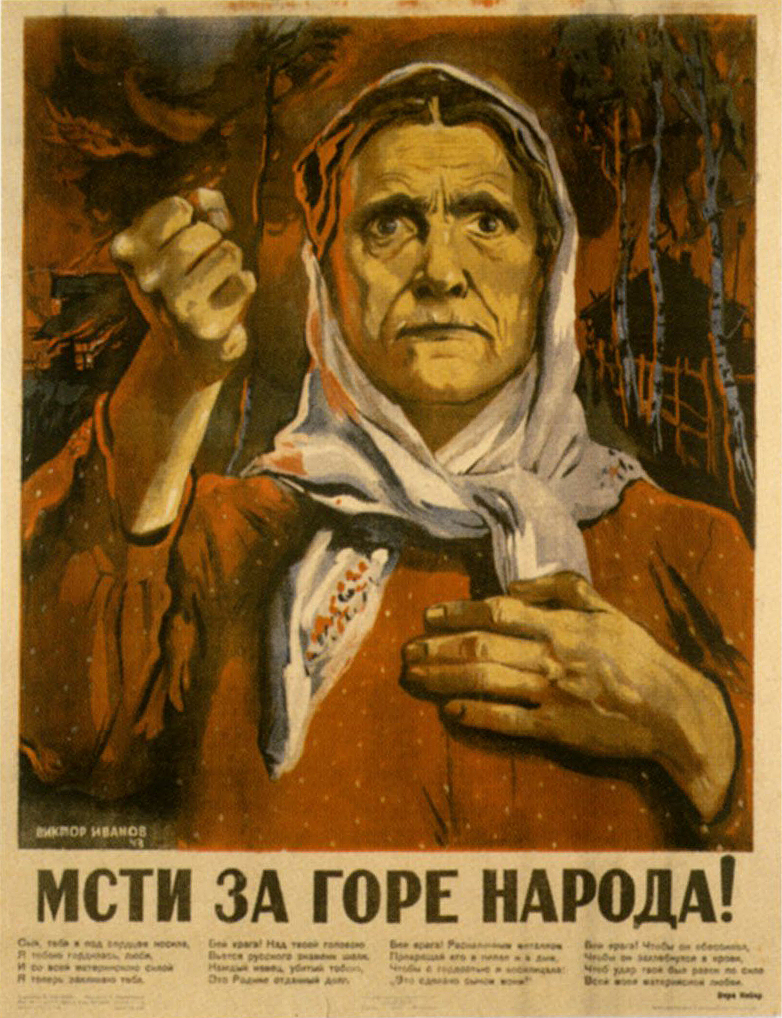
This painting and many others are available in the book North Korean Posters: The David Heather Colleciton by Prestel Publishers.  This weekend, however, I received a copy of Soviet Posters: The Sergio Grigorian Collection also by Prestel Publishers, and after turning only three pages I saw this image:

russian_prop.jpg
(click for larger version)

This poster bears such a resemblance to the North Korean mural above that I believe it is fair to say the North Koreans “borrowed” the sentiment for their own people.  The woman’s face is nearly identical aside from the fact that she has been made Korean and her dress has been converted into a hanbok.  The face, from the nose down, and hands are identical.

The Russian poster is by Konstantin Ivanov and the caption reads “Lets avenge the people’s suffering.”  It was published in 1943, and according to Soviet Posters:

The image of the motherland, born before the war, gained momentum during the conflict (WWII).  Mothers called their soldier-sons to kill and conquer the enemy, and to free the land from the dangers of Nazism.

Can any readers from China or Russia identify any other North Korea copies?

Share

UNDP returns to DPRK

Sunday, October 4th, 2009

According to the Associated Press:

A U.N. development agency has resumed operations in North Korea after a more than two-year pause following allegations of fraud.

The North’s Korean Central News Agency said a ceremony Wednesday marked the return of U.N. Development Program to the country.

UNDP withdrew its operations in March 2007 following allegations that the agency had left itself open to exploitation by the communist regime for money laundering and other illicit purposes.

A U.N. audit cleared UNDP of wrongdoing in June last year, saying the agency knew of no improper financial dealings.

Yonhap news agency reported that UNDP decided to restart its North Korea projects after Pyongyang guaranteed independent auditing and administrative changes to ensure the transparent use of funds.

1. Previous UNDP posts here.

2. Previous DPRK aid posts here.

Read the full article here:
Scandal-hit UN program resumes aid in NKorea
Associated Press
9/30/2009

Share

India detains second DPRK ship

Sunday, October 4th, 2009

UPDATE 2: Last month, South Korea seized a North Korean shipment to Syria which contained hazmat suits “to guard against nuclear, biological or chemical infection”. The four containers that were confiscated in Busan contained the Russian-made suits (or North Korean-made but copied from Russian designs). The report’s lead says that the items were related to chemical weapons, but the rest of the report doesn’t explain why it believes it was chemical-related and not biological or nuclear.

UPDATE 1:  South Korea also searched containers shipped by the DPRK on a Panamanian ship.  According to Yonhap:

South Korea confiscated and searched containers shipped by North Korea on a Panama-registered freighter last month but reportedly found no suspicious cargo, according to sources Monday.

The National Intelligence Service (NIS) and relevant authorities on Sept. 22 ordered an inspection of the ship docked in the southeastern port of Busan and searched the four containers, a government official said, requesting anonymity.

The official said authorities found some kind of protective clothing but did not elaborate further.

A port official in Busan also confirmed that the NIS ordered the search, saying it received tips that the containers could be carrying hazardous material. The ship carrying the containers had arrived from China last month.

“Nothing particular was discovered from the search, but I’m aware that the government is still in the process of confirming the results,” the port official said, refusing to elaborate.

ORIGINAL POST: Last August the Indian government detained and searched a North Koren vessel that was anchored in Indian waters.  This week, the Indian government stopped and searched a second vessel anchored in Indian waters.  According to the Telegraph (of India):

The Indian Coast Guard detained a North Korean vessel for the second time in two months but gave the all-clear to the ship found anchored without permission off the Kerala coast today.

A spokesperson for the navy and the Coast Guard, Commander Roy Francis, said the Hyangro was found stationary in Indian waters when it was supposed to be sailing to Karachi, Pakistan. Coast Guard and naval personnel boarded the ship but found it was carrying no cargo.

The Hyangro was surrounded by two Coast Guard vessels and a naval warship after fishermen reported its presence to the authorities.

The captain of the ship told the investigators he had dropped anchor “because of technical problems in the ship’s tanks that were leaking”. The ship had last made port in Colombo. It is owned by the Pyongyang-based Sinhung Shipping Company.

A navy source in Delhi said later this evening that the crew of the Hyangro had been cleared after questioning. The entire crew of 44 was North Korean.

A UN resolution empowers member countries to inspect North Korean cargo being transported by sea, land or air.

More here.

Read the full article here:
North Korea ship
The Telegraph (of India)
10/4/2009

Share

Russia-ROK gas deal on hold

Tuesday, September 29th, 2009

Last year we reported on an effort to bring Russian natural gas to South Korea via a pipeline that could either go through North Korea or across the East Sea (aka Sea of Japan).  If the pipeline was to cross the DPRK, they stood to gain by leasing the land for the pipeline.

According to news this week, the plan has been indefinitely shelved.   According to the story:

Plans to import Russian natural gas through a North Korean pipeline have been shelved due to strained inter-Korean relations, the head of South Korea’s state-run energy company said Tuesday.

Korea Gas Corp (KOGAS) (KSE:36460) president Choo Kang-soo said unless North Korea specifically asks for the pipeline to be built on its soil, Seoul will not pursue the piped natural gas (PNG) project but opt to import liquefied natural gas (LNG) directly from Russia by ship.

“An understanding has recently been reached with Russian partners on this issue,” the chief executive said, adding that recent developments like the nuclear standoff raised the importance of creating a “controllable schedule” for getting the gas on time.

He pointed out that the inability to control cross-border issues has made the PNG plan less viable.

Under a blueprint announced in 2008, Seoul said it wanted to import 7.5 million tons of Russian gas starting in 2015 to ensure a steady supply of fuel. Seoul had previously relied heavily on imports from Southeast Asian countries, which have since hiked up prices.

The deal, valued at more than US$100 million, called for a pipeline running from Russia’s far east to South Korea through North Korea.

Choo hinted that because Russia is eying both the Japanese and Chinese markets, it also prefers to transform its natural gas into LNG for overseas sales.

KOGAS, meanwhile, said that the total amount of fuel that will be imported from Russia will equal 20 per cent of South Korea’s projected natural gas needs in 2015. In 2007, the country bought 7.8 million tons of gas for home use alone, with more being spent on power generation and various fuel needs.

Russia has an estimated 38 billion tons of natural gas and announced plans to spend US$28 billion to link the Krasnoyarsk, Irkutsk, Yakutsk and Sakhalin gas fields into a unified gas supply system that can facilitate exports.

Statistically speaking, natural resource exports are bad news for good governance and economic development.  This is because resource-dependent governments never need to develop the policies and institutions necessary to promote sustained entrepreneurship in the private economy from which they can extract tax revenue. Since non-democratic countries are supposed to love natural resource exports because they essentially translate into free hard currency, I am surprised the DPRK could not set politics aside and cash in on this deal.

Also, what does this say about Russia’s relationship with the DPRK?

Read the full story here:
S Korean plan to import Russian natural gas via N Korea on hold
TradingMarkets.com
9/29/2009

Share

Capitalism spreads among DPRK laborers in Vladivostok

Monday, September 28th, 2009

From Voice of America (excerpts):

In Russia’s largest port city on the Pacific Ocean, Vladivostok, several small-framed Asian men are bustling around a half-built apartment building, trying to move large metal beams. They are North Koreans sent out by their government to earn much-needed foreign currency for the country.

Kim Dong Gil came from North Korea’s second largest city of Hamhung. He brags that North Korean workers have the best skills in the Russian construction market, which is also filled with laborers from Central Asia and Vietnam.

The estimated 5,000 North Koreans in Vladivostok come from various backgrounds and even include doctors.

“I didn’t have any construction skills since I used to be with the military,” said Kim Soon Nam, who served in the army back home. “I learned from scratch when I arrived here. I got trained by a really young person who used to curse and swear at me all the time.”

Despite the stress of living and working in a foreign country, the North Koreans have come to appreciate the culture of capitalism.

“Back home I couldn’t make money even if I wanted to. But here if I work hard, I can make a dozen times more,” explained Han Jong Rok.

Choi Jong-kun, an assistant professor of political science at Yonsei University in Seoul, says money is just one reason to leave home. The other is improving one’s status among North Korea’s political elite.

“If they bring in more money, then they would sort of have sort of upward mobility in their social class,” explained Choi Jong-kun.

North Korea does not reveal significant economic data, but exporting workers is considered a key source of hard foreign currency.

A report by the Korea Institute for International Economic Policy in Seoul estimated in 2007 that Pyongyang earns at least $40 million to $60 million a year from labor exports. Outside of Russia, the institute has tracked North Korean workers in Kuwait, the United Arab Emirates, Qatar, Bangladesh, China and Mongolia.

In Vladivostok, every North Korean worker is required to pay the Pyongyang government around $800 each month.

Kim Soon Nam says he works extra hours to make sure he has money for himself.

“If we want to save some money, we have to work Sundays and holidays, too,” he said. “We must earn a lot of money no matter what. North Koreans have to work from 8 am to 10 pm.”

The North Koreans in Vladivostok usually get a five-year visa, but many get extensions to earn more money. They sleep in dormitories and live to work, spending much of their time outside the construction sites doing extra jobs in local Russian homes.

Kim Chul Woong, a welder, says he is willing to sacrifice time from his family back in Pyongyang to give his son opportunities few North Koreans enjoy, like a computer.

“The video footage on the computer can enhance children’s intellectual development, but I don’t have the kind of money,” he said. “When I go back home after working in Russia I’ll have a good amount of money. I can buy expensive stuff for my son. If he wants to do music I can buy him a violin or a guitar.”

He says he is taking advantage of the work while he can get it. Kim Chul Woong says the construction jobs are dwindling in Russia because of the economic crisis. There is also greater competition from newly arriving Central Asians who are as hungry for dollars as he is.

Read the full story here:
N. Korean Workers Earn Dollars for Construction Work in Russia
Voice of America
Young Ran-jeon
9/28/2009

Share

North Korea looks to southern China to attract tourists

Sunday, September 27th, 2009

By Michael Rank

North Korea is spreading its net wider in its quest to attract more tourists from China, and now has its eye on the southern province of Guangdong as well as Shanghai.

A Chinese website (link here) reports that a delegation of North Korean travel agents is expected to travel to Guangzhou next month and that local tour operators in Guangzhou and nearby Shenzhen, on the Hong Kong border, are eager to do business.

Tourists will have a choice of two routes to North Korea – they can either fly to Shenyang or Dalian in northeast China and then take the train to Pyongyang via Dandong, or they can fly to Pyongyang via Shenyang. It puts the price at 5,000 yuan ($730) but doesn’t say how many days the tours last or any further details. It says the main attractions will be the usual ones of Pyongyang, the DMZ at Panmunjom, the Myohyang mountains and the annual Arirang pageant.

As NKEW reported in July, North Korea is also targeting Shanghai as a source of tourism revenue, and there is further talk of charter flights from Qingdao in Shandong province to Pyongyang.

Quite apart from the question of how many Chinese are likely to be tempted to visit a Cultural Revolution-type theme park like North Korea, there are also bureaucratic hurdles to overcome. North Korea does not have “approved destination status” for Chinese tourists, which means in theory at least that travel there is restricted to business groups and official delegations. (Incidentally, South Korea doesn’t seem to be an ADS country either).

As the website notes, “An important issue within ADS is to avoid possible illegal immigration through tourism channels. All tourism groups travelling within the ADS framework are supposed to be monitored by both Chinese and foreign authorities to ensure they return to China. Embassies and consulates apply different methods to monitor the return of the Chinese tourists. Whenever a tourism group member does not return to China, the local travel agency is held responsible and sanctions are applied.” Not that there is much likelihood of Chinese tourists defecting to North Korea.

Furthermore, China is encouraging tourists to counter the world recession by spending their money at home, and although this is China-DPRK year marking the 60th anniversary of diplomatic relations, a further obstacle is the fact that Chinese citizens now need a passport to travel there, not just a border pass that was all that was needed previously to cross into the country at Dandong by train.

Nick Bonner of Koryo Tours says: “We have noticed a sharp drop in Chinese tourists visiting DPRK in comparison to this time last year – even though the spectacle of the 100,000 strong performance of the mass games is still going on and has been extended to October 15th.

“I think next year Chinese tourism will be coming back strong – there is a certain ‘busman’s holiday’ attraction for Chinese tourists to visit DPRK.”

Share

British pilot burried in DPRK

Sunday, September 27th, 2009

UPDATE:  Michael posts much more, including pictures, here.  Despite locating the ri and seeing pictures of the grave I have been unable to find it on Google Earth.  Let me know if you have better luck.

ORIGINAL POST: Michael Rank uncovered an interesting story about a British pilot shot down during the Korean War who is now buried near Pyongyang’s Sunan Airport. According to the article:

There can be no lonelier grave anywhere on Earth. Amid fields close to the North Korean capital, Pyongyang, lie the remains of Flight Lieutenant Desmond Hinton, a British fighter pilot who flew for the United States Air Force as a member of United Nations forces in the Korean War.

Hinton is officially listed as missing in action (MIA), but his brother David, himself a retired Royal Air Force pilot, traced records of how and where Desmond died and managed to visit his grave in highly secretive North Korea.

David discovered in RAF archives a graphic report of how his brother died on January 2, 1952.

F/Lt [Flight Lieutenant] DFW Hinton had been ordered to undertake an interdiction and reconnaissance mission in the area of Sunan-Pyongyang with three other aircraft from his unit … After making a bomb run on railroad tracks just north of Sunan, he called the other members of his flight saying he was hit and on fire.

The aircraft was then seen to crash into the ground and explode on impact. The remaining three aircraft flew over the wreckage of F/Lt Hinton’s aircraft for 15 minutes, but returned to their home base after seeing no evidence that F/Lt Hinton was alive. Sadly, F/Lt Hinton is still reported as missing.

From this account, David had a good idea of where his brother had gone down in his F84e Thunderjet, over the Sunan area of Pyongyang which is now the location of the city’s airport.

He managed to buy a US military map of North Korea, and contacted the Foreign Office in London in the hope that the recently opened British Embassy in Pyongyang would be willing to ask the North Koreans if they could provide any further evidence concerning his brother’s fate. The British ambassador David Slinn and his colleague Jim Warren were only too happy to help, and found the North Koreans surprisingly cooperative.

It turned out that despite the North Korean government’s reputation of being deeply xenophobic, the remains of Desmond Hinton, who was fighting for the hated “Yankee imperialists”, had been given a decent burial close to where his body fell to ground.

David was therefore determined to pay his respects to his brother at his grave and in 2004 embarked on a remarkable journey to North Korea, taking the train from Beijing to Pyongyang.

The grave consists simply of a mound of earth surrounded by a white picket fence, without any inscription. It lies close to a narrow footpath on a hillside 200 meters from the road, near the village of Kuso-ri and 2.5 kilometers east of Pyongyang airport.

David was told that not long before his visit, his brother’s remains had been moved about 50 meters to a more accessible location.

He was introduced at the grave to two witnesses to Desmond’s crash, a Mr Ri and Mr Han, local villagers who were only 13-years old at the time but appeared to have perfect recollections of the event. “They told how the aircraft passed directly over their houses at very low level and they were at the crashed aircraft within minutes,” David said.

He asked his hosts if they could dig up a piece of Desmond’s clothing, and was deeply moved when he was presented with part of his flying suit.

He would have loved to have been given Desmond’s identity disc too, but was told this had been taken by Chinese troops who were fighting with the North Koreans against the US and other forces.

David gave a short speech at the grave, thanking Colonel Kwak and the ambassador for making his visit possible, while the head of the village promised to tend the grave and paint the fence regularly.

As a former RAF officer, David was also anxious to fix the position of the grave. “I went to the memorial to the Great Leader Kim Il-sung near the village in sight of the grave and took a compass bearing. The grave bears 160 degrees, 500 meters from the obelisk,” he noted in his diary.

Read the full story in the Asia Times:
Finally, laid to rest in Pyongyang
Asia Times
Michael Rank
8/14/2009

Share

DPRK-China trade (Q1,Q2 2009)

Wednesday, September 23rd, 2009

According to Yonhap:

Trade volume during the January-June period totaled US$1.1 billion, down 3.7 percent from a year earlier and the first decline since 1999, the Korea Trade-Investment Promotion Agency (KOTRA) said in an emailed release that cited official Chinese data. The drop was in striking contrast with a 41 percent increase during the same period last year and a 16 percent gain in 2007.

North Korea was put under U.N. sanctions for its nuclear test in May, barring its weapons trade and strictly limiting cash flows into the country. The sanctions, however, do not appear to have affected North Korea’s trade with China, an official at South Korea’s Unification Ministry said.

Prices of crude oil, which account for a quarter of North Korean imports from China, subsided this year after steep hikes in 2007 and 2008, said Jeon Dong-myeong, a ministry official overseeing North Korean trade.

“It’s not a steep decline. The 3.7 percent decline in trade volume can arise from price differences,” Jeon said.

North Korean imports from China amounted to $750 million, down 8.4 percent, while exports increased by 8.2 percent to $352 million, according to KOTRA.

By item, North Korea’s crude oil imports showed the steepest decline of 54 percent, or $111 million.

Food imports slightly increased to $23 million, and fertilizer imports considerably grew to $11.9 million, close to the amount the North brought in during all of 2008, $12.7 million.

Despite the international sanctions on the country, North Korea’s trade with Germany gained by 46.53 million euros during the first half of this year, according to KOTRA. Citing Germany’s figures, it said trade volume was up 160 percent from the same period last year, and up 30 percent from the total trade volume the two countries registered for last year.

Read the full story here:
N. Korean trade with China falls slightly in first half of 2009
Yonhap
9/23/2009

Further information and requests:
1. Here is the PR of China’s Ministry of Commerce database where trade data is published (does not work well with Mozilla). The usual caveats apply.

2. I have given up on the KOTRA web page.  Can someone please send me the KOTRA email mentioned in the Yonhap story?

3.  Here are general stories about North Korea’s trading activities. Here are stories mentioning specific trade statistics.

Share

Quintermina AG

Monday, September 21st, 2009

*Note, this information was posted in 2009 and is now outdated.

ORIGINAL POST (2009-9-21): Swiss mining company Quintermina AG seems to have a stake in North Korea. According to their web page (Feb 2009):

IT’S ALL HAPPENING in the magnesia supply market. Further to last month’s lead news report on Russian magnesia supply breaking into the European market through a German trader (see IM January ’09, p.6), IM has learned that the considerable magnesite resources of North Korea are to be made available to the global market through Quintermina AG of Switzerland.

Although the company was unable to disclose details at time of press, IM can reveal that the new business is to facilitate supply of North Korean “competitive quality magnesia” for agricultural, industrial, and refractory applications.

The main focus is caustic calcined magnesia (CCM; low iron grade, agricultural grade, including 90200, 92200, 94200), and dead burned magnesia (DBM; including 9003, 9010), and later, perhaps fused magnesia (including 96%, 97% MgO).

Quintermina is headquartered in Chur, Switzerland, and is managed by David Coplet, who is also the Managing Director of Steinbock Minerals Ltd.

Details that are available in the public domain reveal that Quintermina is a joint venture between RHI and Coplet.

It would seem that RHI and Steinbock have formed a joint venture to secure magnesia materials from North Korea.

The magnesite resources of North Korea, an extension of the magnesite-talc belt from Liaoning, China, are considerable, amounting to some 3,000m. tonnes. Current production is in excess of 100,000 tpa DBM.

Sourcing magnesite from North Korea over the last few decades has been tackled by few, and even fewer have succeeded. Key challenges include lack of fuel and power supplies, basic infrastructure for freight, and modern technology, not to mention dealing with a very sensitive government.

However, Steinbock and its associates, notably the logistics company Yasheya Ltd, have a respected pedigree in dealing with North Korean minerals going back many years. Steinbock told IM that it has managed to regularly ship lots of 5-10,000 tonne CCM and DBM on a monthly basis over the last two years.

RHI, a leading refractories producer and consumer of magnesite, has made little secret of its intention to secure and invest in raw material resources worldwide (see IM October’08, p.6).

Outside China, North Korea stands out as the relatively untouched “Eldorado” of magnesite. Last month we reported “North Korea as an alternative [magnesia source] is looking no closer to coming to large scale commercial fruition.” Perhaps we are about to be proved wrong.

IM intends to publish a more detailed report on Quintermina in a forthcoming issue.

David Coplet of Quintermina will be speaking on Supply of magnesite from North Korea and China at MagMin 2009, 10-12 May 2009, Amsterdam – see p2&3. (PDF)

There is more information and pictures published from May 2009 here and here.

Share