Archive for the ‘International Governments’ Category

Ship departing from DPRK intercepted in Greece

Tuesday, September 28th, 2010

According to Kathimerini:

Authorities in Piraeus today were to continue their inspection of a German-flagged French-owned vessel that had been en route to Syria from North Korea with a cargo believed to comprise banned weapons.

Following a tip-off from another country, which was not identified, Greek authorities intercepted the vessel and ordered its mooring at the port of Piraeus so checks could be carried out. Coast guard officers, military experts and members of the National Intelligence Service (EYP) participated in the inspection, which did not result in the discovery of any weapons but did turn up a large quantity of what a government source yesterday described as “nonmilitary material that could have a dual use.” This material reportedly included pieces of metal and pipes that could be used in the construction of missile launchers.

The United Nations Security Council agreed in June last year to ban the export of all weapons from North Korea.

According to Reuters:

The expanded sanctions were aimed at cutting off its arms sales, a vital export estimated to earn it more than $1 billion a year.

North Korea’s biggest weapons sales come from ballistic missiles, with Iran and other Middle Eastern states as customers, according to U.S. government officials.

Read the full stories here:
Ship checked for weapons
Kathimerini
9/29/2010

Greece searches ship for North Korean arms – source
Reuters
9/28/2010

Share

UK names new ambassador to Pyongyang

Tuesday, September 28th, 2010

According to Yonhap:

Britain has named a female career diplomat as its next ambassador to North Korea, the Foreign and Commonwealth Office said Tuesday.

The office said Karen Wolstenholme has been appointed as its envoy to the Democratic People’s Republic of Korea, which is the official name of the communist country. She is to succeed London’s current ambassador to Pyongyang Peter Hughes in September 2011.

Wolstenholme joined the foreign office in 1980 and was previously posted to Moscow, Brussels and Wellington.

She headed various regional teams from 2003 before being named First Secretary, Deputy UK Permanent Representative to the Organization for the Prohibition of Chemical Weapons based in the Hague in 2007.

I wish Mr. Hughes all the best in the future.

Read the full story here:
Britain taps woman as next ambassador to N. Korea
Yonhap
9/28/2010

Share

Myanmar-DPRK collaboration

Monday, September 27th, 2010

There is an interesting article in the Bulletin of Atomic Scientists:

Article Highlights
1. The idea that North Korea and Myanmar are collaborating on a nuclear weapons programs represents only one possible scenario among several that deserve closer examination.

2. Myanmar’s goal might be to improve its missile program or trade in illicit technology rather than build nuclear weapons.

3. Myanmar’s receipt of illegally-exported or questionable dual-use items should cause the international community to reexamine export controls and policies specific to trade with the Southeast Asian country.

Article Text:

Is Myanmar developing nuclear weapons, perhaps with the help of North Korea? That worrisome possibility, prompted by Myanmar’s receipt of dual-use technology via an illegal North Korean procurement network, has garnered considerable speculation. Compelling evidence amassed in reports published this year by the Institute for Science and International Security (ISIS), the Democratic Voice of Burma (DVB), Jane’s Intelligence Review, and Al Jazeera indicates that, as the ISIS report put it, “There remain sound reasons to suspect that the military regime in Burma [Myanmar] might be pursuing a long-term strategy to make nuclear weapons.”1

The possible existence of such a program cannot and should not be discounted, but it is far from the only explanation that can account for Myanmar’s unusual imports. The dual-use technology sent to Myanmar — including a cylindrical grinder and magnetometer — are considerably beyond the country’s current technical capabilities, according to the DVB report. Such sophisticated devices, which could be used to produce nuclear- or missile-related parts, may point to a well-planned, long-term nuclear weapons program, perhaps assisted by North Korea.

However, alternate explanations also warrant consideration to better understand the nature of DPRK-Myanmar trade in such technologies. Plausible alternative scenarios include the use of Myanmar as a transshipment hub for items ultimately destined for North Korea, an evolving conventional missile program, procurement errors or other planning missteps, or some combination of these possibilities.

Myanmar as a transshipment hub. In late 2009, the Yokohama District Court in Japan found the president of Toko Boeki (a small Tokyo-based trading company) guilty of coordinating illegal WMD-related exports to Myanmar.2 Investigators determined that Toko Boeki had acquired cylindrical grinders and a magnetometer at the behest of New East International Company, a North Korean front company based in Hong Kong.3 Although New East International directed Toko Boeki to deliver the equipment to Myanmar, it is possible that the devices were not intended to remain there; Myanmar may have been a transfer point before the goods were shipped to another location — perhaps even North Korea.

Indeed, Myanmar has distinct advantages to North Korean procurement networks that want to circumvent sanctions and illegally divert dual-use equipment to Pyongyang. (See Editor’s Note.) Although it is also subject to sanctions, Myanmar is not as isolated as North Korea, and legitimate shipments originating from Japan, for example, can provide suitable cover for WMD-related deliveries.

In addition, Myanmar’s flourishing illegal trade networks — including drug and human trafficking — represent a familiarity with the kind of knowledge required to covertly transship deliveries to countries with more advanced WMD programs (such as North Korea). The rampant corruption associated with the military regime further enables illicit trade.

The revival of diplomatic and military relationships between Myanmar’s ruling junta and Pyongyang is another reason to consider whether North Korea, and not Myanmar, may have been the final destination for the dual-use equipment.4 Chartered or diplomatic air transport, necessary to ferry officials between capitals, is less susceptible to interdiction, offering an ideal conduit for the transfer of some types of dual-use equipment from Myanmar to North Korea. A UN panel of experts on Resolution 1874 (which strengthened sanctions on North Korea after its second nuclear test) highlighted such a scenario in a May 2010 report PDF, suggesting that Pyongyang may turn to illicit air cargo shipments as a preferred mode of transport for its illegal trade.

A conventional missile program. Myanmar may be an ideal transshipment hub, but reports from ISIS and DVB indicate that dual-use machine tools from Japan and Europe are not simply being stored in Myanmar, but also used there. This could indicate that the devices may actually be intended for use in Myanmar’s indigenous missile program.

Although Myanmar’s overall technological development appears limited in comparison with North Korea, the majority of the questionable dual-use items received by Myanmar may truly be for its own missile development effort. Acquisition of conventionally armed short- and medium-range ballistic missiles would provide the junta with a significant strategic advantage over regional and domestic rivals, and short-range missiles could be useful to fight insurgent groups that challenge the junta’s authority.5

Further, Myanmar’s defense industry already produces artillery and mobile rocket launchers, and the country reportedly has spent more than a decade improving its missile production capabilities.6 This practical experience could facilitate Myanmar’s eventual creation of larger missiles, such as Scarabs or early Scud derivatives. Myanmar cannot yet produce these missiles, but the equipment identified in the Toko Boeki case and in the DVB report could be used to help it develop more advanced missile designs.

Alternative scenarios. It is also possible that, after some of the questionable dual-use equipment had already been received, a North Korea-Myanmar proliferation relationship fell into disarray due to the enormous complexity that plagues all WMD programs. Payment disputes (similar to those PDF that held up Myanmar’s negotiations with Russia for a 10 megawatt research reactor) could be one cause.7 Myanmar’s acquisition of equipment beyond its technical capabilities could also be explained by a procurement error or an overestimation of indigenous know-how, as the DVB report acknowledges. In 2002, Myanmar expressed interest in buying a mini-submarine from Pyongyang, according to Jane’s, but abandoned the idea due in part to its lack of expertise.8

The transfer of such advanced equipment could also be an example of aggressive sales of unsuitable technology to a naïve junta, similar to Geoffrey Forden’s suggestion that North Korea has been selling subpar missile technology to states in the Middle East. It is also plausible that a core group of scientists has the ear of the junta — as well as its funding — and may have over-promised deliverables. These scientists might include U Thaung, the pro-nuclear energy minister of science and technology, and Ko Ko Oo, who is director general of the Department of Atomic Energy and former director of the Department of Technical and Vocational Education (DTVE). The two departments shared the same address, phone number, and fax number until Myanmar’s capital was moved to Naypidyaw, and the DTVE is an end-user of some of the questionable dual-use equipment that Myanmar has acquired, according to ISIS.9

Another possible scenario is that Myanmar could be “warehousing” devices for North Korea under a barter agreement that allows Myanmar to train personnel on the dual-use equipment (and thereby gain valuable hands-on experience with the devices) before it is ultimately moved to North Korea. It is possible that Myanmar may even be viewed as an offshore production hub for transfer of items to North Korea or other interested parties. Sanctions make it nearly impossible for Pyongyang to acquire controlled, technically advanced equipment that requires installation and maintenance by foreign technicians; North Korea and Myanmar may have therefore collaborated to purchase the equipment, install it in Myanmar, and use the machines to produce advanced missile or nuclear parts that could then be more easily routed via air cargo to North Korea (or elsewhere).

Conclusion. The possibility that Myanmar is pursuing a nuclear weapons program is just one of many potential explanations for its importation of technologically advanced dual-use items. The alarming prospect of a nuclear-armed Myanmar cannot be ignored, but neither should it prevent the assessment of other feasible scenarios. More research is needed to determine precisely why Myanmar received questionable dual-use items and to discover their final destination, if Myanmar is a transshipment point. Export control regimes should take note of the potential for diversion of dual-use items through Myanmar, and to protect regional stability, governments in Asia should reexamine their trade policies toward the Southeast Asian country.

Read the full article here:
North Korea and Myanmar: A match for nuclear proliferation?
Bulletin of the Atomic Scientists
Catherine Boyle, Melissa Hanham, Robert Shaw
9/27/2010

Share

South Korea to send hundreds of additional workers to Kaesong

Monday, September 20th, 2010

Institute for Far Eastern Studies (IFES)
NK Brief No. 10-09-20-1
9-20-2010

The South Korean Ministry of Unification announced on September 14 that the number of ROK workers allowed in the Kaesong Industrial Complex, previously limited to fewer than 600, would be increased by two to three hundred. In response to the sinking of the ROKS Cheonan, the South Korean government limited inter-Korean economic cooperation through the May 24 Measure, sharply cutting the number of South Korean workers in the joint industrial complex from around 1,000 down to 500. However, after companies in the complex voiced complaints over production losses caused by the measure, the government slightly raised the number of workers allowed, to 600, in mid-July. With this latest decision, the number will return to almost as many as were working prior to the May 24 Measure. This is the first sanction among those passed on May 24 to be practically rescinded.

A spokesperson for the Ministry of Unification stated, “Companies in the KIC have been complaining about growing difficulties in maintaining quality and of worker fatigue due to the reduction of employees [allowed in the complex],” and announced that the ministry had decided to increase the number of workers since it sees no physical threat to them. This announcement came as inter-Korean relations, which took a sharp turn for the worse after the sinking of the ROKS Cheonan, appear to be improving, with North Korea returning South Korean fishermen seized last month, the ROK Red Cross decision on September 13 to send disaster relief in response to flooding in the North, and working-level discussions on a reunion for separated families being held. However, the spokesperson also stated that although the number of workers allowed to travel to North Korea was being increased, no new or additional investments were being allowed in the KIC, as originally dictated by the May 24 Measure.

Even before the announcement to increase the number of workers in the KIC, the South Korean government had shown flexibility when it came to the May 24 Measure; contracts made before the measure were honored, and North Korean manufactured and agricultural goods have continued to be imported under agreements reached before the sanctions. The government was flexible on humanitarian aid, as well, continuing to provide assistance to the most destitute in North Korea despite the decision to suspend aid on principle. Medical aid, particularly to prevent the spread of Malaria, has also continued. Recently, the South Korean government decided to allow the ROK Red Cross to send 5,000 tons of rice and 10,000 tons of cement, worth approximately 100 million won, to North Korea in response to massive flooding. This is the first time since the Lee Myung-bak administration came to power that any rice aid has been sent to the North. It is very likely that it will be sent as private-sector aid.

Seoul continues to ban visits to North Korea, but private-sector organizations have been allowed to travel to the Kaesong region. Despite the May 24 Measure, exceptions have been made for South Koreans involved with economic cooperation in the KIC and the Mount Keumgang areas. Among the sanctions passed in May, the ban on North Korean ships operating in South Korean waters and the ban on new investment in the North are still being enforced, but the suspension of inter-Korean exchanges, travel to the North, and provision of humanitarian aid have all been eased.

Among the Ministry of National Defense measures, the only psychological warfare tactic employed has been through radio broadcasts, while the distribution of leaflets and the broadcasting over loudspeakers were canceled after North Korean protests. Joint U.S.-ROK anti-submarine warfare exercises in the West Sea were postponed, while the U.S. put on a show of force with the deployment of an aircraft carrier to the East Sea in late July. Maritime interdiction drills led by the ROK military are planned for mid-October. The South Korean government insists that the May 24 Measure continues to stand unchanged, yet the enforcement and execution of the details is less than uniform.

The government’s position is that the restriction on workers in the KIC was not a sanction aimed at North Korea, but rather, a measure to protect South Korean workers; therefore, easing this restriction cannot be seen as a lifting of the May 24 Measure. Ultimately, it appears that a slight improvement in inter-Korean relations has led to a small amount of flexibility in implementing the May 24 Measure, but that the government will continue to enforce the measure until North Korea takes responsibility for sinking the ROKS Cheonan.

Share

How North Korea was lost to China

Friday, September 17th, 2010

Aiden Foster-Carter has written an long piece in the Asia Times on North Korea’s geopolitics.  It is a fairly long piece, so here is the punch line:

So there’s our winner. Its rivals’ missteps have helped, but Beijing has long played a skillful, patient game. Like Moscow, it irked the North by recognizing South Korea (in 1992), but unlike the abrupt Russians it worked hard to soothe sensitivities.

Eighteen years on, guess which power is the top trade partner of both Koreas? Now, there’s subtle hegemony for you. No prizes either for guessing who’s snapping up North Korea’s mines, and beginning the lengthy, costly process of modernizing its decrepit infrastructure.

Face it: who else has the motive, or the means? As all agree, China’s overriding worry about North Korea is not Kim’s nukes but fear of collapse, and the chaos this could cause on its own borders. Beijing’s consistent strategy is not to paint Kim into a corner, no matter what.

Knowing that, how did policymakers in Seoul or Washington delude themselves that China would hurry to join a chorus of condemnation over the Cheonan? No way. Beijing squirmed a bit, but the game was worth the candle. Let Washington and Seoul huff and puff. All that achieved was to push an ever-more isolated North Korea further into China’s orbit and influence.

Nothing is certain, especially about North Korea where forecasts (this writer’s not least) have a habit of turning out wrong. I expected North Korea to collapse long ago: guilty as charged, m’lud. I understimated this tough regime’s staying power, or the horrors it would impose on its people – including famine – to cling to power while refusing to see sense.

But this can’t go on forever. The old game of militant mendicancy is finally up. Kim Jong-il’s frail health, a delicate succession, and an empty treasury – United Nations sanctions have hit arms exports, and crime doesn’t pay like it used to – make defying the entire world just too risky.

North Korea needs a sugar daddy. There is only one candidate left standing, and one who fits the bill perfectly. It may not be a marriage made in heaven, mind you. Pyongyang will keep squawking, and even try the old game of playing off its interlocutors – as in its latest thaw with Seoul.

But at the end of the day Beijing is making an offer no one else can match, and which North Korea can’t refuse. It goes roughly like this: Okay, we’ll bail you out, we’ll guarantee your security, we’ll even stomach your weird monarchical tendencies – unless the kid turns out to be a complete klutz, in which case you know what to do. Jang Song-taek (brother-in-law to Kim Jong-il) knows the score.

You can count on us too not to shame you by spelling all this out and giving the game away. But yes, we do need something in return. Two things. First: markets. For goodness sake just leave them alone, nay let ’em rip – as we’ve been telling you to, ever since Deng Xiaoping.

Look where we are now, and where you are. We’ll do the heavy lifting of investment, so you have functioning factories and railways again. But you have to let it happen. No going back.

Second: no more trouble. We know it may take time for you to give up your footling pesky nukes. But we need an absolute guarantee of no more tests, or else. No other provocations, either. Our People’s Liberation Army will teach your Korean People’s Army how to adapt and how to make money. The new North Korea will be a good global citizen, trading like we do. The returns are good. It beats mugging any day.

And guess what? You’ll love it, all of you. You’ll prosper. No more worries. Your people will eat; your elite will make money. What’s not to like? Just stop all that shouting and marching; what a relief, eh? The rest of the cult can stay, if you must. All hail the young general Kim Jong-eun, finally fulfilling grandpa’s dream of peace and prosperity for all! (With a bit of help from his friends, but we’re modest.) You’ll love him. You really will.

This seems to me a plausible scenario for North Korea’s future. In fact, I struggle to imagine any other. Korean reunification? Maybe in the very long run – but right now, who wants it?

Not the North, whose elite know the fate of their East German counterparts after unification. Can we really expect them to put their faith in the tender mercies of Lee Myung-bak? Even under Kim Dae-jung or Roh Moo-hyun it would have been tricky. What place would there be for most of them, frankly, in a reunified peninsula? Not a privileged one, that’s for sure.

Ordinary North Koreans, too, have learned, from the trickle who have made it to Seoul, that South Korea is no land of milk and honey. True, they’d like a life, and to eat. But China, or a North Korea open to and learning from China, might look a better bet on that score.

Nor is the South enthusiastic, despite all the rhetoric. It would be embarrassing and galling to see the North become a Chinese satellite – yet perhaps also a huge relief. Let Beijing bear the brunt, the burden, and the costs of transforming the madhouse they have long sustained.

Further down the line, blood could prove thicker. By 2040 or so, a by then semi-transformed North Korea may tire of great Han chauvinism, slough off the Chinese yoke, and embrace the cousins south of the demilitarized zone (which would long ago have become more permeable). They’d be easier to absorb, too, now smoothed by a few decades of Chinese-style modernity.

Speculative, to be sure. But what other scenarios are there? And though from one viewpoint China has edged out rival powers as argued above, presumably to their chagrin, might some of them in truth be quietly relieved to be spared the responsibility? Let China take it on and deliver a new-style North Korea, vibrant and fit for a new century. It could last a long time, and spare the region and world much headache and risk. Does anyone have an alternative?

Aidan Foster-Carter is honorary senior research fellow in sociology and modern Korea at Leeds University, and a freelance consultant, writer and broadcaster on Korean affairs. A regular visitor to the peninsula, he has followed North Korea for over 40 years.

You can read the full article here:
How North Korea was lost – to China
Asia Times
Aidan Foster-Carter
9/16/2010

Share

Sinuiju flood photos

Friday, September 17th, 2010

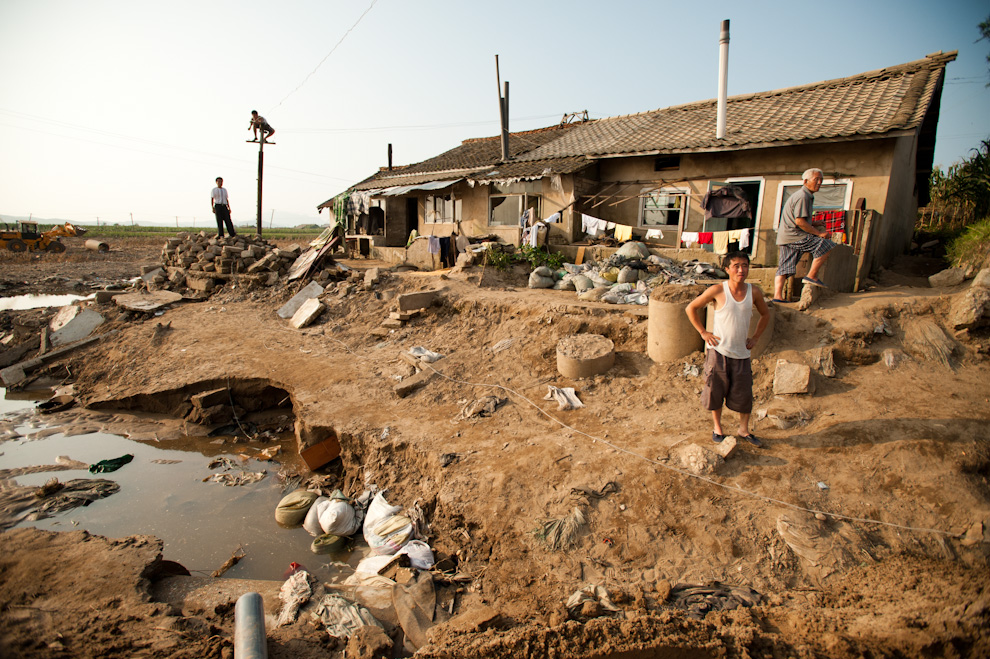
Samaritan’s Purse, the US-based, religious charitable organization, has published some pictures of their recent delivery of flood relief supplies to Sinuiju.

Here is one photo:


You should check out the other photos in the set here.

Here is a video they produced before takeoff.

Samaritan’s Purse is delivering a portion of the US government’s $750,000 flood relief campaign.

Additional information:
1. South Korean aid in response to the flood. China sends aid.

2. Video of Sinuiju. Official Chinese and DPRK photos of the flooding.

3. Here are previous posts about Samaritan’s Purse in the DPRK.

Share

Japanese businessman arrested for exporting pianos to DPRK

Friday, September 17th, 2010

According to the Mainichi Daily News (Japan):

The president of a motorcycle sales company in Hiroshima was arrested Thursday for allegedly exporting pianos to North Korea in violation of Japanese government trade sanctions.

Hiroshima and Hyogo police suspect Yutaka Oyama, 60, exported 22 used upright pianos from Kobe port to North Korea through China’s Dalian on Nov. 5, 2008, without obtaining permissions from the economy, trade and industry minister.

Oyama has admitted to exporting the pianos during interviews with Kyodo News, saying he had “no other work” amid an economic downturn.

The police raided his office and home in April and confiscated items such as a personal computer and a mobile phone.

Japan in October 2006 banned imports from North Korea and exports to the country of luxury goods, including musical instruments, under economic sanctions designed to penalize Pyongyang for the nuclear test it conducted earlier that month.

The sanctions were strengthened in June last year with all exports banned, in response to another nuclear test the previous month and the North’s past abductions of Japanese nationals.

Read the full story here:
Motorcycle dealer arrested over illegal export to North Korea
Mainichi Daily News
9/16/2010

Share

DPRK defectors leaving ROK

Wednesday, September 15th, 2010

According to Yonhap:

An increasing number of North Korean defectors have been attempting to seek asylum in foreign countries, hiding their newly-won South Korean nationality and pretending to be fresh from the communist nation, a lawmaker said Wednesday.

Britain and Norway have been among the popular targets for these fake asylum seekers, Rep. Hong Jung-wook of the Grand National Party said, citing data from the foreign ministry. Hong said the government should make sure the issue does not escalate into diplomatic problems.

Apparently over concerns about fake defections, Britain has stopped granting asylum to North Korean defectors since last year. In 2008, Norway found more than 50 North Korean defectors with South Korean passports or identity cards during an inspection of a refugee camp, according to the lawmaker.

Since 2004, a total of 695 North Korean defectors have formally filed for asylum in Britain, with the number of applications rising from 20 in 2004 to 410 in 2007. Of those applicants, 373 were granted the asylum, 185 were denied and 135 under consideration as of March of last year, according to the lawmaker.

But the British government estimates that the actual number of North Korean defectors who had come to the country for asylum purposes since 2004 would be about 1,000 and suspects that 70 percent of them would be of South Korean nationality, the lawmaker said in a release.

Britain reached the estimate after a survey of three dozen North Korean asylum seekers, who agreed to provide their fingerprints for the investigation, found that 75 percent, or 24 people, were found to be of South Korean nationality, the lawmaker said.

“Based on this problem, the British side has been asking that our government provide it with broader information on the fingerprints of North Korean defectors, and even demanding a treaty be signed on this,” the lawmaker said in the release.

Hong also said that about 600 fake asylum seekers are believed to be still staying in Britain or Norway, and called on the government to take steps to bring them home.

“The increase in fake asylum attempts by North Korean defectors is because their life in South Korea is difficult,” Hong said. “The government should allow them to return by granting a grace period so as to prevent the issue from growing into a diplomatic problem.”

The foreign ministry denied that Britain had asked South Korea to take back the fake asylum seekers or demanded a treaty on fingerprint information.

“As this issue is related to our nationals, we have been cooperating with related countries within the necessary bounds and are in talks with related countries to work out appropriate measures,” the ministry said in a statement.

Since the 1950-53 Korean War, nearly 20,000 North Koreans have defected to the South to escape from hunger and political suppression in their communist homeland. But many of them have a hard time getting decent jobs due to their lack of education and social discrimination.

Read the full story here:
Increasing number of N. Korean defectors in S. Korea seek asylum in foreign countries
Yonhap
Chang Jae-soon
9/15/2010

Share

Number of South Koreans permitted in Kasong zone to increase

Tuesday, September 14th, 2010

According ot the Daily NK:

An official in the Ministry of Unification has revealed that the government is planning to allow an increase in the number of South Korean nationals permitted to overnight within the Kaesong Industrial Complex.

The new standard will allow a 50% increase in South Koreans staying in the Complex, from the current 600 to a maximum of 900, with the new limits set to take effect after the “Chuseok” harvest festival later this month.

Explaining the plan, the official said, “While the restrictions on residing personnel have been in place, fatigue has accumulated and problems have constantly occurred with companies having a great many production and quality errors,” adding, “So we can expect the government to select this course of expanding the number of residing personnel to between 800 and 900 this week.”

“Especially, maintaining production quality during the period of high demand starting in September with the current staffing levels would be difficult,” the official went on, “so companies have requested an increase in staffing levels, and the government has been considering the companies difficulties and requests.”

However, the official stressed that the move doesn’t mean the government is softening its stance in terms of post-Cheonan sanctions measures, saying, “The May 24th Measures will stay in place, and restrictions on new business investment and new investment in existing businesses will continue.”

At the time of the May 24th Measure, the number of personnel permitted to overnight in the Complex was fixed at 550 from its original limit of 1,000, though the real average was only around 500. However, the limit was increased to around 590 in July based, the Ministry of Unification announced at the time, on the “stances of the corporations and (the government’s) experience of running the complex.”

Read the full story here:
Government Plans Kaesong Personnel Change
Daily NK
Chris GReen
9/14/2010

Share

Middlesbrough vs. DPRK Ladies

Sunday, September 12th, 2010

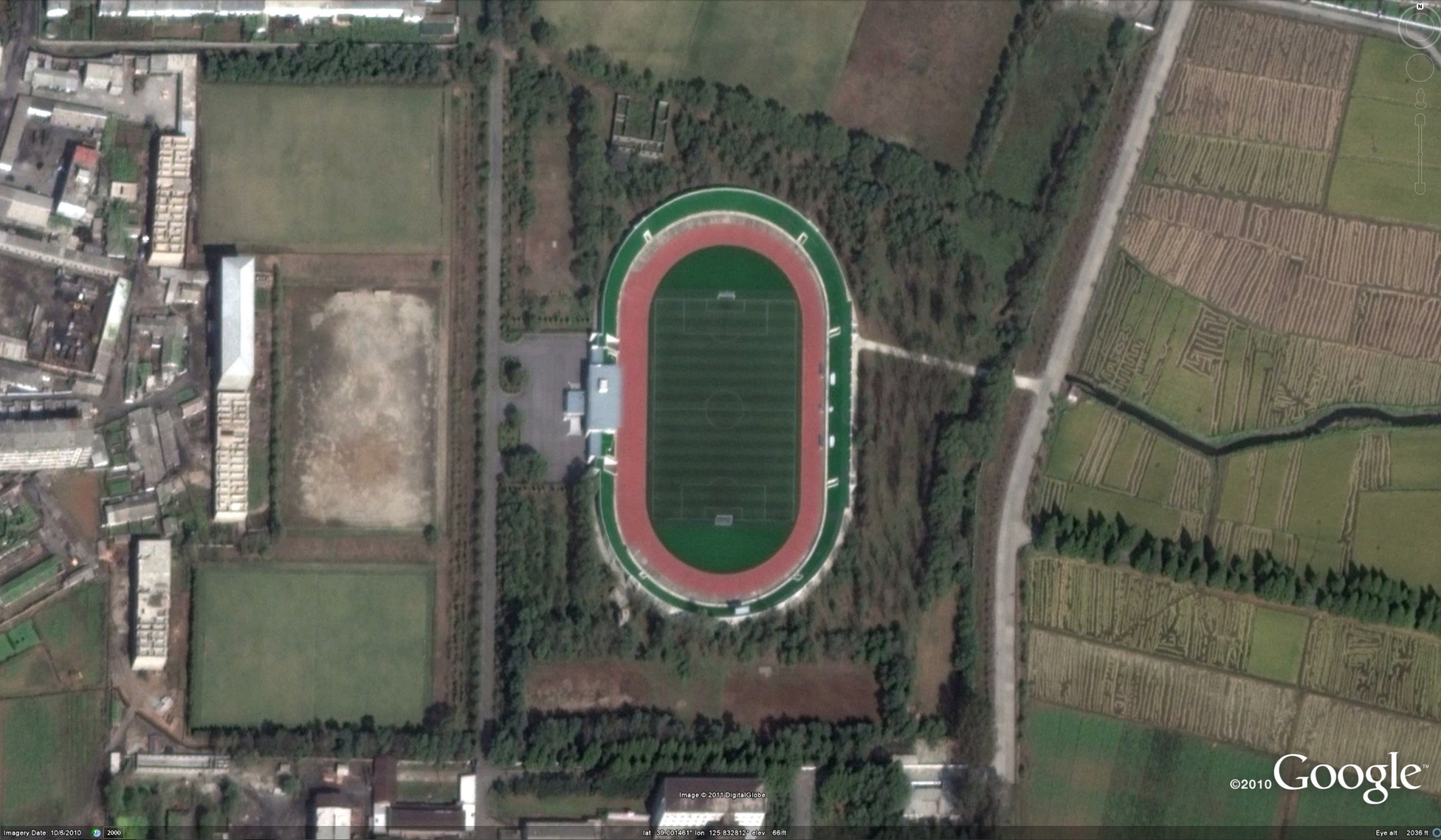
Pictured above: April 25th Sports Club field in Sadong-guyok (사동구역) where the matches were held (Google Maps)

UPDATE 4 (2011-4-25): To mark the ten-year anniversary of DPRK-UK diplomatic relations in September 2010, the British Embassy in Pyongyang and Koryo Tours arranged for the Middlesbrough Ladies Football Club to travel to the DPRK for two friendly matches against the DPRK’s national ladies team.  In addition to the two matches, the ladies team spent an afternoon training children at a local school, and an edited version of the film Bend it like Beckham was shown on North Korean television.  If you can access Facebook, you can see pictures of the visit here and  some videos here.

I managed to get video of one of the matches that was aired on North Korean television, so I edited it and posted it to YouTube:

It is in severn parts.  Part 1 of 7 is here.  The resolution is not great, but I am not a professional video editor!

Koryo Tours now has the ambitious goal of bringing a DPRK women’s football team to Middlesbrough.  According to a recent Koryo Tours newsletter:

We are therefore looking to take a North Korean women’s football team to the UK in 2012.  We also plan to bring a female DPRK film crew to accompany the squad and make a documentary of their time in the UK for both North Korean and international screening.

We do have support from both the British Embassy in Pyongyang and various international institutions but we also need financial support.  It would be extremely useful to have introductions to companies or individuals who you think might be interested in helping us.

Contact Koryo Tours for more information.

UPDATE 3: Sky News has a good summary of the events and a video.

UPDATE 2: According to the BBC, the Middlesbrough FC Ladies lost their second game.

UPDATE 1: According to the AFP, the Middlesbrough FC Ladies lost their first game.

ORIGINAL POST: According to the Guardian:

North Korea, the most secretive country on earth, the nation George Bush located on the Axis of Evil, where the flame of Marxism-Leninism still burns strong, will this week welcome its first British football team: 14 Teesside women players aged from 17 to 23, and their manager, Marrie Wieczorek.

On Thursday, Middlesbrough FC Ladies set off on a football tour with less bar-hopping (it’s illegal to leave your hotel without your guide) and probably more talk about dialectical materialism than usual. “I think it is going to be a bit of a culture shock,” says Wieczorek. “The whole place is shrouded in secrecy.”

At a time of mounting speculation that Kim Jong-il may be stepping down and appointing his son as successor, the team will fly to Beijing and then board an Air Koryo flight to Pyongyang, where they will play two games.

Middlesbrough Ladies will, in their way, be making history. The Democratic People’s Republic of Korea (as it prefers to be known) has so little contact with the outside world that the tour represents one of the most significant cultural exchanges of recent years. But it is also the latest episode in the entirely unlikely relationship between Middlesbrough and North Korea.

Historical link

Back in 1966, when England hosted the World Cup, North Korea played its three group games in the town, and Dave Allan, Middlesbrough’s media manager, said that a bond had existed ever since.

“It wasn’t that long after the Korean War and there were people in Teesside who’d fought in that, and when the Korean team came they were seen as the enemy,” Allan said. “But people really just took them to their hearts. It helped that they played in red, which was the Middlesbrough team colour. But it really was the people themselves, non-stop smiling, and very friendly and open.”

In 1966, North Korea beat Italy in what is routinely referred to as “one of the greatest upsets in World Cup history”, but the team’s failure to win a single game in this year’s finals – the first time they had qualified since then – led to rumours that the national coach had been sent to be “re-educated” on a building site on his return home.

In 2002, Nick Bonner of the travel company Koryo Tours tracked down the 1966 players and brought them back to Middlesbrough in what is still North Korea’s most important non-political exchange with the outside world.

“You don’t hear much about Middlesbrough in this country. But in North Korea they love us,” said Wieczorek. Even more astonishing, she said, they also love women’s football. The North Korean women’s team is currently fifth in the world, and it is as popular a spectator sport as the men’s game.

“Here, on the other hand, it was a battle to even play it when I started out 34 years ago,” said Wieczorek, “and although we’re supported by Middlesbrough FC we still have to raise our own money for transport.”

Culture shock

In North Korea, visitors are expected to bow before statues of the Supreme Leader. Do the Middlesbrough team have any idea what to expect?

Acting captain Rachael Hine, a mortgage adviser with Santander, said: “We know it’s going to be different. But nobody really knows how different.

“We’re just trying to go there with an open mind.”

This was a philosophy that has already been tested. “I told the girls their mobile phones will be confiscated at the airport,” said Wieczorek. “Their jaws just dropped.”

Read the full story here:
Middlesbrough Ladies’ North Korean football tour guarantees place in history
Guardian
Carole Cadwalladr
9/12/2010

Share