Archive for the ‘International Governments’ Category

Inter-Korean trade up 51.3% in first half of 2010

Wednesday, October 6th, 2010

Institute for Far East Studies (IFES)
NK Brief No. 10-10-4-1
10/4/2010

Trade between the two Koreas in the first half of 2010 totaled 980 million USD, 51.3 percent more than the 650 million dollars-worth of trade last year. North Korea’s trade with China was also up, by 16.4 percent, to 1.28 billion USD. Kim Jong Il has made two trips to China and the North has taken other steps to boost cross-border trade with the Chinese.

According to a recent report comparing inter-Korean trade to that between North Korea and China, North-South trade in 2007 equaled 91 percent of Pyongyang’s trade with Beijing, but as inter-Korean relations chilled, that number fell to 65 percent in 2008. This year, that number climbed back up to 77 percent, largely because the Kaesong Industrial Complex, which has avoided political entanglement, has grown 96 percent since last year. Textiles and home electronics top the list of goods in inter-Korean trade, while minerals are the top item traded across the DPRK-PRC border.

North Korea’s import of South Korean goods increased by 63 percent to 430 million USD, while the North’s Chinese imports rose a mere 25 percent, but still totaled 930 million USD. 36 percent of South Korean exports to the North are raw materials for North Korean textile production, while 120 million USD-worth of electronics make up the second-largest export industry. Making up the largest sector, 27 percent (250 million USD) of North Korea’s imports from China are made up of minerals and crude oil, while textiles make up 12 percent and base metal resources make up 8 percent. South Korean imports have also grown 43 percent, to 550 million USD, since last year. In comparison, Chinese imports from North Korea shrunk one percent to 340 million USD. Clothing and other ready-for-market textiles made up 44 percent of North Korean exports to the South, while electrical and electronic goods made up 17 percent. Coal, iron, and other key resources made up 51 percent of DPRK exports to China, while zinc and other base metals make up approximately 20 percent.

Share

ROK lawmaker seeks to cut off PUST funding

Wednesday, October 6th, 2010

According to the Choson Ilbo:

A university in North Korea set up with South Korean funding has opened a research center devoted to studying former North Korean leader Kim Il-sung’s “Juche” or self-sufficiency ideology.

Pyongyang University of Science and Technology, which was established with South Korean funding, opened the research center after erecting a monument honoring Kim Il-sung, Grand National Party lawmaker Yoon Sang-hyun of the parliamentary Foreign Affairs, Trade and Unification Committee said Tuesday.

He showed a photograph as proof and added, “We must immediately halt further aid for the university, which has turned into a school that propagates the personality cult surrounding the Kim dynasty.”

The university was established with donations gathered by South Korea’s Northeast Asia Foundation for Education and Culture in order to help North Korea to train experts in information and technology, agriculture and biosciences and international trade. North Korea provided the land and labor while South Korea handled the hiring of faculty and management.

The university was scheduled to open in April this year but has apparently yet to begin operations. “North Korea rejected our offer to open an MBA school while demanding that the Juche ideology be included as a prerequisite for graduation,” Yoon said. He added Seoul must make sure to transfer no technology through the university, “since North Korea may use it to develop weapons of mass destruction.”

Satellite imagery of the Pyongyang University of Science and Technology (PUST) can be seen here.

Previous PUST posts can be seen here.

Read the full story here:
S.Korea-Funded University in Pyongyang ‘to Preach Stalinist Ideology’
Choson Ilbo
10/6/2010

Share

ROK preparing for psyops…

Wednesday, October 6th, 2010

According to the Choson Ilbo:

The Defense Ministry is preparing to enlarge the range of propaganda broadcasts and float radios to North Korea, which is refusing to admit responsibility for the sinking of the South Korean Navy corvette Cheonan in March.

During a National Assembly audit of the Defense Ministry and the Joint Chiefs of Staff on Tuesday, Defense Minister Kim Tae-young said the ministry is preparing to switch the format of propaganda broadcasts from FM to AM and float balloons carrying AM radios to the North so that North Koreans can listen to the broadcasts.

The South has in the past sent many radios to the North, Kim said. He added the balloons will also carry propaganda leaflets.

“We’ve already put psychological pressure on the North merely by installing loudspeakers for propaganda broadcasts at 11 locations” along the military demarcation line, the minister claimed. But he added that the government will not start the broadcasts and send the leaflets, which are ready, until the North launches a fresh provocation and there is therefore an urgent need to put pressure on the North.

The New York Times offers some good supplemental information:

After six years of quiet along the border, South Korea has reinstalled 11 sets of psychological warfare loudspeakers, Defense Minister Kim Tae-young said Tuesday in Seoul. He said his ministry had switched its transmitters to the easier-to-receive AM band and was ready to send thousands of AM radios and propaganda leaflets across the border using helium balloons.

A continuing balloon and leaflet campaign by South Korean civilians has angered the North Korean government, which suggests that it has been effective. The leaflets ridicule the North Korean leader, Kim Jong-il, and call for people in the North to rise up. North Korea insisted that the leaflet issue be put on the agenda of recent bilateral military talks.

North and South Korea agreed in 2000 to dismantle the loudspeaker systems along the border and to stop radio transmissions. There have been no loudspeaker blasts since 2004, although South Korea made a show of putting some speakers in place in May, after the sinking of a South Korean naval vessel, the Cheonan, in March. Forty-six sailors were killed. The North has denied any involvement.

Read the full story here
Gov’t in Drive to Send Radios to N.Korea
Choson Ilbo
10/7/2010

Share

Power Restructuring in North Korea

Tuesday, October 5th, 2010

Ruediger Frank writes in 38 North:

“Finally,” one is tempted to say. The years of speculation and half-baked news from dubious sources are over. The leadership issue in North Korea has been officially resolved. Or has it?

The third delegate’s meeting[1] of the Worker’s Party of Korea (WPK) on September 28, 2010 answered a few questions. Still, it left some unanswered and posed quite a few new ones as well. In the end, Kim Jong Il emerged the undisputed leader. But has his legitimacy become more independent of his father than it used to be? Kim Jong Un has been introduced to the people. Does this mean he is going to succeed Kim Jong Il? Or will he succeed Kim Il Sung? Kim Jong Il’s sister Kim Kyong Hui has been promoted to the rank of general and is part of the party leadership. Is she supposed to support her nephew, or is this part of a strategy to more broadly enhance the family’s power? Her husband Jang Song Thaek is also on board. Will he share the caretaking job with his wife? Are there any other members of the extended Kim family on the team?

The Hard Facts

(1) On Monday, September 27, 2010, Kim Jong Un was mentioned for the first time in official North Korean media when he was promoted to the rank of general. Now, at last, we know for sure how to write his name (we use the official North Korean version for English; it would be Kim Jong-ùn according to McCune/Reischauer).

(2) On the same day, Kim Jong Il’s sister was promoted to the same military rank as her nephew.

(3) On September 28, 2010, one day later, the first delegate’s meeting of the WPK in 44 years and the biggest gathering since the last (Sixth) Party congress in 1980 opened after a mysterious delay. It had originally been announced for “early September.”

(4) Contrary to western media speculation, Kim Jong Il did not step down nor did he hand over any of his powers to his son. Rather, he was confirmed as the current leader of the party, the military, and the country.

(5) From 1945 until 1980, the WPK held six Party Congresses and two conferences or delegate’s meetings. This means that on average, the WPK had one major Party event every 4.4 years. However, over the next 30 years, it had none. The 21st and so far last plenum of the WPK was held in December 1993. Now, the defunct leadership structure of the WPK has been restored and the delegates elected 124 members of the Central Committee (CC) and 105 alternates. From among the members, 17 were named to the Politburo (PB) of the CC, and 15 as alternates.

(6) The Politburo is headed by a Presidium or Standing Committee of five people, with Kim Jong Il at the top as the general secretary of the WPK.[2] It also consists of Kim Yong Nam (82 years old),[3] Choe Yong Rim (80 years old),[4] Jo Myong Rok (82 years old)[5] and Ri Yong Ho (68 years old).[6] The latter was promoted the day before the delegate’s meeting to the post of vice marshal. He ranks above Kim Jong Un and his aunt and is rumored to be a member of the Kim family, which if true, implies a particularly strong base for loyalty. Given the advanced age of most of its members, if the Presidium is not newly elected in a few years, who will remain? This makes Mr. Ri particularly interesting.

(7) All three known close relatives of Kim Jong Il received posts in the WPK. Kim Jong Un became vice chairman of the Central Military Commission (see below). His aunt Kim Kyong Hui became a member of the Politburo and her husband Jang Song Thaek was made an alternate. The names of regular and alternate members were not provided in alphabetical order, indicating a certain hierarchy. Kim Kyong Hui’s name was listed last out of 17 and Jang was 5th out of 15. A day later, he was 14th (out of 15) on a list of short bios of regular and alternate Politburo members. Kim Kyong Hui was the only member in addition to Kim Jong Il for whom no details were provided.

(8) Except for the Central Committee, there is not a single leadership organ where all three close relatives of Kim Jong Il hold a post. Kim Jong Un is excluded from the Politburo altogether; Kim Kyong Hui is not on the Central Military Commission; and Jang Song Thaek is only an alternate Politburo member. We could speculate that Kim Jong Il wants to prevent having too high a concentration of power in the hands of one of his relatives. He has made sure that the most crucial instruments of power are staffed with the most loyal of his followers who will be ready to walk the extra mile and fulfill his strategic decisions with all the energy of a family member and co-owner.

(9) As was expected, Kim Jong Un has not (yet) become a member or an alternate member of the Politburo, the second-highest leading organ of the party, but did receive a high-ranking post in the WPK’s Central Military Commission. As far as we know, this is essentially the organization through which the Party controls the military, and hence the most powerful of the WPK’s organs. It is no coincidence that this commission is chaired by Kim Jong Il himself. His son comes next in the hierarchy—he is the first of the commission’s two vice-chairmen. Jang Song Thaek is a member, too, but the one with the lowest rank, so it seems. His name was listed last out of 19. Kim Kyong Hui is not a member of the Central Military Commission.

(10) On September 29, 2010, an unusually long and detailed KCNA article was published with profiles of all Politburo members. In addition, a large group picture was published that showed the delegates and the complete Central Committee, including Kim Jong Un. The photo rather openly revealed the true hierarchy within the Party leadership; only 19 people were sitting in the front row, the others were standing. Kim Jong Un sat just one space away from his father, while Kim Kyong Hui sat five spaces away from the center. In a KCNA report on the taking of this picture, Kim Jong Un’s name came fourth after the Politburo Presidium members Kim Yong Nam, Choe Yong Rim and Ri Yong Ho. Kim Kyong Hui was number 18, and Jang Song Thaek was number 23 on that exclusive list of 33 leaders.

(11) A total of 14 department directors of the Central Committee were appointed, among them Jang Song Thaek and Kim Kyong Hui. However, contrary to predictions by many analysts, Kim Jong Un does not seem to have been appointed director of the Organization and Guidance Department (OGD), a post his father held before he was announced as Kim Il Sung’s successor.[7] This could be due to a number of reasons. Either, Kim Jong Un already effectively held that post—we may not know since the last time such positions were given officially was 1980—or the division of labor (and power) within the party has changed, for example in the context of the Military First Policy. In that case, the OGD post may simply not be as important as it used to be. This would imply that the Central Military Commission now makes all the important appointments, and the OGD is merely an administrative unit like any human resources department.

(12) The North Korean media published a message from China’s leader Hu Jintao only a day after the delegate’s meeting. He stressed the deep and traditional friendship, close geographical relationship, and wide-ranging common interests of the two countries. Hu pledged to defend and promote the bilateral relationship, always holding fast to it in a strategic view under the long-term discernment no matter how the international situation may change (KCNA, 29.09.2010). This was a message to the North Korean people and the international community: China is going to support the new North Korean leadership (model).

What Have We Learned?

The Party meeting provided final proof of what has often been doubted since Kim Jong Il took over as leader of North Korea after 1994. All the other things one might say about him notwithstanding, Kim Il Sung undisputedly was an able politician. He did not choose his eldest son Kim Jong Il as his successor by chance. Despite his health problems, Kim Jong Il is (still) able to play the power game. He paved the way for a new leadership without turning himself into a lame duck. He did so by not leaving any important posts to somebody else—although, at the same time, he did not monopolize those positions. He distributed power among a core group of family members and his father’s loyalists, while also ensuring that none of them can be certain to be significantly higher-ranking than any of their colleagues. As in juche, where in the end everything depends on the judgment of the leader, power in North Korea remains Kim’s sole domain. At the same time, he has done what any good CEO does: delegate authority to avoid energy-consuming micro-management of each and every aspect of his job.

The most important decision regarding human resources has been the introduction of Kim Jong Un as a member of the top leadership of the Party and of the military. He will now have to quickly develop a record (at least on paper) of spectacular achievements, so that he can be quickly presented to the people as the most logical and capable candidate for the next leadership post. Since Kim Jong Un was appointed with a clear reference to the military, Kim Jong Il appears to be following the same strategy his father did after 1980. At that time, North Korea analysts noticed that the late O Jin U, the top military official, was always standing close to Kim Jong Il. It would now be logical to expect that like his father before him, Kim Jong Un will be responsible for the promotion of top military officers, thereby ensuring their loyalty.

In terms of strategic decisions, its seems that the succession from Kim Jong Il to Kim Jong Un will be different from the last changing of the guard in 1994. As early as 2008, it seemed likely that the role of the Party would be strengthened substantially. The restoration of the WPK’s formal power organs and the many biographical details that were provided on the top leadership circle, including the group photo, indicate that the new leader will not be as autocratic as his predecessors. The new leadership will have more faces; we could observe something similar a few months ago in the case of the National Defense Commission. This is the reflection of a trend, not a spontaneous event.

What seems most notable is the renewed emphasis on Kim Il Sung as the sole source of legitimacy in North Korea. Kim Jong Il is not going to replace him, which would have been a precondition for the perpetuation of the current system of leadership. Therefore, in a sense, Kim Jong Un and all those who come after him will be, like Kim Jong Il, successors of Kim Il Sung.

Concerning the process of power transfer, as expected, a multi-stage approach is unfolding. At least one more stage will be needed. Chances are good that this will take place at the Seventh Party Congress, whose date is as of yet unannounced. 2012 would be a good time considering the health of Kim Jong Il and that year’s auspicious meaning—the 100th anniversary of Kim Il Sung’s birthday. As stated above, Kim Il Sung was a capable politician. He was clearly aware of the fact that sooner or later, his son would face the succession issue. It would be a great surprise if he hadn’t talked about this with him and jointly developed a rough plan as to how create a sustainable model of power succession. The two problems Kim Il Sung could not consider, simply for technical reasons, were who exactly would show the necessary capabilities to become the next successor, and how much time Kim Jong Il would have to oversee and guide that process.

The year 2008 indeed marked a watershed when, because of his illness, Kim Jong Il realized the need for a quick solution. The last thing an autocrat wants is to create the impression of being forced to act, and of time running out. So he used the already fixed year 2012 not only as the year of the celebration of his father’s 100th birthday, but also as the year when great changes will happen and the gate to becoming a Strong and Prosperous Great Country will be opened. From this perspective, I would argue that Kim Jong Il is indeed fighting a “speed battle,” but in the form of compressing a process that was planned long ago and supposed to last longer, rather than creating such a process from scratch and hastily.

The China Factor

The message of support from Hu Jintao along with the two visits of Kim Jong Il to China before the delegate’s meeting immediately lead to the question: What type of North Korea will China support? Clearly, the last thing China wants is for North Korea to collapse. Such a situation would create a serious dilemma for Beijing. It could either do nothing and watch the U.S. sphere of influence expand right to its border, or it could actively interfere. This would instantly shatter all Chinese efforts to display itself to the carefully watching countries in the region as a peaceful giant that is a real alternative to protection by the United States. In the end, this is what North Korea is all about—competition between Beijing and Washington. Pyongyang knows this.

A third path may be open to China. The North has realized that the economic reforms of 2002, which focused on agriculture and hence closely resembled the Chinese example of 1979, were in principle a good idea, but that conditions were so unlike those in China that the results inevitably differed. In principle, the understanding that economic reform is necessary remains but reservations against the political side effects of such reforms have grown substantially due to the chaos that emerged in the aftermath of the 2002 measures. Given North Korea’s structure as an industrialized economy, reforms need to take place in industry.

There is a well-established blueprint for this; we call it the East Asian model. In short, it consists of a strong state that controls a few big players in the economy—zaibatsu or keiretsu in Japan, chaebol in Korea, and the state owned companies in China. A core requirement for this model to succeed is a huge source of finance, coupled with a strong political partner that, for a while, is willing to turn a blind eye on protectionism. The United States played that role partly for Japan, and very strongly for South Korea. China is now willing to do this service for North Korea under certain political conditions.

Many signs point in the direction of North Korea “returning” to the path of orthodox socialism, or at least to its East Asian version. “Rule by the Party”—a collective with a first among equals at the top—is not only a key component of any socialist textbook case, it is also characteristic of the Chinese model since 1978. After two leaders of the Mao Zedong type, North Korea may now be getting ready for one similar to the position that the current Chinese President, Hu Jintao, occupies in China—that is, a strong leader who rules as the head of a collective. With some luck, Kim Jong Un might even turn out to be a Deng Xiaoping—a man who has the power and vision to use this post to initiate and execute crucial reforms.

Share

Collective farm diplomacy

Monday, October 4th, 2010

For the same reasons that President Obama has a tendency to take visiting dignitaries to my favorite hamburger restaurant in Arlington, VA, the North Koreans have designated “friendship farms” for countries the North Koreans enjoy or expect to enjoy cozy relations.  Below I have identified a few for you to check out on Google Earth.

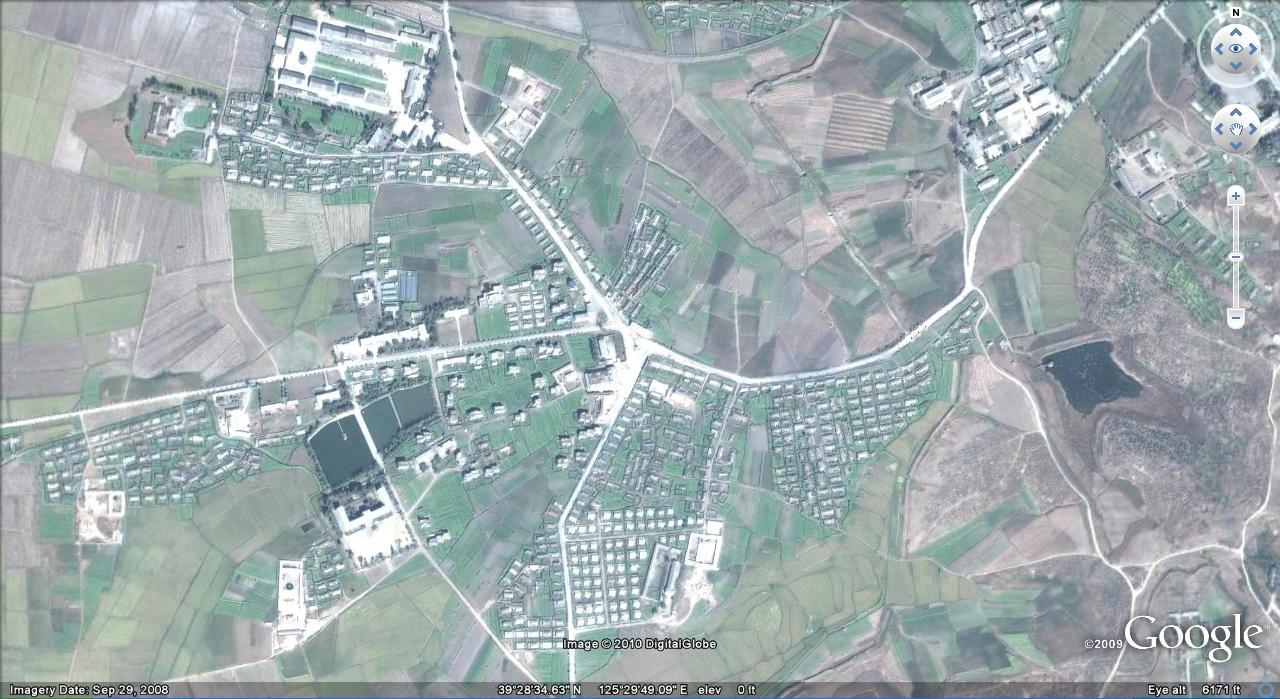
DPRK-Iran Friendship Ripsok Cooperative Farm


iran-friendship-farm.JPG

Coordinates: 39°28’34.69″N, 125°29’48.92″E
This farm has been mentioned in this capacity in KCNA four times: here, here, here, and here.
Date first mentioned: May 17, 2007

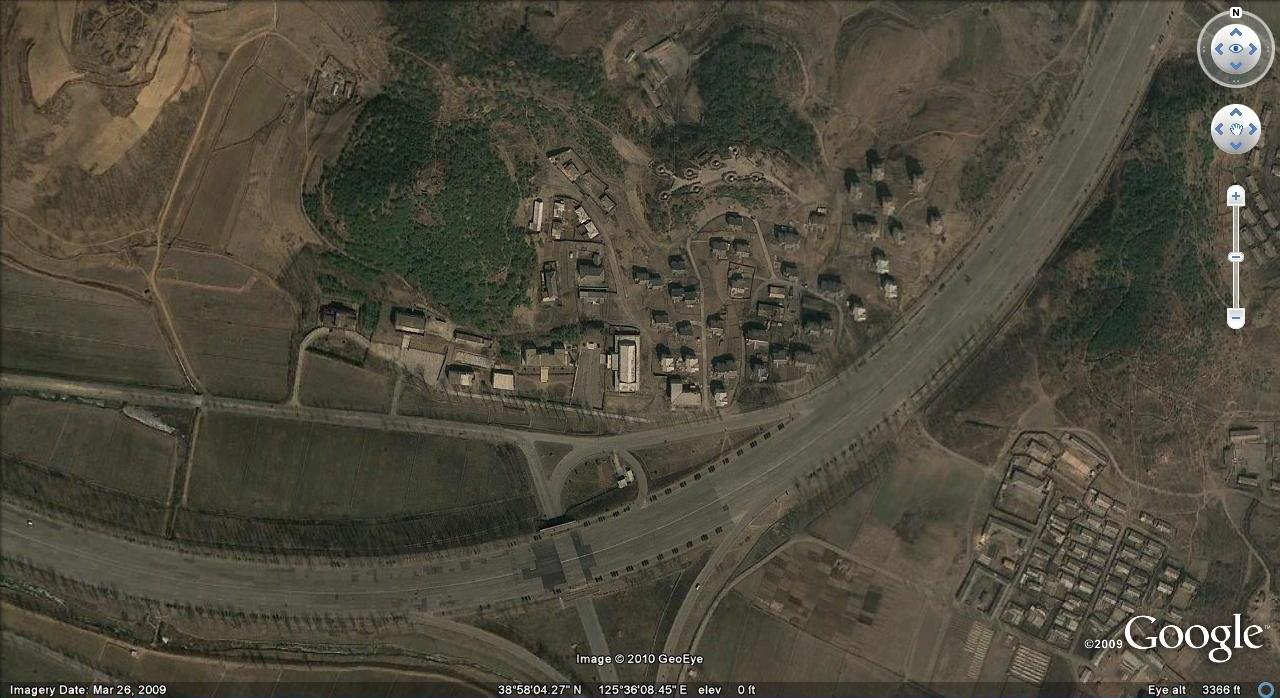
DPRK-Russia Friendship Kochang Cooperative Farm


russia-friendship-farm.JPG

Coordinates: 38°58’3.82″N, 125°36’4.67″E
It has been mentioned in KCNA at least 26 times.  See here.
Date first mentioned:  June 23, 1999

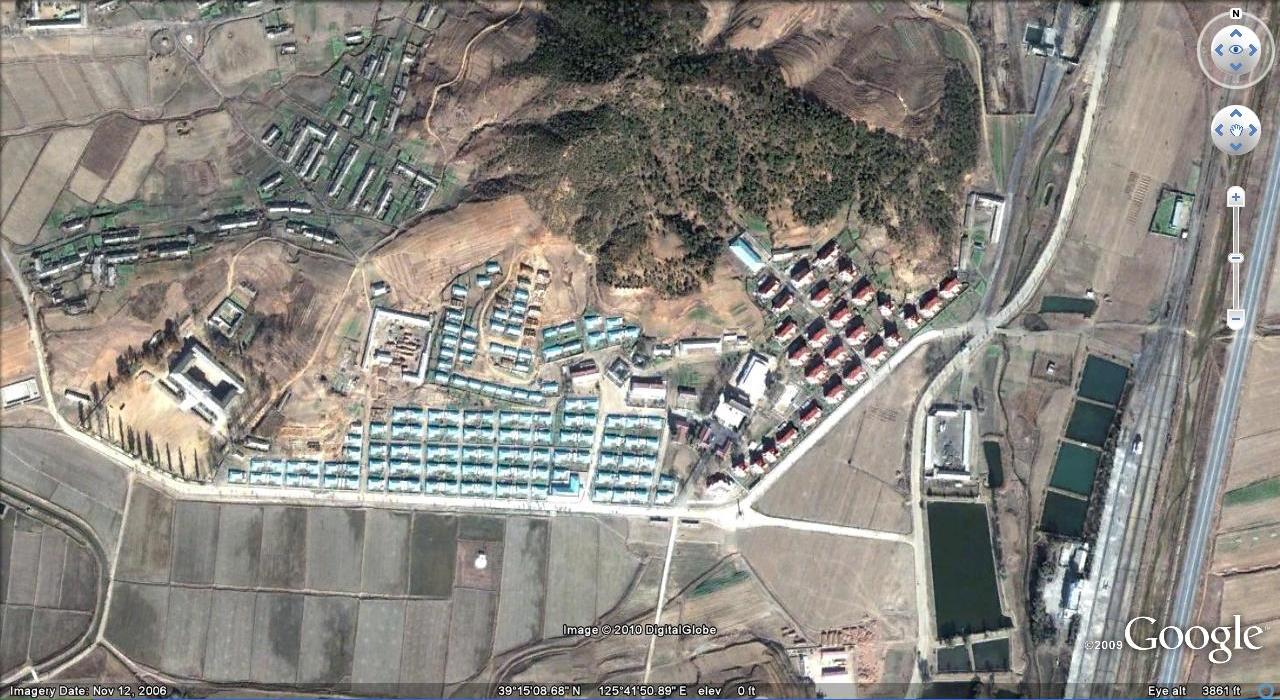
DPRK-China Friendship Thaekam Cooperative Farm


china-friendship-farm.JPG

Coordinates: 39°15’4.41″N, 125°41’53.06″E
This farm has been mentioned at least 29 times in KCNA.  See here.
Date first mentioned: June 1, 1997

I have also located friendship farms for: Laos, Poland, Cuba, Bulgaria, Vietnam, Malaysia,  Indonesia, Germany, Palestine, Cambodia, Mongolia, India, Syria, Nigeria, Libya, Egypt, New Zealand, Yugoslavia, and Pakistan.

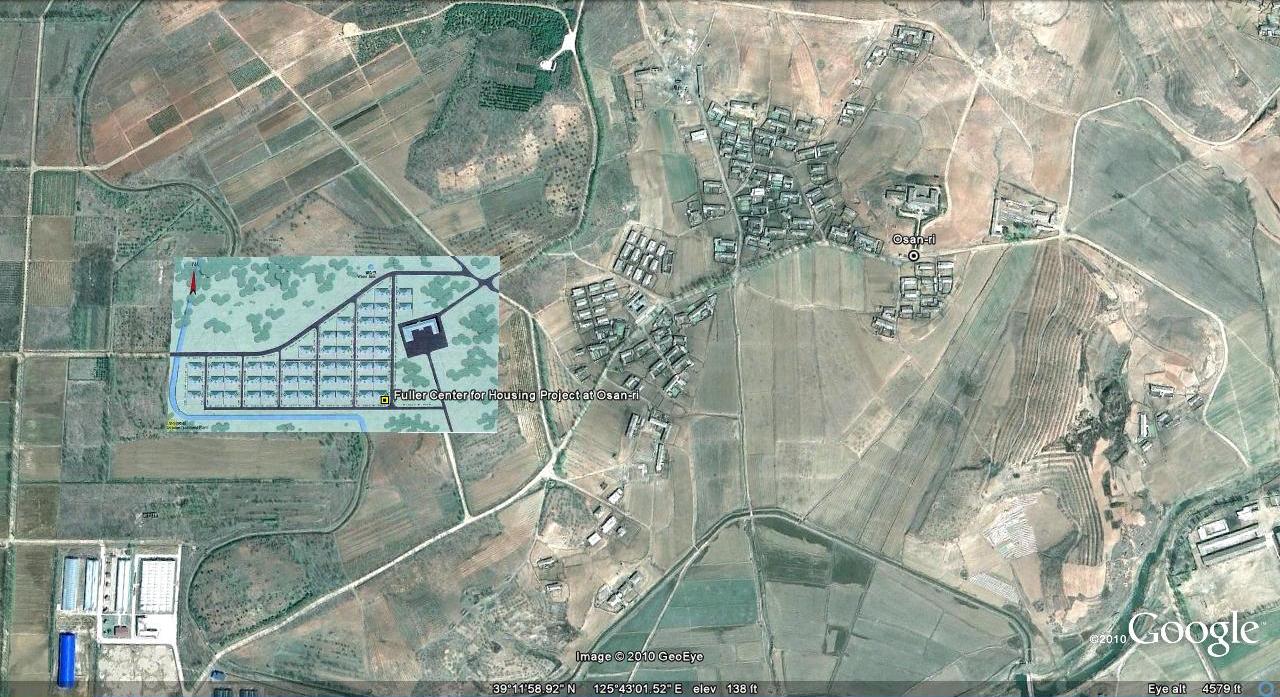
The United States does not yet have a friendship farm in the DPRK, but maybe someday it will be Osan-ri in Sunan-kuyok, Pyongyang. This is where the Fuller Center plans to launch a housing project. Their planned location and site plans are posted below.

Jimmy Carter, who founded Habitat for Humanity, has recently endorsed this project. (UPDATE: more here and here)

Thanks again to Google Earth and GeoEye.

Share

DPRK defectors struggle in ROK

Friday, October 1st, 2010

According to the Donga Ilbo:

More than half of North Korean defectors living in South Korea say they earn under 500,000 won (440 U.S. dollars) per month and suffer hiring discrimination, the results of a survey released Thursday said.

A combined 222 defectors nationwide were surveyed Sept. 15-30 and the study’s results were given to ruling Grand National Party lawmaker Kim Young-woo.

Of the respondents, 76 percent were women in their 20s to 40s. The gender and age ratios were similar to those of the estimated 20,000 defectors in the country, including those expected to enter South Korea by year’s end.

The study said 118 (56 percent) of 211 respondents said they earn under 500,000 won a month, or less than the minimum cost of living (504,344 won) per capita set by the Health and Welfare Ministry. Those who earned more than 500,000 won but under one million won (880 dollars) accounted for 21 percent (44), between one million and 1.5 million won (1,320 dollars) 16 percent (34), and between 1.5 million and two million won (1,760 dollars) five percent (10).

On discrimination in hiring, 93 of 216 respondents (43 percent) said they felt “slight” discrimination and 41 (20 percent) “strong” discrimination. Among 213 respondents, 115 (54 percent) said they earn less than a South Korean for the same work, and 58 (27 percent) out of 206 respondents said they felt ostracized due to their identity.

On their living conditions, 105 (48 percent) of 219 respondents said they are “poor” and 39 (18 percent) “very poor,” while 64 (29 percent) said they lead “moderate” lives, five (two percent) “affluent,” and six (three percent) “very affluent.”

A 40-something North Korean female defector urged South Koreans to show consideration for defectors on the questionnaire.

“We are a family of five. My husband is in bed due to hip surgery. Those unable to work due to illness have a very hard time making a living. I do my best to earn a good living but realize that this is impossible for those who have no power. We are heartened by your words of encouragement. We’d be very happy and grateful if you understand our difficulties and take care of us,” she said.

Read the full story here:
NK Defectors Complain of `Cold Lifestyle` in S. Korea 
Donga Ilbo
10/1/2010

Share

DPRK-China trade and investment growing

Friday, October 1st, 2010

According to Yonhap:

North Korea’s economic dependence on its strongest ally China is growing as its economy slips further into deeper isolation from the international community for its nuclear ambition, a report said Friday.

According to the report compiled by the Samsung Economic Research Institute, bilateral trade with China accounted for 52.6 percent of the North’s cross-border trade last year.

“North Korea’s so-called self-reliant economy is collapsing, and China is emerging as the communist state’s key supplier of economic goods,” the report said.

The report said China’s investment in North Korea surged to US$41 million in 2008 from a meager $1.1 million in 2003. China is also planning to spend $2.37 billion on construction of a transportation network that links the two countries, it said.

But the report said it is hard to characterize the countries’ economic ties as “subordinate,” as the North is also involved in trade with South Korea and other countries.

As with most Yonhap stories, they do not provide a link to the report, or even its name, so I cannot say much about the numbers. 

Here is the English webpage of the Samsung Economic Research Institute.  I have been unable to locate this partuclar study, but maybe you will have better luck.

Yonhap also tells us that the Chinese are working to create a trade zone along the North Korean border.  According to the article:

China is seeking to build an economic zone in the northeastern region bordering North Korea, aiming to promote trade with the world’s most reclusive country, officials said Friday.

Thirteen cities in the Dongbei region, commonly known as Manchuria, issued a joint proposal Thursday to build the “Yalu River Economic Zone” and to boost trade with North Korea. The Yalu River or the Amnok River in Korean is a river on the border between China and North Korea.

The participating cities include Dandong, Dalian, Tonghua and Mudanjiang, all of which are located either in the Liaoning province, the Jilin province or the Heilongjiang province. The three provinces make up the Dongbei region.

North Korea has long been reported as planning to build a free economic zone near the bordering river. A number of ports already exist on the river, used for border trade between the two countries.

Dandong in Liaoning Province, which borders the North Korean city of Sinuiju, has become the largest logistics hub for North Korean trade, handling 70 percent of bilateral trade.

Read the full Yonhap stories here:
N. Korean economic reliance on China further growing: report
Yonhap
10/1/2010

China eyes economic zone for trade with N. Korea
Yonhap
Kim Young-gyo
10/1/2010

Share

ROK endorses US$7m Inter-Korean Cooperation Fund

Thursday, September 30th, 2010

According to Arirang News:

South Korea’s Unification Ministry on Wednesday finally endorsed the Inter-Korean Cooperation Fund worth 8 billion won, or roughly 7 million US dollars in an effort to help North Korea recover from the aftermath of summer floods.

The total cost of aid to be sent is about 12.2 million dollars with about 7 million donated by the Council for the Promotion of Inter-Korean Exchange and Cooperation, chaired by Unification Minister Hyun In-taek and the rest coming from Seoul’s agriculture ministry.

The money will buy 5-thousand tons of rice to be shipped on October 25th from Gunsan Port to the North Korean city of Sinuiju.

Other aid includes 10-thousand tons of cement, three million cases of cup noodles and medicine.

Read the full story here:
S. Korea Endorses US$7 Mil. Inter-Korean Cooperation Fund
Arirang News
9/30/2010

Share

Inter-Korean trade increases in 2010 despite tensions

Thursday, September 30th, 2010

According to Yonhap:

Trade between South and North Korea surged in the first half of the year despite high tensions over the communist nation’s alleged sinking of a South Korean warship in March, a trade organization said Wednesday.

South Korea’s exports to the North soared 63 percent on-year to US$430 million in the January-June period with North Korea’s exports to the South jumping 43 percent to $550 million, according to the Korea International Trade Association (KITA).

Read the full story here:
Inter-Korean trade jumps in H1 despite soured relations
Yonhap
9/29/2010

Share

U.N. audit finds ‘Lapses’ in DPRK food program

Tuesday, September 28th, 2010

According to Fox News:

In an eerie replay of a scandal that enveloped the United Nations Development Program, an internal audit by the U.N.’s World Food Program shows significant “lapses,” “anomalies,” and unexplained variations last year in the way the relief agency reported its financial and commodity management in North Korea.

The holes in WFP’s humanitarian reporting raise questions of whether a U.N. agency has allowed money and supplies intended for starving North Koreans to end up in the hands of the country’s brutal communist rulers, who are under international sanctions aimed at halting their aggressive atomic weapons program.

According to WFP itself, in response to questions from Fox News, the confidential audit “highlighted a small number of inconsistencies in commodity accounting that have subsequently been addressed.” All the issues involved have since been “closed,” the agency added.

However, Fox News obtained a copy of a summary of projects undertaken by WFP’s internal watchdog Office of Internal Audit between July and September of last year, which lists the North Korean lapses first among its audit highlights. Among other things, it notes:

–“inconsistent data and unreliable information systems used for reporting [WFP] commodity movements, stock balances and food utilization” in North Korea;

–“lapses…in financial and commodity management processes.”

—“numerous anomalies…in information systems used for reporting commodity movements and food utilization in the CO [WFP local country office].”

See summary document here (PDF).

The full extent of the management lapses and their consequences cannot be determined without the unexpurgated audit report—and the WFP is not willing to make that public. The agency flatly turned down a request by Fox News for the document.

In fact, WFP has not even supplied a copy of the audit report to nations, including the U.S., that supervise its operations through a 36-member executive board. (The U.S. government gave about $1.76 billion to WFP in 2009, and has so far contributed $959 million this year.)

A Fox News query to the U.S. Mission to the U.N. in Geneva got confirmation that the U.S. government did not have the report, and that “WFP does not currently share its internal audit reports with the WFP Executive Board members.”

By now, however, it was supposed to. A policy that allowed the WFP’s executive director, Josette Sheeran, to give such audit reports to executive board members on demand was up for approval by the board at its last meeting in June. However, it was withdrawn from the board’s agenda; it is now up for consideration at the next Board meeting in November.

Even then, however, the wording of a draft version of the decision underlines that the sunlight provisions “will not be applied retroactively.”

The audit references to lapses in relief aid reporting practices are not the first indicator that the regime of ailing dictator Kim Jong Il might have the opportunity to exploit WFP resources in North Korea.

In June 2009, Fox News got an admission from the relief agency that its food supplies were carried from China to North Korea on vessels owned by the Kim regime. The potential transportation costs for those relief supplies appeared to be enormously high to outside shipping experts asked by Fox News to analyze the agency’s relief program documents. No mention of the regime’s role in transporting WFP goods appeared in the documents or on the agency’s website.

Click here to read an earlier Fox News article on this topic.

WFP has delivered more than $1 billion worth of food aid to North Korea since 2000, but the amount of donated money available for that effort has dwindled sharply as the Kim regime has exploded two nuclear bombs, threatened neighboring Japan and South Korea with war, and even sunk a South Korean warship on the high seas, according to the best forensic evidence available.

Its current plans call for spending about $91 million for food for about 2.2 million North Koreans this year.

The WFP audit reference to lapsed internal controls in North Korea, and the agency’s pooh-poohing of them, also bears a disturbing resemblance to the early stages of a battle over the role of the United Nations Development Program in North Korea, which led to the closure of UNDP’s North Korea office for two years, from 2007 to 2009. The WFP was later named as the U.N.’s lead agency in the country.

In 2006, a whistleblower named Artjon Shkurtaj revealed that UNDP procedures in North Korea had funneled millions of dollars in hard currency to the Kim regime, allowed North Korean government nominees to occupy sensitive UNDP positions in the local country office, kept thousands of U.S. dollars counterfeited by North Korea without informing U.S. authorities, and other transgressions.

All were flatly denied by the U.N. agency, though many of the accusations were later revealed to have been mentioned in internal audit reports — which UNDP refused to make public, on the same grounds currently used by WFP, that they were internal management tools. The existence of the audit criticisms were only made known through an external board of auditors’ investigation in 2007.

A further outside investigation revealed that UNDP’s transgressions were even worse than the auditors had suggested. Not only had UNDP routinely continued to hand over millions in hard currency to the Kim regime, use government nominated officials in sensitive positions, and transfer sensitive equipment with potential for terrorist use or for use in creating weapons of mass destruction, it had done so in violation of U.N. Security Council sanctions in force at the time, and also contravened its own basic financial rules and regulations.

Click here to read an earlier Fox News article on this topic.

In the midst of the furor over its North Korean activities, UNDP finally agreed to make future internal audit reports public—at least to governments on its executive board, and as long as they applied in writing. Since then, it has also amended its internal procedures and is now relaunching itself in North Korea. (To date, the U.N. has not paid recompense to Shkurtaj that was mandated by its own ethics officer in the wake of the UNDP scandal.)

Is the World Food Program following the unsettling trail blazed by UNDP in North Korea, before it mended its ways?

Without the full internal audits, it is hard to tell—but the stonewalling of those audits looks very familiar.

Read the full story here:
U.N. Audit Finds ‘Lapses’ in Managing Food Program Aid to N. Korea
Fox News
George Russell
9/28/2010

Share