Archive for the ‘International Governments’ Category

ROK expanding efforts to censor DPRK web content

Wednesday, October 20th, 2010

According to Voice of America:

North Korean propaganda has emerged on popular Internet social media sites. It is not for domestic consumption as virtually no North Korean has Internet access. Rather it is targeted at other countries, especially South Korea. But in the democratic South, considered the world’s most connected country, the government blocks such content.

South Korea’s Internet censors are working harder these days to keep up with an expanding number of Web sites showing material from or sympathetic to North Korea.

South Korea blocks such sites under laws forbidding dissemination of false information or activities against the state.

Bloggers such as Kim Sang-bum, of the on-line community Bloter, which focuses on digital technology, calls the censorship an over-reaction.

“I don’t think it is necessary for our government to regulate citizens too tightly. South Koreans have become too sophisticated to fall for North Korean propaganda,” he said. “We consider that kind of propaganda as rather silly.”

South Korea’s Communications Standards Commission and the National Police Agency declined requests for interviews.

Jeon Kyoung-woong is the former director of the Korea Internet Media Association, and an on-line journalist. Jeon says pro-Pyongyang material needs to be restricted because it is not as innocuous.

“There are actually forces inside South Korea supporting the North Korean regime,” he said. “Some of them are in touch with North Korean spy groups. Thus the South Korean government sets restrictions on such on-line content.”

South Korean Internet users must register with their real names. On the most popular web sites, anyone posting comments must register with their national identity number.

“The adoption of real-name system shows that the current government is excessively sensitive about political opinion on the Internet. I think the situation has become worse since the current government came into power.”

Jeon, however, is less bothered.

“South Korean cyber police has been active for more than a decade,” said Jeon. “Recently it feels like the cyber police are becoming increasingly active but that is only because it’s being publicized by those subject to such restrictions. Political restrictions were actually tighter under the previous two governments.”

While South Koreans can freely argue about to what degree on-line content here should be regulated, that is not an option in North Korea. Only a few people there are allowed Internet access. And the country only recently established its first full connection to the Internet.

Here are previous posts about the North Kroeans moving into popular social media sites: Twitter, YouTube.

Read the full story here:
N. Korean Propaganda Appears on Popular Internet Social Media sites
Voice of America
10/19/2010

Share

ROK to develop reunification plan

Tuesday, October 19th, 2010

According to Yonhap:

In a move likely to draw a harsh response from North Korea, South Korea will push to come up with a plan by mid-2011 to handle the costs of unifying itself with the impoverished communist neighbor, a senior official said Tuesday.

In an August address, South Korean President Lee Myung-bak proposed a “unification tax” and suggested that his country begin discussions on dealing with what may be astronomical costs of merging with North Korea, an elusive decades-old national goal.

Unification Minister Hyun In-taek said Tuesday in a meeting with civilian advisors on relations with North Korea that his government will work with a group of researchers starting next month to create a blueprint for financing the costs of reunification.

“Based on the research to be completed in February next year, opinions from within the government will be collected by April, and a report will be presented to parliament by June,” he said.

Experts say the costs of merging the divided states will amount to trillions of U.S. dollars in the worst scenario possible.

The state-run Korea Development Institute said in August that the South will need US$2.14 trillion over three decades in the event of a regime collapse in Pyongyang, which could spark political and social chaos in the communist country.

Read the full story here:
S. Korea to draw up plan for financing reunification with N. Korea: official
Yonhap
10/19/2010

Share

Future Sinuiju development affecting Dandong today

Tuesday, October 19th, 2010

According to the Daily NK:

In Dandong, the number of people studying the Chosun language (Korean) is increasing, while real estate prices are rising on the back of rumors that Shinuiju, just across the North Korean border, will soon be opened up to trade and investment.

One anonymous Korean-Chinese trader who already engages in business with North Korea in the area told The Daily NK on the 15th, “The rumor among Chinese traders who have recently been in North Korea has it that ‘The North Korea authorities will open Shinuiju sooner or later.’”

As a result, he said, “There is currently an upsurge in the price of apartments and shops in Dandong, while the number of people wanting to learn the Chosun language is increasing.”

The trader explained that for the last three or four years the real estate market in Dandong has been flat. However, with reports of Kim Jong Eun’s internal appointment as the successor spreading earlier this year, the price of Hanquosheng, Dongfang Minzhu, Taiyang Dasha and other luxury apartments has increased by more than ten percent over the course of the summer.

The source pointed in particular to the fact that the price of apartments under construction in the Langtou Port area has gone from 2,000 Yuan/m² (approximately $300) in May to 3,200 Yuan/m² (approximately $480) in October. The neighborhood has particularly bright prospects as it is the location for the planned Second Yalu River Bridge under an agreement made during the visit to Pyongyang of Chinese Premier Wen Jiabao in 2009.

The Daily NK’s Korean-Chinese source explained that those primarily responsible for fuelling the real estate gains are Korean-Chinese from the Northeastern provinces of China.

He reported, “Since Dandong has geographical advantages, being cool in summer and warm in winter, as well as being able to provide for North Korea’s development of Shinuiju, the city has emerged as the best investment location for Korean-Chinese people.”

“The expectation that Kim Jong Eun is still young and has experience of life in Switzerland; therefore he knows well the need to develop the country and will have no choice but to make that decision, is driving the investment by Korean-Chinese,” the source added.

Naturally, the presumption that Shinuiju will soon offer some new opportunities for business is producing a new trend for learning the North Korean language.

Wang, a 21 year-old student from a university in Dandong said, “Chinese students know that South Korean is different from Chosun,” and went on, “Until now, South Korean has been all the rage thanks to Hallyu (as the South Korean cultural influence in wider Asia is known), but recently the number of students wanting to learn Chosun has been drastically increasing.”

There are presumed to be roughly 3,000-4,000 North Koreans residing in Dandong, including students. Some of them exchange languages with Chinese students, while some others give private classes for between five and ten Yuan an hour.

Alongside which, private Korean language institutes in Dandong are enjoying increased demand.

One South Korean who manages a Korean language institute in Dandong told The Daily NK, “In the case of Korean language institutes in downtown Dandong, each class has seen an increase of four or five students for this fall semester. Alongside Hallyu, the expectation that Shinuiju will open up has meant that the number of Chinese young people wanting to learn Korean is steadily increasing.”

Read the full story here:
Shinuiju Development Making Waves in Dandong
Daily NK
Park In Ho
10/18/2010

Share

[ROK] Investors in DPRK take huge hits; interest in FDI plummets

Monday, October 18th, 2010

Institute for Far Eastern Studies (IFES)
NK Brief No. 10-10-18-1
10/18/2010

The majority of joint ventures investing in North Korea have suffered significant losses since the South Korean government began to enforce sanctions as a result of the sinking of the ROKS Cheonan. On average, companies have incurred losses of almost one billion won, and most companies are no longer interested in investing in the North.

According to the Korea Chamber of Commerce and Industry, a survey of 500 companies (200 inter-Korean economic cooperative schemes and 300 other companies involved in business with the North) showed that 93.9 percent of respondents said they had suffered losses due to trade restrictions put in place due to the Cheonan incident, while 66.5 percent responded that they faced “financial difficulty” due to the sanctions. The companies have suffered an average of 974 million won in losses.

Investment and operational losses due to the ‘all stop’ order from the government amounted to 51.9 percent of losses reported, while 26 percent of respondents pointed to a reduction in orders and 22.1 percent blamed an increase in transportation and other associated costs. One company importing anthracite from the North turned to China, Vietnam, Russia, and other vendors after inter-Korean trade was restricted, but due to each country’s efforts to secure its own natural resources, this year’s sales are expected to be more than 10 billion won less than that seen last year.

Another company, investing in textiles, was strategically producing hand-made works in a North Korean factory, but now production has come to a halt and it may not be able to deliver goods it has produced. A source from the factory stated, “Personnel and raw material expenses in China, Vietnam, and other countries mean that profit margins will be minimal, and there is no alternative.” The same source also stated, “Special funds were distributed from the government, but [companies] are concerned about how long they can hold out.”

As companies invested in North Korea suffer losses in the wake of the Cheonan incident, interest in North Korea investment opportunities is also waning. 82.7 percent of responding companies believe that “even if economic cooperation was normalized, there would be no new investments or continuation of existing projects,” and 76.9 percent of respondents believed that “because of the uncertainty of the North Korean system” non-economic issues would dampen investment enthusiasm. 13.7 percent stated that difficulties with transportation and other infrastructure issues would discourage investment, and 9.4 percent of respondents answered, “North Korean authorities’…interference and restrictions” would turn away foreign investors.

Among those businesses not involved in cooperative economic ventures, 41.5 percent pointed to “North Korea’s overall reform and opening,” while 22.2 percent chose “guaranteeing the security of investments and expanding domestic SOC” as being necessary to propel investment in North Korea. Another 19.7 percent answered, “security issues like North Korean denuclearization” were necessary for improvement in the investment environment.

Many also voiced concerns over the ongoing ban on inter-Korean exchanges. When asked about the impact on business if sanctions against the North were to continue, 5.18 percent of respondents stated, “opportunities for foreign investors will suffer,” while 25.6 percent responded that the North’s economic reliance on China would grow, and 22.6 percent feared that the national image would suffer due to an increase in the security risk.

63.6 percent of respondents call for strengthened protection for investors, including protection against losses as well as guarantees on operational freedoms. 20.1 percent called for easing restrictions on businesses in the Kaesong Industrial Complex, and 16.3 percent pointed to the need for more monetary support.

Even after the government’s announcement halting inter-Korean exchanges on May 24, , inter-Korean trade worth approximately 80 million USD (90 billion won) was recorded due to a number of goods with special exceptions. 639 different cases of imported goods manufactured from raw materials or parts sent to the North prior to the May 24 restrictions amounted to 31.15 million USD, while 269 cases of pre-ordered exports amounted to just over 49 million USD.

This survey was conducted from August 12 to September 1, calling or faxing 200 companies invested in inter-Korean cooperative schemes and 300 of the 1000 companies involved in sales.

Share

More North Korean workers in Jilin, Liaoning

Monday, October 18th, 2010

According to KBS:

The Yomiuri Shimbun says China’s Jilin Province will hire 100 North Koreans this month to work at a plastic manufacturing plant in Tumen City. The report says their wages will be less than half of what Chinese workers are paid.

Japan’s Asahi Shimbun says China’s introduction of North Korean labor is picking up speed. It says that nearby Dandong City in Liaoning Province has also begun the process of bringing in one-thousand North Korean workers.

Read the full story here:
China Border Cities Hiring NK Workers
KBS
10/18/2010

Share

DPRK-ROK aviation hotline restored

Sunday, October 17th, 2010

According to the New York Times:

North and South Korea reopened one of the three severed hot lines between them on Monday in response to a request from the North, its first apparent outreach since the youngest son of the leader, Kim Jong-il, was unveiled as his successor.

The reopened hot line connects the principal international airports — Pyongyang in the North and Incheon in the South — and a test call was conducted late Monday morning, the Unification Ministry said through a spokesman in Seoul.

Another government official here said Monday that North Korea had approached the South about reopening the hot line, which was severed in May following the sinking of a South Korean naval vessel, the Cheonan, in March.

Relations between the Koreas have been badly strained since the Cheonan sinking, which killed 46 sailors. The South has blamed the incident on a North Korean torpedo attack; the North has denied any involvement.

It was not immediately clear whether the renewal of the airspace hot line was an authentic diplomatic entreaty from the North or merely a matter of practicalities. Analysts continue to look for signs of a possibly new foreign policy approach from the North now that Kim Jong-un, Mr. Kim’s Western-educated son, has been given powerful posts in the military and the Workers’ Party.

Commercial aircraft using South Korean airports were still avoiding North Korean airspace, said Lee Jong-joo, an official with the Unification Ministry, adding that the South Korean government was still considering whether to remove that ban.

In May, the nuclear-armed North severed all three hot lines that connect the countries, which remain in a technical state of war because the 1950-53 Korean War ended in a truce, and a formal peace treaty remains elusive.

The principal hot line is located at Panmunjom, the so-called truce village on the highly militarized border. A South Korean government official on Monday described that link as “kind of the official one, used for all official messages.” The official said the North had “unilaterally shut down” that line in May and has not indicated if or when it might reopen.

The North also closed down a naval hot line intended to prevent clashes near its disputed sea border with the South. That link, which remains closed, was established in 2004 after deadly naval skirmishes in 1999 and 2002.

With the hot lines closed, communications between the two governments have been basically conducted through their jointly operated industrial park in Kaesong, located inside North Korea. The South Korean government does not have an official office at Kaesong, but diplomatic messages are routinely passed there.

This story does not explain what two naval centers are connected by the inter-Korean naval hotline. If a reader is aware what organizations are connected, I would appreciate knowing so I can map the hotline on Google Earth.

Read the full story here:
North and South Korea Restore Aviation Hotline
New York Times
Mark McDonald
10/17/2010

Share

DPRK defectors targets of fraud in South

Sunday, October 17th, 2010

According to the AFP:

North Korean refugees struggling to adapt to a bewildering new life in South Korea are increasingly getting sucked into insurance frauds as their first taste of capitalism.

Insurance scams have for years been common in the South, and fraudsters in recent years have targeted the refugees as sometimes unwitting accomplices.

“Sometimes defectors get involved because they don’t know how the insurance system works. They just have no idea what they are doing is wrong,” an official at the Hanawon resettlement centre told AFP.

All North Koreans who flee their impoverished communist homeland for the South must spend their first 12 weeks at the centre, which lies about 80 kilometres (50 miles) south of Seoul.

It offers job education, information on South Korea and basic survival skills — such as buying a subway ticket, opening a bank account and using a credit card.

From May it has also offered a new two-hour course on insurance fraud, with investigators from the Financial Supervisory Service (FSS) warning about the possible consequences.

“We expect that through education, defectors will think twice before making a decision to become an accessory to fraud,” the official, who supervises the course, told AFP on condition of anonymity.

Newly arrived refugees get government financial help but often must repay big debts to the brokers who arranged their escape via China.

This makes them susceptible to taking part in frauds, which focus on bogus medical insurance claims.

After the refugee has bought a private policy or enrols in a state scheme, or both, insurance company workers typically conspire with hospital administrative staff to issue fake certificates of treatment.

When a refugee has been reimbursed by the insurance company, and sometimes by the government, he or she hands over a portion to the accomplices.

“I received about three million won (2,700 dollars) and used the money to pay debts when I came to South Korea,” one woman in her late thirties told the JoongAng Daily newspaper.

Police in Gyeonggi province surrounding Seoul, a known centre for the scams, said that over the past five years ending March refugees received a total of 3.1 billion won from 31 insurance companies in bogus claims.

“It’s prevalent and we are constantly investigating to catch them,” said a provincial police investigator.

The watchdog FSS says refugees typically send 30 percent of their takings from the frauds to brokers in China and the rest to family still in the North.

In one case in 2008, police said they had charged 41 refugees accused of receiving a total of 420 million won through bogus medical claims.

“Insurance fraud has become almost the common thing to do among defectors after they come to South Korea,” Chun Ki-Won, a priest who helps the refugees, told AFP.

“The primary reason why insurance fraud is rapidly increasing is because it’s becoming harder for defectors to adapt to a new environment.”

Refugees find it harder than their southern-born counterparts to find well-paid jobs and some complain of discrimination.

In a survey conducted by legislator Kim Young-Woo, 66 percent of refugees described their living conditions as difficult.

Some 56 percent said their monthly income is below 500,000 won (450 dollars) — officially deemed to be the lowest sum on which families can manage.

About 17,000 North Korean defectors have gone through the Hanawon centre since it opened 11 years ago, and it is currently holding about 500 people.

Read the full story here:
Insurance fraudsters target North Korean refugees
AFP
10/17/2010

Share

Lankov on the DPRK’s nuclear history

Sunday, October 10th, 2010

According to the Korea Times:

In Oct. 2006, a nuclear test was conducted in the remote mountainous area of North Hamgyeong Province, North Korea. This test did not come completely out of the blue. The North Korean government issued an official warning, thus becoming the first nation in history that gave prior notification about a coming nuclear weapons test. This openness might sound strange since we are talking about the world’s most secretive country, but it agrees well with the general character of the North Korean nuclear program. From its inception, the program was largely (but not exclusively) for show, it was aimed at impressing the outside world in order to manipulate it and get what the North Korean leaders wanted to get.

Even though North Korea joined the nuclear club only recently, its nuclear program has long history. It has remained the center of international attention since around 1990, but it began much earlier.

It was the mid-1950s when the first North Korean scientists arrived to work and study in the Joint Institute of Nuclear Research in the Soviet city of Dubna, not far from Moscow. This institution was created by the USSR or former Soviet Union for joint international research in nuclear physics, and until the early 1990s some 250 North Korean scientists underwent training there. Soon afterwards, in 1959 the former Soviet Union and North Korea signed their first agreement on cooperation in nuclear research. A similar agreement was concluded with China as well (Pyongyang never puts all its eggs in one basket!).

In the 1960s, the North Korean version of Los Alamos began to take shape. This role was assigned to the city of Yongbyon, a rather small town, located some 90 kilometers to the north of Pyongyang. It is interesting that, for reasons of greater secrecy, the nuclear research facility was called the “Yongbyon furniture factory.” The major article of infrastructure of this “furniture factory” was not a saw-mill but rather a small Soviet-designed research reactor, completed in 1965. In the 1970s, the North Korean scientists independently modernized the reactor, increasing its output.

There are few doubts that from the very early stages Pyongyang leaders seriously considered the possible military applications of their nuclear research program. But it seems that the North Korean nuclear program made a decisive turn towards military applications in the 1970s. At that time, South Korea was working hard to develop nuclear weapons of its own. For the North, which has always had good intelligence about its arch-enemy, these intentions was hardly a secret, so it seems that around 1975 the North Korean political leaders decided not to lag behind and sped up their own nuclear program.

However, the major obstacle on the path to the acquisition of nuclear weapons was the position of the former Soviet Union. Moscow took non-proliferation seriously, and did everything to control Pyongyang’s nuclear ambitions (incidentally, Washington treated Seoul’s nuclear plans in much the same manner). China also did not want a nuclear power across its border, so the usual North Korean strategy of playing Beijing against Moscow would not work in this case.

The Soviets made their continuing cooperation conditional on full-scale participation in the non-proliferation regime. In exchange for compliance, North Korea was promised technical assistance in building a nuclear power station of its own. Such a station was indeed a good option for a country which heavily depended on imported oil for power generation. Thus, Pyongyang bowed to the Soviet pressure complied and in 1985 signed the Non-Proliferation Treaty while secretly continuing with its nuclear weapons development efforts.

But soon the world changed. The communist bloc that both controlled Pyongyang’s nuclear ambitions and provided it with aid, collapsed around 1990. The foreign aid almost disappeared, and Pyongyang had to survive somehow in an increasingly hostile world.

The North Korean leaders came to a conclusion that in their peculiar situation the Chinese style policy of reforms would be too risky. Indeed, in a divided country, with South doing so much better than the North, attempted reforms were likely to produce German-style collapse, not Chinese-style economic boom. So, in order to keep their power and privileges the North Korean leaders had to avoid any changes in the system. It was a rational choice for them, even though this policy choice condemned hundreds of thousands to death by starvation and completely ruined the already weak economy.

Since the country was stuck with a remarkably inefficient economic system, it could not feed itself, so it badly needed foreign aid ― a lot of it. But the ruling elite, the few hundred families around the Kim’s hereditary dictatorship, also knew that the aid should come without too many conditions attached and, above all, with as little monitoring as possible. They needed food, above all, to feed the privileged and politically significant regions and social groups, leaving others to their sorry fate. Since a riot in the capital would be deadly dangerous for the regime, Pyongyang should be given some food. The police and elite military units should eat well, too, since their loyalty was vital for the stability of the regime. At the same time, the survival of, say, miners at some distant mining town was never a high priority for Pyongyang decision makers.

However, getting large-scale aid without many conditions would be a difficult, almost impossible task had not Pyongyang had in its disposal the already well advanced military nuclear program. From around 1990, the program became the major diplomatic tool which was used with the greatest skill in order to insure the continuous influx of foreign aid.

This is not to say that the nuclear program had no military significance whatsoever ― Pyongyang had some reasons to be afraid of a foreign attack. Pyongyang leaders were correct when they say privately that Hussein would probably still be living in his palace, if Iraq indeed had nuclear weapons. Nonetheless, from the early 1990s the major rationale behind the program has been not military deterrence, but rather diplomatic blackmail.

From around 1990, Pyongyang began to arrange leaks about its nuclear weapons program, while officially denying its existence. It threatened to withdrew from the non-proliferation treaty, and its officials promised to transform Seoul into a “sea of fire” if their demands would not be met.

The strategy worked. In 1994 the strangely named “Agreed Framework” treaty was signed in Geneva. An international consortium where the U.S. and South Korea were major donors, agreed to provide North Korea with light water reactors for power generation (those reactors cannot be used for production of weapon-grade plutonium) and also promised regular shipments of fuel oil. In exchange, North Korea promised to freeze its military nuclear program and accept international inspections of its nuclear facilities. It is widely believed that the U.S. negotiators were ready to give generous concessions because at that time they assumed that the North Korean regime would collapse soon. They were wrong: to the surprise of foreign observers, Kim Jong-il managed to stay in control of his starving country.

The indirect impact of the nuclear program was great as well. In the late 1990s and early 2000s, North Korea got what it needed: a lot of foreign aid without too many monitors. One can doubt whether the amount of aid would have been so large, had North Korean not been seen as a potentially nuclear country.

The so-called “second nuclear crisis” erupted in 2002 when it was discovered that North Koreans were cheating: they were secretly pursuing a uranium enrichment program. This was used as a pretext to the discontinuation of aid. After few years of unsuccessful negotiations, the North Korean diplomats decided to raise the stakes, and in October 2006 the first nuclear test was conducted. It worked: in merely few months, the U.S. agreed to make important concessions and aid was resumed. A new hike in tensions produced a new nuclear test in 2009.

So, by now the nuclear crisis has continued for two decades, and it seems that it might easily continue 25 years. The North Korean government understands that a nuclear weapon is their major diplomatic card, and they are unlikely to surrender it under any circumstances. The outside world is disunited and, frankly, lacks any means to influence Pyongyang. So, we are quite likely to see more nuclear tests (largely successful) and more nuclear negotiations (largely unsuccessful) in the years or even decades to come.

Satellite imagery recently revealed new construction at the Yongbyon facility.

Read the full story here:
North Korea conducted first nuclear test in 2006
Korea Times
Andrei Lankov
10/10/10

Share

DPRK unveils new missiles in parade

Sunday, October 10th, 2010

UPDATE 3: NKnews.org offers a description of both missiles.

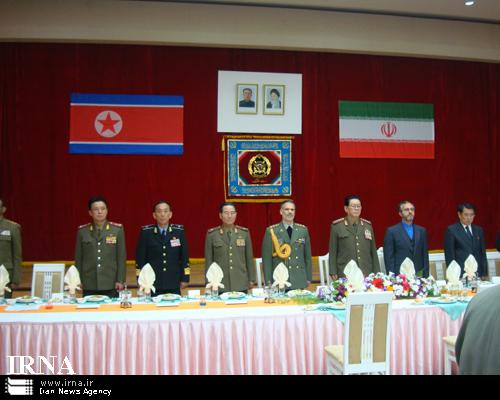
UPDATE 2 (DPRK-Iran cooperation): Arms Control Wonk has more on DPRK-Iran cooperation.  The picture below would probably make Ruhollah Khomeini spin in his grave:

UPDATE  1 (Nodong Missile): Arms Control Wonk has more on a second Nodong missile that has some Iranian influences.

Aviation Week also offers a good summary:

North Korea’s weaponry is showing design characteristics associated with the Shahab 3, Iran’s most advanced missile. Such evidence is leading some international analysts to the conclusion that the ballistic missile development ties between the two countries are active and producing improvements in the arsenals of both.

While it would seem doubtful that complete missiles or missile sections are being shipped — given the close scrutiny by the West of North Korea shipping — components and engineering data could move relatively easily by air and diplomatic pouch.

For years, Iran has been the junior partner in the relationship and used the conduit to acquire No-dong and other missile technologies to build its own systems. Now, Israeli officials have noted the first public emergence in North Korea of the BM-25 Musudan, a weapon they believe has already been supplied to Iran.

It is believed to the first time the road-mobile, liquid-fueled, intermediate-range ballistic missile has been shown to anyone outside the North Korean military. The public unveiling took place Oct. 10 during a military parade attended by the country’s leader, Kim Jong-il, and his son and apparent leader-designate, Kim Jong-un.

The BM-25 is a derivative of the Russian-designed, SS-N-6 submarine-launched ballistic missile, although it has been increased in length to add range. North Korea showed several of the missile and wheeled launchers during the parade, although the operational status remains uncertain owing to a lack of flight trials detected by outside observers.

The parade also showcased a No-dong ballistic missile with a tri-conic nosecone. That configuration is typically associated with Iran’s Shahab-3, causing some analysts to suggest technical information gleaned by Tehran in flight trials is being fed to Pyongyang. Such a move would suggest Iran has made considerable progress in developing its indigenous missile engineering expertise.

The latest Iranian ballistic missile developments indicate the missiles “are much more sophisticated and reliable than the [early] Scud designs,” says Arieh Herzog, director of the Israel Missile Defense Organization. “The inertial navigation systems are better and improved guidance in the final phase makes some of them accurate to without about 100 meters.”

The migration of the BM-25 to Iran has major security implications for Europe, since it would give Tehran the ability to strike targets in southern Europe. For Israel, the introduction of the BM-25 would have relatively modest impact on its strategic calculation, since Iran already has the ability to strike Israeli cities with ballistic missiles, but it would allow Iran to disperse its launchers over a much larger area in the eastern part of the country.

ORIGINAL POST (Musudan Missile): Although Kim Jong-un stole the headlines at at the military parade, the North Korean military also reportedly paraded several new missiles.  According to the AP:

Japanese public broadcaster NHK reported Sunday that the parade included three never-before-shown types of missiles and launching devices.

One was thought to be a new “Musudan” intermediate-range ballistic missile with a long, narrow head, similar to a ball-point pen, NHK said. It has a range of 3,000-to-5,000 kilometers (1,860-to-3,100 miles) and would be capable of hitting Japan and Guam, NHK said.

South Korea’s Defense Ministry said it could not immediately comment on the report. Call to South Korea’s top spy agency seeking comment went unanswered on Sunday.

Arms Control Wonk has much more.

The Choson Ilbo follows up.

Here are lots of great pictures from a Chinese site.

NTI Global Security follows up:

North Korea was reported to have unveiled three previously unseen ballistic missiles and launching apparatus during a major armed forces parade Sunday, according to the Associated Press (see GSN, March 17).

One new missile was believed to be a Musudan intermediate-range ballistic missile, which can travel 1,860 miles to 3,100 miles and could reach Guam and Japan, according to Japanese television channel NHK.

Missiles were prominently displayed at the parade with the words “Defeat the U.S. Military. U.S. soldiers are the Korean People’s Army’s enemy” written on them.

“If the U.S. imperialists and their followers infringe on our sovereignty and dignity even slightly, we will blow up the stronghold of their aggression with a merciless and righteous retaliatory strike by mobilizing all physical means, including self-defensive nuclear deterrent force,” North Korean army General Staff chief Ri Yong Ho said at the parade.

South Korean defense and intelligence officials did not offer comments on the report (Jean Lee, Associated Press/Google News, Oct. 10).

The Musudan is not known to have yet been launched in a test flight, proliferation analyst Joshua Pollack said on the website Arms Control Wonk. He cited the weapon’s flight range at roughly 1,550 miles to 1,860 miles. The missile is said to be based on the Soviet submarine-launched R-27, which is notably shorter in length than the Musudan.

The North Korean missile was initially unveiled in a 2007 armed forces parade; however, that event was closed to international media, the Chosun Ilbo reported. The South Korean newspaper reported the Musudan had a range of about 1,860 to 2,490 miles.

Evidently, some 12 Musudan missiles are fielded at missile installations in the North Hamgyong and South Pyongan provinces. The system can reportedly travel further than any other weapon in the North’s arsenal, including the Rodong missile with an 810-mile range, the newspaper reported.

“We’re looking at a new missile,” Pollack stated. “The lack of a known testing record prior to deployment raises all sorts of questions. Was it tested in another country, for example?” (Joshua Pollack, Arms Control Wonk I, Oct. 10).

The outside world also saw for the first time Sunday a new version of the medium-range Nodong ballistic missile, which was outfitted with what appeared to be a “separating re-entry vehicle,” Pollack noted.

“The question naturally arises: how long have the North Koreans had weapons of this type?” he wrote.

South Korean and U.S. news organizations initially began reporting on the Musudan missile in 2003, “so it’s certainly possible for Pyongyang to sit on these developments for years, if they wish,” he wrote.

The targeting precision of North Korean theater-range missiles such as the Nodong has been reported to have increased since July 2006 missile tests. The separating re-entry vehicle on the Nodong could explain some of that improved accuracy, Pollack stated.

Pollack indicated that details remain unclear regarding the third weapons system cited in the AP article (Joshua Pollack, Arms Control Wonk II, Oct. 10).

Read the full AP story here:
NKorea’s Kim, heir apparent son at lavish parade
Associate Press
10/9/2010

Share

DPRK seeks Japanese luxury goods

Thursday, October 7th, 2010

According to KBS:

A Japanese daily says North Korean officials have regularly bribed Japanese traders since Tokyo banned the export of luxury goods to North Korea in June of last year.

The Sankei Shimbun says North Korean officials in charge of importing luxury goods invited Japanese businesspeople to posh restaurants in places such as Dalian, China, several times and induced them into making illegal shipments.

Sankei said the North would first wire a lump sum of money in the several 100-million-won range to Japanese traders and then place orders for specific products afterwards.

In Japan, six smuggling cases of luxury goods to North Korea via China have been uncovered since June of last year.

Read the full story here:
Sankei: NK Bribes Japanese Firms to Import Luxury Goods
KBS
10/7/2010

Share
