Archive for the ‘Civil society’ Category

DPRK earns $10m at 2010 World Cup

Monday, June 21st, 2010

According to the Choson Ilbo:

North Korea will receive at least US$10 million from FIFA for fielding its national team in the World Cup. The figure amounts to three month’s wages for the over 43,000 North Koreans working in the joint Kaesong Industrial Complex.

FIFA gives the 32 teams playing in the World Cup $1 million each for preparation costs. After playing three matches in the first round, each team is given an additional $8 million no matter if it advances to the next round or not. From this year, every club that has a player in the World Cup receives $1,600 per day, per player. The paid period begins two weeks before the opening of the tournament and ends a day after the final match of each contending team.

For North Korea, the period lasts until this Saturday as it plays its final first-round match against Cote d’Ivoire on Friday. Less the three players who play for foreign football clubs — Jong Tae-se, An Yong-hak and Hong Yong-jo — the North will be given a combined $960,000 for the remaining 20 players on its team. Mostly soldiers, they are affiliated with six domestic clubs. FIFA’s payment is made to each club, but as the North’s are all state-run clubs, Pyongyang has secured at least $9.96 million so far.

If North Korea makes it into the qualifying round it will be awarded an additional $9 million. The teams playing in the quarter-final receive $14 million each and those in the semi-final $18 million each, while the winner takes home $30 million.

With its national team playing in this year’s World Cup, North Korea has also signed a $4.9 million deal under which Italy-based sports apparel maker LEGEA will provide the North with jerseys and training gear for four years.

Read the full article here:
N.Korea to Earn $10 Million for World Cup
Choson Ilbo
6/21/2010

Share

2010 World Cup [Updated]

Wednesday, June 16th, 2010

UPDATE 27 (2010-6-16): Some humor, news, and game scores:

Some non-Korean fans at the Brazil v. DPRK World Cup match brought some humor to the game:

world-cup-sign.jpg

UPDATE 26 (2010-6-16): According to KCNA:

Match between DPRK and Brazil

Pyongyang, June 16 (KCNA) — The league match of the 2010 World Cup between the DPRK and Brazil took place at dawn (Pyongyang time) on Wednesday.

From the outset of the match the two teams fought a seesaw battle. The DPRK footballers created good shooting chances, not losing their confidence even after losing two goals.

At about the 88th minute of the match Jong Tae Se headed the ball before passing it to Ji Yun Nam who powerfully kicked it into the rival’s goalmouth, scoring a goal.

The DPRK team will meet its Portuguese rival on June 21.

According to the Los Angeles Times:

The North Koreans are back in the World Cup after a 44-year absence. But some may wonder why they bothered to come.

The Brazilians, who play in the tournament every four years, have more than 500 journalists following them here. The North Koreans, in only their second World Cup, brought two photographers, two TV reporters and one writer.

In the U.S., where soccer is still considered a minor sport, more than 136,000 World Cup tickets were sold. In North Korea, where the team is making history, the national soccer federation distributed 1,400 tickets.

In South Africa, a soccer game is a thinly disguised reason to sing, dance, scream and blow on a vuvuzela for hours. The North Korean fans handpicked to attend their country’s World Cup opener Tuesday displayed all the joy and spontaneity of accountants attending a seminar.

That the game — played in a wind chill of 24 degrees — ended in a 2-1 victory for Brazil was predictable. That several hundred North Korean fans were on hand to watch it was not.

China’s state-run news agency has reported that North Korea had offered tickets to sporting officials and tour agencies in China, which does not have a team here. Chinese journalists in South Africa had adopted the North Koreans as their own and, the news agency reported, about 1,000 Chinese dancers and musicians were recruited to cheer for the North Koreans.

But shortly before Tuesday’s game started, a five-row block of seats on the second level at Ellis Park Stadium filled up with more than 40 men and a woman, all dressed in identical red shirts, jackets and scarves, wearing identical red caps and waving small North Korean flags. Across the way there was another similarly sized red dot of fans in grandstands that were otherwise filled with the green and yellow of Brazil.

Kim Yong Chon, 43, one of the North Korean fans, said the group, which numbered 300, was not Chinese, but he admitted they had been carefully recruited by the North Korean government to make the trip. Speaking through an interpreter, he said the group had left Pyongyang, North Korea’s capital, and traveled through Beijing the same day and they would stay in South Africa as long as their team does.

They sang the North Korean national anthem loudly but sat passively, almost expressionless, through most of the game, with one man sucking on a beer. They spoke only infrequently to one another — Chon said they didn’t know one another before coming to South Africa — and mainly reacted to the action on the field only when directed to do so by a man who stood before them like an orchestra conductor.

Few of the men bothered to acknowledge the non-Korean fans, following the lead of their team, which was hidden on a private floor of a luxury hotel, failed to show at news conferences and banned outside journalists from its training sessions.

FIFA has chosen not to challenge the team over media availability, so after Tuesday’s game, while members of the Brazilian team spoke at length with reporters, most of the North Korean players brushed by. Only a handful bothered to stop at all, most notably star striker Jong Tae Se, who cried during the playing of his country’s national anthem. And he was quickly shooed along by members of the North Korean delegation.

Perhaps all this would have gone unnoticed had North Korea opened against another team that plays a staid, defensive game. But against the passionate Brazilians and their samba-dancing fans, the contrast was stark.

But Chon at least tried to acknowledge the tenets of international friendship and cultural exchange events such as the World Cup are supposed to engender.

“We will also be supporting South Korea,” he said, mentioning the country that North Korean Coach Kim Jong Hun had refused to acknowledge a day earlier. “Our hearts are with them too.

“But we have no tickets for any of their games.”

And according ot the Daily NK:

The Daily NK can reveal that the roughly one hundred North Korea supporters at the North Korea v Brazil football match on Tuesday night were North Koreans already in Africa earning foreign currency for the state.

A Daily NK source in China explained more, “The people who were mobilized for cheering were workers from ‘Overseas Construction Company’ and the Mansudae Art Institute. They are all in Africa generating foreign currency.”

“Overseas Construction Company” is a government department managing personnel and their lives on construction projects abroad. North Korea has several hundred such people in African countries.

The Mansudae Art Institute earns foreign currency producing statues and other public works of art in countries such as Namibia, Angola, Ethiopia and Zimbabwe, and most recently the 164-foot high, $27 million “Monument to the African Renaissance” in Dakar, the capital of Senegal, which was unveiled in April this year.

A second source explained the background to their presence. “North Korea planned to send a large cheering group from Pyongyang,” he said, “but it was cancelled due to problems of cost and difficulties regulating them on site.”

After the authorities cancelled the original plan, they attempted to sell the 65 free tickets they received from FIFA for each of North Korea’s games through overseas offices. However, that also failed.

The source explained, “The authorities attempted to sell them through Chongryon (General Association of North Korean Residents in Japan) and other foreign agents, but no one wanted to buy. Who wants to go South Africa only to see the North Korea games?”

The authorities were reportedly asking $169 per ticket.

Contradicting The Daily NK’s sources, Yonhap released an interview with one of the group, Sunwoo Ryong, today. In it, he claimed, “About 100 of us arrived here two days ago. We’re all from Pyongyang and are regular workers that volunteered.”

According to Yonhap, the group refused to reveal any further information about how they came to be in Johannesburg, but did say they intend to be at every one of the North’s matches.

UPDATE 25 (2010-6-16): It was alleged that the DPRK was pirating the World Cup broadcast, but this was not the case. According to Evan Ramstad in the the Wall Street Journal:

North Korea’s TV station legally obtained the rights to broadcast World Cup games in a deal brokered by Malaysia-based Asia-Pacific Broadcasting Union on behalf of broadcasters in five countries, the union said Tuesday.

North Korea’s rebroadcast on Saturday of the opening game of the World Cup surprised South Korea’s tournament broadcaster, which feared the North was pirating its signal after refusing to come to terms for sharing its rights to the event.

But when the controversy came to the attention of World Cup governing body FIFA, it said it had signed a broadcast agreement with the Asia-Pacific Broadcasting Union to send video of the games to North Korea.

The union confirmed the deal on Tuesday. A person in the union’s sports department said the deal was reached just before the tournament started Friday for TV stations in East Timor, Kyrgyzstan, Laos and Uzbekistan, as well as North Korea. Terms weren’t disclosed.

The union is a nonprofit organization of broadcasters in 58 countries that facilitates the exchange of news and entertainment programs.

North Korea illegally used some South Korean broadcasts of the 2002 World Cup, but in 2006 it made an arrangement to obtain TV coverage legally from a South Korean network.

Its state broadcasting system held two meetings with the South Korean TV network SBS, which purchased broadcast rights for the Korean peninsula from FIFA, for a retransmission arrangement on the current tournament, but the two sides couldn’t come to terms.

When the North Korean TV station on Saturday showed a replay of Friday’s tournament-opening game between South Africa and Mexico, SBS officials said they suspected their signal had been pirated by the North.

North Korea has since showed excerpts of several other games on a delayed basis. Analysts say the country is unlikely to show live broadcasts of its own team because of fears by its authoritarian government that the team will perform poorly or the prospect that protesters who dislike the North will be given screen time.

North Korea’s coach, Kim Jong Hun, in a news conference in South Africa on Monday said he expected that the country’s games will be broadcast back home.

North Korea was scheduled play Brazil, one of the tournament’s favorites, on Tuesday night in South Africa, early Wednesday Korea time. North Korea’s TV station typically broadcasts five to seven hours a day and doesn’t usually operate in the overnight hours when the game will be played.


UPDATE 24 (2010-6-10): Here is a video clip of the DPRK team training in a local South African gym. Also, it appears that Hyundai is providing buses for all the teams, including the North Koreans. Link here.

hyundai-bus-1.jpg

hyundai-bus-2.jpg

UPDATE 23 (2010-6-8): There are some North Korea fans who will be traveling to South Africa: The Chongryun.  According to the Wall Street Journal:

An excited bunch of about 50 soccer fans are set to fly out from Tokyo June 14 for a historic game at the World Cup in South Africa. Not to watch Japan, though –- to follow their preferred team, North Korea.

A majority of Japan’s 600,000 ethnic Korean population prefers to cheer for North Korea, rather than its southern neighbor. And as part of its World Cup promotional campaign, the North Korean Football Association of Japan (in Japanese), a Tokyo-based soccer organization that runs leagues for the North Korean-affiliated community in Japan, has organized tours to watch the games in South Africa, as well as selling team merchandise online.

According to Lee Kang Hong, who works at the NKFA, there will be approximately 50 people from all over Japan traveling to South Africa to cheer on the “Chollima”, meaning winged horses, when they take on heavyweight Brazil in its first game on June 15.  Mr. Lee, who will also be making the journey to Johannesburg, says the five-night trip to the host nation costs 630,000 yen ($6,900) per person. While there are two tours in the works, no one has signed up for the second trip to watch North Korea’s second game against Portugal, according to Mr. Lee.

But the Portugal game looms large in NFKA’s Japan plans. A bright red t-shirt emblazoned with the slogan “1966 Again” might have proved popular with fans of England, still longing for a repeat of its only victory in the tournament. But the shirt actually recalls the near miraculous upset North Korea pulled off against Italy in the 1966 World Cup in England before succumbing in the quarter-finals to Portugal.

The t-shirt is on sale for 2,500 yen ($27), while a scarf costs 1,500 yen ($16). Those with a bit more to spend can snag a replica of the team uniform for 12,000 yen ($130). But demand hasn’t been brisk so far: less than 100 items have been sold thus far, according to Mr. Lee.

Still, the apparel will also be sold at the various organized festivities to be held in school gymnasiums and restaurants around Tokyo when North Korea takes the field in its World Cup rematch against Portugal June 21. Similar events were held in late May to send off the three players born in Japan who will be playing for North Korea and hail from the tight-knit community of Japanese-born ethnic Koreans who affiliate themselves with Pyongyang.

As for the team’s prospects in South Africa, a repeat performance of the 1966 run would stun the entire world of soccer. But then again, the team wasn’t exactly a hot favorite 44 years ago either.

UPDATE 22 (2010-6-5): Apparently the DPRK tried to pass a striker off as a goalkeeper.  According to the Los Angeles Times:

For reasons that are not entirely clear, North Korea seems to have to learn everything the hard way.

Take the World Cup, for example. The rules clearly state that a team must be made up of 23 players, three of whom must be goalkeepers.

But North Korea decided to select only two real goalkeepers and named a striker as its third goalkeeper. The idea was to carry 21 field players compared to 20 for all other 31 competing teams.

Cheating, is what it amounted to, really.

But FIFA, decided that this was not at all sporting and has told North Korea that by designating forward Kim Myong-won as a goalkeeper means that he can only play as a goalkeeper during the tournament.

In other words, the North Korean ploy backfired in two ways: The team has only two goalkeepers at its disposal — so an injury and a red card would leave it with none — and it can’t use Kim at all, unless it wants to put a forward in the net.

Not that it matters in the long run. Coach Kim Jong-hun’s team plays Brazil, the Ivory Coast and Portugal in the first round, after which it will be on a plane headed home. All it has achieved by the bizarre move is to ruin what little chance it had, which was none.

But perhaps that was the real ploy all along. Now North Korea can claim a conspiracy to deprive it of the right to field its best team. Not that North Korean fans will know anything about the tournament. The country’s oddball leader, Kim Jong Il, said last year that only North Korean victories could be shown on television.

Since there are likely to be none of those, the fans are out of luck.

Their fans in South Africa have been shut out, too, since North Korea arrived. The team has held four training sessions and has barred foreign reporters from all of them.

Embarrassment, no doubt.

UPDATE 21 (2010-3-15): North Koreans allegedly working on South African football stadiums.

UPDATE 20 (2009-12-13): DPRK allotted 17,000 tickets for world cup, but uses only 200.  According to the Mirror:

Football-mad North Korea will get 17,000 tickets to the World Cup… but NONE of their fans will be allowed to go.

Despot Kim Jong-il will ­hand-pick just 200 of his ­pampered party officials to go to South Africa while ordinary people will be left at home.

And in a bitter blow to ­England’s travelling army of 30,000 fans, we will get 2,000 FEWER tickets than the ­dictatorship for group stages.

According to officials, Kim Jong-il, 68 – known to the ­Korean people as the Dear ­Leader – ­“proposed the tactics” which helped the little-known side finish second in their qualifying group.

But while he revels in his country’s ­qualifying for a World Cup for the first time since 1966, his countrymen are banned from flying to South Africa.

About 80,000 fans regularly watched the team’s qualifying campaign. But the 17,386 tickets the country will get for their games against Brazil, ­Portugal and the Ivory Coast are expected to find their way on to the black ­market.

It is not known whether Kim Jong-il will fly to the World Cup. But in April Kim Jong Su, ­of the North Korean ­Football Association, said: “The Great Leader gave in-depth ­guidance on the development of Korean football. He proposed the game’s tactics most relevant for the physiological characteristics of the Korean players.”

The official also said Kim Jong-il personally guided the team at the stadium during the crucial draw with Iran in April last year.

He added: “Perhaps there’s no other team in the world who would be fighting with the same dedication to please the leader and to bring fame to their ­motherland.”

The reason North Korea gets more tickets than ­England is because they are playing in two of South Africa’s biggest stadiums – Ellis Park in Johannesburg and Cape Town Stadium.

Each country gets 9.8 per cent of the stadium’s capacity.

As England are playing two of their group games in the smallest stadiums, their share is less.

UPDATE 19 (2009-11-3): According to Yonhap:

North Korea bestowed awards on players and coaches of its national football team for advancing to next year’s World Cup finals, their first entry in more than four decades, state media said Tuesday.

Yang Hyong-sop, vice president of the Presidium of the Supreme People’s Assembly, awarded the merit citations and medals in a ceremony on Monday, said the Korean Central Broadcasting Station, an official radio channel.

The football players “brought glory to the homeland and encouraged our military and people who are in a great struggle to build a thriving nation,” the report said.

Among the award winners were Kim Jong-sik and Kim Jong-su, director and a vice director at the Commission of Physical Culture and Sports Guidance. They received merit citations of North Korean founder Kim Il-sung and current leader Kim Jong-il, respectively, it said.

The team coach, Kim Jong-hun, and players also received honorary titles of “people’s athletic” or “merited athletic,” the report said.

North Korea qualified for next year’s World Cup finals in South Africa for the first time since 1966. In that World Cup in Britain, North Korea beat Italy on the way to the quarterfinals before losing to Portugal.

Read the full article here:
N. Korea awards football team for advancing to 2010 World Cup
Yonhap
Kim Hyun
11/3/2009

UPDATE 18:  According to Goal.com Mr. Eriksson will not take the job.UPDATE 10/13/2009:  Sven-Goran Eriksson is in talks to manage North Korea at World Cup.  According to the Guardian:

Sven-Goran Eriksson and Peter Trembling are heading to east Asia this week to hold final talks on a deal that could see the former England manager become the coach of the North Korea team at next summer’s World Cup.

Trembling, the Notts County executive chairman, is understood to have been involved in talks with intermediaries representing the Football Association of the Democratic People’s Republic of Korea. Those negotiations were with a view to securing the Meadow Lane director of football’s services on loan.

The process is now advanced enough for Trembling and Eriksson to be travelling to Beijing later this week on an eight-day trip. The club chairman is also expected to discuss Chinese business investment opportunities in Qadbak, the British Virgin Islands-registered investment vehicle that owns County.

A source close to the deal confirmed that the trip to east Asia is going ahead and did not deny that Eriksson’s stewardship of the world’s 90th-ranked team was under discussion. North Korea’s embassy in London suggested there might be an announcement in “two or three weeks”.

Read the full story here.

UPDATE 17 (2009-10-6): The North Korean team has arrived in France for some scheduled friendly matches.  According to USA Today:

The [North Korean] government banned the [previous national] team from traveling abroad following defeats to both Japan and South Korea in the qualifying stages for the 1994 World Cup in the United States. The squad returned to the international stage in 1999 but skipped the 1998 and 2002 World Cups, and failed to qualify for the 2006 tournament.

Only a few North Koreans players have signed for foreign clubs and the 19 players reunited in Nantes all play at home.

According to Cadet, their trip in France was made possible by the French ministry of foreign affairs.

“They immediately understood that the purpose of their trip was just about football,” he said.

But the North Koreans will not be free to do as they please during their stay. Some outings as tourists are scheduled for them in Paris and in the Nantes area, but they always will stay together.

UPDATE 16 (2010-6-3): Italian sports apparel firm Legea snagged the DPRK men’s and women’s football contracts.

UPDATE 15 (2009-9-24):  The North Korean football team will play three games in France this October.  According to the AFP:

North Korea’s footballers will play three matches in France in October as part of their build-up to the 2010 World Cup, the Asians’ first venture into Europe for 40 years.

The squad will be based near the western city of Nantes from October 5-15, the French organisers Sports Live Agency said.

North Korea, who last qualified for the World Cup in 1966 in England, will take on second division side Nantes at La Roche-sur-Yon on October 9 and the Congo national team on October 13 at Le Mans.

The date for a third game, probably against a French footballer’s union side, is being arranged.

The North Koreans secured their place in the 2010 tournament in South Africa with a 0-0 draw away at Saudi Arabia last June.

UPDATE 14 (2009-7-3):  Kim Jong Il masterminded North Korea’s World Cup qualification? According to Russia Today (Successor to USSR Today–like Korea Today):

North Korean sporting officials claim that it was the invaluable tactical advice that the head of the state gave to the players that allowed them to win a ticket to South Africa in 2010, reports Choson Sinbo, a Japan-based newspaper published by the General Association of Korean Residents.

“The Great Leader gave in-depth guidance on the development of Korean football. He proposed the game’s tactics most relevant for the physiological characteristics of the Korean players”, Kim Jong Su, General Secretary of North Korean Football Association, said.

The official also said Kim Jong Il personally guided the team at the stadium in April last year.

According to the newspaper, the Great Leader’s involvement allowed the Korean footballers to show their own game and cope without copying the style of play of the leading Western teams.

Head Coach of the North Korean national squad, Kim Jong Hun, explains the main reason of his men’s success lies in their “exceptional spiritual strength and unity.”

“Perhaps there’s no other team in the world, who would be fighting with the same dedication to please the leader and to bring fame to their motherland,” Kim Jong Hun said.

Read the full story here.

UPDATE 13 (2009-6-21): The North Korean team came home to a hero’s welcome.  Photos here and here.  The best is by far this one:

nkworldcup.jpg

click for larger image

Too bad Kim Jong il could not meet them at the airport in person… 

UPDATE 12 (2009-6-17): The North Korean team is going to South Africa. From the Washington Post’s Stephen Goff:

North Korea secured its first World Cup berth since 1966. The other automatic qualifiers from Asia are Japan, South Korea and Australia. The Saudis will face Bahrain in a two-game regional playoff in September, with the winner facing Oceania champion New Zealand for a World Cup slot.

Why do I have a sneaking suspicion the North Koreans and Americans will land in the same group in South Africa next summer? Sort of like when the USA and Iran were “randomly” paired in 1998. (How many of you remember the USA-North Korea friendly at RFK Stadium in 1991? The Koreans won, 2-1.)

Other Notes:
1. The Bleacher Report offers a satirical take.

2. More coverage of the game here.

3. If you have not seen The Game of Their Lives, you probably should.  YouTube has a trailer here.

4. How come the Koreans get to send two teams to the World Cup? (joke)

UPDATE 11 (2009-6-6): DPRK draws 0 – 0 with Iran. South Africa still possible. According to the AFP:

North Korea inched closer to their first World Cup finals since 1966 with a gritty 0-0 draw against Iran on Saturday.

But it was not the result newly appointed Iran coach Afshin Qotbi was looking for, with their World Cup fate now hanging in the balance.

The draw edged North Korea level with South Korea on 11 points in Group B, but they have played two games more. The South take on United Arab Emirates in Dubai later Saturday.

Saudi Arabia, who do not play Saturday, have 10 points with Iran languishing on seven points and facing a home game against UAE next Wednesday and then a tough trip to Seoul on June 17 — matches they must win.

Despite the draw North Korea, at the centre of international criticism after its second nuclear test, appeared disappointed after the game in front of a full house in Pyongyang, with players slumping to the ground in frustration.

But ultimately it moved them closer to ending their long wait for another crack at the World Cup.

Time also covers some of the drama behind this game.

South Korea advances to the next round.

Read more below:
North Korea inch closer to World Cup finals
Associated Free Press (AFP)
6/6/2009

North Korea Wipes Out Iran (from the World Cup)
Time
Ishaan Tharoor
6/7/2009

UPDATE 10 (2009-4-6): KCNA publishes their full complaint to FIFA:

A spokesman for the DPRK Football Association, in a statement released on Sunday as regards the serious incident that happened at the football match of the final Asian qualifier of 2010 FIFA World Cup between the DPRK and south Korea held in south Korea, expressed the expectation that the FIFA would examine the whole process of the match and take an appropriate measure.

The statement says:

Main players of the football team of the DPRK could not get up due to serious vomiting, diarrhea and headache since the night on March 31, just a day before the match.

They were healthier than any others in ordinary days and they had their meals only in the place they put up. They were enthusiastic in the training till that day. It can be said that it was beyond all doubt that the incident was a product of a deliberate act perpetrated by adulterated foodstuff as they could not get up all of a sudden just before the match.

Moreover, the Oman chief referee was so seriously biased in refereeing at the match that he insisted the ball headed by our player into the goal mouth at about 6 minutes after the start of the second half of the match was not the goal. He also declared that the foul committed by the rival side about 3 minutes before the end of the match was our player’s though it was an obvious foul on the part of the rival side, thus resulting in the loss of our team.

It was something surprising that the Japanese refereeing supervisor tacitly connived at this shameless behavior though he was obliged to ensure the fair refereeing.

The match thus turned into a theatre of plot-breeding and swindling. It is as clear as noonday that it was a product of the Lee Myung Bak group’s moves for confrontation with the DPRK and a deliberate behavior bred by the unsavory forces instigated by it.

We sternly condemn the attitude of the Lee group, which runs the whole gamut of evil doings in violation of the noble idea of sports after betraying its fellow countrymen, as anti-reunification and treacherous moves to incite confrontation with the DPRK. We strongly urge the south Korean authorities to own full responsibility for such serious incident and promptly make an apology for what happened.

The DPRK Football Association will always remain true to the FIFA which regards friendship and peace as its mission and the sports idea. It once again vehemently denounces the south Korean authorities and the unsavory forces responsible for the incident and will closely follow their future acts.

UPDATE 9 (2009-4-4): DPRK protest to FIFA over loss to South Korea:

North Korea protested to world governing body FIFA on Sunday that they were the victims of a South Korean plot which caused them to lose a World Cup qualifier 1-0 to their rivals in Seoul last week.

The North Korean FA said in a statement that their players’ food had been tampered with and that the referee was biased.

“The match thus turned into a theatre of plot-breeding and swindling,” the statement said.

“It is as clear as noonday that it was a product of (South Korean President) Lee Myung-bak group’s moves for confrontation with the DPRK (North Korea) and a deliberate behaviour bred by the unsavoury forces instigated by it.”

The statement said FIFA should “examine the whole process of the match and take appropriate measures” and called on South Korean authorities “to own full responsibility for such serious incidents and promptly make an apology”.

No one from FIFA was immediately available to comment. (Reuters)

UPDATE 8 (2009-4-1): South Korea tops the DPRK in Seoul. Final score 1-0 . The Koreans hold first and second spots in Group B. Read more here and here.

Question: How many other countries would like to be divided so they can send two teams to the World cup?

UPDATE 7 (2009-3-29): The North Korean team has arrived in Seoul for the April 1st inter-Korean qualifier match. According to Fifa.com, the DPRK have a June 6th game against Iran and a June 17th game against Saudi Arabia.

UPDATE 6 (2009-3-28): North Korea looking good for a first World Cup appearance since 1966.

Pak Nam Chol and Mun In Guk gave North Korea a big push in the direction of South Africa on Saturday afternoon in Pyongyang by giving their team a 2-0 win over UAE in their 2010 World Cup qualification clash.

Group 2 rankings: 1: North Korea-10 2: South Korea-8 3: Iran-6 4: Saudi Arabia-4 5: UAE-1 (Goal.com)

UPDATE 5: FIFA has set the September 10 DPRK-ROK World Cup qualifying match in Shanghai (again). Pyongyang is still reluctant to raise the South Korean flag in Kim il Sung stadium. Someone please tell the DPRK foreign ministry that this does not reinforce the image of social strength that the North works so hard to cultivate. Read more here.

Goal.com makes the claim that these political decisions also hurt the team’s chances of winning.

FIFA is neutral, and it will not sanction the DPRK since both teams agree to play the game in Shanghai. More on their decision can be found here.

UPDATE 4: As reported below, North and South Korea were both drawn into Group 3 in Round 3 qualifying matches for the 2010 World Cup in South Africa. North and South Korea tied 0-0 in both games against each other. However, due to Pyongyang’s refusal to raise the South Korean flag and play the South Korean national anthem, the initial Pyongyang home match was moved to Shanghai, where yours truly was able to attend. Pyongyang also tried to have the Seoul home match moved to another city or country before finally abandoning politics and just letting their boys play.

Well, FIFA has drawn groups for Round 4 qualifiers, and both North and South Korea have been chosen for Group 2. This means Pyongyang will have another opportunity to host the South Korean national football team—along with their flag and anthem. What are the odds that Pyongyang will actually host their home game this time around?

Matches are scheduled for September 10 and January 4, 2009. Venues TBD.

UPDATE 3: 0-0 draw in Seoul

From the Associated Press (via the IHT):

Amid an atmosphere of goodwill, South Korea and North Korea tied 0-0 in a 2010 World Cup qualifier Sunday.

With both teams already through to the final round of qualification, the match had the feeling of a friendly from start to finish. The visitors were given a rousing reception when they appeared for warmups. The respective anthems were played before 55,000 fans in Seoul’s World Cup Stadium, including 500 North Korean supporters. At the final whistle, fans applauded both sets of players.

Both teams finished with 12 points, though South Korea took the top spot in Group Three due to superior goal differential.

The draw for the final round of Asian qualification will be made on June 27 and matches begin in September.

UPDATE 2 (2008-6-14): North Korea tops Jorday 2-0, next stop Seoul!

From the Associated Press (via Herald Tribune):

North Korea reached the final stage of Asian qualifying for the 2010 World Cup with a 2-0 win over Jordan on Saturday, ensuring neighbor South Korea also progressed.

Two goals from Hong Yong Jo gave North Korea 11 points from 5 games, meaning it can finish no lower than second in Group Three, and therefore progresses to the final 10-team round that will decide Asia’s berths at South Africa 2010.

North Korea travels to Seoul for the final match to take on South Korea on June 22.  The match had been in some doubt as North Korea officials demanded that the game be held in a third country or on the southern island of Jeju. The Korean Football Association refused to compromise and North Korea finally agreed Friday to play the match in Seoul. The team will arrive in the South Korean capital on June 19.

Read the full story here:
World Cup: North Korea beats Jordan 2-0, puts North and South Korea in last qualifying round
Associated Press (via Herald Tribune)
2008-6-14

UPDATE 1  (2008-6-11): North Korea’s World Cup Football shenanigans made headlines earlier this year when Pyongyang refused to raise the South Korean flag and play its national anthem in a regulation match.  FIFA responded by moving the game to Shanghai, China, where North Korean Economy Watch was able to attend.  Well the DPRK men’s team has risen to second place in its qualifying bracket (see original post below), and now that it has only two games left, Pyongyang again inserts politics into sport.

From the Korea Times:

The South’s Korea Football Association (KFA) had a meeting with its North counterpart in Gaeseong Tuesday, and the North side asked the KFA to host their match, scheduled for June 22 at Seoul World Cup Stadium, in another country due to a cold relationship between the two sides and ongoing rallies in Seoul.

The North Korea Football Association also asked Mohamed bin Hammam, the president of the Asian Football Confederation (AFC), last month to change the site of the June 22 match.

However, FIFA, which has already selected referees and match supervisors, ignored the North’s pleas, and the KFA also stated that it would stick with the original schedule.

South Korea’s action compelled the North to propose Jeju Island, where the North’s under-17 squad participated in the U-17 World Cup last year, as an alternative. But the original plans were not changed.

ORIGINAL POST: The North Korean national men’s team toppled Turkmenistan 1-0 last week in the 2010 World Cup qualifier.  With the game heading toward a goalless stalemate, Choe Kum Chol scored with 19 minutes remaining to put the North Koreans in sight of a place in the final round of qualification.

North Korea now has 8 points, putting the team at the top of group 3.

On June 14, North Korea will host Jordan in Pyongyang.

On June 22, North and South Korea will meet in Seoul.  For coverage of their March game in Shanghai, click here.

Read the full stories here:
North and South Korea draw 0-0
Associated Press
2008-6-22

North Korea downs Turkmenistan 1-0 in World Cup qualifier
Herald Tribune (via Associated Press)
2008-6-7

N. Korea Disputes Match Location
Korea Times
Kang Seung-woo
2008-6-11

Share

DPRK, PRC to produce film on Korean War

Tuesday, June 15th, 2010

According to Yonhap:

North Korea and China will jointly produce a film marking the 60th anniversary of the Korean War, according to the Chinese embassy in Pyongyang on Tuesday.

The announcement was posted on the official Web site of the Chinese embassy amid heightened tensions after North Korea’s sinking of the warship Cheonan in the Yellow Sea in March this year, which killed 46 South Korean sailors.

Read the full story here:
N. Korea, China to produce film on Korean War
Yonhap
Kim Young-gyo
6/15/2010

Share

Most DPRK defectors watched ROK media

Monday, June 14th, 2010

According to Yonhap:

More than half of North Korean teenage defectors viewed South Korean movies and dramas when they were in the communist country, a survey said Monday.

According to the survey conducted last month by Yoon Sun-hee, a professor for Hanyang University, 79 of 140 students, or 56 percent, in Hangyeore Middle and High School said they watched South Korean films and TV programs in North Korea.

North Korea reportedly strictly bans its people from viewing South Korean broadcasts and films.

Hangyeore, located in Anseong, 77 kilometers south of Seoul, is a school for North Korean defectors founded in 2006.

Among the respondents, 57 students said they saw South Korean movies on DVD and 43 claimed to have watched videotaped dramas, while 15 watched broadcasts on TV, the survey showed.

It did not say how the students had obtained the South Korean DVDs and videos, or gained access to the broadcasts.

Forty students said they could see the South Korean programs whenever they wanted and five watched them everyday, when asked how often they had seen the banned films.

The survey also showed that 21 teenagers said they had watched the programs once a month, six said once a year, while seven students experienced the South Korean material only once during their lifetimes in North Korea.

According to the survey, most of them said South Korean films and dramas were “interesting,” although they had to view them secretly in the reclusive country.

“It’s hard to make generalizations but the results are surprising,” said Prof. Yoon. “The result itself indicates that North Korea is more open than we expected.”

“The study shows that North Korean teenagers tend to protest against the regime and also enjoy their lives,” she added.

Some 125 respondents were living near the North Korea-China border, while 15 others were living closer inland, including Pyongyang.

Read the full story below:
More than half of young N.K. defectors watched S. Korean TV programs: poll
Yonhap
6/14/2010

Share

The DPRK’s internet, business, and radio wars

Friday, June 11th, 2010

Martyn Williams releases three DPRK stories this week all covering interesting issues…


North Korea Moves Quietly onto the Internet

North Korea, one of the world’s few remaining information black holes, has taken the first step toward a fully fledged connection to the Internet. But a connection, if it comes, is unlikely to mean freedom of information for North Korea’s citizens.

In the past few months, a block of 1,024 Internet addresses, reserved for many years for North Korea but never touched, has been registered to a company with links to the government in Pyongyang.

The numeric IP addresses lie at the heart of communication on the Internet. Every computer connected to the network needs its own address so that data can be sent and received by the correct servers and computers. Without them, communication would fall apart.

It is unclear how the country’s secretive leadership plans to make use of the addresses. It seems likely they will be assigned for military or government use, but experts say it is impossible to know for sure.

North Korea’s move toward the Internet comes as it finds itself increasingly isolated on the world stage. The recent sinking of a South Korean warship has been blamed on the insular country. As a result, there are calls for tougher sanctions that would isolate North Korea further.

“There is no place for the Internet in contemporary DPRK,” said Leonid A. Petrov, a lecturer in Korean studies at The University of Sydney, referring to the Democratic People’s Republic of Korea. “If the people of North Korea were to have open access to the World Wide Web, they would start learning the truth that has been concealed from them for the last six decades.”

“Unless Kim Jong-Il or his successors feel suicidal, the Internet, like any other free media, will never be allowed in North Korea,” he said.

The North Korean addresses were recently put under the control of Star Joint Venture, a Pyongyang-based company that is partly controlled by Thailand’s Loxley Pacific. The Thai company has experience working with North Korea on high-tech projects, having built North Korea’s first cellular telephone network, Sunnet, in 2002.

Loxley acknowledged that it is working on a project with Pyongyang, but Sahayod Chiradejsakulwong, a manager at the company, wouldn’t elaborate on plans for the addresses.

“This is a part of our business that we do no want to provide information about at the moment,” he said.

A connection to the Internet would represent a significant upgrade of the North’s place in cyberspace, but it’s starting from a very low base.

At present the country relies on servers in other countries to disseminate information. The Web site of the Korea Central News Agency, the North’s official mouthpiece, runs on a server in Japan, while Uriminzokkiri, the closest thing the country has to an official Web site, runs from a server in China.

North Korean citizens have access to a nationwide intranet system called Kwangmyong, which was established around 2000 by the Pyongyang-based Korea Computer Center. It connects universities, libraries, cybercafes and other institutions with Web sites and e-mail, but offers no links to the outside world.

Connections to the actual Internet are severely limited to the most elite members of society. Estimates suggest no more than a few thousand North Koreans have access to the Internet, via a cross-border hook-up to China Netcom. A second connection exists, via satellite to Germany, and is used by diplomats and companies.

For normal citizens of North Korea, the idea of an Internet hook-up is unimaginable, Petrov said.

Kim Jong-Il, the de-facto leader of the country, appears all too aware of the destructive power that freedom of information would have to his regime.

While boasting of his own prowess online at an inter-Korean summit meeting in 2007, he reportedly rejected an Internet connection to the Kaesong Industrial Park, the jointly run complex that sits just north of the border, and said that “many problems would arise if the Internet at the Kaesong Park is connected to other parts of North Korea.”

Kim himself has made no secret of the Internet access that he enjoys, and famously asked then-U.S. Secretary of State Madeleine Albright for her e-mail address during a meeting in 2000.

The government’s total control over information extends even as far as requiring radios be fixed on domestic stations so foreign voices cannot be heard.

The policy shows no signs of changing, so any expansion of the Internet into North Korea would likely be used by the government, military or major corporations.

The World’s Most Unusual Outsourcing Destination

Think of North Korea, and repression, starvation and military provocation are probably the first things that come to mind. But beyond the geopolitical posturing, North Korea has also been quietly building up its IT industry.

Universities have been graduating computer engineers and scientists for several years, and companies have recently sprung up to pair the local talent with foreign needs, making the country perhaps the world’s most unusual place for IT outsourcing.

With a few exceptions, such as in India, outsourcing companies in developing nations tend to be small, with fewer than 100 employees, said Paul Tija, a Rotterdam-based consultant on offshoring and outsourcing. But North Korea already has several outsourcers with more then 1,000 employees.

“The government is putting an emphasis on building the IT industry,” he said. “The availability of staff is quite large.”

At present, the country’s outsourcers appear to be targeting several niche areas, including computer animation, data input and software design for mobile phones. U.S. government restrictions prevent American companies from working with North Korean companies, but most other nations don’t have such restrictions.

The path to IT modernization began in the 1990s but was cemented in the early 2000s when Kim Jong Il, the de-facto leader of the country, declared people who couldn’t use computers to be one of the three fools of the 21st century. (The others, he said, are smokers and those ignorant of music.)

But outsourcing in North Korea isn’t always easy.

Language can be a problem, and a lack of experience dealing with foreign companies can sometimes slow business dealings, said Tija. But the country has one big advantage.

“It is one of the most competitive places in the world. There are not many other countries where you can find the same level of knowledge for the price,” said Tija.

The outsourcer with the highest profile is probably Nosotek. The company, established in 2007, is also one of the few Western IT ventures in Pyongyang, the North Korean capital.

“I understood that the North Korean IT industry had good potential because of their skilled software engineers, but due to the lack of communication it was almost impossible to work with them productively from outside,” said Volker Eloesser, president of Nosotek. “So I took the next logical step and started a company here.”

Nosotek uses foreign expats as project managers to provide an interface between customers and local workers. In doing so it can deliver the level of communication and service its customers expect, Eloesser said.

On its Web site the company boasts access to the best programmers in Pyongyang.

“You find experts in all major programming languages, 3D software development, 3D modelling and design, various kind of server technologies, Linux, Windows and Mac,” he said.

Nosotek’s main work revolves around development of Flash games and games for mobile phones. It’s had some success and claims that one iPhone title made the Apple Store Germany’s top 10 for at least a week, though it wouldn’t say which one.

Several Nosotek-developed games are distributed by Germany’s Exonet Games, including one block-based game called “Bobby’s Blocks.”

“They did a great job with their latest games and the communication was always smooth,” said Marc Busse, manager of digital distribution at the Leipzig-based company. “There’s no doubt I would recommend Nosotek if someone wants to outsource their game development to them.”

Eloesser admits there are some challenges to doing business from North Korea.

“The normal engineer has no direct access to the Internet due to government restrictions. This is one of the main obstacles when doing IT business here,” he said. Development work that requires an Internet connection is transferred across the border to China.

But perhaps the biggest problem faced by North Korea’s nascent outsourcing industry is politics.

Sanctions imposed on the country by the United States make it all but impossible for American companies to trade with North Korea.

“I know several American companies that would love to start doing IT outsourcing in North Korea, but because of political reasons and trade embargoes they can’t,” Tija said.

Things aren’t so strict for companies based elsewhere, including those in the European Union, but the possible stigma of being linked to North Korea and its ruling regime is enough to make some companies think twice.

The North Korean government routinely practices arbitrary arrest, detention, torture and ill treatment of detainees, and allows no political opposition, free media or religious freedom, according to the most recent annual report from Human Rights Watch. Hundreds of thousands of citizens are kept in political prison camps, and the country carries out public executions, the organization said.

With this reputation some companies might shy away from doing business with the country, but Exonet Games didn’t have any such qualms, said Busse.

“It’s not like we worked with the government,” he said. “We just worked with great people who have nothing to do with the dictatorship.”

Radio Wars Between North and South Korea (YouTube Video)

Share

Political Life Launched by Chosun Children’s Union

Tuesday, June 8th, 2010

Daily NK
Min Cho Hee
6/7/2010

On June 6, 1946, the Chosun Children’s Union was founded. The Children’s Union, an organization for all children between seven and fourteen, is guided politically by the Science Education Department of the Central Committee of the Party.

Its hierarchical structure consists of a number of levels populated by students, including section committees of class and school, provincial and local school committees, and the national coalition of the Children’s Union. Within the structure, there is one head and two vice-heads of the Union in each school, one school committee member from each classroom, one head and two vice-heads of a section committee which exists within each class, and three to five committee members of each section committee.

The teacher who takes responsibility for the Children’s Union in a school is known as the Children’s Union Instructor, while the homeroom teacher of each class is generally also the section committee instructor. Based on the notion that a student’s political and organization life should be divided from his or her general school life, the teacher undertakes homeroom tasks and Children’s Union tasks under two different official positions.

Members of the Children’s Union must act according to the “regulations and obligations of the Chosun Children’s Union.” In order to “do good works,” part of the social activities of the Union, Union members make a “Kid’s Plan,” which specifies the kind and scale of the activities the member intends to carry out, be it collecting scrap iron, copper or paper, raising rabbits, participating in propaganda choirs or being a children’s watch guard (someone who monitors the activities of other students).

The symbols of the Children’s Union are the red scarf, like that of Young Pioneer organizations in other communist states, a badge showing a torch, and the greeting and slogan of the Union, “Let’s always be ready to become workers in the construction of socialism!” in long form, or, more pithily, “Always ready!”

Every student has to take part in one of three Union entrance ceremonies during their second year of elementary school.

The first entrance ceremony is held on Kim Jong Il’s birthday, February 16, the second on Kim Il Sung’s birthday on April 15, and the last one on June 6, the date of the organization’s founding. Model students who have a good family background can join the Union on Kim Jong Il’s birthday with his or her homeroom teacher’s recommendation, the next political class of students enter it on April 15 and the rest of students joint en masse on June 6th.

Entrance ceremonies are held regionally. First on the agenda at the ceremony is to recite the entrance oath; next, Union officials give badges and ties to new members; then the children shout the Union slogan with right arm aloft in salute.

The main concern of parents is the day of their child’s entrance ceremony. Students who are permitted to join on Kim Jong Il’s birthday have the best prospects, with a high possibility of becoming Union leaders of one kind or another. Activities within the Union are, of course, noted, so it is important to be successful from the beginning.

Therefore, the position of homeroom teacher of a second-year elementary class is desirable, since it allows the teacher access to bribes of money, clothes, rice and more from parents keen to see their child enter the Union on February 16.

Until the early 1990s, when the authorities stopped provided students with school uniforms, the red scarf was also provided by the state, but now, as with so much, it is the duty of parents.

Therefore, from February to June demand for the ubiquitous red scarf of the Children’s Union increases in North Korean markets. In the Sunam market in Chonjin, the red scarf of the Union sells for between 500 and 1200 won.

Yet even in the simple red scarf there is a symbol of inequality. Children from the upper classes have silk scarves manufactured in China, while the other students use cheap nylon versions or receive them from siblings.

Share

Great collection of DPRK art

Sunday, June 6th, 2010

On the Ctigmata Livejournal.  Really good collection.

He also has a great collection of historical pictures from China.

Share

CanKor on DPRK-Canadian assistance

Sunday, June 6th, 2010

According to CanKor Report #323, 2 June 2010:

North Korea began opening up to nongovernmental organizations in the 1990s, when severe food shortages forced it to seek outside aid. While both the famine of the mid-90s and the efforts to alleviate it got a good deal of press at the time, attention to this aspect of North Korea has fallen off in recent years as most press coverage now deals with the nuclear issues or questions of leadership succession. But while NGO activities may have dropped off over the last decade, a select few groups continue in their efforts to better the lives of ordinary North Koreans, despite all the limitations and difficulties they face in doing so.

CanKor has collected a partial list of nongovernmental organizations from the non-six-party talk countries currently engaged in humanitarian activities in North Korea. While some have been left out at their own request due to the politically sensitive nature of their work, we will endeavour to present regular updates on current or new projects in the DPRK. Readers are encouraged to write in and inform us of any activities we may report.

Featured Project:  Mennonite Central Committee

MCC has been engaged in the DPRK since the mid 1990s, the earlier years through the Canadian Food Grains Bank (CFGB) in partnership with other organizations to support the Food Aid Liaison Unit (FALU), and also together with other non-resident NGOs such as Caritas International, American Friends Service Committee (AFSC), and Foods Resource Bank/Church of the Brethren Global Foods Crisis Fund to support sustainable agriculture and provide humanitarian assistance. Between 1995 and 2006, approximately $15 million in food and other material resources was sent to the DPRK by MCC.

Since 2006 and the dissolving of FALU, MCC has worked in the DPRK through its MCC NE Asia office. MCC has continued to send food and material resources to orphanages, initially via First Steps, and eventually in direct relationship. Soymilk production equipment was also provided to assist orphanages and soymilk production facilities to increase production of their own nutritional needs. MCC also sends food and material resources to tuberculosis hospitals and rest homes through its partnership with Christian Friends of Korea. Greenhouses have also been provided to enable these facilities to raise more of their own food needs.

Here   is a story on MCC’s partnership with First Steps in sending soybeans to orphanages in the DPRK and

Here   is a story on MCC’s cooperation with Christian Friends of Korea in sending food and other material resources to TB facilities.

Beginning in 2009, MCC is partnering with the Ministry of Agriculture in the DPRK on a three- year food security project. Given the success of conservation agriculture in other climatically-similar districts around the world, including Asia and Canada, this project aims to build longer-term food security at three cooperative farms and surrounding areas by increasing the scale of conservation agriculture practiced on each farm.

This is being done through the provision of technical support, training, specialized equipment and inputs. The program will benefit 12,287 residents on the three project farms. The total budget for the 3-year project is U.S.$1 million, with approximately 75% of the funding provided through CFGB and the remainder through individual donations to MCC. Click here   for a news release about the conservation agriculture project. In the interest of further engagement, MCC has also hosted delegations from the DPRK in both the U.S. and Canada, most recently an agricultural delegation to Canada in the fall of 2008. MCC also looks for ways to advocate DPRK engagement with Canadian and American governments. MCC seeks to share its resources in the name of Christ with those in need, placing emphasis on people-to-people relationships.

CanKor has more on NGOs here.

Share

DPRK promotes anti-doping campaign

Tuesday, June 1st, 2010

According to the Daily NK:


dnk-table-tennis.jpg

The Daily NK has obtained images from the North Korean women’s national table tennis team training facility located in the Mankyungdae-district of Pyongyang. On the bulletin board in the gymnasium, the team’s main aim is posted, “To go forth with an ideological resolve to give joy to the revered General.” The General, Kim Jong Il’s name is posted in red ink.

The notices were posted to encourage players to do their best at the World Table Tennis Championships in Moscow, which finished on the 30th.

The images, which The Daily NK received from a Chinese civilian returning from North Korea, also show a list of demands for players: to train themselves to face tense of games; to develop strategies based on a deep understanding of the opponents; to take their own serving and receiving skills one level higher; and to control their body condition so as to be able to take part in 100% of training.

On another notice, “Let’s eliminate doping,” it explained the notion of doping and emphasized, “From the social, moral and medical point of view, doping is a serious action. Let’s step forward into the anti-doping struggle knowing the dangers of doping.”

Other notices analyze North Korea’s competitors and offer ways to deal with other players, especially South Korean players Kim Kyung A, Kim Mee Young and Lee Eung Hee. The notices elaborate on these players’ special skills and their weak points.

Despite these efforts, however, the North Korean women’s table tennis team lost their clash with the South Korean team 3-0 in the first round, presumably failing to give much pleasure to the General.

See more pictures at the Daily NK.

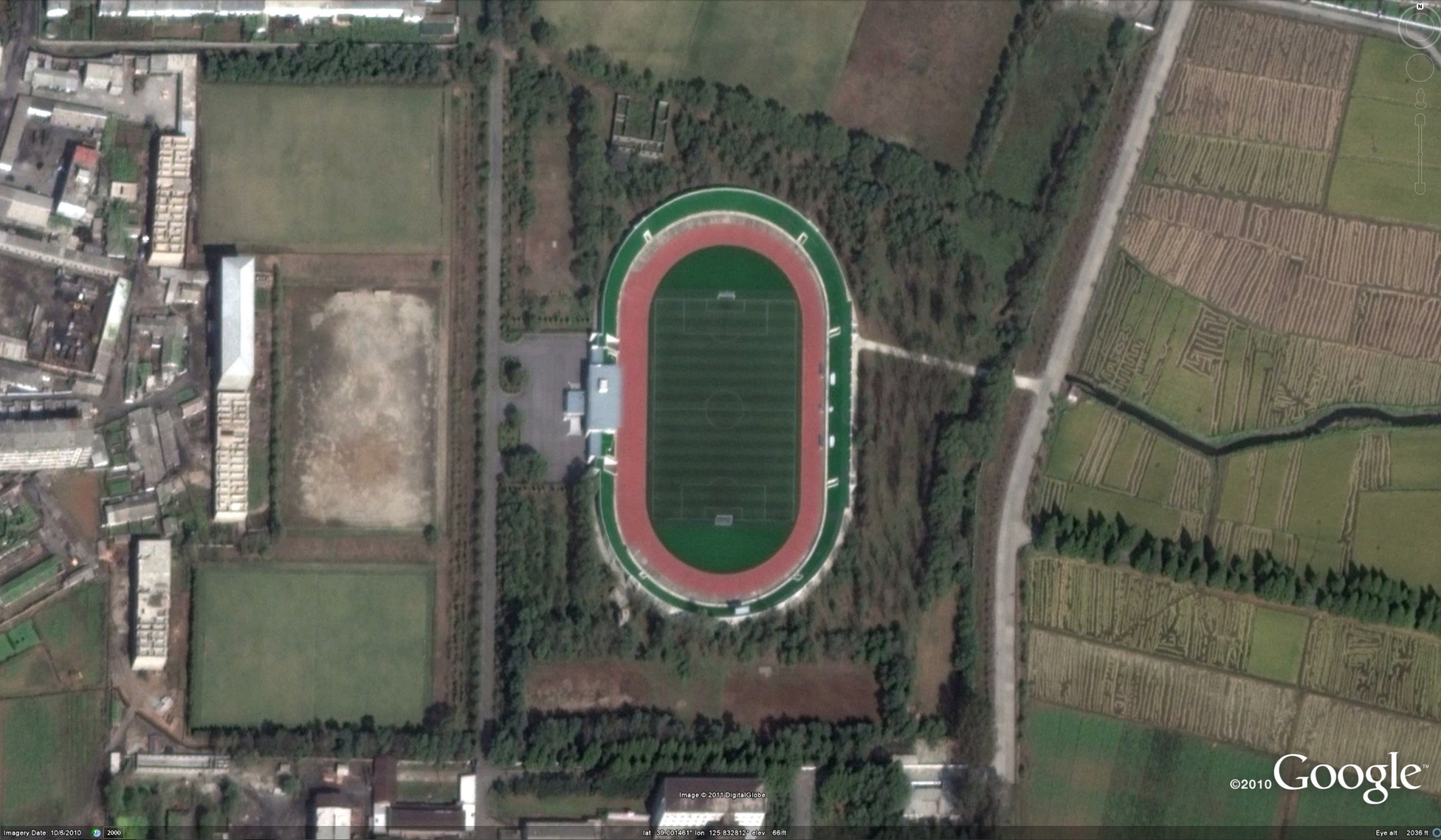
Click here to see a satellite image of the DPRK’s table tennis facility in Pyongyang’s sports district (where the pictures were taken).

Read the full story here:
Playing Table Tennis for the General
Daily NK
Park In-ho
5-31-2010

Share

Friday Fun: North Korean fashion

Thursday, May 20th, 2010

I watch a lot of North Korean television either by seeking out content or receiving it through friends.  I have decided to post some of it to YouTube (apologies to readers in China) so that I can blog about it.  This first clip is from North Korean television (this month) and the subject is women’s fashion.

 nk-fashion.JPG

Click on image to watch the 5 minute television show.

I am not a fashion critic, so let a thousand flowers bloom–but I should add that clothing lies within the portfolio of the KWP Light Industry Bureau which is controlled by Kim Jong-il’s sister.

UPDATE: This video was featured in an article on Radio Free Asia.  It has a lot more information.

While figuring out how to use YouTube I also stumbled on another discussion of North Korean fashion by Suk-young Kim, associate professor of theater and dance at the University of California, Santa Barbara, and author of Illusive Utopia: Theater, Film, and Everyday Performance in North Korea and translator of Long Road Home: Testimony of a North Korean Camp Survivor. See her discussion on Youtube by clicking on the image below.

suk-young-kim.JPG

Share

An affiliate of 38 North