Archive for the ‘Civil society’ Category

Can North Korea be safe for business?

Thursday, May 20th, 2010

Geoffrey Cain writes in Time:

Few investors can boast the one-of-a-kind global pedigree of Felix Abt. Since 2002, the Swiss businessman has found his calling as a point man for Western investments in — of all places — North Korea, where he helped found the Pyongyang Business School in 2004. He also presided over the European Business Association in Pyongyang, a group in the capital that acts as a de facto chamber of commerce. A few years ago, that position led him to help set up the first “European Booth” featuring around 20 European companies each year at the Pyongyang Spring International Trade Fair, an annual gathering of 270 foreign and North Korean companies currently underway in the hermit kingdom until Thursday.

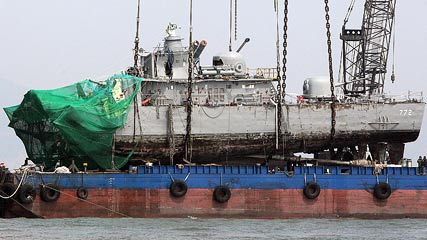
Yet Abt, 55, who lives in Vietnam and therefore won’t be attending the trade fair this year, laments the giant cloud hanging over the country: in recent years, political turmoil on the peninsula has raised the stakes even further for doing business in North Korea — even for the country’s main patron, China. Though investors have always faced the prospect of sanctions, he says, the situation has worsened after the United States ratcheted up sanctions on the government in 2006 on allegations that it was counterfeiting U.S. dollars. And in 2006 and 2009 the Kim Jong-il regime tested two small nuclear bombs, prompting heavier sanctions from the United Nations in 2006. Recently, tensions with Seoul have spiked over the March sinking of a South Korean corvette in waters near the North.(See pictures of the rise of Kim Jong-il.)

Those measures hit home for Abt. While he was running a pharmaceutical company in Pyongyang called Pyongsu in the mid-2000s, he learned that the U.N. Security Council had imposed sanctions on certain chemicals — a move that could have forced him to completely stop manufacturing medicine. Thankfully, he adds, he had already secured a large stock of the substance beforehand. “Whatever business you are involved in,” he says, “some day you may find out that some product or even a tiny but unavoidable component is banned by a U.S. or U.N. sanctions because it can, for example, also be used for military purposes.”

Those dilemmas haven’t stopped Abt. In 2007, he co-founded an information technology firm in Pyongyang called Nosotek, whose 50 or so employees design software applications for the iPhone and Facebook. The venture has already seen its share of success: one of its iPhone games ranked first in popularity for a short while on Apple’s Top 10 list for Germany — though he can’t name the software out of concern for protecting his contractors from bad publicity.(See pictures of North Koreans at the polls.)

For some companies, the stigma of a “Made in North Korea” label matters less than the competitive edge gained from having low overhead costs and a diligent workforce whose wages remain less than outsourcing powerhouses like China, Vietnam and India. In the past, North Korea has attracted the interest of multinational corporations looking for cheap labor in fields as diverse as electrical machinery and cartoon animation. Yet few multinationals show their faces at this month’s fair, a decline from the early 2000s when Abt says they were appearing regularly to look for opportunities in electricity, infrastructure, transportation and mining.

Not all foreign ventures in the North are driven by profit margins alone. The 2005 animated Korean movie Empress Cheung, a popular fantasy film drawn jointly by South and North Korean animators, brought attention to the animation industry in North Korea. Nelson Shin, head of the Seoul-based animation studio that started the project, claims he worked with North Korea for a greater cause than cheap labor. “It wasn’t so much because of cost efficiency as because of cultural exchange between the two Koreas,” he says.

For a country so poor, North Korea has churned out a remarkable number of talented engineers and scientists who fuel some of these small sectors (along with its controversial nuclear weapons program). In the 1960s and 1970s, the government pushed the country to become self-sufficient through development projects, a part of its ideology of “Juche” that promotes absolute autonomy from foreign powers. The communist regime of Kim Il-sung prided itself on its universities and public housing system, in particular. “It was an advance from pre-World War II days,” says Helen-Louise Hunter, a former CIA analyst now in Washington, D.C., who researched North Korea during those decades. “Kim Il-sung was genuinely interested in improving his people’s standard of living, and was off to a good start in a couple of areas compared to South Korea in those early days.”

Yet North Korea fell behind after the South’s own military dictators put their country into industrial overdrive throughout the 1970s and 1980s. Then the Soviet Union collapsed in 1989, depriving North Korea of valuable aid. Then came a famine in the mid-1990s that delivered the final blow, leaving up to 3 million people dead and crippling the capacities of the already isolated state.

Today, the pariah regime of Kim Jong-il is allegedly known to raise money through illicit activities like trafficking narcotics and money laundering. But it’s not known how much those activities figure into the country’s GDP of $28.2 billion in 2009 and its $2 billion worth of exports in 2008, the most recent year data is available. “Not that much income comes from illegitimate operations if you mean drugs and counterfeited dollars,” says Andrei Lankov, a North Korea expert at Kookmin University in Seoul. “More come from arms sales, though, but I would not describe this as an illegitimate trade.”

Abt shakes off the image of Pyongyang being the center of a mafia state. He sees himself and other foreign investors as the potential movers and changers of Kim’s hermit regime. “Cornering a country is ethically more questionable than engagement,” he says. “Foreigners engaging with North Koreans are change agents. The North Koreans are confronted with new ideas which they will observe and test, reject or adopt.”

Read the full story here:
Can North Korea Be Safe for Business?
Time
Geoffrey Cain
5/20/2010

Share

Vienna’s Museum of Applied Arts hosts DPFK art

Tuesday, May 18th, 2010

UPDATE 3: The Los Angeles Times also covers the story:

More than 100 oils, watercolors, traditional Korean ink paintings and posters from the Korean Art Gallery in Pyongyang have been drawing a blurry line here between art and propaganda.

Does the show at Vienna’s MAK: Austrian Museum for Applied Arts/Contemporary Art offer a rare glimpse into an isolated and largely unknown North Korean art scene, or is it merely a stage for a regime that uses art not only as a messenger of its political ideology but also as a source of international funding?

The term “political propaganda” does indeed come to mind while viewing the exhibit “Flowers for Kim Il Sung,” on display since May and running through Sept. 5.

A significant portion of the show is dedicated to monumental portraits of Kim Il Sung and his son/successor, Kim Jong Il. They are either walking proudly together or are featured in scenes with peasants, soldiers or children in front of lush, blossoming gardens.

One work, titled “Kim Jong Il, the Supreme Commander of the KPA, Deeply Concerned Over the Soldiers’ Diet,” shows Kim looking into a cooking pot.

Another is a portrait of Kim Jong Il staring at paperwork on his desk, a cigarette burning in his hand. The night sky dominates the view from the window at his side. The canvas is called “The Endlessly Burning Light of the Party Center.”

All paintings with the Kims are carefully arranged in deep niches and protectively cordoned off with red rope. None of the artworks in the exhibit bears any comment about the nature of the North Korean regime — the main point contested by the critics of the show.

But MAK’s director, Peter Noever, appears unfazed by any debate surrounding the exhibit.

“I am neither a politician nor a political scientist. And besides, everybody knows what sort of a regime that is; we don’t have to explain this to anyone,” Noever said, sipping coffee in his office on the same floor as the North Korean artworks.

Such a display, the museum director said, offers a unique glimpse into the character, the mentality and the culture of a nation.

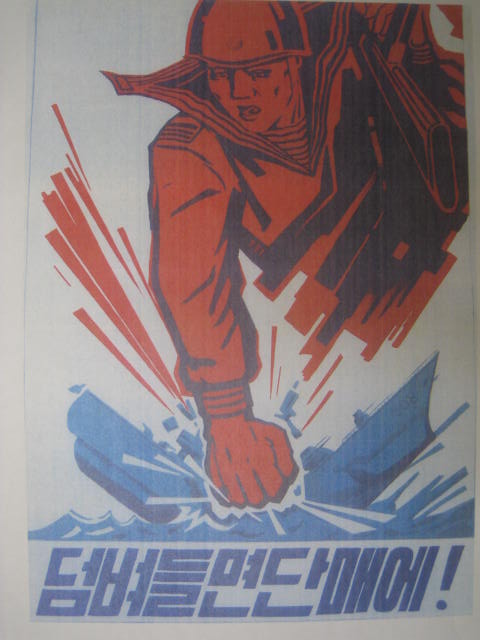
Along with portrayals of smiling, neatly dressed citizens, children with rosy cheeks under baby blue skies and happy peasants toiling amid stunning scenery, there are brightly colored prints in a style reminiscent of the Soviet poster tradition. The North Korean ones transmit messages — complete with exclamation marks — such as “Utmost efficiency in the use of electricity!”, “Spare every drop of water!” and “Even more consumer goods for the people!”

MAK officials said it is the first time the Korean Art Gallery has sent such a significant collection of work — dating from the 1960s to 2010 — abroad.

In North Korea, “art assumes a social function and is subordinate to the revolutionary process,” organizers of the Viennese exhibit said in a news release. North Korean artists are all members of state artist associations and have regular working hours. They receive a monthly salary for producing a certain number of works that “communicate the correct attitude, behaviors, morality and values.”

And their work has apparently become a profitable export that is able to skirt North Korea’s international isolation, helping to bring cash back home.

Ardent collectors can travel to the country to shop for art, said Rudiger Frank, professor of East Asian Economy and Society at the University of Vienna. Or works can be acquired at specialized galleries in more easily accessible locations, such as Beijing. Art can even be ordered directly from North Korean artists or the associations they work for.

Mansudae Overseas Project Group of Companies — the largest such association and the main center of production for North Korean art — was founded in 1959 and employs about 4,000 people, including about 1,000 artists working in all media.

Noever said his counterparts in Pyongyang had no financial demands for lending works to the Vienna exhibition, but arranging the show had its difficulties.

While on a trip to Japan seven years ago, he spontaneously decided to visit North Korea, managing to obtain a permit to enter alone and stay for a week. He went to the national art gallery in Pyongyang and met its manager, who showed him artworks that Noever decided had to be seen by a wider audience.

Persuading North Korean authorities, however, was not easy.

“They were surprised and did not understand at first why we would want such an exhibition,” Noever said. “It was a long back-and-forth affair. We had to wrestle with them because they had totally different, very academic ideas about what should go on display.”

He has had the chance to visit some of the artists’ workshops and said he was impressed by the decent working conditions, although he doubts that all North Korean artists have such good jobs.

After all his effort, Noever believes that bringing the North Korean artworks to Vienna was a coup. Frank too is convinced that having them in Austria is a good thing.

“One quickly forgets that North Korea is not only about nuclear weapons and its regime. The exhibition helps people think about what more is there; it brings up questions,” Frank said.

UPDATE 2: The BBC offers coverage of the art show. See it here. 

UPDATE 1:  Daylife offers some pictures of the exhibit: Photo 1, Photo 2, Photo 3, Photo 4, Photo 5, Photo 6, Photo 7, Photo 8.

ORIGINAL POST: According to the AFP:

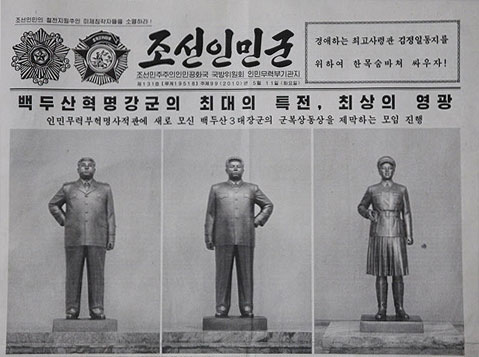
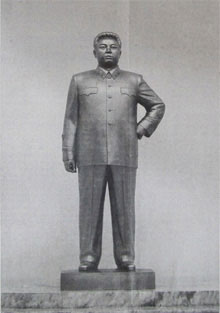
Portraits never seen outside North Korea of leader Kim Jong-Il and his late father Kim Il-Sung go on display in Vienna on Wednesday alongside dozens of propaganda posters produced by the secretive nuclear state.

The exhibition, entitled “Flowers for Kim Il Sung” also includes a model of the capital Pyongyang’s landmark Juche Tower and architectural drawings and photographs.

The 16 portraits of Kim and his father, the founder of North Korea, are being exhibited for the first time abroad, according to museum officials.

The pair are the subject of an all-embracing personality cult in North Korea.

Kim Il-Sung was declared president for eternity after he died of a heart attack in 1994 at the age of 82. His embalmed body lies in a glass coffin at a palace in Pyongyang.

Kim, 67, who reportedly suffered a stroke in August 2008, is widely thought to have chosen his third son, Jong-Un, to inherit power.

Vienna’s Museum of Applied Arts, or MAK, which prepared the exhibition in cooperation with the Korean Art Gallery in Pyongyang and the Paektusan Academy of Architecture, has been accused by some critics in Austria of supporting the North Korean regime.

But the museum’s director Peter Noever dismissed the suggestion.

“As a museum of art, our job is to display art so that it can be discussed afterwards,” he said.

The exhibition runs until September 5.Read the full story here:
Rare portraits of N.Korea leader revealed
AFP
5/18/2010

Share

Mass Games to be performed in 2010

Monday, May 17th, 2010

According to the Koryo Tours newsletter:

Koryo Tours has been officially informed by the Korea International Travel Company that Arirang Mass Gymnastics (Mass Games) will be performed from August 2nd throughout to October 10th, 2010. Mass Games can basically be described as a synchronized socialist-realist spectacular, featuring over 100,000 participants in a 90 minute display of gymnastics, dance, acrobatics, and dramatic performance, accompanied by music and other effects, all wrapped in a highly politicized package. Literally no other place on Earth has anything comparable and it has to be seen with your own two eyes to truly appreciate the scale on display.

Book your tour here.

See the group tours we offer during Mass Games.

You can choose your dates of travel, methods of entry and exit and also the itinerary can be tailored to suit your requests if you prefer to travel with an independent tour. Find more information here.

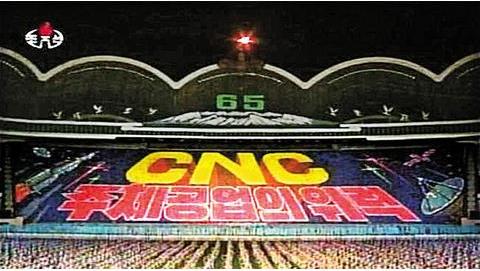
Preparations are visible on the streets of Pyongyang well in advance of the Mass Games with tens of thousands of gymnasts preparing their routines in the city’s open spaces and parks. The 2009 performance was entitled ‘Arirang’ based on a historic tragic love story but was adapted to represent the struggle of North Korea during the Japanese occupation and Korean War. Students practiced every day from January onwards. The 90 minute performance is held every evening at 7pm and features the ‘largest picture in the world’ a giant mosaic of individual students each holding a book whose pages links with their neighbours’ to make up one gigantic scene. When the students turn the pages the scene or individual elements of the scene change, up to 170 pages make up one book.

In 2003 we made our film on the Mass Games A State of Mind (Koryo Tours, VeryMuchSo productions and BBC4), The film has been broadcast unedited in both North and South Korea and in 2004 won the Pyongyang Film Festival Special Prize and best film music award as well as various international awards and is currently on worldwide release.

Share

North Korea scores with fascinating football film

Tuesday, May 11th, 2010

By Michael Rank

North Korean films are as hard to find as kimchi-flavoured ice cream, so Koryo Tours have done us a big favour by releasing on DVD Centre Forward (film trailer here), a highly watchable and fascinating Pyongyang production from 1978.

It’s the tale of talented novice footballer Cha In-son (Kim Chol), who’s been on the bench for Taesongsan for the last three years, but finally makes the team. Not everything goes well at first, and he’s forced to leave the field injured in his first match. But he sticks at it, and strongly supports the coach’s tough new training regime, unlike his complacent best friend and teammate, Chol-gyu, who thinks it’s unnecessary for such a successful team. Chol-gyu (Choi Chang-su) tries to distract him with drinking sessions, but In-son will have none of this, and eventually everyone’s won over to the coach’s demanding regime and Taesongsan ultimately win the North Korean equivalent of the Premiership.

The film, co-directed by Pak Chang-song and Kim Kil-in, is well paced (and only 70 minutes long) and the black and white camerawork is fluent and confident.

There’s a strong political message, inevitably. “Oh, we are the sports soldiers of the leader/ Let us glorify the honour of the motherland…,” goes the splendidly rousing theme song, and to underline the point, the coach reminds In-son, “The Fatherly Leader taught us that we should train harder to win every single game and we should turn our country into a great sporting nation. But we’re still not sweating enough, that’s why our football isn’t getting any better and we’re failing to achieve the teachings of the Fatherly Leader who taught us to make the country a kingdom of sport.”

On a less overtly political level the role of the women in the film is fascinating. In-son doesn’t seem to have a girlfriend, and the love interest, as it were, is provided by his pretty sister,  Myong-suk. She is the star member of a dance troupe and her hard work and dedication is an inspiration for her brother, while she is just as devoted to him, going off to talk to the coach about his prospects when he is feeling despondent. And she takes time off from her dancing duties to iron her brother’s clothes, while his mother washes them for him as he rests, exhausted.

There’s some wry comedy in the relationship between In-son’s mother and best friend Chol-gyu’s grandmother. After her grandson’s string of successes on the pitch, she feels right at home in the world of football and knows all the jargon, and she’s apt to be a bit condescending to In-son’s mum to whom she has to explain terms like “left back” and “having an off day”.

There’s a bit of melodrama when In-son is concussed during a match – don’t worry, he makes a miraculous recovery – and his mother who is watching the game on television wants to rush to the stadium to be with her son. But then she realises she can’t face seeing In-son apparently seriously injured, and Chol-gyu’s granny tells her, “You’re not ready to be a footballer’s mother yet.”

Interestingly, neither In-son or his friend seem to have fathers, and this emphasis on mother figures seems to underline what Brian Myers says in his excellent book The Cleanest Race (Order here) about the roles of mothers and motherliness in North Korean politics and society.

This is the perfect film to see ahead of the World Cup in South Africa next month, in which North Korea have qualified for only the second time ever. Not for nothing has Centre Forward been hailed as “the best North Korean-themed football movie of all time” and there’s no doubt that the Choson Art Film Studio is a truly worthy winner of the Kim Il-sung medal and the National medal, first class.

Share

The DPRK’s missing bishops

Monday, May 10th, 2010

According to Asia News:

According to the Catholic geography, North Korea is divided into three dioceses – Pyongyang Hamhung and Chunchon – and a territorial abbey that of Tomwok directly subject to the Holy See. After the end of the civil war in Korea (which was de facto in 1953, but never expressly recognized by the two governments) and the resulting division of the peninsula in two, the Vatican gave over Apostolic administration of the diocese to bishops of the South.

Under the Pontifical Yearbook – the mighty Volume printed in the Vatican, which represents a sort of map of Catholic presence in the world – the bishops are still the same. Under “Pyongyang”, we read Mgr. Francis Hong Yong-ho, born in 1906 and now “missing” for Hamhung we find an empty space, Chunchon, however, has a territory that “borders” in the North. Here, then, the entitled bishop is Mgr. John Chang-yik (but the post “is vacant” according to local Catholics).

The situation of the bishops is a true reflection of the situation of the Church of North Korea. In the middle of last century 30% of the inhabitants of the capital Pyongyang were Catholics, compared to 1% of the rest of the country. During the Korean War (1950-1953) Communist troops penetrated the South and hunted missionaries, foreign religious, and Korean Christians. The North Korean regime intended to destroy every Christian presence. In the north all the monasteries and churches were destroyed, monks and priests were arrested and sentenced to death.

During the war, the apostolic delegate to Korea, Patrick James Byrne. Bishop and U.S. citizen was arrested, was sentenced to death but the sentence was not executed. He was deported to a concentration camp and died there, after years of hardship and deprivation. There has been no news of what happened to the Christians in the following years: we still do not know the fate of the 166 priests and religious who remained in the North after the war. When questioned about them, North Korean officials respond: “They are perfect strangers.”

Today the Church in the North is without clergy and without worship. According to official government figures, there are about 4,000 Catholic North Koreans, in addition to some 11,000 Protestants. But AsiaNews sources in the country claim that the “real” Catholics number no more than two hundred, mostly very elderly. Throughout the North there are only three places of worship approved for the Christian faith: two Protestant Churches and one Catholic Churc. This is the church of Changchung (pictured) in the capital Pyongyang, which for many analysts is only for “show” and controlled by the regime.

The Christian community is subjected to harsh repression by the authorities. A Christian is doubly unpopular: accused of disloyalty to the regime and suspected of ties with the West. The majority of the faithful have been forced to express their faith in secret. In a communist country, being “discovered” while attending a mass in an unauthorized location may result in imprisonment and, at worst, torture and even capital punishment. Even the mere fact of possessing a Bible is a crime that can carry the death penalty. On 16 June 2009, a 33 year old Christian, Ri Hyon-ok, was sentenced to death and executed “for putting Bibles into circulation.”

The figure of Mgr. Hong Yong-ho is emblematic of this situation. Ordained May 25, 1933, he was appointed vicar apostolic of Pyongyang and titular bishop of Auzia March 24, 1944 by Pope Pius XII. The following June 29, he was consecrated by Archbishop Bonifatius Sauer, co-consecrating Bishop Hayasaka Irenæus, Archbishop Paul Marie Kinama-ro.

On March 10, 1962 Pope John XXIII decided to elevate the vicariate of Pyongyang to diocese, also in protest against the policies of the North Korean regime, and appointed as its first bishop, Mgr. Hong, who has becomes a symbol of persecution against Catholics in North Korea and in general in the communist regimes. Although he is now well over one hundred, in the Vatican they say it “can not be excluded that he may still be a prisoner in some re-education camp”.

Share

Future of industrial complex on other side of DMZ is in doubt

Saturday, May 1st, 2010

Stars and Stripes (h/t NKnews.org)
Jon Rabiroff and Hwang Hae-rym,
4/29/2010

Kim Na-rae regularly travels three miles into enemy territory inside North Korea to work as a clothing embroidery designer — ignoring threats that the leadership there will someday turn Kim’s homeland into a “sea of fire.”

She is one of the 1,000 or so South Koreans who routinely venture across the Demilitarized Zone into North Korea to work at the Kaesong Industrial Complex, even though the two countries are technically at war and come close to resuming hostilities a couple of times each year.

Last week, South Korean President Lee Myung-bak met with two former presidents, Chun Doo-hwan and Kim Young-sam, who reportedly suggested shutting down Kaesong in response to North Korea’s suspected role in the March 26 sinking of the Cheonan, a South Korean warship.

The square-mile-plus complex — home to about 120 South Korean companies and more than 43,000 workers — was developed under former South Korean President Kim Dae-jung’s “Sunshine Policy” of promoting North-South relations and business opportunities.

It was launched during the administration of former President Roh Moo-hyun.

However, long-term plans to expand the complex to more than 25 square miles, 2,000 companies and 600,000 workers are frequently stalled by continuing friction between the North and the South.

The future of the 5-year-old complex is once again in doubt.

In a statement released in early April through the official Korean Central News Agency, the North said it would “entirely re-evaluate” its involvement in the Kaesong Industrial Complex if relations continue along a confrontational path.

Last week, South Korean media reports — citing an unnamed South Korean Unification Ministry official — said North Korean military officials who inspected the complex expressed concerns the South could use high-rises there to spy on the North or sneak troops into the country through the complex’s water system. The inspection intensified speculation the North might end or suspend its participation in the complex.

In a dispute last week, the North confiscated five buildings owned by South Korea at Diamond Mountain — a jointly operated tourist resort in North Korea that, much like the industrial complex, was designed to benefit South Korean businesses and the North Korean economy.

The North said it was seizing the buildings as compensation for losses it has sustained since the South stopped sending tours in 2008 after a North Korean soldier shot a South Korean tourist who reportedly wandered near a restricted area. The North said the shooting was accidental.

During its short history, the  industrial complex “seems to hang there in limbo … swinging back and forth depending on the political winds at the time,” according to David Garretson, an international relations professor at the University of Maryland’s University College in South Korea.

For her part, Kim said she plans to continue working, trying to shut out the political posturing.

“I was very nervous and afraid about going into North Korea at first,” she said. “But I’ve found out [North Koreans] are more pure and naive than South Koreans. They don’t easily get angry. They just work hard.”

Cheap labor

When the complex opened in December 2004, benefits for both countries were clear.

The impoverished North would open a flow of cash into the country through land leases and wages that factories paid to tens of thousands of North Korean workers.

Businesses in the South would get access to low-paid workers for the labor-intensive production of clothes, electronics equipment, kitchen appliances and more.

If not for Kaesong, those businesses would have to look to open factories in such countries as Vietnam, Cambodia or Indonesia, according to Ok Sung-seok, president of the Nine Mode Co. and vice-chairman of the Kaesong Industrial Park Corporations Association.

Kaesong factories now produce goods worth more than $250 million a year. North Korean workers there make about $65 a month, but can earn as much as $90 by working overtime in addition to their regular 45-hour workweeks, Ok said.

South Koreans work primarily in managerial positions, and their pay varies depending on their employer. Most work three or four days a week, and while some return to their homes each day, many stay overnight between workdays in dormitorylike accommodations.

Canadian Navy Lt. Cmdr. Hugh Son, the United Nations Command Military Armistice Commission’s corridor control officer, said Kaesong workers have told him there are no armed North Korean guards manning the complex, but there is always “a presence” of security personnel.

Kwak Sang-bae, president of the Chung Song Trade Co. at Kaesong, said every business in the complex has a North Korean government official assigned to oversee and represent North Korean workers.

To Ok, the arrangement at Kaesong goes beyond commerce.

“I’ll never forget the touching moment of seeing South Koreans and North Koreans working together, side by side … when my factory first opened,” he said. “Cultivating and spreading the spirit of freedom to the Kaesong people is very inspiring.”

Ok fears further growth in factories could be jeopardized “because of the latest aggravated, unstable situation between the two Koreas.”

Convoy crossings

Because relations between the two Koreas have been tense even in the best of times, transportation between South Korea and the industrial complex is complicated.

For the project to begin, both countries had to clear what is now the Western Transportation Corridor — a yearlong effort that, on the South Korea side alone, required the removal of 1,700 land mines, Son said.

Now 20 DMZ convoys cross each day, with workers from the South going back and forth and materials heading North and manufactured goods heading South. Everybody must clear customs and immigration in both countries, going both ways, and no one is allowed to cross the DMZ without being granted clearance at least three days in advance, Son said.

After manifests are checked and immigration and customs are cleared, vehicles heading north line up for inspection. South Korean and U.N. vehicles then escort them as a convoy from the southern boundary of the DMZ to a point close to the Military Demarcation Line — the official border between the two countries and the midpoint of the DMZ.

After the convoy crosses the border, two North Korean military jeeps take over escorting duties to the industrial complex.

The corridor has been closed to vehicles on occasions when tensions between the two countries have been high. Son said the last time was for two days during the 2009 U.S.-South Korea Key Resolve/Foal Eagle exercise, an annual event the North routinely condemns as an act of aggression.

Small talk

Ok said North Korean and South Korean workers at the complex are free to talk with each other about anything, except politics or government.

“We usually talk about our families, like how your children study well at school, or about our lives,” he said. “Listening to them, I cannot help thinking that there is a huge difference in the standards of living between us.

“And the lack of food makes them not grow tall enough. They are generally shorter than us.”

Kwak said that when his company opened a men’s clothing factory in the complex in 2007, Moon Pies were handed out to all the workers.

None of the North Koreans ate their snack.

“Instead, they put these very small pies into their pockets to bring home so they could give them to their children, even though they were hungry themselves,” he said. “I got choked up.”

Nationalism does sometimes find its way into conversations.

Yu Eun-jae, who is in charge of distribution for a cell phone parts manufacturer in the complex, said he stopped sharing details of his personal life at work, because a North Korean worker kept saying how far superior his country’s education system is compared to South Korea’s.

“ ‘Going to universities in North Korea is free,’ ” the worker would say, according to Yu. “ ‘How can you send your children to universities that are so expensive in South Korea?’ ”

Kwak said he believes North Korean workers at the Kaesong factories enjoy an atmosphere of freedom they would not find in state run businesses in the North.

Still, he added, “I am afraid and worried that we could be in danger if hostilities get worse. But, as a businessman, I am trying to do my best under the circumstances.”

Garretson doesn’t believe either country will “pull the plug” on the complex, because too much would be lost for both sides.

“It is a point where they meet, so there’s going to be friction,” he said.

The complex for both sides “is very profitable. At the same time, the communication is there for both sides,” said Son, the Canadian lieutenant commander with the U.N.

“I’m ethnically Korean … and I hope things work out,” he said. “I would love to come back here one day and take a tour of North Korea.”

Share

DPRK art troup performs in Beijing

Saturday, May 1st, 2010

According to Yonhap:

A North Korean remake of the Chinese opera A Dream of Red Mansions will premiere in Beijing next month, a Chinese-language daily reported Thursday.

The Hong Kong-based Takungpao said the staging of the Chinese classic of the same title, also known as “Hong Lou Meng,” by North Korea’s national Phibada (Sea of Blood) Opera Troupe will be staged in the Chinese capital city from next Thursday through Sunday.

A Dream of Red Mansions is a masterpiece of Chinese vernacular literature, written between 1749 and 1759. It is one of China’s Four Great Classical Novels.

The North Korean version of the opera reportedly debuted in the North last year as part of celebrations marking 60 years of diplomatic relations between the two allies.

North Korean leader Kim Jong-il was reported to have been directly involved in updating the 1961 version created by his father and the regime’s founder, Kim Il-Sung. Former Chinese leader Deng Xiaoping and other Chinese leaders watched the original version of the North Korean performance, newspaper reports from that era show.

The North’s Korean Central News Agency (KCNA) reported last October the North Korean leader and Chinese Premier Wen Jiabao watched the Chinese opera remade by North Korean artists at the Pyongyang Grand Theater, during the latter’s visit to North Korea. China’s Ministry of Culture donated costumes for North Korean artists involved in A Dream of Red Mansions.

The Takungpao report said more than 200 North Korean performers will visit Beijing for the staging of the opera, the largest foreign theatrical company to visit China in recent years.

The newspaper said that the leading and supporting actors are well-known stars in North Korea, most of them educated at the Pyongyang Kim Won Gyun Conservatory (Satellite image here), a higher educational institution for music named after a North Korean composer.

Kim Il-hwang, who stars as the protagonist Jia Baoyu, is the grandson of Kim Jong-hwa, who also played the protagonist in the 1961 version, according to Takungpao.

Read the full story here:
N. Korean version of classic Chinese opera to premiere in Beijing
Yonhap
Kim Young-gyo
4/29/2010

Share

DPRK currency reform hit markets hard

Thursday, April 22nd, 2010

Great reporting by the Choson Ilbo–which provides video footage (before and after) of the DPRK’s currency reform on the market  in northern Onsong.

onsong-before.jpg

(October 2009)

 onsong-after.jpg

(March 2010)

Video of the market is available from the the Choson Ilbo and ABC web pages.

According to the Choson Ilbo:

Footage taken in October shows a bustling market, but the same place in March is almost deserted, with only a few traders selling goods. In October, the market was overflowing with food, clothes, shoes, cooking oils, squid and other goods. But three months after the currency debacle, only a few bags of corn are visible in the stalls. Products that were part of South Korean aid shipments to North Korea can also be spotted.

“Judging by the fact that the market was still deserted even in late March, it appears that retailers are waiting until prices go up even more,” said an official at the Unification Ministry. “The sale of goods picked up somewhat after North Korean authorities increased supply by importing products from China and other countries ahead of Kim Il-sung’s birthday” on April 15, a North Korean source said.

Onsong market before the currency revaluation used to include both roofed and open-air stalls where unauthorized merchants sold goods on mats placed on the ground. The square in front of the train station was also a bustling market where traders sold products away from the watchful eye of the authorities. But in early March 90 percent of the stalls were empty.

Pastor Kim Sung-eun of the Caleb Mission said, “If the owners of roofed stalls, who paid a fee for official approval to sell goods, disappeared, it suggests that North Korea’s middle class has collapsed.”

There was also evidence of South Korean aid products being sold in the markets. Bags of grain bearing the South Korean Red Cross symbol could be seen in various parts of the market. Some North Koreans used them as shopping bags. Goods sent as part of aid shipments by South Korea including grain bags are said to be very popular in the North. “There are rumors that high-ranking North Korean officials sold South Korean aid products in the markets, but none of them have been confirmed,” a Unification ministry official said.

“The market opens around 8:30 a.m. and closes around 7 p.m. after sunset,” said a North Korean defector from Onsong. “It’s heartbreaking to see the once bustling market so empty.”

This particular market is not visible on Google Earth.  The imagery is low-resolution and likely predates the construction of the market. See for yourself.

Share

Zimbabweans planning to protest DPRK football team (canceled)

Monday, April 19th, 2010

UPDATE 4: The DPRK has canceled its football team’s visit to Zimbabwe.  According to the Times Live of South Africa:

The North Korean squad had been due to arrive in Zimbabwe on Tuesday to train and play friendlies against local teams before moving onto South Africa, where the World Cup kicks off on June 11.

But a senior source in the power-sharing government of President Robert Mugabe and former opposition leader, Prime Minister Morgan Tsvangirai, said the visit was called off after it provoked outrage among supporters of Tsvangirai’s Movement for Democratic Change (MDC).

UPDATE 3: Zimbabwe continues to put off  deliberation.  According to Voice of America:

Cabinet discussion of whether Zimbabwe should invite the North Korean soccer team to train in the country through the June-July World Cup period has been put off to next Tuesday as President Robert Mugabe and Prime Minister Morgan Tsvangirai are in Tanzania for the World Economic Forum, a ministerial source said.

Education, Sports and Culture Minister David Coltart told VOA Studio 7 reporter Gibbs Dube that the Cabinet will review the decision by the Zimbabwe World Cup 2010 Committee to invite the North Koreans.

“I presume that if the issue has to be discussed by Cabinet, it will be discussed on Tuesday and as far as I am concerned that team has not yet confirmed that it will be training in this country,” Coltart said.

Political commentator Samukele Hadebe said the North Korean team visit should be canceled to promote healing and reconciliation among Zimbabweans traumatized not only by political violence during the 2008 elections but by older episodes like the 1980s Gukurahundi purge of rival liberation activists in the Matabeleland region.

UPDATE 2: It is possible Zimbabwe could back out of the plan since they have yet to confirm a date. And according to the Guardian:

Zimbabwe’s sports minister, David Coltart, said the dates of the North Koreans’ visit were still to be confirmed. “It is important that the Zimbabwe government deals with this matter in a very sensitive way and does not ignore the history of North Korea here, and does not do anything that might inflame passions or reopen old wounds,” he said.

But he added: “I don’t think it is right to attack a group of young players for what happened 27 years ago in this country.”

Strangely…I met Coltart in Washington a few years ago. He was an MP representing Bulawayo at the time.

UPDATE 1: A Zimbabwe perspective:

Boycotting North Korea solves nothing
Tendai Huchu
4/21/2010

The people of Zimbabwe, more than any other nation in Africa, seem pathologically unable to come to terms with their past. As a nation we share the same psychological symptoms of people who have suffered abuse as children.

At the moment there are calls by some for the people of Matebeleland to boycott the visit by North Korea’s football team on May 25 for warm up matches before the World Cup. They site the Gukurahundi massacres in the mid 1980’s as the reason the North Koreans should be boycotted. These people forget that aggressive attempts to court teams like Brazil to Zimbabwe were rebuffed because of our current circumstances. A lot of countries want nothing to do with us but the North Koreans have agreed to come. They could have gone directly to South Africa like everyone else and found facilities there far superior to anything we can offer.

That the Gukurahundi atrocities were a great tragedy in the history of our nation is beyond debate. This is still an issue we have yet to come to terms with, but exactly how boycotting a team we have invited can help redress our past is difficult to understand. North Korea like Zimbabwe is an undemocratic state. These footballers have no influence whatsoever on their government’s policies, especially those from twenty years ago. The majority of them would have been toddlers or not even born when we were slaughtering each other in the 80s. It is absurd to punish these players for something that they had nothing to do with whatsoever. We are quick to protest when New Zealand and England boycott our cricket team because of their differences with the Mugabe government, yet here we are proposing to do the exact same thing to the North Koreans.

The Observer newspaper in the UK quoted Bulawayo-based activist Effie Ncube saying that the invitation is a “profound insult” because of North Korea’s role in training the Fifth Brigade. This is a typical Zimbabwean attitude of blaming everyone else except ourselves for things that have gone wrong.

The North Koreans are a people we should sympathize with. There are too many similarities between them and us to mention. Like us they depend on handouts from the international community or else they would starve. We, better than most other nations, know what it is like to be isolated from the rest of the world. We know what it is like to live under a government which has no regard for its citizen’s rights and opinions. This is an opportunity to show solidarity to a people who have many similar problems to our own.

We can continue to be a bitter and angry people who constantly look back at the past, not taking responsibility for our actions and blaming everyone else for the things we have done to one another or we can move on. The North Koreans are not our enemy, they have never been. Sport is supposed to bring people together, not to divide them. There is nothing that can be gained by protesting against the North Korean football team for something they had absolutely no involvement in. They deserve to be shown our true Zimbabwean hospitality. We can only pray that the future of both our nations is going to be better than the past we are leaving behind.

ORIGINAL POST: According to Times Live of South Africa:

Zimbabwe’s tourism minister has appealed to activists in the western provinces of Bulawayo to drop plans to protest against the North Korean football team’s scheduled camp in the country during the World Cup.

The presence of the team from the dictatorship of President Kim Jong Il has stirred up strong emotions over the massacre in the early 80s of an estimated 20,000 civilians of the Ndebele speaking people of western Zimbabwe, carried out by soldiers of the Zimbabwe army’s notorious Fifth Brigade who were trained by North Korean instructors.

Groups have threatened to carry out protests against the team in the western city of Bulawayo and in South Africa where over a million Zimbabwean exiles from President Robert Mugabe’s rule now live.

“We are totally against bringing the team to Zimbabwe,” said Methuseli Moyo, spokesman for the Zimbabwe African People’s Union party. “Having a team flying the North Korean flag is very provocative.” The team is due in Harare on May 25 and is set to play friendly matches against the Zimbabwe national team in the capital and in Bulawayo, but activists have warned they would make Bulawayo’s Barbourfields stadium a centre of resistance against the North Koreans.

Tourism minister Walter Mzembi was quoted Sunday in the weekly Standard newspaper as appealing to the groups not to mix politics with sport and to allow national healing to take place.

“Sport must remain the bridge for people-to-people contact, probably the only bridge that has remained standing even when nation states are in a state of fall-out,” he said.

“I wouldn’t want to make this a political issue. It’s purely a sports issue.” He said he had extended invitations to the major teams in the World Cup, including Brazil, England and the United States, but North Korea was the only team that had responded.

The North Korean [5th Brigate] instructors were brought to Zimbabwe in 1983 at the request President Robert Mugabe to form a new brigade of the army, composed exclusively of Shona-speaking veterans of Mugabe’s civil war guerrilla army, to put down a limited insurgency against Mugabe’s rule by Ndebele-based guerrilla veterans.

The Fifth Brigade troops immediately developed a reputation for savage brutality, butchering children and pregnant women to deny the guerrillas support among the population of rural areas where they operated.

Military experts say that the Fifth Brigade’s methods were starkly different from the rest of the country’s largely British-trained army.

Mugabe, held responsible for the massacres, has only referred to the murderous period in the country’s history as a moment of madness. Demands for acknowledgment of the brutality are rising round the country, but two weeks ago police forcibly closed down an art exhibition portraying the suffering of the period, and arrested the artist.

Additional information: 
1. Here is a satellite image of Barbourfields stadium.  (I visited Bulawayo in 1996 and it was a lovely town at the time).

2. Last I read North Korean laborers were building football stadiums in South Africa for the World Cup.  This was in dispute and I do not know whether it has been confirmed or disproven.

3. North Korean laborers built Zimbabwe’s Heroe’s Acre.  Here is a satellite image of it.

4. And just for fun, here is a satellite image of Robert Mugabe’s retirement palace.  If you view the location in Google Earth, you can scroll through historical imagery to see this and neighboring houses under construction.

Share

Pyongyang’s Women Wear the Pants

Friday, April 16th, 2010

Andrei Lankov writes in the Wall Street Journal about the growing role women have come to play in the North Korean economy.  According to the article:

A joke making the rounds in Pyongyang goes: “What do a husband and a pet dog have in common?” Answer: “Neither works nor earns money, but both are cute, stay at home and can scare away burglars.”

North Korea is still a strongly patriarchal society, so the popularity of jokes deriding men is a surprising sign of shifting attitudes. The cause is also a surprise—women are running the country’s booming unofficial economy.

A decade ago North Korea went through a man-made social disaster which exceeds everything East Asia has experienced since Mao’s ill-conceived experiments of the 1960s. An estimated 600,000-900,000 people perished in the 1990s famine, which was largely a product of the government’s unwillingness to reform the economy. The social and economic structure of a Stalinist society collapsed. Antiquated iron mills and power plants ground to a halt, and the rationing system did not provide enough food for the average citizen to survive.

Facing this challenge, North Korean society reacted in an unusual way: It rediscovered the market economy. Unlike China, where capitalism was re-introduced from above by Deng Xiaoping and his fellow reformers, in North Korea its growth has been largely spontaneous. Nonetheless, by 2000 market exchange, both illegal and semilegal, came to play a decisive role in the lives of North Koreans.

This worried the Kim regime’s leaders, who understand full well how the marketplace undermines their political control. In recent years they launched a number of policies aimed at undermining markets. The recent currency reform was meant to deliver another blow to the markets by annihilating the capital of private businesses. It backfired, though, and the economic situation worsened considerably.

However, the nemesis of the regime, the market vendors of North Korea, are by no means the kind of street toughs one might encounter in the black markets of other countries. North Korea’s “new capitalism” of dirty marketplaces, ancient charcoal trucks and badly dressed vendors has a distinctly female face. Women are overrepresented among the leaders of the growing post-Stalinist economy—at least at its grassroots level, among the market traders and small-time entrepreneurs.

This is partly due to a distinctive feature of North Korean society. Until around 1990, markets played a very slight role in the North Korean economy. Almost everything was rationed by the state. In those days, the North Korean state required every able-bodied male to be employed by some state enterprise. However, some 30% of married women of working age were allowed to stay at home as full-time housewives.

When in the early 1990s the old system began to fall apart, men continued to go to their jobs. At first glance this might appear irrational, since most state-run factories came to a standstill, subsidized rations were not delivered and an official monthly salary would barely buy one kilo of rice.

Nonetheless, North Koreans expected that sooner or later things would eventually return to what they thought of as “normal”—that is, to the old Stalinist system. They were not aware of any alternative. They also knew from experience that people who showed any disloyalty to the state—for instance those who cooperated with South Korean authorities during the Korean War—were discriminated against for the rest of their lives. Even the children of such “unreliable elements” faced many official restrictions. So men believed that it would be wise to keep their “official” jobs for the sake of the family’s future.

The situation of women was different. They had time, and their involvement with private trade was seen as less dangerous—precisely because of the patriarchal nature of a society where only males’ behavior really mattered. In some cases women began by selling household items they could do without or homemade food. Eventually, these activities developed into larger businesses, and today at least three-quarters of North Korean market vendors are women.

For many North Korean women, the social disaster of the 1990s has become an opportunity to display their strength and intelligence. In recent months those women have become the primary target of government policies designed to destroy private enterprises. But the experience of the last two decades suggests that the women are likely to continue wearing the pants.

Read the full article here:
Pyongyang’s Women Wear the Pants
Wall Street Journal
Andrei Lankov
4/16/2010

Share

An affiliate of 38 North