Archive for the ‘Civil society’ Category

KCNA publishes new “motivational” posters

Thursday, September 22nd, 2011

Click images for larger view.

According to KCNA (2011-9-22):

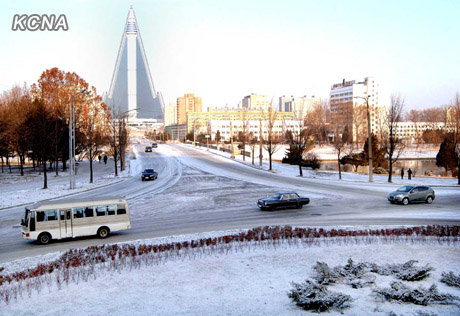
New posters have been produced in the DPRK to help more splendidly spruce up Pyongyang and hasten the harvest this year.

Poster “Let’s develop Pyongyang, the capital city of revolution, into a world-class city!” vividly reflects citizens all out to turn their city into a more beautiful and magnificent one.

Poster “Let us all go for harvesting!” depicts an agricultural worker at work with joy against the background of a coop field alive with harvesting. It arouses the people to go out for reaping in good time the crops cultivated with the sweat of their brow during spring and summer.

Click here to learn more about Pongyang’s recent renovations.

Share

North Korean defects to claim inheritance in ROK

Wednesday, August 31st, 2011

According to the AFP:

A North Korean woman has defected to South Korea to claim an inheritance from her late grandfather, an official said Wednesday, in the latest of several cross-border claims on long-lost relatives.

The unidentified woman has filed suit claiming a share of the property that her step-grandmother gained after the grandfather’s death, the official at Seoul Western District Court told AFP.

The grandfather left his wife and four children in the North and came South during the 1950-53 war. He married again and amassed a fortune, according to JoongAng Ilbo newspaper.

He had no children with his new wife in the South and a few years ago met the granddaughter — his only surviving kin in the North — through a family reunion programme.

The two stayed in touch and the grandfather often sent money to the woman in the impoverished communist state.

She defected after learning of her grandfather’s death last year, and recently filed court evidence to try to prove her family connection.

The step-grandmother was now seeking a DNA test to verify the family relationship, the court official told AFP on condition of anonymity.

“If the family relationship is proved by the DNA test, the North Korean woman will for sure get her share of the inheritance,” he said.

The official said he was aware of “more and more” similar lawsuits filed by North Koreans. He declined to say how much the inheritance in this particular case was worth.

The South Korean government is taking steps that it claims will protect the rights of North Koreans to receive their inheritance in the South while making it harder for them to take the funds out of the country.

There are two other cases of which I am aware where North Koreans are seeking inheritance funds from wealthy relatives in the South.  See here and here.

Read the full story here:
N. Korean defects to S. Korea to seek inheritance
AFP
2011-8-31

Share

Economic performance and legitimacy in the DPRK

Sunday, August 28th, 2011

Geoffrey See and Andray Abrahamian (both representatives of Choson Exchange) wrote an article in the Harvard International Review which asserts that economic successes are becoming more important to the political narratives that reinforce the DPRK leadership’s claims to legitimacy. Below is an excerpt from their article:

North Korea’s most important domestic policy statement comes each New Year, when the major newspapers publish a joint editorial. The editorial often signals where government priorities will be in the coming year. In 2010 the newspapers spoke of “Bring[ing] about a decisive change in the people’s lives by accelerating once again light industry and agriculture.” Similar themes were echoed in 2011. This is opposed to the joint editorials of the past few years, which have focused on the more traditional themes of military strength, revolution, and socialism.

Another public sign of a shift towards focusing on economic issues is the type of official visits and inspections carried out by Kim Jong Il. Following in the footsteps of his father, Kim uses these visits to signal emphasis or encouragement of specific industries, activities, and policies. According to a report by the Institute for Far Eastern Studies, the first six months of 2011 have seen Kim exceptionally busy, participating in 63 official activities. Unlike previous years, however, the number of military visitations has dropped off: only 14 visits were military related, the lowest number ever recorded. By contrast, 28 visits were economic related.

In terms of policy, North Korea has been haltingly experimenting with Special Economic Zones (SEZ) since the mid-nineties, but has recently built a bit more momentum in this area. Rason, an SEZ in the far northeast, is finally seeing some basic infrastructure upgrades that were long talked about but always delayed. Government investment bodies have started to promote the idea that Rason will be the “next Singapore,” an ambitious marketing claim to anyone who has been to Rason. With both Russia and China leasing port space, it seems more likely to be transformed into a regional transportation hub. Meanwhile, along the Chinese border in the northwest, the Hwanggumpyong SEZ recently held a groundbreaking ceremony, attended by high-ranking North Korean officials and Wang Qishan, China’s commerce minister.

Senior politicians in North Korea are increasingly judged by their ability to bring in foreign direct investments. These efforts appear to be competitive rather than coordinated. North Korean leaders associated with the National Defense Commission, the highest level policy body, have been meeting with visiting foreign investors. In 2009, the Daepung International Investment Group was re-purposed along the lines of a holding company model as a vehicle for attracting foreign direct investment l with “27 joint ventures planned and to be managed by the Group.” Daepung Group is backed by specific high-level individuals. Jon Il-Chun, reportedly the Director of Office 39, a murky international trade and finance organ, is definitely involved with the Daepung Group. Media reports also indicate that Kim Yang Gon, Director of an organization tasked with managing contacts with South Korea, the United Front Department of the Workers’ Party, is also behind the group.

In July of the same year, the Joint Venture & Investment Commission (JVIC) was established. Instead of a holding company model, JVIC is a government institution modeled as a “one-stop shop” for investors – that is, JVIC is meant to “seek out investments and assist investors in setting up operations in North Korea.” While multiple institutions claiming to hold such authority have always existed in North Korea, many of these institutions have been merged into JVIC and long-time investors have been directed to liaise with JVIC as their primary government contact. JVIC’s nominal and public head is Ri Chol, a high-ranking North Korean government official.

In August of 2010, we received credible reports that foreign investors were approached to help set up a group similar to Daepung that would be backed by another member of the National Defense Commission. Given this proposed initiative’s similarities to Daepung, the prior establishment of JVIC, and that all three groups do not appear to communicate with each other, we surmise that these various groups have a competitive relationship with the support of different patrons. Investment officials with whom our teammates have met confirm that the relationship between the agencies is “very competitive.” If this is the case, it is a signal that influential groups in Pyongyang sense that future power bases will require the ability to attract and deploy capital.

The full article is worth reading here:
Harvard International Review
Geoffrey K. See and Andray Abrahamian
August 23, 2011

Share

2011 Women’s World Cup

Thursday, August 25th, 2011

UPDATE 6 (2011-11-18): An Australian Women’s team is unhappy with the way the DPRK doping scandal has erupted. Accoridng to the Herald Sun:

A doping storm surrounding the North Korea women’s soccer team has given the Matildas a glimmer of hope they will be able to compete at the London Olympic Games.

The Matildas failed to qualify for next year’s Games after finishing third in the Asian qualifying tournament in September behind Japan and North Korea.

But North Korea was contentiously allowed to contest the play-offs despite being banned by soccer’s ruling body FIFA following a doping scandal involving five players and a team doctor only three months earlier.

The furore erupted in the wake of this year’s World Cup in June and July when the five players tested positive to steroids, earning bans of up to 18 months.

The team doctor was barred for six years and the team was thrown out by FIFA until the 2015 World Cup.

But a FIFA disciplinary committee’s decision to penalise the Koreans in only the World Cup competition meant they were able to remain in Olympic contention.

The Matildas are furious at the decision, especially since no drug tests were taken at the Olympic qualifying tournament in China, where they endured a 1-0 loss to North Korea.

The Australian Olympic Committee has now asked the International Olympic Committee and the World Anti-Doping Authority to clarify North Korea’s Olympic eligibility.

Ultimately, it is understood the IOC will bow to FIFA rulings because FIFA runs the Olympic tournament.

Football Federation Australia national teams chief John Boultbee said FFA had also asked WADA to appeal FIFA’s decision.

But the FFA is also yet to make any inroads.

“We think it’s strange that a team is banned for 2015 and not 2012 so we have raised the issue with WADA, the IOC and FIFA but so far to no avail,” Boultbee told AAP.

“We recognise there’s an element of self interest from our point of view because we were third in the qualification tournament but also we are not happy that what FIFA has found to be systematic doping, has not been dealt with in the most effective way.”

It’s believed Matildas players were initially instructed not to comment on the issue but they’ve opted to speak publicly because of their frustration with the situation.

Matildas captain Melissa Barbieri stressed the women’s side did not want to make excuses for their failed campaign but simply could not fathom why no drug testing was done at the qualifying tournament.

“It’s surprising to say the least, especially when a team has been caught with drugs in their system for the World Cup a month beforehand and to have no drug testing,” Barbieri said.

“They (North Korea) played better than us and we lost the game.

“But it plays on your mind – do you really believe that they didn’t have any drugs in their system when they were playing us as well? Who knows?”

While the five North Korean players banned at the World Cup did not take part in the Olympic qualification and cannot compete in London, veteran Matildas defender Thea Slatyer said she was concerned a host of new players had been brought into the squad but not tested.

Slatyer, who would have played her last international tournament in London, said the players had been left disheartened.

“We’re a very fair country. We’ve always played fair and played by the rules,” Slatyer said.

“… It does make you really upset to know that a team that has conducted this behaviour is kind of allowed to get away with not being tested.”

FIFA told AAP in a statement the Asian Olympic qualifying tournament had not been considered a priority for doping control.

“As due to logistical reasons, FIFA cannot conduct at all qualifying games doping controls,” the statement read.

“Therefore, an assessment is done by the FIFA Anti-Doping Unit and it is decided at which matches doping controls will be performed.”

UPDATE 5 (2011-8-25): The DPRK women’s team has been banned from the 2015 Women’s World Cup.  According to USA Today:

FIFA banned North Korea from the 2015 Women’s World Cup after five players tested positive for steroids from traditional musk deer gland therapy at the tournament last month.

FIFA on Thursday imposed bans of up to 18 months on all five players, who North Korean officials said were treated with traditional therapy after being struck by lightning at a pre-tournament training camp.

Jong Pok Sim, Hong Myong Hui, Ho Un Byol and Ri Un Hyang were suspended from all soccer-related activity for 18 months, while Song Jong Sun was ineligible for 14 months, FIFA said.

North Korea’s soccer federation was fined $400,000, and team doctor Nam Jong Ae was banned for six years.

The fine “exactly corresponds to the prize money the association would have received for their 13th place in the final ranking of the Women’s World Cup in Germany,” FIFA said.

Defenders Song and Jong failed drugs tests before the World Cup game against Colombia. FIFA then tested the entire North Korean team after its final match.

FIFA’s disciplinary panel also banned Colombia backup goalkeeper Yineth Varon for two years for doping at the tournament.

The doping case was the most serious at a major FIFA tournament in 17 years.

In July, FIFA’s chief medical officer Jiri Dvorak said after extensive testing, “we can really say with far-reaching confidence that these steroids were the result of this so-callled Chinese traditional medicine.”

UPDATE 4 (2011-7-16): Once again, the North Koreans come up with a creative explanation for testing positive in doping tests.  According to the Associated Press:

North Korea officials blame traditional medicine using musk deer glands for five of their players testing positive for steroids at the Women’s World Cup in soccer’s biggest doping scandal in nearly two decades.

Their loss to the US was due to being struck by lightning (see below).

UPDATE 3 (2011-7-16): Three more players have tested positive.  According to Bloomberg:

Three more North Korean soccer players failed anti-doping tests given to the whole squad after two teammates failed a test earlier this month at the Women’s World Cup.

FIFA didn’t name the players or the substance in a statement today. All North Korean players were tested after Song Jong Sun and Jong Pok Sim were provisionally suspended July 7 before a game against Colombia in Bochum. The two had been tested after the team’s previous matches and the results received yesterday morning.

UPDATE 2 (2011-7-11): A new German language documentary has been released featuring may of the players and their training facilities.  See it here.

UPDATE 1 (2011-7-7): Two members of the DPRK Women’s team have been suspended for doping.  According to CNN:

World football’s governing body FIFA announced Thursday that two players from the North Korea side have been provisionally suspended from the Women’s World Cup after failing dope tests.

Jong Sun Song and Sim Pok Jong were prevented from playing in the tournament being held in Germany prior to their team’s Group C tie against Colombia in Bochum yesterday.

FIFA said in a statement that adverse “analytical findings” were present in “A” samples collected in two anti-doping tests conducted after the team’s previous matches.

The statement continued: “In accordance with article 58 of the FIFA Anti-Doping Regulations … the whole Korea DPR team was required by FIFA to undergo an anti-doping test after yesterday’s match between Korea DPR and Colombia. The target testing of the entire Korea DPR team was coordinated with WADA [World Anti-Doping Agency].”

North Korea drew 0-0 with Colombia in their third and final game at the event in which they failed to score a goal; previous defeats to Sweden and the USA consigning the team to an early exit.

Colombia finished below North Korea to bottom Group C after also failing to score a goal in their three group games, a result which preceded the announcement from FIFA that a player from their squad was also subject to suspension.

“In total, there have been three adverse analytical findings in connection with the Women’s World Cup. The chairman of the FIFA Disciplinary Committee [also] provisionally suspended the Colombian player Yineth Varon after an out-of-competition doping test conducted in Leverkusen on 25 June 2011.

“Disciplinary proceedings have since been opened and are still pending. FIFA would like to emphasize once again its determination to keep football free of doping.

“It is FIFA’s duty and will to protect players from harm and ensure that footballers can compete on an even playing field. FIFA is a reliable partner of the World Anti-Doping Agency (WADA) in the worldwide collaboration to safeguard the health of athletes and the spirit of fair competition,” the statement said.

Both North Korea and Colombia failed to progress from the group stage to the quarterfinals, the first of which will be played in Leverkusen when England take on France on Saturday.

Funny, this scene must have been cut from the recent DPRK-made television drama about the women’s football team.

The Middlesbrough Women’s team should demand a rematch!

This is one more sign that the North Koreans are just like everyone else—or rather, North Korean athletes respond to incentives in the same way as athletes from other countries.  They just can’t afford the kind of staff that is sophisticated enough to beat the doping tests. Unlike some sports purists, I would just assume allow doping in competition.

But despite being such a small country, the North Koreans do seem to draw their fair share of controversy at sporting events. Two North Korean athletes in the 2008 Olympiad were also punished for doping. North Korean gymnasts have been banned from international competition until October 2012 for age falsification. And up until 2008, the North Koreans were the only team ever disqualified from the International Mathematical Olympics.

ORIGINAL POST (2011-6-28): The US team wins 2-0.  The DPRK gave the Americans a good game for the first half I am told.

Most interestingly, the DPRK coach blamed the loss on a lightning strike!  According to the Los Angeles Times:

North Korea Coach Kim Kwang-Min had an extraordinary explanation for the loss.

“When we stayed in Pyongyang during training, our players were hit by lightning, and more than five of them were hospitalized,” he told the BBC.

“Some stayed in hospital and then came to Germany later than the rest of us. The goalkeeper and four defenders were most affected, and some midfielders as well. The physicians said the players were not capable of participating in the tournament.

“The fact that they played could be called abnormal, the result of very strong will.”

Additional information:
1. In the past, DPRK players have frustrated foreign sponsors by not thanking them for their victories, but rather “you know who”.

2. The DPRK 2011 women’s team was sponsored by Legea (Italy). The 2008 Olympic team and 2007 women’s football team were sponsored by China Hongxing.  Yet a recent North Korean television drama about the women’s team (broadcast last week) featured apparel by FILA.

3. Here is the BBC article mentioned above.

Share

Pyongyang seeing more inspections

Wednesday, August 24th, 2011

According to the Daily NK:

With the border area enveloped in ‘Storm Trooper Unit’ inspections, operations against South Korean goods have been stepped up in distant Pyongyang, according to a man from the city who talked to the Daily NK in Dandong, China on Tuesday.

“Inspections by ‘Group 109’, which has been around for a while, have gradually become more intense,” the man, Kim, explained. “Worst of all, they are showing up in the middle of the night without warning to search for CDs, DVDs and recorders, and if there are any materials such as pornography or South Korean merchandise, then the offender is taken away. There are no exceptions.”

“In the past when the National Security Agency or People’s Safety Ministry came to inspect, people would pay them to let it slide, but nowadays the authorities send an agent from both of those agencies and the Defense Security Command as a team, which makes it hard to get out of it if you get caught,” he added.

A Daily NK source from Pyongyang confirmed the story, saying that as recently as July one could escape Group 109 punishment for watching South Korean or American DVDs with a bribe of $100 in central Pyongyang, or less in the surrounding areas.

Group 109 is an organization set up by the Chosun Workers’ Party to crack down on illegal media including CDs and DVDs. The group is one of a number of ‘Gruppas’, as they are locally known, currently operating in the capital, with others including Group 622, which handles juvenile delinquency, and Group 27, actually a branch of the Defense Security Command, which deals with mobile phone usage.

The various groups have been conducting their assorted inspections to weed out myriad ‘anti-socialist’ behavior for some time, but bribery has always provided an escape route, albeit while those without money or connections were made an example of. However in recent times, allegedly since successor Kim Jong Eun ordered more intense inspections and punishments, the ‘Gruppas’ have had to take their tasks more seriously.

The volume of South Korean goods trading in the market has contracted due to the recent crackdowns, but their popularity is undiminished; evasion of inspections is apparently being achieved via house calls to trusted clients. Kim says that the preference is only getting stronger for South Korean goods amongst cadres, a group which has always been safe from inspections.

“The traders go around the city knocking on people’s doors, quietly asking whether the residents would like to buy some South Korean merchandise. For this reason the nickname ‘knock-knocker’ is sometimes used to refer to them,” Kim explained.

Read the full story here:
Pyongyang Seeing Tighter Inspections
Daily NK
Lee Seok Young
2011-8-24

Share

DPRK art merchant arrested in ROK

Wednesday, August 17th, 2011

Pictured above (Google Earth): The Mansudae Art Studio in Pyongyang. The blue roofs indicate that most of the buildings have recently been renovated. See the studio in Google Maps here.

According to Yonhap:

Seoul police said Wednesday that they have booked an ethnic Korean woman from China for allegedly smuggling North Korean paintings into South Korea, selling them to local consumers and sending some of the profits to the North.

The 46-year-old woman, surnamed Kim, was accused of bringing in about 1,300 paintings by some well-known North Korean artists in violation of a law regulating the flow of goods between the two Koreas, the Seoul Metropolitan Police Agency said.

Police also booked three others for allegedly helping Kim peddle the smuggled artworks.

Kim is suspected of smuggling in 1,308 artworks, mostly landscape paintings created by North Korean artists, between May last year and July this year, and pocketing 30 million won (US$27,943) after selling 1,139 of them to local galleries and over the Internet, police said.

Police said the North Korean artists include some famous names who were authorized by the Pyongyang regime and affiliated with the communist country’s top-notch Mansudae art community widely known to be peddling artwork overseas as a means of earning foreign currency.

Kim is believed to have obtained those paintings through her North Korean husband living in China who uses his membership in an expatriates’ support committee in North Korea to secure his supply, police said.

Kim’s husband is believed to have clinched the supply of artwork on the condition that he pays $8,000 won annually on top of half the sales proceeds to the art community, according to the police.

“It is the first case ever to confirm that North Korea is selling (artwork) abroad through the committee,” a police official said.

Police said that the artwork, smuggled personally or through international mail, was mostly sold to art galleries in Incheon, Daejeon and Gwangju for prices ranging from 30,000 won to 1 million won per unit.

Police said they plan to expand the investigation as more North Korean goods could be smuggled into the country.

The Atlantic also has a good blog post on the whole saga.

Share

Are Pyongyang citizens getting tired of the mass games?

Friday, August 5th, 2011

Pictured Above (Google Earth): Pyongyang’s May Day Stadium (see in Google Maps here)–home of the Arirang Mass Games

UPDATE 1 (2011-8-15): According to Yonhap:

North Korea’s massive dance and gymnastics extravaganza Arirang has drawn more than 10 million spectators since it was first staged in 2002, Pyongyang’s state media reported Monday.

About 300 Arirang shows have been staged since 2002 and the number of people who watched the performance has topped the 10 million mark, including some 100,000 foreigners, Radio Pyongyang reported.

ORIGINAL POST (2011-8-5): According to the Korea Times:

A growing number of North Korean people are discontent over a widespread rumor that their regime is considering continuing a massive propaganda show for foreign tourists until 2015.

The North Korean regime had said the performance, Arirang, would end next year thus also ending the forced mobilization of hundreds of thousands of citizens as performers.

“Many people in Pyongyang are upset by the rumor that Arirang might be performed until 2015,” Radio Free Asia (RFA) quoted an unidentified Chinese source who recently visited Pyongyang as saying. “They say it’s hard to understand the reason for possibly keeping the show going, which nobody watches.”

The non-profit radio station headquartered in the United States reported that many Pyongyang citizens openly criticized the regime for extending the run of the show indicating a loss in people’s confidence in the regime.

Arirang was first performed in 2000 to mark the 90th birthday of the North Korea’s founder Kim Il-sung, father of the current “Dear Leader” Kim Jong-il.

The current version of the Mass Games, Arirang, aired first in 2002 then it took a break and resumed in 2005 (I know because I was there).  It has run annually since then with only slight modifications each year (CNC, China friendship, etc).

While most coverage of the mass games focuses on the ideological conditioning of the performers and the audience, I believe their true value to  the leadership is much more practical: Arirang training keeps the youth of Pyongyang occupied in group activities for extended periods of time.  There are few physical resources in the DPRK with which to urban children may be occupied during the summer, and idel hands are the devils workshop! 🙂

Read the full story here:
N. Koreans unhappy with Arirang show
Korea Times
Park Si-soo
2011-8-5

Share

Friday Fun: clearing out the inbox

Thursday, July 21st, 2011

Ultimate Frisbee – Pyongyang

Pictured Above: Taesongsan Park where the games will be held.  Also the site of the DPRK’s first cricket match.

Time is running out to sign up for the DPRK’s first Ultimate Frisbee tournament.  Find more information here. This is a Facebook page, so you might not have access depending on where you are seeing this web page.  If you would like to know more, get in touch with Koryo Tours.

_________

Choson Exchange Update

Choson Exchange posted a whole bunch of new photos to their Facebook page which were taken on their September 2010 visit to the DPRK .  See the photos here.

_________

Kim Jong-il’s daughter on guidance trips?

A clever North Korea blogger in Poland (h/t Leonid Petrov) seems to have identified Kim Jong-il’s daughter in the entourage that accompanied the Great Leader on his recent visit to Pyongyang’s Department Store No. 1.

_________

Synchronized Swimming

North Korea’s synchronized swimming team competed in the final of the free combination synchronized swimming competition in the FINA World Championships in Shanghai on July 21, 2011.  Lots of photos (as shown above) are at Daylife.com.  Sorry ladies, I don’t think the DPRK (or anyone else) has a men’s synchronized swimming team.  A quick search on YouTube revealed only joke videos.

_________

Lankov on the DPRK’s fiction
Andrei Lankov writes an interesting piece on the role of fiction in North Korean society…and how it reflects foreign policy!  Read the article here.

_________

Sand Art Redux
Uriminzokkiri has posted another “Sand Art” piece to their YouTube account.  You can watch it here.  This one is very different from the first which surfaced a couple of weeks ago.

_________

NPR’s Planet Money on the DPRK’s international trade
Listen to the podcast here.

Share

Foreign clothing gaining popularity in DPRK

Thursday, July 21st, 2011

According to the Daily NK:

Young people in North Korea are emerging as proponents of Hallyu (the South Korean cultural wave) and as fashion leaders, showing themselves to be particularly keen on the South Korean music, movies, and fashion that are being smuggled into the country and traded.

On Wednesday, The Daily NK met with a Chinese merchant who conducts business in Pyongyang to find out about trends amongst young people in North Korea. He told us that, “Hooded sweatshirts are enjoying immense popularity with young people at the moment.” The reason, he explained, is that, “They want to emulate the fashion they see in South Korean dramas.”

He added, “At the jangmadang, hooded sweatshirts sell for about 200 Yuan (around US$31), so they’re not cheap, but so many people come looking for them that we almost run out of hooded sweatshirts to sell.”

The source explained that, in spite of this, South Korean brands and products with English lettering are prohibited from being sold.

“As the days get hotter, people are looking to get their hands on short-sleeve clothing. Light-colored clothing is most popular,” he noted, also mentioning that, “In general, new clothes sell for about 15,000 won and second-hand clothes for about 3,000 won.

One-piece dresses are in vogue with females as summer takes hold. These dresses tend to sell at the jangmadang for around 70,000 won. Additionally, the source said, “There are lots of young ladies looking for high-heel shoes, which go for about 25,000-30,000 won. Skinny jeans are as popular as ever, and you see lots of people walking around in three-quarter pants.”

He also mentioned that many people are taking advantage of the opportunity to wear shorts and sleeveless shirts to beat the humidity.

However, authorities have already cracked down on “inappropriate attire” for women, for example by banning skirts that do not go down past the knee. The sleeveless shirts, short skirts and pants that have become fashionable in recent times are difficult to wear out of the house because a person wearing them would become a target of the Union of Democratic Women’s community watch guards.

Regarding this, the source said, “People get punished for wearing shorts or skirts that don’t come down past the knee. The UDW’s community watch guards are in every lane and alleyway inspecting women (who break the law). Sleeveless clothes do sell, but nobody can wear them. So they just wear such items at home.”

Furthermore, he mentioned that, “Young ladies walk around wearing earrings and bracelets,” explaining that, “Bracelets, watches, rings and hairpins all tend to be popular itemsbecause people think they’re pretty.” North Korean authorities restricted the wearing of accessories in the past, but appear to have eased off on this policy in recent times.

He relayed that crackdowns on South Korean-made goods are as common as ever. According to him, those who get caught in the crackdowns have their goods confiscated on the spot. “The crackdowns on South Korean goods are still going strong,” he said. “At the outdoor market, the patrolling officers are checking practically every item tag now. That’s how serious it has got.”

“The intensity of crackdowns on South Korean movies and dramas on DVD that are coming into the country is always increasing,” he said, “but university students and young people in general are getting hold of South Korean and other foreign movies and selling them in secret.”

South Korean dramas and movies usually sell for 5,000 won (a normal DVD sells for 1,300 won), and at the moment IRIS, Assorted Gems, Slave Hunter, Queen of the Game and Smile, Mom are said to be the most popular.

Read the full story here:
Fashion Also Influenced by South Korean Culture
Daily NK
Choi Cheong Ho
2011-7-21

Share

DPRK defection numbers / trends update

Wednesday, July 20th, 2011

(2011-7-14) The International Crisis Group published a report on DPRK defectors living in South Korea.  Here is the executive summary.  Here is the full report (PDF).  Below are some statistics that others might like to know for future reference (Footnotes can be found in the original document):

There were only 86 defectors from 1990 to 1994, and the numbers remained under 100 each year until 1999. North Korea’s deteriorating economy and a subsequent famine in the mid-1990s, along with an erosion of border controls that opened an escape route into China, began to push the numbers higher by 2000. In 2001, 583 North Koreans arrived in South Korea. The following year the figure nearly doubled to 1,138. By 2007, about 10,000 North Korean defectors had arrived in the South, and by December 2010, the number reached 20,360. The number is expected to remain steady at about 2,500-3,000 per year or even to increase, although slightly fewer defectors arrived in 2010 due to tightened restrictions in North Korea, including greater punishment for attempting to defect.

In 1998, only 12 per cent of the 947 defectors in the South were female. But they surpassed males in 2002, and in 2010 they accounted for 76 per cent of the 2,376 defectors who arrived in the South. By January 2011, the cumulative total of defectors nineteen years of age and younger was 3,174 – 15.4 per cent of all defectors in the South.

About 70 per cent of the defectors arriving recently have graduated from middle school or high school, about 9 per cent have graduated from junior colleges, and about 8 per cent are college graduates. About 50 per cent were unemployed or dependents before they left the North, and about 39 per cent were workers.

According to Pak Chŏn-ran [Park Jeon-ran], a specialist on defectors at Seoul National University’s Institute for Unification Studies, “the health status of defectors who left their families in the North is five times worse than that of defectors who escaped North Korea with relatives or friends”.107 She also found in a study that 20 per cent of ailments afflicting defectors were psychosomatic. The medical staff at a government reintegration centre reported that about 70 per cent of their patients exhibited symptoms of depression or other stress-related disorders.

In 2007, researchers from Seoul National University disclosed that in interviews conducted with over 200 defectors, 80 per cent indicated they had contracted at least one ailment since arriving in the South. In April of the same year, the Korea Institute for Health and Social Affairs released a study on the health of 6,500 defectors who had arrived in the South between 2000 and 2005. Some 1.8 per cent were infected with syphilis in 2004 and 2.1 per cent in 2005. About 20 per cent of 700 women aged twenty to 49 suffered from some type of gynaecological disorder.

The Korea Centre for Disease Control and Prevention (KCDC) reports that the average height and weight of defectors is much lower than their South Korean counterparts. The average North Korean male defector is 164.4cm tall and weighs 60.2kg, compared to the average South Korean man, who stands 171.4cm tall and weighs 72kg. The figures for North Korean female defectors and South Korean women are: 154.2cm and 158.4cm; 52.8kg and 57.1kg. The average teenage male defector’s height is 155.7cm, 13.5cm less than the average South Korean counterpart; the average weight is 47.3kg, 13.5kg less than that of the South Korean. The average heights and weights for teenage female defectors and South Korean teenage females are: 151.1cm and 159.4cm; 46.9kg and 52.3kg.

In January 2011, only 50 per cent of defectors were employed (10,248 of 20,539), and most of these were in unskilled manual labour jobs (7,901, or 77 per cent of those employed). Only 439 defectors (4 per cent) were working in skilled jobs, and 381 were working in administrative positions.

Those who do find work earn on average W1.27 million (about $1,170) per month, which is just above the minimum subsistence level for a family of three.

These levels of unemployment persist despite subsidies for employers who hire defectors; the government provides up to W500,000 of monthly salaries for the first year and up to W700,000 of monthly salaries for the second year.

Many defectors reach the South with the help of people known as brokers. The journey can cost anywhere from $2,500 to $15,000. Many brokers will defer payment until the government in Seoul has paid resettlement money. To prevent a developing business in bringing defectors to the South, in 2005 the government cut the payments from a W10 million (about $9,400) lump sum to W6 million (about $5,600) paid out over several years. This has left many defectors with considerable debts.

More posts on this topic below:

(more…)

Share

An affiliate of 38 North