Archive for November, 2011

Russia-Korea gas pipeline compendium

Thursday, November 17th, 2011

Post 35 (2011-11-17): According to RIA Novosti, the DPRK looks to reap $100 million per year in transit fees:

North Korea will get $100 million annually if it becomes a transit country for Russian gas supplies to South Korea, the Russian president’s envoy to the Far East said on Thursday.

In August, President Dmitry Medvedev said after talks with his North Korean counterpart Kim Jong-il that the parties had reached an agreement to draw up a project to build a gas pipeline to South Korea. The pipeline will cost an estimated $6 billion.

“It [$100 million] would be a huge sum for a country with annual gross product of $10 billion. Moreover, the country would have to make no big effort to get it,” Presidential plenipotentiary envoy to the Russian Far East Victor Ishayev said.

Alexander Medvedev, Gazprom deputy board chairman, said the expected volume of Russian gas exports to South Korea was raised to 12 billion cubic meters from 10 bcm.

Supplies of Russian gas to South Korea are expected to be started in 2017. Gazprom currently supplies up to 1.5 million tons of liquefied natural gas to South Korea annually.

Post 34 (2011-11-16): According to the Daily NK, Russia has agreed to guarantee deliveries of gas via the pipeline:

Responding to fears over the possible risks that may come with the proposed three-way gas pipeline from Russia to South Korea via the North, Russian Ambassador to the Republic of Korea Konstantin Vnukov reaffirmed again on Tuesday that Moscow is ready to shoulder that burden.

Delivering the keynote address at a forum held by the Korean Council for Reconciliation and Cooperation in central Seoul, Ambassador Vnukov asserted that Russia is in a position to “guarantee the risks arising from the North Korea pipeline.”

The ambassador’s words mirror an earlier pledge given by President Dimitry Medvedev during a summit meeting with President Lee Myung Bak in St. Petersburg on November 2nd, in which the Russian president revealed that his country would be willing to assume responsibility for the security risks associated with the project.

Vnukov also reaffirmed the benefits of the project for South Korea, saying, “Russian natural gas is coming into South Korea at the moment, but if imports were to be brought in via a pipeline, the cost would fall by 20-30%.”

He further noted that there is already a gas pipeline network in Russia stretching as far as the Russia-North Korea border region, meaning that “practical discussion about this can be had,” although he noted that it would require greater tripartite cooperation.

“Russia is pushing forward with joint projects including not only the gas pipeline but also the railways project,” he concluded, “These projects offer benefits to all of the North, the South and Russia, and help with the security of the Korean Peninsula and the normalization of inter-Korean dialogue.”

Post 33 (2011-11-4): According to the Donga Ilbo, the ROK is planning to offer the DPRK a natural gas power plant (rather than cash) in return for pipeline transit rights. The article reports:

South Korea plans to build a natural gas power plant in North Korea in return for the latter letting a gas pipeline linking the South and Russia pass through North Korean territory, a source said Thursday.

According to the source from the ruling Grand National Party of South Korea, if the pipeline goes through the North, the South is considering building a power plant rather than offering cash that Pyongyang could misuse.

“North Korea has no reason to reject this offer considering its dire power shortages,” the source said.

South Korean President Lee Myung-bak agreed with Russian leader Dmitry Medvedev to closely cooperate to ensure success of the pipeline, so debate has risen in Seoul on how to compensate Pyongyang. Certain voices warn that if Seoul pays between 100 million U.S. dollars and 200 million dollars in cash, Pyongyang might use the money to expand its nuclear and military facilities.

Without transparency in the North`s use of the funds, others say, South Korea and the U.S. could even argue over the pipeline project in addition to conservatives in Seoul.

“The key issues in the pipeline project are safety and the passage fee,” told Won Hee-ryong, a member of the ruling party`s supreme council, at a party meeting. “Public consensus is necessary since public opinion will be divided if Russia gives the money paid by the South to the North in cash.”

Therefore, Seoul and Moscow will likely include specific details on the proposed power plant in the North when they sign a contract for the pipeline and gas supply. Seoul`s plan is to pay cash to Moscow for the pipeline, while the latter will use part of the money to build a natural gas plant in the North.

The South would then provide part of the natural gas from Russia to the North, which would use the gas to generate power.

The source said it was in the same vein that Medvedev promised that Russia will take complete responsibility for the risks of the pipeline going through North Korea.

Two points: First, this plan seems to be taking the proposal to route gas to the DPRK through South Korea seriously. See the map below for more details, but the bottom line of the proposal is that if Pyongyang carries through with a course of action that leads to the disruption of gas supplies, Pyongyang itself would pay a direct economic price for their behavior.  The offer to build a gas power plant, in this sense, can be seen as an effort to coax North Korea into an economic game in which it faces a strong economic incentive to control its future behavior.

Secondly, every country’s budget is fungible. Offering to build a power plant instead of cash might reduce the quantity of funds the DPRK devotes to activities the international community considers undesirable, however, it will not zero them out.  If the South Koreans and Russians build and maintain a power plant int he DPRK, this will free up significant resources in the DPRK budget for other activities, some of which may be considered unacceptable by its neighbors.

Post 32 (2011-11-3): The Korea Herald also reports on the Medvedev-Lee talks in St. Petersburg:

The two leaders agreed that once the security problem was dealt with, they could consider supplying surplus electricity as well as gas from the Russian Far East to South Korea via the North, Choe said.

A tentative agreement reached between Korea Gas Corp. and Russia’s Gazprom calls for starting the construction of a pipeline through North Korea in 2013 in order to begin gas supply in 2017.

The two state-funded companies agreed on the roadmap in September, Nikolai Dubik, head of Gazprom’s legal department, said at the Korea-Russia Dialogue forum in St. Petersburg Wednesday.

The roadmap calls for the completion of commercial negotiations on the basic conditions related to the pipeline gas project by January and the signing of a deal between January and April.

The two sides will then draft the gas pipeline route between March next year and September 2013, start the construction right away and complete it by December 2016 to begin supply in January 2017, Dubik said.

Chief executives Choo Kang-soo of KOGAS and Alexey Miller of Gazprom signed on to the plan in September during Choo’s visit to Moscow.

Alexander Medvedev, head of Gazprom’s export, said in an international management forum in Tokyo late last month that his staff were in talks with their Korean counterpart on the main conditions related to the gas supply.

He said they plan to complete the discussions by January and sign a basic agreement in mid-2012.

Lee said intensifying Korea-Russia cooperation in Siberia and the Russian Far East region was highly encouraging for the future of the two countries as well as Northeast Asia in a speech at the closing ceremony of the Korea-Russia Dialogue forum earlier Wednesday.

“I visited Siberia and the Russian Far East a number of times when I was a businessman, confirmed the infinite potential of the region with my own eyes and have sought bilateral economic cooperation since,” Lee said at the second annual KRD forum in St. Petersburg.

Post 31 (2011-11-2): The Korea Times reports on the Medvedev-Lee summit in St. Petersburg:

President Lee Myung-bak and Russian President Dmitry Medvedev agreed Wednesday to work closely together to push a pipeline project to send Russian gas to South Korea via North Korea.

During a summit here, Lee and Medvedev shared the view that the three sides involved will benefit if the project goes ahead.

Russia could send as much as 10 billion cubic meters of gas to South Korea a year if the trans-Korea pipeline is built.

South Korea could purchase quality Russian gas at a reasonable price — at nearly a 30 percent discount compared to current prices — while North Korea can earn an estimated $100 million a year in transit fees.

The gas pipeline was on top of the agenda for the Lee-Medvedev summit.

Although they agreed on the benefits, Lee addressed the political risks of the project. He said he was concerned with the possibility of North Korea, which was responsible for two attacks last year, “playing games” with the pipeline.

If that problem is resolved, Lee said Seoul could consider cooperating with Moscow on sending electricity from the Russian Far East to South Korea through North Korea as well.

Although the two leaders shared the need for cooperation on the project, no concrete agreement signaling a development in the matter was announced after the talks.

The state-run Korea Gas Corporation signed an exploratory blueprint with its Russian counterpart Gazprom in September.

Russia has been talking with North Korea over the pipeline project after Medvedev and North Korean leader Kim Jong-il agreed to construct the gas pipeline during a summit held in Sakhalin in August.

In an interview with French daily Le Figaro, Lee said the three sides involved may be able to sit down together some time in the future to discuss the trilateral project.

“But there are several conditions that need to be met before this happens,” he said.

Post 30 (2011-11-2): The Korea Times reports that South Korean officials are downplaying the importance of the roadmap:

South Korean officials on Wednesday downplayed the significance of a roadmap it had agreed with Russia to build a massive gas pipeline linking the two countries via North Korea, saying the project still has a long way to go.

On Tuesday, a senior Russian official said the two countries hope to start construction of the transnational gas pipeline in 2013 and transport Siberian gas through the connection in 2017.

The timeline was part of a memorandum of understanding South Korea’s state-run gas firm Korea Gas Corp. signed in September with its Russian counterpart Gazprom on the project, said Nikolai Dubik, chief of Gazprom’s legal department.

On Wednesday, South Korean officials downplayed the plan’s significance, saying it is not legally binding and little more than wishful hopes for now. They stressed the two sides have not made any progress since September, and that any meaningful progress can come only after Russia and North Korea agree on pipeline transit fees.

“There has been no progress since the MOU in September,” a government official said on condition of anonymity. “Russia has not yet made any commercial proposals to us, such as gas prices or terms of construction. Once proposals are made, we have to hold negotiations.”

The ambitious project, which has been discussed for about 20 years but never materialized due in part to security tensions, gained momentum after North Korean leader Kim Jong-il expressed his willingness to permit the envisioned pipeline to go through the nation during summit talks with Medvedev in August.

South Korean President Lee Myung-bak and Russian President Dmitry Medvedev were expected to discuss the project during summit talks in Russia’s second-largest city of Saint Petersburg Wednesday, along with efforts to end Pyongyang’s nuclear ambitions.

“I doubt today’s summit will produce any specific results (about the pipeline),” the government official said.

The project has drawn keen media attention because it could help reduce tensions on the divided peninsula. Lee has also said that the project is workable as it would benefit all parties involved.

But in an interview with the French newspaper Le Figaro published Tuesday, Lee also said there is a long way to go before the project comes to fruition.

“There will be a point in time where the South, the North and Russia hold three-way discussions,” Lee said in the interview. “But before reaching that stage, a lot of conditions must be fulfilled. Discussions on the gas pipeline project could proceed swiftly, or not. It is difficult to predict for now.”

Post 29 (2011-10-24): The Korea Economic Institute and the National Committee on North Korea co-hosted a presentation with Georgy Toloraya on the current dynamics of North Korea – Russia relations and how their diplomatic efforts affect approaches to solving important issues involving North Korea. You can watch the presentation here.

Post 28 (2011-10-24): Russia, South Korea discuss gas pipeline. According to RIA Novosti:

A Russian delegation has left for Seoul for a meeting of the intergovernmental commission on gas supplies to South Korea and construction of a pipeline via North Korea, a source in the Russian Energy Ministry said on Monday.

“A meeting of the intergovernmental commission will be held tomorrow. A large Gazprom delegation has set off there and I hope they will reach an agreement,” the source said.

The source said that three-party negotiations would start only after all necessary agreements with South Korea were concluded. “We are looking forward to holding tripartite talks,” the source said.

In August, President Dmitry Medvedev said after talks with his North Korean counterpart Kim Jong-il that the parties had reached an agreement to draw up a project to build a gas pipeline to South Korea. The pipeline will cost an estimated $6 billion.

Alexander Medvedev, Gazprom deputy board chairman, said the expected volume of Russian gas exports to South Korea was raised to 12 billion cubic meters from 10 bcm.

Supplies of Russian gas to South Korea are expected to be started n 2017. Gazprom currently supplies up to 1.5 million tons of liquefied natural gas to South Korea annually.

Post 27 (2011-10-5): Stephan Haggard links to a fantastic report (in the Korean Yonhap) which offers an economic solution to the DPRK’s credible commitment problem with regards to pipeline contract enforcement: build the pipeline to Pyongyang via South Korea.

In this scheme (above left), if Pyongyang cuts off the gas in the pipeline, Pyongyang can be cut off as well. This is basically a form of bonding (insuring) the investment in the absence of a credible third party contract enforcer.

Haggard offers the following information from the Korean report:

South Korean demand will always be larger than North Korean demand, creating asymmetries in bargaining power. But this scheme requies that North Korea have some skin in the game beyond simply collecting transit fees. This idea creates a classic—and beneficial–mutual hostage situation: “you hold me up, I hold you up.”

Kwon’s cost estimate for the project–$2.2 billion—is slightly lower than what Kogas’ Russian subsidiary (Kogas Vostok) has estimated ($2.5 billion). But the project would increase Russia’s share of the South Korean market from 6 to nearly 30 percent. While the Kogas Vostok official stated that the pipeline option is more efficient than either compressed or liquefied natural gas (CNG or LNG), he also admitted that the pipeline involved “unavoidable” political risks.

(more…)

Share

Greece seizes DPRK-made chemical weapons suits

Wednesday, November 16th, 2011

According tot he AFP (2011-11-16):

Greek authorities seized almost 14,000 anti-chemical weapons suits from a North Korean ship possibly headed for Syria but did not disclose the find for nearly two years, diplomats said Wednesday.

The seizure was reported to the UN Security Council, which discussed the monitoring of nuclear sanctions against the isolated North, diplomats said.

The Greek operation was carried out in November 2009 but only reported to the United Nations in September, a diplomat told AFP on condition of anonymity in confirming the number of suits to protect against chemical weapons involved.

“It seems the shipment was headed for Latakia in Syria,” a second diplomat said, noting that the Greek report to the council did not mention Syria.

“There is increasing concern because more and more of the violations before several sanctions committees seem to involve Syria.”

Syria has already been linked to breaches of an arms embargo against Iran.

Both diplomats spoke on condition of anonymity as the report by the chairman of the North Korea sanctions committee, Portugal’s UN Ambassador Jose Filipe Moraes Cabral, was given behind closed doors.

The UN Security Council ordered tough sanctions against North Korea after it staged nuclear weapons tests in 2006 and 2009.

The North pulled out of nuclear talks with China, the United States, Japan, Russia and South Korea in 2009 and efforts to kick start negotiations are struggling, with the United States and its allies saying that North Korea is not serious about disarmament.

In a comment sent on an official Twitter account, a British diplomat said it was “clear that North Korea (is) still violating” Security Council resolutions.

“Strong concerns in council about the ongoing proliferation efforts,” added a German diplomat. Neither mentioned the seizure of the anti-chemical weapons suits.

Additional Information:

1. Here and here are the two UN panel of Experts reports on the DPRK which detail other UN embargo violations.

2. The Security Council this morning extended the mandate of the Panel of Experts helping monitor sanctions on the Democratic People’s Republic of Korea for an additional year, until 12 June 2012.

3. Here are links to embargo violations which I previously posted.

Share

Seoul – Pyongyang tension metrics

Wednesday, November 16th, 2011

The Korea Times reports that Seoul has ended the government’s practice of sending propoganda flyers into the DPRK:

Seoul has suspended its launches of anti-regime pamphlets into North Korea, a military source said Tuesday in the latest sign of easing tension on the peninsula.

The decision comes nearly a year after the South resumed the controversial launches in retaliation for the North’s deadly shelling of Yeonpyeong Island on Nov. 23 last year. The pamphlets are floated across the border attached to giant helium balloons.

The source, who spoke on condition of anonymity, said the launches have been stopped for “a few months” and that the decision was made in view of the “government’s efforts to improve inter-Korean ties,” Yonhap News Agency reported.

Ending an 11-year moratorium, the government resumed the launches and allowed citizen groups to send their own balloons after the shelling that killed four people.

The North has called loudly for the halting of the act, calling it a “war action.” On several occasions, it threatened to fire on border sites where civilians float the balloons, which typically carry pamphlets information on the outside world, including news of the popular uprisings in the Middle East, as well as DVDs and dollar bills.

The source said the military would continue to broadcast anti-regime messages from giant loudspeakers placed near the border. Those were resumed after a 6-year moratorium in response the North’s sinking of the warship in which 46 sailors were killed.

Tension between the sides have been high since 2008, when the Lee Myung-bak administration, seeking a fundamental change in the Pyongyang’s belligerence, implemented a hard line policy that slashed aid to the North and tied its provision to denuclearization steps.

The icy relations have thawed somewhat since July, when the two Koreas sat down for surprise talks in a bid to resume six-party talks on the North’s denuclearization.

Seoul also replaced its hard-unification minister with Yu Woo-ik, who has gradually expanded inter-Korean exchanges under a more “flexible” approach.

In further sign of warming, Seoul completed its delivery of hepatitis B vaccines intended to reach 1 million children in the North, a unification ministry official said.

Worth $942,300, the vaccines were delivered to the North through international relief agencies in the South in two installments. It coincided with Seoul’s recent decision to deliver $6.94 million worth of medical aid northward through the World Health Organization.

Private sector activists continue to send leaflets.

The Daily NK reports that NLL incursions by DPRK ships have decreased:

New statistics have shown a significant reduction in the number of detected North Korean intrusions across the Northern Limit Line (NLL) this year.

According to the data, ‘Intrusions across the Northern Limit Line in the Past Six Years’, submitted by Song Young Sun to the National Assembly Defense Committee, there have only been 16 intrusions this year to November, representing only 1/6 of the 95 intrusions which occurred last year.

This is also the lowest number of intrusions over the last six years; fewer than 2006 (21), 2007 (28), 2009 (50) and 2010 (95).

Commenting on the data, Song told the committee, “It seems that the military authorities have strengthened their military patrols and the government is improving inter-Korean relations, and so the North seems to be controlling tensions in that area.”

To give a sense of a desire for reduced tensions between  the two Koreas, here is a list of recent stories from my “South Korea” post index:

1. ROK to resume food and medical aid.

2. Seoul to begin Kaesong road repairs.

3. ROK government planning to resume construction and relax sanctions in Kaesong zone

4. South Korea to allow firms to resume Kaesong construction

I wonder if the trend has anything to do with this.

However, there are some recurring serious issues:

1. The Cheonan and Yonphyong 

2. KEDO

3. Kumgang

Read more here:
Seoul halts flying leaflets to N. Korea
Korea Times http://www.koreatimes.co.kr/www/news/nation/2011/11/116_98791.html
Kim Young-jin
2011-11-15

NLL Intrusion Numbers Falling
Daily NK http://www.dailynk.com/english/read.php?cataId=nk00100&num=8413
Park Seong Guk
2011-11-16

Share

DPRK cracks down on grain market

Tuesday, November 15th, 2011

According to the Daily NK:

The overbearing presence of ‘grain patrols’ is being keenly felt in North Korea these days. Formed at the municipal level from People’s Safety Ministry agents and Worker and Peasant Red Guards from factories and other enterprises, these groups of 20-30 individuals are busy manning checkpoints on main transit routes in agricultural areas to thoroughly restrict the movement of grains from cooperative farms and private plots.

To transit grain legally in North Korea at this time of year, a permit must be sought from the relevent Rural Management Committees. Those who do not hold the required documentation are meant to face punishment, although many simply bribe their way out of trouble. The patrols, which arrive in August, usually disband at the end of November.

A Hwanghae Province source recently told one Daily NK reporter, “They are blocking roads day and night inspecting people and their carts. They do not allow the carrying of any kind of foodstuff and confiscate without condition the goods of those caught.”

The source added, “Even people mobilized for the fall harvest are getting body searched; they are really annoyed.”

Another source from Pyongyang also described the scene, saying, “Currently the grain patrols are focusing on regulating the movement of corn, and are carefully watching for harvested corn being taken into people’s homes. So, some people get together to rent a car and bribe the patrol to be able to get around.”

The source also agreed that a substantial number of market traders are bribing guards and taking this year’s rice and corn from farms to sell.

Read the full story here:
Return of the Grain Patrol
Daily NK
Lee Seok Young
2011-11-15

Share

KEDO to demand $1.89 bln from N. Korea over failed LWR project

Monday, November 14th, 2011

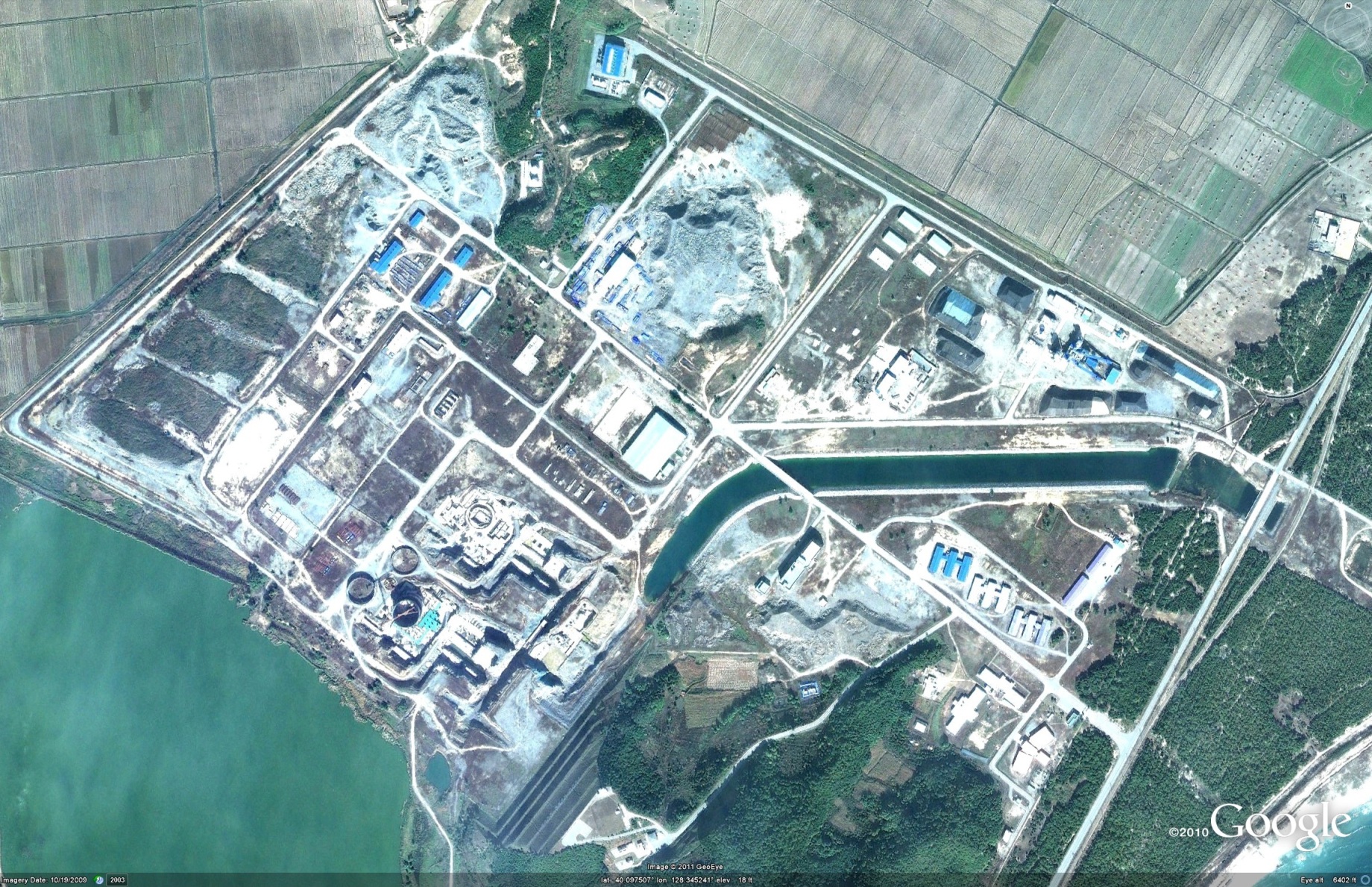
Pictured above (Google Earth): The KEDO light water reactor construction site in Sinpho County, South Hamgyong Province.  See in Google Maps here.

 According to Yonhap:

An international consortium once tasked with building two power-generating nuclear reactors in North Korea will soon demand that the communist country provide US$1.89 billion in compensation for the project’s failure, a Seoul official said Monday.

The demand comes after North Korea filed its own compensation claim worth some $5.8 billion in September, saying it suffered heavy financial losses and other troubles from the failed project.

In a 1994 deal linked to North Korea’s promise to denuclearize, the Korean Peninsula Energy Development Organization (KEDO), which includes South Korea, Japan and the United States, agreed to build two 1,000-megawatt light-water reactors in the communist country within several years.

After years of delays due to poor funding and other problems, the project fell through in 2006 after the U.S. caught North Korea pushing a second nuclear weapons program based on enriched uranium in addition to its widely known plutonium-based one.

The $4.2 billion project was about 35 percent complete when the KEDO called it off.

“Ever since the project fell through in 2006, the KEDO has sent a request to North Korea each year, demanding compensation for its breach of the agreement,” the government official said, requesting anonymity. “North Korea gave no response, and its sudden claim for compensation is completely unacceptable. The KEDO plans to send an official reply in the coming days.”

The latest development comes as diplomatic efforts are under way to revive the stalled six-party talks on ending North Korea’s nuclear weapons programs. Pyongyang is pushing for an unconditional reopening of the multilateral negotiations it walked away from in April 2009, while Seoul and Washington insist that the communist country first demonstrate its sincerity toward denuclearization through such pre-steps as a monitored shutdown of its uranium enrichment program.

The forum, which offers economic and political aid to North Korea in exchange for its denuclearization, also involves Japan, China and Russia.

The Korea Times also reported on this story.

Read the full story here:
Power consortium to demand $1.89 bln from N. Korea over failed energy project
Yonhap
2011-11-14

Share

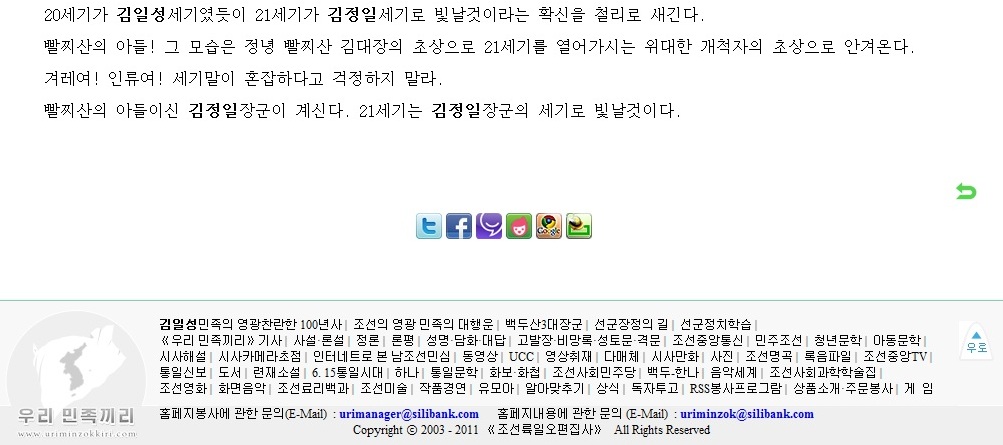
Uriminzokkiri using social networking to spread DPRK propaganda

Monday, November 14th, 2011

Pictured above is a screen shot from the Uriminzokkiri web page featuring the social networking buttons

According to Yonhap:

North Korea’s government-run Web site began linking posts critical of South Korea to popular social networking sites (SNS) to allow netizens to more easily spread its message online, in its latest effort to step up cyber propaganda.

The official Web site of the Committee for the Peaceful Reunification, Uriminzokkiri, on Monday inserted six SNS icons, including Twitter, Facebook and Korean micro-blogging services, in two postings critical of the South Korean government, according to Yonhap’s monitoring team on North Korea.

Other articles on the site, however, did not include the icons, showing the North’s apparent intention to drive more traffic to specific Web sites when it comes to stories critical of Seoul, the analysis noted.

South Korean authorities ban Web sites containing communist information, illegal under the National Security Law, but some people take advantage of proxy servers to gain access to the blocked sites in the communist state, raising concern that such a bypass will be abused to promote the Pyongyang regime.

Uriminzokkiri (“on our own” in Korean), which opened a Twitter account in August of last year, posts 5-10 messages daily, with 10,000 followers across the world. The propaganda mouthpiece also created its own channel on Youtube, putting up over 1,800 video clips of performances and events by North Korean military and art troupes.

In January of this year, hackers were able to break into Uriminzokkiri’s Twitter and YouTube accounts.

Read the full story here:
N. Korea’s propaganda Web site adds links to SNS sites
Yonhap
Kim Eun-jung
2011-11-14

Share

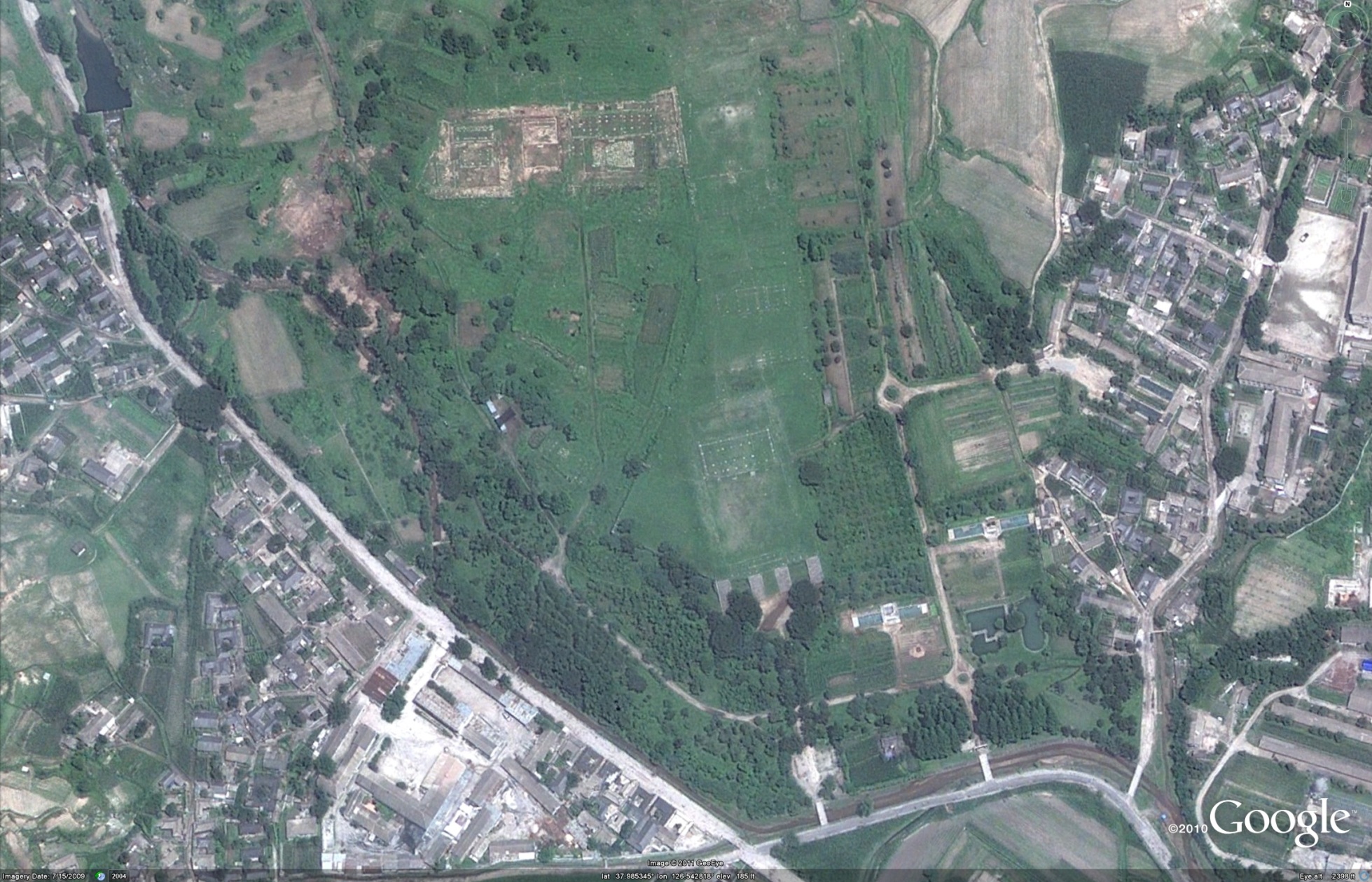
ROK historians visit Kaesong to study Manwoldae renovation

Sunday, November 13th, 2011

Pictured above (Google Earth): Manwoldae Palace in Kaesong, DPRK. See in Google Maps here.

According to Yonhap:

South Korea’s Unification Ministry said Sunday it has allowed a group of historians to visit North Korea this week for the resumption of a long-stalled joint project to excavate an ancient royal palace site.

The approval is another sign of lessening tensions on the divided Korean Peninsula, as Seoul is easing restrictions on civilian contact with Pyongyang following a year of animosity caused by the North’s deadly military attacks on the South.

On Monday, 14 South Korean historians will travel to the North’s border city of Kaesong, the site of Manwoldae, the royal palace of the Goryeo Dynasty that ruled the Korean Peninsula from 918 to 1392.

During their 10-day stay in Kaesong, the South Korean experts will conduct a safety survey on the site with their North Korean counterparts, a ministry official said.

“Based on the results of the safety survey, the joint excavation work will begin on Nov. 24 for one month,” the official said on the condition of anonymity.

The two Koreas launched the excavation project in 2007, but South Korea halted it last year as part of its sanctions against Pyongyang for the March sinking of a South Korean warship blamed on the North.

Seoul’s new Unification Minister Yu Woo-ik, who took office in September, has said he would consider “flexibility” in dealing with North Korea. The ministry is in charge of North Korea policy.

Kaesong served as the capital for most of Goryeo’s reign. Now it is home to an industrial complex run by both Koreas.

The Choson Ilbo also covered this story.

Read the full story here:
S. Korea OKs historians’ visit to N. Korea
Yonhap
2011-11-13

Share

Air Koryo launches/cancels Kuwait service

Thursday, November 10th, 2011

UPDATE 3 (2011-11-15): NK News has more on the unofficial Air Koryo Facebook Page here.

UPDATE 2 (2011-11-12): The unofficial Air Koryo Facebook Page posted the following comment in response to a question about service to Kuwait (thanks to a reader for the pointer):

It is not canceled. It is restricted bookings just like Moscow services.

The comment is followed by this one:

Kwang-tae Kim: I am a reporter of South Korea’s Yonhap news agency. Can u elaborate on why bookings are restricted and when bookings will be resumed? Some people speculated that it could be North Korea’s attempt to prevent the news of popular uprisings in the Arab world from reaching North Korea. Do u have any comment? Thanks

UPDATE 1 (2011-11-12): According to Yonhap:

North Korea’s flag carrier has canceled an air route to Kuwait, Airline Route blog says, in what could be Pyongyang’s latest attempt to prevent the news of popular uprisings in the Arab world from reaching the isolated country.

The move came less than six months after Air Koryo started a weekly direct flight service between Pyongyang and Kuwait City, Airline Route said Monday on its Web site, citing the carrier’s planned winter operation.

In late May, Air Koryo announced the service on its Facebook page, adding that a large number of North Koreans work in the Middle East.

The North’s airline has not yet commented on the reported cancellation of the service on its Facebook page, which was last updated late in October.

Here is the source information for this story:

As per 07NOV11 GDS timetable display, the following is North Korean flag carrier Air Koryo’s planned Winter 2011/12 operation.

Pyongyang – Bangkok
JS153 FNJ1020 – 1420BKK T20 4
JS154 BKK1220 – 2000FNJ T20 4

Pyongyang – Beijing
JS151 FNJ0900 – 0955PEK T20 26
JS251 FNJ1030 – 1130PEK T20 4

JS152 PEK1255 – 1600FNJ T20 26
JS252 PEK1405 – 1710FNJ T20 4

Pyongyang – Kuala Lumpur
JS159 FNJ1340 – 2000KUL T20 14
JS160 KUL2300 – 0730+1FNJ T20 25

Pyongyang – Kuwait Service Cancelled

Pyongyang – Shenyang
JS155 FNJ1200 – 1210SHE T20 36
JS156 SHE1500 – 1710FNJ T20 36

Pyongyang – Vladivostok
JS271 FNJ0830 – 1220VVO T20 5
JS272 VVO1830 – 1820FNJ T20 5

On an similar note, according to the Air Koryo Facebook page (Oct 28):

Air Koryo 2012 European Charters:

We are glad to announce to our European Union fans that Air Koryo will indeed be operating a seasonal service to Germany with a service from Pyongyang’s Sunan to Berlin’s Schonefeld airport. The serivces will operate from April till May 2012 and will operate weekly. Service dates are currently listing as first departure of 12 April and final flight 3 May. All service will be operated by Tupolev Tu-204 aircraft.

More information including timetable and official route i.e. non-stop or one stop will be released soon.

The flight will operate via Moscow Sheremetyevo Airport, the flights will operate on alternate dates to the weekly direct flight to Moscow. Note that the flight to Berlin will be a direct flight, and not non-stop. The service will be operated by the larger Tu-204-100E

ORIGINAL POST (2011-6-1): According to an online aviation forum:

Air Koryo are opening a new route to Kuwait City, to operate once a week.

Outbound (Tue, day 2): JS 161 FNJ 1800 / KWI 0110+1
Return (Wed, day 3): JS 162 KWI 1400 / FNJ 0500+1
Aircraft: Tupolev Tu-204-300

From the schedule it is obvious that the aircraft parks for thirteen hours, enabling the crew to have an eight hour sleep before operating the machine back to Pyongyang.

The Tu-204-300 is the long haul, “SP” version of the 204, and the Air Koryo machine (they have just the one, plus a pair of regular -200s) is the only airframe of the type exported from Russia. It is also used on flights to Moscow, plus Beijing of course.

It is an interesting choice of route out of the hermit kingdom. The airline says, “We are glad to announce Air Koryo has started serving Kuwait City, the capital of the Arabic nation of Kuwait, with a weekly Tupolev Tu-204-300 serivce. The route offers many connections onto the Middle East, Iran, Africa and offers business links in the region.”

A reader in the comments points out that one of the DPRK’s new Tupolevs was in Kuwait on March 25, 2011 at 10:54 CET, so the route may already be in use.

In April 2011, Air Koryo announced regular service to Kuala Lumpur.

UPDATE: This was apparently picked up by VOA and Yonhap.

Share

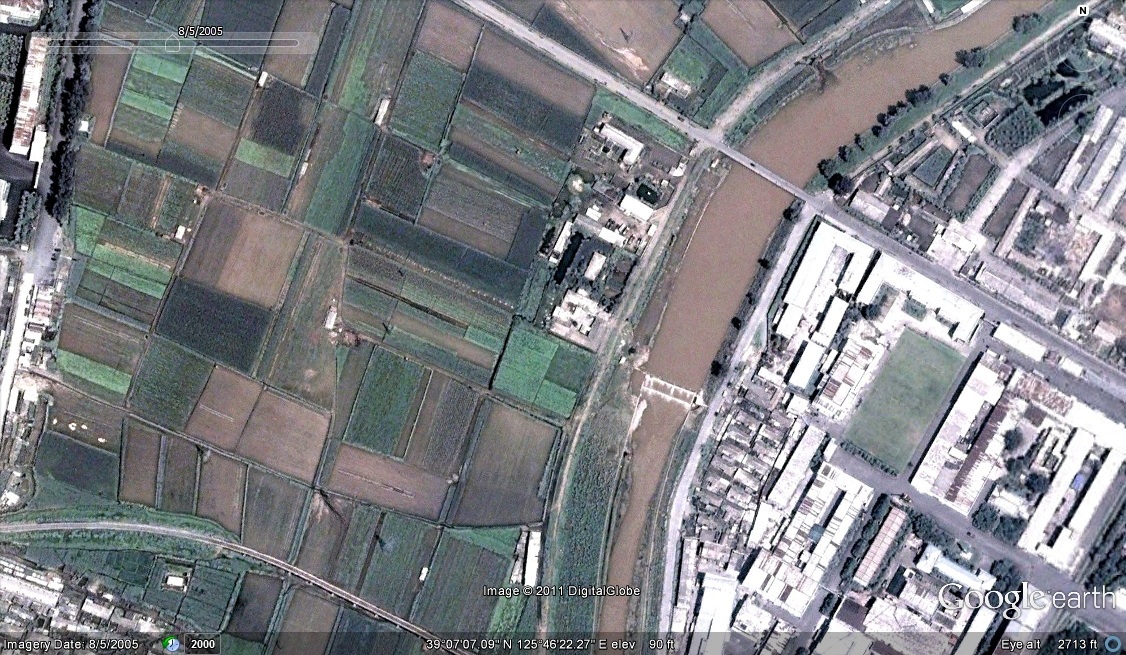
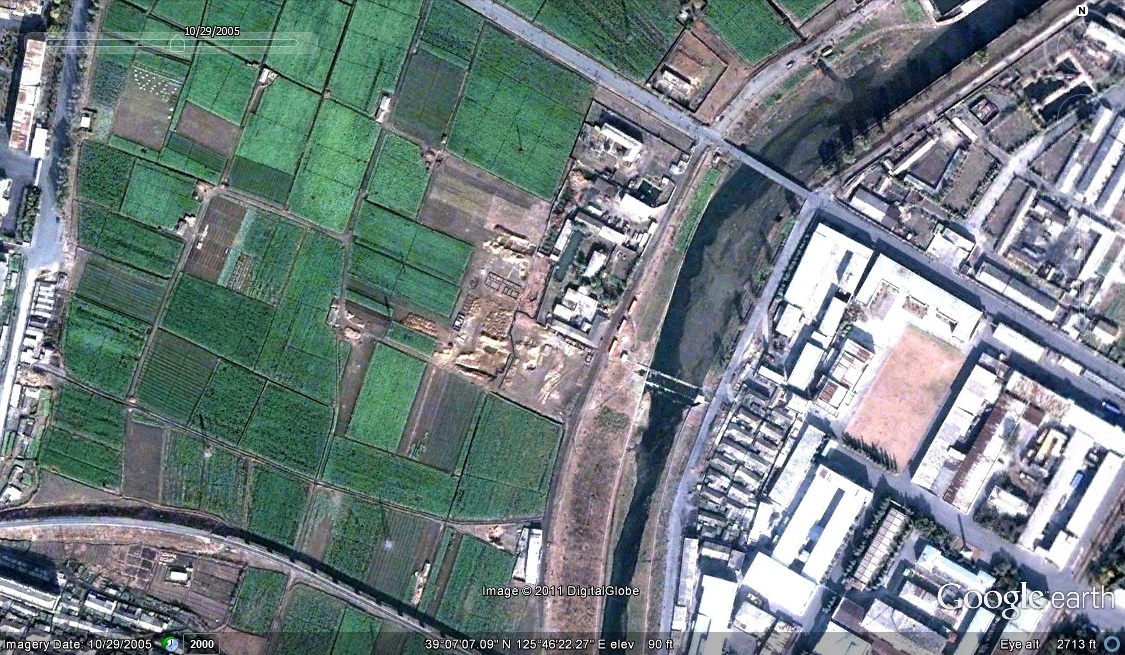
Ryongsong water-purifying station completed

Wednesday, November 9th, 2011

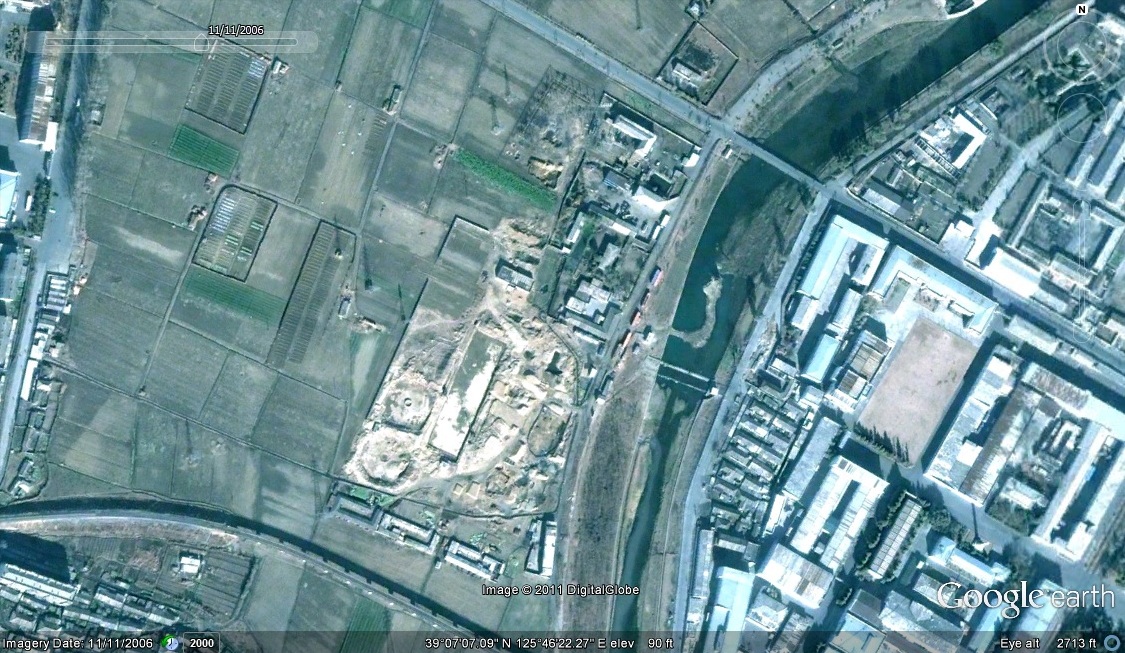
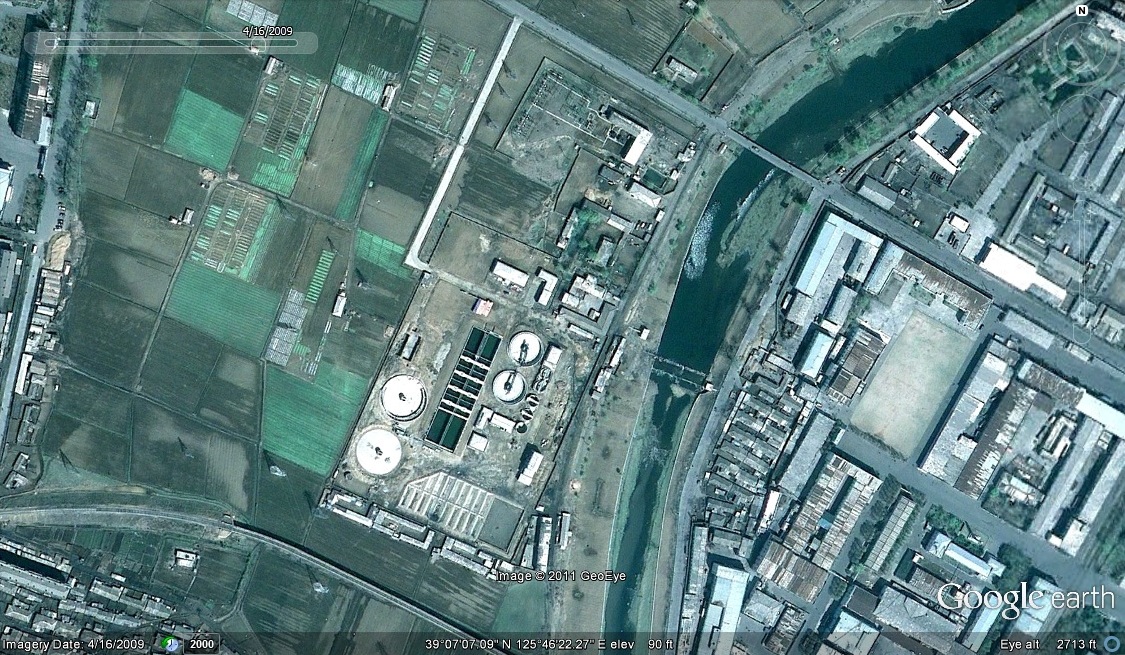
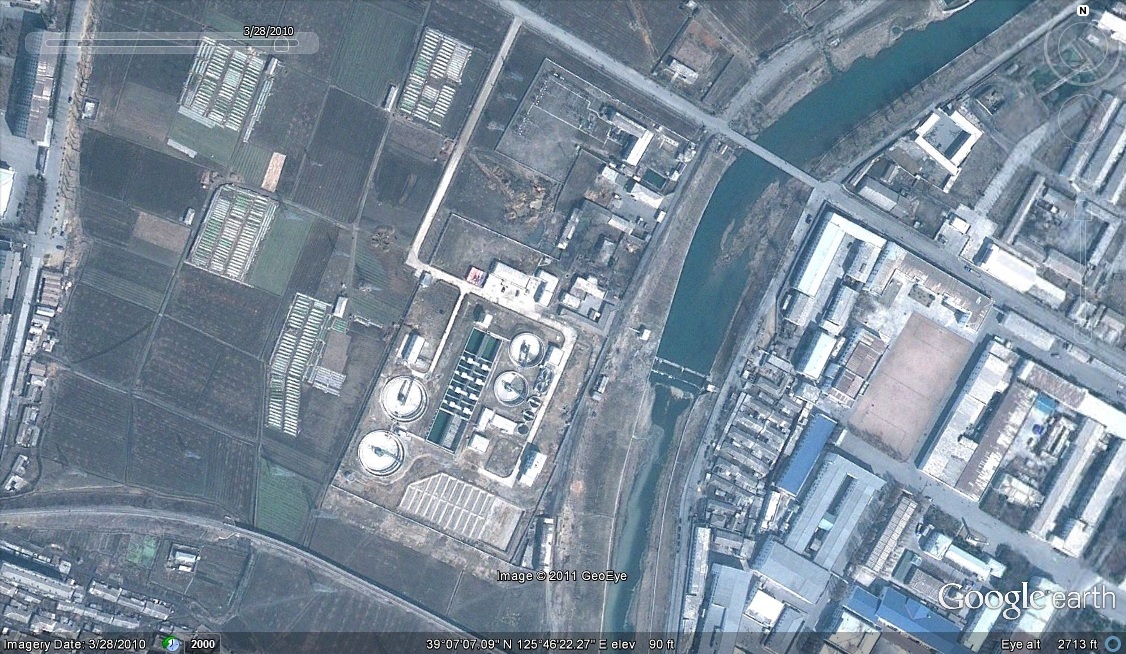
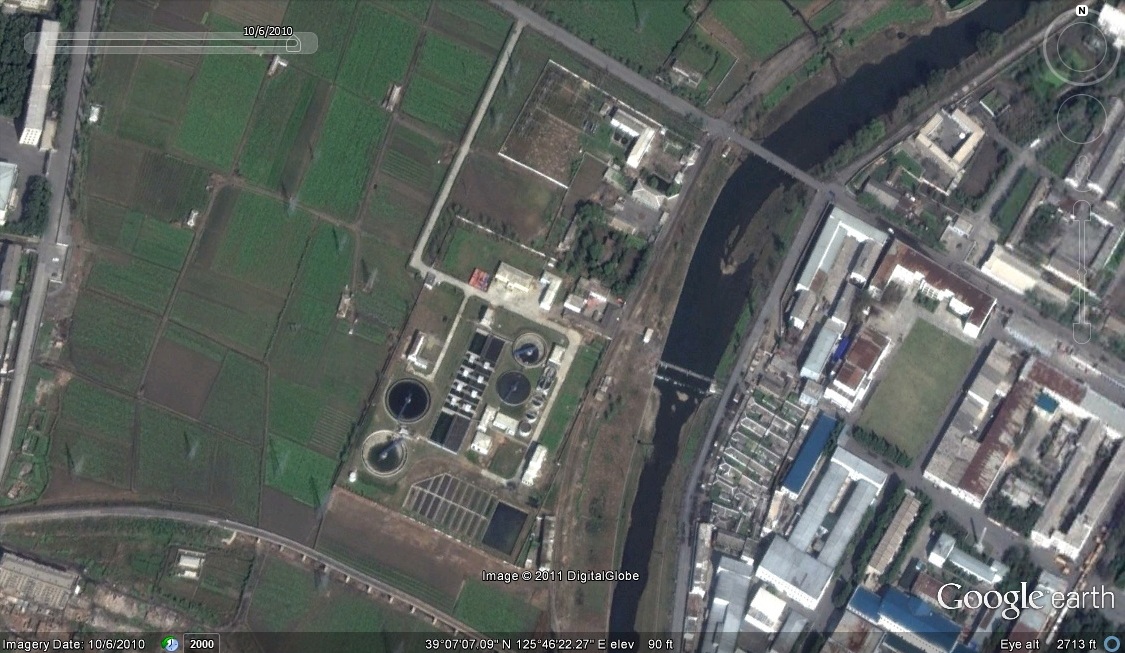
Here is the relevant satellite imagery from Google Earth which shows the construction of the facility (which began in late 2005):


Image Dates: (L) 2005-8-5, (R) 2005-10-5


Image Dates: (L) 2006-11-11, (R) 2009-4-16


Image Dates: (L) 2010-3-28, (R) 2010-10-6

You can see the facility in Google Maps here.

Here is the story according to KCNA:

Pyongyang, November 9 (KCNA) — The Ryongsong Water-purifying Station has been built on a modern basis.

Latticing, detritus chamber, settling basin and others were successfully built to ensure the flow of clean water into the River Pothong and provide the people in the capital city with better living conditions and circumstances.

A ceremony for its completion took place on Wednesday.

Present there were Vice-premier Jon Ha Chol, officials concerned, scientists, builders and workers.

Hwang Hak Won, minister of Urban Management, addressing the ceremony, noted that the station was perfectly completed in a short span of time.

He stressed the need to strictly abide by the requirements of the technical regulations in managing and operating the station, further perfect the processes and make green-belt in its surrounding area.

Additional information:

1. Some Pyongyang water sanitation projects  have been funded by Kuwait Fund for Arab Economic Development.

2. Here is a previous post on waste management in the DPRK.

Share

Lankov on Kim Jon-un’s rise to power

Tuesday, November 8th, 2011

Lankov writes in the Asia Times:

In October last year, media worldwide reported that Kim Jong-eun, Kim Jong-il’s third son, had been made a four-star general and promoted to the position of vice chairman of the Korean Workers’ Party’s Central Military Commission.

It was taken as evidence that at long last, the Dear Leader had decided on his successor. At the time, it was often overlooked that Kim Jong-eun had not yet been officially described as “successor”. Officially, he is merely a top dignitary, even though few would cast doubt on the actual meaning of the promotion of a 28-year-old to a top circle of decisions makers whose average age is well above 70.

Over the following year though, the media – at least, the English-language media – have not paid much attention to the succession process underway in the North. This lack of attention is easy toexplain. The media usually report unusual developments while the North Korean dynastic succession has so far progressed without many surprises.

It seems that North Korea’s decision makers do not want to be too creative. So far, they have generally followed the script which was developed 40 years ago, in the 1970s, when Kim Jong-il was promoted to succeed his father, Kim Il-sung.

From late 2010, Kim Jong-eun began to appear in the pages of the North Korean press and in news broadcasts on North Korean television. He is shown mimicking the public activities of his father (and earlier activities of his grandfather). Kim Jong-eun goes to factories where he explains to the managers how they should run their enterprises and extols workers to labor with even greater enthusiasm.

He is shown touring newly built apartments and inspecting military units, providing artists with moral guidance and mixing with exemplary soldiers.

At least in one case, such a visit was commemorated in stone. In 2009, Kim Jong-eun, then still unknown to most, accompanied his father on a visit to Wonsan Agricultural College. Soon afterwards, a commemorative stone feature was erected to celebrate this great historical event.

One should not be too surprised about this, the present author, when walking through Pyongyang, once came across a wooden bench that was fenced off and had a large commemorative stone placed next to it. The bench’s claim to fame was that in the 1950s, Kim Il-sung, founder of the dynasty, had once placed his buttocks on its wooden planks. Until this year though, such commemorative stones could only mark the activities of the two elder Kims. Now it seems that the successor has joined the top league.

Kim Jong-eun has been introduced to foreign embassies in Pyongyang and now frequently meets with visiting foreign officials and delegations. Recently, during a meeting with a Chinese dignitary, he was pictured sitting on the right hand side of the guest while his father, Marshal Kim Jong-il, sat on the left.

Jong-eun’s attire is worth noting. He wears a navy blue Mao Zedong suit. This dress is rather anachronistic, but it clearly has been chosen for its symbolism: his grandfather wore exactly the same daily uniform in the 1950s and 1960s. Kim Jong-eun resembles his grandfather indeed, and the likeness is further emphasized by his choice of haircut. This exercise in political image-making delivers a clear message: Kim Jong-eun is the next incarnation of his grandfather, the legitimate heir to the Kim dynasty.

Kim Jong-eun’s connection with his still-ruling father is also emphasized in clothing selection. In winter, he appears clad in a grey parka that is an exact copy of Kim Jong-il’s winter dress. In other words, the successor is made to look like a young clone of his two predecessors.

One should probably not overstate the significance of these facts too much, but nonetheless, this does not encourage the idea that Kim Jong-eun will break with the current line and become a radical reformer.

Every ruler of the Kim family has had his own, clearly defined, set of titles. Nowadays Kim Il-sung is usually referred to as the “Leader” (suryong in Korean) and Kim Jong-il is usually referred to as the “General” (changun). Kim Jong-eun, unremarkably, has also acquired a title: he supposed to be referred to as the “Four-star General” (taejang) – in Korean, this is a technical term for a military rank, different from the generic “General”, which is Kim Jong-il’s title.

Recently, North Koreans saw the emergence of a new type of personality cult-related object: three plaques or stones, identical in size and shape, each containing a short three character inscription. Such triple plaques or stones are increasingly common in public places in North Korea.

One plaque says “The blessing [of having] the leader”, the next says “The blessing [of having] the general”, while the last one says “The blessing [of having] the four-star general.” As we remember, “Leader” means Kim Il-sung, “General” stands for Kim Jong-il, and the “four-star General” is Jong-eun’s new sobriquet.

This is a way to remind North Koreans how incredibly lucky they are to be blessed by destiny, which has provided them with three geniuses of leadership, the three best leaders the world has ever seen.

As one should expect, the arts have been put to good political use as well. For the past few years, North Koreans have been encouraged to sing a song entitled Footsteps. It extols the manifold virtues of Jong-eun and especially his desire to be among the common people and take care of their needs.

Ko Yong-hui, Jong-eun’s late mother, has also begun to get her fair share of attention. Back in the 1970s, Kim Jong-il’s rise to power gave birth to personality cult for his mother, Kim Jong-suk. Jong-eun’s mother was a beautiful folk dancer who died in 2004. Nowadays she is supposed to be referred to as “Pyongyang’s mother”. Predictably, there is at least one song dedicated to her virtues and glory.

The city of Wonsan seemingly has started somewhat special standing in North Korea. Jong-eun’s mother was actually born in Japan, but she moved to North Korea with a large number of pro-Pyongyang ethnic Koreans. The major port of arrival for these people was Wonsan and it has been stated that Jong-eun described this city as “his second home town”.

According to some rumors, he was actually born in one of the Kim Jong-il’s residences in Wonsan or close by, but it is not currently clear whether these rumors should be taken seriously. Nonetheless, Wonsan is clearly a rising star of North Korea’s political geography.

What does this all mean? So far it seems that North Korea’s agitprop department is following the pattern that was developed in the 1970s. Then, they spent a few years on promoting the personality cult of the newly appointed successor whose virtues and devotion to the people were continuously extolled.

A significant part of this propaganda appeared in confidential publications that were not supposed to be seen by outsiders and often not even by common North Koreans as well. This allowed them to claim that the North Korean public suddenly experienced a burst of spontaneous love for young Kim Jong-il. His official confirmation as his father’s successor was presented as merely the corollary of this universal love and admiration.

In the case of Kim Jong-il, these preparations took eight years. Kim Jong-il was selected as successor and promoted to top positions in the government in 1972, but his standing as heir-designate remained unofficial until 1980. In 1980, the sixth congress of the Korean Workers’ Party officially declared Kim Jong-il to be the official successor of Kim Il-sung.

Recent events, especially the speedy emergence of Jong-eun’s personality cult, leaves little doubt that the decision pertaining to his future has been made and is unlikely to be changed. However, he is yet to be declared a successor, officially and unequivocally. Technically speaking, he is merely one of a dozen top military commanders, albeit very young and enjoying unparalleled admiration among the common people.

If the experiences of the 1970s are a guide as to what is likely to happen, we should expect that in due time Jong-eun’s standing will be made official. Judging by the hype North Korean propaganda makes about 2012 (meant to be a year of great events and achievements), one cannot rule out that the final promotion will happen as soon as next year – perhaps, but not necessarily, at a party congress which will be convened for this purposes.

There is one noticeable difference between Kim Jong-il’s promotion in the 1970s and Kim Jong-eun’s promotion of late. In the case of Jong-eun, North Korean agitprop has moved much faster, so it may be possible that the entire preparatory phase be compressed into two or three years.

They have a good reason to be in a hurry. Kim Il-sung was 60 when he made a decision about his son, Kim Jong-il made the same decision at the age of 68, whilst being in far worse physical shape. So nobody knows how much time North Korea has to complete the tricky dynastic succession.

At any rate, things appear to be moving smoothly right now. The succession process has yet to run into any noticeable obstacles. So the chances are that the world’s youngest four-star general will succeed Marshal Kim Jong-il, becoming the third Kim to rule the world’s only communist absolute monarchy.

Read the full story here:
The rise of Kim Il-sung’s mini-me
Asia Times
Andrei Lankov
2011-11-8

Share