Archive for the ‘Civil society’ Category

Civilians along the North Korea-Chinese Border Prefer Small-Size TVs?

Tuesday, November 13th, 2007

Daily NK
Moon Sung Hwee
11/13/2007

Recent demand for small-sized TVs has been rapidly increasing in North Korea’s border regions, resulting in a huge price increases.

According to an inside North Korean source, the price of 12-inch (dubbed “chok” in North Korea) and 14-inch TVs, compared with prices this time last year, increased by 50 thousand to 100 thousand won (approx. USD15-30). Despite the increase, these small TVs are selling out, resulting in a supply shortage in stores located throughout the border regions.

Most 12-inch black and white TVs are Chinese-made. These TVs, which could have been purchased for a mere 150,000 won (approx. USD46) up until the end of last year, have recently sold for as much as 250,000 won.

The reason for the increase in the border region is that the state has strengthened inspections in these areas of those who watch Chinese TVs. The recent preference for small-size TVs comes from the fact that they are relatively easy to conceal.

A majority of border region civilians from North Pyongan to North Hamkyung Province can receive Chinese TV signals, thanks to the close distance. Among the channels able to be viewed is once broadcasted via Yanbian TV and South Korea’s China TV (www.openchina21.com). In accordance with a 2004 agreement between these two companies to promote broadcasting and cultural exchange, diverse South Korean dramas and movies as well as advertisements of South Korean products can be viewed.

The North Korean government collected remote controls to prevent the viewing of Chinese TV along the border region and implemented measures such as sealing the channels. Throughout the China-North Korea border region, inspections conducted by the No. 27 Bureau (under the Central Communications Office) are still very much underway.

The source said, “No. 27 Bureau agents come knocking at the door and turn on the TV at once to verify which channels have been viewed. Further, they inspect the state of sealed channels; if the seal has been damaged, the TV is confiscated.” When inspections take place, 30~50 sets are taken at a time, and in order to retrieve them, several thousand won in bribes is needed.”

However, in cases where these methods have failed to prevent the viewing of Chinese TV, technicians have entered homes and intercepted the circuits inside the TV, re-sealing the attached apparatus with high-strength adhesives. By doing so, the channels are forcibly fixed on Chosun Central TV broadcasting.

When the government carried out such invasive measures, the civilians put up a strong resistance, “Are they planning to just break TVs?” However, the government enforced the regulation of internal equipment, even when faced with civil rebellion.

The source said, “The apparatus inside televisions have been fixed so that people cannot watch Chinese TV channels, and inspections have been occurring randomly, so people have been watching and hiding small-size TVs in their homes.” This activity is reflected in the price increase.

One defector who has experience in selling used TVs in Rajin in North Hamkyung Province said, “Small-size TVs by which people could watch South Korean broadcasting were originally in high demand in South Pyongan, Kangwondo and South Hwanghae.” He said, “Since they cannot pass through customs, they are usually smuggled into and sold on the black market.”

The People’s Safety Agency handed down a decree stating that, “Those who pose a threat to the state and social system will be severely punished. Get rid of all kinds of places offering karaoke, movies, film subscriptions, PCs, and games.” It further emphasized the National Security Agency’s tightening of cell phone regulations along the border region.

Since last year, severe regulation of illegal films (foreign and South Korean DVDs and VCDs) has continually been enforced. Since this year, the North Korean government has gotten headaches from regulating the houses of civilians.

The North Korean government claims that the purpose of the regulations is “Destroying enemy maneuvers and directly impugn acts that pose a threat to society and the system.” North Korea’s opening and reform still seems far off.

Share

Surfing Net in North Korea

Monday, November 12th, 2007

Korea Times
Andrei Lankov
11/12/2007

Kim Jong-il loves to surf the net. In 2001 he asked the U.S. Secretary of State for her e-mail address, and in 2002 he told a visiting North Korean dignitary that he spent much time going through South Korean sites. He repeated this statement during the recent summit describing himself as ”an internet expert.”

Despite his relatively advanced age, Kim Jong-il takes the IT industry seriously. He obviously believes that the IT industry might become a wunderwaffen (super weapon) which one day will save the ailing North Korean economy (Kim Jong-il has always believed in simple, one-step, technology-based fixes for problems).

Now and then, news agencies report on North Korean efforts to train software specialists, or on a technology firm established by the North Koreans, or even on Kim Jong-il’s plans to create a large industrial complex which would become the North Korean reply to the Silicon Valley.

Efforts to create a computer industry go back to the late 1970s. In those days, the U.N. Development Program helped the North build a small pilot integrated circuit plant. Its history was plagued by one misfortune after another: the plant’s building proved to be badly insulated, the electricity supply was unreliable, and the engineers who were sent overseas for training arrived too late (most of them did not speak English, anyway). However, by late 1985 the plant was operational, producing ICs, an essential component of a computer.

By the early 1990s, the North was producing some 20,000 computers a year. Not much, but enough to provide for the military and even earn some money from export (over 60 percent of them were said to be exported).

In the early 1990s the North Koreans developed their own software, including a word processor. The latter had, among others, a peculiar function: it could automatically insert the names of the Great Leader and Dear Leader through a specially designated hot key.

In the North the PC was never meant to be a personal computer. It is reserved for office or industrial use, not for home – not least because the Internet is unavailable. For a regime which (correctly) assumes that its survival depends on its ability to keep the populace ignorant about outside world, the internet presents a mortal danger. Matters are further exacerbated by the unique success of the South Korean internet. If North Koreans were allowed to surf the numerous Southern sites at will, the carefully constructed picture of the world would instantly fall apart.

Thus, the internet is outlawed – but not completely. In recent years, foreign embassies have been allowed to connect to Chinese internet providers, but they have to pay the exorbitant fee for an overseas call (currently, $2 a minute). The connection is unreliable, but if your bills are paid by your country’s taxpayers, you probably can check your email… Access to email through business centers and even Internet cafes is becoming possible as well _ as long as one is a foreigner and is willing to pay exorbitant prices.

Only the privileged few have unlimited high-speed access to the Internet. But these trusted people are numbered in the hundreds or, perhaps, count a few thousands. Access is provided for the military, intelligence, and few privileged research centers only. Rooms where the internet-connected computers are installed are considered off limits for the North Korean personnel, and only people with proper security clearance can access this source of dangerous knowledge.

Less privileged institutions have access to local networks with limited connections to the World Wide Web. Their task is to let scientists and engineers retrieve the data they need without unduly exposing them to the dangers of overseas decadence.

There have been attempts to make money through IT. None of the grand plans for selling locally developed software on the international market have come to fruition, but there are easier ways to make a buck. In 2002 the North Koreans started an on-line gambling site in cooperation with a South Korean company. It targeted South Koreans, since gambling is illegal here. Its message board attracted much popularity since it was a place where the Southerners could exchange messages with the North Korean staff. The ability to chat with the Northerners was exciting (even though the largely young participants probably did not realize to which extent their interlocutors were controlled). The combination of gambling and propaganda obviously terrified Seoul, and the site was closed down.

Another area where North Koreans are trying their luck (and obviously not without moderate success) are game development and computer animation. Indeed, even major studios are sometimes inclined to outsource their animation work to North Korea.

The Internet remains a hot potato for the North Korean leaders. They understand its importance, but they do not know what to do about its political dangers. While facing such a choice, they have always opted for political security.

Share

North Korea authorities “Stop Operating Chinese Motorcycles for Commercial Use”

Monday, November 12th, 2007

Daily NK
Kwon Jeong Hyun
11/12/2007

North Korean authorities recently started regulating motorcycle operation in order to control private market.

Motorcycle is most preferred means of transportation especially for North Korean salespersons. And in North Korea, everybody must get a license from the government to operate cars, motorcycles or even bicycles.

North Korean authorities now give license to only Made in DPRK “Bugang Motorcycle,” which is considerably more expensive than those imported from China.

Choi, a 33 years old resident of Sinuiju visiting his relative in Dandong, China, said on last Thursday “getting operator’s license for Made in China motorcycles has become ridiculously difficult.” According to Choi, only domestic motorcycle owners receive license and popular dissatisfaction increased.

It seems that North Korean authorities want to stop growing of private market by making it impossible to operate motorcycle, a vital part of transportation of goods.

Choi added “even before, someone had to bribe police officer to get a license, but now, bribery doesn’t work for Chinese-built motorcycles at all.”

Why people prefer Made in China? “Korean motorcycles manufactured in Pyongyang cost 1,500 US dollars and often break down. However, Chinese ones cost only 600 dollars while perform far better.”

Choi complained that “some people who operated Chinese motorcycle without license got their bikes confiscated.”

The loots were sent to the Army troops on DMZ.

Chinese motorcycle has become prevalent since 2002 when North Korean residents whose relatives lived in China received it as gift and operated for commercial purpose.

According to Choi, “Motorcycle can carry a certain amount of goods to inlands and it is so convenient. Even if motorcycle is expensive, everybody wants to own one. People buy seafood on the coast and bring them to the cities or sell small commodities.”

For alluvial gold, price differs among regions, so transporting it fast with motorcycle is lucrative business.

Lee, defected Pyongyang last year, said “In the past, a few rich people bought used Japanese motorcycles like Honda or Yamaha, but now many people operate Chinese ones for commercial purpose.”

Share

Google Earth North Korea (version 6)

Sunday, November 11th, 2007

The most authoritative map of North Korea on Google Earth
North Korea Uncovered: Version 6
Download it here

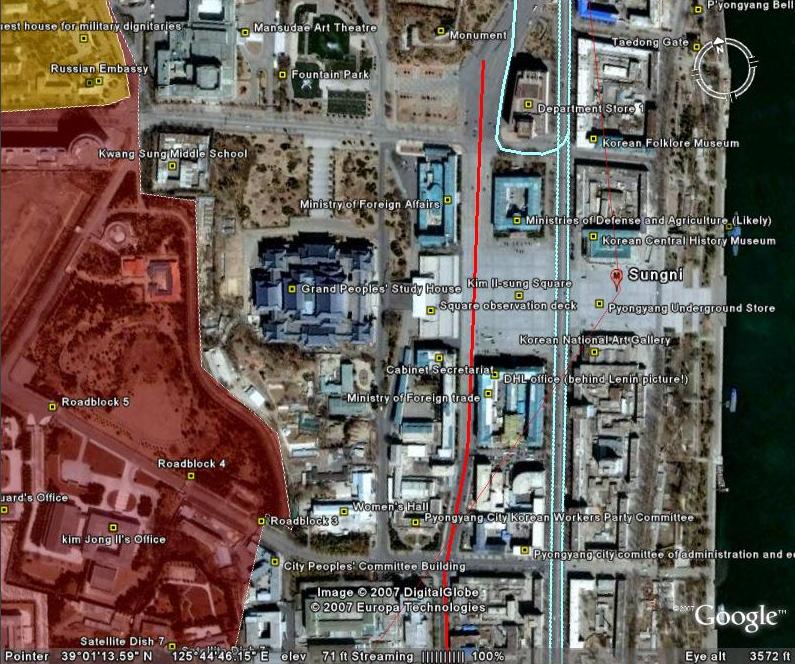
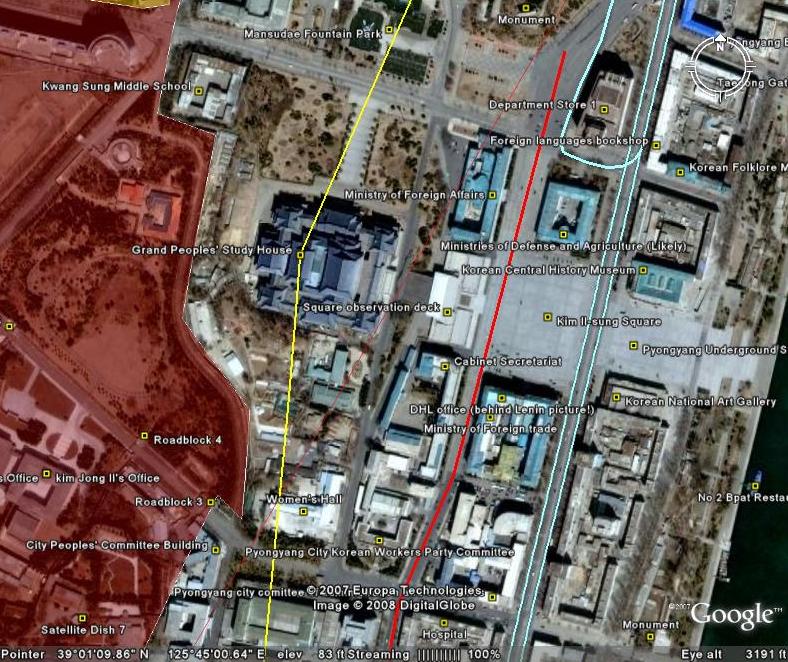
kissquare.JPGThis map covers North Korea’s agriculture, aviation, cultural locations, manufacturing facilities, railroad, energy infrastructure, politics, sports venues, military establishments, religious facilities, leisure destinations, and national parks. It is continually expanding and undergoing revisions. This is the sixth version.

Additions to the newest version of North Korea Uncovered include: Alleged Syrian nuclear site (before and after bombing), Majon beach resort, electricity grid expansion, Runga Island in Pyongyang, Mt. Ryongak, Yongbyon historical fort walls, Suyang Fort walls and waterfall in Haeju, Kaechon-Lake Taesong water project, Paekma-Cholsan waterway, Yachts (3), and Hyesan Youth Copper Mine.

Disclaimer: I cannot vouch for the authenticity of many locations since I have not seen or been to them, but great efforts have been made to check for authenticity. These efforts include pouring over books, maps, conducting interviews, and keeping up with other peoples’ discoveries. In many cases, I have posted sources, though not for all. This is a thorough compilation of lots of material, but I will leave it up to the reader to make up their own minds as to what they see. I cannot catch everything and I welcome contributions.

Share

N. Korea Shows Signs of Opening Up, After Decades of Self-Imposed Isolation

Friday, November 9th, 2007

Washington Post
Blaine Harden
11/9/2007
Page A14

Choi Won-ho has made six trips to North Korea in the past two years, struggling each time to convince the reclusive government there that the time was ripe for a chicken franchise.

“I told those guys that Kentucky Fried Chicken would come sooner or later,” said Choi, president of a company that has franchised 70 chicken restaurants in South Korea. “I told them it would be better to have an indigenous Korean brand, with takeout delivery.”

To Choi’s astonishment, his pitch is now falling on receptive ears in Pyongyang. This month, he plans to open the first foreign-run restaurant in the North Korean capital in the history of the Stalinist dictatorship.

North Korea is opening up to much more than fast-food chicken.

A team of U.S. experts is in North Korea this week to start disabling three key facilities at the Yongbyon nuclear site — just 13 months after the government of Kim Jong Il stunned the world by exploding a nuclear device. The disabling process was off to “a good start,” a State Department official said Tuesday.

And as part of an extraordinary spurt of diplomacy, senior officials from Pyongyang have been touring Southeast Asia, the Middle East, Africa and Russia in recent months. In the same vein, relations with five countries have been initiated or renewed since summer.

Officials from the New York Philharmonic were welcomed this fall to Pyongyang, where they inquired about holding a concert next year, and a North Korean taekwondo team made its first visit to the United States in September. Last week, the U.S. Navy helped out a North Korean cargo ship that had been attacked by pirates off the coast of Somalia.

In the wake of a summit last month with South Korea, the North is also opening up to a new kind of tourism. It will allow nonstop flights from Seoul to a mountain resort called Mount Baekdu.

The decision — ballyhooed this week on the front page of a state-controlled North Korean newspaper — would for the first time in 62 years give travelers a direct connection from South Korea to the resort without a detour through China.

All this seems to add up to something of significance in the long effort to persuade North Korea to abandon nuclear weapons and emerge from decades of self-imposed isolation, according to Christopher R. Hill, assistant secretary of state for East Asian affairs and the principal U.S. negotiator in six-nation nuclear talks.

“In the past, North Korea often spoke of their isolation as a great benefit for their country,” Hill told reporters in Tokyo last weekend. “I think they’ve understood it now as something that is actually harming them, and that the best-case scenario for what they’re doing is to believe that perhaps it is part of an overall effort to open up.”

Hill said that not everyone in North Korea agrees that opening up is a good idea and that whatever happens is “going to be a slow process.” In Seoul, South Korean Defense Minister Kim Jang-soo told reporters that the North is continuing to buy weapons. “We cannot conclude that the threat from North Korea has been reduced,” Kim said.

But Hill sounded genuinely optimistic about the North’s recent gestures.

He said officials in China, which shares a border with North Korea and is its most important ally, have also noticed signs of economic reform in the North. “The Chinese, who probably know the DPRK best, believe that there is an effort on the part of the DPRK to open up,” Hill said, using the initials of the North’s official name, the Democratic People’s Republic of Korea.

North Korea’s recent high-level contact with Vietnam, another communist state that has opened its economy, is “very interesting,” Hill said. North Korea’s premier, Kim Yong Il, who is in charge of economic policy, traveled last week to the Southeast Asian country, where he visited a port, a coal mine and an industrial zone.

A breakthrough in the six-party talks occurred last month, when Pyongyang agreed to disable its nuclear-processing facilities and disclose all of its nuclear programs in exchange for aid, trade and a U.S. agreement to move toward removing the country from its list of states that sponsor terrorism.

The cause of that breakthrough, in the view of many Western and Korean analysts, was a burst of intense and pragmatic U.S. diplomacy after North Korea’s nuclear detonation last year.

Since Hill’s subsequent outreach to his diplomatic counterparts in North Korea, Kim Jong Il has come to believe that he can negotiate with the Bush administration, said Koh Yu-hwan, a professor of North Korean studies at Dongguk University in Seoul.

“The Bush administration is not going to be around for long, and North Korea is worried about losing momentum,” Koh said. The economy of the North desperately needs the outside investment that would come if the United States removes the terrorist listing, he noted.

If that designation is still in place when Bush leaves office in January 2009, officials in North Korea fear they will have to start all over with a new administration, costing them years, Koh said. “The North cannot wait that long,” he said. “The economy there is in too much trouble. The reason you see noticeable change in the North now is that they have an incentive to act.”

Even with that incentive, any opening up of North Korea is certain to be slow and quirky.

A case in point is Choi and his push north with fast-food chicken.

Choi received an e-mail this week from his joint-venture partners in Pyongyang demanding changes in the words and the font used in brochures for the chicken restaurant. The partners are from a government-owned company.

The e-mail said the brochures could not include any descriptions of chicken dishes derived from English. “Chicken fry-ee-doo,” a term widely used in South Korea, was unacceptable and must be changed to more authentic Korean language, the e-mail said.

The partners from Pyongyang also insisted that the chicken brochures be printed in the official North Korean national font.

Share

Are the Residents of Samjiyeon Subject to Forced Mass Relocation for Baekdu Mountain Trip Project?

Friday, November 9th, 2007

Daily NK
Moon Sung Hwee
11/9/2007

The conservative wing in South Korea purported that the opening of the direct Seoul-Baekdu air route would not lead to reforms and open-door policies of North Korea as proved in the case of Geumkang Mountain sightseeing. Hyundai Asan Co. and Korean Asia-Pacific Peace Committee of North Korea have just made a contract for the direct airline staring May next year.

Individuals who travel Mt. Geumkang by land will pass Yuongwoong Middle School, and Onjeong-ri and Yangji village on both sides of the road, all of which are walled off from tourists. Even in Geumkang Mountain, many places are enclosed with iron railings and armed soldiers are guarding them.

Many defectors originally from the Mt. Baekdu areas say that the locals have relatively ease access to the mountain, and so the sightseeing tour of Baekdu Mountain would bring considerable impact on the locals.

The sightseeing tour of Mt. Baekdu passes through Lake Cheonji and Yimyungsoo Waterfall, both of which are popular visiting places for many locals, and Samjiyeon ski resort is located in nearby villages.

Furthermore, every year hundreds of thousands pay a visit to many revolutionary sites in Mount Baekdu. When the tour begins in May next year, the locals and visitors would inevitably run into South Korean tourists. Many people wonder what the North Korean authorities would do about the contact before tourism begins.

According to the Hyundai Asan Co., tourists will fly a direct airline to Samjiyeon Airport and stay at either Sobacksu Visitor’s Hall or Begaebong Hotel. Then, they will visit Sobaeksu Forest, Yimyungsoo Waterfall, Mangchun Peak, Jangkoon Peak and Cheonji Lake.

Tourists must pass through the downtown of Samjiyeon in order to get to Mount Baekdu from Samjiyeon Airport. Unlike Onjong-ri located nearby Geumkang Mountain, it is difficult to close off many places in the Baekdu Mountain areas especially those densely populated villages around Yimyungsoo Waterfall and Samjiyeon ski resort.

In July, 2005, Hyundai Corporation had also once made a contract with North Korea for the development of the Baekdu Mountain areas for tourism. But it was not successful back then because North Korea had a conflict with the Hyundai over economic cooperation and so grew reluctant to cooperate with the corporation as the day for a pilot sightseeing to Mt. Baekdu approached. Moreover, It was difficult for the North Korean authorities to ignore the fact that hundreds of thousands of people make a field trip to many revolutionary sites in the Mt. Backdu areas every year.

The Mt. Baekdu areas have many national treasures such as Mt. Baekdu Billet publicized as Kim Jong Il’s birthplace, the so-called “slogan tree” (referring to those cherished trees which are inscribed with anti-Japanese slogans and the eulogy for Kim Il Sung, and supposedly carved by Kim Il Sung’s soldiers during his anti-Japanese struggle), and many other historical sites and monuments. In fact, Mr. Baekdu is considered sacred and lies at the center of “Su-Ryeong Absolutism” (the idolization of the late Kim Il Sung). The North Korean authorities use the national treasures in Mt. Baekdu to mystify Kim Il Sung and Kim Jong Il.

The itinerary of North Korean people who make a field trip to Mt. Baekdu for two nights and three days is planned as follows. First, they arrive to Samjiyeon Pond by train, and visit Kim Jong Il’s birthplace and Samjiyeon Monument. Next day, they go to Lake Cheonji. On the last day, they pay a visit to the first slogan tree at Gunchang Billet and Begaebong Billet, and Yimyongsoo Waterfall. The problem is that the itinerary of North Korean field trippers is the same as that of South Korean tourists.

Therefore, it is not clear yet whether the North Korean authorities would really open the tourist route in the Mt. Baekdu areas for South Koreas as scheduled in May next year.

It seems that the North Korean authorities allowed the development of Mt. Baekdu because they now have the knowledge and skill to manage tourism business from years of experience of operating Geumkang Mountain tourism business. In addition, the North Korean authorities might have figured out that tourism business normally does not directly lead to reforms and open-door policies.

It is impossible for the North Korean authorities to relocate all residents in the Mt. Baekdu areas. Therefore, they will likely relocate those who have “bad family background” among the residents. (North Korea is highly stratified by class based on family background.) Moreover, the authorities will likely build a block wall designed to keep the residents from encountering South Korean tourists, and construct a new road for tourists.

However, if the itinerary of North Koreans overlaps with that of South Korean tourists, two groups will inevitably have an encounter with each other. Even if North Korean field trippers go on foot and South Koreans travel by bus, two groups will confront each other at tourist attractions such as Samjiyeon Pond, Samjiyeon Monument, Begaebong Peek, Gunchang, and Lake Cheonji.

The North Korean authorities may have North Koreans make a field trip to Mt. Baekdu between November and April during which Samjiyeon Airport has to be closed due to ice on the runaways, and therefore the sightseeing trip is unavailable.

In other words, Mt. Baekdu will be available for half a year for North Korean field trippers and for the rest half for South Korean tourists. However, that is not likely to be a solution since it is difficult to make a trip to Mt. Baekdu during winter due to bad weather conditions. Indeed, the authorities have been restricting the field trip to Mr. Baekdu during the winter period.

A defector from Yangkang Province said, “The authorities may build a new road for tourists or change the tourism schedule.” The defector added, “Once the tour begins, North Korean field trippers will take more interest in South Korean tourists than the legendary struggle for revolution by Kim Il Sung and Kim Jong Il.”

Share

American Tourists in the DPRK 2008

Wednesday, November 7th, 2007

According to the Koryo Tours website, the DPRK will once again be performing Arirang in 2008.  This time around, American tours have been extended by a full day.  Where as previous tours ran from Saturday to Tuesday, now they will run from Tuesday to Saturday (matching the days that Air Koryo flies to Beijing).

I saw the Mass Games in 2005 with Kim Jong Il himself (official coverage, Simon’s coverage).  It was quite an experience.  You will never see anything like it.

Traditionally the Mass Games have only been held on big holidays (typically on notable anniversaries: 10,15, 20, etc.)  This is now the fourth year in a row that Arirang will be performed (2005, 2006, 2007, 2008), a show that was first performed in 2003 (I think).

To the Americans out there: it is not illegal and will not put you on any kind of watch list.

Warning: flooding in October has interrupted trips the last two years!

Share

No More Old-fashioned Chinese Stuff. We like South Korean Culture

Wednesday, November 7th, 2007

Daily NK
Moon Sung Hwee
11/7/2007

A source inside North Korea reported on November 5th that the North Korean Ministry of Education lately directed every school to stress the importance of the Korean language education and to encourage the use of the mother tongue.

In a phone interview with DailyNK, the source said, “At workplace, there are those who read out to the workers a handbook titled ‘Let’s maintain our superior morals and actively promote the use of our mother tongue!’”

In the March 2007 edition of “Learning Culture & Language,” Jong Soon Ki, the most well-known linguist in North Korea and a professor at the Institute of Linguistics of Social Science Center, urged the public to stop admiring English and Chinese language, saying, “The difference of our mother tongue between North and South Korea has been getting larger since the division of Korean.”

The source said that the North Korean authorities started to place high importance on the native tongue in an attempt to stop the surge in the use of the Chinese and foreign languages which have been spread to the country through the circulation of South Korean soap operas since 2000.

After the food crisis in the mid-1990s, the number of defectors, border traders, and Chinese businessmen investing in North Korea have increased, which helped the Chinese culture spread into the country. Many young North Korean began to display interest in Chinese movies, Chinese products and the Chinese language. It became popular among them to read out the brand names of Chinese products in Chinese.

In North Korea, people use the Chinese words “yaoyunji (搖運機)” or “yaoyun (搖運)” for a remote control. They do not use its Korean name “wonkyuk-jojonggi,” translated and adopted by the North Korean authorities.

As for a cell phone, people use its Chinese name “Dakeda (大可大)” or “Souji (手機)” rather than its North Korean name “Sonjeonhwa (literally meaning a handphone).” Blue jeans are called “Niuzaiku,” in the border areas, a refrigerator is called its Chinese name “Bingxiang (冰箱)” and VCD “Woicidie.” Indeed, many products or medical supplies are called their Chinese names such as “Kouhong” for a lipstick.

The use of foreign languages has become more prevalent across the country especially since 2003 when the frenzy over Chinese culture was replaced by its South Korean counterpart. It is particularly noticeable that North Korean people no longer call South Korea “South Chosun” as they used to but call it “Hankuk (meaning the Republic of Korea).” In these days, the young people in Pyongyang look down on those who still use the old name, “South Chosun.”

The source said, “South Korean culture is taking over the Chinese one, and the demand for the South Korean films and products is increasing. People learn new words from South Korean soap operas and these words are becoming popular.”
The source added, “I guess this is because South Korea is better off than China, and people have a sense of homogeneity towards South Korean people.”

“Nowadays, when people go to restaurants, they do not use the words “siksa annae” or “siksa pyo,” a Korean name for a menu. Instead, many people just call it “menu” as it is pronounced in English and widely called so in South Korea,” said the source.

The source continued, “We can see how rapidly the South Korean culture has spread into the country by the fact that many people no longer use the Chinese name for a cell phone, Shouji (手機) and instead use the name ‘Hyudaephone’ as it is called in South Korea.” The source said, “At Jangmadang (markets), people casually say the names of South Korean products as they are such as “Cuckoo (rice cooker)” or “Color TV.”

When asked about the popular words adopted from South Korean culture, he listed following words: “diet,” “wellbeing,” “music video,” “sausage,” “single,” “wife,” “dress,” “pop song,” and “fast food.” (See that all of them are English words. In South Korea, people use many English words like the one listed here in everyday life)

32-year old Kim Kyung Wuk (pseudonym), who defected from Kyungsung county of North Hamkyung Province and recently came to South, also confirmed this phenomenon.

Kim said, “In the past when people feel distressed, they expressed their feeling using the word, ‘uljukhada’. But now many young people use the words ‘jajeong’ or ‘stress’ as South Korean people do.” Kim added, “The North Korean people did not know the word ‘stress’ when they first heard it from South Korean movies they watched only three years ago. But now even the old people know the new word.”

Many defectors say that many new words adopted from South Korean TV dramas are being spread into the country especially among the young people such as “miss-Korea (a beautiful woman),” “show (fake),” “ssonda (I will treat you),” “hwakeun (passionate),” “single” and “wife.”

Kim said, “Those who watch South Korean dramas and listen to its music take a great interest in everyday language of the South, and try to adopt it as long as they could escape the state’s regulation.”

Defectors said that the current phenomenon illustrates that North Korean people admire the South Korea and greatly hope for reforms and open-door policy.

Lee Chul Min, the operating manager at the Association of the North Korean defectors said, “For those who live in a closed society, exposure to foreign cultures can be a really fresh experience. It is natural of them to admire more advanced societies and cultures.” Lee added, “The current frenzy over South Korean culture will help bring a change into North Korea and overcome the differences between two Koreas.”

Share

DPRK Economic Revival Campaign Redefined

Tuesday, November 6th, 2007

Institute for Far Eastern Studies (IFES)
NK Brief No. 07-11-6-1
11/6/2007

Following the economic turmoil of the early 1990’s, the North Korean Workers’ Party adopted the slogan of ‘salvation through our own efforts’ for its economic revival campaign. Recently, signs of change in that campaign have been apparent.

On October 30, the Rodong Sinmun, the DPRK socialist party’s newspaper, printed an editorial headlined, “Let’s hold the ‘salvation through our own efforts’ banner even higher and go forward,” in which it explained, “Our strengthening of the [campaign] in no way means building the economy while ignoring the relationship with the international economy.”

In the past, the economic campaign encouraged the mobilization of outdated technology and methods in areas that were seen as lacking, but without fail, to do so independently. Now, the campaign has shifted toward being based on ‘modern science and technology’ and ‘utility’.

The article emphasized, ‘turning our back to science and technology and not relying on science is tantamount to not revolutionizing,” and “if you make world-wide vanguard technology your own and actively use it, that is ‘salvation through our own efforts.”

The newspaper highlighted childrearing, excavation, and mobilization as the three most important areas in which science and technology would play a role as the foundation the newly defined economic revival campaign. The latest twist came when the article purported that utility would be the new foundation for the campaign. “The future [campaign] for the 21st century is a [campaign] based on utility,” and, “economic projects in which the people can see no virtue, and which can give no benefits to the nation are absolutely meaningless.”

In particular, “It is easy to rely on capitalist elements in the economic sector,” and, “if we do not have the will to overcome obstacles and move forward, strange, non-socialist factors will enter [our society] and shake the physical foundation of socialism.”

The article portrays the idea that even if, through inter-Korean economic exchange and transactions with the international community, capitalist elements of the outside world enter the North, ultimately they would not get in the way of bracing up the socialist system, and the current regime could be maintained by adopting a utilitarian economic revival campaign.

It would be difficult to interpret this Rodong Sinmun editorial as a green light for opening up North Korea. However, it does appear to indicate a decision to redefine the campaign to reach ‘salvation through our own efforts’ due to the recognition that the North cannot survive in isolation, and that outside assistance is necessary in order to revive the economy.

Share

It Costs about $300 for a Visa to China

Monday, November 5th, 2007

Daily NK
Yang Jung A
11/5/2007

Forty-year old Park Sung Jin (pseudonym), a cloth merchant in Chongjin lately went to Tumun in Jilin Province, China under the pretext that he would visit his relatives there. He looked for Chinese business partners and tried to find items he can sell.

It took guts for Mr. Park to venture a trip to China. However, his efforts might turn out to be fruitless.

Mr. Park needed to get a border pass to go to China, and it costs him a great fortune. The pass allowed Mr. Park to visit his pre-determined destination only once. He paid 1 million North Korean won (approx. US$340) for the pass which he applied for in February, 2006 and received in August, 2007. If he wanted to have it within six months, he had to pay about 4,000 Yuan (approx. USD560).

Applicants for the pass also need to bribe the officials of People’s Committee and Security Agency because they are in charge of issuing visas to China. In fact, Mr. Park had to spend extra money on bribery to go to China for business.

Since it was Mr. Park’s first time to apply for the visa, he went through a relatively simple visa procedure. As for those who apply for the visa more than once, more complicated procedure is waiting. They are asked to state what they had done during their first visit to China.

If Mr. Park is issued a passport by any chance, he can go to many places for long periods of time. Unfortunately those over the age of 45 are more likely to get a passport (Mr. Park is forty). Moreover, the eligibility for the issue of a passport is much more complicated and it costs big fortune to get one. For instance, those who apply for the issue of a passport are supposed to pay $40 for application fee. However, the applicants need to spend extra money on bribes and other things, and for the most time end up spending more than $500 to get a passport.

Mr. Park is now busy visiting relatives and business partners. He is determined to make money as much as possible during his stay in China so that he can get his money’s worth upon his return home.

There are more theft incidents in Hoiryeong than ever

Lately, 45-year old An Myong Sook, a resident in Hoiryeong city, never hangs out the wash to dry outside. She tells her 15-year daughter not to forget to lock the doors when she leaves home because there are so many thieves in her neighborhood.

Since last year, the construction of apartments and roads has been underway around her area in order to commemorate the 90th birthday of Kim Jong Suk (the late mother of Kim Jong Il). For the construction, many outside workers came to her area, and some of them have broken into neighboring houses.

After having repaired the road laid behind the statue of Kim Jong Suk, the workers have started building the road between Hoiryeong and Chongjin since June. Many workers came to Hoiryeong from Rajin, Chongjin, Kilju, and Hamheung.

However, ever since the outside workers came to Hoiryeong in June, the number of households which lost their belongings or livestock has increased. The local people of Hoiryeong are increasingly complaining that the increase in rice price and theft has to with the presence of the outside workers.

Accordingly, the North Korean authorities have strengthened the punishment for theft. In the past, stealing was considered as a petty misdemeanor. Nowadays, that guilt of theft is sent to labor training facilities. The authorities confiscate all stolen items sold to the third person.

However, it is difficult to get back basic supplies such as clothes once they are stolen, and therefore every household in Hoiryeong is on the alert for theft.

Share