Archive for the ‘Civil society’ Category

Signals coming from the media in North Korea

Saturday, November 3rd, 2007

Joong Ang Daily
Brian Lee
11/1/2007

Newspapers indicate a desire for more outside interactions

North Korea is increasingly sending out signals through its state media indicating a desire to interact more with the outside world.

The North’s communist party newspaper Rodong Sinmun said in an editorial earlier this week that it is no longer a time for production and construction to be achieved through the workers’ bare hands alone.

“We are stressing self-sufficiency, but that does not mean we are disregarding international economic relations while striving to build our economy,” the newspaper said. “The republic has always maintained its position that it wants to have good relations, even with capitalist countries.”

The Chosun Sinbo, a pro-Pyongyang newspaper in Japan widely believed to be representing North Korea’s views, also said this week that progress in the six-party talks reflected Pyongyang’s political will to improve ties with neighboring countries.

“The nuclear test was Pyongyang’s tool to change the stalemate with Washington,” said Koh Yoo-hwan, a North Korean specialist at Dongguk University. “It got its attention and now both sides are talking. The diplomatic exchanges with other countries are a sign from the North that it can accept capitalist methods and that it is open to the outside. This is not coming just out of the blue. In the North everything is planned from the top and all these moves are done strategically. They want to connect to the outside.”

Yesterday, North Korea restored diplomatic ties with Burma after 24 years of severed ties over the North’s involvement in a bomb attack on South Korean cabinet members in 1983, The Associated Press reported.

North Korean Premier Kim Yong-il has also embarked on a rare sweep of the Asian region, visiting Vietnam last week with Malaysia, Cambodia and Laos also on his itinerary.

Washington has tried in its own way to lure the isolated North more into the open.

A visit by the New York Philharmonic to the North is being pondered while the JoongAng Sunday reported that the North’s women’s soccer team may visit the United States.

In a related development, Christopher Hill, Washington’s chief representative to the six-party talks, met with his North Korean counterpart Kim Gye-gwan in Beijing yesterday to discuss progress in the nuclear negotiations.

Hill is scheduled to arrive in Seoul today to brief officials here on the meeting, a government official said yesterday on condition of anonymity.

Foreign Minister Song Min-soon told reporters a U.S. team of nuclear experts is scheduled to enter the North today to take actual steps to disable the North’s key nuclear facilities. Pyongyang said earlier this week that such measures would start within this week.

Share

South Korean Dramas Are All the Rage among North Korean People

Friday, November 2nd, 2007

Daily NK
Yoon Il Geun
11/2/2007

“Foreign Films That Are Circulating at More Than One Million CDs”

Despite the North Korean authorities’ strict control, foreign films and South Korean drama Video Compact Disks (VCDs) circulating around North Korea is reportedly over 1 million copies since 2000.

Defector Choi Young Bum (pseudonym, 38), who has circulated South Korean and foreign movie VCDs among North Korean citizens said, “If one goes to a large city market, not only Pyongyang, but Pyongsung, Chongjin, Hamheung, Wonsan, and Shinuiju, hundreds or thousands kinds of movie and drama CDs can be obtained through black marketeers.”

According to Mr. Choi, foreign movie CDs inside North Korea have become significantly more mainstream.

Mr. Choi said that the largest market for the North Korean VCD business is the Pyongsung market. He said, “In Pyongsung market alone, merchants who sell South Korean dramas or foreign movie CDs while avoiding regulations, are sufficiently over 100. One person has several hundred copies at the least while another person has over 2,000 copies on the higher end. The authorities are stepping forward for inspections, but VCDs that have been circulating are at over several million copies.”

He said, “In Pyongyang, VCDs that have been circulating are more than in other regions. In early 2000, Hong Kong movies, South Korean dramas in mid-2000s, and recently, American movies that have been translated in Korea have been drawing a lot of popularity.” He relayed that the cultural difference between Pyongyang or other large cities to the provinces are sizable. The South Korean drama “Winter Sonata” became already a classical one in Pyongyang, but was still a hit in the countryside.”

He said that with the rise in popularity of South Korean dramas among North Korean people, the VCD merchants along the border region made quite a profit.

According to Mr. Choi, the prime cost from China was 150 North Korean won, but now, the asking price is over 300 won. The price of a VCD was around 900~1,000 won per copy in 2003, but it is now over 1,500 won. The price is supposed to jump twofold as the VCDs pass through each phase through Chinese merchants, the wholesaler, runner (regional circulators), and to retail trade.

He explained, “With popular action movies or dramas, they were sold at 2,000 won per copy. South Korean Series that have been consistently popular like “Autumn Sonata,” “Hourglass,” and “Glass Slippers” are wrapped in cases by sets, so the price is a bit discounted.”

Mr. Choi said that the price of a VCD player is around 30,000 won. “There were times when we sold the VCDs in cash, but we have thrown in extra as a bonus when selling used TVs from China.”

He added, “From mid-2004, DVDs started entering North Korea. Nowadays, their qualities are better than VCDs and high-capacity DVDs have been in circulation.”

Mr. Choi said that according to a change in DVD trends, North Korea’s Hana (one) Electronics Company have assembled and sold DVD players from attachments from China with the “Hana Electronics” brand. These DVDs can be purchased at North Korean stores.

”The contents of DVDs which can be produced legally in North Korea are mostly North Korean movies, films, former Soviet movies, former Chinese movies, screen accompaniment music (music videos), etc. North Korean civilians pretend like they are watching DVDs that are officially sold in North Korea while they have been watching South Korean dramas bought from the black market.”

Defector Ms. Im, who entered South Korea, said, “North Korean citizens, when someone comes to visit them while they are watching South Korean dramas with doors locked, hide the CDs while the other person goes to the door. They switch on a North Korean CD as if they were watching a North Korean movie.”

Ms. Im said, “Even the National Security agents and the Safety agents watch South Korean dramas and most people are watching them secretly. No matter how much the authorities regulate, it is difficult to control the practice. Once people are exposed to such a culture, it is not easy to stop. They are not going to stop watching them.”

Share

The Best Identity in North Korea Is Being Pyongyang’s “Front Road” Resident

Thursday, November 1st, 2007

Daily NK
Kim Min Se
11/1/2007

Behind Pyongyang’s welcoming crowd at the time of the Vietnamese Communist Party’s Secretary General Nong Duc Manh and President Roh Moo Hyun’s visits, buildings, apartments, and residential homes could be spotted.

Residing in Pyongyang itself can be considered upper-class in North Korea. Defectors say that civilians who live apartments surrounding the city’s highways represent the highest class within North Korea.

North Korea calls roads that Kim Jong Il uses frequently or is able to use as “front roads.” The factor which is considered the most when allocating residents on these roads is preventing terrorist directed toward Kim Jong Il.

To reside in surrounding apartments of Pyongyang’s roads, potential residents have to go through a strict background search. Party members in Pyongyang, municipal party leaders, influential persons of the army and the administrative branch receive first priority. Besides this, average residents have to pass stringent background investigations.

It is difficult for even Pyongyang civilians to reside a day in these apartments. Even when visiting parents and siblings, it is not easy to stay overnight.

Ms. Kim, a defector from Pyongyang, said, “To reside in an apartment adjacent to Pyongyang’s front roads, we have to go through the National Security Agency, the Safety Agency, and Party investigative agencies. This is because all kinds of “top-ranked events” related to Kim Jong Il frequently occur on the road.

Ms. Kim said, “If a ‘top-ranked event’ is planned or is going on, the residents of nearby apartments have to undergo daily lodging inspections almost daily.”

Ms. Kim said, “A key aim of the inspections is to prevent illegal lodging of outside civilians (from zones other than Pyongyang) in these apartments. This is to prevent any outbreaks from possibly occurring at the events or when Kim Jong Il’s car passes by.”

She also said, “Even when residing in Pyongyang, people cannot freely stay at the apartments of parents or siblings near the roads. If one has to stay over, no matter the time of the night, he has to go to the Safety Agency, report to the officer in charge, register in detail information about family and kin, and get approval.”

Lee Ae Ran, a defector, said, “It is very important for Pyongyang residents to live near the “front roads.” That is a measure of the confidence North Korean authorities have in you and these residents receive better treatment than other civilians.”

Ms. Lee said, “At the ‘World Youth Student Festival,’ held in Pyongyang in `’89, all apartment residents were given a set of color TVs due to the fact that foreigners can suddenly drop by. Another time, the state provided ham only to the residents living near the ‘front roads,’ so Pyongyang residents called this region the ‘ham region’ and areas that are not near the roads ‘non-ham regions.’”

Ms. Lee was also said, “Civilians who live near the roads also suffer a lot. Daily street-cleanings are a must and people have to clear roads even in the middle of the night during winter.” When asked if cleaning snow is challenging, she was noted as saying, “If the snow is not properly cleared, the Great’s Leader’s car will be at risk on the icy roads.”

In North Korea, where Kim Jong Il’s safety is considered top priory, most Pyongyang residents were expelled to remote areas on account of their family backgrounds up until mid`70s.

Mr. Kim said, “The authorities banished residents of the capital to the rural areas regularly, just as one weeds a garden regularly.”

Ms. Lee said, “I don’t know how many people were purged to the countryside. When I tried to find a high school classmate in Pyongyang back in `92, only 16 out of 53 had remained. Most likely, over 50% were banished because of their family backgrounds.”

Share

Economic doldrums, restrictions on hawking cost jobs in N. Korea: aid group

Friday, October 26th, 2007

Yonhap
10/26/2007

North Koreans have been suffering from chronic job shortages due to worsening economic conditions and a recent move by North Korean authorities to limit the number of hawkers for fear of capitalism spreading in the isolated, communist state, an aid group said Friday.

The North has recently forbidden women under the age of 40 from selling merchandise on their own, Good Friends said in its latest newsletter. The previous age limit was 30.

Share

The Story of a Honorary Soldier Selling Noodles in Pyongyang

Friday, October 26th, 2007

Daily NK
Lee Kwang Baek
10/26/2007

Mr. “Kim,” who lives in Pyongyang, lost a foot in an accident in the army. After his discharge, he became a 1st-class Honorary Soldier of merit living on provisions and bonuses supplied by the nation. The wounded soldiers are named as “Honorary Soldiers” in North Korea. Even before the great famine, Mr. Kim and his family could survive on provisions and bonuses alone. However, after the worsening of the economic situation, they fell into serious hardship.

Nowadays, Mr. Kim steps outside every morning, dragging his one foot, because he has to buy noodles at the “Sunkyokak (a noodles restaurant)” that sells honorary soldiers at a state-assigned price of 230 won. Mr. Kim, who is a first-class honorary soldier, can buy two bowls of noodles at one time.

There is no limit on the number of times one can buy a bowl of noodles. However, with the increase in honorary soldiers living on the profit from noodles bought and resold, the number of bowls Mr. Kim can buy from standing in line all day is only four. Even then, he can sell a bowl which he bought for 230 won for 1,000 and can go home with a slightly upward amount of 3,000 won after selling four bowls.

The subsidies Mr. Kim receives as an honorary soldier every month is 3,000 won. That only comes out to 100 won per day, not even sufficient for a bowl of noodles from Sunkyokak. The cost of living for a family of four is usually 100,000 won (approx. USD30.0), so it is not enough to get by for a month. If one can earn one month’s worth of bonus in a day by selling noodles, there is nothing he can do, besides sell them, but to stand in line all day on crutches.

Until now, North Korea has poured a lot of energy to support for honorary soldiers. After the Korean War, it has guaranteed jobs for soldiers by erecting the Distinguished Soldier Fountain Pen Factory, the Sariwon Honorary Soldier Dressmaker Factory, the Hamheung Honorary Soldier Plastic Products Factory, etc. and to soldiers who have lost their ability to work, it has given provisions and bonuses. Further, it has advertised support for honorary soldiers as the “citizen’s responsibility” and has sought out civilian support.

However, recently, according to North Korean sources, among the guests who come to the Sunkyokak, approximately half are honorary soldiers who resell the noodles. The honorary soldiers demonstrate the fact that survival based on provisions and bonuses alone are impossible.

After the food shortage, an important transformation has taken place in North Korea. The number of people relying on national provisions decreased by around 30% and the rest were placed in situations where they could not survive on provisions, salaries, and bonuses provided by the state alone. At least 100,000 won is needed for monthly living costs, but the salary and bonus that the state can provide is only several thousand won. North Korea has become a society where honorary soldiers who had received the state’s special consideration and support now have to sell whatever they can to survive.

In order to buy four bowls of noodles, Mr. Kim, who has to stand on crutches all day, is the testament of North Korea’s economic system which has crumbled since the food shortage and the rapid deteriorate of whatever grip it does have.

Share

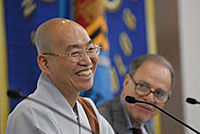
Inside North Korea: A Report by Good Friends Chairman Venerable Pomnyun and Seungjoo Baek

Wednesday, October 24th, 2007

pomnyun.jpgInside North Korea: A Report by Good Friends Chairman Venerable Pomnyun and Seungjoo Baek
SAIS US Korea Institute
September 19, 2007


For audio, click here. 

Chairman of the Good Friends Center for Peace, Human Rights and Refugees, the Venerable Pomnyun, briefed audience members at SAIS on current trends inside North Korea, including issues surrounding the current food crisis caused by the flooding, continuing health crisis, and the breakdown of the education system.

Good Friends, one of the largest Korea-based organizations providing humanitarian aid inside the D.P.R.K. and to refugees in Northern China, contributes some of the most accurate and timely reports on conditions inside North Korea. The Venerable Pomnyun visited Washington D.C. with a team of experts to discuss the on-going food shortage and proliferation of non-government controlled information. While here, they briefed Congress and held a day-long conference at CSIS.

Highlights of his comments (paraphrased, not direct quotes):

  • In contrast to the much lower number of famine deaths provided by Stephan Haggard and Marcus Noland Pomnyun maintained the 3 million number claimed by Good Friends in the past.
  • He provided a short narrative of coping mechanisms people have adopted to stay afloat (selling and manufacturing in homes). Society is being sustained by activities that are still considered illegal.
  • He claims the food situation is getting worse, and he does not think the DPRK can resolve the situation on its own.  Now people buy all their food on the market.
  • He claims that people’s lives are not improving.
  • TB is on the increase along with other epidemics.  Since there is no electricity, water is not clean. 
  • He offered that there are four levels of hospitals: clinics at the town level, hospitals in cities and some towns, hospitals at province level, and specialist offices in the Pyongyang area.
  • Hospitals and clinics are not working at the city/province level.  The situation is better in Pyongyang hospitals.  The amount of international medical aid, however, is not enough for even the Pyongyang hospitals.
  • Medical aid is the second most needed good (after food).  People do not get medicines from the hospital, but from the markets.  With low salaries, however, medicines are difficult to afford.  [Because the institutional environment is still not supportive of entrepreneurship] there are qulaity problems with pharmaceuticals purchased at the markets.
  • The education system, though ‘free’ is not functioning well.  Due to the food shortage problem, students do not go to school.  Teachers also do not come to class.  The cost of education is being pushed back to students directly.  For example, students buy chalk for teachers.  As a result, however, poor students cannot attend school.  The rich students are hiring tutors, so we are seeing a market in private education emerge in the DPRK.
  • The DPRK is slowly moving to a private economic system.  Men who cannot get work are now jokingly referring to themselves as “guard dogs,” because they sit at home all day.
  • North Koreans do not trust the government or party.  People on their death beds are telling their children to trust their descendents, not the government.  People still spend much of their time trying to subsist, but these complaints will not become a political issue.  The political system is stable and will not collapse any time soon.
Share

British singer charms North Koreans into a tour

Wednesday, October 24th, 2007

Times of London
10/24/2007
Lucy Bannerman

She is one of the few Westerners to be invited behind the borders of the world’s most secretive state, and is surely the only soprano from Middlesbrough to perform for Kim Jong Il.

Having become an unlikely celebrity in North Korea over the past six years, the opera singer Suzannah Clarke has pulled off perhaps her greatest coup by getting permission to take the state’s national orchestra to Britain. The Times has learnt that plans are under way for 120 musicians to perform at a number of big venues across the UK early next year.

The Foreign Office has already given its support to the project and the search is now on for sponsors.

For the performers, it will be their first experience of the outside world; for Clarke, 38, it will be the culmination of years of work, using her position as the darling of Pyongyang to build close relations with North Korea’s leaders. She said: “This is not an easy project. Two years ago I wouldn’t have had any hope of succeeding. But when I went out there last April, I could feel a change in the air, a warmer atmosphere. This is the first time the North Koreans have ever let their orchestra abroad.

Clarke, who opened the Euro 96 football championships at Wembley, claims that ending isolation is the best way for the West to build relations with the hardline state, which has a dismal record on human rights and is thought still to be holding up to 200,000 political prisoners, and has presided over millions of deaths from famine and economic mismanagement. However, she argued that isolation was not the answer. The idea of a British tour came to her as she watched the orchestra perform during the annual Friendship Festival this year.

As befits the tough standards set by the dictatorship, the musicians displayed the same discipline and technical prowess demonstrated by the thousands of dancers who take part every year in the synchronised gymnastic games marking Kim Jong Il’s birthday. “They played a cheeky medley of tunes – Shostakovich, Mozart, as well as some of their own repertoire. It was powerful, passionate, but funny as well, and I thought, ‘Gosh, British audiences would love this’,” she said.

She is seeking sponsors and dealing with the considerable logistical challenge of arranging transport and accommodation for 120 North Koreans and their chaperones during their visit. “I wake up from mini-nightmares of losing a North Korean on the Tube,” she said.

Supporters include Lord Alton of Liverpool, chairman of the British-North Korean All Party Parliamentary Group and official patron of the project, and David Heather, a British financier who curated Britain’s first exhibition of North Korean art in Pall Mall, this year.

Share

Unemployment Grows as DPRK Businesses Reject Hiring Regulations

Tuesday, October 23rd, 2007

Institute for Far Eastern Studies
NK Brief No. 07-10-23-1
10/23/2007

DPRK authorities are quick to stress that not one single unemployed worker can be found in Socialist North Korea. The truth is, however, unemployment has existed in the past, and now out-of-work laborers are taking on a new form.

With the exception of a small minority of North Koreans, most citizens are assigned professions and dispatched to their place of employment by DPRK authorities with no regard to personal aptitude or skills. This has led to the refusal of some to take assignments in mines, shipyards, and other undesirable factories, creating a group of ‘non-workers’.

However, today’s unemployed are different from the unemployed found in the 1980s and 90s. In the past, these workers refused positions at undesirable factories. In the late 1990s, with the cessation of food rations and lack of job positions, a good number of factories and businesses shut down operations, leading to an increase in unemployment. Now, it is the mines, companies, and yards that are refusing to take on new workers.

Currently, North Korean authorities are tasking managers of organizations and companies with the responsibility of feeding employees. Anyone with the skills and the money can become a manager. Authorities assess whether someone can provide wages and rations for employees, and if so, will put them in charge. However, the order that “Managers not able to carry out the task of feeding [employees] will be released or demoted” has been passed down, putting a considerable burden on executives and managers. As they are now responsible for both the wages and the rations of their employees, these managers are not looking to take on new workers. This is problematic for those dismissed from military service with little or no trade skill, and for those receiving only a middle-school education, especially women. These citizens are turning to trade to provide a living.

Share

South Korea’s Average Life Span 78 years – North Korea’s 64…a 14-year Difference

Tuesday, October 23rd, 2007

Daily NK
Namgung Min
10/23/2007

North Korean civilians’ average life span was disclosed to be approximately 14-years lower than the average life span in South Korea.

The Ministry of Health and Welfare said through inspection documents of the administration on “North Korea’s Health and Medical Situation,” which was recently submitted to the National Assembly.

According to this document, the North Korean civilians’ average life span is 61.4 years for males and 67.3 for females, an average of 64.3 years. For South Korea, the average is 78.1 years, with 74.4 for males and 81.8 for females.

The significant difference in average life span for North and South Korea reflects the fact that the severely worsened medical environment in North Korea.

According to the document, North Korean teenage boys’ smoking rate is supposed to be at an extremely alarming level. In the case of 16-year old males, the smoking rate is around 59.9%. This exceeds by 20.7% the smoking rate of South Korea high school students, provided by the Korean Association of Smoking and Health.

Cigarettes in North Korea, in contrast to South Korean cigarettes, contain a very high level of tar and nicotine content as well as higher toxicity, due to the fact that cigarettes lack filters or are hand-made.

One defector said, “In North Korea, even very young children smoke cigarettes without reservation and easily come in contact with them because they do not have much else to do.”

The document also revealed that 32~40% of North Korea’s 20~34 year olds show signs of malnutrition and approximately 34~36% of them are anemic patients.

These results can be attributed to North Korea’s continuous food shortage situation; disease rates due to malnutrition and anemic are high.

North Korea’s birth rate is 1.94, higher than South Korea’s 1.19. However, the infant mortality rate, between `99~`02, was 23.5 per 1,000 persons, but conversely, the `06 mortality rate was 42 persons, 14 times higher than South Korea’s (at 3 persons).
The health span (a period without sickness or handicap) is 52.3 years old (based on 2000 data), a significant decrease from South Korea’s 67.8 years (in 2005).

The reason why North Korea’s health and medical situation is so tenuous as shown above is due to the lack of the state’s investment in this area. The actual situation is that there is an unmistakable gap between North Korea’s single dollar payment for a person’s health and medical fee and South Korea’s $625.

Further, in North Korea, it is extremely difficult to obtain basic medical goods, such as cold medicine or antibiotics.

One defector who escaped in 2005 said, “In North Korea, even if one wants to go to the hospital, he or she cannot receive treatment without any money and there is not even a full equipment of medicine. It is much easier to buy medicine in the jangmadang than in a hospital, because there is more variety and it is more easily obtainable. Only, the price of medicine, compared to other products, transcends the imagination.”

The Ministry of Health and Welfare plans to invest 294 million won (approx. USD316,120) to modernize the People’s Hospital in Gosung and Songdo in Kaesung next year, besides continuing medical support for North Korea.

Share

Pyongyang No. 1 Senior-middle School, the Best Elite Training Institute in North Korea

Monday, October 22nd, 2007

Daily NK
Yoon Il Geun
10/22/2007

As part of special education policy for the talented, North Korean government established in 1984 Pyongyang No. 1 Senior-middle School, whose education course corresponds to the national curriculum for high schools in South Korea. By 1985, the North Korean regime had finished establishing No.1 Senior-middle School at every seat of provincial government and started a full-scale special education for the gifted.

The competition for No. 1 Senior-middle School is fierce because only those graduates from these schools can get into universities. The No. 1 Senior-middle School is different from the ordinary schools in terms of teaching materials and the quality of teachers. However, there is a huge difference even among No.1 Senior-middle Schools. The best one is Pyongyang No.1 Senior-middle School.

Located in the Shinwon-dong of Bontongkang-district, Pyongyang, Pyongyang No. 1 Senior-middle School has a total floor space of 28,000 square meters, a four-story building for primary school, a ten-story building for Senior-middle school, dormitories, cafeteria, and other accessory buildings. It is surely the best school in North Korea.

The entrance quota is approximately one thousand students with around 300 selected from the countryside. The dorms for these students from provinces have better facilities than the dorms of Kim Il Sung University have.

The predecessor of the present Pyongyang No. 1 Senior-middle School was “Pyongyang Namsan Advanced Middle School,” that Kim Joing Il attended between 1957 and 1960. In those days, the school only received as its students the children of army general, anti-Japanese fighters, the cadres of the central party, cabinet members, and renowned artists or intellectuals. It was “the school for the nobility.”

As part of Kim Jong Il’s policy for special education, the school changed its name into Pyongyang No.1 Senior-middle School. The latter now boasts about having best education and experimental facilities, and prominent teachers. The school buildings which were constructed at a cost of 5.8 million U.S. dollars are very modern. All facilities were imported from Japan including desks and chairs, interior decorations, laboratory tools, reagents, musical instruments, and sports equipment

Also called as Kim Jong Il’s alma mater, the school has a pool of teachers, most of whom are graduates from Kim Il Song National University, Kimchaek University of Technology, and Kim Hyong Jik College of Education. It also has twenty (or so) up-to-date laboratories, an excellent specimen room, and the scanning electron microscope, one which is not available even in Kim Il Sung University.

At the 10-story and its accessory building, there is the “Kim Jong Il Memorial Hall,” which exhibits materials from Kim Jong Il’s school days, and is used for idolization education of Kim Jong Il. Moreover, the school has an auditorium with the sitting capacity of 500 persons, libraries, gyms, swimming pools, dispensaries and a barbershop.

Inside the 10-story building are the principal’s office, the room for party secretaries, teachers’ rooms, classrooms, laboratories, audio-video classroom for foreign language studies, “Kim Il Sung Revolutionary History Study” room, modern computer labs, and a studio fully equipped with Japanese electronic musical instruments.

Those students originally from Pyongyang are mostly the children of the central Party or central ministry members, anti-Japan fighters, army generals, and rich Pyongyang citizens including some Korean-Japanese. Unlike the children of the upper classes, students from the countryside are selected not based on family background but talents. Most of these students are transfer students from provincial Senior-middle Schools. Therefore, there is a stark contrast between less qualified students from affluent Pyongyang families and highly talented transfer students from not–so- rich families.

The students from provinces display real talents.

In fact, it is these transfer students from provincial No.1 Senior-middle School who really raise the prestige of Pyongyang No.1 Senior-middle School. For the most time, it is them who won awards at the International Math Olympic or computer tournament, or achieve academic success later in college.

Apparently, Pyongyang No.1 Senior-middle School serves two purposes. It is both an aristocratic school for the upper-class children and a special school which offers education for the gifted and produces the most brilliant men in North Korea.

As the most elite school, Pyongyang No. 1 Senior-middle School values not only science and technology education but also art and physical education. This is what makes Pyongyang No.1 Senior-middle School different from other provincial No.1 senior-middle Schools. The physical education program emphasizes activities such as basketball, swimming, and apparatus gymnastics (horizontal bar, parallel bars), and offers lessons of boxing, soccer, and table-tennis. It is mandatory to make swimming lesson two times per week. In addition, the music education program offers classes such as singing and composition course, and electronic piano lessons. There are also music bands in the school.

As a result of the broad-based curricula of Pyongyang No.1 Senior-middle School, the graduates of this school are taller on the average than their counterparts from No.1 provincial Senior-middle Schools, and display better performance at physical and music education. The self-confident students of Pyongyang No.1 Senior-middle School are also good at dating.

On the streets in Pyongyang, people can easily spot schoolboys with school badge of Pyongyang No.1 Senior-middle School flirting with school girls from No.1 or No.2 Geumsung School Special Art Schools.

Thanks to Kim Jong Il’s favoritism, Pyongyang No.1 Senior-middle School enjoys many kinds of privileges. In 1997, the students received exemption from military service. Furthermore, they have great advantage over the students of No.1 provincial Senior-middle Schools in obtaining the nomination letter needed to get into top universities,

When it comes to entering into Kim Il Sung University, each No. 1 provincial Senior-middle School is allowed to write about 5~9 nomination letter whereas Pyongyang No.1 Senior-middle School can write about 80~90. Similarly, the provincial schools can write no more than 1~2 nomination letters for Pyongyang Medical School whereas Pyongyang No.1 Senior-middle School can write 20~30 nomination letter. Almost all students who graduated from Pyongyang No.1 Senior-middle School go to top universities. Those graduates who were poor at school performance go to Pyongsung College of Science.

The graduates from Pyongyang No.1 Senior-middle School also enjoy special treatment in their universities. They are more likely to be selected as student leaders and to receive attention from professors. As Kim Jong Il’s alma mater, Pyongyang Senior-middle School No.1 draws national attention and support. It is surely the best elite school in North Korea.

Share
