The Keyword for the Best Husbands Is “Foreign”

July 16th, 2007

Daily NK
Park Choel Yong
7/16/2007

In Chosun (North Korea), free dating between male and female students is prevented during middle school years and even in college. If an unmarried man and woman are walking down the street arm in arm, then they have to worry about the glare of passersby. However, marriage from dating is a gradually increasing trend, but most of the time, people marry through arranged marriages.

Before the period of the food shortage before 1990, the best husband material was males who “had joined a party, performed military service, and graduated from college.” However, since 2000, a huge shift has taken place in the mentality of people.

Lately, three levels of husbands have been common. The first level is males who are included in the following three categories: those who frequently go abroad, those attend foreign-currency earning companies, and those who have high possibility of going abroad.

The second level is those who have parents who are high-ranked leaders or come from a wealthy background. The third level is those whose parents do not have power, but as individuals, are smart enough to finish military service, join the party, are able to support themselves through college.

Males, who are not classified in these categories, select as spouses females who belong to similar categories. However, even if the classes are divided as such, males who earn a lot of money are inevitably the most popular.

The candidates for No.5 Department of the Party are special-grade women

If one looks at the basis for which brides are chosen in Pyongyang, the first level are those whose parents have power and come from an affluent family. Nowadays, there are provincial men who, thanks to the spouses’ family, who succeed by achieving the status of a Pyongyang citizen.

The second level is female college graduates, whose parents may not have authority, but the individual is smart and can make a living by herself. Of course, a woman cannot do better than graduate from Kim Il Sung University, Pyongyang Foreign Language University, or Pyongyang Medical College. Historically and now, women who graduate from the College of Education can work as a teacher is still an admirable bride material.

The third level is those whose parents do not have power, the household is not too affluent, and the woman did not graduate from college, but she has a strong will of survival so can conduct business well. In Chosun nowadays, women who cannot do business are not popular among the men.

However, above power, education level, and money, is a class which is counted as a special level of women among all the men. They are those whose appearances are superior that they are selected into the No.5 Department of the Party, or are actors, dancers, or singers. The No.5 Department’s females work as phone operators or as Gippeumjo (pleasure-givers, special entertainers just for high-ranking officials) of high-level leaders and should quit once they reach 25. Afterwards, they are acceded to the party, are married to military commanders of the Escort Bureau or party leaders, and enter married life and a house which have been prepared for them.

The No.5 Department of the Party is a division, which is charge of Kim Il Sung’s food, clothing, and shelter and every aspect of his private life.

A refined marriage of mutual exchange of vows and pouring drinks at home

Once the marriage partner is selected, the parents select the date of the engagement ceremony. There are differences by province, but as a whole, the groom’s side of the family prepare deok (rice cakes) and food on the day of the ceremony and go to the bride’s home. On engagement day, the parents choose the wedding date.

The wedding clothes do not require a large sum of money. The men wear suits and women can prepare traditional Chosun dresses.

Japanese-Koreans who have returned to Pyongyang wear Western-style wedding clothes, which are rarely seen, and marry. In the past, Chosun period receptions and wedding attires, invoking the national tradition, were popular, but recently, they have completely disappeared.

The wedding is first conducted at the bride’s house. The wedding itself is the exchange of Korean drink glasses at the feast table and after the exchange of bows, the ceremony ends by pouring the drinks to both sides of parents and giving bows. Then, on the next day, the party leaves for the groom’s house. There, the same ceremony is conducted. Three days later, food is prepared and the bribe’s house visits take place.

In big cities such as Pyongyang, large-scale weddings can take place. First of all, cars that are brought to the wedding vary. In Chosun, it is not easy to acquire cars, but people choose high-scale cars anyways. In the house of upper-level leaders, several cars are mobilized.

For wedding photos, the Mansudae Arts Theater is the Best

Post the wedding ceremony, people ride rented cars and offer flowers and take ceremonial photos at the Kim Il Sung statue. They ride the car once more and take photos at various places and of statues in Pyongyang City.

The Party Foundation Commemorative Tower, the 5.1 Stadium, the Juche Ideology Tower, etc. are the major photo sites. There are political reasons for seeking out these sites, but they are also the most-decorated facilities in Pyongyang, so the pictures come out beautifully.

When one has a wedding, they have to report the marriage, carrying citizen registration cards, within a set time at the police station of jurisdiction. The bride and the groom, at this time, have to simultaneously read aloud the wedding oath.

The wedding oath pledges devotion to Kim Jong Il and as a cell of society, diligent leadership of the family, trust and reliance on each other, and walking the single path of revolution together.

In agricultural districts, the farmers do not even properly receive crops, so since they do not have anything to eat, they do not like going to the farm to work. However, the unmarried women, once they are engaged, are freed from going to the farm to work. Once there is an engagement ceremony, the woman is classified as a housewife who can receive 300 grams of provisions per day, so they are no longer required to go out to the farms and can wholly go into selling.

Thus, the young women in rural villages do not pay too much attention to the appearance or background of the grooms and in many cases, they become engaged as soon as they meet a man. Consequently, in the rural region, 19 or 20-year old married females are common. To them, marriage, which should be built on mutual love and faith, are considered as asylums for being freed from difficult labor.

Share

N. Korea Shutters Nuclear Facility

July 15th, 2007

Washington Post Foreign Service
Edward Cody
7/15/2007; Page A01

Move Follows Delivery of Oil; U.N. Team to Verify Shutdown

After four years of off-and-on negotiations, North Korea said it began closing down its main nuclear reactor Saturday, shortly after receiving a first boatload of fuel oil aid.

The closure, if confirmed by U.N. inspectors, would mark the first concrete step in a carefully orchestrated denuclearization schedule that was agreed on in February, with the ultimate goal of dismantling North Korea’s nuclear weapons program in exchange for fuel and other economic aid, and increased diplomatic recognition.

More broadly, it constituted the first on-the-ground accomplishment of six-nation negotiations that have been grinding away with little progress since 2003 under Chinese sponsorship. The talks — including North and South Korea, Russia, Japan, the United States and China — are likely to resume next week in Beijing to emphasize the parties’ resolve to carry out the rest of the February agreement and eventually create a nuclear-free Korean Peninsula.

“We welcome this development and look forward to the verification and monitoring of this shutdown by the International Atomic Energy Agency team,” said State Department spokesman Sean McCormack, referring to a 10-member team of U.N. inspectors who flew into North Korea earlier Saturday.

Assistant Secretary of State Christopher R. Hill, the chief U.S. negotiator, warned reporters in Japan, where he was visiting in anticipation of the new talks, that moving forward into further denuclearization would probably prove as difficult as the previous four years of discussions. Given the track record, which includes several North Korean walkouts and long standoffs, some Asian and U.S. analysts have questioned whether North Korea’s leader, Kim Jong Il, has genuinely made the strategic decision to give up nuclear weapons after so many years devoted to developing them.

The next steps, as outlined in the accord, would be for North Korea to permanently disable the reactor, a plutonium facility at Yongbyon, 60 miles northeast of Pyongyang, the capital, and to reveal the full extent of the nuclear weapons, nuclear processing plants and stored nuclear material it has accumulated. That would include an accounting of any uranium enrichment efforts, which North Korea denies it has undertaken but which the Bush administration says have been part of the country’s nuclear research.

Uranium aside, U.S. intelligence estimates have said North Korea has extracted enough plutonium from the Yongbyon facility to build as many as a dozen bombs, although it is not known how many weapons the reclusive Stalinist nation’s military has put together. Last October, while the talks were again stalled, North Korea announced it had conducted its first underground nuclear test and henceforth should be considered a nuclear-armed state.

Kim’s government has based much of its power on the military, and possession of nuclear weapons has been described in North Korean propaganda as a matter of national pride. But the thought of nuclear weapons in the hands of Kim and his aides has unsettled his Asian neighbors, including China. As a result, they have persisted in the six-party negotiations despite repeated delays and abrupt changes of position by North Korean diplomats.

North Korea’s decision to go ahead with the Yongbyon closure, for instance, came only after nearly two years of wrangling over about $25 million in North Korean accounts blocked in a Macau bank.

The funds were frozen because of U.S. Treasury Department allegations in September 2005 that they were tainted by money laundering and counterfeiting. After months of insisting the Treasury accusations were a law enforcement matter separate from the nuclear talks, the Bush administration switched positions and promised to get the money liberated, leading to February’s milestone agreement. But several months more passed while Hill struggled to find a banking system that would handle the allegedly tainted money. Ultimately, the funds were transferred out of Macau via the Federal Reserve Bank of New York into the Russian banking system and, from there, transferred into North Korean accounts in a Russian trading bank near the border with North Korea

Diplomats from the six nations have suggested that, should they be successful, the North Korean nuclear negotiations could eventually evolve into a permanent forum for East Asian security cooperation, bringing North Korea into a closer relationship with its neighbors. But as Hill did in Japan on Saturday, they acknowledge they have a long road ahead before anything like that is possible.

Saturday’s announcement, while widely applauded, essentially returned the East Asian landscape to what it was in 2002, when operations had been suspended at the Yongbyon reactor under an earlier deal put together in 1994 under the Clinton administration.

U.S. diplomats said in 2002 that North Korean representatives acknowledged a secret uranium enrichment program — something North Korea has steadfastly denied since then — and the Bush administration stopped the oil shipments that were part of the 1994 deal. In return, North Korea expelled U.N. weapons inspectors, quit the nuclear Non-Proliferation Treaty and restarted operations at Yongbyon.

The North Korean government had made no formal announcement by early Sunday. But a diplomat at the North Korean U.N. mission, Kim Myon Gil, told the Associated Press that the reactor was shut down Saturday and its closure would soon be verified by the U.N. inspectors. The State Department said in Washington that it got official word from North Korea shortly after a South Korean ship pulled into Sonbong, a port in northeast North Korea, with a cargo of 6,200 tons of heavy fuel oil to power generators in the rickety North Korean electricity grid.”

The delivery represented a down payment on a scheduled 50,000 tons of fuel oil aid in return for shutting down the reactor. In all, the February accord promised North Korea up to 1 million tons of oil and other economic aid as it takes further denuclearization steps over the months ahead.

The accord also held out the prospect of improved relations with the United States, which has long been a goal of North Korea. In signing the accord, for instance, the Bush administration undertook to review whether it could remove North Korea from the list of countries said to sponsor terrorism and to engage in diplomatic discussions aimed at dissipating the hostility that remains more than half a century after the Korean War.

Share

Expelled for Watching Videos at Chongjin High School

July 14th, 2007

Daily NK
Park Young Nam
7/14/2007

Even in North Korea, there are special schools for the gifted and talented. In particular, talented students are selected for high schools and special education. The writer also attended a special high school while in North Korea.

I enrolled at an elementary school in `92. Since 3rd I was taught separately and received special education. Under the care of my class teacher, I studied math and nature subjects in detail until 6 o’clock at night.

After completing 4 years of elementary school, I was selected as a representative for Musan and entered Chongjin No.1 High School in April `96. No. 1 high schools are special schools for the talented and are located in Pyongyang and each province.

I arrived at Chongjin No. 1 High School to find many other students as bright as me. On top of that, these students all came from good backgrounds.

Undoubtedly, I was no different. My father worked for the People’s Committee and my mother was a doctor. At the time, my family lived an abundant life and had all the necessary electrical goods such as a TV and refrigerator.

High school days, shirking going to school

Unlike average high schools, we often missed classes and went on day trips. Again, punishment is severe at average high schools but we were not treated to harsh punishment because of our respectable backgrounds. Even if you were caught drinking alcohol on the streets and taken to the police, you were let go once you informed them that you attended “Chongjin No. 1 High School.”

Despite playing like this, I studied very hard at the end of each month in order to sit for the exams. I studied 10 days prior to each exam. During the summer, I could study a lot as the days are long, however in the winter, I couldn’t study because the sun set early and there was no electricity.

The winter was the worst as there was no central heating in the dormitories. Even if you wanted to cook rice, you couldn’t. The moment you placed a heater, which was made with twisted nicrome wire, in the socket and, the dismal light only became dimmer and if you put three of these wires into the wall socket the fuse went out. In the end, I became so frustrated that I shoved a spoon into the fuse socket only to find that it didn’t black out but operated fine.

Expelled for watching a video

That’s how I spent my days at school. Then things began to go wrong from about 4th grade.

In February `99, after I had begun 4th grade and sat for an entry exam for Pyongyang No. 1 High School. I sat for the test with the desire to go to a slightly better school but it ended in failure. At the time, I fell into misery and for a while I went around playing and my grades continued to drop.

In August `99, I went to visit a friend’s home who had come from Hoiryeong with 4 other mates. He had a TV and video player in his home. To be honest, the house had been under inspection by the National Security Agency because of this, but at the time, I didn’t even consider this. We watched three videos at that friend’s home.

I watched the old South Korean drama “Men from 8 Provinces,” and other American movies, “Titantic” and “Six Days, Seven Nights.”

I was alarmed after watching “Titantic” and “Six Days, Seven Nights.” The foreign movies were really enjoyable but what clearly remains in my memory is the thrill I had from simply watching the films. We watched the complete and unabridged version of Titanic, even the scene where the two main characters have an affair in the car. As part of the audience, I found this shocking.

While watching these characters traveling freely in the movie, I thought, why can’t we travel on boats like that and why can’t we play freely like that. It was inevitable that I felt culture shock.

However we were caught and were sent to the detention centre in early October. All 4 of my friends who watched the videos were also caught and we sat in the centre for about 10 days.

I wasn’t even sure what the crime was, but I had a feeling it was because we had watched foreign movies. Whether or not it was because we were young, we were let go after a few beatings with something like a broomstick.

After returning to school, there was no reason for us to be the centre of attention. We didn’t tell anyone where we had been but I think everyone generally knew. At the same time, my grades were really low and in the end I was expelled from school.

From expulsion until arriving in South Korea

Following that incident, I went to live with relatives in Pyongyang for 1 year.

I had a business in Pyongyang. When my mother brought clothes from China, I sold them in Pyongyang. With this money, I bought rice and then made profits by acting as an intermediary and selling the rice to Musan. Compared to Pyongyang, rice was expensive in Musan and as a result, I was able to reap in a lot of profits.

However, I couldn’t continue to do this. I felt bad living with my relatives. In the end, I returned to my home in Musan.

Having returned to Musan, I began to associate with children from the wealthy class and one day heard that they traveled in and out of China and in 2001, I crossed over to China in search of a better life.

I crossed the borders, not because I was hungry or because I was in danger. I was merely worried about my uncertain future and found living in North Korea suffocating. I yearned for a more abundant life.

Currently, I am preparing to enroll at POSTECH. However, for the 5 years since my expulsion, I have not had any opportunity to study while traveling from Pyongyang to China, then Korea. Re-starting my studies is not easy. The time I lost while defecting is such a shame.

Studying is something I had forgotten for a long time. I must acclimatize myself to an education system very different to that of North Korea. Nonetheless, I believe I will be able to do well if I try very hard.

Share

North Korea ready to learn from the outside world

July 13th, 2007

New Zealand Herald (hat tip DPRK Studies)
David McNeill
7/13/2007

North Korea is set to take a potentially giant leap out of the intellectual cold with the construction of a new all-English language university staffed by academics from around the world and teaching the cream of the country’s graduate students.

Construction of the Pyongyang University of Science and Technology is nearing completion on a 100ha plot leased by the People’s Army in the North’s capital. The Army has loaned 800 solders to build the campus, which is largely funded by a network of Christian evangelicals.

North Korean leader Kim Jong Il is believed to have personally ordered the site cleared for use and granted the university the right to hire staff from anywhere in the world.

The university is expected to eventually have 2600 undergraduate and postgraduate students and to help train a new generation of elite business executives and technicians.

The project’s leaders in South Korea and the United States are playing down its potential impact for fear of spooking the North’s jittery authorities, but agree that it represents potentially a seismic shift in the reclusive state’s largely frozen relations with the rest of the planet.

“It will be the country’s first international university,” said Professor Chan Mo Park, co-chair of the university and a prominent Seoul scientist.

“The North has good universities but they don’t communicate with the rest of the world. This will let everyone know that the capacity of their scientists is very high.”

Despite crumbling facilities, Pyongyang’s standards of computer science, software and applied mathematics are world-class, say experts, and its youth are bursting with pent-up business energy. The university is expected to generate spin-off businesses and eventually a Silicon Valley-style business park.

The faculty of 45 will offer an MA in business administration as well as courses on information technology and agriculture to an initial cohort of about 150 students recruited from the country’s top research institutions.

Given the scale of foreign involvement and the money poured into the new campus so far, those involved say they are confident it will open its first research laboratories this autumn and its doors to students next spring.

But the legendary unpredictability of the Kim Jong-Il government could still throw a spanner in the university’s works.

Share

The world according to Pyongyang

July 13th, 2007

Asia Times
Andrei Lankov
7/13/2007

Over the past couple of weeks, the small community of Seoul-based Pyongyang watchers was busy discussing a minor professional sensation. The Wolgan Chungang monthly, widely known for its good insights on all things North Korean, published a lengthy transcript of a speech, allegedly delivered last December, by a high-level Central Committee official. He was obviously talking to a group of prominent academics and engineers. The official’s name is cited as Chang Yong-sun, but he seems to be a complete unknown to the North Korea experts.

The authenticity of the transcript cannot be proved beyond doubt, but the Seoul expert community tends to believe that this tape was indeed secretly recorded somewhere in Pyongyang a few months ago and then smuggled to the South.

Being a former Soviet citizen, this author is inclined to believe this view as well. The tape rings true. This is how a high-level official would talk when lecturing lower layers of elite on the current situation, and such regular lectures were typical for many communist countries.

The semi-privileged met the bigwigs to get instructions on recent events, as well as some alleged insiders’ stories and anecdotes. The semi-privileged cadres felt themselves partaking in the enigmatic world of grand politics, and also learned something about the new trends in their leadership’s thinking about the world.

Most people who deal with “Chang’s lecture” concentrate on those parts of the lengthy presentation that deal with US-North Korea relations and the six-party talks on nuclear disarmament. Indeed, such issues are treated at great length by this document. Many others pay attention to rather unfavorable depictions of the Chinese or outbursts of threats against Japan.

However, I believe that there are more important things in the transcript than merely a North Korean version of what happened during former assistant secretary of state James Kelly’s visit to Pyongyang or during the first rounds of the six-party talks. The tape allows us to have one more glimpse at the world view held by the North Korean elite or, at least, by its lower reaches.

What are the features of the world as seen from Pyongyang? First of all, the significance of North Korea is blown out of all proportion. Somebody would describe this as Pyongyang megalomania, but perhaps author Bruce Cummings found a better term when he talked about “North Korean solipsism”, an assumption that North Korea lies at the center of the world, and that the world itself surely must be aware of this.

The North Korean press now tells its readers that the major international conflict of the modern world is the ongoing struggle between US imperialism and heroic North Korea. Chang Yong-sun even told his audience that the development of North Korean missiles has produced a serious impact on the public-health issues in the US: “Nobody can intercept our missiles now. All the people in the US are aware of this.

“This is why all the people in the United States are completely allergic to missiles of our republic. Once they learn that we test-fired missiles, they become so worried about the rockets changing their directions and exploding over them and killing them, so they develop nervous diseases and nettle rash breaks out all over their bodies. This is what is happening in the United States.”

One should not feel too sorry about the bastards, however. According to the official North Korean world view, once again reiterated by Comrade Chang, the US is responsible for everything that goes badly in Korea, and the constant military threat from the warmongering Washington is the major fact of North Korean life.

The audience was reminded that in 1950 it was the Americans who attacked North Korea, bringing death and destruction to the country (this official version of 1950 events seems to be almost universally believed by North Koreans). This great crime of 1950 has not been avenged yet, Comrade Chang reminded his listeners.

Many people in the US want to believe that such hostility stemmed from President George W Bush’s policies, but Comrade Chang reminded his audience a number of times that there is no real difference between the Republicans and Democrats: both US parties are pathologically hostile to the Country of the Beloved General. The differences between them are of a purely tactical nature, Chang Yong-sun told his audience. He said Republicans rely more on brute force, while Democrats are more canny and more willing to use ideological subversion and economic pressures.

Chang Yong-sun repeated a number of times that the major threat from the US is not that of a sudden military attack. The imperialists are not that simplistic: these days their major weapon is internal subversion. He said: “Although it appears as if the Americans do good things to us, their real nature has not changed at all. Their primary objective is, from start to finish, to undermine us from within and melt us down by disarming us ideologically.”

Chang Yong-sun repeated the message that has been delivered countless times by North Korean leaders big and small: the ideological threat of the outside world constitutes a greater danger than all imaginable military threats. He alleged that the foreign enemies have designed some grand plan of subversion. Chang said specially designated think-tanks work on this issue day and night. If his fantasies are to be believed, one of such centers is somewhere in Washington and employs no fewer than 370 retired generals whose only job is to find ways to undermine North Korea from within.

Being an enthusiastic supporter of soft power, the present author knows perfectly well that there is no coordinated plan of applying soft pressure on Pyongyang. The amount of money and efforts spent on broadcasts aimed at North Korea, on support of refugee groups and other similar activities, is ridiculously small. It is a dream to have a US research center specifically dealing with North Korean issues and stuffed with even, say, five post-doctoral candidates (let alone with 370 ex-generals).

But this raises a question: If this the case, why do Pyongyang politicians keep repeating similar statements? Why do they refer to a non-existent threat? Perhaps because they know what they should be really afraid of. They know only too well how potentially precarious against such a challenge their position is, and they probably cannot even believe that their adversaries fail to appreciate the major vulnerability of Pyongyang and do nothing to exploit the related opportunities. Comrade Chang would be really surprised to learn how weak and disorganized are actual efforts of the “class enemies” in the area that he (perhaps correctly) considers decisive.

Some twists of Pyongyang’s official mindset might come as a surprise to many readers. For example, Comrade Chang found a source of great pride in the North Korean penchant for secrecy. He used one peculiar example to explain why this secretiveness is great. According to him, the Americans defeated the Iraqis because they imitated the voice of Saddam Hussein and then sent fake orders to Iraqi troops in his name.

However, as he proudly reminded everyone, Marshal Kim Jong-il had spoken in public only once, so Americans will never find enough material for their perfidious schemes. The entire secrecy is necessary to keep foreigners at a disadvantage: “A long time ago, the Great General taught us to make sure that our internal things appears to be hazy as if covered by fog when the Americans spy on us. So we have made sure that internal things of our country appear really hazy as if in a fog when our country was viewed from outside.”

It is remarkable that the country’s economic woes are explained in a novel way, which was made possible by the nuclear test. Until 2006, North Koreans were supposed to believe that the only reasons for the recent famine were huge floods that “might happen only once a century”. Now it is admitted that the government needed money for missile and nuclear development, and hence had no other choice but to sacrifice some people to save the nation.

Chang Yong-sun said: “To be frank with you, even if one sells 50 plants as large as Kim Ch’aek Steel Mill, the money is not enough to develop a missile. During the ‘arduous march’ [Pyongyang-speak for the famine of the late 1990s], if there [was] a bit of money, it had to be spent on developing missiles, even though the generals knew that factories did not work and people were starving. This is why we have survived, and were not eaten up by those bastards. Had it not been like this, the bastards would have eaten us a long time ago.”

This line of argument is psychologically more powerful than the earlier version. Nowadays, people’s suffering can be presented not as the result of some blind misfortune caused by nature, but as a part of heroic sacrifice. People died because their country was at war and needed everything to save itself from complete destruction by the brutal enemy. Their deaths were those of heroes.

Such a change of tune is indeed typical of North Korean propaganda during the past few months. However, it might have some political consequences. This propaganda line makes it more difficult to surrender nuclear weapons even if such a notion will ever be seriously entertained by Pyongyang. If North Korea chooses to give up its nuclear arsenal, these sacrifices will be rendered meaningless.

Another propaganda line is that now people should expect a certain improvement of their lot, since the major work has been done: “Now we have conducted a nuclear test and other things, so we have to improve the people’s living standards by concentrating on economic construction.”

Still, Comrade Chang does not want his audience to entertain an excessively optimistic picture of their country’s future. Improvement will be minor and, as one might guess from some other parts of the speech, is likely to be limited to, say, complete reintroduction of Kim Il-sung-era consumer standards, which were not exactly luxurious (550 grams or cereal a day, plus a few pieces of meat on special occasions, four or five times a year).

Chang Yong-sun explained that North Korean industry is surely capable of producing quality consumption goods but cannot do it, because the ever present threat of an imperialist attack deems austerity and sacrifices necessary. He also made clear that his listeners should not await serious improvement of their lot any time soon.

The statement resonates very well with what another life-long analyst of North Korean propaganda, Tatiana Gabroussenko, wrote recently: unlike earlier eras when masses were extolled to make sacrifices for the sake of some identifiable future, nowadays North Korean leaders tell their people that no significant improvement is in sight. Comrade Chang even made a joke of this: “Since the end of the Korean War, we have lived with our belts tightened … One thing I can assure you: we’ll have to live with our belts tightened until the day our country is unified. If we do not have any more holes in our belts, let us make them.”

However, the audience was reminded that in the final count it is again the foreign forces who are to be blamed for these hardships. To quote Comrade Chang once again: “It is not because we do not know how to live better that we are not well off. Who is responsible for this? The US imperialists are responsible for this. That is why we call the US imperialists our mortal enemy with whom we cannot live under the same sky!”

Most of the speech consisted of US-bashing and Japan-bashing, but what about South Korea? Here Comrade Chang used the new tactics that have become typical for North Korean propagandists since the 2002 inter-Korea summit. Brian Myers, another remarkable specialist on North Korean culture and propaganda (not quite distinguishable areas, actually), recently wrote at length about a change of tune in Pyongyang propaganda: South Korea ceased to be depicted as the living hell, the land of depravation. The new image of the South is that of the country whose population secretly (or even not so secretly) longs to join its Northern brethren in their happiness under the wise care of the Beloved General.

This society might be relatively affluent, but it is inherently corrupt and lacks integrity, so its population knows that the only way to regain the moral purity is to join the spiritually superior North Korean civilization. The only force that prevents the South from achieving such happiness is the brutal US occupation army and a tiny handful of traitors on the Central Intelligence Agency payroll, but even those perverts are losing control over South Korean society.

Sometimes Chang’s fantasies went positively wild. He said, for example: “A portrait of the General is [respectfully] placed on the wall of the Main Hall on the fourth floor at the [Seoul] Government Building. Right now!” Then the flight of fantasy goes even further: “These days, South Korean publications do not sell in South Korean society if they do not carry the images of the General … 45% of the entire population in South Korea say that in case of a war they will fight on the side of the General.”

The domestic situation did not attract much of Chang Yong-sun’s attention, but he still made some comments on these issues. He admitted that even last December, in spite of all the government’s efforts, it was impossible to provide rations for the entire population, and that most people had to rely on the market for their needs, which is not good but was unavoidable.

He also explicitly stated that growth of the markets is not compatible with the socialist system: “All the people’s talk is money and again money. Is this socialism?” It is remarkable, however, that the virtues of socialism were seldom mentioned in the speech: its rhetoric was overwhelmingly nationalistic.

Chang Yong-sun also admitted that some North Koreans are very rich, and that their fortunes are now measured as a few hundred million North Korean won (100 million won is roughly equivalent to US$50,000). He did not make a secret that under less critical conditions the government would strike these reactionary elements hard, but under the current circumstances such a radical solution is impossible because of ongoing economic difficulties.

In essence, he admitted that government is not capable of controlling society as tightly as it wishes (or as it used to in the good old days of Kim Il-sung’s ultra-Stalinist rule): “Those ideological perverts are no longer counted as our people. Why are we not able to strike [them]? We are not able to strike them because we are not able to provide rations to the entire population.”

So the picture is quite clear. North Korea as depicted by Comrade Chang is a small but proud state that lives under the constant threat of annihilation by brutal enemies, betrayed by money-hungry allies. It fights for a great goal of national unification. There are signs that this goal is getting nearer, but people should not expect too much: life will not become easy any time soon.

Compromise with enemies is impossible since they, especially the Americans, will never change their nature, will never stop dreaming about destroying the small and proud republic led by the Beloved General. However, the country has finally developed military means that make all enemies’ schemes powerless. This project required great sacrifice, but the people who died during famine were in essence soldiers: their deaths saved many more lives.

There are internal problems in this society, largely because the government lacks resources to make sure things move smoothly (and it is assumed that government should be ultimately responsible for everything). However, these problems should not distort the larger view of ongoing heroic struggle and new victories.

Dr Andrei Lankov is an associate professor in Kookmin University, Seoul, and adjunct research fellow at the Research School of Pacifica and Asian Studies, Australian National University. He graduated from Leningrad State University with a PhD in Far Eastern history and China, with emphasis on Korea. He has published books and articles on Korea and North Asia.

Share

N.K. orders shutdown of karaoke bars

July 13th, 2007

Korea Herald
7/12/2007

North Korea has ordered the closure of karaoke bars in an apparent attempt to stem outside influences on the isolated communist country, AP reported, quoting a South Korean civic group as saying Wednesday.

Separately, the North’s Ministry of People’s Security conducted house-to-house overnight inspections in areas near the border with China earlier this month to search for cell phones and illegal video CDs, the Good Friends aid agency said in a newsletter, according to the report.

It reported that the ministry said in a directive last week that the move against karaoke outlets was a ”mopping-up operation to prevent the ideological and cultural permeation of anti-socialism,” according to the aid group.

Violators were warned they would face punishment, including deportation to other regions within North Korea.

The group did not say how it obtained the information. Its previous reports on the North’s isolated regime have been reliable.

It was not clear how many karaoke bars the country has.

AP said officials at South Korea’s top spy agency, the National Intelligence Service, were not immediately available for comment.

Share

North Korean Restaurants without Electrcity

July 13th, 2007

Daily NK
7/13/2007

Even in North Korea, there are a variety of fine dining restaurants. Of these restaurants the number 1 and finest restaurant catered for Kim Jong Il is located at his private villa. Undoubtedly, the dishes placed on Kim Jong Il’s dining table are nothing less than sumptuous.

Next there is a seafood restaurant in Pyongyang and Hwanggeumbul (golden field) Restaurant which is targeted at foreigners. The Okryu-kwan in Pyongyang is also one of the restaurants reaping in foreign money.

North Korean restaurants of these standards can also be found in foreign countries such as in China, Australia, Vietnam or Cambodia.

Nonetheless, for the majority of North Korean citizens, restaurants such as these are no different to a pot of gold at the end of the rainbow. In North Korea, entering through restaurant doors itself is a special occasion. Further, there aren’t many restaurants with formal entrances hence it is rare that common people enter restaurants.

The average North Korean eats from the restaurant visible in this footage. The restaurant looks rather empty.

Though this is a restaurant, there are only 3 tables. Nonetheless, this is a place where North Korean people can go to fill their hunger. It seems that a person ordered a bowl of noodles as the waitress delivers a large tray of food.

There aren’t many side dishes. Nevertheless, a grandfather and grandmother eat their food with gratitude.

Electricity is not available regularly in North Korea. Hence, there does not seem to be any globe as such on the ceiling to even provide light. Electricity in North Korea is yet another dire issue.

Many people boast of Pyongyang to be a glamorous and fashionable city as there are many beautiful workers and numerous catchy restaurants.

Though there are restaurants where you can have a bowl of rice soup and radishes, there is another need to address the issue that dining five times at such simple restaurants would cost a person a whole months wage.

Free North Korea Broadcasting, a broadcast operated by defectors has been broadcasting 10 part series on the lives of North Korean people. The video footage was filmed last August by an inside source in North Korea.

Share

Oil Is Shipped to North Korea Under Nuclear Shutdown Pact

July 13th, 2007

NY Times
CHOE SANG-HUN
7/13/2007

A South Korean ship loaded with 6,200 tons of heavy fuel oil left for North Korea on Thursday under an agreement intended to end the North’s nuclear program.

The United Nations’ chief nuclear inspector said the North was expected to begin shutting down its main nuclear facilities early next week, after four and a half years of operation, during which time enough plutonium was thought to have been produced to make several atomic bombs.

The ship is expected to arrive at Sonbong, a port in northeastern North Korea, on Saturday, the same day a team of inspectors from the United Nations International Atomic Energy Agency is scheduled to arrive in the North to monitor and verify the shutdown.

Mohamed ElBaradei, the director general of the atomic agency, told reporters in Seoul that shutting down five nuclear facilities in Yongbyon, 62 miles north of Pyongyang, the capital, would not be difficult and should be completed “within maybe a month or so.” His agency and North Korea have already agreed on the procedures.

The shutdown would be significant because it would halt the North’s only declared program for producing fuel that can be used in nuclear weapons. The five facilities to be frozen in Yongbyon, including the country’s sole operating nuclear reactor and a radiochemical laboratory, can yield more than 13 pounds of plutonium a year, enough for one atomic bomb, according to experts.

But the steps to be taken after the initial freeze of the nuclear program remain “very much open questions,” Dr. ElBaradei said. Those include whether North Korea will provide the agency with a complete inventory of its nuclear materials, and when it might return to the Nuclear Nonproliferation Treaty.

“It’s going to be a very long process,” he said. “It’s going to be a complicated process. How smoothly the rest of the operation will go very much depends on how progress will be made in six-party talks.”

Chief envoys to the six-nation nuclear talks will meet in Beijing next Wednesday and Thursday, the Chinese Foreign Ministry said. The envoys, gathering for the first talks since March, were expected to discuss moves beyond the reactor shutdown.

North Korea agreed to shut down its Yongbyon facilities in a February agreement with the United States, South Korea, China, Russia and Japan. The deal called for shipping 50,000 tons of fuel oil to North Korea, and South Korea volunteered.

It plans to complete shipping the oil by early August, starting with the installment on Thursday.

North Korea indicated last week that it would undertake the long-delayed shutdown after the first shipment arrived.

When United Nations inspectors return to Yongbyon, they will face the same problems they had faced there before they were expelled in late 2002. They will put in seals, install cameras and leave monitors to ensure that the facilities remain shut. But they will not be allowed to collect samples or access North Korean data, much less travel around the country, to determine how much nuclear material North Korea has produced in Yongbyon or elsewhere.

The five-megawatt reactor in Yongbyon began operating in the mid-1980s. When suspicions about North Korea’s nuclear activities emerged in the early 1990s, a key dispute was how much plutonium had been produced at Yongbyon until then — 90 grams, about 3 ounces, as North Korea reported to the I.A.E.A., or up to 10 kilograms, about 22 pounds, as the agency suspected.

The dispute has never been resolved, although North Korea agreed to suspend operations at Yongbyon in an agreement with the United States in 1994. The accord collapsed in late 2002, when North Korea expelled the United Nations inspectors and restarted the Yongbyon operation.

North Korea has since claimed to have taken spent fuel unloaded from the reactor and reprocessed it into plutonium. Last October, it conducted its first nuclear test.

“It remains an unanswered question: how much plutonium has North Korea so far produced?” said Lee Un-chul, a nuclear scientist at Seoul National University. “North Korea won’t easily give up its operational data.”

Share

The North Korean Rice Price Narrowly Increased after the Spring Shortage

July 12th, 2007

Daily NK
Kim Young Jin
7/12/2007

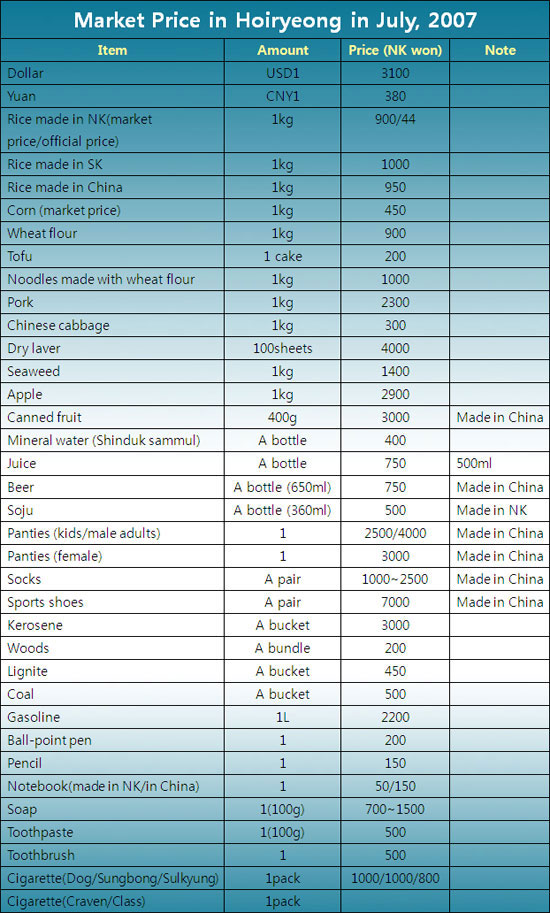
prices.jpgThe North Korean jangmadang’s (market) rice price has narrowly increased after the spring shortage season.

As a result of DailyNK’s investigation of price levels in Northern cities of North Korea at the end of June and beginning of July, the price of North Korean rice is 900 won per kilogram which has increased 80 won compared to its price at the end of March.

At the jangmadang in Shinuiju, North Pyongan, the price of rice, compared to three months ago, has been sold at a 120 won higher price at 980 won. North Korea’s spring shortage season is around March to May before the barley harvest, after the passage of spring.

The reason why the price of rice has shown a narrow upward tendency of 100 won domestically is that along with the effects of the spring shortage season, the nationwide “farm supporting combat” was implemented last May. During the farm supporting period, the jangmadang was closed out, so it became difficult to obtain rice.

Further, with the delay in South Korea’s support of 40,000 tons of rice to North Korea, the increase in the price of rice seems to have been fueled. The price of South Korean rice, compared to the end of March, increased over 150 won. South Korean rice was sold at the increased price of 1,100 in the Shinuiju region.

Along with the increase in the price of rice, the exchange rate seems to show a slight increase as well. In Hoiryeong, it increased by 50 won, compared to the end of March, according to the basis of 3,100 won per dollar. The Chinese Yuan was sold at a 390 won line, having increased 20 won.

Besides this, the staple of North Korea’s lower-class, corn, compared to the end of March, increased by approximately 80 won to 450 won per kilogram. With the rise in the price of rice, the demand for corn as a substitute ration seems to have increased as a result. Frozen pollack, which cost 4,000 won per one, went down to 3,500 won.

Chinese-made shoes, compared to March, is being sold for 7,000 won per pair, having decreased around 5,000 won. In addition, the price of Chinese industrial products as a whole is showing a decline.

Due to North Korean merchants who received goods through Korean-Chinese peddlers in the past going over to China themselves and obtaining goods through dumping, the drop in prices has been continuing.

Pork (2,300 won per kg) or cabbage (300 won per kg) and the price of other vegetables, compared to the end of March, declined by 200 won. In the case of fruits, the price of apples skyrocketed by 1,400 won from three months ago to 2,900 won per kilogram.

Also, among North Korean cigarettes, a product with the brand “Dog” recently surfaced. The price is the same as “Sunbong” at 1,000 won. The representative foreign brand “Craven (called ‘Cat’ in North Korea)” narrowly declined to 1,300 won.

Cost of DPRK grains up as lean season continues
Institute for Far Eastern Studies (IFES)
NK Brief No. 07-7-16-1
7/16/007

The results of a general survey of market prices in the northern region of North Korea carried out by the “Daily NK” show that grain prices continue to rise. The survey, taken from the end of June to the beginning of July, showed that the price per kilogram of domestic rice was 900 Won, 80 Won higher than at the end of March. Sinuiju market prices have risen 120 Won over the last three months, with rice now selling for 980 Won per kilogram.

The ‘lean season’ in North Korea runs from the spring and lasts 3 to 5 months into the summer until barley crops are ready for harvesting. The rise in rice costs by around 100 Won appears to be due to a combination of factors, one being the influence of the lean season, and another being the mobilization of city residents to farming communities to help with harvesting. During harvesting season, markets are closed as workers are sent to the fields, making it difficult to purchase rice. In addition, the decision by Seoul to delay delivery of 400 thousand tons of aid has further aggravated the situation. The price of South Korean rice in the North has also risen, up 150 Won since March in some areas, and up as much as 250 Won in Sinuiju, where a kilogram of ROK rice sells for 1,100.

The rising cost of rice is fueling demand for substitute grains, causing their prices to rise as well. Corn, a staple food for low-income DPRK families, has risen 80 Won since March, to now sell for 450 Won per kilogram. In addition to rising grain prices, currency exchange rates also appear to be on the rise. In the city of Hyeryung, one USD is worth 3,100 Won, 50 Won more than in March. The Chinese Yuan has risen 20 Won, and now trades for 390 Won.

On the other hand, the prices of some goods in the markets are falling. In particular, Chinese goods are becoming more available, thus lowering costs. Chinese shoes have fallen to 7,000 Won, 5,000 Won less than the price in March. Previously, goods were brought into the country only through Chinese-Korean cross-border traders, but now North Korean vendors have direct access to Chinese goods being ‘dumped’ in the North, causing their prices to continue to decline.

Share

North Korea Sells Fishery Licenses in Chulsan’s Coastal Sea to China

July 11th, 2007

Daily NK
Yang Jung A
7/9/2007

A North Korean insider source said on the 5th that the North Korean government sold the fishery licenses of coastal waters at Chulsan, North Pyongan during the crab catching season between May and July for a moderate price.

Chinese marine traders who bought the fishery licenses from North Korea are large marine companies based on Donggang in Lianoning.

The ship-owners and fishermen of North Korea, due to a huge decline in fishes with the Chinese ships’ competitive entry into Chulsan’s offshore waters after receiving the North Korean government’s fishery licenses, are supposed to be going through a hard time.

The source said, “Recently, with the exclusion of the neighboring sea off the coast of Chulsan near the People’s Army’s marine head where the fish farms are located, the fishery licenses to the offshore of the Chulsan-Donggang (China) have been sold to Chinese businessmen. Tens of Chinese fishermen have bought the rights.”

The source said, “The organization in charge who has issued the fishery licenses is not the marine products association, but the No. 64 naval squadron in charge of the this region’s seashore boundary.

Donggang in Liaoning in China located in the mouth of Yalu River, is a small-size city across from Bidan Island.

He said, regarding the price of the fishery licenses, “A small boat is 1,000 Yuan (US$133) per day and a large boat which can accumulate over 100 ton is around 7,000 Yuan (US$ 922) in Chinese currency.”

He added, “The rumors say besides the costs of the licenses, a lot of money has been handed over to North Korea in the negotiations process.”

“Due to monopolizing of the Chinese fishing boats, North Korea’s ships anchored at decks of Donggang are barely seen. North Korean businessmen who have smuggled marine products using small-size boats are having a difficult time because they cannot go out to sea where the current is rough and a lot of gas is required.”

North Korea’s fishermen are saying they have no choice but to go out to the far sea, because they cannot go near the oceanic region operated by Chinese ships.

The source also said, “Chinese ships surreptitiously attacking North Korean ships in their permitted region and beating people have been occurring frequently.”

The Korea Martime Institute, in a report which was announced early this year, said, “The C
hinese government is promoting advancement of North Korea’s operations when the complaints of the country’s fishermen climaxed due to the reduction of ships in the Yungeun Sea and the decline in their income.”

On one hand, besides the oceanic operation rights, the situation is that China’s direct investment in North Korea’s resource development, such as the mining rights being handed over to China, is increasing.

China, instead of investing 70 hundred million Yuan at Musan Mine in 2005, is exercising its 50-year mining licenses to take 10bn tons of iron ore annually.

Share
