North Korea Tech Transfer

July 20th, 2007

Wall Street Journal
Melanie Kirkpatrick
7/20/2007

Of all the evidence turned up by the U.S. concerning irregularities in the United Nations Development Program’s operations in North Korea, some of the most disturbing concerns the transfer of dual-use technology.

As reported last month, the U.S. has uncovered documents showing the UNDP procured and delivered to North Korea in May 2006 technology that could be used for military purposes: global positioning system (GPS) equipment, a portable high-end spectrometer and a large quantity of high-specification computer hardware. According to packing lists and confirmation receipts, the items were intended for a “GIS” — geographic information system — project.

The equipment “is the type of technology subject to (U.S.) export controls,” says a spokesman for the Commerce Department’s Bureau of Industry and Security, which is responsible for issuing export licenses. So how did it end up in Pyongyang? It would seem more than passing strange that Commerce would have issued the requisite export licenses. The answer is: It didn’t.

U.S. officials, led by Ambassador Mark Wallace at the U.S. mission to the U.N., have spent a year looking into the UNDP’s operations in North Korea. Now, at the request of the State Department, Commerce searched its archives and found no record of any application for export licenses for the GPS, spectrometer or other equipment for the GIS project in North Korea.

Over the past 10 years, Commerce has received more than 200 license applications to export U.S. technology for U.N. projects in North Korea. Of those applications, the UNDP was named in a grand total of two, including one for software for the same GIS project that was equipped last year. That application was rejected.

Previously undisclosed documents show that the UNDP had been trying to equip the GIS project since at least 1999, when the application for an export license for mapping software was denied. Commerce cited concerns over the lack of safeguards in the project that could result in the software being diverted to the North Korean government and used for military purposes.

Yet seven years later, the UNDP procured and transferred sensitive technology to the same, unsafeguarded project — this time without bothering to apply for a license. And while there’s no evidence the UNDP went ahead and purchased the software for which it had been denied a license, that possibility must be considered, since GPS equipment is useless in such a project without mapping software.

The denial notice for “Case Number: Z177037” is dated Sept. 18, 1999. The “consignee in country of ultimate destination” is listed as the UNDP in Pyongyang. The one-page notice is written in prose that is clear and unambiguous: “The Department of Commerce has concluded that this export would be detrimental to U.S. foreign policy interests.”

The 14 items on the UNDP’s wish list were all classified “EAR99,” which means they are subject to Commerce jurisdiction but didn’t specifically appear on the Commerce Control List of items restricted for export. In discussions over the past several weeks with State Department officials, Commerce officials who examined the archives explained their agency’s decision to deny the export license. During the interagency review of the UNDP request, they say, questions were raised about whether the software would stay in North Korea after the UNDP international staff left and whether North Koreans would have access to the software.

Supporting documents show that the answer to both questions was yes. A letter dated April 5, 1999, from the software manufacturer that was seeking the export license on behalf of the UNDP, explains: “The project is supposed to be completed in three (3) years and the software will be left with the state agencies.”

Emails from the UNDP to Commerce offer further information about the UNDP’s security controls — or lack thereof. An Aug. 3, 1999 email from the UNDP’s Shankar Manandhar, in response to a Commerce query, says, “We would like to inform you that the North Korean nationals will have access to the computer in the project office in [the] presence of UNDP staff.” In another email, Mr. Manandhar notes that the software will be “utilized in the project office.”

The Defense Department recommended to Commerce that the application be denied. In a memo dated July 20, 1999, Defense explains that “These items could pose both national security and proliferation issues for the US and allies if diverted to the North Korean military.” Among the list of potential military applications cited are “planning a nuclear weapons infrastructure or missile launch sites.” And, “it could also be used for targeting.” In the end, as one Commerce official explained, since this type of mapping software can be used for military purposes, it was deemed to be “too great a risk of diversion.”

The Commerce official also says the case notes for the denial specify that several earlier licenses granted to the UNDP in North Korea had been conditioned in such a way that no North Korean nationals were to have access to the licensed items. Oh, really? Based on the UNDP’s replies to Commerce’s questions regarding the 1999 application, the official says that the licensing officer at the time believed it was “highly likely” that the UNDP was violating the terms of its previous licenses by allowing North Koreans access to licensed items. We now know — as confirmed by the U.N.’s preliminary audit of the UNDP’s North Korea operations — that the agency’s local staff were Ministry of Foreign Affairs employees assigned to the UNDP by the government.

It’s also worth noting the year these events took place: 1999. That is, the denial notice originated in Bill Clinton’s Commerce Department, part of an administration that was “conducting a one-sided love affair with North Korea,” in the felicitous phrase of Christopher Cox, then a Republican congressman closely monitoring Asian issues. On Sept. 17, 1999, the day before the issuance of the denial notice, the administration announced it would ease economic sanctions on North Korea. But approving the sale of sophisticated mapping software was a bridge too far even for the Clinton administration.

Since the U.S. went public in January with evidence of the UNDP’s lack of oversight of its programs in North Korea, the agency hasn’t exactly been forthcoming. At first, the UNDP denied that it had purchased dual-use equipment for North Korea, referring instead to “rice husk removers” and “plotters to help the [Korean] authorities more accurately produce maps for environmental monitoring.”

Next it look the line that the GPS equipment, portable spectrometer and computers delivered in May 2006 “do not represent state-of-the-art technology,” as Ad Melkert, the No. 2 UNDP official, put it in a June 28 letter to Zalmay Khalilzad, U.S. ambassador to the U.N. An annex to Mr. Melkert’s letter describes the technology as “not high-end or sophisticated” — an assessment at odds with the representations of the manufacturers. Trimble, for example, maker of the GPS GeoXT Handheld sent to North Korea, describes its product as having “a powerful 416 MHz processor running the most-advanced operating system available.” Mr. Melkert says in the annex that the UNDP is investigating “whether the vendors [in the Netherlands and Singapore] were required to obtain export permits for these items” — which sure sounds like an effort to shift responsibility.

Since January, when the U.S. concerns were made public, the UNDP has pulled out of North Korea and the U.N. audit has confirmed extensive violations of U.N. rules regarding hiring practices, the use of foreign currency and site inspections. The latest U.S. revelations raise far more serious questions about the UNDP’s oversight. Under the most generous interpretation, the agency was negligent of its legal responsibilities to keep dual-use technology out of a country that is on the U.S. list of terror-sponsoring states. At worst, it deliberately transferred the technology, knowing it was breaking U.S. law and helping to strengthen Kim Jong Il’s military dictatorship.

These questions — and many more concerning the UNDP’s record in North Korea — highlight the need for an independent, external inquiry of the UNDP’s programs world-wide. The U.S. first went public with its concerns in January, after months of pressing the UNDP for more transparency. If anything, as the latest U.S. evidence shows, things are worse than anyone thought.

Ms. Kirkpatrick is a deputy editor of the Journal’s editorial page.

Share

Int’l Red Cross to continue N.K. aid on containing measles

July 19th, 2007

Korea Herald
7/19/2007

The international Red Cross will continue to help North Korea in treating measles-related illnesses, including medicine aid, the organization said Wednesday in its program update, Yonhan News Agency reported.

In the first phase of a joint immunization plan, the International Federation of Red Cross and North Korea campaigned to vaccinate 6 million children between 6 months and 15 years old.

“The DPRK Red Cross and the federation are contributing 10.2 million doses of vitamin A. The federation is also contributing 262,000 doses of ampicillin to health facilities in four provinces for the treatment of measels-related complications,” the update said.

DPRK stands for Democratic People’s Republic of Korea, an official name of North Korea.

Share

EU Rejects Inter-Korean Industrial Zone

July 19th, 2007

Korea Times
7/19/2007

The European Union shunned South Korea’s request to include goods made in an inter-Korean industrial park in North Korea in a potential free trade agreement between the two sides, Seoul’s chief negotiator said.

South Korea launched free trade talks with the 27-country economic bloc in Seoul in May, only a month after it successfully concluded similar trade talks with the United States. A second round of South Korea-EU free trade talks began in Brussels on Monday.

“The EU side told us that it’s difficult for trade negotiators to deal with the Gaeseong issue because it’s complex legally and politically,” Deputy Trade Minister Kim Han-soo told reporters on the third day of the five-day negotiations this week, referring to the South Korean-built industrial complex in the North Korean border city of Gaeseong.

But the EU left open the possibility of a compromise, depending on the progress both sides will make in upcoming meetings, Kim said.

Before the second round began, Kim had expressed optimism over the Gaeseong issue.

“The Gaeseong issue is one of our top priorities. So we will keep pushing the EU to accept our request,” he said.

South Korea considers the industrial park, located just north of the world’s most heavily fortified border, to be a model for inter-Korean economic cooperation. About 15,000 North Korean workers are employed by 23 South Korean companies, producing garments, kitchenware and a number of other goods.

The industrial park is one of the prominent symbols of inter-Korean reconciliation efforts following a landmark summit in 2000 between then South Korean president Kim Dae-jung and North Korean leader Kim Jong-il.

The Gaeseong matter was one of thorniest issues during the 10 months of tough negotiations between South Korea and the U.S., but the two sides made an artful compromise, allowing them to discuss the issue later, depending on progress in international efforts to dismantle the North’s nuclear weapons program.

Kim and his European counterpart, Ignacio Garcia Bercero, director of bilateral trade relations at the European Commission, are leading the negotiations to move a deal forward between South Korea and the EU.

This week’s talks were centered on the pace of tariff reductions on automobiles. The EU asked South Korea to phase out its 8 percent tariff on auto imports within three years, instead of the seven years suggested by Seoul. according to a South Korean delegate who asked not to be named.

Other potential sticking points in the negotiations are South Korea’s protective pharmaceuticals and cosmetics markets. In addition, the EU wants better access to South Korea’s services market, particularly for law firms and hospitals, Kim said earlier.

Some progress has been reported, as the EU agreed to soften its anti-dumping rules for South Korean goods.

“So far, talks have been underway at a pace that we expected,” Kim told reporters. However, he admitted this week’s negotiations were aimed at clarifying each side’s positions, rather than bargaining.

No discussion was held on the agriculture sector. South Korea initially offered to exclude some 250 agricultural products such as rice, pork and chicken.

Officials at the EU delegation were unavailable for comment.

The EU is the second-largest trading partner of South Korea, with US$79 billion in bilateral trade in 2006. Unofficial studies suggest a deal would boost the figure by as much as 40 percent.

A third round of talks was scheduled for September in Brussels.

Share

Former Hyundai Asan head begins overland trade with N. Korea

July 18th, 2007

Yonhap
Lee Joon-seung
7/18/2007

A company run by the former head of Hyundai Asan Corp. said Wednesday that it will import agricultural products from North Korea that could open full-fledged overland trade with North Korea.

Acheon Global Corp. said it will import three truckloads of fernbrake, fatsia shoots and dried noodles made from buckwheat and arrowroot on Thursday.

Share

N. Korea keeps South Koreans away from downtown Kaesong

July 18th, 2007

Yonhap
Sohn Suk-joo
7/18/2007

North Korea Wednesday banned a tour of downtown Kaesong by South Koreans in an apparent protest against Seoul’s decision to scale down a Buddhist pilgrimage program to an ancient temple there, sources here said.

North Korea closed off downtown Kaesong to South Koreans in retaliation for the South’s refusal in July 2006 to allow the North to change its South Korean business partner for tours of the city. But since January, it has opened the main street of the medieval capital city to South Korean officials and tourists off and on.

On Wednesday morning, North Korean authorities did not allow some 60 Woori Bank officials to tour the heart of the city, and canceled a scheduled trip by South Korean financial supervisory officials to Kaesong the following day, according to the sources.

“According to industry sources, the North’s measure comes as a result of the South’s limiting of a pilgrimage program to Yongtong Temple,” said Kim Kyu-cheol, president of the South-North Forum, a civic group for inter-Korean economic cooperation.

The South’s Unification Ministry limited the number of pilgrimages to once a month, even though the North agreed to an unconditional number of pilgrimages to the restored temple as long as it could charge each tourist US$50.

Cheongtaejong, one of South Korea’s major Buddhist orders, also protested the decision, saying it would limit freedom of religion as many Buddhists are waiting to make a visit.

The government decision was made after North Korea requested a new deal on its tour business in 2005. The North wanted an agreement with Lotte Tours Co. despite having exclusive contract with Hyundai Asan, operator of the Mount Geumgang tours.

The South Korean government rejected the North’s request, saying the change could happen only if Hyundai Asan voluntarily pulls out of the business.

Share

NK Shuts Down 4 More Nuclear Facilities: ElBaradei

July 18th, 2007

Korea Times
7/18/2007

North Korea has ceased operations of four more nuclear facilities after closing Saturday its key nuclear reactor that produces weapons-grade plutonium, the chief of the U.N. nuclear watchdog said Wednesday.

“We have verified all the five nuclear facilities have been shut down,” Mohamed ElBaradei, head of the International Atomic Energy Agency (IAEA), was quoted as saying in Kuala Lumpur, Malaysia, by the Associated Press.

He said some of the facilities have been sealed by IAEA inspectors who are currently staying in the North to verify the shutdown and disablement of the North’s nuclear facilities.

His remark comes as a new round of six-party talks on North Korea’s nuclear disarmament is set to resume in Beijing Wednesday afternoon.

The talks involving the two Koreas, the United States, China, Japan and Russia are supposed to deal with disablement of the North Korea’s nuclear facilities and the North’s declaration of all of its nuclear programs under the second phase of a February agreement.

Share

North Korean Elections Slogan “Everyone vote in agreement” Still the Same

July 18th, 2007

Daily NK
Shin Joo Hyun
7/18/2007

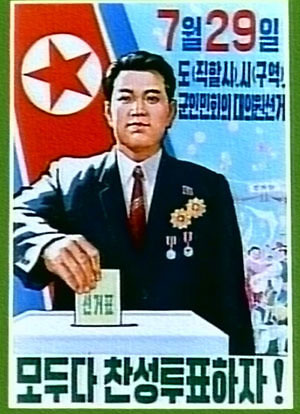
DPRK vote.jpgChosun (North Korea) Central TV, with the Local People’s Assembly representative elections ahead on the 29th of the month, reported on the 14th that a poster with the election slogan, “Let everyone vote in agreement,” has been produced.

North Korean Local People’s Assembly elections is a process of electing People’s Assembly representative at the province and the city under the direct control of the central government, and general cities, gun (county levels) and districts. At the election held in August 2003, 26,650 delegates were elected to the local People’s Assembly representative.

All elections at each unit of North Korea take place by each sole candidate coming forth and people voting for or against him or her. The nomination of candidates takes place by the elections party committee, who selects the candidates before the fact, and each level of organizations.

When the election date is publicly announced, events or meetings are held to encourage the approval votes of each People’s unit, civil organizations, or organs. Not only election slogans to encourage votes, but political slogans also emerge, such as “Let’s shine the military-first politics even more through participation of the populous.”

Mr. Lee, who defected to South Korea in 2004, said, “The National Security Agency tries to instill fear among the citizens by spreading rumors such as ‘So and so of a certain region voted in disagreement, so the entire family was banished. If one does not vote, he or she becomes special object of inspections.’ I did not know this there, but when I came here, I realized they were groundless acts of propagation to encourage approval votes.”

On the day of elections, if one enters the voting place, the citizens registration card is confirmed and people form lines to enter the voting area. Failure to participate in the voting is the same as being classified as anti-revolutionary persons.

In the case that one votes in agreement with the candidate, he or she can drop the voting paper in the voting box. Only in the case of disapproval can one enter the polling booth and mark X with a pencil. In reality, it is a public vote without the assurance of secrecy because the person in disagreement can be identified right away.

At the time of a vote of disagreement, the person is taken to the National Security Agency and undergo severe interrogations and is classified as a anti-revolutionary person, so no one dares to disagree. In the view of South Korean, we can become incensed about the fact that and ask ‘how can elections be so undemocratic?’ but to North Korea citizens, this is such a natural fact.”

As a result, North Korean elections are an election in words, but has a different dimension from our elections. In North Korea, the dimension of testing political character and understanding civilian population is much stronger than the meaning of electing representatives. In actuality, it is a political event to seize citizens.

With this year’s elections approaching, the inspections of North Korean borders and maritime has become much more strict and the issuance of permits for relocation has become more difficult. By doing so, means to restrain relocations have actually been implemented.

When elections end in the North, there is no special announcement on the result. Korean Central TV only reports the expected results in a lump, such as a 99.9% voting rate and a 100% approval rate.

Election slogans such as “Let everyone vote in agreement” cannot be abrupt to North Korean. However, such undemocratic election campaigns cannot continue forever by the North Korean authorities. When North Korean citizens realize that slogans to encourage votes of approval is the starting point for a dictatorship and anti-humanitarian politics, North Korea’s quality will change.

Share

North Korean Studies Unpopular

July 17th, 2007

Korea Times
Kang Shin-who
7/17/2007

More and more universities are removing departments of North Korean studies. Since Dongguk University was the first Korean university to establish a major in North Korean studies in 1994, five other universities followed: Kwandong University in 1996, Myongji University and Korea University in 1997, Chosun University in 1998 and Sun Moon University in 1998.

However, three of the five universities no longer offer the major. Chosun University abolished the department a year after its establishment because it could not guarantee jobs for graduates. Sun Moon University will change the department to North Asian studies from next year.

Also, Kwandong University, which is located in Gangwon Province, gave up the studies last year because the school has failed to meet the admission quota over the last few years.

Although students can major in North Korean studies at Dongguk University, the school will recruit only 20 new students for the next academic year, 20 less than the previous year.

Experts say that severe competition on landing jobs has caused many universities to give up North Korean studies. Many of the major hopefuls expect that they could easily get a job at the Ministry of Unification or research institutes for North Korea, but they have not taken advantage of their major. According to a survey by the Korea Research Institute for Vocational Education and Training, only 20 percent of students majoring in North Korean studies said that they are positive about their future, but 40 percent of them said their studies have no future.

While undergraduate schools have seen a decrease in the number of North Korean major students, more graduate schools have opened the studies. Sogang University set up the program at its graduate school in 1990, Kyungnam University in 1997 and Ewha Womans University last year.

Share

Foreign Sales of Drugs Decline, North Korean Citizens Surface as Consumers

July 17th, 2007

Daily NK
Kim Min Se
7/17/2007

Only six, seven years ago, drugs inside North Korea secretly circulated among a portion of the upper-level officials and the specially affluent class, such as Chinese emigrants. Opium or heroine, produced in North Korea, were sold abroad to make foreign currency.

North Korea produces and exports drugs at the national level. Events where North Korean vessels and diplomats, through drug transport or charges of sales, are prosecuted by third-party countries is common. South Korean government, in the midst of North Korea’s breakdown in foreign currency supply in 1998, has deduced at one point that foreign-currency earners through illicit drug sales and illegal activities had amassed 100 million dollars.

From year 1970, North Korea’s drug sales, which secretly began on a small-scale, by the decree of Chairperson Kim Jong Il, rose in reality as a national enterprise and began official productions. In the August of same year, Chairperson Kim named the opium seed cultivation work as “White Bellflower Business.”

Further, he bestowed the appellation, “White Bellflower Hero,” to the person who sold over 1 million dollars of drugs, and ordered, “For the acquisition of foreign currency, export opium on a large scale (information reported by the National Intelligence Service, Lee Jong Chan former Chair at the inspection of National Intelligence Service on November 6, 1998).” As for North Korea’s drug production factories, the Nanam Pharmaceutical Factory in Chongjin and Hamheung’s Heungnam Pharmaceutical Factory are well-known.

Drugs, which are costly to average civilians preoccupied with making a living, were considered as a portion of the special class’ acts of aberration. The North Korean government, besides the foreign-currency earners, strictly inspected acts of drug circulations, so one could not even dream about this as a means of making money.

After the collapse of national provisions, drug sales also increase.

However, the food shortage brought a huge change to North Korea’s drug production and circulation. When the planned-economy system, where the nation was in charge of the provisions, broke down, the citizens started doing sales for survival. In North Korea where means of making money are not abundant, the place where one can smell money is at the market.

The revitalization of the jangmadang (black market) and general markets gave citizens in the cities a certain of opportunity to make a living. Further, they learned the mentality that money is best for survival. The custom began to spread where the citizens went through thick and thin if it meant working at a money-making job. Drugs infiltrated this opening.

Drugs that are most highly circulated in North Korea are philopon and heroine. The center of philipon productions is in Hamheung, South Hamkyung.

Hamheung is considered as a chemical industry synthesis base within North Korea where companies related to the chemistry branch can be abundantly found.

The representative place is the 2.8 Vinyl Chemical Complexes. Besides this, there are Hamheung Chemical Industry College (in its 5th year), the Heungnam Fertilizer Factory, and the Heungnam Pharmaceutical Factory, which are the providers of North Korea’s top chemical researchers.

The reason why Hamheung became the main place of philopon production

The raw materials for the vinyl complex are limestones of the Ounpo Mine in Hongwon-gun and the raw materials of the Heungnam Fertilizer Factory are ramrods of Huhcheon-gun and emulsified steel of the Manduk Mine.

For this reason, many chemistry-related researchers and workers are residing in Hamheung. The problem is that after the food provisions were cut off, they turned their eyes to Philopon production when making a living became difficult.

They can produce high-quality philopon, if they just have a good laboratory and raw materials. In particular, outside demand for Philopon was explosive in early 2000, when there were no huge restraints in the North Korea-Japanese trade and when the North Korea-Chinese trade became active.

Hamheung citizen Choi Myung Gil (pseudonym) said, “In the initial stage, if the businessmen provided raw materials and funds to researchers, they made high-quality Philipon and kept half of the profit. Do poor researchers have any money? They made them because businessmen received orders from China and Japan and sold them. Also, there was nothing to fear because bribes kept the mouths of the National Security Agency and the Social Safety Agency shut. There is nothing one cannot do with money, so what kind of a researcher would crush such a money-making scheme?”

Mr. Choi said, “The cost of production of philopon is no more than 3,000 dollars per kilogram in North Korea. If one sells this, he or she can receive 6,000 dollars on the spot. Manufactured Philopon can be handed over to middlemen or if it directly enters Shinuiju and is given to dealers, it can bring in from 9,000 to 10,000 dollars.”

He said, “My friend, who worked as a researcher in the Hamheung Branch Laboratory, also lived poorly, but became wealthy overnight by making philopon. I also am benefitting from him. There are many people who have become wealthy in Hamheung by making philopon.”

Ultimately, when the North Korea-Chinese traders bring the raw materials from China, the Hamheung chemical researchers make the philopon and the merchants take these to China for sale. In this process, the Chinese crime syndicate have also intervened.

Share

Chinese Government Demands Abolition of North Korean Drug

July 17th, 2007

Daily NK
Kim Min Se
7/17/2007

Researcher Raphael Pearl at the U.S. Congressional Research Service (CRS) maintained that recently, the Chinese crime syndicate has interfered in North Korean drug manufacturing and deals. Through the steady appearance of the up and coming wealthy class who have amassed a lot of money through sales, a significant amount of drugs began to be circulated in China.

North Korea-Chinese businessman Kim Myung Guk (pseudonym), who is in charge of North Korean mineral exports, frequently enters Hamheung to get minerals (uranium concentrate). Presently, Mr. Kim is in Dandong, China to meet Chinese businessmen.

Mr. Kim said, “The philopon from Hamheung is the best. In Pyongyang, Shinuiju, and Chongjin, Hamheung-made philipons are the most trusted. So I frequently receive requests to deal Hamheung philopon from other businessmen.”

Mr. Kim said, “It got to the point that the Chinese government requested inspection of the Hamheung factory, so the North Korean authorities carried out partial abolition. Nowadays, there is hardly anyone among the North Korean businessmen who do not know about the fact that Hamheung is the center of drug production.”

The Chinese government, when North Korean drugs started coming in on a mass-scale, pointed out the Heungnam Pharmaceutical Factory in Hamheung as a drug production factory in North Korea and demanded the abolition of the factory.

With exports to the outside closing, the great enterprise sold in North Korea

Currently in Shinuiju, philopon made in Hamheung is being sold for 9,000 to 10,000 dollars per kilogram. Drug dealers bring these into China and resell them at three times the higher price to Chinese drug dealers.

However, foreign sales of North Korean drugs is significantly decreasing as a whole.

In recent years, PSI and other international surveillance network have been strengthened regarding North Korea’s illegal actions, so drug exports have remarkably decreased. Further, North Korea-Japan relations have become worsened, so it seems to have exerted an influence on control of North Korean drug sales.

In Dandong, Chinese-North Korean businessman Kim Jong Man (pseudonym), who does trade with North Korea, said, “North Korea, before it ceased trade with Japan due to bad relations, sold a lot to Japan. It is a well-known fact that they were sold at high prices to Japanese yakuza via regular traders.”

However, with the worsening of relations, most avenues for drug sales have been closed. Also, the Chinese government, while proclaiming an all-out war with drugs recently, have significantly intensified control and inspections.

The Chinese government has shown a strong intention to control by broadcasting live via China’s CCTV the trial process of drug criminals through recent unconventional circumstances.

Mr. Kim said, “Due to the circumstances, the significant decrease in North Korean drugs going into China, compared to a year or two ago, can be felt.” Such an atmosphere is collectively acknowledged by other businessmen.

Inevitably, since routes for foreign sales have been closed, drug sales are increasing inside North Korea recently.

If such a trend continues, the day when North Korea will become one of the handfuls in the world known for its drug production and consumption does not seem too far off.

Share